
Mini trucks have carved a niche for themselves in Texas, offering both utility and a unique driving experience. Whether you are a small business owner looking for compact delivery options, a residential property owner needing a handy vehicle for errands, or simply a mini truck enthusiast, understanding the legal framework surrounding these vehicles is essential. This comprehensive guide will explore the key legal requirements, the critical classification distinctions between motor vehicles and low-speed vehicles, and any local ordinances that might affect your ability to drive your mini truck on Texas roads. Join us as we unravel what it takes for your mini truck to hit the streets legally and enjoy its many benefits.
Driving Within Texas Rules: The Long Road to Making a Mini Truck Street-Ready
In Texas, the question of whether a mini truck can legally share the same stretches of road as other cars is not a simple yes-or-no verdict. It hinges on a careful alignment of design, weight, speed, and the spectrum of regulatory thresholds that stretch from federal safety standards to district or city ordinances. The core truth is that mini trucks—often described as compact utility vehicles or light-duty trucks—can be street legal, but only when they satisfy a layered set of requirements that govern every motor vehicle that operates on public Texas roadways. At the center of this labyrinth are two converging paths: the vehicle’s classification by state authorities and its conformance to federal safety standards. The Texas Department of Public Safety, alongside the Texas Department of Motor Vehicles, and the federal FMVSS (Federal Motor Vehicle Safety Standards), all play pivotal roles in determining whether a given mini truck can be titled, registered, insured, and driven on public streets. This framework is not a bureaucratic maze for its own sake. It exists to ensure that vehicles in everyday traffic meet baseline safety expectations: predictable lighting, dependable braking, sound tires, functional seat belts, and mechanisms for emissions control that keep air quality in check. The practical reality is that each mini truck project, from a factory-built compact utility vehicle to a homegrown conversion, starts with a critical question: how will it be classified for purposes of regulation? Is it a standard motor vehicle, or is it an LSV, a low-speed vehicle, designed with a restricted top speed and limited to specific routes? The answer shapes nearly every subsequent step in the ownership journey, from how the vehicle is titled and registered, to what kinds of insurance are required, and on which roads it may legally travel. The distinction between motor vehicle and LSV is not cosmetic. It translates into real-world implications about speed, road access, and safety equipment. A mini truck built around a traditional truck chassis, designed to deliver payloads while traveling at conventional highway speeds, typically lands in the motor vehicle category. In this classification, the unit must adhere to the full spectrum of safety standards applicable to passenger and light-duty vehicles. These standards encompass lighting systems that provide daytime and nighttime visibility, brakes with reliable stopping power under varying loads, tires approved for road use, seat belts for all occupants, and emissions controls that meet state and federal environmental expectations. In short, the motor-vehicle path demands compliance with a robust set of features that match the performance and safety profile of other street-legal cars and light trucks. By contrast, if a mini truck is designed to stay under a top speed of 25 miles per hour and meets the criteria for LSV designation, it may ride on roads where the posted speed is 35 mph or lower. In the LSV scenario, the regulatory expectations shift. LSVs must meet a specific subset of must-have features—such as lighting, signaling, mirrors, and a seat-belt-equipped interior—while the on-road privileges are narrowed by speed and access, often excluding typical high-speed corridors. This is not a mere labeling exercise; it is a recognition that speed capacity and road interaction change the risk calculus on public streets. The best way to navigate this nuance is through a practical lens: if a mini truck is intended to perform on urban streets and public highways at typical car speeds, it will most likely be treated as a motor vehicle and must comply with FMVSS standards and Texas safety regulations in full. If, however, the vehicle is purposefully designed to move slowly, carry light loads, and remain within a tighter speed envelope, the LSV framework can provide a road-legal path—but only on certain routes that meet the local speed restrictions and that allow operation of LSVs under state law. The lines between these paths are not abstract. They define how a vehicle can be licensed, how premiums for insurance are calculated, and how much of a driver’s license may be involved in keeping the vehicle street-legal. Even the act of naming the vehicle—whether it is a “mini truck” or a “compact utility vehicle”—does not automatically settle the matter. Texas uses a classification system that looks at weight, size, and the intended use of the vehicle, as well as its construction. A robust approach to determining legality involves a careful review of whether the vehicle meets FMVSS, which set out universal safety performance requirements for motor vehicles operated on public roads. The same set of standards also informs the duties of a vehicle owner, including regular maintenance to ensure ongoing compliance. For a Texas resident exploring a mini truck purchase or conversion, the first port of call is the DPS and the official FMVSS framework enforced at the federal level. The Texas DPS will guide you on whether your build qualifies as a standard motor vehicle or an LSV and what steps are necessary to move from a project to a legal, road-ready vehicle. The path to being street-legal is not merely about ticking boxes; it is about integrating a safety-first mindset into every phase of the process. This means that every light must function correctly, all brakes must stop and hold as expected, tires must meet load and speed ratings, and seat belts must be present and in good condition for all occupants. Emissions controls must be in place and verified to meet applicable standards. In practical terms, this means gathering documentation that demonstrates compliance, maintaining the physical condition of the vehicle in a way that does not undermine safety, and being prepared to undergo inspections or provide proof of compliance when required. The question of road access is equally important. A motor-vehicle classification tends to open broader options, including access to urban arterials and state highways that permit mixed-traffic use. An LSV classification, while offering a potential route to legality for certain applications, constrains access to roads with lower speed limits and excludes many busy highways. The difference between these classifications often determines not only the routes you can take, but also the insurance options and the ongoing maintenance expectations that come with legal operation. When it comes to the day-to-day realities of owning a mini truck in Texas, the registration and titling process stands as the most tangible step that translates philosophy into practice. Like any other motor vehicle, a mini truck must be registered and titled if it will operate on public roads. The registration process itself is designed to certify that the vehicle exists within the regulatory framework, that it has passed or is recorded as meeting necessary safety and emissions standards, and that it can be identified and tracked within the state’s system. For lighter, standard motor vehicles, registration pathways align with those of typical passenger cars, with fees and tax considerations that reflect weight, value, and intended use. Heavier mini trucks, especially those closer to the commercial end of the spectrum, may fall into a different classification that triggers commercial vehicle registration requirements. This distinction matters not only for licensing and fees, but also for how insurance coverage is structured. The insurance landscape for a mini truck mirrors the broader market for light-duty vehicles, but with attention paid to the vehicle’s use case, payload capacity, and the jurisdiction in which it will operate. A vehicle used primarily for commercial work on public roads may require commercial liability coverage and may be subject to different liability limits, while a personal-use vehicle typically falls under standard passenger-vehicle insurance policies. The weight-based nuance matters here as well. Vehicles weighing under a threshold that classifies them as standard passenger vehicles generally carry familiar insurance and registration terms. Heavier models, especially those closer to commercial classes, may entail higher premiums and more stringent documentation. In all cases, the owner should be prepared to provide proof of ownership, proof of insurance, and, where applicable, documentation that demonstrates compliance with FMVSS. The transfer of ownership, such as gifting a mini truck to a family member, is governed by the same Texas rules that apply to other vehicles. In many respects, a gift does not bypass the legal framework; it initiates the same sequence of steps required for any transfer. The recipient must complete the necessary paperwork with the county tax assessor-collector and ensure that the title and registration are properly transferred within the prescribed timeframe to avoid late fees or penalties. There is a notable nuance worth highlighting: if the transfer occurs between immediate family members, there can be a sales tax exemption under Texas law. This exemption can ease the financial burden associated with the transfer, but it does not circumvent the obligation to complete the essential paperwork and update the records to reflect new ownership. The administrative timeline can be unforgiving if ignored. In Texas, the 20-working-days window is a commonly cited target for completing transfer paperwork, and missing this deadline can introduce delays or penalties that complicate ownership. The county tax assessor-collector offices are the gatekeepers for these processes, and their instructions should be followed closely. The official Texas Department of Motor Vehicles (TxDMV) website is a valuable resource for understanding the exact steps, forms, and deadlines for vehicle registration, titling, and transfer of ownership. For readers seeking authoritative guidance, the TxDMV portal provides detailed information that corresponds to the vehicle’s weight class, classification, and intended use. While the broad regulatory framework might seem daunting, there are practical steps that a prospective mini-truck owner can take to streamline compliance. First, determine the vehicle’s classification early in the process. If the vehicle will be used in a manner consistent with a motor vehicle at typical highway speeds, plan for FMVSS compliance and eventual registration as a standard road vehicle. If the plan involves limited speed and purpose-built design, investigate the LSV pathway and ensure the vehicle is specifically designed to meet LSV criteria. Second, verify that the vehicle, whether new or converted, meets the lighting, signaling, braking, steering, and occupant protection requirements that Texas enforces. This often involves a combination of manufacturer-supplied components and certified aftermarket items. Third, maintain a robust record of compliance. This includes documentation of safety features, inspection records, and any certificates or statements from manufacturers or installers confirming conformity to relevant standards. These records are not mere paperwork; they are the evidence that keeps the vehicle in good standing with authorities as it traverses the roadways. A practical, real-world approach to achieving and maintaining legality centers on ongoing diligence. Even after initial registration, vehicles are subject to enforcement checks and periodic inspections in some jurisdictions. A mini truck owner should be prepared to present proof of registration, insurance, and compliance in the event of a traffic stop or roadside check. This is not about being suspicious of the system; it is about fulfilling the obligations that come with sharing the road with other motorists and pedestrians. Local ordinances add another layer of consideration that must be weighed alongside state and federal rules. Texas is a large and diverse state, and many cities or counties impose their own restrictions that may not be apparent from the state-wide framework. Some jurisdictions may restrict certain vehicle types on particular streets due to size, noise, or other concerns. Even a legally compliant mini truck under state law can encounter road-use limitations if trespassing against municipal codes. Before investing in or transforming a mini truck for road use, a careful check of the local regulatory landscape is prudent. This often means consulting city or county codes, speaking with local law enforcement, or contacting the DPS to obtain guidance tailored to the vehicle’s intended routes. The picture becomes clearer when we consider specific, jurisdictional examples: a compact truck designed for urban delivery on congested streets versus a rugged utility vehicle used on rural rights-of-way. In the former case, the vehicle is more likely to be treated as a motor vehicle with full safety standards and licensing requirements; in the latter, there may be more flexibility for specialized uses, subject to registration and insurance appropriate to its weight and duty cycle. It is important to recognize that legal compliance is not a static achievement but a continuing practice. Road conditions, regulatory interpretations, and the status of federal or state standards can evolve. Owners should remain engaged with official channels to stay current. The DPS, the TxDMV, and, when appropriate, the state environmental agencies, provide up-to-date information that helps ensure ongoing compliance. For readers who want a broader perspective on vehicle classification, registration procedures, and transfer rules, the official TxDMV website is a trusted source of guidance. In the larger ecosystem of information, practical, experience-based resources on mini trucks can be helpful, too. A well-curated blog that focuses on these vehicles discusses ownership experiences, common pitfalls in registration, and nuanced interpretations of state rules that may not be immediately obvious from regulatory texts. To readers who wish to explore more, there is a dedicated online resource that offers ongoing insights into mini truck ownership, maintenance, and the realities of living with these vehicles on Texas roads. For readers seeking a direct path to the broader conversation, consider visiting resources that compile practical, user-friendly guidance on registration and vehicle management. A recommended starting point is minitrucksocala.com/blog/. This hub can provide a narrative complement to the formal guidance discussed here, helping owners reconcile practical considerations with regulatory obligations as they move from concept to road-ready reality. While the personal journey to street legality may vary, the structure of compliance in Texas remains anchored in safety and accountability. The road to legality is not simply about passing a single test or obtaining a single certificate; it is about building a vehicle that is demonstrably safe, properly registered, and consistently maintained to meet the standards that Texas expects of all drivers. The end of the process, in other words, is not a finish line but a milestone in ongoing compliance. For those who prefer to ground this discussion in official channels, a reliable external anchor point is the state’s vehicle registration framework operated through the Texas Department of Motor Vehicles. The broader regulatory architecture—spanning vehicle classification, safety standards, registration, and transfer—rests on the same pillars that support everyday driving: predictable safety, accountability, and an accessible path to legal road use. External resource: https://www.txdmv.gov/vehicles/vehicle-registration
Two Worlds in One Lane: Navigating Texas’s Dual Identity for Mini Trucks
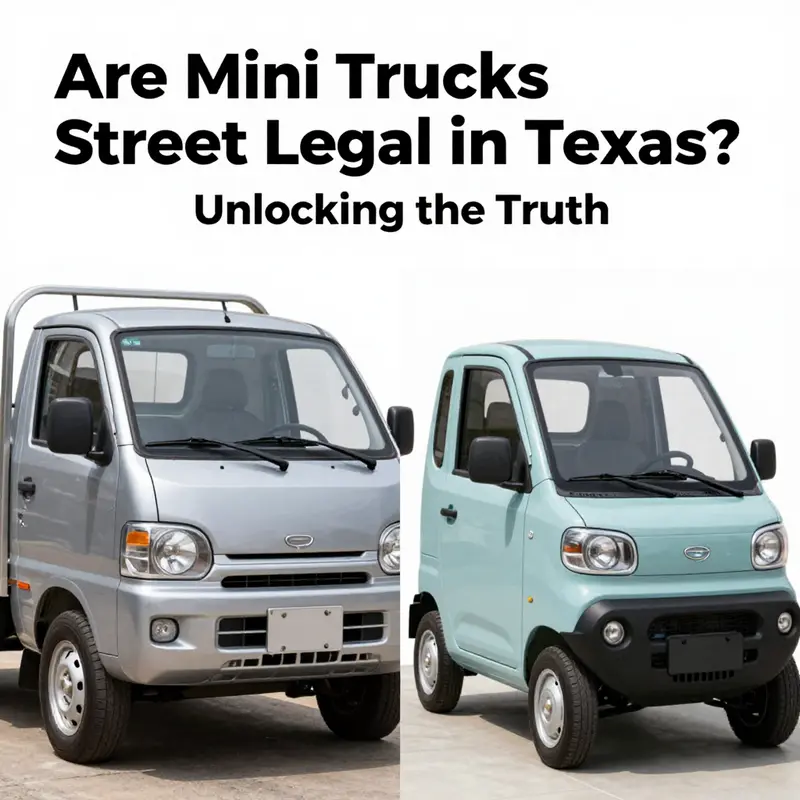
In Texas, the path a mini truck takes from factory floor to public road is less a straight line and more a braided route through two intertwined regulatory systems. On the surface, the state has moved to treat certain small, electric vehicles as motor vehicles for the purposes of titling and registration. That shift, enacted through HB 4578 during the 89th Legislature, establishes that qualifying miniature vehicles are motor vehicles under Texas law for title and registration. It is a legal designation with teeth: it means a mini truck can be registered, licensed, and taxed like a conventional car or light truck, complete with ownership proof and a formal title. The central irony, however, is that this administrative status sits atop a separate federal framework that continues to define how these same machines function on the road. In other words, Texas says one thing for papers, while federal standards dictate another for performance and operation. The result is a creature of two identities, one striding through the state’s paperwork with all the trappings of a motor vehicle, the other tethered to the restrictions of a low-speed vehicle in everyday use. This dual identity does not frustrate a single goal—safety and accountability—but it does demand a careful reading of what is permitted where and under what conditions. And as owners or prospective buyers wade into the details, they discover that the difference between legality and practicality often hinges on the precise design of the vehicle, its speed capabilities, and the road on which it rolls. The Texas approach, then, requires a layered understanding of the law’s architecture and a practical awareness of how a vehicle is meant to behave on real streets. The legislature draws a line that categorizes the vehicle for tax, title, and liability purposes, while the federal framework draws the line where and how fast the vehicle may travel. This means that a mini truck can be fully titled and registered within Texas, yet its day-to-day operation on many roads will still be constrained by the federal low-speed vehicle standard. It is a nuanced balance that reflects both a commitment to modern, smaller, electric mobility and a cautious respect for highway safety and traffic dynamics. The result is a regulatory landscape where the paper status can be motor vehicle, but the road-use status will often resemble that of an LSV, a category defined by speed, road type, and the limitations that come with operating a vehicle designed to move modestly and with a civil sense of neighborhood-scale mobility.
To unpack how this works in practice, it helps to anchor the discussion in the two pillars that shape Texas policy: the administrative classification for titling and registration, and the federal standards that govern on-road operation. The administrative side is explicit. HB 4578 clarifies that qualifying miniature vehicles—those that meet the defined criteria of size, weight, and purpose—are to be treated as motor vehicles for the purposes of titling and registration under Texas law. This is not merely semantics. It is the gateway to a formal title, an official registration plate, and the fiscal and regulatory responsibilities that come with operating a motor vehicle in any Texas municipality or county. It means the owner will interact with the Texas Department of Public Safety (DPS) or its agents, present proof of ownership, and comply with registration periods, fees, and the state’s vehicle registration framework. It also implies that the vehicle must meet the state’s safety and equipment expectations as they apply to motor vehicles in general. These expectations typically include lights, brakes, tires, seat belts, and a host of other safety features that have long been the baseline for roadworthy vehicles in Texas and across the United States.
But the federal layer—FMVSS, administered by the National Highway Traffic Safety Administration (NHTSA)—continues to shape how the vehicle may operate on public roads. The federal standard that applies here designates such miniature vehicles as low-speed vehicles for operational purposes. LSVs are permitted to operate at speeds up to 25 miles per hour, a ceiling set by federal rules, and they are restricted to roads with posted speed limits of 35 mph or less. The result is a regulatory paradox that is not unusual in modern law: the vehicle is a motor vehicle on paper, with all the registration and accountability that status entails; on the street, it must behave within the much narrower confines of an LSV’s operating envelope. In practical terms, this means a Texas-registered mini truck can be driven on local streets and residential corridors where traffic moves slowly, but it cannot be treated as a regular automobile when it comes to highway access. It cannot legitimately share lanes with high-speed travel on interstates or expressways where the speed limit climbs beyond the LSV threshold. The duality is not a contradiction so much as a carefully drawn compromise that acknowledges the reality of why such small vehicles exist—fuel efficiency, urban mobility, and the appeal of compact utility—and simultaneously guards the safety margins needed in faster-moving traffic.
A critical implication of this arrangement is the requirement to navigate two parallel tracks. On one track, the manufacturer’s or importer’s compliance with FMVSS for LSVs matters. The vehicle must meet the federal safety standards that apply to low-speed vehicles. These standards cover a range of features from structural integrity and crashworthiness to lighting, signaling, and occupant protection. On the other track, Texas requires the vehicle to pass the state’s titling and registration regime, which in turn triggers a different set of checks and fees, and the obligation to secure appropriate insurance coverage. The result is a consistent message: even though the vehicle enjoys the status of a motor vehicle for administrative purposes, its day-to-day use remains bounded by the LSV framework that restricts how and where it can be driven. The practical upshot is that Texans who own and operate these mini trucks must be prepared for a process that validates their compliance with both sets of rules. They must not only ensure the vehicle conforms to federal safety standards but also take the necessary steps to title, register, and insure it in a manner that satisfies state requirements. The DPS will oversee the administrative classification, while the federal framework will guide the vehicle’s permissible mobility. The interplay can feel intricate, especially when a local ordinance further adds layers of limitation or permission based on community preferences for street noise, curb space, or pedestrian safety.
Within this framework, the day-to-day questions most owners encounter crystallize around three themes: how the vehicle is designed and certified, how it is titled and insured, and where it can legally operate. First, the design and certification. The state’s motor vehicle classification does not change the fact that federal safety standards still govern. A vehicle built on a compact chassis with electric propulsion is required to meet FMVSS for LSVs if it is to be considered within the legal orbit of federal safety rules. The federal standard sets a ceiling on speed and a set of conditions for road use. The vehicle, then, must be able to accelerate and brake in a way that is predictable and stable at low speeds, with a lighting and signaling package appropriate for low-speed traffic. The design intent behind this is to ensure that even small, urban-oriented vehicles can function safely in mixed traffic where drivers do not expect unprotected pedestrians or unalert drivers from a distance. The standard that applies to the vehicle’s construction and safety features remains the North American baseline that has evolved over decades to accommodate a broad spectrum of vehicle sizes and uses. At the same time, Texas’s administrative classification ensures that the vehicle can be owned, titled, and taxed as a traditional vehicle, with a clear proof of ownership and a formal registration that links the vehicle to its operator in state records.
Second, titling and insurance. The title process attaches to the ownership of the vehicle, not to the speed at which it can travel. The owner will provide the usual documentation—proof of ownership, applicable fees, and identification—and a formal title will be issued. The registration follows, with plates or a registration sticker as determined by the DPS. Insurance is a non-negotiable ingredient of lawful operation in Texas for most motorized vehicles, and a mini truck is no exception. The insurance is not merely a regulatory formality; it is a financial guarantee of accountability in the event of a collision, a requirement that reflects the vehicle’s motor vehicle status but recognizes its operation within the constraints of an LSV. For owners, this means budgeting not only for the purchase of the vehicle itself but for ongoing registration fees, insurance premiums, and periodic safety checks that align with motor vehicle expectations. The administrative side thus anchors the vehicle in the broader ecosystem of Texas motor vehicles, while the vehicle’s performance and operation are steered by the federal LSV framework that governs what can be expected on the road.
Third, road use and local ordinances. Even when a mini truck is legally titled and registered, and even when it complies with FMVSS for LSVs, there is no blanket permission to roam every street. Local jurisdictions can impose their own rules about which vehicles may traverse certain corridors, how late in the day they may operate, or what noise and size profiles will be tolerated near residential neighborhoods or commercial districts. Some cities may restrict street access to vehicles that are not conventional passenger cars, while others may create designated lanes or shared-use paths where compact electric vehicles can travel with greater ease. These municipal or county-level regimes exist because road space is a finite resource and because the introduction of any new vehicle category can ripple through traffic patterns, pedestrian flows, and noise levels in ways that require careful management. For residents and visitors alike, awareness of these local rules is as important as the knowledge that the state has created a pathway for motor vehicle status. It is not unusual for a vehicle to be perfectly compliant on a state level and still require the operator to adjust routes, times, or even the types of streets used in daily errands. The practical takeaway is straightforward: before hitting the street, verify both statewide eligibility and the local rules that govern the specific routes intended for use. The DPS guidelines, along with municipal codes, together shape where the mini truck can be a regular feature of everyday life rather than a curiosity in the driveway.
This layered regulatory design can appear paradoxical, but it serves a purpose. It acknowledges the legitimate desire to expand mobility options in urban and compact spaces while preserving the safety standards that protect all roadway users. The dual status also provides a predictable framework for accountability. With title and registration in hand, the vehicle is part of the state’s official transportation system. With LSV operating limits, the vehicle remains part of a category designed to minimize risk on streets that have lower speed expectations. The two-track system also clarifies responsibilities should an incident occur or a vehicle requirement be questioned. If a vehicle is involved in a collision or if a safety defect comes to light, the fact that it is a motor vehicle for title purposes anchors the accountability in state records and insurance coverage. If there is a question about road use, the LSV constraints provide a straightforward standard to apply. The result is not a perfectly simple classification, but a robust framework that can accommodate a growing family of small, efficient vehicles while maintaining a clear boundary between high-speed and low-speed environment expectations.
For readers seeking a broader context on how regulators frame compact utility vehicles in Texas, the landscape becomes clearer when you consider the practical steps an owner must take. The journey begins with a careful assessment of the vehicle’s design. A compact electric vehicle that is built on a light chassis and intended for utility use—such as brief, neighborhood deliveries, personal transport in tight urban spaces, or light cargo movement on short trips—fits the general mold of what Texas looks to classify as a miniature vehicle. The next step is to verify compliance with FMVSS that apply to low-speed vehicles. This involves confirmation of the vehicle’s safety features: appropriate lighting packages (headlamps, taillamps, brake lights, turn signals), a functional brake system suitable for street use, properly sized tires with adequate tread and sidewall strength, and restraints such as seat belts. These features are essential for reducing the risk of injury in collisions and for ensuring predictable handling in emergency maneuvers. The state’s own safety expectations for motor vehicles reinforce the notion that even small, electric, neighborhood-oriented machines belong to the same ecosystem as larger, more traditional cars and trucks, at least in terms of their responsibility to operate safely in mixed traffic.
An important nuance is that the operator must recognize the vehicle’s operating limitations. The federal standard permits operation on roads with 35 mph speed limits or lower, but not on highways or interstates that experience higher speeds. In Texas, this means that even a vehicle that has a motor vehicle title and registration may still be restricted in its road choices. It is not merely a legal compliance issue; it is a practical safety measure designed to align the vehicle’s performance with the surrounding traffic environment. The operator should plan routes that avoid high-speed corridors, or if such routes are necessary, to do so only under conditions that preserve safety for all road users. The emphasis is on responsible mobility that respects both the vehicle’s capabilities and the surrounding traffic environment.
This interplay between state classification and federal operation can lead to questions about how to reconcile the two identities on a given day. The solution lies in a disciplined approach to compliance and a readiness to adapt to local rules. If the vehicle’s design and certification meet FMVSS requirements for LSVs, then the owner can proceed with titling and registration in Texas, establishing the motor vehicle status in state records. If a local ordinance restricts or even bans certain types of small electric vehicles in specific zones, the owner must adapt by choosing permissible routes or by adjusting the vehicle’s use to comply with those local rules. The dual-framework reality invites a level of proactive engagement: owners should not only register and insure their vehicle but also inquire about any city or county ordinances that might affect where and when they can operate. This is not a critique of the framework but a practical reminder that road rules evolve with communities and with the introduction of new mobility options.
In thinking about this regulatory environment, a broader perspective emerges. The Texas approach exemplifies a careful balance between enabling innovation and preserving safety standards on busy roads. The motor vehicle status for administrative purposes ensures that mini trucks contribute to a transparent system of ownership, accountability, and revenue through registration. The LSV operational ceiling, meanwhile, preserves the traffic dynamics that communities have long depended on, ensuring that these small vehicles do not collide with higher-speed traffic flows that can magnify risk. For consumers, this means a clear but nuanced set of expectations: you can own and title a mini truck in Texas, and you can operate it on roads that stay within the 35 mph limit, but you must remain mindful of speed constraints, local rules, and the responsibility that accompanies any motor vehicle on public streets. This is not a barrier to mobility but a framework that invites thoughtful use of small electric vehicles in the places they serve best—dense urban cores, campus zones, business parks, and neighborhoods where a compact, efficient vehicle can make a meaningful difference in congestion and emissions.
To support readers seeking further practical guidance, the chapter encourages direct engagement with state resources. Verification of classification and registration requirements is best accomplished by contacting the Texas DPS and consulting their official guidance. While the general outline of HB 4578 provides the backbone for classification, the day-to-day procedures—proof of ownership, fees, and the specifics of the title and registration process—are administered through DPS processes that may have updates or nuances depending on local county offices or changes in policy. The aim is to empower readers with a clear expectation: a mini truck can be a legitimate road vehicle in Texas, but its operation is bounded by both the state’s administrative framework and the federal low-speed vehicle standards, with local authorities adding the final word on where it can travel.
For readers who want to explore the topic further and situate it within a broader discussion of compact mobility, a quick visit to the dedicated blog on mini trucks can provide broader context and analysis. You can explore more on that site at minitrucksocala.com/blog/.
External resource: https://www.dps.texas.gov/
Local Orders on Texas Roads: How Ordinances Shape the Street Legality of Mini Trucks
When a driver considers taking a miniature vehicle onto a Texas street, the first instinct may be to search for a simple yes or no. But the reality is a layered puzzle that begins with state law and threads through every city, county, and neighborhood in between. The question of whether a mini truck can legally share Texas roads is not answered by a single statute or a single police officer’s discretion. It hinges on a chain of requirements that starts with the way the vehicle is classified and ends with the specific ordinances that may govern a particular corridor. This is not an abstract exercise. It affects registrations, insurance, road use, and the day-to-day decisions that a driver must make about where and when a vehicle can operate. For anyone considering a smaller, utility-oriented vehicle in Texas, a clear-eyed view of the interplay between state regulation and local rule is essential because the difference between lawful on-road use and a potential citation often comes down to where you plan to drive and how your vehicle is built to meet safety expectations on the highway and beyond.
At the state level, Texas has established a framework that seeks to balance access to smaller, more versatile vehicles with the basic safety expectations that keep all road users protected. A key piece of this framework is the notion of a miniature vehicle, a category that the legislature has defined to address on-road titling, registration, and operation. The law outlines criteria related to size, weight, speed, and safety features—things like lighting, braking systems, and seat belts—that must be present for such a vehicle to be legally titled and registered. In practical terms, this means a mini truck cannot simply be parked on a street because it resembles a small utility vehicle; it must conform to the safety and performance standards that a conventional motor vehicle would meet. The process echoes the general truth that the road is a shared space where even smaller, more economical transport options must demonstrate a baseline level of safety that aligns with the expectations of other drivers and pedestrians.
Within this framework, a crucial distinction arises between two broad classifications: motor vehicles and low-speed vehicles (LSVs). The difference is not merely academic. A mini truck that qualifies as a motor vehicle is subject to the full spectrum of safety standards that govern typical road-going vehicles. Those standards touch on structural integrity, crashworthiness, lighting, signaling, braking, tires, and occupant protection. The path to lawful operation thus often rests on whether the vehicle can satisfy these full-spectrum requirements and be properly titled and registered as a motor vehicle. On the other hand, if a mini truck is designed to achieve a top speed of less than 25 miles per hour and meets the criteria for an LSV, it may enjoy a narrower road access window. LSVs are generally allowed on roads with speed limits of 35 mph or lower, provided they satisfy the LSV specification and are operated in accordance with applicable rules. This bifurcation introduces a practical decision point for buyers, builders, and drivers: should the vehicle be oriented toward full motor-vehicle compliance, or is there an opportunity to position it as an LSV for a more limited, low-speed operating environment? The choice affects not only the registration category and insurance requirements but also the driver’s exposure to higher-speed traffic and the kinds of roads on which the vehicle may legally travel.
Even when a mini truck meets state standards and earns the necessary title and registration, the road-use landscape in Texas still includes a significant caveat: local ordinances. Texas cities and counties retain substantial authority to regulate traffic within their jurisdictions. Local governments can enact rules that further restrict or specify how miniature vehicles may traverse streets, turn onto a given corridor, or share the road with vehicles of other sizes and speeds. In practice, that means a vehicle that is perfectly compliant at the state level may face a different fate on a particular street if the municipality has elected to impose additional restrictions. Local ordinances can address a variety of concerns—from safety on specific routes to city-wide noise control or the aesthetic and design expectations that reflect neighborhood character. The result is a patchwork of rules that can feel opaque to the casual driver but is entirely deliberate in its purpose: to tailor traffic management to the realities of a given urban or rural setting.
This patchwork has real implications for everyday operation. Some municipalities may prohibit mini trucks from using certain highways or high-speed corridors, arguing that even compliant vehicles pose a risk when mingled with heavier, faster traffic. Others may allow use on primary streets but limit access to certain hours, or require operation only along designated routes that the city has identified as suitable for slower-moving, smaller vehicles. There may also be minimum lighting and visibility requirements at dusk or dawn, or prohibitions on operation during late-night hours in specific districts where street noise or safety concerns are heightened. The exact mix varies from place to place, and the differences are part of what makes researching local rules essential prior to purchase or conversion.
To navigate this environment, a driver or owner must engage in a methodical due-diligence process that begins with state guidance and culminates in a careful scan of city or county codes. The Texas Department of Public Safety (DPS) and the Texas Department of Motor Vehicles (TxDMV) provide the state-level context, including how miniature vehicles are defined, what safety features are expected, and how to obtain the proper title and registration. However, the day-to-day reality on the ground is governed by local codes. A city clerk or code enforcement officer can interpret a local ordinance and determine whether the vehicle is permitted on specific streets, whether any modifications are required, and what inspections or approvals are necessary before a road registration can be renewed.
The practical upshot is that even a model-class miniature vehicle that has gone through the right state channels can still be excluded from use on certain routes by a municipal ordinance. This is not a sign of inconsistency in the system; it is a recognition that traffic dynamics, roadway design, and community priorities vary widely across Texas. A major highway through a fast-growing urban corridor presents different challenges than a rural byway, and policy makers respond accordingly. The result is a dynamic where compliance is not solely a matter of ticking the right technical boxes at the state level but also of understanding the specific street-by-street constraints that the local authority has established. In practice, this means a driver must do more than register and insure the vehicle. They must verify that the local environment will permit ongoing operation on the routes they intend to use.
To illustrate the practical consequences of this arrangement, consider the typical journey of a miniature vehicle from showroom or workshop to the public street. The journey begins with a determination of how the vehicle will be classified for registration and how its safety equipment aligns with state requirements. If the vehicle is to be operated as a motor vehicle, it will be subject to standard safety tests, lighting, braking, and occupant protection protocols. If it is designed to be an LSV, the operator must ensure that the vehicle’s top speed, performance characteristics, and design meet the LSV criteria and that it is used in a context where the roadways meet the allowable speed thresholds. After the state-approved title and registration are in hand, the vehicle owner must then check the city’s code to ensure there are no prohibitions on the selected routes. This process often requires a careful review of municipal code sections and perhaps a conversation with local law enforcement or code officers who can provide guidance on where the vehicle may operate legally and safely. It is not unusual for a driver to discover that a road perceived as accessible in an informal sense is in fact restricted by a local rule when examined against the precise language of the local ordinance.
This is why the practical pathway to legality is not a single checklist but a layered exploration. An owner may discover that a given street is perfectly acceptable for an LSV with a compliant vehicle, while the same street may be off-limits to a full motor-vehicle-class mini truck because the road design or traffic patterns are incompatible with even compliant small vehicles wedged into faster traffic. Conversely, a city might permit on-road use only on certain arterial corridors and not on neighborhood streets. The existence of such restrictions underscores a broader truth: the road space is a shared resource subjected to policy choices that reflect safety priorities, urban design goals, and community preferences.
To stay compliant, it is essential to adopt a holistic approach to road use. First, verify state compliance by confirming that the vehicle meets the criteria for its chosen classification and that it holds a valid title and registration. This means ensuring the vehicle’s safety features—lighting, brakes, tires, and occupant restraints—are up to date in line with state standards. Next, check local ordinances. This is where many otherwise compliant vehicles encounter a wall. Municipal codes may specify which roads mini trucks may traverse, and they may impose restrictions related to hours of operation, noise, or parking. The consequence of noncompliance is not merely a citation; it can include vehicle impoundment, fines, or the need to reconfigure the vehicle or its use to conform with local rules. Given the potential for penalties and hassle, most responsible owners adopt a routine of routine checks before a planned trip, especially when navigating a new city or a newly developed district where the local rules may differ from those in nearby jurisdictions.
For readers seeking practical, community-oriented context, it helps to consult sources that translate state policy into everyday language and offer examples of how different communities implement rules. A good starting point is the broader online discourse surrounding miniature vehicles, which includes discussions of real-world cases, compliance challenges, and the evolving landscape of vehicle design aimed at balancing utility with safety. These sources can provide a bridge between the technical criteria imposed by state statutes and the real-world constraints imposed by city codes. For readers who want a concise synthesis of how to proceed, a visit to a dedicated mini trucks blog can offer both educational material and a sense of what neighbors in different towns are experiencing as they attempt to operate on public streets. You can explore practical perspectives and case studies at the Mini Trucks Blog, which aggregates community experiences and policy developments in a format that can help demystify the process for prospective owners. Mini Trucks Blog
Ultimately, the core message is simple: legality on Texas streets is not a guarantee that comes from state approval alone. It requires alignment across the regulatory spectrum—from the safety standards verified at the state level to the explicit permissions or restrictions articulated by local authorities. This is why a single road trip planning session often becomes a research project that spans multiple agencies and codes. Before any miniature vehicle is taken out onto a public road, the operator should have in place a clear plan that accounts for the vehicle’s classification, the specific road segments intended for use, and the local rules that may apply along the way. A small investment of time in this pre-trip due diligence pays dividends in avoiding penalties, keeping the vehicle on the road where allowed, and maintaining a respectful balance with other road users who shareTexas highways and byways.
From a planning perspective, the onus falls on the vehicle owner to do more than ensure that a vehicle conforms to a checklist. They must cultivate an understanding of how local governance shapes the experience of driving and how safety, efficiency, and community expectations intersect. The local ordinance landscape can reflect concerns about traffic flow, neighborhood noise, and the perceived risk of smaller vehicles on busy corridors. It is not unusual for a city to implement a staged approach to mini trucks, permitting operation on certain streets, while requiring additional safety features or restrictions on others. This staged approach may be part of a broader effort to manage the coexistence of vehicles of varying sizes and speeds on a shared road network. In turn, drivers should prepare to adjust routes, travel times, or even the vehicle configuration to comply with local expectations.
The bottom line is that while state law sets the foundation for what it means to be street-legal as a miniature vehicle in Texas, local ordinances layer on the details that determine where and when the vehicle may be used. The legal status is thus a product of both the vehicle’s compliance with state standards and the vehicle’s fit within the local regulatory landscape. For anyone considering ownership, modification, or long-term operation, the prudent course is to begin with state guidelines, then actively consult the city’s codes, and finally verify with local authorities whether the chosen routes remain permissible under current regulations. This approach minimizes the risk of negative enforcement actions and aligns the operation with the broader public safety goals that Texas communities strive to uphold.
The practical implications of this framework extend beyond mere legality. They influence decisions about vehicle design, maintenance, and the social contract that governs road use. When states and municipalities require reliable lighting, functional brakes, and properly installed safety belts, they are not simply erecting a barrier to entry; they are shaping a road environment in which drivers of all vehicle sizes can anticipate, understand, and respond to the behaviors of others. Adhering to these expectations contributes to smoother traffic flow and a safer community, a goal that resonates across the many jurisdictions that a Texas road trip might traverse. With this perspective in mind, anyone who owns or contemplates owning a miniature vehicle gains not only a sense of how to meet the letter of the law but also a clearer understanding of the responsibilities that accompany operating in a shared, dynamic public space.
For readers who want a concise factual summary to guide their next steps, it remains essential to consult official state resources and local codes. The state-level guidance helps determine classification, titling, and registration, while the local codes reveal the exact roads or time windows that may be restricted or open to operation. In many cases, the safest and most practical path is to plan routes that stay on roads known to be permitted for the chosen vehicle class and to maintain open lines of communication with local law enforcement or code officers if plans change. This proactive approach helps ensure compliance over the long term and reduces the likelihood of conflicts with enforcement authorities who are charged with upholding traffic safety standards in their communities.
For readers who seek broader context and practical examples, exploring supplementary sources that address the lived experience of mini truck ownership across Texas can be enlightening. The mini truck community often discusses the challenges of mixing small, low-speed, or vehicle-classified-on-road configurations with everyday city traffic. These discussions, while informal, shed light on real-world obstacles and successes that residents encounter as they navigate official processes and city policies. The aim is not to sensationalize the experience but to provide a grounded sense of the conditions under which these vehicles can function legally and safely in different parts of the state.
If you are starting this journey today, take a moment to map the routes you expect to use most often and then cross-check them against both state requirements and local ordinances. This proactive planning will reduce the chance that you discover a compliance gap only after your vehicle has rolled onto a street. It will also help you determine whether your vehicle should be configured for motor-vehicle compliance or positioned as an LSV intended for lower-speed environments. And it will make it easier to navigate questions you may encounter from neighbors, local enforcement, or city staff who are tasked with interpreting local rules and applying them on the ground. In short, the road to legality for mini trucks in Texas is best traveled with a layered, thoughtful approach that respects state standards while acknowledging the unique character of each community. This approach not only protects a driver from regulatory risk but also advances the shared objective of keeping Texas roadways safe, predictable, and accessible to a broad range of acceptable vehicle types.
As a guiding principle, remember that local ordinances are not mere hurdles; they are instruments of local policy designed to reflect a community’s traffic realities and safety philosophy. A vehicle that meets broad state standards may still be constrained by street-level decisions that consider traffic density, pedestrian activity, and the capacity of roadways to handle vehicles of varying sizes and speeds. Being aware of this reality helps drivers set realistic expectations, plan more effectively, and engage constructively with local officials when questions arise. The most reliable way to stay within the bounds of the law is to approach miniature-vehicle ownership as ongoing compliance work rather than a one-time compliance moment. That ongoing work includes revisiting both state guidance and local regulations whenever plans change—such as when moving to a new city, expanding a route, or upgrading a vehicle’s features to meet enhanced safety criteria.
For readers seeking further information about the state framework and how it translates to daily practice, the Texas Department of Public Safety and the Texas DMV provide foundational guidance on the classification and operation of miniature vehicles. While this chapter has focused on the local dimension, recognizing that the local rules can override or restrict what state-level approvals imply is essential. The dynamic between state standards and local codes can be nuanced, but with careful due diligence, it becomes navigable and predictable rather than opaque. It is this navigability that ultimately empowers drivers to enjoy the practical benefits of mini trucks—utility, versatility, and efficiency—without compromising safety or legality across the diverse landscape of Texas roads.
In closing, the story of mini trucks on Texas streets is a story about layered governance rather than a single rule. It is a story of how state standards enable the basics of titling and safety, and how local ordinances determine the practical streetscape for real-world operation. The road ahead for any prospective owner is not merely about finding a vehicle that meets a compliance checklist but about understanding the place where that vehicle will live on the map of Texas roads. By embracing the interplay between state regulation and local control, drivers can plan their paths with confidence, knowing that their choice—whether to pursue full motor-vehicle status or to operate under LSV criteria—will fit within the specific safety, traffic, and community expectations of the places they call home. For those who wish to deepen their understanding, practical insights and community perspectives are readily available through the broader mini-trucks community resources, which provide context for how different Texas locales implement these rules in ways that are both practical and enforceable on a day-to-day basis. The journey from state framework to street-ready operation is thus a careful, informed progression that honors safety, legality, and the everyday realities of Texas roadways. Ultimately, the goal is clear: to keep every journey on Texas streets lawful, predictable, and considerate of the needs of all road users.
External resources and official guidance can provide the most authoritative baseline for decision-making. For official guidance and current regulations, consult the Texas Department of Public Safety and related state resources.
External resource: https://www.dps.texas.gov
Final thoughts
Navigating the landscape of mini truck legality in Texas can be complex, but understanding the essential requirements is the key to enjoying these versatile vehicles responsibly. From ensuring compliance with safety standards and vehicle classifications to remaining aware of local regulations, owners can operate their mini trucks with peace of mind. Whether for business, personal use, or as a beloved hobby, knowing the ins and outs of Texas mini truck laws equips you to make informed choices. Therefore, continue to value safety and legal compliance as you appreciate your mini truck’s capabilities. The road is waiting!