
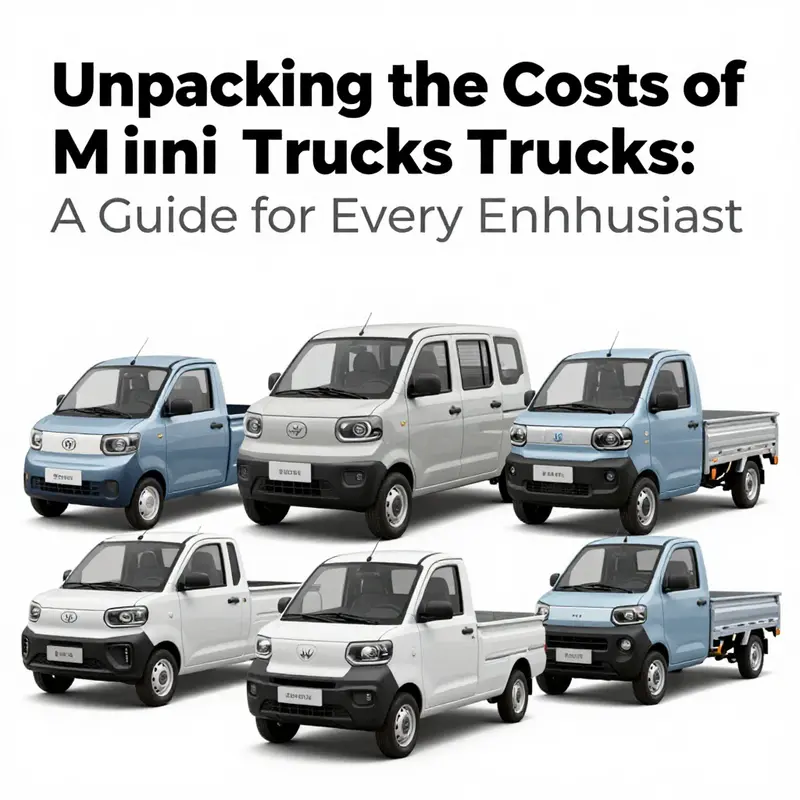
Are you considering getting a mini truck but unsure about the cost? Whether you’re a small business owner in need of an efficient delivery vehicle, a residential property owner looking to haul supplies, or a mini truck enthusiast who revels in all things compact, understanding the pricing landscape can help you make informed decisions. This article will delve into the cost of various types of mini trucks, from electric models to diesel options and premium vans to budget-friendly choices. Each section will provide insights tailored to your needs, ensuring you find the perfect fit for your requirements without breaking the bank.
Wired for Savings: The Real Price and Long-Term Cost of Electric Mini Trucks

Price is the first question most people ask when they consider a mini truck, but it is only the surface of a much larger truth. The cost of owning a compact electric work vehicle includes not just the sticker price, but a spectrum of ownership costs that unfold over years. In markets around the world, prices for electric mini trucks can be surprisingly broad. The most accessible range for new, four-wheel electric cargo vehicles generally sits higher than the lowest end but lower than many full-size pickups. You can find entry models that begin in the low tens of thousands, while more feature-rich versions, especially those built for demanding workloads or longer daily ranges, often land in the mid to high twenty thousands or beyond. This spread is not a single number, but a map that shifts with regional incentives, supply chain dynamics, and the choices buyers make about capacity, range, and equipment. It is a map that deserves careful reading because, over the life of the vehicle, the financial difference between choosing a lean, efficient option and opting for more power or more comfort can be substantial.
The core drivers of price for electric mini trucks are straightforward in principle but intricate in practice. Battery size is the most obvious lever. A larger battery can deliver more range, power, and potential resale value, but it adds weight and cost. Motor power and drivetrain complexity matter as well. A truck designed to haul heavier loads or to operate in challenging urban or off-road conditions will typically require sturdier components, tougher suspensions, and more robust thermal management. Those engineering choices translate into higher upfront costs. The vehicle’s interior, onboard electronics, safety features, and level of robustness against daily wear and tear also push the sticker price upward. The country or region where the truck is sold can sway price through tariffs, taxes, and import duty, as well as through the presence or absence of government incentives for light commercial electrification. Finally, the vendor’s business model matters. Some suppliers target bulk buyers with lower unit prices but demand minimum orders, while others price to individual buyers with higher margins but flexible purchasing terms.
Prices, therefore, do not tell the full story. A price tag simply indicates the exchange of money at the moment of purchase. The real measure of value lies in total cost of ownership, a composite that includes charging costs, maintenance, parts, insurance, depreciation, and potentially battery renewal. Electric mini trucks have a compelling case here. Their operating expenses tend to be frugal—fuel costs disappear or shrink to a fraction of gasoline or diesel equivalents, and maintenance needs are often simpler because electric drivetrains omit many moving parts found in internal combustion engines. If a vehicle uses a single-speed or two-stage transmission, there are fewer mechanical tolerances to manage, fewer fluids to replace, and fewer wear items to monitor. All of this contributes to a lower annual cost of operation, which, over several years, can dramatically narrow the gap between a mid-priced electric model and a higher-end alternative.
To translate that into a practical sense of numbers, consider the ongoing cost picture. In many markets, electricity prices for home charging are predictable and stable enough to model. If a small electric mini truck consumes a modest amount of energy per mile and is charged overnight at home, the monthly energy bill can become a predictable line item, often much cheaper than the equivalent miles driven with a gasoline or diesel truck. The cost per kilometer or mile, while not zero, tends to be a fraction of what fuel expenses would be for a comparable internal combustion vehicle. This is where the long tail of savings lives, and it helps explain why buyers frequently justify a higher upfront price with a strong expectation of payback through lower running costs.
Borrowing from broader market data, the landscape of electric mini truck pricing is nuanced. In one spectrum, there are budget-conscious offerings in certain regions that appear at modest price points after government incentives, volume discounts, or localized manufacturing incentives. In other markets, a broader set of features, higher payloads, and greater range push prices into a higher band, even as the underlying efficiency remains compelling. A practical observation is that, for the segment of urban and short-haul delivery duties, there is a meaningful cluster of options that balance affordable upfront pricing with respectable range and payload capacity. This affordability is not simply a matter of low sticker price; it is the combination of a functional footprint, reasonable range for day-to-day tasks, and predictable energy costs that makes these vehicles attractive for small fleets and individual operators alike.
For readers seeking a digestible summary of typical price bands, consider the broad reality: entry-level electric mini trucks often begin somewhere in the range of a few thousand dollars in markets with aggressive incentives and lower labor costs, but could rise into the mid teens or beyond in markets with higher base prices and fewer subsidies. In many mature markets, a more common new purchase price hovers in the low to mid twenty thousands for a decent balance of range, payload, and features. There are inevitably outliers: ultra-compact, stripped-down variants that can dip toward the lower end of the spectrum, newly engineered platforms with longer range and greater endurance that push upward, and premium variants that add comfort, safety tech, and extended warranties. The reality, then, is that there is no single answer. The vehicle, the market, and the incentives all converge to produce a price that is best understood as a part of a broader economic calculation rather than a standalone figure.
An important practical note for buyers is the role of minimum order quantities and supplier terms. Some suppliers require buying multiple units at once, which can depress per-unit price but increase the upfront commitment. In markets where fleets or delivery businesses are common buyers, these MOQs are often the norm, and they can shape the perception of affordability when viewed on a per-vehicle basis. Conversely, individuals or small businesses that purchase a single unit may face higher per-vehicle prices, but may still find the total cost of ownership favorable given the lower fuel and maintenance burden. The dynamic is not simply supply and demand; it is the interplay of scale, logistics, and the practical realities of battery production cycles that determine the price a buyer ultimately pays.
From a buyer’s perspective, the decision often begins with a clear use case. If the primary requirement is maneuverability in tight urban spaces, a compact electric mover with a modest payload and a limited daily range can meet needs with a price tag that remains within reach. If the operation involves longer daily runs, heavier loads, or more frequent duty cycles, the emphasis shifts toward greater payload, larger batteries, and perhaps higher powertrains. In such cases, the initial price climbs, but the long-run cost of ownership can still be favorable if the vehicle delivers reliable uptime, minimal downtime, and consistent energy costs. The calculus becomes a matter of aligning the vehicle’s performance envelope with the business’s workload profile and financial expectations. Keeping a careful eye on warranty coverage, battery degradation risk, and the projected depreciation curve is essential because those factors can swing total cost of ownership as decisively as the sticker price.
The practical reader who wants a grounded sense of price and value can also look to the broader ecosystem of learning and comparison resources. For those who prefer a structured, model-agnostic overview that emphasizes buying criteria, a well-regarded guide collects the essentials: range, payload, charging options, and total cost of ownership over a vehicle’s life. This kind of guidance helps decode the pricing signals in a crowded market and puts even a budget-minded shopper in a position to ask the right questions of a supplier. Readers who want to explore the landscape further can tap into discussions and reviews on industry blogs that focus on small utility vehicles and regional market dynamics. A good starting point is the MinitrucksSoCal community blog, which offers a broad perspective on how these compact work vehicles are used in real-world scenarios and how pricing interacts with the realities of daily operation. For easy access, see the MinitrucksSoCal blog.
Beyond the numbers and the spec sheets, there is a human element to price. The choice often comes down to a quiet calculation: how much value does the buyer assign to lower daily operating costs, reduced maintenance, and the reliability of an electric drivetrain in daily work? The answer is not universal. It depends on the geography, the energy market, the reliability of the supplier’s network, and the operator’s tolerance for upfront investment in exchange for predictable costs over time. One thing is clear: electric mini trucks present a compelling business case for many buyers who evaluate total cost of ownership rather than sticker price alone. This is not merely about cutting fuel expenses; it is about eliminating several recurring maintenance tasks that brittle traditional powertrains demand. In markets where electricity is relatively affordable and charging infrastructure for commercial use is practical, the math tilts decisively toward ownership that favors energy efficiency, simpler maintenance, and a more predictable operating budget.
As with any substantial purchase, it is advisable to engage with suppliers directly to obtain a precise quote tailored to one’s specific configuration, payload, and range needs. MOQs, delivery timelines, service packages, and battery warranties can all influence the final cost. A careful buyer will also consider regional incentives or tax credits that can significantly alter the effective price. In addition, it makes sense to compare across several regions if the operation can be relocated or if fleet expansion is planned. The price you see at the showroom or on the distributor’s quote is not the final word; the final cost is a function of the entire economic package you assemble around the vehicle.
In the end, price transparency—paired with a rigorous assessment of total cost of ownership—delivers the best long-term value. For a fleet or a solo operator, the right choice balances upfront affordability with predictable operating expenses, a durable chassis, and a battery system that remains reliable under daily duty cycles. The result is not a single price tag but a forecast of cost savings that accrue with every mile driven under electric power. When considered through that lens, the electric mini truck becomes less a static purchase and more a strategic instrument for reducing operating risk and stabilizing budgets over time.
External resource for further reading: Electric Mini Truck Buying Guide.
For readers seeking a broader context and ongoing discussions about mini trucks, the MinitrucksSoCal blog can provide ongoing updates and community perspectives on how pricing and ownership experience vary in real-world use: MinitrucksSoCal blog.
Pricing Under the Hood: Decoding the Costs of Lightweight Diesel Mini Trucks
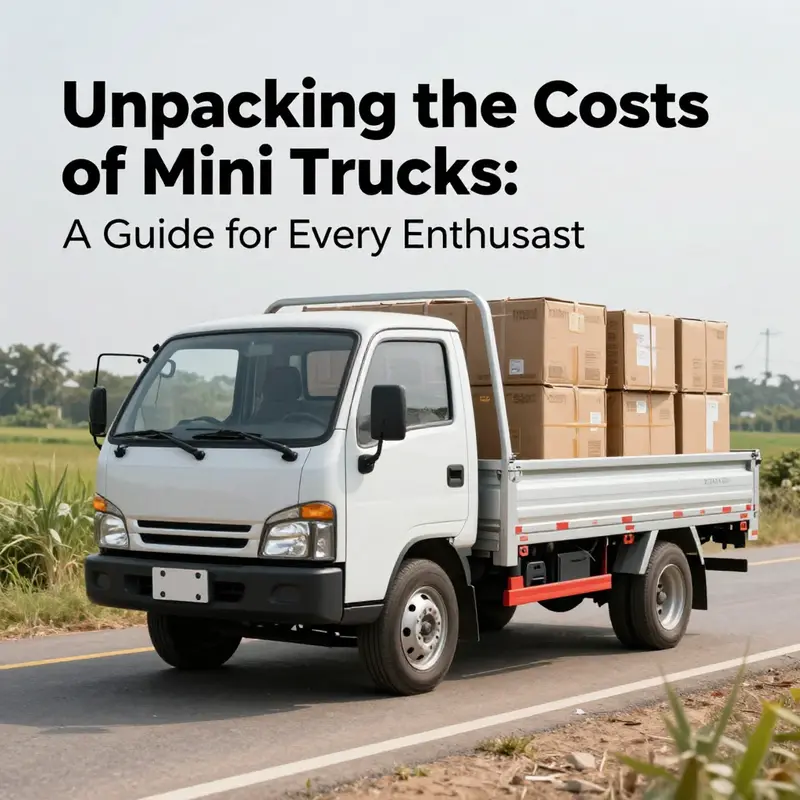
Pricing a lightweight diesel mini truck is less a single figure than a spectrum shaped by design, purpose, and the paths that buyers choose to travel along in procurement and operation. The market sketches a broad corridor where new vehicles commonly land between roughly four thousand and thirteen thousand US dollars, with wide gaps that reflect what buyers value most: payload capacity, drivetrain configuration, build quality, and the degree of localization in production and parts sourcing. Within this corridor, two major forces constantly tug at price: the configuration chosen by the user and the geographic and regulatory context in which the purchase happens. For a buyer who needs a simple, city-focused tool for light payloads, the baseline entry price often sits near the lower end of the range. It corresponds to a basic diesel powertrain with simple suspension, a modest payload rating, and a conventional, compact chassis. When the job requires more rugged capability—whether that means a 4×4 drivetrain, higher ground clearance, or a hydraulically operated tipping bed—the price tends to move upward. The higher end of the band, while not astronomical by industrial standards, reflects the added complexity of a vehicle engineered for tougher work environments and more demanding duty cycles. It is here that buyers encounter not only a more capable vehicle but also a more expensive maintenance profile, with components designed to withstand repeated off-road use, heavy loading, and harder service conditions.
This pricing ecology is not purely about raw engineering prowess. It is equally about how these vehicles are produced and how supply chains are organized. A growing share of lightweight diesel mini trucks are built on modular lines that can be localized, enabling parts and even major subsystems to be sourced within a relatively short radius from the final assembly site. The consequence is twofold: manufacturers can shave costs tied to long-haul logistics and inventory, and buyers can benefit from shorter lead times and more flexible procurement terms. For many small businesses and fleet operators, this translates into a surprisingly low barrier to fleet refresh or incremental scaling. Where once a single vehicle was a major capital decision, modular production, local content, and a willingness to accept slight variations in spec now allow a company to add units piece by piece, test a configuration, and then expand or adjust as needs evolve.
In practical terms, the price bands also reflect differences in drivetrain philosophy and regulatory compliance. A base diesel mini truck with a modest payload and a simple 2- to 4-cylinder diesel engine is typically designed for steady daily use—urban deliveries, tools transport, and light construction tasks. These powertrains are chosen for reliability and ease of maintenance; they lean toward robust torque delivery at moderate speeds, a trait valued by operators who confront frequent stop-and-go traffic or a mix of pavement and rougher worksite surfaces. Emissions considerations, particularly Euro 2 or similar regional standards, shape the design around fuel efficiency and exhaust treatment requirements. Engines that meet such standards are prized for their balance of durability and maintainability, offering fuel economy that helps keep operating costs predictable over time while limiting regulatory risk. For fleet owners weighing total cost of ownership, this combination of durability and lower regulatory complexity is a meaningful driver of value, even if it means accepting a somewhat higher upfront price relative to the most basic configurations.
The role of regional production and import dynamics cannot be overstated. When a vehicle is manufactured locally or regionally, it tends to carry a premium advantage in terms of service availability and parts responsiveness. A quick parts shelf in a nearby supply network translates into shorter downtime and lower carrying costs for fleets that rely on frequent servicing or upgrades. Conversely, import-heavy supply chains can offer stronger nominal build quality or more advanced features, but they often entail longer lead times, higher landed costs, and exposure to import duties and currency fluctuations. In markets where local manufacturers have invested in a lean, modular ecosystem, buyers can leverage a compelling combination: a price point that sits within the four-thousand-to-thirteen-thousand-dollar range, a warranty framework built around local service networks, and a rapid path to spare parts that keeps downtime to a minimum. The practical impact is that the same model line—if it exists in both a local and an import variant—may present noticeably different total cost profiles, even when the sticker price looks roughly aligned. For buyers who plan to operate a small fleet, this distinction matters, because it translates into a different cadence of maintenance events, a different set of spare parts priorities, and a different risk profile for cost surprises.
A recurring theme in this segment of the market is the willingness of producers to accommodate flexible procurement with a minimal order quantity. Unlike many other industries where a single unit is a rare exception, lightweight diesel mini truck suppliers in this space often allow orders as small as one unit. That policy reduces the barrier to trial and deployment for small businesses and independent operators, enabling a staged adoption where a company can test a configuration, observe real-world performance, and then scale up or pivot based on actual operational experience. The strategic value here is clear: a simple, transparent pricing path that aligns closely with the realities of small-scale logistics. It also supports fleet renewal strategies that might outperform more rigid procurement models in terms of depreciation and technology refresh rates. With the ability to source core components locally within a short radius—perhaps within fifty kilometers, as some suppliers optimize—the model becomes attractive not just on price, but on the total experience of getting a vehicle in service quickly and with predictable cost exposure.
From a buyer’s perspective, price is only part of the equation. The true calculus involves total cost of ownership—how much a vehicle costs to acquire, operate, and maintain over an expected service life. For diesel mini trucks, fuel efficiency, maintenance intervals, spare parts availability, and the cost of mandatory regulatory compliance all feed into a prudent TCO assessment. In urban logistics, where daily miles might be modest but the cadence of usage is high, the reliability of a diesel powertrain translates into meaningful savings over time. The same engine that delivers dependable torque for heavy loads at peak periods also tends to yield favorable fuel economy when duty cycles involve frequent short trips and idling. The cost of fuel is a running line item. While electricity from a battery-electric mini truck may present a different kind of price calculus, in the arena of diesel-powered small trucks, diesel pricing, maintenance costs, and the relative ease of obtaining parts on short notice are the primary levers that buyers pull when they compare a $4,000 entry unit to a $13,000-plus configuration.
Beyond the numbers, there is a practical narrative about capability and durability. A larger investment is often linked to a drivetrain that can sustain heavier loads, a more rugged chassis, and components that are designed for longer service intervals in harsh environments. For enterprises anchored in seasonal work or on-site projects in remote locations, the cost delta toward a more robust package can seem justified by the reduction in downtime and the smoother performance under load. In contrast, a smaller operation focusing on light urban deliveries may find the lower end of the spectrum perfectly adequate, trading ultimate payload for shorter lead times and lower upfront risk. The decision, therefore, is not merely about sticker price; it is about aligning a vehicle’s design envelope with the enterprise’s daily workflow, maintenance resources, and risk tolerance.
To translate these dynamics into actionable guidance, buyers should map their applications against the price tiers with honesty about what “enough” payload and torque truly means for their operations. A truck with a 1-ton to 1.5-ton payload that can traverse modest off-road conditions will be far more affordable and easier to service locally than a model that targets heavy off-road use or dump-bed versatility. Yet, for a job that occasionally demands a hydraulic dump or the ability to shuttle materials on uneven surfaces, the higher tier may become the more prudent choice, because it reduces the frequency of workarounds and the risk of equipment failure on critical tasks. In many markets, the modular production model accelerates this decision by offering add-ons and options that scale the price in predictable increments. Buyers who approach the purchase with a clear list of must-haves and negotiable nice-to-haves often arrive at a configuration that balances upfront investment with long-run operational efficiency.
The market’s nuanced pricing also feeds the way suppliers communicate value to potential buyers. Instead of presenting a fixed price for a feature set, many vendors reveal a transparent ladder of options, enabling buyers to choose a base chassis and then layer on a limited set of capabilities that precisely match their work order profile. This approach makes price signaling more intelligible. It also reduces the risk of overpaying for capabilities that will remain unused. For example, a basic urban logistics model may not require a transfer bed or a 4×4 drivetrain, while a rural or mixed-terrain operation might consider those features indispensable. In a system that emphasizes local sourcing and modular configuration, the cost of the optional enhancements tends to remain within a rational band, avoiding the extreme premium sometimes associated with highly specialized builds. This combination of price transparency and modular flexibility is a central driver of the market’s appeal for small businesses and independent operators seeking dependable tools without locking into a heavy, inflexible asset.
Importantly, buyers should be mindful of the lifecycle costs that accompany any purchase. A lower upfront price can be offset by higher maintenance costs if sourced parts are scarce or if warranty coverage is limited. Conversely, investing in a locally supported, slightly higher-priced configuration may deliver superior after-sales service, faster turnaround on repairs, and longer intervals between major overhauls. The decision framework, then, is not simply a snapshot of the price tag but a projection of risk, downtime, and the speed with which a fleet can recover when a vehicle is off the road. In practice, many operators find it prudent to work with suppliers that offer regional service networks, short spare-parts lead times, and clear maintenance schedules. These factors often translate into more stable monthly operating costs, which can be more valuable to a business than a marginal reduction in the sticker price.
For readers seeking a broader perspective on how these pricing and production dynamics play out across the industry, a deeper dive into industry reports and supplier pricing analyses can illuminate how manufacturers balance performance, cost, and supply chain resilience. Such sources emphasize the central role of regional production and local content in shaping price competitiveness. They also highlight how procurement models—ranging from single-unit purchases to small fleets—are increasingly optimized through modular architectures and localized parts networks. An external resource that reviews these themes in detail provides an external frame of reference for buyers who want to understand where price bands come from and how to assess value in a way that aligns with their own operating realities. For readers who want to explore these industry dynamics further, see the external resource linked at the end of this chapter.
In sum, pricing for lightweight diesel mini trucks sits at the intersection of engineering choice, production strategy, and practical fleet needs. The four-to-thirteen-thousand-dollar range captures baseline affordability, the premium for rugged capability, and the added value of localized sourcing that keeps maintenance lean and predictable. When evaluating options, buyers should translate sticker price into a dynamic forecast: what does it cost to acquire, what will maintenance and spare parts cost over the vehicle’s life, and how quickly can downtime be reduced through a well-supported service network? The most compelling value proposition often lies not in chasing the lowest price, but in choosing a configuration that matches the work profile, minimizes downtime, and leverages a procurement approach that scales with the business. The result is a sensible, predictable cost structure that supports steady operations and a clearer path toward fleet growth.
For further reading and a deeper practical framework, the industry blog offering ongoing commentary on market trends and procurement strategies can be a useful companion resource. You can explore more insights at minitrucksocala.com/blog/.
External resource: https://www.example.com/gmc-truck-suppliers-pricing
Beyond Price Tags: Unraveling the True Cost of Premium Mini Vans

Premium mini vans occupy a distinct niche in the mobility landscape. They are not merely transportation; they are a blend of space, comfort, technology, and capability designed to meet the demands of families, small businesses, and fleets that require more than a compact ute or a standard van. When you strip away the surface sticker price, several intertwined factors emerge that determine the final cost. This chapter pulls back the curtain on what drives the price of premium mini vans, how those costs interact with ownership expenses, and what buyers should weigh as they move from wish list to purchase order. It also places the premium segment within the broader spectrum of mini trucks and vans, showing how a few design choices can swing the economics of a vehicle that promises more interior room, more power, and more safety than its leaner peers.
At the heart of premium pricing is propulsion. In the space of mini vans, powertrains are not just about moving people or cargo; they symbolize efficiency, reliability, and the ability to operate across a range of scenarios. Electric powertrains in premium configurations bring a sizable portion of the cost premium. The electric option often features a larger battery pack, more sophisticated thermal management, and advanced electronics that optimize range and performance. A representative example from the latest data shows an eight-seat electric minivan with a battery designed for around 300 kilometers of real-world range selling in a price band of roughly US$15,500 to US$16,000 per unit, with the ability to order a single unit. Such figures illustrate several realities. First, the cost of electrified premium minis is increasingly accessible to individual buyers who might previously have considered fleets as the only legitimate market. Second, the price is a function of energy storage beyond basic propulsion. More range means more battery cells, more complex battery management, and more robust safety systems around the pack. All of these add up in the bottom line. When a vehicle transitions from a conventional internal combustion layout to one that relies on high-density lithium chemistry and active cooling, the design and manufacturing processes must accommodate strict quality controls, higher-cost materials, and longer testing cycles. The result is a price that can be justified by the value of extended range, higher reliability, and lower operating costs over the vehicle’s life.
Another major driver is the drivetrain architecture. Premium mini vans that offer four-wheel drive or other enhanced traction systems command additional cost. The premium for a 4×4 setup goes beyond simply adding a different transfer case. It entails reinforced chassis structure, more capable differentials, upgraded stabilization systems, and software that coordinates power delivery across all four wheels. This technology not only improves off-road capability and all-weather usability but also enhances load stability and safety in urban and rural environments. The upshot is that buyers who anticipate challenging road conditions or who need all-weather performance will often find the 4×4 option economically attractive in the long term, even if the upfront price is higher. The market signals that this isn’t merely a novelty feature; it’s a functional extension of the vehicle’s core purpose for certain operators, which is why it maintains a premium status in pricing.
Seating capacity and interior design are more than comfort; they are cost multipliers. An eight-seat configuration, common in premium mini vans, requires a different approach to weight distribution, seating materials, and occupant safety systems. The engineering involved in ensuring passenger comfort throughout long runs, while maintaining safe crash performance and ease of entry and exit, adds layers of complexity. The interior layout drives material choices—softer plastics, more selective use of real or simulated leather, and enhanced acoustic treatment to dampen road and wind noise. All these choices contribute to the price, but they also deliver a tangible payoff in user experience. For fleets, the ability to move more people in a single vehicle reduces per-seat transportation costs, a practical consideration that buyers weigh against the higher initial outlay.
The design and engineering strides in premium minis also translate into technology packages that go beyond basic safety. Modern premium vans often bundle advanced driver-assistance systems, network-enabled infotainment, and premium climate control, sometimes with individualized settings for different seating rows or zones. Dual airbags, reinforced side structures, and sophisticated pedestrian recognition technologies may be standard in well-equipped variants, while optional or modular packages provide higher levels of protection and convenience. These features are not just add-ons; they are integrated into the vehicle architecture. Each layer—from the passive safety of crumple zones to the active safety of perception sensors—adds to the build complexity and, consequently, the cost.
An important, sometimes overlooked factor is the pace of innovation and the pace of product refresh cycles. Premium minis often debut with updated design cues, more efficient motors, and smarter software. When a maker introduces a refreshed interior or a revised battery pack, the cost baseline for subsequent units can shift upward. For buyers, this means that today’s price is a snapshot in a moving landscape. The premium segment tends to experience more frequent updates than budget equivalents, reflecting consumer demand for modern aesthetics, better ergonomics, and the latest in vehicle-to-everything connectivity. This tendency to refresh—while beneficial to users—contributes to a higher depreciation curve in the early years of ownership if the market valuations track remaining fulsome for the newest variants.
From a regional perspective, pricing is not uniform. Exchange rates, import duties, local taxes, transport costs, and dealer incentives can tilt the final figure by a sizable margin. In some markets, premium minis command a breadth of options that tailor the vehicle to local needs, such as climate control configurations and safety packages that meet or exceed regulatory requirements. In others, prices may appear more favorable but are offset by higher insurance costs or maintenance expenses driven by regional service availability. Even within the same model family, a premium configuration can be priced differently depending on the national setup, the availability of spare parts, and the strength of after-sales networks. The point is not to assume a universal price ladder but to recognize that the total cost of ownership is a mosaic of upfront cost, ongoing expenses, and local market dynamics.
The story about cost cannot ignore the total cost of ownership. While sticker price grabs attention, fleets and households often care more about how much it costs to keep the vehicle on the road. Energy costs, whether from electricity or fuel, are a recurring line item. For electric premium minis, charging efficiency, the rate for off-peak or on-peak electricity, and the availability of charging infrastructure can swing annual energy expenses meaningfully. In many situations, the electric option can be cheaper to operate on a per-kilometer basis than a diesel or petrol counterpart, thanks to fewer moving parts, simpler maintenance regimes, and favorable depreciation on battery-related components in some markets. But this scenario hinges on access to reliable charging, energy prices, and the vehicle’s efficiency in real-world driving.
Maintenance and warranty are other long-term cost considerations. Premium vehicles typically carry generous warranty terms that reflect confidence in the engineering and an expectation of higher service standards. These warranties can reduce the risk of unexpected repair bills in the early years. They also influence resale value because buyers feel more secure with manufacturer-backed protection. However, premium components—such as complex battery packs, high-strength materials, and advanced electronics—can incur higher service costs if repairs fall outside covered terms or if skilled technicians are scarce in a given region. It is not unusual for premium minis to require service visits that cost more than those for base models, particularly if maintenance requires dealer-only parts or specialized diagnostic tools. In total, the financial calculus of premium minis favors owners who can maximize uptime and minimize unexpected downtime.
Pricing is rarely a single number. A realistic assessment involves envisioning the vehicle in a specific use case. A fleet operator prioritizing passenger throughput, reliability, and ease of service will weigh the premium against potential productivity gains. A family seeking comfort on long trips will weigh the premium against interior space, ride smoothness, and long-range confidence. In both cases, the price is a function of what you get for that extra cost: more versatile seating, safer travel, better insulation and acoustics, longer-range assurance, and the potential for higher resale value. The framing is crucial because it reframes the question from ‘What is the cheapest premium mini van?’ to ‘What is the right premium mini van for my needs, and what is the total cost across its lifecycle?’
Of course, many buyers still want a sense of concrete price anchors. The current premium electric eight-seater, when purchased as a single unit with no bulk discounts, sits in a band around fifteen and a half to sixteen thousand dollars. That price is striking because it positions a vehicle with substantial interior space and modern electrified powertrain within reach of individual buyers who previously assumed such capabilities were reserved for larger, more expensive models. The MOQ of one unit challenges the idea that premium minis are exclusively fleet-forward; it signals a market trend toward democratizing access to premium features for smaller operators and affluent private buyers alike. Yet even within this attainable band, the perceived value will hinge on the confidence a buyer places in real-world range, the immediacy of service support, and the seamlessness of the vehicle’s electronic ecosystem.
The decision to choose a premium mini van, therefore, is as much about trade-offs as about sticker price. If a buyer values off-road capability and all-weather traction, the premium for a 4×4 drivetrain is not merely cosmetic; it is a functional asset that expands usability and safety. If a buyer prioritizes long-range comfort and a refined cabin, the interior package and material choices become central to the value proposition. If energy costs and charging access are favorable, an electric option becomes compelling for the same reason that a diesel or petrol version might be for others: it aligns with the buyer’s operational realities. In practice, the optimal choice is a balancing act that takes into account not just the initial outlay, but the vehicle’s performance envelope, the reliability of service networks, and the expected schedule of updates as technology evolves.
What does this mean for a consumer standing at the threshold of a premium mini van purchase? It means embracing a more nuanced approach to cost. It means asking not only how much the vehicle costs today, but what it will cost to own, operate, and eventually replace or refresh in the coming years. It means recognizing that premium pricing naturally accompanies higher standards—space that truly accommodates families or cargo, safety systems that push beyond baseline requirements, and powertrains that deliver not just performance but peace of mind. And it means acknowledging that the price today reflects not only the sum of parts but the promise of a more capable, more comfortable, and more connected travel experience tomorrow.
For readers seeking guided comparisons as they navigate these considerations, a practical path is to consult broad overview resources and then drill down into dealer quotes and official documentation. A reliable starting point is the general content found on industry-focused blogs and product summaries that discuss premium minis in aggregate terms rather than in brand-specific terms. For broader context and ongoing updates, the minitrucks blog offers a useful, neutral perspective on how the market is evolving and what buyers can expect as new features arrive. minitrucks blog.
When evaluating numbers, it is prudent to anchor expectations in real-world scenarios rather than hypothetical maxima. A typical premium mini van with eight seats, an electric drivetrain, and a mid-range design package might fetch a price in the low-to-mid teens of thousands of dollars. Add four-wheel drive, a longer-range battery, premium interior materials, a more expansive infotainment ecosystem, and upgraded safety features, and you can see how the price can climb in a controlled way toward the higher end of the premium spectrum. Simultaneously, buyers should be mindful that base models in the premium space exist at more approachable price points, but the value proposition will be narrower, with fewer seats or less range, and with fewer luxury touches. In short, the cost is a precise reflection of the feature set and the underlying engineering complexity that supports the vehicle’s most valued attributes. For those who require resilience, range, and comfort, the premium jump is often worth the investment when the total cost of ownership is carefully calculated over the vehicle’s lifecycle.
In closing, the price of premium mini vans is not a single figure or a fixed line on a spec sheet. It is the result of a layered equation that includes propulsion choice, drivetrain configuration, interior volume and quality, safety and tech packages, and regional market dynamics. It also embodies a strategic choice about what kind of mobility is most appropriate for a buyer’s daily routines and future plans. For anyone considering this class of vehicle, the path forward lies in clarifying priorities, modeling total costs, and engaging with sources that reflect current market realities. While numbers provide a clear frame, the real value emerges when one aligns the vehicle’s capabilities with the actual needs of the user—whether for daily commutes, family trips, or business scales that demand reliable passenger and cargo movement. As the market continues to evolve, the premium tier will likely become even more compelling to those who demand balance: more space, more safety, more efficiency, and more confidence in every mile.
External reference for further data: https://www.alibaba.com/product-detail/Best-8-Seat-Minivan-Electric-Minivan-9-Seats_1600447354582.html
Budget Mini Trucks: What Your Wallet Gets You—and What It Might Not
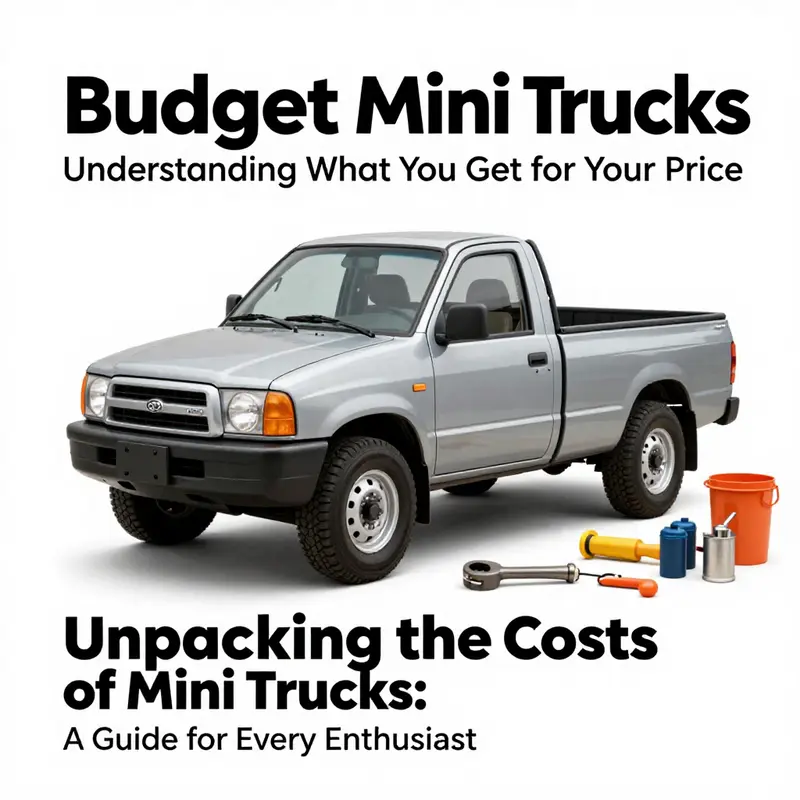
Budget mini trucks sit at a curious crossroads, where affordability meets utility, and every dollar saved on the sticker price is weighed against long-term operating costs, reliability, and how hard you’ll have to work to make the vehicle fit your daily tasks. When you’re sizing up a purchase in this category, the big question is not just how low the price can go, but how much value you actually get for that price. In many markets, new mini trucks commonly fall into a price band that stretches roughly from four thousand to about thirteen thousand dollars. That range captures a broad spectrum of vehicles: from bare-bones urban workhorses intended for straightforward deliveries to more polished work trucks that carry modest payloads, offer better ride comfort, and come with a more robust warranty. The spectrum matters because the price tag is a proxy for capabilities, and those capabilities define where the truck will succeed and where it might fall short. It is easy to assume that a cheaper truck is simply a more economical version of its pricier cousins, but the truth is more nuanced. The lower end often emphasizes economy and reliability over refinement, while the higher end introduces additional payload, larger cargo beds, improved durability, and more comfortable interiors. Neither approach is inherently superior; the right choice depends on the tasks you need to accomplish, the environment where you’ll operate, and how you value ongoing costs over the vehicle’s lifespan.
The reality behind those numbers is anchored in trade-offs. Price serves as a short-hand for a bundle of capabilities that have real-world consequences. A budget mini truck priced around four thousand dollars is likely to exhibit a smaller engine, simpler suspension, and fewer interior amenities. It may have a shorter cargo bed and limited towing capacity, with basic safety features and a modest warranty. You’ll probably notice a greater emphasis on durability and straightforward maintenance because the market that accepts such a price point tends to prioritize a vehicle that can survive daily hustle with minimal frills. Conversely, a model closer to the thirteen-thousand-dollar mark typically offers a larger payload, a longer cargo bed, and a drivetrain designed to handle more demanding tasks. You’ll likely encounter a more comfortable cabin, better insulation from road noise, and a suite of features that, while not luxurious, materially improve daily usability—things like improved climate control, more refined seating, and upgraded infotainment or convenience options. This is the practical reason why a single task can demand a different price band: not all tasks are the same, and not all operators require the same degree of comfort or capacity.
A central point that many buyers discover is that the price you pay is not a direct line to performance. A lower sticker price might forego torque, bed length, or powertrain durability, but it can still be a perfect fit for light urban duties, short-range deliveries, or a small business that operates within a tight budget and can live with more basic equipment. The higher price points, on the other hand, may translate into longer service life under heavy use, better resale value, and fewer mid-life repairs—benefits that can tilt the economics in a favorable direction if the new capabilities align with your needs. The balance between upfront cost and long-term cost of ownership—maintenance, repairs, insurance, fuel or electricity, and depreciation—needs to be part of the budgeting conversation from day one. When you step back and consider Total Cost of Ownership (TCO), the lowest price isn’t always the most economical choice, and the most expensive option isn’t necessarily the best fit for a given workflow.
What, then, should a practical buyer look for in the budget space to maximize value without overspending on features that won’t be used? First, define the tasks. If you’re urban through and through, with short trips and tight parking, a compact footprint and nimble handling may trump everything else. If you’re delivering goods in smaller quantities within a 20- to 30-mile corridor, a modest payload and good reliability may be the most important metrics. If you’re running a micro-operation that relies on a predictable, low-cost platform, you’ll want to scrutinize maintenance costs and parts availability more than surface-level comfort upgrades. In this sense, the budget segment rewards a disciplined requirements exercise: list what you must move, how often you’ll move it, and the environment in which the truck will work. Then map those needs to a price tier that provides just enough capability without paying for extras you won’t exploit.
The practical architecture of these trucks also matters. Smaller engines and simplified drivetrains can improve fuel economy and lower maintenance costs, but they can also sacrifice reserve power when a full load is on the bed or a steep incline must be conquered. For a business, the ability to keep moving without frequent stops and starts is more valuable than a few extra miles per gallon, yet a heavy-featherweight approach can backfire if the work demands consistent, dependable performance. The bed and chassis design influences how you load and secure cargo. A longer bed is more forgiving for loose items or unusual shapes, while a shorter bed may be perfectly adequate for standard boxes and pallets when paired with efficient packing and strap strategies. Tire choice and wheelbase affect stability, ride quality, and the ruggedness of daily use. These elements do not operate in isolation; they combine to shape the vehicle’s habitability, durability, and suitability for your operations.
Another critical factor is the service and parts network. Budget trucks depend on a network that can provide affordable parts at scale and a service ecosystem that can handle routine maintenance without turning into a delayed downtime event. In many markets, the lowest-price tiers come with more limited service coverage, which can translate into longer downtime and higher inconvenience for maintenance or repair. When considering a budget purchase, it is worth investigating how local technicians view the vehicle, how widely parts are stocked, and how long it might take to obtain a critical component. This is not a glamorous line item, but it is often decisive for small businesses and individuals who cannot afford extended outages. You should also verify the warranty coverage—what it covers, for how long, and how easy it is to claim—and explore whether the manufacturer or seller offers a maintenance plan that reduces the risk of unexpected repairs during the first few years of ownership.
The figures in this budget arena also reflect regional differences in taxes, shipping, and import duties. In some markets, a price tag on a new mini truck can be influenced by additional costs that aren’t immediately obvious at the dealership—freight, registration, and local fees can push the total investment beyond the headline price. Conversely, in other areas, government incentives for low-emission or small-displacement urban vehicles can tilt the economics in favor of more affordable operating costs over time. These nuances underscore why a straightforward sticker price is only part of the equation. When you are comparing options, you should ask for a comprehensive breakdown that includes delivery charges, dealer fees, and any post-sale service commitments. The goal is to arrive at a price that is not just bearable at the moment of purchase but sustainable across the vehicle’s expected life.
As you weigh what you can get for your price, it’s helpful to consider how others in similar situations have approached the decision. If your needs are modest—occasional deliveries in a dense city environment or a light-haul pattern for a small venture—the budget end of the spectrum often provides a simple, robust pathway to operation without the burden of heavy debt or complex financing. In such cases, buyers can budget for essential upgrades later, such as safer cargo tie-downs, improved lighting for nighttime operations, or a modest protection package against corrosion and wear. If your workload is predictable but starts to scale, you may discover that the mid-range models offer a better blend of payload capacity and reliability without the premium price tag of top-tier variants. The exact moment when a jump in price yields meaningful marginal value depends on your specific usage profile and the predictability of demand in your market.
To illustrate the practical path forward, many buyers begin with a careful feature checklist rather than the raw price. This checklist often centers on three pillars: payload and bed practicality, drivetrain and efficiency, and the quality of the cabin and controls. Payload and bed practicality focus on the ability to carry the expected items in a safe, secure manner. Drivetrain and efficiency consider whether the powertrain provides sufficient torque for typical loads, and whether the operating costs over a year align with the financial plan. Cabin quality and controls cover the ease of daily use, visibility, climate comfort, and the intuitiveness of the instrumentation. When these pillars are aligned with the budget, the resulting choice tends to deliver the best value rather than the best possible feature set. If you recognize that a particular job will require frequent heavy loading or long daily drives, the budget end may not be the right place to search. It may be wiser to stretch the budget toward a mid-range option with more durable components and a more capable drivetrain.
For readers seeking a practical, experience-based path to comparison, a model-focused approach can provide a concrete way to assess value. Start by listing the daily tasks—the average load, the typical distance, the traffic environment, and the expected frequency of use. Next, translate those tasks into tangible requirements: payload capacity, bed length, ground clearance, turning radius, and available maintenance options. Then, translate those requirements into price bands and assess whether the difference in price between two candidates can be justified by a measurable improvement in utility or total cost of ownership. It is often worth constructing a simple cost-of-ownership scenario: estimate annual fuel or electricity costs based on your routes, add maintenance and insurance estimates, and factor a conservative depreciation rate. If the difference in annualized costs between two options is small, but one option delivers a clearly better fit for your daily workflow, that option is typically the smarter choice. This disciplined approach helps prevent price alone from steering the decision and ensures the selected truck improves productivity rather than becoming a source of friction.
In the broader landscape of budget mini trucks, there is also a structural question about where value comes from. Some buyers value the possibility of a rapid, simple acquisition with minimal lead time and strong dealer support. Others prize customization potential, even within budget limits, such as easier access to aftermarket parts, flexible cargo solutions, and modular upgrades that can extend the truck’s usable life. It is important to recognize that value can be created not only by a feature that is factory-installed but also by a practical adaptation that increases efficiency in daily operations. A cost-conscious buyer might, for example, invest in a robust cargo strap kit, weather-resistant bed liners, or a compact tool set that keeps the vehicle working consistently without needing expensive upgrades elsewhere.
If you are reading this and evaluating potential purchases, you are not alone in seeking a sound balance between price, capability, and reliability. The challenge is not simply picking the lowest price; it is choosing a platform that can sustain your activities without imposing a high maintenance burden or frequent downtime. This is where a thoughtful, non-cliché approach to budgeting becomes essential. Rather than chasing the lowest upfront number, you are better off building a structured forecast that captures what you actually need in the coming years and then identifying the best fit within the budget to meet those needs. In practice, this means keeping your eyes open for subtle indicators of long-term value—such as the availability of replacement parts, the reputation of service centers, and the promise of a sensible warranty—alongside the headline price.
For readers who want a concise, practical touchpoint as they begin their search, consider a straightforward, model-agnostic approach to comparing options. Look beyond the sticker price and request: a clear payload rating, bed dimensions, drive configuration, a maintenance schedule, and a warranty summary. Seek documentation that confirms the vehicle’s build quality and safety features, and ask for references or case studies from other buyers with similar usage patterns. If possible, test the vehicle under a load that approximates your typical use; this is the moment when the real differences reveal themselves—how stable the handling remains with cargo, how predictable the braking feels, and whether the cabin environment remains comfortable during a standard workday. While this kind of diligence requires time, it yields a more confident purchase and reduces the likelihood of regret after a few months of operation.
As this discussion circles back to the central premise—understanding what you get for your price—the key takeaway is that price is a compass, not a verdict. A budget mini truck can be an excellent enabler for urban logistics or light hauling, provided you align your expectations with the vehicle’s strengths and openly acknowledge its limits. By clarifying tasks, evaluating the practical payload and bed configurations, considering the total cost of ownership, and verifying service and parts availability, you position yourself to select a truck that completes the workflow rather than complicating it.
For readers who want a quick jump into practical comparisons without wading through glossy marketing claims, a model-agnostic resource that emphasizes real-world specs and functional differences can be valuable. You can explore a dedicated page designed to compare various budget options side by side, which provides a compact snapshot of how different configurations stack up on the metrics that matter most to light-duty work. This kind of resource helps you avoid being trapped by a single specification, such as horsepower or a single feature, and instead focuses on the combination of cargo capacity, reliability, and operating costs that actually drives daily productivity. When you approach the decision in this way, a modestly priced truck can become a genuine workhorse rather than a financial afterthought.
For those seeking practical guidance beyond the price tag, an accessible collection of resources can illuminate the path. The mini trucks blog offers a broad context, tips, and user experiences that can ground your expectations and inform your purchase strategy. It can be a starting point to understand how other buyers approach similar constraints and goals. You can visit this resource collection to gather perspectives and practical insights that complement the more formal specifications and pricing breakdowns you’ll encounter when engaging with dealers. minitrucks blog.
In sum, the budget end of the market is not simply about pinching pennies. It is about choosing a pragmatic, repeatable approach to work that respects the realities of daily use, serviceability, and lifecycle costs. By framing the decision around your actual needs, recognizing the trade-offs, and validating the long-term implications of your choice, you can select a budget mini truck that genuinely delivers value. The journey is not about finding the cheapest option, but about finding the option that best aligns with your tasks, your geography, and your tolerance for maintenance and downtime. If you want a structured, model-agnostic way to compare options, consider consulting a focused model-comparison resource that helps translate specifications into practical outcomes—then pair that with a direct inquiry to suppliers to verify current pricing, availability, and after-sale support. As with any investment of this scale, taking the time to ground your decision in real-world needs will pay dividends in daily performance, peace of mind, and predictable cash flow.
External resource for deeper guidance: for a broader, no-nonsense guide to selecting a mini truck based on cost and buying considerations, you can consult a detailed buyer’s guide from an automotive resource. This external reference provides additional perspectives that complement the practical, hands-on thinking outlined above. https://www.carinterior.com/how-to-choose-a-mini-truck-cost-buying-guide/
Final thoughts
In conclusion, understanding how much mini trucks cost reveals a range of options that cater to the unique needs of local business owners, residential property owners, and mini truck enthusiasts. From affordable electric models to premium vans, each category offers distinct value propositions designed to satisfy various requirements. By contemplating the features and benefits discussed throughout this guide, you’re now equipped to make a well-informed decision while optimizing your budget.