
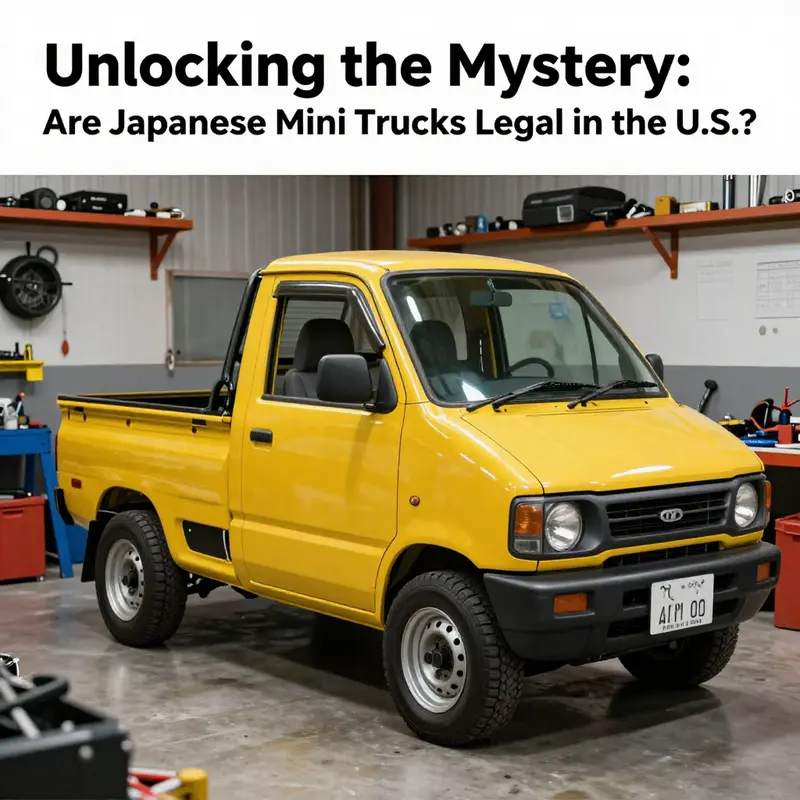
Japanese mini trucks, known as kei trucks, encapsulate versatility, efficiency, and charm. These compact vehicles have gained popularity among local small business owners, residential property owners, and mini truck enthusiasts alike. But navigating the legality of these vehicles in the United States can be complex. Each chapter of this article will guide you through important aspects: the federal import regulations linked to the 25-year rule, state-specific regulations affecting registration and operation, and common registration challenges faced by owners. By the end of our journey, you’ll be equipped with the knowledge to make informed decisions about owning and using a Japanese mini truck.
Chapter 7: The 25-Year Rule and Japanese Mini Trucks in the U.S.
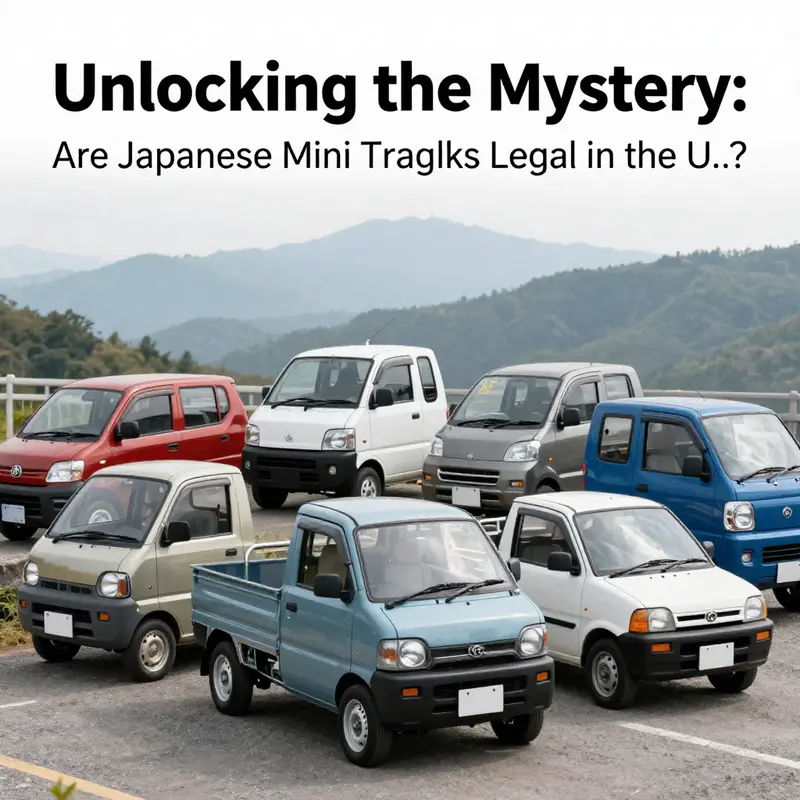
The 25-year rule is often the first hurdle for importing Japanese mini trucks into the United States. It acts as a federal threshold that exempts older vehicles from many modern safety and emissions requirements. This creates a potential path for vehicles built in 1999 or earlier to enter the U.S. market with fewer federal barriers. However, the journey does not end at import eligibility. After crossing the federal line, states become the deciding authority on whether a vehicle can be registered and driven on public roads. Different states have different inspections, emissions standards, and documentation demands. Understanding the interplay between federal rules and state regulations is essential for anyone considering ownership of a kei truck in the U.S. The NHTSA provides guidance on what qualifies for import under the 25-year rule, and the state DMV offices provide the door to on-road legality. By approaching the process with both federal awareness and state-specific planning, enthusiasts can pursue a practical, road-legal kei truck within the unique framework of American vehicle regulation.
Navigating Patchwork Rules: How State Doors Open or Close for Japanese Mini Trucks in the United States
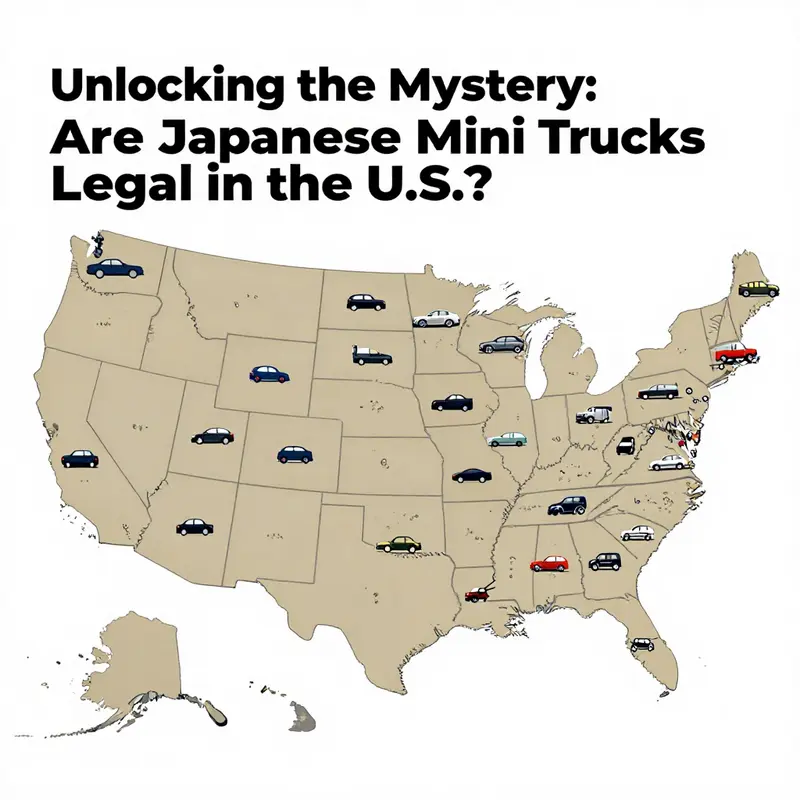
Regulatory landscapes in the United States are a patchwork: federal import rules create a doorway for older Japanese mini trucks, but each state holds its own keys to road use.
Federal rule: vehicles over 25 years old are exempt from most FMVSS and current emissions standards, making import feasible. The doorway, however, does not guarantee that the vehicle can be driven on public roads everywhere.
Texas example: a 2010s statute defines qualifying mini trucks—Japanese-made, engine displacement at or below 1.2 liters, a top speed meeting a minimum threshold—as eligible for license plates and operating on public roads through standard registration. This turns federal permissibility into practical access in that state, with ongoing administration at the DMV.
Michigan case: despite federal clearance, Michigan’s definitions around what constitutes a motor vehicle and historic vehicle classifications can block registration, leading to legal challenges and a reminder that state definitions shape actual use more than import permissibility.
Rhode Island: policy guidance has effectively prohibited registration for mini trucks, microvans, and kei cars, creating a hard stop even if import is technically possible.
Other states: many jurisdictions apply a mix of requirements—modifications, safety equipment, or inspections—that can seem inconsistent or costly relative to the vehicle’s value and purpose.
Practical steps: start by clarifying your intended use and address; contact the state’s DMV to learn current registration criteria, gather required documents, obtain insurance details, and consider engaging a regulatory consultant or attorney familiar with automotive compliance. In some cases, a state may require certain modifications; in others, you may be able to register the vehicle with minimal changes, but inspections and fees can still apply.
Bottom line: federal permission enables import of older kei trucks, but state-level realities decide whether you can drive them legally. A careful assessment of local rules, up-to-date agency guidance, and realistic budgeting for inspections and registration is essential for any plan to own and operate one on public roads.
For ongoing context, consult official DoT and state DMV resources and stay alert to legislative updates, court decisions, and regulator guidance, which can shift the practical horizon quickly.
On the Road and in the Grey Zone: Navigating the Legal Patchwork for Kei Trucks in the United States

When people imagine a small, economical workhorse moving quietly through a farm lane or weaving between urban blocks, they may picture a compact vehicle designed for tight spaces and straightforward tasks. In the United States, however, the arrival and everyday operation of Japanese kei trucks—ultra-compact pickups and vans born from a specific Japanese regulatory category—unfolds not as a simple yes or no, but as a nuanced negotiation between federal policy and a tangle of state interpretations. The core tension is straightforward in principle: a vehicle that is technically older than a quarter of a century can, under federal law, be imported without having to meet the current U.S. Federal Motor Vehicle Safety Standards or emissions requirements. Yet once it crosses the border and enters the state registration system, the real work begins. Each state may read the same grandfather clause through a different lens, and those lenses shape whether a kei truck can be titled, insured, registered for street use, or—perhaps most frustratingly for enthusiasts—held in limbo as a vehicle that cannot be legally driven on public roads.
From this vantage point, the kei truck becomes less a single machine and more a case study in how federal permissiveness and state discretion interact. The federal 25-year threshold exists to ease the importation of vehicles that were designed and built under different standards and timelines than those used for today’s new cars. It is a kind of safety valve: it accepts that older designs reflect older engineering philosophies and regulatory expectations, and it recognizes that many classic imports have a loyal and practical following. Yet that same rule, which may seem straightforward at first glance, does not line up neatly with how states regulate on-road use, inspections, and environmental compliance. The result is a spectrum: in some places, old kei trucks may be registered and operated with relative ease if they clear a series of inspections or qualify as antique or collector vehicles; in other places, they face outright rejection or relentless hurdles that push ownership into the realm of hobbyist display rather than everyday mobility.
The practical route for someone who wants to bring a kei truck into the U.S. usually starts with the 25-year rule. If a vehicle is more than 25 years old, it is exempt from the modern FMVSS and much of the current emissions regime at the federal level. This exemption has made the importation process more accessible for older kei-truck designs, which is a central reason why a robust, if loyal, community of importers and enthusiasts exists. But the story does not end there. The next chapters unfold at the state level, where registration and on-road use are governed by a patchwork of statutes, administrative interpretations, and sometimes evolving court decisions. Some states have crafted specific language that can impede or even deny the registration and roadworthiness of these imports, while others provide pathways that, with careful documentation and compliance steps, accommodate these unusual yet road-legalged vehicles. The contrast is not merely academic; it translates into real-world implications for owners who may find themselves facing prolonged processing times, unexpected fee structures, or veritable gatekeeping through vehicle inspections.
Among the most consequential flashpoints are the state distinctions regarding what constitutes an automobile and what falls into a category that is deemed non-highway or limited to off-road use. This semantic boundary—whether a kei truck is considered a standard automobile subject to traditional registration or a non-highway vehicle with restricted use—has become a fulcrum for regulatory action in several states. In practice, this means that even if a vehicle qualifies under the federal grandfather clause for import, it may still be rejected at the DMV’s counter if the state interprets its intended on-road use through a different regulatory lens. State reliance on this distinction has produced outcomes that range from straightforward antique-vehicle registration to outright denial based on perceived mechanical unsuitability for highway operation. The variability is not merely a procedural inconvenience; it can determine whether a vehicle remains a travelable asset, a farm helper, or a costly curiosity collecting dust in a garage or a yard.
A telling pattern emerges when examining a handful of states that have publicly weighed in on kei trucks and similar micro-vehicles. In one widely cited case, a state legislature passed language in 2019 that explicitly excluded so-called gray-market off-road mini-trucks from on-road registration. This is not your everyday bureaucratic tweak; it is a purposeful narrowing of the class of vehicles that can lawfully share the road. While the original intent behind such an exclusion might be debated—whether it aims to preserve highway safety, protect consumer investment, or limit loopholes—the practical effect is clear: owners who had already secured registrations or who might have otherwise possessed legally road-legal older kei trucks faced abrupt changes in their eligibility. The legal tension that ensued, including disputes over due process and fee refunds, underscored how state interpretations can upend expectations set by federal permissiveness. The friction is not merely about paperwork; it touches on the predictability and stability that owners rely on when planning purchases, operations, and long-term maintenance.
Another illustrative point of friction arises from a state that has taken a more cautious stance, issuing formal guidance that it will not process registration applications for mini-trucks, mini-vans, or kei cars. The rationale commonly invoked is the perceived mechanical unsuitability for highway operation given their diminutive size and comparatively modest power-to-weight ratio when measured against mainstream highway traffic. This stance, while arguably grounded in safety concerns, has itself become a matter of contested interpretation and legal debate. In isolation, such guidance might seem like a prudent, even conservative, approach. When viewed across multiple states with divergent views, it forms part of a broader mosaic in which the same vehicle can be treated as a legal road machine in one jurisdiction and a non-starter in another.
This patchwork of rules has provoked a number of legal and practical challenges. Advocates for kei-truck ownership argue that these vehicles are not inherently unsafe on public roads; rather, they are simple, durable, and well-suited for tasks that require nimble handling, low operating costs, and reliable performance at modest speeds. They point to the real-world utility of kei trucks in rural or agricultural settings, where narrow lanes, soft soil, and short trips between fields are common. They emphasize that the vehicles in question are designed for a different regulatory era and for different driving environments than modern full-size, high-speed automobiles. Critics, meanwhile, maintain that the safety standards built into the current vehicle fleet are the product of decades of highway-focused regulation for vehicles designed to reach higher speeds and weigh more. Their concern is that a large number of low-powered, compact vehicles could complicate traffic safety in ways that are not easily addressed by simple grandfathering.
Beyond the philosophical debates, the practical consequences are often concrete and personal. Importers and owners face logistical steps that include obtaining the proper documentation, arranging the appropriate inspections, and sometimes navigating a state’s antique- or collector-vehicle framework. Some states offer a pathway that aligns with antique or collector vehicle status, frequently associated with looser emissions requirements and special registration privileges. The catch, as with many other vintage or niche vehicles, is a race against time and administrative backlog: what qualifies for antique status in one year can be treated differently in another if the legislature or the DMV’s interpretation shifts. The result is a risk profile that can deter prospective owners who need reliable, predictable access to street-legal operation—precisely the kind of predictability that wholesale import and registration processes thrive on.
From a governance perspective, the central dilemma is about coherence and consistency. Federal grandfathering provides a permissive floor for importation, but it does not, by itself, mandate a universal, uniform road-use policy for each state. In fact, the very term “automobile” versus “non-highway vehicle” has become a vehicle for state authorities to characterize the intended use, the capability of the vehicle, and, crucially, the fit between a modern regulatory framework and older, simpler engineering. Some states look at the vehicle’s dimensions, curb weight, and performance envelope and find them compatible with on-road operation, especially if the vehicle is properly registered and insured and passes a state inspection. Others apply a more cautious lens, citing size, speed capability, or maintenance concerns and concluding that the vehicles are unsuitable for highway travel, regardless of age. The divergence is not a minor detail; it is the beating heart of why the kei-truck story in the United States remains unsettled, debated, and, for many owners, frustratingly uncertain.
The broader social and economic context cannot be ignored. Enthusiast communities have grown around these compact vehicles because of their straightforward mechanicals, low fuel consumption, and versatility in tight spaces. They have become a kind of sustainable, low-cost mobility solution for certain tasks—farming, small-scale delivery, maintenance work in dense urban cores, and hobbyist restoration projects. This popularity does not compel regulatory harmonization, but it does exert pressure on policymakers and regulators who must balance safety, consumer choice, and the market realities that older, simpler vehicles represent. Critics worry about regulatory arbitrage, where permissive import rules could be exploited to bypass modern standards, but supporters argue that the kei-truck category has always been intended to serve specific use cases where large, modern trucks are impractical or unnecessary. The reality is that the public policy question is not merely about the vehicle’s age or its technical specifications. It is about how a federal framework can be translated into a predictable, fair, and enforceable state regime that respects both the integrity of highway safety standards and the legitimate uses of these small, utilitarian vehicles.
Importantly, the path from importation to daily road use remains a journey rather than a single leap. Prospective owners frequently encounter a sequence of checks: verify eligibility under the federal 25-year rule, gather documentation showing the vehicle’s age and origin, obtain a bill of sale and title, arrange for a state-level inspection, and determine the most appropriate registration category—standard, antique, or a special-use designation if the state provides one. Each step can vary significantly by state, and the availability of an inspection facility, a knowledgeable DMV staffer, or a sympathetic registrar can tip the balance toward either success or delay. The result is a reality in which the kei truck, for all its simplicity, becomes a symbol of regulatory nuance, and the process itself becomes part of the ownership experience.
From a practical standpoint, a seasoned reader might ask: what does this mean for the average person who wants access to a kei truck for legitimate on-road use? The answer hinges on a mix of timing, jurisdiction, and how well the vehicle’s documentation aligns with state expectations. In states with more flexible interpretations, an owner who can demonstrate the vehicle’s age, provide proof of compliance with any applicable emissions exceptions for antique or collector vehicles, and complete the required inspections can usually secure registration. In states that apply stricter standards or that interpret the regulatory language in a more restrictive way, the same vehicle might face an uphill battle, including denials that require appeals or even legal challenges. The gaps between intent, policy, and practical enforcement are precisely what makes this topic so persistent and controversial among regulators, collectors, and everyday drivers alike.
For readers seeking a practical compass, the key is to recognize that while federal law provides a permissive gateway for import, the ultimate road-legal status is local. The best-informed path involves not only consulting the federal framework but also engaging with a state’s DMV, seeking guidance from vehicle-registration professionals, and reviewing any recent legislative or regulatory updates that could affect eligibility. It also helps to connect with communities and forums where people share experiences about specific states, which can illuminate how a given jurisdiction handles inspections, antique plate programs, and emissions exemptions. Those communities—whether on dedicated forums or in informal networks—often act as accelerants for understanding the nuances that official texts cannot fully capture.
The practical advice that emerges from these observations is clear and pragmatic. If the goal is to operate a kei truck on public roads, it is wise to pursue a three-pronged strategy: first, confirm eligibility under the federal grandfather clause with a tax and title history that clearly documents age and origin; second, approach the state DMV early to gauge registration possibilities and to learn about any required inspections or special-use classifications; and third, maintain robust documentation supporting the vehicle’s intended use, maintenance history, and any exemption status claimed under antique or collector vehicle provisions. Even with careful preparation, owners should anticipate that the outcome may not be guaranteed and that regulatory winds can shift with new laws or administrative interpretations.
The evolving legal landscape is part of a broader conversation about how the next generation of policymakers envisions vehicle safety, environmental responsibility, and transportation equity. Kei trucks challenge preconceptions about size, speed, and on-road capability, inviting regulators to consider whether the current standards are agile enough to accommodate a wider spectrum of legitimate, practical vehicles. Some policymakers argue for clearer, more uniform guidance that would reduce the current uncertainty and encourage lawful use where it is feasible. Others emphasize the need to preserve safety margins in a rapidly changing automotive ecosystem, where new technologies and evolving urban mobility patterns demand careful consideration of every vehicle’s role on public streets. The outcome of these debates will influence not only whether kei trucks can be registered and driven, but also how states design future rules to accommodate legacy designs while preserving highway safety.
For now, any reader who contemplates bringing a kei truck into the United States should be mindful that the importation of an older vehicle is a gateway event, followed by a path that is state-specific and, at times, unpredictable. The 25-year exemption is not a universal passport to road access; it is a piece of a larger regulatory puzzle. The experiences of Michigan and Rhode Island illustrate how a single state’s approach to interpretation can recast the same vehicle from a potential road asset into a non-road vehicle, or at least a project in progress rather than a practical tool. Those experiences have sparked legal debates, with advocates arguing that due process and fair application of rules should govern registrations and refunds, and regulators maintaining that road-vehicle classifications must reflect current safety, environmental, and infrastructure considerations. The tension between these perspectives is unlikely to fade soon, which means that anyone entering this space should stay informed, stay patient, and stay engaged with both the policy conversation and the practical realities of vehicle registration.
As the dialogue continues to unfold, the kei-truck narrative serves as a reminder that the road to legality is not merely about the vehicle’s age or its physical dimensions. It is about how federal permissiveness translates into state practice, and how the human element—drivers, inspectors, lawyers, and regulators—interacts with a set of laws designed to balance safety, mobility, and choice. For enthusiasts and users who value the versatility and efficiency of these compact machines, the path forward may involve continued advocacy for clearer, more predictable guidelines that respect the legitimate places these vehicles can fill while preserving the safety standards that keep all road users secure. The story of kei trucks in the United States, therefore, remains one of nuance, a steady reminder that legality is a living negotiation, shaped by age, authority, and the practicalities of everyday life on America’s roads.
For those eager to delve deeper into community experiences and ongoing developments, the broader conversation is often captured in online discussions and resource hubs that chronicle state-by-state changes and case outcomes. To explore a community-driven perspective and stay current with practical tips, readers can visit the community hub at minitrucksocala.com/blog. This resource provides a snapshot of user experiences, registration tips, and real-world considerations that complement the regulatory texts and news reports. For a broader understanding of the evolving regulatory stance, refer to the reporting on Rhode Island’s registration stance, which highlights how state interpretation can influence outcomes for kei cars and mini trucks. The story underscores the real-world impact of legal ambiguity on owners and operators who rely on these vehicles for farming, small-scale logistics, or personal mobility. External references that document these developments provide essential context for readers who want to bridge the gap between law and practice.
In sum, the registration challenges for Japanese mini trucks in the United States are not a singular hurdle but a spectrum of regulatory approaches that vary from state to state. The federal framework offers an opening, but the road to driving legally on public streets is optimized by careful preparation, informed legal interpretation, and ongoing engagement with both regulatory authorities and the communities that rely on these vehicles for practical tasks. The kei-truck story is still being written, with each state contributing its own lines to a larger chorus about how small, efficient, and affordable transportation can coexist with safety, environmental stewardship, and a fair regulatory environment. As the landscape continues to shift, the central message remains: knowledge, preparedness, and local engagement are the best tools for turning a 25-year-old import into a workable, road-appropriate vehicle in the United States.
External reference: https://www.thedrive.com/vehicles/378618/rhode-island-dmv-blocks-registration-of-kei-cars-and-mini-trucks
Final thoughts
Owning a Japanese mini truck in the U.S. can be a rewarding experience, provided you stay informed and navigate the legal landscape carefully. Understanding the 25-year import rule, state regulations, and the common challenges of registration will empower you as you explore this unique vehicle option. Whether you’re a small business owner needing dependable transport, a property owner looking to enhance your operations, or simply a mini truck enthusiast, there’s a community and resources available to support you. Your journey with a kei truck starts with the right knowledge—embrace it and drive forward!