
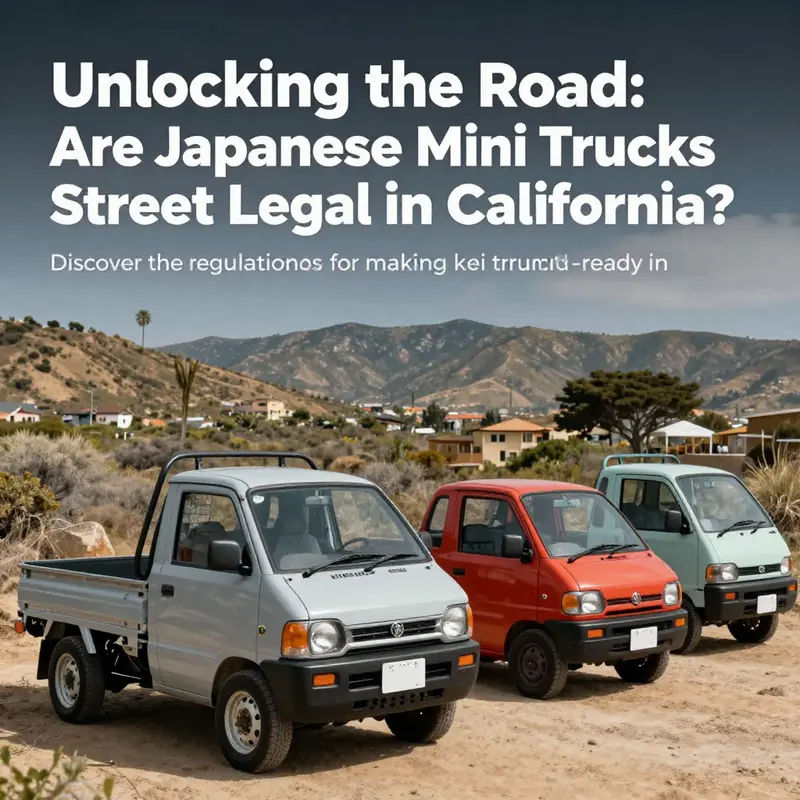
Japanese mini trucks, also known as kei trucks, have gained popularity among local small business owners, residential property owners, and enthusiasts. However, understanding their legality on California streets can be a complex process. This guide walks you through emissions compliance, safety standards, the importation process, and the challenges that come with registering these unique vehicles in the Golden State. Each chapter equips you with the knowledge to navigate the intricacies of kei truck ownership, making your journey both informed and enjoyable.
Emissions Gateways and the Price of Street Legality: The California Challenge for Japanese Mini Trucks
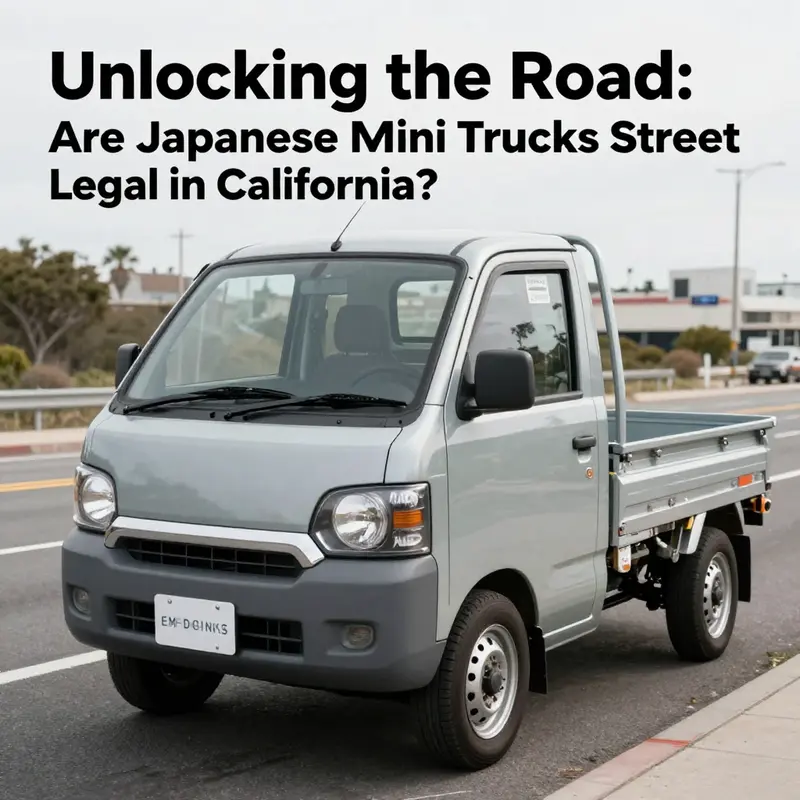
When people imagine the small, practical workhorses known as Japanese mini trucks, the first image is often not of California highways but of tight alleys, farm lanes, and the kind of dusty job site where a compact footprint offers real utility. Yet translating that utility into street legality on California roads turns out to be less about clever modifications and more about navigating a strict, multi-layered regulatory landscape. This chapter looks beyond the charm of these diminutive workhorses to lay out why, in California, where emissions rules are among the most exacting in the nation, the dream of daily driving a kei truck meets a stubborn reality. The core of the matter is straightforward in principle: California demands that vehicles on public roads meet specific federal safety standards and state emissions limits. The federal side is enforced through the National Highway Traffic Safety Administration, which sets the FMVSS requirements that define what a vehicle must prove in crash performance, occupant protection, lighting, and a host of other safety features. The state side is enforced by the California Air Resources Board, which has crafted some of the most stringent emissions regimes anywhere in the United States. Put simply, a kei truck right off a Japanese assembly line, particularly one built for markets with looser standards and older technology, is unlikely to meet both sets of demands without substantial and often impractical changes. This is not a matter of taste or preference. It is a structural mismatch between two regulatory ecosystems that assume very different things about how a light vehicle should behave in real traffic. The practical upshot is that most kei trucks are not street legal in California in their stock form, and the pathway to compliance is paved with high costs, scarce parts, and regulatory uncertainty. The very question many prospective owners ask—can I import a kei truck and register it for daily driving—usually yields a cautious answer rooted in the realities of enforcement, market access, and the technical hurdles that stand between a Japanese market vehicle and a California street. The friction begins with emissions. California’s CARB framework looks for a level of control that many Kei vehicles were not engineered to provide. In Japan, the regulatory emphasis has traditionally focused on different pollutants, testing cycles, and fuel systems. The result is a vehicle that might run decently enough on alternative fuels or with certain modifications, but without the rigorous catalytic converter configurations, oxygen sensing, and advanced exhaust treatment typical of newer U.S. compliant vehicles, it remains difficult to certify under CARB’s standards. The challenge is not purely computational. It is practical as well: the vehicle’s age tends to sit in a grey zone, where the emissions profile is too rough to pass a modern test and too old to qualify for some of the easier exemptions that exist for truly historic or show purposes. The regulatory framework does not simply permit a blanket exemption for imports that trace back to a different regulatory culture. The state’s attitude toward emissions testing is precise and unforgiving: a vehicle must demonstrate compliance to current or applicable standards, not a nostalgia-based claim of equivalence to vehicles sold domestically decades ago. In many cases, a kei truck might be deemed nonconforming at the emissions stage before it has even entered the testing bay for safety evaluation. The safety dimension adds another layer. Japan’s market vehicles were not designed to align with U.S. crash testing regimes. FMVSS requirements for structural integrity, occupant protection, seat belts for all occupants, energy-absorbing barriers, crash-worthy dashboards, and meet-in-hand side impact resistance are not optional in California. Kei trucks often arrive without airbags in configurations that the U.S. safety regime views as noncompliant, and features such as crumple zones, reinforced door structures, and standardized lighting regulations may not meet the precise beam patterns and material specifications demanded by U.S. inspectors. Even if a kei truck mechanically operates with relative reliability, fitting it into a framework that can withstand the scrutiny of a DMV inspection, a CARB emissions test, and the potential for ongoing compliance monitoring adds a layer of cost, time, and risk that many prospective owners decide is not worth pursuing for a vehicle intended to be a daily driver. The importation process itself is not a mere paperwork exercise. It requires a formal sequence of steps that connect federal import regulations to state certification. In practice, this means pursuing either a pathway under a historical or show-car exemption, which itself comes with rigid usage restrictions, or enduring a modern certification process that can be prohibitively expensive. The historical or show-car route, while talked about in various forums and informal discussions, is rarely viable for a kei truck expected to perform normal daily tasks. Such exemptions typically limit operation to exhibitions, parades, or private property, not regular highway travel. They are not a substitute for a genuine street-legal conversion that would permit routine use on public roads. The broader takeaway is not a claim about impossibility but about practicality. The reality most people encounter when they begin to research this path is a cost-benefit calculation that tilts heavily toward keeping the vehicle off the open road beyond a limited, nonstandard use case. The pathway to compliance is often more expensive and uncertain than the vehicle’s original appeal would suggest. It is not simply a one-off engineering fix; it is a sustained program of compliance that touches the engine management system, exhaust aftertreatment, fuel delivery, ignition, and the vehicle’s entire electrical architecture, all guided by regulatory inspectors who demand precise conformity to current standards. For those who still pursue the dream of a street-legal kei truck, the landscape requires careful planning, a robust budget, and an openness to the possibility that the vehicle may never become a practical daily driver. The process commonly involves multiple stakeholders: a licensed importer who understands California’s rules, an emissions testing facility familiar with CARB expectations, and a DMV clerk who can translate a stack of compliance certificates into a registration that won’t be subject to a surprise stop by law enforcement or a roadside inspection. Some applicants discover that the most realistic path involves treating the kei truck as a collector or show vehicle, or as a utility vehicle used primarily on private property or restricted demonstrations. In such cases, the emphasis shifts away from roaming county roads and toward controlled environments where registration restrictions align with the vehicle’s actual use. Even when a path exists that might bring a kei truck closer to legality, it remains a high-cost, high-uncertainty undertaking. The scarcity of replacement parts, the need for specialized labor to adapt safety systems and emissions components, and the potential for ongoing compliance updates create a persistent risk of a vehicle that becomes technically road-legal only in a narrow sense or for a limited period before further modifications or tests are required. The broader context helps illuminate why the California regulatory environment is particularly challenging for kei trucks. California does not ban imports by default, but it does demand a level of conformity that is widely debated among enthusiasts, importers, and regulators alike. The tension between a state that prizes clean air and a federal system that values standardization across a vast and diverse market produces outcomes that feel contradictory to those who love the practicality and nimbleness of kei trucks. The conversation is not just about technical feasibility; it is about tradeoffs between the appeal of a small, efficient utility vehicle and the realities of a regulatory regime that prioritizes uniform safety and environmental performance on public roads. For readers who want a grounded sense of the current state of play, a careful consult of official sources is essential. The California Air Resources Board’s materials outline the standards, testing protocols, and exemptions in explicit terms, and the statutes governing vehicle import and registration are accessible through the California DMV. The upshot, across regulatory guidance and real-world practice, is that as enticing as the kei truck concept is in a compact, cost-conscious, and highly usable form, most of these vehicles, in their stock configuration and in the current regulatory climate, are not street legal for routine daily use in California. The dream belongs more to collectors, hobbyists, and those who want a novelty on private property or at limited, controlled events than to the average driver seeking a practical, compliant, year-round road vehicle. Those who approach the subject with eyes wide open will see a landscape where emissions and safety comply with a complex set of requirements, and where the path to everyday road use is long, uncertain, and expensive. The broader lesson is that the popularity of kei trucks in other markets should not be mistaken for a ready-made solution for California roads. If you are exploring this option, it pays to map out not only the engineering work but the regulatory milestones, the cost of compliance, and the practical limitations that will shape how, or whether, a kei truck becomes part of your daily life. For those seeking ongoing discussion and more practical context—on topics that extend beyond the regulatory frame—this blog space offers a broader look at how these small workhorses are discussed, modified, and understood in the wider community. See the blog for more context on the broader world of light, utilitarian imports and the varying approaches enthusiasts take to maximize utility while staying within legal boundaries: minitrucksocala.com/blog/. Finally, for a definitive reference on standards and enforcement, consult the official California Air Resources Board website and related materials. External resource: https://www.arb.ca.gov
Safe on California Roads: Navigating Safety Standards for Japanese Kei Trucks
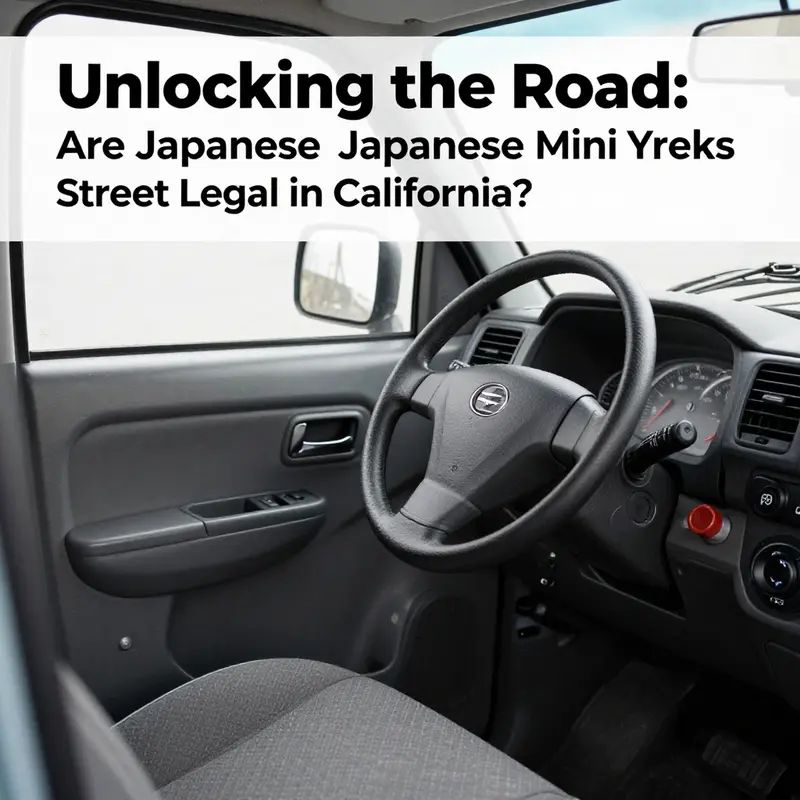
Japanese kei trucks, with their stubby noses and boxy cargo bays, have carved out a niche in urban deliveries, rural farming, and weekend utility runs. Their compact size and efficiency appeal to Californians who want capable workhorses without the bulk of full-size pickups. Yet the path to street legality in California is not simply a matter of desire. It hinges on aligning with federal safety expectations and state emissions rules that were designed for different decades and different vehicle classes. This chapter threads through that regulatory landscape, explaining what it takes to move a kei truck from a factory in another country to a registered vehicle on California roads. The goal is not just to describe rules, but to illuminate how those rules shape practical decisions about import, modification, and daily use. When the smoke of novelty clears, what remains is a sober portrait of the cost, complexity, and careful planning required to keep a kei truck road-legal in a state famous for its meticulous standards and strict enforcement. For readers seeking a compact, work-ready vehicle, understanding this framework helps separate aspiration from feasible reality.
At the heart of legality in California is the intersection between the Federal Motor Vehicle Safety Standards (FMVSS) and the California Air Resources Board’s emissions rules (CARB). The FMVSS set minimum safety responsibilities for every vehicle sold in the United States, while CARB enforces emissions thresholds and testing requirements that can be more stringent than federal standards. A kei truck must clear both hurdles, not merely resemble a safe vehicle in its country of origin. The challenge is twofold: first, the vehicle must be considered to meet the applicable FMVSS through direct conformity, adaptation, or an accepted equivalence. Second, the vehicle must prove its emissions are within California’s limits or show a compliant path approved by CARB. In practice, that means a careful audit of how the truck was built, how it will be operated, and whether there is a credible plan to reconcile foreign design with U.S. expectations. The process places a premium on documentation, precise tailoring of parts, and a willingness to engage with specialists who can interpret both sets of rules with confidence. It is not a casual purchase decision; it is a regulatory project with real financial and logistical implications.
A decisive practical barrier is age. California adheres to a 25-year rule that determines how importers and owners can approach vehicles from overseas. As of January 2026, kei trucks built in 2001 or earlier qualify for many regulatory pathways simply by virtue of age. In theory, that ages the vehicle beyond the standard conformity regime, but it does not erase the requirements. A vehicle this old may still face documentation hurdles and may be restricted to certain uses if it relies on an older emissions profile. The historic vehicle or show-car designations exist as routes around the most onerous daily-use requirements, but those routes come with a caveat: operating on public roads may be limited to parades, exhibitions, or private property under many programs. The distinction matters because it reframes the decision from a straightforward registration to a nuanced assessment of how the vehicle will be used, for how long, and under what conditions. The outcome often hinges on a careful balance between historical value and practical mobility.
Safety considerations stretch beyond nostalgia for a vehicle that once served efficiently in another country. There are concrete, testable features that California inspectors scrutinize. Even if a kei truck was built to meet stringent safety norms in Japan, the U.S. market expects certain crashworthiness provisions, side impact protection, and lighting standards that reflect modern design philosophy. Japan’s regulatory system has shifted toward UNECE-type safety practices in recent decades, aligning with international practice in many respects. Yet this alignment does not automatically translate into FMVSS compliance. Lighting configurations, such as headlamps and signaling, can be wired differently or use assemblies that do not meet U.S. expectations. Seat belt arrangements and anchor points may not align with FMVSS specifications, and the absence of typical safety features—airbags, crumple zones, and advanced restraint systems in many compact imports—creates significant hurdles for universal acceptance without modification. The result is a careful calculation about whether a vehicle can be upgraded to U.S. standards without erasing its identity and utility.
Emissions are the other non-negotiable gatekeeper. CARB programs require workable certification pathways, emissions testing, and, in some cases, a demonstration that the vehicle’s control systems operate within permissible limits. The reality for most kei trucks is that their original engines, designed under older Japanese standards, produce exhaust profiles judged too rich or too dirty by California’s air rules. Importers sometimes seek a CARB Executive Order (EO) for specific models indicating certification or exemption from stringent emissions requirements, but obtaining an EO is neither guaranteed nor quick. The result is that many of these vehicles must undergo costly retrofits or be shielded behind registration categories that limit daily use. For enthusiasts who intend off-grid work or weekend trips, this nuance matters: the vehicle may be street-legal in a narrow, carefully defined sense without serving as a practical daily driver on congested state highways.
From the procedural side, the importation journey is formal and exacting. It starts with a precise verification of FMVSS applicability to the specific vehicle in question. Some kei trucks may be eligible for import under exemptions, while others require substantial modification to meet safety standards. If the vehicle qualifies by model year, the importer or owner proceeds to obtain a CARB EO number—a formal acknowledgment that the vehicle or its modifications meet applicable emissions requirements. The final stage typically involves a DMV inspection, where roadworthiness, identification, and documentation are checked before any registration is issued. Even when a vehicle checks the regulatory boxes, it may require adjustments to lighting, mirrors, horn sets, or other safety-critical features to satisfy a DMV examiner. In many cases, the path requires professional assistance from a licensed importer or a specialist who can navigate both CARB’s procedures and the DMV’s inspections. That help adds cost, but it often improves the odds of a successful registration.
Consider a hypothetical kei truck that reaches the 25-year milestone. It might be technically eligible for a pathway recognizing its historic value, allowing street use under strict limitations. However, the same vehicle must still meet or be exempt from FMVSS requirements and would likely require emissions-management updates based on how the state views the exhaust system and fuel delivery architecture. If the vehicle lacks essential safety features by U.S. standards, retrofits to seat belts, dash instrumentation, and the like could be necessary. Even when all boxes are checked, it could be restricted to non-commercial use or limited daily operation. This layered reality helps explain why kei trucks in the U.S. attract hobbyists and small-business operators alike, but are not typically chosen as primary daily drivers in California. The sense of practical possibility is tempered by a sober appraisal of cost, risk, and ongoing compliance obligations.
Against this backdrop, the practical takeaway is clear. The rarity and cost of compliance mean that most kei trucks do not present a straightforward path to regular, day-to-day street legality in California. The most viable routes often involve accepting restricted usage under historic or show-car status, or pursuing a vehicle designed and certified for U.S. roads. Even these options come with caveats worth understanding before a purchase, lease, or import decision. Some readers find clarity in recognizing the structured process that governs road-legal status. Those who want to explore further might consult dedicated resources or official guidance to avoid missteps that could lead to penalties or stranded vehicles. For readers seeking practical perspectives from the community, the Minitrucks CA blog offers a repository of insights and case studies that illuminate decision-making for importing and registering these vehicles. This resource helps frame the regulatory realities described here in a way that translates to both hobbyist interest and professional due diligence.
Ultimately, the question of street legality for Japanese mini trucks in California rests on a nuanced landscape where desire meets regulation. The 25-year rule provides a potential entry point, but the ongoing weight of emissions and safety expectations keeps the door partially closed for most vehicles. The result is a world where owning a kei truck can be enjoyable without guaranteeing smooth passage into everyday use. The prudent path blends research, professional guidance, and a clear-eyed understanding of California law. With that foundation, buyers and owners can pursue a route that respects the spirit of the kei-truck concept while acknowledging the rules that govern the state’s roadways. If you want to deepen your understanding and see how others have navigated this terrain, the internal perspectives and practical tips available on the Minitrucks CA blog can be a helpful compass, serving as a bridge between theory and practice while you weigh whether a kei truck belongs on your California driveway or your next weekend adventure.
External reference: California DMV – Importing a Vehicle into California. For official guidance, see https://www.dmv.ca.gov/portal/vr/vehicle-import/.
Bringing Kei Trucks to California: Navigating the Import-Registration Path to Street Legality
The journey of a Japanese kei truck from a dock in Yokohama to a sunny California highway is less about a quick title transfer and more about a careful, multi‑layered negotiation between two very different regulatory worlds. On one side sits the precise, sometimes unforgiving framework of California’s emissions and safety standards. On the other, the pragmatic realities of importing a vehicle designed for a very different market, often with older underpinnings and a compact footprint that already makes it appealing for certain tasks. The practical question—are these little trucks street legal in California?—has an answer that can be navigated if you understand the landscape. Importantly, the answer is rarely straightforward, because legality hinges on meeting both federal and state rules, and in California those rules are tightly carved around safety, emissions, and proper documentation. The pathway begins with a recognition that most kei trucks were built to Japan’s roadscape, not the United States’ highways, and that the federal gatekeepers and the California Air Resources Board (CARB) will not grant an open door to direct entry without a careful audit trail. Yet the law does provide an opening: the 25‑year rule. This exemption is the hinge on which many would‑be importers turn. To be eligible for the broadest import admission, a vehicle must be at least 25 model years old. As of January 25, 2026, that means only kei trucks from the 2000 model year or earlier are potentially eligible for the standard exemption. The arithmetic is nuanced, and the practical effect is meaningful: a 2000 model year truck, for example, becomes a candidate for import under the age‑based exemption in the 2020s, while newer models must navigate the full spectrum of federal and state standards or end up in more restricted categories. This isn’t simply a numbers game; it reframes the entire process and quietly redirects many hobbyists toward a different goal—historic or show‑car status—when that status is compatible with how they intend to use the vehicle. The distinction matters in daily life because a show car or historic vehicle generally carries restrictive use provisions. They are designed for exhibitions, parades, private property demonstrations, and limited road usage rather than routine commuting on crowded freeways. The interplay between age, use designation, and cost of compliance is central to any realistic plan for California registration. The story becomes more complicated once age is satisfied, because the 25‑year rule does not erase the bedrock requirement to comply with safety standards and emissions rules that the state enforces. The Federal Motor Vehicle Safety Standards (FMVSS) and California’s emissions regime are not optional add‑ons; they are the backbone of the permitting process. In practical terms, most kei trucks lack certain safety features that are standard in U.S. market vehicles. Side impact protection, modern crumple zones, airbags, mandated lighting, particle and evaporative emission controls—these are not merely bureaucratic hurdles. They represent substantial engineering and component changes that may require significant retrofit work, recalibration, or even replacement of key systems to pass a DMV inspection and CARB certification. This is where the regulatory dialogue becomes a careful balancing act between preserving the vehicle’s character and achieving compliance that will stand up to road use in California. The California DMV does not operate in a vacuum; it works in concert with CARB and other federal agencies. The import process is procedural and documentary at its core. It begins in earnest with a clear set of paper trails: you must present an original Japanese title and proof of ownership, along with shipping documents such as a bill of lading. These documents establish ownership and lineage, and they are the opening gate in the DMV’s inspection process. It is not enough to simply claim, “This is an old kei truck, and we think it should be allowed.” The DMV will verify the vehicle’s history, ensure that it is properly titled, and determine whether the vehicle’s age brings it under the 25‑year exemption or whether it must meet the more stringent standard set that governs newer imports. A licensed Customs broker often becomes a practical necessity in this arena. The broker helps navigate U.S. customs, import approvals, and the detailed paperwork that accompanies crossing an ocean with a vehicle that might not fit into standard tariff classifications. Their role extends to ensuring that the vehicle meets import compliance standards, coordinating with the DMV for the required inspection, and guiding the applicant through the documentation chain that culminates in registration. Yet even with the title, proof of ownership, and a broker’s expertise, the California DMV’s gatekeeping is not complete without a separate, mandatory emissions screening. CARB’s rigorous scrutiny of emissions profiles means that, for older imports not covered by the 25‑year rule, the vehicle may have to undergo modifications to meet California’s standards. The road to compliance often entails a careful assessment of the vehicle’s engine, exhaust system, evaporative controls, and fueling system. The objective is to demonstrate that the vehicle’s emissions output aligns with what California expects from on‑road vehicles. In many situations, the practical choice many importers face is to align with the age exemption and pursue the historic or show‑car designation, which brings its own set of usage limitations. In that lane, the vehicle’s function becomes a matter of timing and context: it can be driven on public roads, but not as a daily commuter on the freeway at peak hours. This path can be attractive for a farmer’s market delivery route, a workshop utility vehicle, or a light‑duty farm chore vehicle, where constant high‑mileage use is not the primary objective. However, the cost calculus still matters. Compliance costs—modifications, parts procurement, testing, inspections, and potential retrofits—often rival the initial purchase price. The balance between preserving the vehicle’s Japanese character and achieving legal street use can tilt toward leaving the kei truck in a less regulated status or choosing a different import strategy altogether. The practical takeaway for anyone considering this route is to begin with the state’s official guidance and to build a plan around it. The California DMV’s vehicle imports page is a crucial starting point, and engaging with it early helps clarify which path is feasible for a particular truck and a given set of circumstances. For readers who want to explore how this looks in practice, the DMV site provides step‑by‑step information, forms, and contact points that are essential when mapping out the journey from shipper to street. This is not a path to a quick, casual register; it is a careful, documented process that rewards patience and thorough preparation. A careful prospective importer also benefits from talking with licensed importers who specialize in classic or imported vehicles. Their experience can illuminate the practicalities of inspection schedules, the kinds of modifications that have historically allowed vehicles to pass, and the often subtle differences in how local BAR or DMV inspectors view a kei truck’s compliance. It should be noted that even after a vehicle clears all regulatory hurdles, ongoing compliance remains a factor. Routine vehicle inspections, periodic emissions testing, and adherence to vehicle use restrictions all play into whether a kei truck can be maintained as a street‑legal asset rather than relegated to private property or limited‑use status. The landscape is not unalterable. Innovations in retrofitting and after‑market support mean that older trucks can sometimes be brought into line with modern expectations without sacrificing too much of their character. Yet the effort must be measured against the vehicle’s intended use, the owner’s budget, and the realistic likelihood of keeping the vehicle in a compliant state for years to come. For those who want a clear, formal starting point, consult the official DMV guidance on vehicle imports and the related regulatory bodies. This not only anchors decisions in current law but also helps prevent missteps that can prove expensive or time consuming. If you want a concise overview as you begin this process, theCalifornia DMV’s vehicle imports resource is a reliable anchor. See the official page here: California DMV Vehicle Imports. It serves as the practical filing cabinet for the steps described above, from the earliest paperwork to the final plate. In the larger arc of the topic, the importation pathway for kei trucks in California is a reminder that legality often hinges on nuance—the difference between a vehicle that can be cherished as a small, efficient workhorse and one that can truly roam the public roads on a regular basis. If a reader’s goal is daily reliability on crowded urban corridors, the odds favor choosing a vehicle aligned with California’s standards or one that has undergone careful, comprehensive conversion work. If the aim is to capture the charm and utility of a compact Japanese work truck for occasional use—perhaps on rural routes or as part of a hobbyist project—the 25‑year rule paired with a well‑documented, inspection‑ready plan makes a credible path possible. Either way, the process is about clarity, patience, and fidelity to safety and environmental expectations. For those seeking more technical grounding on safety standards and how federal rules apply to imported vehicles, a broader look at FMVSS via official federal resources is beneficial. External resources such as the National Highway Traffic Safety Administration provide a comprehensive overview of federal safety standards and how they apply to all vehicles entering the U.S. market, which can inform decisions during the import process: https://www.nhtsa.gov/fmvss
Steering Through the Compliance Labyrinth: Navigating the Challenges of Making Japanese Kei Trucks Street-Legal in California
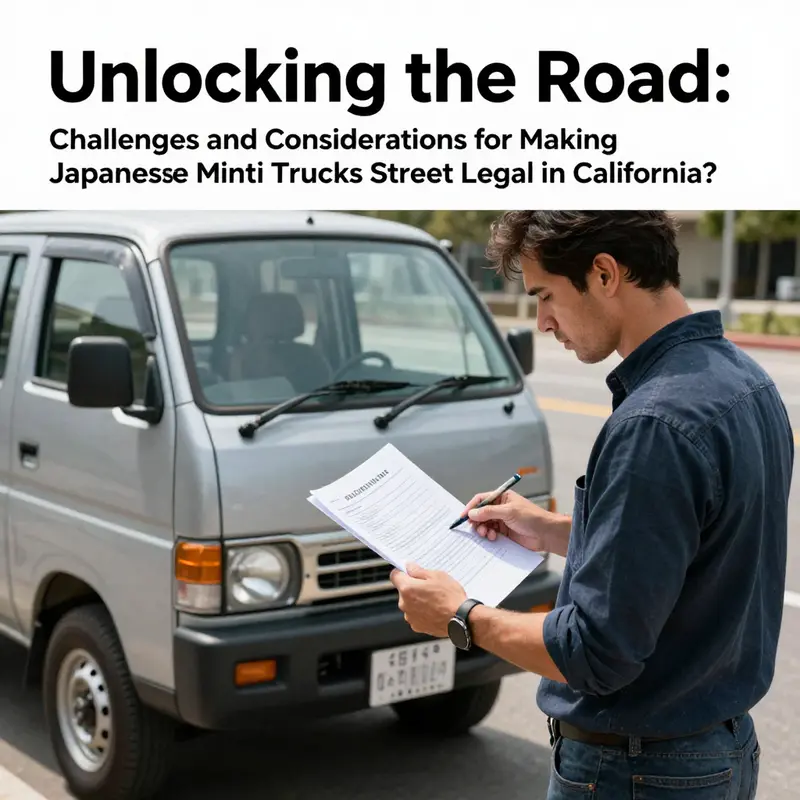
The appeal of Japanese kei trucks in California rests on a simple promise: maneuverability, efficiency, and a footprint that fits crowded urban sites and mountain forestry roads alike. Yet the road to street legality in the state is not a straight path. It runs through the overlapping terrains of federal safety standards, state emissions rules, and the practical realities of importing and registering a vehicle whose design was optimized for very different streets. What looks, at first glance, like a clever solution for narrow streets and tight loading tasks soon reveals itself as a complex negotiation with multiple agencies, each with its own benchmarks for safety, air quality, and roadworthiness. The result is less a quick upgrade and more a series of calculated steps that must align with both federal requirements and California’s exacting regulatory framework. This is not merely a question of whether a kei truck can technically be driven on a public road; it is a question of whether it can satisfy a constellation of standards that are, in practice, difficult to retrofit, particularly for older models that began life well outside today’s baseline expectations for emissions and occupant protection.
A central hurdle concerns safety. Kei cars, as they were originally conceived, prioritize compactness and economy over the sort of comprehensive crash protection now standard in U.S. markets. On U.S. highways—where speeds are higher and heavier vehicles dominate—crash dynamics change, and so do the protective expectations for occupants. In California, the regulatory posture mirrors this reality. Vehicles sold for use on U.S. roads must meet the Federal Motor Vehicle Safety Standards (FMVSS). Many kei trucks lack the modern airbag systems, advanced crumple zones, and electronic stability control that regulatory language now presumes, and while some older imports can technically be grandfathered in, they frequently require modifications to pass the thorough inspection process that follows any attempt to register them for public roads. The philosophical tension is clear: a machine designed to be extremely light and frugal by design is not automatically compatible with a safety regime that has evolved through decades of safety testing and consumer expectations. This is not just about compliance paperwork; it is about a fundamental redefinition of what “roadworthy” means when the baseline is a vehicle that was never intended to perform within North American collision standards.
The emissions landscape adds another layer of seriousness. California’s Air Resources Board (CARB) enforces some of the strictest emissions rules in the United States. For kei trucks produced before the threshold where modern standards apply, the practical path to registration is constrained. The state’s framework often leaves older models stranded in a gray zone: technically importable, but not easily registerable for regular daily use on public roads. The notion of a blanket exemption, such as a broad “25-year rule,” does not sweep away the more nuanced realities for contemporary or mid-century Japanese designs. For many kei trucks, the off-ramp is the reality that, unless the vehicle qualifies for special status—such as a historic or show car designation—the emissions profile cannot be certified to meet CARB requirements without substantial and costly modifications. The result is a decision point for prospective buyers: accept the potential for a limited, restricted-status vehicle that may be driven only under specific conditions, or pursue a more traditional, and often more expensive, route of compliance that brings the vehicle into a fuller, California-friendly status on the road.
The practical implications extend beyond the technical. The process of importing and registering a kei truck is seldom instantaneous or inexpensive. It typically involves obtaining a certification pathway, undergoing emissions testing, and, in some cases, installing modifications to align with FMVSS expectations. In California, the Department of Motor Vehicles (DMV) and CARB coordinate to confirm whether a vehicle can be registered, under what category, and what kind of inspections will be required at the point of registration. The bureaucratic choreography can be lengthy and expensive, especially when retrofits or device substitutions are necessary to meet the safety and emissions criteria. Even if a kei truck arrives in the state with an impressively low price tag or a beguiling sense of thrift, the total cost of bringing it into compliance can quickly eclipse initial expectations. It is also worth noting that parts availability can become a stubborn constraint. As vehicles get older or rarer in the U.S. market, compatible replacement components and safety-system upgrades may require bespoke sourcing or custom fabrication, which adds time and risk to the import-and-register equation.
A further dimension in the California equation is the configuration of the vehicle itself. Japanese kei vehicles often employ a right-hand-drive layout, a feature that creates practical friction in a left-hand-drive country. In daily driving, the difference in visibility, lane positioning, and merging dynamics can be subtle yet persistent. While many owners learn to adapt, the long-term considerations cannot be dismissed. Public road use in California implies a suite of expectations about driver behavior, vehicle geometry, and the visibility canvas presented by the vehicle. Even when a kei truck achieves an approved status, it becomes a vehicle with a distinct operating profile—one that requires careful attention to the limitations of its design in high-speed traffic, long-distance travel, and the demands of a highway network where faster vehicles and larger mass predominate.
The broader ecosystem around this challenge is not purely adversarial. There is a growing community of enthusiasts and a chorus of advocates who argue for regulatory reform that would allow urban-focused, low-speed, low-emissions use of kei vehicles in constrained corridors where they can’t meaningfully compete with normal-density cars for long commutes. The argument often centers on the potential for reduced fuel use, lower parking demand, and a smaller urban footprint. Yet any reform would still have to reckon with the safety and emissions thresholds that California now enshrines as non-negotiable. It is unlikely that a sweeping loosening of standards would occur without targeted safety enhancements, testing protocols, and perhaps a tiered approach that distinguishes between urban-use scenarios and higher-speed, high-mileage operation. For now, the status quo remains a disciplined regime: import, verify, test, and, where possible, qualify under exemptions that are tightly circumscribed and carefully monitored by the regulatory bodies.
In this environment of careful calibration, the path forward for individuals who dream of bringing a kei truck into California’s public roadway system is best understood as a multidimensional calculation. It starts with an honest assessment of the vehicle’s origin, its emissions pedigree, and the likelihood that any required safety retrofits can be sourced and installed in a cost-effective manner. It continues with a clear-eyed view of the total ownership equation, including inspection fees, potential modifications, insurance considerations, and the logistical timing of compliance. It may also involve a decision to pursue a legal status that permits limited, ceremonial, or show-use only operation, rather than a full daily-driver role. In such cases, the vehicle can still occupy a meaningful space—perhaps on a shared commercial site, a private access road, or a specially designated venue—where the unique charm of a kei truck can be celebrated without compromising the broader safety and regulatory expectations of California’s streets.
This perspective is not about surrendering the dream but about reframing it within a framework that makes sense for California’s roads, its climate goals, and its safety standards. It acknowledges that the state’s regulatory apparatus is designed to protect both motorists and pedestrians while balancing innovation and practicality. It also recognizes that the appeal of kei trucks—their nimbleness, their simplicity, their affordable maintenance—remains compelling for certain users, particularly in urban or semi-urban contexts where space and fuel efficiency deliver real value. By engaging with the process with a long-range view, the curious buyer or small-business operator can navigate toward a compliant, if carefully managed, outcome that respects both the letter and the spirit of California’s road-safety and environmental stewardship mandates. For readers seeking practical, up-to-date guidance as regulations evolve, the community-driven resources associated with the kei-truck niche can offer shared experiences and lessons learned along the way. See the Minitrucks Cali Blog for ongoing discussions and practical notes from enthusiasts who have walked parts of this path. Minitrucks Cali Blog
If readers want to anchor their plans in official, current requirements, they should also consult the state’s formal guidance. The California DMV and CARB websites outline the importation process, testing expectations, and the possible pathways for registration, special use, or historic-status designation. The nuance of these pathways is best understood through careful reading of the official materials and, when possible, direct consultation with a licensed importer experienced in classic or imported vehicles. This is not a journey for the impatient. It is a sequence of checkpoints that, when addressed with diligence, can yield a vehicle that is legal to operate on California’s roads without compromising safety or air-quality standards. For readers who want to explore further with authoritative detail, the California DMV’s vehicle imports section provides essential context and procedural clarity. For official details, see the California DMV’s vehicle imports page: https://dmv.ca.gov/portal/vr/vehicle-imports/.
Decoding California’s Road Rules for Japanese Kei Trucks
In California, bringing a Japanese kei truck onto public roads is a careful balancing act between emissions rules and safety standards. CARB’s emission limits apply to the tailpipe, and many kei trucks built for Japan were not certified to California standards, so registration often requires exemptions or historic or show vehicle status with accompanying usage restrictions. The federal safety framework from NHTSA, via FMVSS, can also pose hurdles because older kei trucks may lack modern safety features expected in the US market. The import and registration process typically involves coordination between the DMV and CARB, possible certificates of conformity or alternative pathways, emissions testing, and sometimes vehicle modifications. The practical reality is that while a street legal kei truck is technically possible under certain conditions, the path is lengthy, expensive, and variable by model. Many owners opt for restricted use paths such as historic or show vehicle registrations, which limit daily driving but permit some public-road access. Prospective buyers should work with licensed importers or regulatory consultants who understand both federal and state requirements and should plan for inspections, potential modifications, and a potentially extended timeline. Official guidance from the DOT on vehicle imports, and CARB and DMV resources, provide baseline directions, along with community forums for shared experiences.
Final thoughts
Understanding the complex landscape of Japanese mini truck legality in California is pivotal for enthusiasts and business owners alike. By adhering to emissions compliance and safety standards while navigating the importation process, you can enjoy the unique charm of kei trucks on the open roads. Whether you’re aiming to make your vehicle street-legal or exploring limited-use options, arm yourself with the right knowledge and resources to enhance your experience.