
In the beautiful state of California, mini trucks are making a mark, particularly among small business owners, residential property owners, and enthusiasts. As these compact utility vehicles gain popularity for their versatility, it’s essential to understand the legal landscape surrounding them. Whether you’re considering a purchase, eager to show off your vehicle at local events, or utilizing it for business needs, knowing the laws governing mini trucks can provide peace of mind. Our exploration will break down the vital aspects, including legal requirements, safety standards, emissions regulations, registration procedures, and the impact of modifications. You’ll come away with a comprehensive understanding of how to keep your mini truck within California’s laws while enjoying all the benefits these vehicles have to offer.
Small, Street-Ready: Demystifying Mini Truck Legal Requirements in California
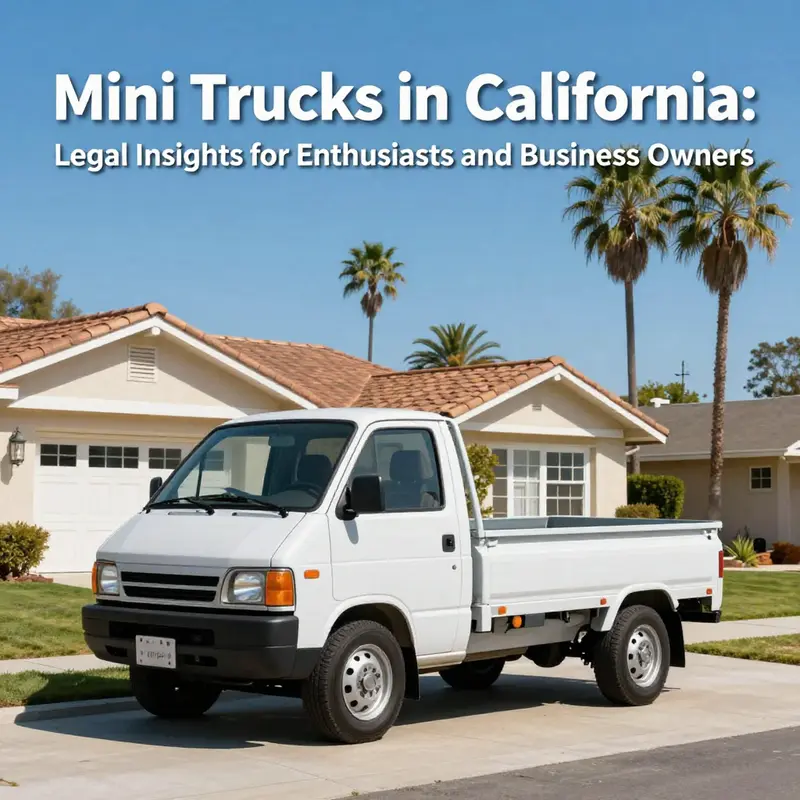
California has long treated small, workhorse vehicles with a blend of practicality and caution. For would‑be owners of compact trucks designed to slip through tight confines and haul tools around a job site, the path to lawful street use is narrower than the bed of a pickup, but it is not blocked. In California, a mini truck can be street legal if it earns the right classifications and meets a checklist that spans federal safety standards and state emissions rules. The most common route is through the low speed vehicle category, a niche that has its own set of expectations and limitations. This chapter unpacks what that means in practice for daily drivers, contractors, and hobbyists who value efficiency without sacrificing reliability. At the heart of the matter is a careful alignment of federal and state requirements, because vehicles that do not clear both sets of regulations can drift into a legal gray area where road use becomes risky or outright unlawful. The journey from garage concept to public road readiness begins with clear definitions and ends with a simple, sometimes painstaking, verification that the vehicle you intend to operate truly belongs in the lane you plan to share with cars and trucks of all sizes.
Classification and speed are the first facts a prospective owner must accept. In the federal framework, certain mini trucks qualify as low speed vehicles, or LSVs, which are designed to operate at modest speeds and on roads with speed limits they can safely navigate. The cap is a top speed in the neighborhood of 25 miles per hour, a constraint that reflects the vehicle’s purpose and its intended environment. This speed limitation is not merely ceremonial; it interacts with California’s own expectations about what kinds of vehicles can share the road with standard automobiles, trucks, and buses. If a mini truck is to be treated as an LSV, it must meet that speed criterion consistently and be marketed and inspected as a vehicle designed for low speed operation. Those who imagine using an ultra‑compact truck on busy arterial streets or highways can quickly learn that the LSV route is not the right path for everything, and that other classifications or separate vehicle designs will be necessary to achieve broader reach. The reality is that a more robust vehicle, with higher performance and stricter certification requirements, may be the only path to full public road access in some California settings, while the LSV route remains ideal for neighborhoods, campus campuses, and certain 35 mph or slower corridors.
Safety features anchor the LSV requirement, and California’s expectations match federal intent. To qualify as an LSV, the vehicle must carry a standard set of safety equipment that keeps companionship with other road users practical and predictable. Seat belts are nonnegotiable, providing protection in the event of sudden stops or minor collisions. Headlights, brake lights, and turn signals are essential for visibility and communication with other drivers, while windshield wipers ensure a clear view in bad weather. A horn is a basic cue that helps signal intent when space is tight, and the presence of a functioning horn reinforces the idea that this vehicle is a road participant rather than a private‑property curiosity. These features are not decorative extras; they are the minimum that helps ensure the mini truck behaves like a legitimate member of the roadway community. When any of these elements is missing or fails, the vehicle’s classification can shift, exposing the operator to higher risk and altering the legality of its road status. The emphasis on safety features is not about imposing a uniform standard for a novelty vehicle, but about safeguarding all road users through predictable, verifiable performance.
Registration and title carry the most concrete steps toward legal operation. California requires that these vehicles be registered with the Department of Motor Vehicles (DMV) and that the title and license plates be issued in the name of the owner. The process typically begins with proving that the mini truck meets the LSV criteria and that it maintains the safety and performance characteristics required by both federal and state law. Documentation often includes proof of compliance with the LSV classification, the vehicle’s identity, and evidence that it meets emissions and safety standards that California imposes for street use. As with any vehicle, the driver must hold a valid driver’s license. The DMV’s handling of LSV registrations is designed to reduce ambiguity on public roads and to ensure that the vehicle’s recorded pedigree aligns with its actual capabilities and limitations. The practical upshot is straightforward: without the DMV title, proper registration, and visible license plates, the vehicle cannot lawfully participate in traffic in California.
The road use limitations that accompany LSVs are specific and meaningful. LSVs are permitted on roads where the posted speed limit is 35 mph or less, a constraint that aligns with the vehicle’s performance envelope and its intended use in campus districts, residential corridors, and light commercial zones. They are generally prohibited from highways and major arterials, where higher speeds and heavier traffic create conditions that exceed the LSV’s design and safety margins. Local jurisdictions sometimes exercise additional flexibility or impose additional restrictions, and it is not unusual for homeowners associations, business districts, or city corridors to adopt rules that further govern where and when these vehicles may operate. The reader should recognize that the legal allowances for road use are not universal across California; they are subject to local interpretation and enforcement. A vehicle that is legally registered as an LSV on a quiet street might face different rules if it is seen attempting to merge into a busier, higher‑speed environment.
Manufacturers certify their models for LSV status, but that certification does not end a buyer’s responsibility. The owner must verify that the specific model is certified as an LSV by the manufacturer and that all necessary documentation is in order. This step helps prevent a situation where a vehicle is claimed to be an LSV but is not supported by the necessary paperwork or by a model that the seller cannot substantiate as meeting FMVSS 500 and California’s requirements. The importance of documentation cannot be overstated; misclassification can lead to the vehicle being deemed illegal for public road use, resulting in fines, out‑of‑state registration complications, or vehicle impoundment in enforcement scenarios. Modifications to a mini truck—such as altering its frame, engine, or body—can have a chilling effect on its legal status. If any change pushes a vehicle away from the LSV compliance envelope or otherwise violates safety or emissions standards, the owner may lose the LSV designation and the corresponding road allowances. This is a cautionary note: a seemingly minor alteration can transform a road‑legal asset into a highly regulated, noncompliant machine that cannot legally circulate on public streets.
For readers seeking a practical lens on this topic, consider following ongoing coverage and perspectives in dedicated mini truck discussions and community updates. The Minitrucks California Blog provides a space where enthusiasts and potential buyers discuss real‑world experiences, share checklists, and interpret evolving policies in a way that complements official sources. It is not a substitute for regulatory clarity, but it can illuminate how rules play out in day‑to‑day decisions and help gauge what to ask a dealer or a DMV examiner when you are evaluating a particular vehicle. To explore that broader conversation, you can visit the Minitrucks California Blog. Minitrucks California Blog
As with any vehicle choice, the path to legality in California for a mini truck hinges on due diligence. Prospective buyers should engage in careful verification before purchasing or operating such a vehicle on public roads. In addition to confirming the LSV status, buyers should gather, store, and organize all related documentation so that the vehicle can pass inspection, registration, and any local compliance checks without delay. The process is not opaque, but it is precise. The DMV and the federal safety standards aim to maintain a predictable standard for what qualifies as a road‑worthy micro‑truck, and that standard favors devices that can operate with a familiar and repeatable level of safety. If the vehicle fails to meet any of these lines—top speed, missing safety equipment, lack of proper documentation, or unclear emissions compliance—the path to street legality becomes uncertain and the option may be limited to private property use or very controlled corridors.
For readers who want a definitive, official baseline beyond the narrative, the California DMV provides a dedicated resource on Low Speed Vehicles that outlines the criteria, registration steps, and road use limitations. This page is the authoritative reference for the statutory framework and the practical steps a potential owner should take before moving forward with a purchase or a registration application. Official guidance is essential when evaluating a specific vehicle’s eligibility and when navigating local variations in road use permissions. You can access the DMV resource for Low Speed Vehicles to complement the context provided here and to confirm any jurisdictional nuances that could affect your plans. Official details and updates are available at the California DMV site on Low Speed Vehicles.
External resource: For official details, see the California DMV page on Low Speed Vehicles at https://www.dmv.ca.gov/portal/vehicle-information/low-speed-vehicles/.
California Mini Truck Roadworthiness and Registration
In California, a mini truck may be on public roads only if it meets federal safety standards (FMVSS) and state emissions and registration requirements. Federal safety standards establish the baseline for braking, lighting, occupant protection, and crashworthiness, while California adds state-specific emissions criteria and vehicle-class considerations that affect highway eligibility. The DMV handles title, registration, and inspections, and CARB enforces California emissions limits. Vehicles marketed as off-road or low-speed may face restricted highway use unless properly certified for on-road operation. Changes to a vehicle’s frame, powertrain, exhaust, or safety systems can trigger re-certification or reinspection requirements. Prospective buyers should verify highway certification with the DMV and consult official guidance for the latest rules. Official information is available on the California DMV website.
Zero-Emission Roadmap: The Legal Landscape for California Mini Trucks
California’s embrace of ambitious emissions targets does not hinge on the size of a vehicle so much as its impact on air quality and climate. When it comes to mini trucks, the state treats them like other light-duty vehicles in most regulatory respects. There is no distinct emission standard labeled specifically for “mini trucks.” Instead, these small workhorses fall into California’s light-duty category, where the rules are written around weight class and intended use, and where the path to legality on public roads is defined by compliance with CARB’s standards and the DMV’s registration requirements. Understanding this framework helps clarify what is required to keep a mini truck legally on California streets today and what the regulatory horizon will demand in the years ahead. For readers looking to place practical context on how small, utilitarian vehicles navigate the regulatory maze, a broader overview is available at the mini truck-focused blog that tracks California policy, market trends, and real-world ownership experiences. The blog serves as a narrative companion to the formal standards, translating regulatory jargon into street-level implications for daily drivers and small businesses alike. The blog is available at minitrucksocala.com/blog/. \n\nAt the core of California’s approach is a division by weight category and vehicle use rather than by the vehicle’s size. The Advanced Clean Cars II (ACC II) program sits at the heart of how light-duty vehicles, including mini trucks, are regulated as California moves toward a zero-emission fleet. ACC II expands upon earlier rules by setting a clear trajectory for the future: by 2035, all new light-duty vehicles sold in the state, including passenger cars and light trucks, must be zero-emission. This is not delivered as a footnote for the future; it is the governing target that shapes how manufacturers design, certify, and market new micro-trucks and similar light-duty platforms in California. The practical effect is that any consumer or business looking to purchase a new mini truck in California faces an expectation that the model they choose will be zero-emission if it is part of the state’s new-vehicle market in the 2035 window. The ACC II framework is designed to drive rapid adoption of electric and hydrogen-powered propulsion, while maintaining a path for technology improvement and cost reduction through milestones and compliance pathways. In effect, the policy signals that the days of large, all-ICE mini trucks being introduced as new models may be drawing toward an end, at least for vehicles newly sold within California’s borders. The emphasis, however, is on technologies that meet the state’s stringent emissions profile, and on ensuring these technologies are scalable across the light-duty segment, which includes micro-trucks and compact utility vehicles that serve much of the same work needs as traditional small pickups. \n\nThe regulatory narrative around ACC II is complemented by a broader decarbonization framework. The Low Carbon Fuel Standard (LCFS) influences the overall lifecycle emissions of all vehicles, including mini trucks, by encouraging fuels with a lower carbon footprint. While LCFS does not directly mandate tailpipe emissions, it rewards cleaner energy sources and fuels, guiding market choices toward electricity, hydrogen, and other low-emission options. In a practical sense, this means that a mini truck powered by electricity or hydrogen not only complies with the zero-emission trajectory but also benefits from a policy environment that recognizes its lower carbon footprint at the fueling or charging stage. The LCFS thus acts as an indirect accelerant for the adoption of zero-emission mini trucks, helping to reduce total cost of ownership over the vehicle’s life and enhancing the appeal of electric micro-trucks to fleet operators and private buyers alike. \n\nOn the regulatory margins, the Omnibus Rule and related heavy-vehicle standards show where California draws lines between different vehicle classes. The Omnibus Rule targets heavy-duty engines and vehicles—those typically weighing more than 14,000 pounds GVWR. Because most mini trucks fall into the light-duty category, they do not automatically fall under the heavy-duty efficiency mandates that govern larger commercial fleets. This distinction matters for buyers who might otherwise worry about how a compact, utility-first vehicle will be regulated if it frequently operates in a mixed-vehicle environment or if a user considers converting or heavily modifying a mini truck. In typical scenarios, the heavy-duty provisions are not the governing constraints for a micro-truck, but the rule set underscores that the state’s environmental policy is nuanced. It separates the different regulatory tracks so that the specific challenges faced by heavy-duty fleets do not automatically cascade onto light-duty and micro-vehicle platforms. This separation helps preserve a path for mini trucks to remain legally operable on public roads while still aligning with the state’s overarching emissions goals. \n\nFor owners and operators, the practical implications of this regulatory architecture are straightforward in principle but intricate in practice. A mini truck sold in California must comply with the ACC II regime, which translates into a direct expectation of zero-emission propulsion for new models as the market moves toward 2035. In the near term, the transition is shaped by intermediate standards, compliance pathways, and manufacturer timelines. This means that buyers of new mini trucks today should anticipate, and plan for, a future where the vehicle they purchase is either already zero-emission or is designed to transition quickly to a zero-emission variant as markets evolve and policy signals crystallize. The policy landscape also makes clear that any modification to a mini truck—such as recasting the drivetrain, altering engines, or altering the vehicle’s fundamental architecture—could destabilize compliance. Before undertaking heavy modifications, owners should verify that the resulting vehicle would still meet safety, emissions, and registration requirements. The DMV and CARB both emphasize that legal operation on public roads depends on continual adherence to the standards that govern vehicle certification and safety features, including lighting, brakes, seat belts, and emissions controls. \n\nThe road to legality is therefore a road toward zero emissions for newly sold light-duty vehicles, including mini trucks, within California’s framework. This is not just a regulatory issue; it is a market signal that reshapes how manufacturers, dealers, fleet operators, and individual buyers approach the purchase and use of mini trucks. It means that even if a particular micro-truck model has long served well as a workhorse in off-road contexts or on private property, bringing it onto public roads in California involves a certification process that verifies compliance with ACC II and related standards. Practically, this can translate into a tiered timeline for model availability, with early adopters of electric micro-trucks already benefiting from the state’s push toward cleaner mobility and potentially enjoying incentives tied to zero-emission fleets. It also means that the consumer should approach ownership with an eye toward future-proofing—ensuring that the chosen vehicle can continue to meet evolving standards as policy tightens, rather than becoming stranded in a regulatory drift. \n\nIn sum, there is no separate “mini truck” emission code in California. The legality of mini trucks hinges on their alignment with light-duty emission standards under ACC II and related frameworks. As California marches toward 2035, all new light-duty vehicles sold in the state, including micro-trucks and small cargo vehicles, are expected to be zero-emission. This trajectory aligns with the state’s broader climate and air quality goals, offering a clear horizon for buyers and a clear mandate for manufacturers. For people who operate mini trucks today, the immediate concerns remain those of standard vehicle compliance—motor vehicle safety systems, proper lighting, brakes, seat belts, and correct emissions controls—tied to ongoing DMV registration and titling. For those aiming to operate on public roads beyond the near term, the emphasis is on transitioning toward zero-emission technology. And for readers wanting a grounded, ongoing narrative about how policy translates into day-to-day realities, the blog linked earlier provides a steady stream of updates, insights, and user experiences that complement the formal regulatory text. minitrucksocala.com/blog/
Registration Roadmap: Navigating California’s Rules for Mini Trucks on Public Roads
California treats mini trucks as a practical blend of compact efficiency and regulatory nuance. These small utility vehicles can legally share public roads, but only if they meet a constellation of safety, emissions, and documentary requirements set by the California Department of Motor Vehicles (DMV) and the California Air Resources Board (CARB). The path to legality is not a single form or a one-time stamp; it is a process that confirms that the machine is built to be driven, not merely stored, and that it can meet the standards that California imposes on any vehicle that travels on its streets and highways. In practice, a mini truck that fits within the typical light-duty category—often defined by a gross vehicle weight rating (GVWR) under 10,000 pounds and designed for on-road use—can be registered and operated legally, provided it clears the same gatekeeping steps that apply to conventional passenger cars and larger light trucks. The numbers themselves are not the whole story, however. A vehicle’s highway eligibility rests on a combination of federal safety compliance, state emissions standards, and the accuracy of its documentation. If any of those elements falter, the vehicle risks being relegated to private property or limited to private-use scenarios. This is where a reader might find themselves in a regulatory gray zone. Some very small, lightly modified, or golf-cart-like configurations fall into areas governed by different rules, particularly low-speed vehicles (LSVs) or golf carts, which have separate pathways to legality and often require operation only on private property or designated low-speed roadways. Those distinctions matter because the purposes behind the rules differ: standard registration is designed for vehicles that can operate safely at typical road speeds, with adequate braking, lighting, and emissions controls, while other classifications reflect limited use or restricted environments. Understanding where a mini truck sits in this spectrum is the first critical step in determining whether it can be driven legally on California streets. In the heart of the registration process lies the vehicle’s title and its proof of ownership. When a mini truck changes hands, the new owner must establish a valid title through the DMV. If the transfer occurs between private parties, the seller provides a signed bill of sale along with the clear title, which forms the backbone of the vehicle’s identity in the DMV system. Imported mini trucks add another layer, requiring additional documentation to prove origin, compliance, and legality under California’s rules. Without a valid title, the road-legal status of the vehicle remains unsettled. Once the title is in order, the next milestone is the smog requirement. California has long maintained a rigorous statewide emissions program. Most vehicles registered in California, dating to model year 1976 or newer, must present a valid smog certificate. The requirement is straightforward in intent: ensure the vehicle meets state air quality goals and does not emit pollutants beyond what California considers acceptable for on-road use. Yet there are important exceptions. Some low-emission or electric mini trucks may be exempt from smog certification, a nuance that reflects the state’s ongoing evolution in emissions policy as technologies shift toward cleaner powertrains. Prospective owners should verify whether their specific configuration falls into an exempt category or if a smog test remains mandatory. Insurance follows title and emissions in the registration chain. California law requires that all registered vehicles carry liability insurance. The proof of insurance must be presented as part of the registration package, signaling to the DMV that the vehicle behind the registration is backed by financial responsibility in the event of a collision. This requirement, while routine for most on-road vehicles, reinforces the practical reality that a mini truck, despite its smaller size, is still a participant in the broader traffic ecosystem and must be able to compensate for injuries or property damage caused in the course of operation. The registration application itself is the formal conduit through which the DMV records the vehicle as a road-going entity. In California, Form REG 34, the Application for Registration, is the document most commonly engaged in this step, submitted at the local DMV office or through the online portal in many cases. The form captures essential details: ownership, the VIN, vehicle type, usage, and the applicant’s information for contact and billing. The fees accompanying the registration are part of the consideration for the DMV’s ongoing oversight of the vehicle’s compliance with state law. After the DMV processes the application, license plates and registration stickers are issued. Displaying these plates and stickers is more than a procedural courtesy; it is a constant visual reminder to law enforcement and other road users that the vehicle has been through the state’s inspection regime and is authorized for public road use. The last set of practicalities involves two perennial concerns: use and modification. For mini trucks that are not manufactured for highway use—such as off-road utility vehicles or agricultural equipment—the path is different. These vehicles may not be eligible for standard road registration and could be relegated to private property or designated off-road areas. People who intend to repurpose or heavily modify a vehicle in ways that affect safety or emissions—changing the frame, converting the engine, or altering the body—should anticipate that such changes may trigger reclassification or reinspection. California’s regulatory framework recognizes that modifications can shift a vehicle from one category to another, with corresponding consequences for registration, licensing, and permissible operation on public roads. In practice, this means cautious planning before purchasing or converting a mini truck for highway use. The state’s approach is not merely about stamping forms; it aims to ensure that every road-going mini truck has a demonstrable history of compliance with safety and environmental standards, and that its documentation accurately reflects its current configuration. For readers seeking a clearer sense of how these pieces fit together in daily life, the upshot is simple enough: a mini truck can be legal on California streets if it can prove, through title and ownership documentation, a valid emissions status, proof of insurance, and a clean bill of health in terms of safety inspections when applicable. The steps are logical, but they require careful attention to detail, especially for those who purchase used or imported vehicles. The DMV’s public resources provide a reliable reference point for the exact forms and requirements, and staying informed helps prevent delays or unexpected hurdles during registration. For readers who want a concise orientation to a broader regional perspective on mini trucks in California, the Minitrucks CA Blog offers a space that compiles practical considerations and real-world experiences in the state’s regulatory environment. Minitrucks CA Blog provides an accessible entry to the kinds of questions owners often ask, including how various configurations fare under California rules and what to expect during the registration journey.
The bottom line remains practical and patient: ensure the vehicle is properly titled, confirm its emissions status, secure insurance, complete the registration application, and prepare for the possibility that some configurations fall outside standard motor vehicle registration. If the mini truck is built with road use in mind and meets applicable federal and state standards, it can participate in California’s traffic system with the same responsibilities as any other on-road vehicle. If, however, the vehicle doesn’t align with these standards, or if it is restricted to off-road or private-property use, it should not be assumed to be road-legal, and alternative uses or configurations should be explored. In all cases, diligence pays off in smoother ownership and greater confidence navigating the state’s regulatory landscape. For those curious about how this work translates into everyday practice, the official and most current guidance can be found through California’s DMV resources, which detail the precise steps, forms, and fees involved in registering any highway-ready vehicle. External reference: California DMV official site. https://www.dmv.ca.gov
Shifting Gears, Shifting Rules: The Legal Impact of Modifying Mini Trucks in California
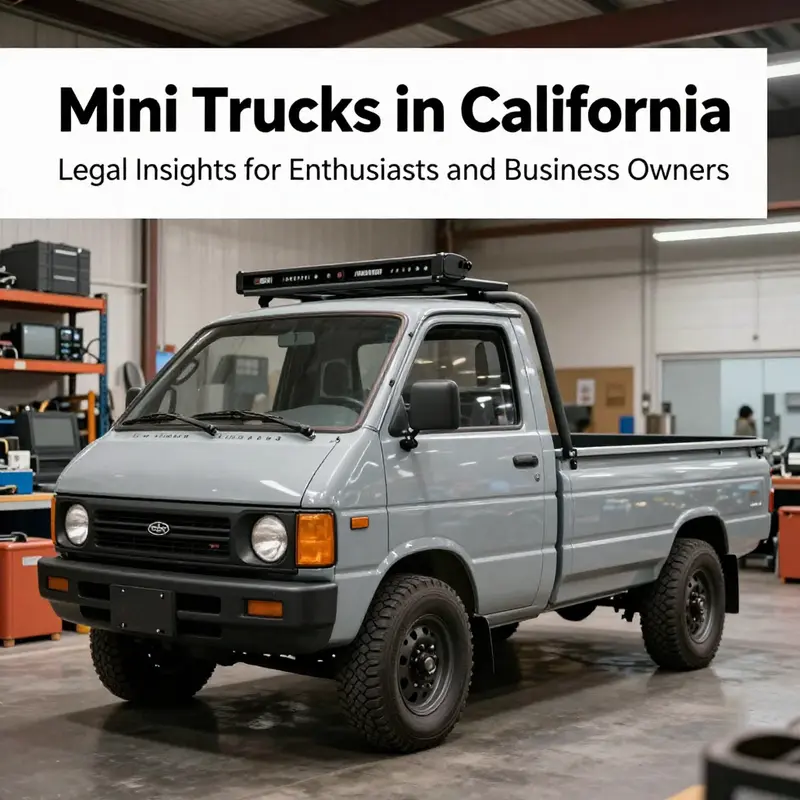
In California, whether a mini truck can use public streets isn’t a simple yes or no. It sits at the intersection of safety standards, emissions rules, and the paperwork that keeps a vehicle properly registered. The state treats these compact vehicles as road legal only when they meet DMV and CARB requirements. The basic path is straightforward: a mini truck that fits within the light duty category—typically with a GVWR under 10,000 lb—can be street legal if it passes inspections, meets safety and emissions controls, and remains properly registered. Yet modifications complicate the picture. Regulators watch for changes that affect safety, emissions, or certification history. Even well intentioned upgrades can alter a vehicle’s legal status. Structural alterations such as changing the frame or chassis can upset baseline safety calculations. Suspension changes that affect handling or braking pose risks to road safety. Wheel and tire changes can influence braking distance, steering, and stability, and may trigger re certification or inspection requirements. The emissions layer adds another dimension. CARB rules are stringent, and engine swaps, exhaust changes, or fuel system modifications require formal approval or certification to remain compliant. Without that approval, the vehicle could fail inspections or lose the right to operate on public roads.
Gray areas arise when vehicles resemble golf carts or low speed vehicles, which are regulated differently. LSVs and golf carts usually have restricted road access and may be limited to private property. If a modified mini truck sits between standard auto and exempt categories, it is essential to document where it fits under state law. The prudent approach is to consult a compliance-focused advisor who understands DMV and CARB expectations. Documentation should trace the origin of parts, describe the modifications, and map them to the original certification. Regulators need concrete evidence that changes preserve safety margins and emissions compliance, and remain compatible with the vehicle’s design.
The safest path is to avoid drastic deviations. When possible, replacing like for like with OEM or OEM equivalent parts through approved channels reduces risk. If a modification goes beyond cosmetic changes, seek professional guidance early. Noncompliance can carry penalties such as vehicle impoundment, registration suspension, or gaps in insurance coverage. These outcomes reflect California’s strong posture on safety and environmental responsibility.
In practice, the owner bears responsibility to verify that a modification does not alter the vehicle’s classification in a way that affects road use. Prospective buyers should map out a regulatory trajectory from modification through to inspection, registration, and potential incident response if something goes awry. By treating modification as a regulatory project rather than a mere upgrade, owners can better protect road use, insurance, and ongoing compliance. For broader context, it helps to review DMV and CARB guidance and consult qualified compliance professionals before any purchase or alteration.
Final thoughts
Understanding the legal requirements for mini trucks in California empowers owners and enthusiasts to enjoy these vehicles without worry. By adhering to safety standards, emissions regulations, and proper registration, you can navigate the legal landscape confidently. Remember, while modifications can enhance your vehicle’s performance or aesthetics, they should always comply with state regulations to avoid legal complications. Mini trucks offer unique versatility for personal and business use; thus, being informed is key to fully enjoying your mini truck experience.