
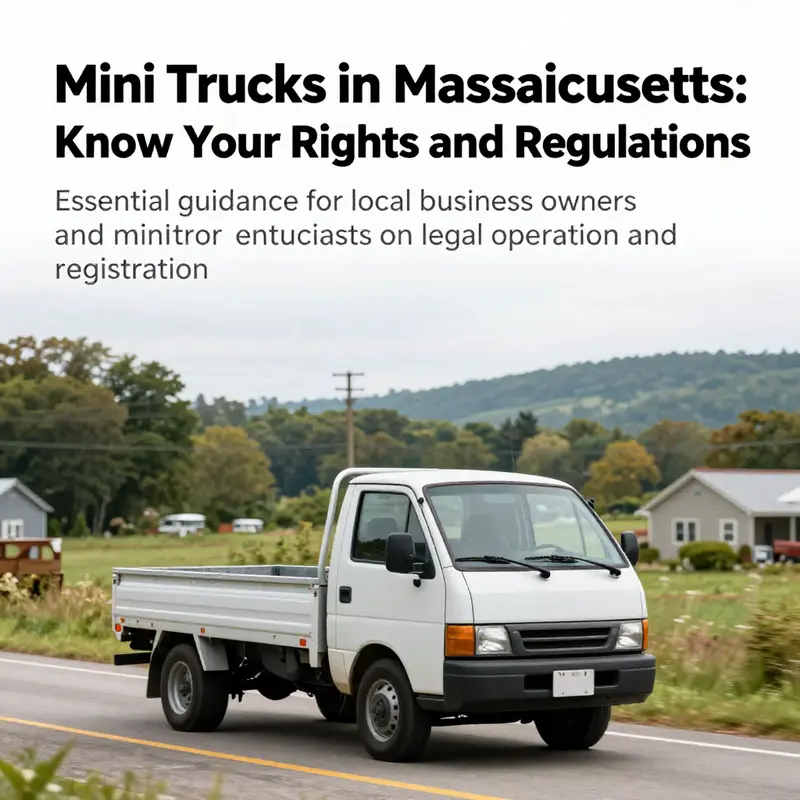
Are you a local small business owner or a mini truck enthusiast? Navigating the world of mini truck legality in Massachusetts can be tricky, but understanding the laws and regulations is crucial for safe and legal operation on public roads. This article provides comprehensive chapters on the legality of mini trucks, safety and registration requirements, vehicle classifications, insurance implications, and navigating the Massachusetts Registry of Motor Vehicles. By the end, you’ll be equipped with all the knowledge necessary to confidently operate your mini truck in compliance with state laws.
null
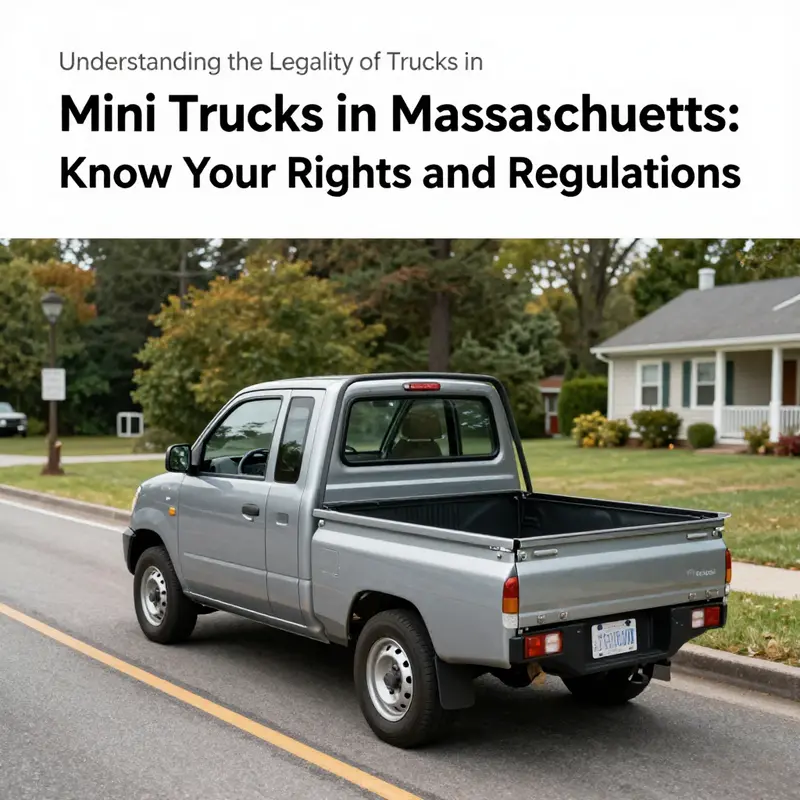
null
Road-Ready on a Small Frame: Navigating Safety, Classification, and Registration of Mini Trucks in Massachusetts
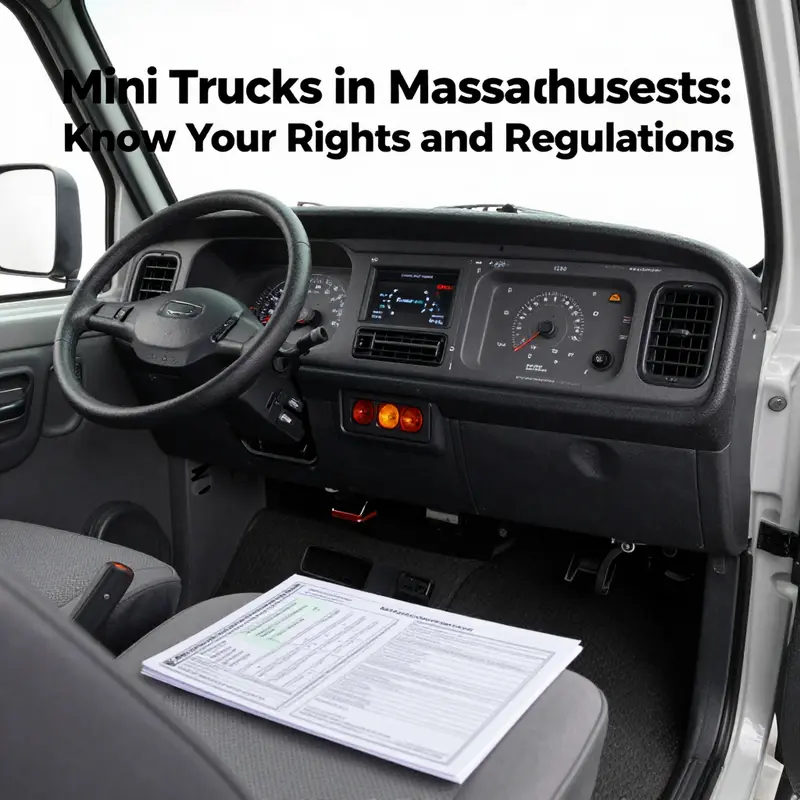
In Massachusetts, the journey of a mini truck from a neighborhood workshop to the public road is less about size and more about precise classification, safety compliance, and the formalities of registration. The common assumption that any small pickup can be legally driven on public streets is tempered by a framework that defines how these vehicles are categorized, what equipment they must have, and how they must be titled and insured. The state does not treat every compact utility vehicle the same way; instead, it places mini trucks on a spectrum that stretches from low-speed vehicle to full motor vehicle, and in doing so it creates distinct road-use realities for each path.
The first question drivers encounter is classification. Massachusetts law distinguishes mini trucks that qualify as Low-Speed Vehicles (LSVs) from those that are simply motor vehicles. This distinction matters because it governs where the vehicle may be operated and what safety standards must be met. An LSV is designed to operate at modest speeds on public roads, and it must meet a defined set of equipment requirements to be permitted on those roads. If a mini truck does not meet the LSV criteria, it may still be driven on public streets only if it is properly titled and registered as a motor vehicle with the RMV and conforms to the safety expectations applied to motor vehicles generally. The line between the two classifications is not cosmetic; it is the hinge that determines permissible routes, speed, and the level of regulatory scrutiny the vehicle must pass before it can legally share Massachusetts highways with other powered vehicles.
When a vehicle is classified as an LSV, the road-legal package becomes concrete about what you can expect in terms of safety features. The vehicle must have seat belts for the driver and all passengers, because keeping occupants secured is a fundamental protection in the event of a mishap at the relatively lower speeds characteristic of LSV operation. Lighting is another non-negotiable: headlights must illuminate the road ahead, brake lights must signal the vehicle’s deceleration to drivers behind, and turn signals must be functional to indicate lane changes and turns. Mirrors are essential for the driver to maintain situational awareness, especially in mixed traffic environments where larger vehicles share the same lanes. A speedometer is required to keep the operator aware of the vehicle’s pace, which is critical given that LSVs are limited to relatively modest speeds. This ensemble of features is not merely a checklist; it is a practical framework that supports predictability on the road and reduces the risk of collisions when small, lower-speed vehicles mingle with conventional cars and trucks.
Speed, in particular, is a defining parameter for LSVs. Massachusetts imposes an upper ceiling that places the vehicle squarely in the slow-velocity category: a maximum speed between 20 and 25 miles per hour. This range is deliberate, reflecting the vehicle’s purpose—light, neighborhood-level transportation—while acknowledging the realities of shared road space. Vehicles that cannot maintain within this speed range typically do not qualify as LSVs and must meet the more stringent standards that apply to conventional motor vehicles if they are to be operated on public roads at all. The consequence of misclassification could be significant, as it would require different registration, insurance, and tax treatment, along with possible restrictions on where the vehicle may be used.
Registration is the procedural anchor that converts classification into street legality. For a mini truck to be legally driven on Massachusetts public roads, the owner must complete a registration process that confirms ownership, establishes a safety baseline through inspection, and records the vehicle with the RMV for title and plate purposes. The process begins with proof of ownership, which can be a bill of sale or title documents that demonstrate who holds the right to operate the vehicle. A safety inspection is then required to verify that the vehicle meets the applicable safety standards—whether as an LSV or a motor vehicle. This inspection acts as a quality control step, providing the state with assurance that critical systems and features are functioning as intended. Following inspection, the requisite registration and title fees must be paid, and the DMV may request additional documentation, such as a title certificate or a bill of sale, to finalize the record. These steps, while routine for any motor vehicle, acquire special weight when the vehicle in question is a mini truck navigating the shared roadways of a busy state.
Beyond the formalities of ownership and inspection, the legal framework asks about the driver. A valid driver’s license is required, and the license type must be appropriate to the vehicle class being operated. This requirement reinforces the principle that road safety is a shared responsibility between the vehicle and the operator. It also has practical implications: even if a mini truck is legally permitted on the road, the operator must be equipped to handle a vehicle that, while small, still demands attention, anticipation, and appropriate driving behavior in traffic. The licensing dimension underscores the broader regulatory context in which these vehicles exist, ensuring that operators are capable of handling the vehicle’s performance characteristics and the realities of highway sharing.
Another layer worth acknowledging is the gray area that can arise with off-road or golf-cart-style configurations. Some mini trucks may be designed for properties or limited environments and may lack the modifications or documentation needed to operate on public roadways. If such a vehicle is not properly titled or lacks the necessary equipment, its use may be restricted to private property, with public-road operation potentially resulting in fines, impoundment, or other enforcement actions. In practice, this means that prospective buyers, homeowners, or small-business operators who rely on these vehicles should begin with a clear assessment of the vehicle’s intended use, the necessary classifications, and the exact requirements of the RMV. The safety and registration landscape is not an abstract hurdle; it directly governs how, where, and under what conditions these machines can contribute to daily routines, whether for hauling tools in a yard, shortening a commute on a quiet street, or supporting light manufacturing or service tasks.
From a risk management perspective, insurance plays a crucial role alongside registration and licensing. Even when a mini truck is legally permitted on public roads as an LSV or motor vehicle, obtaining appropriate insurance coverage is essential. Coverage not only satisfies potential legal obligations but also protects the operator and others sharing the road from the financial consequences of accidents. The scope and cost of insurance will depend on how the vehicle is classified, its usage, and the operator’s driving history, among other factors. In addition, local regulations and municipal ordinances can shape practical use. Some towns may impose additional restrictions or require permits for certain low-speed vehicles, particularly in dense urban areas or near school zones. It is therefore prudent to consider not only the state-level rules but also local interpretations and enforcement practices when planning how to deploy a mini truck on Massachusetts streets.
For readers seeking ongoing, community-informed perspectives on compliance, practical modifications, and road-use experiences, a visit to the Mini Trucks Blog can be a helpful companion as you navigate the regulatory landscape. It offers a forum for discussing how others interpret and meet the requirements, share practical tips, and stay informed about evolving guidelines. See the Mini Trucks Blog for more discussions and updates on road-legal status and related topics.
Ultimately, the Massachusetts framework for mini trucks emphasizes safety, accountability, and clarity. It requires a thoughtful alignment of classification, physical requirements, registration, and lawful operation. The rules acknowledge that these compact vehicles can offer meaningful utility, but they also insist that owners and operators abide by the standards that protect all road users. When in doubt, the best course is to consult the official RMV resources for the latest guidance on vehicle registration and classification, as well as the general requirements for motor vehicles and low-speed vehicles in the state. For comprehensive registration and title information, the official state page provides the definitive reference: https://www.mass.gov/vehicle-registration-and-title-information. This linkage to authoritative guidance is a reminder that, while mini trucks may promise efficiency and versatility, their true value is realized when they harmonize with Massachusetts’ safety and registration expectations.
External resource: Massachusetts RMV vehicle registration and title information remains the authoritative source for the latest rules, fees, and procedures governing how mini trucks can be legally operated on public roads. Consult official state guidance to confirm current requirements before purchasing or operating a mini truck in Massachusetts.
Between Street-Ready and Off-Road: Decoding Massachusetts’ Mini Trucks and the Rules That Shape Their Use
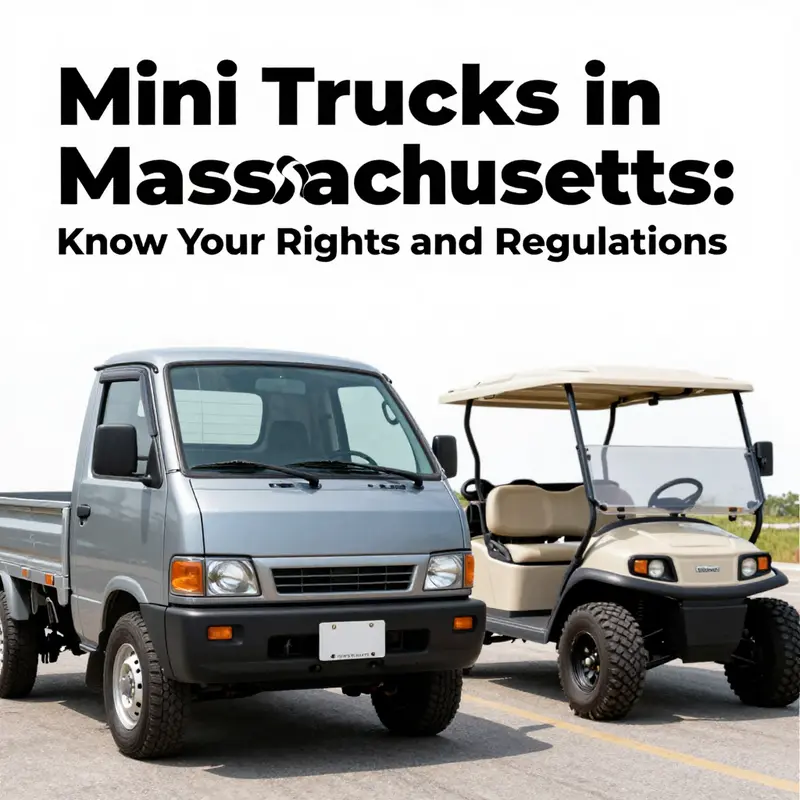
In Massachusetts, the small, boxy silhouette of a mini truck can evoke questions about whether it belongs on the same lanes as full-sized pickups and family sedans. The short answer is nuanced: many mini trucks can be driven on public roads today, but only if they meet a set of safety, registration, and classification requirements. To the untrained eye, a compact, four-wheeled vehicle with a bed might look road-ready. But the law treats the vehicle’s certification, equipment, and official designation as critical gatekeepers that determine where and how it can operate. The heart of the matter lies in the distinction between a vehicle that is legally titled, insured, and equipped for highway use, and one that remains on private property or on designated off-road courses because it lacks the elements that the state requires for street access. This distinction matters not just to the driver’s convenience, but to safety, liability, and the practicalities of everyday life in a state where heavy traffic and narrow streets are common features of daily travel. For readers exploring the broader question of legality, it helps to anchor the discussion in the way Massachusetts handles vehicle classification, registration, and the handful of practical realities that follow from those rules. A useful entry point into this maze is to consider how a given mini truck model is classified by the Massachusetts Registry of Motor Vehicles (RMV) and what that classification implies for on-road use, on private property, or on construction-site roads. The RMV does not treat every small, four-wheeled vehicle as a guaranteed street-legal car by default. Instead, a vehicle must meet established federal safety standards and state criteria to earn a title, registration, and the right to operate on public streets. A core feature of this process is the Vehicle Identification Number (VIN), which the RMV uses to verify a vehicle’s history, compliance, and safety status. If a mini truck lacks a VIN by proper registration practices, or if it is not equipped with the mandated safety components, it is at risk of being categorized as an off-road vehicle. Once categorized this way, its operability becomes largely restricted to private property or limited public settings that do not involve highway speeds or public-road access. This is not merely a theoretical boundary. It translates into real-world consequences for owners who drive unregistered or inadequately equipped mini trucks, with potential penalties, impoundment, and the practical exposure of liability in case of accidents. The road to clarity for Massachusetts residents who own or plan to buy a mini truck often runs through the RMV’s guidance and the state’s broader transportation framework. The RMV’s rules require that vehicles intended for public road use be properly titled and insured, and that they carry the full complement of safety equipment that modern cars are expected to have. This includes, among other features, working lights, mirrors, seat belts, and a braking system that meets applicable standards. The requirement for a VIN is especially meaningful; it is not merely bureaucratic trivia. A VIN links the vehicle to a verifiable, traceable record that assures authorities and insurers that the machine has a defined legal identity and a track record of compliance with federal safety standards. When a mini truck passes this test, it earns the privilege of street-legal status in Massachusetts, at least under the conditions of the model’s design and the owner’s responsibilities for registration and insurance. It is here that many owners discover the subtle but crucial boundary between use on public roads and the more permissive, private-property applications common in other contexts. Vehicles marketed as “off-road” or “golf cart-style” often live in a gray area. They may roll on four wheels and boast a motor, but their design priorities can undercut the safety and performance criteria the RMV requires for road operation. Their brakes, lighting, suspension, and collision-avoidance features may be insufficient for highway speeds or the stresses of regular traffic. In such cases, those vehicles are more appropriately used on private property, on construction sites, or in recreational venues, rather than on public streets. This distinction is not merely academic. It has practical implications for how a driver navigates a neighborhood, runs errands, or commutes to a work site. A vehicle manufactured with the intent of on-road use, properly titled and insured, will typically be eligible for registration and licensing through MassRMV processes, plus compliance checks that confirm features like headlights, turn signals, and seat belts meet state expectations. By contrast, a vehicle designed without those road-ready features runs the risk of being treated as an off-road vehicle. In everyday life, that means limits on where it can be operated, and what kind of liability might attach should an accident occur. To the curious reader, a telling approach is an ongoing conversation with the state’s guidelines. MassDOT provides practical guidance that helps determine whether a given mini truck can qualify for street use after evaluating its compliance with safety standards and federal motor vehicle laws. This is where the conversation becomes more concrete, and where the practical steps of verification become clear: check the model’s specifications, look for a valid title and VIN, confirm that the vehicle is insured, and ensure the vehicle is equipped with the required safety features. The process is not a mere formality; it is an insistence that small vehicles on the road meet the same baseline standards that protect all road users. It also invites a careful, informed decision-making approach for owners who might otherwise assume that a compact size alone guarantees road access. When in doubt, a direct contact with the RMV or a review of official RMV materials can prevent missteps and reduce the risk of penalties or liability. To deepen understanding and hear how enthusiasts interpret these rules in practice, many readers turn to perspectives within the broader community of mini truck owners and fans. A steady stream of discussion emerges in dedicated forums and blogs where practical experiences are shared about converting, registering, or using these vehicles on Massachusetts streets and properties. If you want to explore how the conversation unfolds in a community context, you can follow the information and experiences documented in the Mini Trucks Blog. It offers a window into how owners navigate regulatory expectations while pursuing practical utility in everyday life. For reference, see the discussion and content at Mini Trucks Blog. The discussion underscores that the core issue remains: legality depends on compliance, not on the vehicle’s size or appearance alone. The bottom line is that Massachusetts does permit certain mini trucks on public roads, but the authorization is conditional and highly dependent on proper classification, documentation, and equipment. Those seeking to operate such a vehicle should begin with a careful verification of the model’s compliance with RMV regulations, then proceed to the practical steps of registration, insurance, and safety upgrades as needed. The state’s framework is not designed to discourage utility vehicles; rather, it seeks to ensure that the benefits these small machines offer do not come at the expense of road safety or the legal certainty that protects drivers, other motorists, and pedestrians alike. In the end, the question of whether a mini truck is legal in Massachusetts is answered not by the vehicle’s appearance, but by a process of confirmation: is it properly titled, insured, and equipped to meet federal and state safety standards? If so, it can share the state’s roads alongside other vehicles. If not, the vehicle’s use is framed around private property and off-road settings where its design and purpose align with those restricted spaces. The distinction is clear, and the practical implications are real, shaping how residents plan purchases, insurance coverage, and daily mobility. For a definitive determination, consult the official Massachusetts RMV resources and guidance, and consider reaching out to the RMV directly to confirm the current classification for a specific mini truck model. Official guidance can be found on the RMV’s platform, which provides the up-to-date criteria and procedures for vehicle registration and classification. RMV guidance: https://www.mass.gov
Insuring Massachusetts Mini Trucks: Legal Foundations, Coverage Choices, and the Road Ahead
In the conversations about whether mini trucks belong on Massachusetts streets, insurance often sits at the center of the practical equation. The question isn’t merely about whether the vehicle can legally exist in a driveway or be titled as a road vehicle; it is about whether that vehicle can be legally and securely operated on public roads, with coverage that stands up to the state’s requirements and the realities of everyday use. The Massachusetts landscape for these compact, utility-focused machines is nuanced. The RMV regulates registration, titling, and classification, while the Division of Insurance and the carriers that issue policies translate those classifications into binding financial responsibility. The result is a framework where legality and protection hinge on careful compliance, transparent use, and prudent risk management. The message is clear: being on the road with a mini truck in Massachusetts requires more than just a title and a driver’s license; it requires a coherent insurance strategy that reflects how the vehicle is used within state law and insurer rules.
At the core of any insurance discussion in Massachusetts, as with any motor vehicle, is the obligation to carry minimum liability coverage. The state’s baseline framework specifies bodily injury coverage of at least $50,000 per person and $100,000 per accident, together with property damage coverage of $25,000. These numbers—often summarized as 50/100/25—set the floor for financial responsibility in the event of a collision. In addition to the liability requirements, uninsured/underinsured motorist coverage is mandatory. This suite of coverages is not merely bureaucratic padding; it is how drivers absorb the financial shock of collisions when the at-fault party is inadequately insured or uninsured altogether. For mini trucks used on public roads in the Bay State, these requirements apply just as they would for any other vehicle, even though the vehicle’s size and duty cycle may look markedly different from a traditional pickup or sedan.
The rigidity of a state-mandated minimum stands in tension with the reality that many mini trucks are used not for personal commuting but for light commercial tasks—delivering tools, transporting equipment, or performing service calls in suburban and semi-urban settings. When the vehicle is employed for business or delivery services, the risk profile shifts, and a standard personal auto policy may not provide adequate or appropriate protection. Massachusetts law and typical underwriter practice converge on a straightforward principle: disclose how the vehicle is used. If the mini truck will function as part of a business operation, a commercial auto policy is typically the proper vehicle to ensure both liability and physical damage are aligned with business exposure. Failing to disclose the true use can lead to gaps in coverage, denied claims, or even policy voidance. The consequence is not merely an insurance hiccup; it is a legal risk that can affect personal finances, business continuity, and public road safety.
This is where the logic of a properly structured policy becomes visible. Insurance providers in Massachusetts, as elsewhere, assess risk through a lens that includes the vehicle’s weight class, safety features, storage conditions, and the nature of its use. They look for clear documentation that the vehicle is titled and registered as a motor vehicle suitable for highway operation, with all required safety features in place. They also weigh the daily realities of how far and how often the mini truck travels, and what types of loads it carries. When the use is clearly personal, a standard auto policy may be adequate, provided the vehicle meets the insurer’s criteria for a passenger or light-duty commercial vehicle. If the use is commercial, expect to encounter a more scrutinized underwriting process. The insurer will want to understand routes, business hours, and potential on-road duties that might elevate liability exposure. The prudent course is full disclosure: share the intended uses, mileage expectations, and any commercial applications so the policy fully reflects the risk.
For drivers navigating these waters, there is value in exploring a range of coverage options rather than fixating on the minimum. Beyond the statutory minimums, many policyholders consider endorsements that can be meaningful given the vehicle’s role. Roadside assistance becomes a practical asset for small fleets or single operators who rely on a mini truck for critical tasks. Rental reimbursement can matter when a vehicle is out of service due to a covered loss, ensuring business continuity. Comprehensive coverage, in particular, merits attention if the mini truck spends time in areas with higher theft risk or if it is parked outside in urban or exposed settings. Such breadth of protection can prevent gaps that might otherwise leave a driver personally responsible for repair costs or a total loss.
The landscape for insurers extends beyond coverage and into pricing mechanics. Many drivers appreciate pay-as-you-go or usage-based policies that align premium costs with actual exposure. In the context of a MA mini truck, this can be especially appealing for part-time operators or seasonal work where mileage fluctuates. A few carriers offer flexible payment arrangements that reward low mileage or limited use, a practical fit for owners who use their mini truck for specific tasks rather than daily commutes. The trade-off, of course, is that a more dynamic pricing model may require closer ongoing communication with the insurer and periodic policy reviews to ensure the coverage continues to reflect current use. Regardless of the pricing approach, it pays to shop around carefully and to provide a precise picture of how the vehicle is used. The diversity of the Massachusetts market means that some carriers will tailor solutions that align with a mini truck’s unique profile, while others may push for more conventional auto policies that do not fully address business-related risk.
One practical route for readers who want to gauge the texture of these insurance decisions in the context of everyday life is to explore real-world narratives and perspectives on mini trucks. The online community of mini truck enthusiasts often contains practical discussions about maintenance, modifications, and road-use experiences that echo the regulatory and insurance considerations discussed here. A simple, informative entry point is the broader Mini Trucks Blog, which collates shared experiences and practical insights from operators who balance on-road realities with the demands of their work or hobby. This resource can help readers frame their questions and prepare their conversations with insurers and the RMV. Mini Trucks Blog
Beyond the coverage specifics, the legal backbone remains rooted in clear compliance with state requirements. A vehicle used on Massachusetts roads must be properly registered, titled, and equipped with the safety features that make it roadworthy. If a mini truck lacks the necessary modifications or a valid title, or if it is marketed or utilized in a way that does not align with highway regulations, it may be restricted to private property or limited to off-road contexts. These classifications are not simply bureaucratic labels; they determine where, when, and how the vehicle can be operated, and they shape the attendant insurance commitments. In practice, the sequence of steps is straightforward yet essential: verify that the RMV has correctly classified the vehicle, ensure the title reflects motor vehicle status, confirm registration is current, and secure a policy whose terms match the intended use, whether personal or commercial. This alignment reduces the risk of coverage disputes and helps maintain uninterrupted access to the roads.
As readers consider their own plans for a mini truck in Massachusetts, the combined implications of legality and insurance point toward a disciplined approach. Begin with the official guidance from state authorities to confirm the vehicle’s eligibility for highway operation and the required equipment. Then engage in a candid discussion with a licensed insurer about how the vehicle will be used, what routes it will travel, and the kind of protection that best serves those duties. In this way, legal compliance and practical protection reinforce each other, creating a reliable foundation for safe, responsible use on Massachusetts streets. For more detailed guidance on state-specific regulations and available insurance products, visit the Massachusetts Division of Insurance at https://www.mass.gov/insurance.
Massachusetts Rules for Small Pickup-Style Vehicles: What Determines Legality
Massachusetts does not have a separate ‘mini truck’ category. Vehicles that resemble small pickups are evaluated under the state’s framework for light trucks, passenger cars, and commercial vehicles. In practice, a compact, truck-like vehicle can operate on public roads if it is properly titled, registered, insured, and equipped for highway use, and if RMV classification considers its weight, design, and intended use.
The key metric is weight. If the gross vehicle weight rating (GVWR) is at or below 10,000 pounds, the vehicle is generally treated as a light truck for registration and titling purposes. Design, equipment, and intended use still influence classification and insurance requirements. Ensure you have a valid title, proof of insurance, and compliance with safety and emissions rules applicable to its category.
Vehicles designed primarily for off-road use or lacking typical on-road equipment can be misclassified or restricted to private-property use. Modifications that alter performance or appearance can trigger reclassification and additional inspections; plan changes with RMV guidance.
Practical steps: check the RMV vehicle registration pages for required documents (proof of ownership, insurance, and emissions status if applicable), confirm the vehicle’s GVWR and design, and verify safety equipment (seat belts, lights, signaling devices, mirrors). If you anticipate significant modifications, consult RMV guidelines before proceeding.
External resources: use the RMV’s official vehicle-registration portal and MassDEP emissions information. If uncertain, contact your local RMV office for current rules and classifications.
This content is informational and not legal advice.
Final thoughts
Understanding the legal landscape for mini trucks in Massachusetts is vital for any owner or enthusiast. With the right knowledge about safety and registration requirements, classification implications, and insurance options, you can enjoy the benefits of your mini truck while staying compliant with state laws. Make sure to always stay updated on any changes in regulations and keep your vehicle well-prepared for both work and play.