
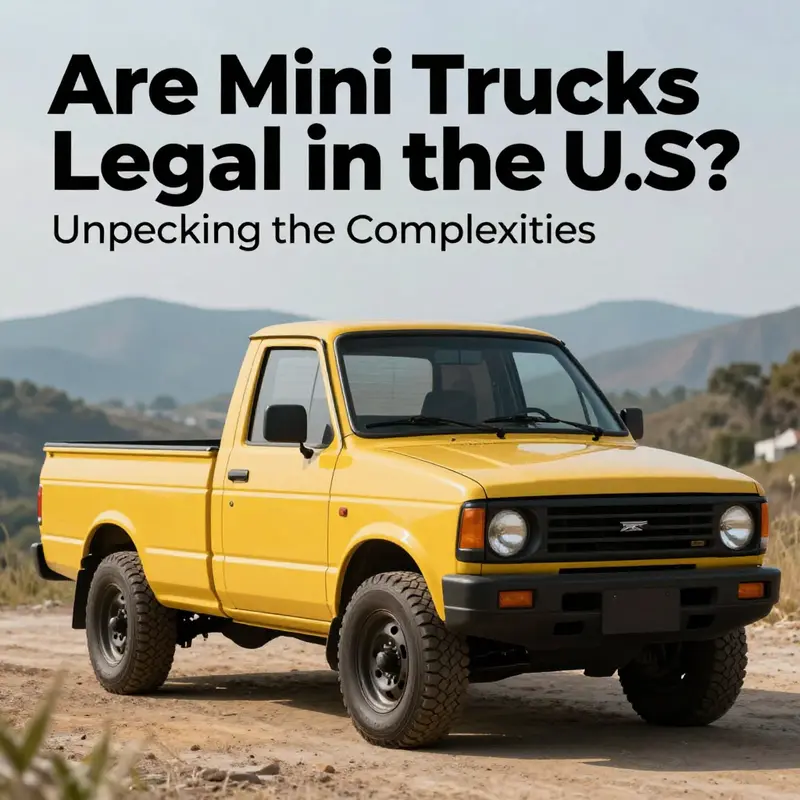
Navigating the legalities of mini trucks in the U.S. can feel like a maze for anyone interested in purchasing or utilizing these compact vehicles. Whether you’re a local small business owner looking for an efficient utility vehicle, a residential property owner needing a fun, flexible transport option, or simply a mini truck enthusiast eager to learn more, understanding the legal status of mini trucks is crucial. This article aims to demystify the regulatory environment surrounding mini trucks in the U.S. in three engaging chapters. We will present an overview of what mini trucks are and their general state of legality, dive into the specific regulations governing these vehicles, and illuminate the state-by-state variations that could impact your mini truck experience. With this knowledge, you can confidently make informed choices about ownership and usage.
Road-Ready or Road-Blocked? Navigating the Legal Terrain of Mini Trucks in the United States
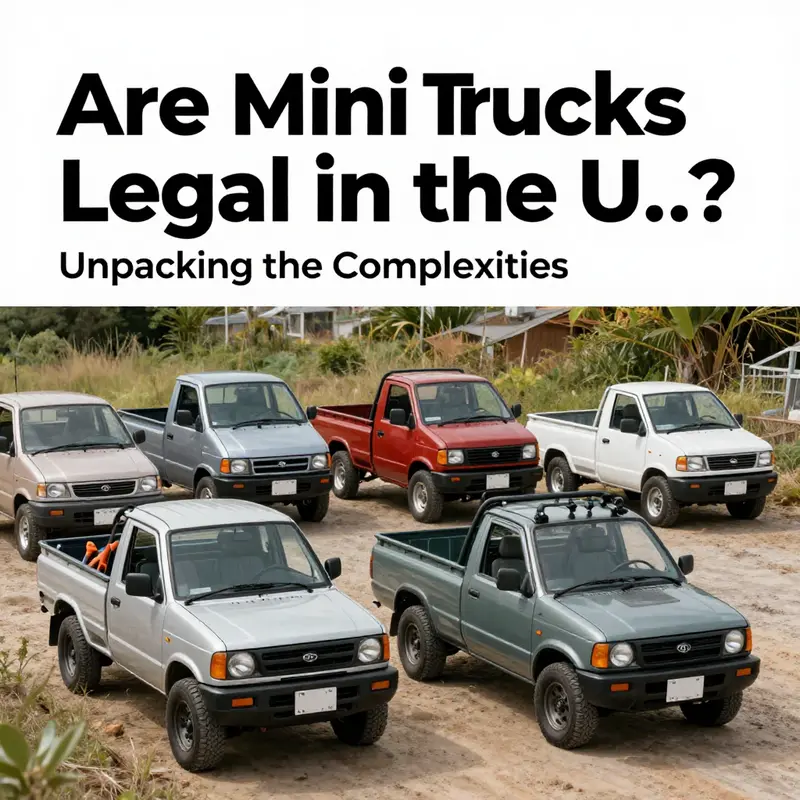
The appeal of mini trucks lies in their paradox: they are small enough to squeeze through tight city streets yet sturdy enough to carry a load, making them ideal for work, trailering, or weekend projects. Yet in the United States, the question of whether these compact workhorses can legally share public roads is not a simple yes or no. The answer unfolds along the fault lines of federal standards, state implementation, and the way a vehicle is classified when it arrives at a port, a showroom, or a driveway. The central hinge in this complex landscape is not the size of the bed or the horsepower on the engine, but the creature that governs road legality across the nation: age. Age determines whether a mini truck can bypass the modern safety and emissions regime or must prove its compliance anew. In practical terms, the legal status of mini trucks depends on whether the vehicle is 25 years old or older, which vehicles qualify under that federal exemption, and how state rules translate federal eligibility into on-road approval.
To understand why age matters, it helps to start with the framework set by the two federal agencies most directly involved in road legality: the National Highway Traffic Safety Administration (NHTSA), which writes and enforces federal safety standards, and the Environmental Protection Agency (EPA), which sets emissions requirements. These two bodies establish a baseline that all vehicles sold or imported into the United States must meet to be operated on public roads. For most modern vehicles, those standards are not optional. They require an integrated approach to crashworthiness, restraint systems, electronic stability features, emissions controls, and a host of other safety and environmental criteria that new vehicles must satisfy before they can be registered for highway use. In the world of mini trucks—where many examples arrive as low-speed, off-road, or industrial utility vehicles—the path to street legality becomes a matter of whether the vehicle can meet those standards or whether it can be exempted from them under a specific federal rule.
The 25-year rule is the cornerstone of this exemption. It provides a clear, if not always perfectly intuitive, threshold that can dramatically alter the legal status of a vehicle. In practical terms, any vehicle that is 25 years old or older is exempt from current federal safety and emissions regulations for importation and sale. In other words, a mini truck manufactured in a year that makes it at least 25 years old is not required to undergo the same modern compliance process as a newer vehicle to be legally imported and operated in the United States. This exemption applies to both domestic and imported vehicles, which means that many compact pickups from earlier decades can be brought into the country and used without demonstrating full compliance with the latest crash tests, airbag requirements, electronic stability standards, or EPA emissions controls that govern newer models.
As of 2026, that rule translates into a concrete consequence: any vehicle manufactured in 2001 or earlier qualifies for the 25-year exemption. A hypothetical example helps anchor this idea. If a compact pickup is a 2001 model, it would be eligible for import and regular operation under the federal exemption, provided it is properly documented and registered in the state where it will be operated. This has created a thriving niche market for classic and vintage mini trucks among enthusiasts and entrepreneurs who value utilitarian simplicity and nostalgic design. The 25-year rule has done more than give a green light to collectors; it has shaped a robust subculture of importers, restorers, and dealers who navigate a blend of old-school mechanicals and modern legal realities. Importantly, the rule does not make every such vehicle immediately street-legal by magical decree. The exemptions hinge on the vehicle’s age and the local interpretation of that federal permission, and even with an eligible year, the path to road use is often mediated by state-level processes.
Yet the 25-year exemption is not a universal passport for all mini trucks. For vehicles younger than 25 years, the federal highway safety and emissions regime applies in full. Newer mini trucks must demonstrate compliance with the full suite of NHTSA standards—crashworthiness, occupant protection, airbag systems where applicable, seat belts, and advanced electronics—and with EPA emissions requirements. In this arena, most foreign-made mini trucks arriving from overseas, especially those marketed as low-speed or utility platforms rather than passenger cars, face a significant uphill climb. They are rarely certified through the official importer or manufacturer process that would grant them street-legal status for general public road use. The result is a landscape where many of the most interesting mini trucks stay parked in showrooms as industrial or off-road tools, not as cars that officially share highways with everyone else.
The federal framework is only part of the picture. States interpret and apply federal eligibility in ways that can either smooth or complicate the road to registration. Even when a vehicle is federally compliant or exempt by age, state motor vehicle departments may impose their own requirements before a vehicle can be registered, titled, or inspected. Some states have processes that allow or require certain inspections, emissions tests, or documentation to verify compliance, and others may impose modifications or safety requirements before granting a plate and a title. In some cases, the status of a vehicle can hinge on how it is classified at the state level—whether it is treated as a passenger car, a commercial vehicle, a utility vehicle, or a specialty vehicle—and what limitations the state places on its use.
For anyone considering a mini truck in the United States, the practical upshot is clear. If you are eyeing a model that is 25 years old or older, you may be able to navigate importation and road use under the federal exemption. You will still need to verify the vehicle’s exact manufacturing year, confirm there were no unusual modifications that might affect its eligibility, and secure the appropriate state registration and plate. If the vehicle is newer than 25 years, be prepared for a more exacting process. You will likely have to pursue certification through an authorized importer or additional testing to demonstrate compliance with current safety standards and emissions rules. In both cases, the path forward is not guaranteed to be quick or inexpensive. Costs can accumulate quickly with inspections, potential modifications, and the careful documentation required to satisfy both state and federal authorities.
A common, practical distinction emerges when people discuss “on-road” use versus “limited-use” or “off-road” status. Some vehicles marketed as mini trucks or electric utility carts fall squarely into the category of Low-Speed Vehicles (LSVs) or Neighborhood Electric Vehicles (NEVs) in certain contexts. These classifications are not universal across all states, but where they apply, they define a narrow operating envelope: a top speed of no more than 25 mph and a suite of safety features, typically including seat belts, headlights, turn signals, and reflective tape. The catch is equally important: LSVs and NEVs are generally restricted to roads with speed limits of 35 mph or lower and are not permitted on highways or major thoroughfares. They can be extremely practical in certain geographies—campgrounds, large campuses, or compact suburban streets—but their role is very different from that of a standard passenger vehicle. They are not a universal substitution for a conventional pickup on a highway, and many models marketed as mini trucks fit more naturally into the utility-vehicle or industrial category than into the passenger-vehicle category that most people expect when they hear “truck.”
The reality therefore is nuanced. A small, electric, two-seat or four-seat mini truck that claims a “truck” identity may not be eligible as a street-legal passenger vehicle if it eschews the safety and emissions framework, or if its top speed is too low to meet the thresholds for highway use. Some iterations might be legally used on certain urban roads with low speed limits, provided the vehicle is certified as an LSV or NEV and the jurisdiction accepts that classification. Others can be legally registered and used on standard public roads only if they have been certified for highway use or if they fall under the 25-year exemption. In practice, the line between “street-legal” and “restricted-use” is painted in shades of gray rather than a stark black-and-white boundary. This is precisely why prospective buyers, importers, and owners must do careful due diligence before purchasing or importing a mini truck. The federal exemption provides a door, but whether that door opens onto a public road depends on the state’s latch and the vehicle’s age, configuration, and documentation.
An important part of this diligence is understanding how to verify a vehicle’s eligibility and what steps to take to align a purchase with road-use goals. First, determine the model year and confirm the exact manufacture date. The 25-year rule is time-bound, so a model year without clear documentation can create ambiguity about eligibility. Second, search for the vehicle in the NHTSA vehicle compliance database. The database is designed to help importers, dealers, and owners determine whether a vehicle meets current safety standards or qualifies for the 25-year exemption. If the vehicle is older than 25 years, you should obtain confirmation that there are no outstanding safety compliance issues that would block import or registration in your state. Third, consult the state’s DMV or equivalent agency about the registration, inspection, and potential modification requirements. Some states are more permissive, others are more stringent, and a few require specific equipment or inspections as a condition of registration for non-standard or imported vehicles.
In practical terms, the journey from purchase to road use for mini trucks often threads through a small, dedicated ecosystem rather than a broad consumer market. There are businesses that specialize in importing, restoring, and preparing older mini trucks for road use under the 25-year exemption. They navigate documentation, bill of sale, and title processes, and they work to ensure that a vehicle meets state requirements for registration. There are also communities of enthusiasts who share information about what works, what to avoid, and how to navigate the complexities of aging mechanical systems, brake components, suspension, and steering geometry in a way that remains safe on public roads. For readers drawn to this corner of automotive culture, there is value in turning to a dedicated source of information and experience where the conversation remains focused on the practical realities of ownership, maintenance, and legal status. To connect with ongoing discussions and updates from the community, you can explore the Mini Trucks Blog, which offers a repository of articles, insights, and practical considerations relevant to the topic.
For those who want a reliable, up-to-date resource that frames the broader legal landscape without getting lost in the minutiae of individual models, the core takeaway remains straightforward: age is destiny when it comes to federal regulatory thresholds, while state rules determine the final act of registration and road use. If you are pursuing a vehicle that is 25 years old or older, you may be able to bring it in and use it without the burden of modern safety compliance, yet you still must respect state-level registration requirements. If you are considering a vehicle younger than that, you should anticipate a more involved process that may require certification through an authorized importer or additional testing to demonstrate compliance with current safety and emission standards. In both cases, the practical path is to verify the year, confirm documentation, check the state rules, and be prepared for a timetable that reflects the complex negotiation between federal policy and local administration. The law, in other words, is not a single signposted highway but a set of local byways that an informed traveler must navigate with patience and careful preparation.
As readers consider the future of mobility and the expanding interest in compact, versatile vehicles, it is worth noting that this legal framework is not advancing in a straight line toward universal acceptance of all mini trucks on all roads. Rather, it is evolving in response to the realities of age, design, and the balance between safety and utility. The 25-year rule remains a powerful accelerant for the classic mini-truck market, while the market for newer, more modernized platforms continues to wrestle with the rigorous standards that govern passenger safety and environmental impact. For policymakers, manufacturers, and users alike, the challenge is to harmonize the desire for practical, efficient, low-cost transportation with the public interest in safety, pollution control, and predictable road rules. That balance will continue to shape the legal status of mini trucks in the United States for years to come, with each new model and each new interpretation of state law contributing another paragraph to a living, evolving chapter in road-legal realities.
In closing, the question of whether mini trucks are legal in the United States cannot be answered with a simple yes or no. It is a nuanced inquiry that hinges on the age of the vehicle, its compliance with federal standards, and the specific rules of the state where it will be registered and driven. The 25-year exemption offers a clear pathway for older vehicles, while newer models require careful navigation of compliance processes and potential modifications. The distinction between on-road, limited-use, and off-road configurations adds another layer of complexity, particularly for electric or low-speed variants that are marketed as utility or industrial equipment rather than passenger vehicles. Prospective owners should approach the process with a clear map: confirm manufacture year, review federal eligibility, consult the state DMV, and leverage trusted sources of information within the mini-truck community. And when in doubt, consult the official resources—beginning with the federal safety and emissions framework and extending to the state-specific registration requirements—to determine the right path to realizing the practical benefits of a compact, utilitarian vehicle on public roads.
For ongoing, community-based guidance and perspectives on mini trucks, readers can explore the Mini Trucks Blog for updates and discussions that complement this chapter’s overview. The chapter’s aim is not to sanitize complexity into a single verdict but to illuminate the regulatory terrain so readers can make informed decisions about eligibility, ownership, and use. Additionally, for a formal reference to the 25-year rule and its application, the National Highway Traffic Safety Administration’s vehicle eligibility resource is the authoritative source that clarifies how age interacts with federal standards and what that means for importers and owners alike. The interplay between federal exemptions and state implementation remains the core challenge—and the central reason that the legal status of mini trucks is a story of nuance rather than a mere checkbox. If you are contemplating bringing a mini truck into your life, approach it with curiosity, patience, and a thorough understanding of the legal steps ahead.
External reference: For the official rule and detailed, up-to-date guidance, see the National Highway Traffic Safety Administration’s Vehicle Eligibility 25-Year Rule. https://www.nhtsa.gov/vehicle-safety/vehicle-eligibility-25-year-rule
On the Threshold of Legality: Navigating Federal Standards and State Rules for Mini Trucks on U.S. Roads

Mini trucks occupy a curious and increasingly debated niche in the United States. They are compact, efficient, and often suited to tightly scoped tasks—urban deliveries in tight alleys, campus maintenance routes, agricultural plots, or construction sites where maneuverability matters more than horsepower. Yet their place on public roads is not simply a matter of capability or cost. It sits at the intersection of federal safety and emissions standards, age-related regulatory frameworks, and a mosaic of state and local rules that can change the destination of a vehicle long after it leaves the showroom or the importer’s dock. The result is a legal landscape that looks straightforward at first glance—are mini trucks street-legal?—and then reveals a labyrinth of conditions, exemptions, and practical hurdles that vary by location, vehicle type, and intended use. To understand whether a given mini truck can legitimately share the pavement with passenger cars, one must trace the chain from federal mandates to state registrations, through the narrow lane carved out for very specific low-speed alternatives, and finally to the practical realities of enforcement, insurance, and local zoning. The core tension is clear: these machines promise efficiency and utility, but meeting the broad and sometimes brittle framework designed for traditional passenger or larger commercial vehicles is the stumbling block that keeps many mini trucks off the highway where most people want to drive them.
At the federal level, the rules are anchored by two large agencies with overlapping spheres of responsibility. The National Highway Traffic Safety Administration (NHTSA) sets the safety standards that define what a vehicle must include to be sold and operated on public roadways. These standards cover a spectrum that ranges from crashworthiness to lighting, seat belts, and overall vehicle integrity—what FMVSS, or the Federal Motor Vehicle Safety Standards, codifies. The Environmental Protection Agency (EPA) then governs emissions. For any vehicle that will be driven on public roads, compliance with these safety and emissions standards isn’t optional; it is the gatekeeper for legal operation. The practical upshot is that most mini trucks, especially those imported or manufactured as low-speed or utility vehicles, arrive on the market without the explicit federal certification required to be considered street-legal passenger vehicles. They may be marketed for off-road use, industrial tasks, or farm work, but without a formal federal approval that confirms they meet the safety and emissions criteria, they sit outside the regular lane of public traffic in most states.
A second and equally important thread in this regulatory fabric is the age of the vehicle. The current framework, as summarized in public materials and regulatory discussions, places a strong emphasis on ensuring that vehicles driven on public roads meet current standards. The rule of thumb drawn from the literature is that vehicles under 25 years old generally must adhere to modern safety and emissions requirements to be legally operable on public roads. By contrast, vehicles older than 25 years operate under a broader, sometimes looser regime—though not automatically exempt. The point of reference in this chapter is clear: the 25-year benchmark creates a built-in filter that excludes most older micro-trucks from straightforward road legality. Why this matters for mini trucks is practical: many of the compact, lower-cost, or import-focused models that circulate in niche markets tend to fall well within or right at that boundary, making the difference between a legitimate urban tool and a non-street-legal novelty.
Beyond the federal framework, state governments step in with rules about registration, classification, licensing, and insurance. States often categorize mini trucks in ways that seem intuitive but carry concrete consequences. When they classify a mini truck as a light-duty commercial vehicle, for example, the operator may be expected to hold certain licenses or endorsements, and the vehicle may require commercial insurance rather than a standard personal automobile policy. Some states treat mini trucks as farm or industrial equipment when used on private property or on designated industrial roads, conferring a limited or non-existent right to access common public roadways outside of a work site. In practice, this means that even if a mini truck could clear federal safety and emissions hurdles, it can still be denied road access or required to meet additional state-specific criteria before it is allowed to roll down a public street. The consequences are not just about paperwork; they affect how a business buys, registers, insures, and operates its fleet, often influencing whether an owner sees a mini truck as a practical asset or a legal headache.
A particularly consequential category that often enters discussions about mini trucks is the class of Low-Speed Vehicles (LSVs) or Neighborhood Electric Vehicles (NEVs). These are designed with a narrower purpose: to provide short-range mobility at slow speeds. The critical threshold is a top speed limit of no more than 25 mph, combined with a suite of safety features such as seat belts, headlights, turn signals, and reflective tape. The LSV/NEV category exists because it provides a regulated pathway for smaller, slower vehicles to operate on certain roads without meeting the full spectrum of motor vehicle standards intended for conventional cars and trucks. However, LSVs are not free to roam all public roads. They are generally restricted to roads with speed limits of 35 mph or lower and are not permitted on highways. In practice, if a mini truck is stripped of its intended utility profile and certified as an LSV or NEV, it gains a defined corridor but sacrifices access to higher-speed corridors that many U.S. roads embody. This is a fundamental point for any buyer or operator: the legal life of a mini truck is often defined as much by speed and safety feature compliance as by weight or engine type.
The interplay of federal and state rules becomes even more nuanced when we consider the various pathways that a given mini truck might pursue toward street legality. Some vehicles, particularly those designed or marketed for low-speed industrial tasks, may be marketed explicitly as industrial or off-road utility vehicles rather than as passenger vehicles. In such cases, manufacturers often design them to avoid some of the heavier federal compliance requirements tied to passenger cars. Yet when an operator wants to use one on public roads for any practical transportation task, the vehicle must still satisfy the safety and emissions standards set by NHTSA and EPA. In other words, a vehicle that starts as a work tool for a farm or a campus cannot simply be pressed into service as a road-legal passenger vehicle without undertaking a comprehensive compliance program or a formal conversion that would bring it into alignment with FMVSS criteria, or at least an approved niche pathway such as an LSV classification. The practical implication is that the street-legal status of mini trucks is not a binary yes-or-no proposition; it is a conditional state that depends on how the vehicle is classified, what standards it meets, and where its owner intends to use it.
The regulatory reality translates into a series of real-world steps that owners must navigate. First, a prospective user must determine whether the mini truck, in its intended form, already conforms to the FMVSS. That involves a certification process that confirms the vehicle meets crashworthiness, lighting, signaling, occupant protection, and the myriad minor safety features that collectively make a vehicle roadworthy. If the vehicle falls short, an option exists only if it can be brought into compliance or if it is legally treated as an LSV/NEV under applicable rules, which would typically restrict its road use to low-speed zones and non-highway settings. The next layer involves emissions: if the vehicle uses an internal combustion engine, emissions controls must meet EPA standards appropriate to the vehicle’s classification, powertrain, and age. If the vehicle is electric or uses a non-traditional propulsion system, it may encounter different regulatory considerations, with electric micro trucks often aligning more naturally with contemporary environmental policy goals, including tax incentives and access to certain policy-based benefits in some jurisdictions. Yet even in the electric case, the vehicle must still be navigated through the process of registration, insurance, and, where applicable, compliance verification for public-road operation.
With this regulatory map in place, it is instructive to consider how the landscape looks in practice across different jurisdictions. States vary in how they classify minimal-truck-sized vehicles and how they assign licensing requirements. Some states treat micro trucks as light-duty commercial vehicles, which can trigger commercial-licensing requirements for the operator, as well as insurance considerations that differ from personal auto policies. Other states may require the vehicle to display particular markings or to operate under a license that reflects its commercial role, even if the vehicle is not used commercially on a given day. There is also the matter of registration fees and plate types, which can differ significantly from standard passenger vehicles. For individuals who intend to use such a vehicle on farmland or within a defined campus or industrial complex, public-road access can hinge on whether the state system recognizes the vehicle as a form of equipment eligible for highway duty signs, which would blur the line between a private-use craft and a commercial operator. These uncertainties tend to push many potential users toward the safer, simpler, and more legally straightforward pathways: either to pursue a vehicle that has already been certified as a street-legal passenger vehicle, or to limit road use to where permitted under an LSV/NEV framework, thereby avoiding highway access altogether.
The topic is not purely regulatory theory; it bears on everyday decisions about purchase, modification, and daily operation. For a business that relies on a compact utility vehicle for on-site tasks but also wants occasional street runs, the question becomes whether to pursue a federally certified model or to reclassify a lower-speed vehicle under an LSV/NEV framework. This decision is not trivial. A federally certified, passenger-class mini truck can, in theory, be driven on public roads across multiple states. But achieving and maintaining that status requires a level of compliance that can be expensive and time-consuming, with ongoing obligations to meet FMVSS standards and EPA emissions requirements. On the other hand, adopting an LSV strategy offers a smoother entry point into road use, but only within constrained geographies and speed-intensity limits that restrict practical mobility. The constraints shape the business case: for many operators, the economics of operation—fuel cost, maintenance, insurance, and depreciation—are tightly coupled to the vehicle’s classification. When a device that is ostensibly for utility becomes a legal question, the decision may hinge on whether the mission profile can be confined to low-speed roadways or must extend into faster urban corridors where the LSV category loses its relevance.
In this context, it is worth noting a broader regulatory trend that intersects with mini trucks and their path to legality: the tightening emphasis on carbon footprints and emissions across motor vehicle policy. A 2026 regulatory discussion around mixer trucks and related commercial vehicles underscored a broader shift toward stricter emissions controls and an increasing willingness to pursue low-emission or electric powertrains for small commercial fleets. While the mixer-truck analysis is not about mini trucks per se, it reflects a policy environment that continues to push vehicle designers toward electric propulsion or other low-emission solutions, precisely because public policy is increasingly attuned to performance standards and environmental impact. For mini trucks, that policy signal can translate into two practical outcomes. First, electric micro trucks gain an advantage in many state and municipal programs that incentivize zero-emission mobility, including potential access to restricted lanes, parking credits, or subsidies for charging infrastructure. Second, even if a given micro truck remains outside the strict definition of a street-legal passenger vehicle, the push for electrification broadens the universe of acceptable designs within the LSV/NEV domain, expanding the set of permissible configurations that owners can adopt with greater confidence that they will not run afoul of future rules.
Within this evolving landscape, a practical approach for anyone considering a mini truck is to consult the relevant state motor vehicle department and to probe the NHTSA’s vehicle compliance database. The database provides a comprehensive reference for which models and configurations have achieved federal certification and which do not. It is the authoritative source for the safety and compliance status of a vehicle that one intends to register and drive on public roads. Because state rules can diverge from federal standards, an additional layer of due diligence is essential: engineers or compliance consultants can verify a specific vehicle’s conformity with FMVSS and EPA requirements, and prospective owners can confirm the exact licensing and insurance requirements in their state. While this may sound meticulous, it is the dependable path to avoid surprise penalties, registration holds, or a vehicle sitting idle because it cannot legally be driven as intended.
For readers who want a practical sense of how these rules play out when evaluating mini-truck options, consider a path that focuses on model-agnostic comparisons and safety baselines rather than brand-specific configurations. A useful way to frame this is to think through two mutually exclusive road-use strategies: (1) pursuing full federal street-legal status as a passenger vehicle, which would require that the truck meets FMVSS safety standards and EPA emissions requirements; or (2) joining the narrow channel of LSV/NEV classification, which enables on-road use but limits speed and access. Each path has its own set of prerequisites, costs, and constraints that ripple into financing, insurance, maintenance, and long-term operability. In practice, the choice often reflects a balance between practical mobility needs and the willingness to engage with a complex regulatory process. A person operating on a campus, for example, might find the LSV route entirely adequate, enabling efficient intra-site transport while avoiding the high costs of full federal compliance. A business requiring highway-appropriate payloads and long-range travel, by contrast, may conclude that the economics and risk profile align more closely with a certified street-legal platform, even if the upfront investment is higher and the compliance work more extensive.
The regulatory conversation cannot be fully captured without acknowledging the dynamic nature of state-specific rules, which often evolve in response to local concerns about safety, noise, and traffic flow. Some states have been more welcoming to micro-truck experimentation, offering pilot programs or streamlined registration processes for low-speed electric vehicles. Others maintain a more conservative stance, emphasizing that road access for any motor vehicle must be harmonized with established traffic rules and safety expectations. The practical impact is simple but powerful: the same mini truck can be a lawful road traveler in one state and a non-starter in another, depending on whether it is certified for public-road use, classified as an LSV, or treated as specialized equipment on private or controlled roadways. The absence of uniform national standards for every possible micro-truck configuration is part of the reason why readers should not assume universal legality. Instead, the prudent course is to map out the exact legal environment of the state in which the vehicle will operate, verify the vehicle’s safety and emissions status, and confirm the licensing, insurance, and registration requirements before making a purchase or planning a route that includes public roads.
In closing, the road to legality for mini trucks in the United States is neither a single law nor a single path. It is a composite of federal safety standards, federal emissions rules, vehicle age considerations, and a patchwork of state and local classifications and requirements. The most reliable guide remains the federal database and the state DMV resources, both of which provide the formal criteria for what is permissible on public roadways. This regulatory framework matters not just to individual owners, but to fleet managers, municipal services, and larger institutions that rely on compact, efficient transport solutions. As policy continues to emphasize lower emissions and smarter mobility, the landscape will likely continue to shift toward models that can meet safety and emissions standards while offering practical solutions for short-range, on-site, or urbanized use. The balance will be found in how manufacturers design micro trucks to anticipate these standards and how regulators adapt to new technologies, safer low-speed configurations, and the growing interest in electric, zero-emission options for small-scale transportation. For those who want to dig deeper into the federal standards that govern these decisions, the National Highway Traffic Safety Administration’s authoritative resources offer the most direct guidance on the safety criteria and compliance requirements that shape the legality of mini trucks on U.S. roads: https://www.nhtsa.gov.
Internal link note: For readers seeking model-agnostic insights into how design choices influence compliance and road usability, a practical resource that discusses a range of miniature truck configurations and their specifications can offer additional context. This overview of mini truck model comparisons and specifications can help illuminate how choices around powertrain, weight, and safety features affect eligibility for road use in different jurisdictions. mini truck model comparisons and specifications.
External resource: For federal standards and compliance databases, consult the NHTSA’s official materials and database entries on FMVSS and related safety requirements at https://www.nhtsa.gov. The dynamic nature of regulatory interpretation means that direct consultation of these sources is essential for anyone considering purchase, import, registration, or operation of micro-trucks on U.S. roads.
Patchwork Road Rules: Navigating the Legal Landscape of Mini Trucks Across the United States

The question of whether mini trucks can legally roam American roads is rarely straightforward, even for the most curious urban planners or potential buyers. The appeal of these compact machines is clear: they promise utility with a smaller footprint, better maneuverability in congested streets, and the kind of efficiency that resonates with cities that value nimble, low-cost transport. Yet the moment you tilt your head toward the regulatory horizon, the landscape grows complex and uneven. Much of the difficulty arises not from a single national decree but from a mosaic of state and local rules that treat these diminutive workhorses in different ways. What sounds like a uniform path to legality quickly reveals itself as a patchwork where a vehicle’s fate on public roads depends on how a given jurisdiction classifies it, what standards it must meet, and what environment it is permitted to share with conventional passenger cars. The practical upshot is that the question “Are mini trucks legal in the US?” invites a careful, nuanced answer rather than a simple yes or no. To understand why, it helps to trace how federal safety and environmental benchmarks interact with state definitions, how certain narrow categories exist to accommodate slower, specialized utility vehicles, and how the overall regulatory ecology shapes decisions at the DMV counter, in insurance offices, and on the street where daily routines hinge on reliable access to safe vehicles.
At the federal level, the frame is set by two major agencies with overlapping concerns: the National Highway Traffic Safety Administration and the Environmental Protection Agency. The federal rule is stringent for anything entering the broad category of street use and public operations, especially for vehicles under 25 years old. The stance is not exotic or punitive so much as pragmatic: vehicles must meet a baseline for safety features, crashworthiness, and emission standards that are designed to protect passengers, other road users, and the broader environment. When mini trucks are imported or manufactured in forms that do not align with those standards, they face restrictions that are not simply about speed or weight but about verifiability of compliance. In practice, most standard mini pickup trucks—especially those produced primarily for utility or off-road use rather than as general consumer automobiles—do not arrive at U.S. roadways with the necessary federal certifications of conformity, or without modifications that would bring them into alignment with federal expectations. The end result is that they are typically not street-legal for highway driving in the United States without the appropriate official certification or substantial alteration. This is not a blanket ban, but rather a reminder that federal standards operate as a baseline that every state can build upon or diverge from depending on how a given jurisdiction interprets vehicle classes and road-use eligibility.
Even when a vehicle seems to drift toward legality, one important distinction often comes into play: the possibility of replacing a blanket street-legal label with a narrower classification that fits a specific use scenario. The concept of a low-speed vehicle, or LSV, and its cousin the neighborhood electric vehicle, NEV, represents a practical pathway for certain very small electric or gas-powered vehicles to enter the public-road system under tightly defined conditions. The criteria are explicit and strict: a top speed not exceeding 25 miles per hour, a configuration that typically includes seat belts, appropriate lighting, turn signals, and reflective marking, and, crucially, operation restricted to roads where the posted speed limit does not exceed about 35 mph. These limitations are not arbitrary; they reflect a calculated balance between enabling utility and maintaining safety in mixed traffic. The LSV/NEV category is widely recognized in many states as a specific lane of road-legal operation, but it is not a universal passport. Vehicles in this lane are generally not permitted on highways or on major arterial routes designed for faster traffic. The practical implication for someone considering a mini truck purchase is simple but consequential: if a vehicle can be certified and registered as an LSV, registration requirements, insurance considerations, and permitted road access shift in meaningful ways. If not, the vehicle may be confined to private property, industrial sites, or designated non-highway routes. The regulatory implications of such classifications extend beyond mere legality; they shape the economics of ownership, including insurance premiums, maintenance obligations, and the long-term resale prospects within a state’s regulatory ecosystem.
Within this federal-state tension, the states exercise substantial sovereignty over how they treat mini trucks. California’s regulatory environment is emblematic of the more demanding end of the spectrum. The state operates with stringent emissions and safety standards that often far exceed the federal baseline. In practice, this means that many mini trucks, especially those imported as low-speed or off-road utility vehicles, require robust emissions compliance and potentially substantial modifications to align with CARB requirements before they can be registered for street use. The burden in California is not simply about whether a vehicle can technically reach highway speeds; it is about whether the vehicle can consistently meet the state’s environmental and safety expectations in a broad, real-world operating context. For residents who rely on city streets and commuter routes, the process can be time-consuming and costly, with uncertain outcomes if a vehicle cannot demonstrate CARB compliance or if retrofit pathways prove impractical.
In other states, the thread of regulation unravels in different ways. Texas and Florida, for instance, are often cited in discussions about more permissive regulatory frameworks for light, low-speed, or utility-oriented vehicles. In these jurisdictions, the focus can center on how a vehicle is classified—whether as a low-speed vehicle, a small electric utility vehicle, or some other category—and the specific criteria that accompany that classification. Under the right conditions, a mini truck may be permitted to operate on public roads, potentially with restrictions on speed or on the types of streets it can enter. This relative flexibility is not universal, however. It depends on how state authorities interpret vehicle category definitions, how they enforce seat-belt and lighting requirements, and how local municipalities integrate state guidelines with their own traffic and zoning laws. In practice, then, a vehicle that qualifies in one state as legally road-ready may face additional hurdles in another. The difference is often a matter of technical interpretation: is the vehicle a passenger car, a commercial vehicle used for light-duty tasks, or a vehicle designed primarily for off-road or industrial use? Each classification carries a different regulatory load, and each has distinct implications for licensing, registration fees, insurance needs, and street access.
The increasing complexity of registration and insurance rules adds another layer to the decision-making process. Even when a mini truck clears the vehicular safety and environmental hurdles or is neatly placed into an LSV category, the practical day-to-day costs can differ sharply from one state to another. Some jurisdictions impose different annual registration fees, weight-based assessments, or special surcharges that reflect how the vehicle is classified in the public registry. Insurance, too, is rarely uniform across states. Because these vehicles occupy a gray area between passenger transportation and commercial or industrial use, insurers may require additional documentation, such as proof of intended use, anticipated mileage, or proof of compliance with specific safety features that align with the vehicle’s operational profile. The result is that the total cost of ownership, even for a small, fuel-efficient machine, can vary substantially depending on where it is registered and how it is used. This reality often nudges prospective owners toward careful, case-by-case evaluation rather than a one-size-fits-all expectation.
A third dimension that deserves attention is the practical usage patterns that drive people to consider mini trucks in the first place. Urban and suburban settings—where narrow streets, limited parking, and frequent cargo moves characterize daily life—offer a tempting upside: a vehicle small enough to weave through traffic, easy to park, and capable of handling light-duty chores without the cost or footprint of a larger pickup. Yet the choice of vehicle must contend with street-legal realities. A private owner who needs to haul mulch, tools, or small equipment to a job site may find themselves negotiating a permit process or considering a vehicle that can be certified as an LSV for occasional street use. A small business might weigh the economics of registering a fleet of micro vehicles for restricted road access versus maintaining a more conventional fleet that can operate without regulatory constraints. The nuance here is not just about a single vehicle’s features but about how a community has designed its road network to accommodate or restrict slow-moving, low-speed, or utility-oriented traffic. Localized traffic patterns, school zones, bike lanes, and neighborhood speed controls all feed into decisions about what kinds of vehicles are appropriate on different corridors. When cities limit speed on certain streets to protect vulnerable users, the value proposition of a mini truck that can travel at modest speeds becomes more appealing, but only if the vehicle’s legality—on that specific street or road segment—aligns with the local policy.
The regulatory conviction that governs mini trucks is not simply a matter of ticking boxes on a compliance checklist. It also hinges on how people intend to use these vehicles. A vehicle operated exclusively on a private property, or one used for occasional delivery within a defined industrial zone, may be treated differently from a vehicle that travels city streets during peak hours. The line between private use and public-road use, while sometimes clear, is often porous in practice. States that adopt clearly defined thresholds for what constitutes public-road operation relative to a vehicle’s registered purpose can create pathways for access that might not be available in other jurisdictions. This layered approach can feel opaque to consumers who are new to the space, yet it reflects a fundamental priority: safety and efficiency on the public road, balanced against the need for practical utility in everyday life. Even as some readers and buyers seek loopholes or exemptions, the prudent route remains the same: evaluate, verify, and verify again against the exact language of state statutes, DMV guidelines, and, when possible, official compliance data.
As a practical matter, the best first move for anyone eyeing a mini truck for street use is to consult the state’s Department of Motor Vehicles or its equivalent. The DMV is the gateway to understanding whether a vehicle can be registered for road use in a given state, and if so, under what conditions. The process often involves cross-checking the vehicle’s safety features, emissions status, and any required third-party certifications. For vehicles operating under an LSV or NEV framework, the DMV will typically require proof of compliance with the relevant safety equipment and performance criteria, and will specify which roads may be traveled on and which highways are off-limits. If the vehicle cannot meet that framework, the DMV will usually offer alternatives, which might include private-use status, restricted public-road use on designated routes, or a plan to pursue certification through the federal or state channels that govern vehicle compliance. In some situations, owners discover that their vehicle can be used legally in one part of the state but not in another, or that local ordinances impose even tighter constraints than statewide rules. This is not an indictment of the concept of mini trucks on American roads; it is a reminder of the regulatory reality: the route to legality is as much about geography as it is about the vehicle’s mechanical specifications.
To readers who want to explore regional perspectives and real-world experiences, there is value in looking beyond the generalized framework and into community-specific conversations. For example, a regional blog focused on compact and micro-trucks offers a digest of what residents encounter when they bring a small utility vehicle into a city or county that has its own set of rules. This resource provides context about how a particular locale envisions the interplay between small-scale mobility, freight movement, and street safety. It is not a substitute for official guidance, but it does illuminate common practical issues—permitting processes, fire and safety inspections, and how local law enforcement interprets these vehicles in the flow of traffic. If you are curious about the lay of the land where people actually live with these vehicles, consider visiting the dedicated regional blog that tracks the experiences and decisions of owners and regulators in that area. Mini Trucks OCALA blog
The broader takeaway remains consistent: while some mini trucks can earn a place on public roads under specific conditions, most standard mini pickup configurations are not street-legal for general highway use in the United States without the appropriate certification, modification, and a clear pathway through the regulatory maze. The regulatory picture is intentionally granular because it seeks to balance two core aims: enabling useful, energy-efficient, small-footprint transport where appropriate, and maintaining safety and environmental protection across diverse road networks. That balance necessitates a careful, jurisdiction-by-jurisdiction approach. For many people, this means being prepared to adapt expectations, budgets, and timelines. It also means recognizing that a vehicle’s legality is not guaranteed by its size or its ingenuity, but by its alignment with the precise safety, emissions, and regulatory criteria that govern the public road system in the state where it will be operated. The result is a landscape where patience, due diligence, and up-to-date information are as essential as the vehicle’s mechanical condition.
In closing, the path from a compact, capable, urban-friendly vehicle to a legally road-ready one is not uniform. It depends on where you live, how you intend to use the vehicle, and how stringently your state translates federal standards into local rules. The best guardrails for any prospective owner are clear: verify federal eligibility through the NHTSA and EPA compliance databases where available, confirm local classification and permits with the state DMV, and be prepared for costs that reflect a vehicle’s proper certification, not merely its size. When in doubt, seek definitive guidance from the state authority responsible for vehicle registration and from reputable, official regulatory resources. The idea is not to stifle innovation or undercut utility but to ensure that the practical promise of mini trucks—better efficiency, easier urban mobility, and targeted utility—does not come at the expense of road safety or environmental integrity. For those who want to continue the conversation about how these vehicles fare in different communities, and to explore more granular, regionally grounded experiences, the Mini Trucks OCALA blog offers a resource that captures local practice and the evolving expectations of regulators and users alike. External resources from state regulatory authorities can also provide a trustworthy compass for those navigating the maze of local rules and processes. External resource: https://www.dmv.org/united-states/
Final thoughts
In conclusion, while mini trucks can present an appealing solution for transportation and utility needs, navigating their legality in the U.S. requires careful consideration of federal and state regulations. By familiarizing yourself with the general legal landscape, understanding specific regulations, and recognizing the variations from state to state, you are better equipped to make informed decisions regarding mini truck ownership. Just remember, local laws can significantly impact your ability to utilize these vehicles on public roads, so it’s wise to consult local authorities and resources before proceeding. Enjoy your journey into the world of mini trucks, and drive safe!