
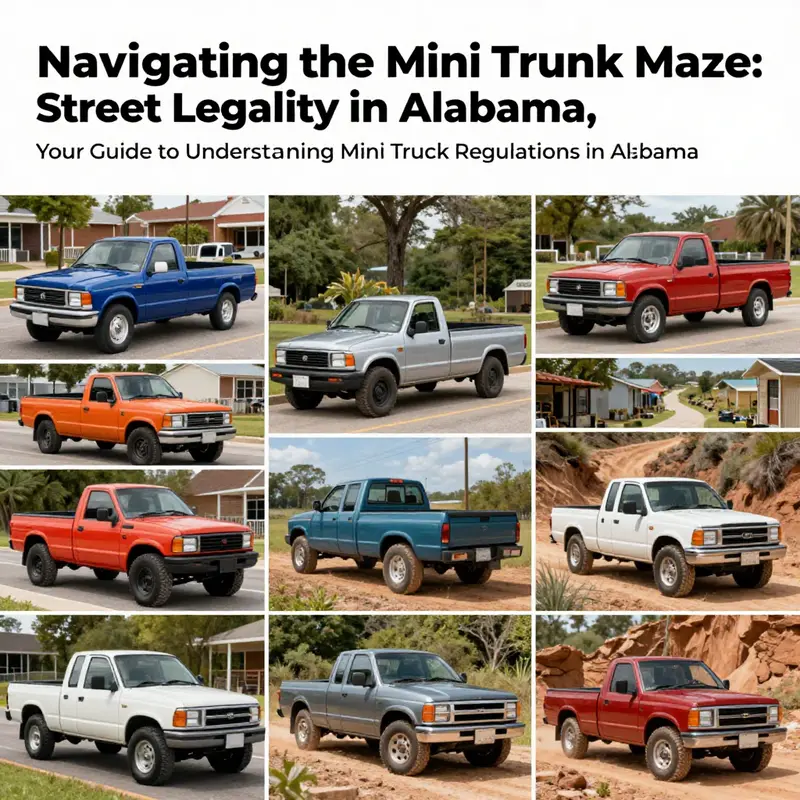
Mini trucks, more commonly known as utility task vehicles (UTVs) or off-road vehicles, have become a popular choice for many small business owners, hobbyists, and residential property owners in Alabama. However, one important question arises—are mini trucks street legal in Alabama? Understanding the legal status of these vehicles is paramount for anyone considering adding them to their fleet or personal arsenal. In the following chapters, we’ll dive into the specifics regarding their street legality, explore what makes a mini truck compliant with state regulations, and discuss the implications of these laws on ownership and operation. Whether you’re a local business owner looking for a dependable work vehicle, a homeowner wanting a fun utility vehicle, or an enthusiast wanting to ensure compliance while enjoying your mini truck, this guide will equip you with the knowledge you need.
On the Road or Off-Road? Navigating Alabama’s Rules for Street-Legally Compliant Mini Trucks
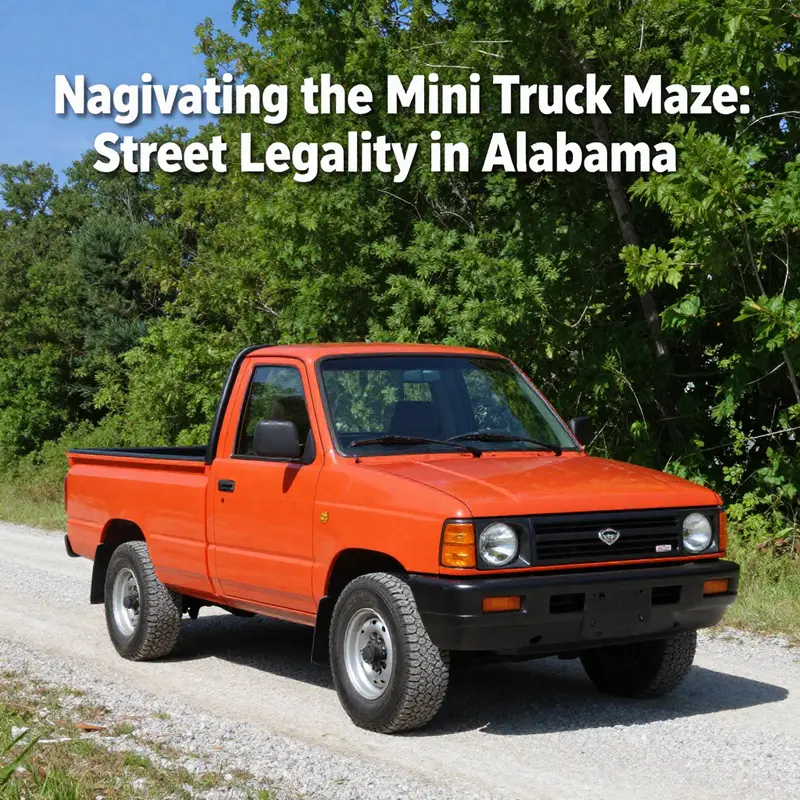
Alabama’s landscape invites practical curiosity about the vehicles people use to move goods, tackle property work, and chase adventures across rural byways and suburban stretches. Among those vehicles, mini trucks often called utility task vehicles or small off road machines sit at an intersection of utility and recreation. The core question many owners, enthusiasts, and first-time buyers ask is whether these compact machines can legally share Alabama’s public roads. The answer is nuanced and tightly bound to safety standards, vehicle classification, and the administrative processes that govern road use. In this chapter, we will trace how Alabama’s rules come together to determine street legality for mini trucks, explain the requirements and practicalities, and outline a clear path for anyone hoping to operate such a vehicle on public streets without courting penalties or liability.\n\nThe starting point is the principle that street legality is not automatic for mini trucks in Alabama. The state’s regulatory framework treats vehicles that enter the public road network as motor vehicles requiring a baseline level of safety, documentation, and financial responsibility. This alignment with federal safety norms is deliberate: it ensures that on road operations are predictable and that occupants and other road users are shielded by consistent requirements. From the outset, a mini truck, to be lawful on a public road, must conform to a set of criteria that span design, labeling, and the paperwork that accompanies road use. The chain of compliance begins with the vehicle’s safety features. Headlights, taillights, brake lights, and turn signals form a mandatory signaling system that communicates intent and status to other drivers. Mirrors provide the necessary rearward visibility, while seat belts secure occupants in the event of a sudden stop or collision. A horn serves as a basic alert mechanism for avoiding hazards. Together, these elements help ensure that a compact vehicle designed for off-road tasks does not become a hazard when sharing lanes with cars, trucks, buses, and motorcycles on paved surfaces.\n\nBeyond the safety hardware, the administrative gatekeeping is equally decisive. A mini truck must be registered and insured through the state’s motor vehicle framework, specifically through the Alabama Bureau of Motor Vehicles in the context described here, and it must bear a valid license plate. Registration and insurance are not mere formalities; they enact the state’s recognition of the vehicle as a motor vehicle subject to traffic laws and the corresponding responsibilities. These steps also create a paper trail that supports liability and accountability in the event of an incident. Registration connects the vehicle to the owner in state records, while insurance provides a financial mechanism to cover damages or injuries that may occur on public roadways. Without both elements, even a vehicle that otherwise meets the technical safety requirements cannot legally circulate on Alabama streets.\n\nA crucial threshold in the legality equation is the vehicle’s classification, which the Alabama Department of Revenue and allied agencies interpret through rules that balance weight, design, and intended use. In practical terms, if a mini truck is classified as a motor vehicle under state law, typically applying to vehicles with a gross vehicle weight rating (GVWR) of 10,000 pounds or less, it may be eligible for registration and operation on public roads, provided it also meets all statutory requirements. This classification is not merely about weight; it serves as a bridge between a vehicle’s physical attributes and the legal permissions attached to on-road operation. When a mini truck falls within this category and can demonstrate conformity to FMVSS, the door opens for public-road use, subject to ongoing compliance.\n\nThe reality for most off-road mini trucks, however, is that they were designed with a single primary purpose in mind: performance off the beaten path. Their lighting packages are often minimalist, their frames and cab configurations may prioritize durability and clearance over highway crashworthiness, and their emissions and safety systems may not align with road-use expectations. In the absence of substantial modifications, these vehicles do not meet the safety and equipment standards that Alabama expects for on-road operation. Operating such a vehicle on public roads can lead to a cascade of consequences: fines at the very least, but potentially more serious outcomes such as vehicle impoundment or liability exposure in the event of an accident. The potential penalties reflect the state’s effort to maintain a predictable mix of road users and to minimize the risk that under-equipped vehicles pose to others on the highway.\n\nYet the pathway from off-road to street-legal status is not closed to all mini trucks. Some models can be transformed or selected to meet the necessary standards, allowing them to be registered and used on public roads. The key condition is that the vehicle must be FMVSS-compliant and capable of fulfilling the federal and state safety requirements. In addition, it must be reclassified and registered as a motor vehicle within the state framework. The practical implication is that owners contemplating street use should be prepared for modifications, inspections, and a potentially substantial investment to bring the vehicle into full compliance. Upgrading lighting to highway-grade standards, adding proper turn signals and mirrors, ensuring that seat belts are present and functional for all occupants, and confirming that the braking system can reliably work under a full range of weather and traffic conditions are all pieces of the puzzle. Emissions requirements, while not exhaustively detailed here, may also factor into the compliance picture depending on environmental regulations and the vehicle’s specific configuration.\n\nAn important part of navigating this landscape is recognizing which agencies hold the reins of the process and how they interact with owners. The Alabama Department of Public Safety (DPS) serves as a primary source of safety standards and operating guidelines that influence whether a vehicle can be operated on public roads. The DPS’s official website is a necessary reference for anyone seeking up-to-date requirements, interpretations of law, and the latest enforcement practices. On the administrative side, the Alabama Bureau of Motor Vehicles (BMV) handles the practical steps of registration and licensing, transforming a compliant vehicle into a road-ready asset. In many states, these tasks may be distributed differently, but in Alabama, the coordination between DPS and BMV is essential to ensure that a street-legal mini truck meets the state’s safety and regulatory expectations. To avoid missteps, readers should verify current classifications and any local nuances with both the DPS and BMV, as well as with the Alabama Department of Revenue’s motor vehicle division where classification determinations may influence registration pathways.\n\nFor those seeking a concise, current summary of these requirements, the combination of the FMVSS standard, the GVWR threshold, and the registration-insurance obligation forms the backbone of Alabama’s street-legal criterion for mini trucks. A practical way to approach this is to audit the vehicle against a checklist that includes: FMVSS compliance verification or retrofit plan, a complete lighting and signaling overhaul to highway-grade specifications, properly installed mirrors and seat belts in all seating positions, a horn that performs reliably, a functioning license plate mount, and a confirmed GVWR at or below 10,000 pounds with classification as a motor vehicle. If any one of these elements is missing or inadequately addressed, even a vehicle that otherwise appears rugged and well-suited for work or recreation may fail the street-legal test at the licensing or inspection stage.\n\nThe practical decision for many Alabama residents, therefore, is a trade-off between the benefits of road access and the costs of compliance. The aligned path typically requires time, coordination with multiple agencies, and, in some cases, retrofits that can approach the price of a new vehicle. It is not a trivial undertaking, but it is a well-lit pathway for those who need to operate a mini truck on public streets for legitimate work or daily mobility. Importantly, the state’s approach is designed to prevent a mismatch between a vehicle’s capabilities and the risks of road usage. It emphasizes that safety features must be on par with the expectations set for all motor vehicles, and it requires ongoing compliance through registration, insurance, and periodic verification.\n\nTo keep readers oriented, it helps to reinforce where to start and what to expect. For official, current guidance, consult the Alabama Department of Public Safety’s resources and the Alabama BMV’s registration instructions. These sources provide the formal framework and the procedural steps necessary for verifying a vehicle’s street-legal status, and they help owners avoid the common pitfall of assuming street legality without securing the proper documentation and equipment. Where local jurisdictions add their own rules, owners should also check municipal codes and county regulations to anticipate any unique road-use constraints that could affect on-street operation. In practice, the decision to drive a mini truck on Alabama roads is not a yes-or-no judgment but a careful alignment of vehicle design, federal standards, state classification, and the obligations that come with motor vehicle registration and insurance.\n\nFor readers who would like to explore further context or perspective, the Mini Trucks Blog offers ongoing discussions and case studies that illuminate the day-to-day realities of owning and operating these vehicles in Alabama and nearby regions. It provides practical insights that complement the formal regulations, helping readers gauge how others have approached the process, what modifications have proven effective, and how local enforcement interprets compliance in real-world scenarios. See the Mini Trucks Blog for more practical perspectives and ongoing updates on the street-legality journey. See Mini Trucks Blog: https://minitrucksocala.com/blog/\n\nAs always with regulatory matters, engagement with official sources remains essential. Because rules and interpretations can shift, especially as new safety technologies or environmental standards emerge, keeping an eye on DPS and BMV announcements helps ensure ongoing compliance and minimizes surprises. The dialogue among manufacturers, vehicle owners, and regulators is ongoing, and it shapes how the market evolves in Alabama. When in doubt, prioritize official guidance over anecdotal advice and seek direct confirmation from the DPS or BMV whenever a vehicle modification or prospective purchase moves into the on-road arena. The effort to align with the law not only protects the driver and others on the road but also reinforces the broader goal of safe, predictable road sharing for all Alabama motorists.\n\nIn closing, the street legality of mini trucks in Alabama is best understood as a regulatory convergence rather than a singular feature. It requires that the vehicle meet federal safety standards, be properly classified as a motor vehicle with a GVWR within the allowed threshold, and be registered and insured through the state’s motor vehicle infrastructure. It also demands that the vehicle carry the essential safety equipment that road-going vehicles rely on every day. While many mini trucks are tailor-made for off-road adventures, there exists a legitimate path for select models to enter the public-road arena, provided owners are prepared to navigate the process, invest in necessary upgrades, and maintain ongoing compliance. The journey from off-road tool to street-legal machine is not guaranteed; it is earned through careful planning, adherence to state standards, and a clear understanding of the legal responsibilities that accompany road use. Official channels remain the most reliable compass, with the DPS and the BMV serving as the primary beacons.
Road-Ready or Off-Road Only? Navigating Alabama’s Street-Legal Path for Mini Trucks
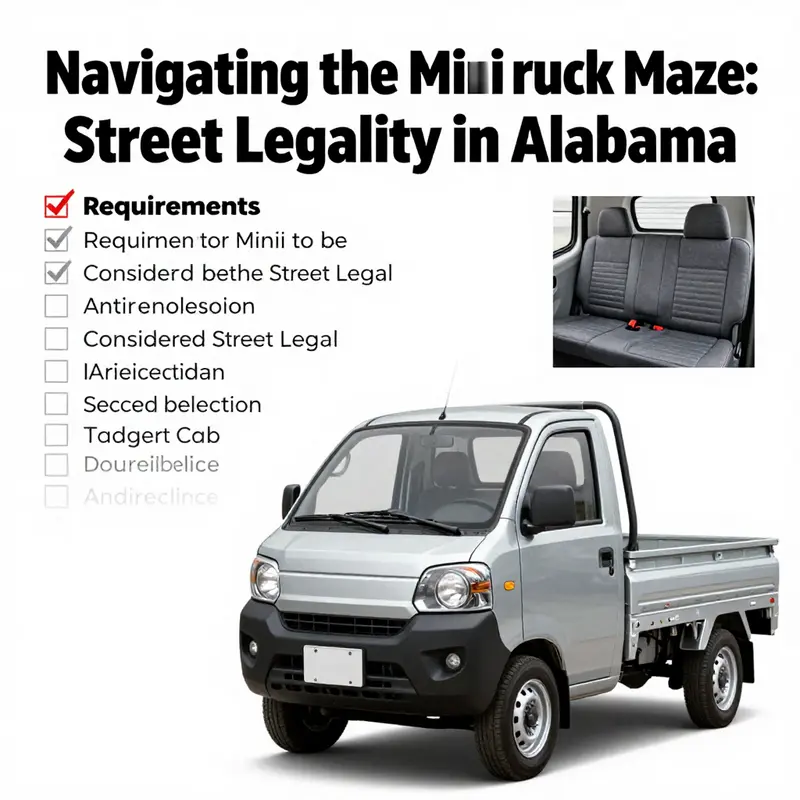
When people ask whether mini trucks can legally share Alabama’s public roads, the answer is not a simple yes or no. The state’s regulatory framework treats these compact utility vehicles with a careful blend of caution and potential, recognizing that a small, low-speed vehicle can deliver practical benefits without compromising general traffic safety. Yet the same framework also places clear boundaries around what it takes for a mini truck to move from off-road usage to street-legal status. To understand how a seemingly modest, nimble vehicle becomes eligible to travel on Alabama’s streets, it helps to picture a continuum rather than a binary classification. On one end lies the vehicle’s design and performance, which determine whether it can even be considered for on-road use. On the other end sits the regulatory process—federal standards layered with state requirements—that governs whether that design can be registered, insured, and operated in public traffic. The middle space is where most aspiring street-legal mini trucks must travel, and that journey is defined as much by documentation and compliance as by engineering specifics.
Alabama’s approach to street legality for mini trucks hinges on two related concepts: classification and conformity. Vehicles are commonly described as low-speed vehicles (LSVs) or off-highway vehicles (OHVs), with the distinction carrying real consequences for where and how they can be used. The DPS and Alabama State Police oversee the safety standards that determine whether a given mini truck can be registered for street operation. The central thread across these rules is safety: a street-ready mini truck must operate as reliably on pavement as it does off it, without introducing hazards to drivers, passengers, or pedestrians. This safety envelope translates into concrete requirements for a vehicle’s core systems—lighting, signaling, braking, steering, restraint systems, and overall structural integrity—while wire-brushing its conformity with federal standards helps ensure uniformity across state lines. The practical reality is that many mini trucks are purpose-built for off-road tasks, with rugged suspensions, compact bodies, and configurations optimized for rough terrain rather than highway stability. That design focus, in most cases, runs counter to the on-road criteria, which is why a significant portion of mini trucks remain legally restricted to off-road use unless they have been deliberately adapted to meet the full spectrum of street-legal standards.
A foundational element of the process is identification and ownership documentation. A vehicle must have a valid Vehicle Identification Number (VIN), a feature that isn’t optional in the eyes of the DMV. The VIN is more than a serial code; it is the key to establishing ownership, tracing the vehicle’s history, and validating conformity with safety standards. Without a VIN, registration and titling become nearly impossible, leaving a mini truck confined to private property or closed-course demonstrations rather than open highways or city streets. Once a VIN is established, the road to legality continues through the acquisition of a title and proof of ownership, followed by the registration process with the Alabama Department of Motor Vehicles (AL DMV). This sequence of steps converts a private-use asset into a documented, trackable vehicle that the public road system can recognize and regulate.
Beyond the paperwork, the tangible safety equipment on the vehicle is non-negotiable. Alabama’s street-legal standard demands that a mini truck be equipped with a suite of functional features designed to communicate intent and protect occupants. Seat belts are not an afterthought; they are a baseline requirement. Lighting must perform reliably: headlights for night visibility, taillights and brake lights to signal deceleration, and turn signals to indicate lane changes and turns. Mirrors must provide a proper field of view to reduce blind spots, and a horn serves as a critical signal in moments of sudden danger or confusion on the road. The vehicle must also carry a horn, a crucial component that can avert near-misses on busy streets. These elements are not merely decorative; they are enforced indicators of the vehicle’s ability to operate in harmony with other road users.
Speed is another decisive factor. In Alabama, mini trucks that are designated for street use generally conform to a maximum speed standard that places them into a low-speed vehicle category. A common threshold cited in federal and state contexts is up to 25 miles per hour. This limit shapes not just how the vehicle is driven but how it is designed and certified. The 25 mph ceiling helps define the operating envelope and informs decisions about braking systems, tire construction, steering geometry, and suspension tuning. It also steers the vehicle toward the appropriate regulatory pathway—LSV status often carries its own set of registration, insurance, and inspection expectations that differ from standard passenger cars. The interplay between speed, stability, and controllability matters because street operation, even at modest speeds, introduces dynamic demands that a public roadway environment imposes on a vehicle’s design and performance.
Registration and insurance complete the statutory triad that makes a mini truck lawful on Alabama’s streets. The owner must register the vehicle with the AL DMV and obtain a title, which requires a proof of ownership along with the payment of applicable fees. Insurance, specifically liability coverage, is mandatory for all registered vehicles, spanning cars, motorcycles, and the more modest street-eligible mini trucks. The insurance requirement serves as a financial safety net for accident scenarios, ensuring that victims and responders have a source of coverage in the event of a collision. The counting of these costs—registration fees, title processing, insurance premiums—should not be underestimated, because the financial implications are often as consequential as the technical requirements. The total package—VIN, safety equipment, lighting, signaling, speed limitations, registration, title, and insurance—together defines whether a mini truck earns the right to share Alabama’s public lanes under a legal framework that prioritizes safety, accountability, and consistency.
Compliance with federal standards remains a central compass throughout this journey. The vehicle must meet Federal Motor Vehicle Safety Standards (FMVSS) related to critical systems such as lighting, braking, and structural integrity. In practice, this means that even a vehicle that is otherwise compact and nimble must demonstrate adherence to the same safety principles that govern larger highway vehicles. This alignment with FMVSS helps ensure that a street-legal mini truck behaves predictably under the kinds of stresses a road experience imposes—braking loads, steering inputs, fatigue resilience, and crash performance being the most prominent concerns. Achieving FMVSS compliance is not merely about ticking a box; it often entails a careful sequence of manufacturer certifications, third-party inspections, and sometimes modifications that bring a vehicle’s hardware and software into alignment with federal expectations. Depending on the specific model and its base configuration, some mini trucks might be engineered to meet FMVSS standards from the outset. Others may require dealer or specialty-shop interventions to install compliant lighting kits, proper seat belt assemblies, or reinforced frames. In either case, the path to on-road legality is inseparable from the vehicle’s ability to meet these safety benchmarks in a way that integrates smoothly with Alabama’s regulatory posture.
Local nuance adds another layer of complexity to the question of street legality. While the state provides a broad framework, counties and municipalities may impose additional restrictions on where and when mini trucks can be operated. Some rural or unincorporated areas might be more permissive, while towns with denser traffic or tighter road geometries may require stricter enforcement or more stringent compliance checks. This local dimension means that aspiring street-legal mini truck owners must not only confirm statewide eligibility but also verify local ordinances, road classifications, and permissive routes before designating their vehicle as a road-going asset. The upshot is clear: legality is not only about meeting a checklist of safety features; it’s also about aligning with the road-rights and road-design realities that specific streets or counties impose. A vehicle that passes the DPS review and the DMV paperwork could still be limited by local use restrictions, which is why prospective owners are wise to consult both state guidance and local authorities when planning regular, unrestricted street travel.
To navigate this landscape successfully, many people begin by distinguishing between a vehicle’s intended use and the legal language that surrounds it. If the goal is regular driving on city streets or arterials, then the mini truck must be prepared to meet a comprehensive on-road standard. That includes validating FMVSS compliance, securing proper registration and insurance, and confirming the vehicle’s operating speed fits the LSV profile. If the aim is modest suburban trips or occasional highway access within a permitted corridor, the regulatory path may still demand the same core elements but could allow for localized exceptions or staged compliance that acknowledges the vehicle’s advanced safety features and its demonstrated reliability. The practical message is that there is no shortcut around the fundamentals: documentation, safety equipment, and conformity with recognized safety standards are the invariant prerequisites that transform a mini truck from a niche off-road tool into a street-legal vehicle in Alabama.
For those who want a more concrete sense of how these requirements play out in daily life, the road map often begins with an assessment of the vehicle’s current state. Look at the vehicle’s lighting and signaling systems, then verify that all components function correctly and consistently. Check the shutdown and reset procedures for safety devices, confirm the presence of seat belts in all seating positions, and inspect the mirrors for adequate visibility. Consider whether the vehicle’s headlights, brake lights, taillights, and turn signals meet state expectations for brightness, color, and durability. The horn should emit a clear signal that can be heard above surrounding traffic noise. If any of these elements are missing or defective, repairs or replacements are usually required before the vehicle can even be considered for inspection or registration. In some cases, these improvements are straightforward and affordable; in others, they may require more extensive work or a reconfiguration of components to align with FMVSS directions.
Once safety features are verified, the next stage is documentation and inspection. The VIN must be verified and matched to the vehicle’s title and registration records. The owner then proceeds to the AL DMV to obtain the title and register the vehicle. At that stage, proof of liability insurance is presented to demonstrate financial responsibility. The DMV will issue license plates and registration credentials if all elements are in order. The vehicle may also be subject to an on-site inspection or a compliance check to confirm that safety features are operational and that the vehicle’s performance characteristics do not exceed the defined limits. This process underscores a central reality: the road-legal status of mini trucks in Alabama is not guaranteed by a vehicle’s dimensions or off-road heritage alone. It rests on a deliberate, verifiable commitment to meet established safety and regulatory standards, as monitored and enforced by state agencies that coordinate with federal guidelines.
For many readers, the prospect of modifying a mini truck to meet these standards can be both enticing and daunting. The prospect of bringing a compact, capable tool into the realm of everyday transportation raises practical questions about cost, maintenance, and long-term viability. The financial equation includes the price of FMVSS-compliant lighting and signaling components, potential frame or structural reinforcements, seat belt upgrades, tires suitable for mixed use, and the fees associated with registration and insurance. Maintenance considerations follow closely: on a daily basis, a street-legal mini truck will require routine checks and timely repairs of braking systems, steering linkage, and electronic controls. These maintenance practices do more than keep the vehicle compliant; they also support overall safety by ensuring that the vehicle retains its on-road performance throughout the miles it covers. In this sense, legality and reliability move together, as ongoing attention to safety features, faults, and calibration instills confidence in the vehicle’s ability to operate safely amid Alabama’s diverse road environments.
As readers weigh these factors, they may wonder how local communities validate the on-road status of a mini truck once it has completed the formal process. In practice, law enforcement and highway safety officials can require proof of compliance during routine stops or inspections. They may request documentation showing FMVSS conformity, registration details, and evidence of insurance. If any element appears out of compliance, the officer may issue a citation or require corrective action before the vehicle can be operated again on public roads. This enforcement reality reinforces the point that street legality is an active state of compliance, not a one-time achievement. Owners should expect ongoing accountability, periodic renewals, and the possibility that local ordinances could introduce occasional restrictions that reflect neighborhood conditions, traffic patterns, or broader public safety considerations.
For those seeking to connect with ongoing updates, practical guidance, and community perspectives, it can be helpful to engage with resources that compile local regulations, case studies, and retrofit experiences. A well-curated blog hub in this space offers real-world narratives about the challenges and triumphs of converting off-road mini trucks into street-legal vehicles. It can be a valuable companion as you navigate the steps described above, helping you anticipate common obstacles, identify reputable services for compliance work, and understand how peers balance cost with safety. For a broad overview rooted in the wider community, you can explore the insights at the following resource: minitrucksocala.com/blog/.
In the end, the question of whether a mini truck can be street-legal in Alabama hinges on a disciplined sequence of verification, modification, and documentation. It requires recognizing that the vehicle’s on-road future is not solely about how it looks or how it performs off-road, but about its readiness to meet a full spectrum of safety and regulatory expectations. The process has structure and predictability, yet it also invites a careful, case-by-case approach given the interplay of state standards and local regulations. For some owners, the reward is practical mobility—an agile vehicle that can navigate urban corridors, run errands, or shuttle passengers within a defined safety framework. For others, the costs and complexities of compliance may steer them toward keeping the vehicle within its traditional off-road role. Either outcome reflects a nuanced landscape where Alabama’s roadways and safety norms ultimately guide the path from private workhorse to public-road partner.
External reference for official guidance: https://www.dps.alabama.gov
Between Off-Road Identity and Public Roads: The Practical Realities of Mini Truck Legality in Alabama
When a curious owner starts shopping for a small, boxy vehicle with a bed that can haul tools, seed, or camping gear, the appeal often rests on two promises: nimble handling and versatile utility. Yet in Alabama, that tug between off-road identity and street legitimacy is not merely a matter of preference. It is a legal distinction with concrete consequences for daily use, insurance, and even personal safety. This chapter does not pretend that every mini truck is a problem waiting to happen; it instead follows the thread of regulation from the moment a buyer moves from dream to driveway, tracing how the state’s rules shape whether a vehicle designed for dirt paths and ranch lanes can ever confidently share the same lanes as commuter cars and school buses. The difference between a vehicle that can legally sip fuel and pass inspection on a public road and one that remains restricted to off-road trails hinges on a cluster of standards and registrations that many first-time buyers overlook, often because they assume a small footprint automatically translates into road-readiness. In practice, the decision to pursue street legality begins with a careful assessment of purpose and ends with matching a vehicle’s build, paperwork, and protection features to a precise set of Alabama requirements. The journey is not simply about whether a vehicle exists that can be driven on public roads; it is about whether the vehicle, as configured, meets the state’s definitions of a motor vehicle, a safety benchmark, and a documented commitment to liability and accountability on public streets. The consequences of misalignment go beyond a one-time fine. They ripple through insurance, ownership records, and the ability to legally operate a vehicle in standard traffic. The story of mini truck legality in Alabama is, at its core, a story about how the line between a specialized off-road tool and a road-ready vehicle is drawn—and who bears the responsibility to keep within it when a driver leaves the driveway and enters the public lane. The rule of law here is not an abstract courtesy; it is a framework built to ensure crash protection, predictable operation, and an auditable chain of ownership and safety compliance that all drivers on state roads can rely on. To understand what this means in concrete terms, one must trace the chain from the initial purchase through registration, tax, insurance, and the ongoing obligations that come with every mile traveled on public asphalt rather than sand or mud. The outline of this chain is not a maze, but a map that requires each stop to align with federally recognized safety standards and Alabama-specific administrative steps. The result can be straightforward for a highly modified, FMVSS-compliant utility vehicle that has been purpose-built to meet the standards and registered accordingly. It can also be ambiguous, or even costly, for a vehicle that remains primarily an off-road unit with little to no compatibility with on-road requirements. In navigating this landscape, owners often discover that legality is not a one-time checkbox but a continuous process of verification and adjustment—ensuring that every feature a driver relies on on the highway is present, functional, and properly documented. The value of clarity at the outset should not be underestimated. A vehicle with the correct lights, mirrors, seat belts, turn signals, horn, and license plate is not merely a matter of compliance; it is a statement that the vehicle is designed for predictable, preventable safety outcomes. It is a signal to other road users that the mini truck, though small, is a vehicle with a recognized role on public streets and a responsibility to shared road safety. When a potential buyer understands this distinction, the decision to pursue or forego street legality becomes a measured assessment of cost, risk, and practicality. The practical questions then shift from “Can it be driven on a public road?” to “What must be added or changed to meet the law, and what will that cost?” The answer rests on a combination of federal safety standards, state registration rules, and the specifics of how the vehicle is equipped and operated. The federal angle—safety standards that many mini trucks do not automatically meet—depends on whether the vehicle can be demonstrated to comply with FMVSS (Federal Motor Vehicle Safety Standards). FMVSS compliance is not automatically granted at purchase; it requires a design and a assembly that conform to detailed performance benchmarks for crash protection, occupant retention, lighting, and more. Alabama follows federal baselines but marries them to state-level registration and licensing policies. The Alabama Department of Public Safety and the Alabama State Police act as gatekeepers, along with the Alabama Department of Revenue for vehicle classification and registration considerations. The interplay among these agencies determines whether a particular mini truck can be treated as a motor vehicle suitable for public roads, a categorically off-road device, or something in between that requires a special permit, a modified configuration, or a different tax treatment. The practical effect for the owner is that legality cannot be assumed from the vehicle’s appearance or name. A small truck that looks like a compact pickup may in fact fail the on-road test if it lacks essential safety equipment or proper registration. Conversely, a rugged unit designed, tested, and certified to meet FMVSS can, with proper documentation and compliance, be registered and insured for road use. The difference is a chain of verifiable steps rather than a single decision at purchase. In Alabama, the chain begins with how the vehicle is registered. The official line from the Alabama Department of Revenue indicates that vehicles must meet certain criteria, including engine displacement, weight, and safety equipment, to qualify for registration as a motor vehicle. If the vehicle does not meet these prerequisites, it remains in a gray area or falls outside road-legal classification entirely. This is not merely a bureaucratic distinction. It has real consequences for licensing, licensing plate issuance, insurance eligibility, and the ability to operate legally on state roads. The stakes rise quickly for someone who uses an unregistered or non-compliant mini truck on public roads. Law enforcement may treat such operation as a traffic code violation, which can lead to fines, vehicle impoundment, or, in cases of repeat violations, more serious charges. Even a single stop can escalate into questions about registration status, proof of insurance, and the vehicle’s intended use. The cost of non-compliance extends beyond fines. Vehicles operated without proper registration or insurance may be denied coverage in the event of an accident. Many standard auto insurers will examine a vehicle’s classification and compliance before underwriting a policy. If the mini truck does not meet the on-road standards, obtaining affordable liability or comprehensive coverage can become difficult, or coverage may be denied after a claim. This creates a financial vulnerability where drivers face out-of-pocket exposure for medical costs, property damage, and legal expenses that ordinarily would be cushioned by insurance. The financial risk is compounded if the vehicle becomes a point of contention in a dispute about fault or if it is involved in a collision with another road user. The consequences of non-compliance ripple into the legal environment as well. Drivers may encounter civil penalties for operating an unregistered vehicle on public roads and could be subject to court costs and administrative fees in addition to any criminal charges that might arise from repeated violations. A clear pattern here emerges: for Alabama residents, legality is not simply a function of vehicle choice; it is a function of ongoing compliance. The state’s classification system, and the administrative processes that support it, require owners to take a comprehensive approach to vehicle readiness. That means not only meeting the structural safety features but also ensuring all the administrative boxes are checked—registration, licensing, and insurance—before the first mile on a public street. For many people, the turning point comes when they realize the difference between buying a vehicle that is compatible with off-road use and buying a vehicle that has been prepared to meet highway safety standards. The process often involves additional steps: ensuring the vehicle is properly registered as a motor vehicle with the Alabama Department of Revenue; confirming it carries adequate insurance through a licensed insurer; and confirming that the vehicle has the required safety equipment. The required safety equipment is not a luxury; it is the minimum set of protections that help mitigate risk on busy roads. Lighting systems must be functional and visible; mirrors must provide a full field of view; seat belts must be present and operable; turn signals must convey intent clearly; the horn must be audible; and the vehicle must display a valid license plate. All of these features are in service of a larger goal: predictable, auditable behavior on the public roadway. They also provide a framework that improves accountability for the vehicle’s operator and reduces the likelihood of crashes with other vehicles and pedestrians. The safety features also bear on the infrastructure conversation in Alabama. When a small utility vehicle is properly equipped and registered, it is counted and tracked as a roadworthy asset within the state transportation ecosystem. This matters for traffic safety data, for enforcement, and for the evolution of regulations that might adapt to changing technology and usage patterns. It is easy to imagine a future where narrow, compact, and lightly powered vehicles play a larger role in urban and rural logistics. But for now, the law requires a cautious approach: a mini truck must prove it is a motor vehicle for on-road use, with documentation that demonstrates compliance with standards intended to protect the driver, passengers, and others on the road. The ambiguity that exists in the marketplace can distort consumer expectations. Some buyers may assume that because a vehicle is small, it must be street legal; others may assume the opposite, that any off-road vehicle is automatically limited to unpaved surfaces. This misalignment often arises from incomplete information or from marketing language that does not clearly separate off-road design intent from roadworthy status. It is why the most reliable way to determine eligibility is to engage with the state’s official channels. The Alabama Department of Revenue’s guidelines are key in this process, but so are the Alabama Department of Public Safety guidelines and the BMV processes that handle license plates and registration for motor vehicles. In practice, a prospective buyer should start with a careful inventory of the vehicle’s features and specifications. If the engine displacement and the gross vehicle weight are within a range that could be classified as a light-duty truck, and if the vehicle includes the requisite safety equipment, then the door to road legality is opened—provided the vehicle can also be configured to meet emissions and noise standards where applicable, and provided it passes any required inspections before registration. The reality is that many mini trucks will not, out of the box, satisfy every criterion for street use in Alabama. They may be excellent for hauling and off-road work, but they might lack appropriate lighting or crash protection on public roads. In such cases, modifications or a different configuration may be necessary. This is not an indictment of the vehicles themselves, but a reminder that meeting the bar for on-road operation is a multi-layered proposition that includes engineering, paperwork, and ongoing compliance. As a practical matter, owners who pursue street legality should view the process as a project with clear milestones: confirm classification with the BMV, ensure insurance coverage, verify compliance with FMVSS where applicable, and complete any required inspections or emissions checks. The journey will vary by vehicle and by county, and it will depend on how a vehicle is used. A utility vehicle used primarily for farm work on a private road may not require the same on-road treatment as one used for daily commuting on public streets. Yet the baseline expectation remains steady: for any operation on a public road, the vehicle must be equipped to the standards that protect all road users. This is where the consumer-facing narrative often becomes more practical than theoretical. For many, the turning point is realizing that street legality is not a badge granted by the vehicle’s size or its off-road lineage, but a status earned through certification, registration, and ongoing compliance. A thoughtful approach blends financial planning, a willingness to adjust the vehicle, and a commitment to staying informed about changing rules. The Alabama regulatory ecosystem is not static; it evolves with technological advances and shifting transportation needs. Therefore, staying current with official sources is not optional but essential for anyone who intends to drive a mini truck on public roads. For readers seeking further context on how these rules translate into everyday decisions—such as the practical realities of obtaining registration, insurance, and compliance—there is value in consulting community resources that document state experiences while reframing them within the official framework. To explore practical perspectives and narrative examples from fellow Alabama residents, you can visit the Minitrucks Alabama blog. This internal reference offers a glimpse into the lived experience of navigating licensing, registration, and the everyday responsibilities that accompany road use, alongside discussions of safety enhancements and regulatory hurdles. The aim is not to persuade or to sensationalize but to illuminate the path from purchase to lawfulness with honesty about cost, effort, and risk. In summary, the legality of mini trucks on Alabama roads hinges on more than the vehicle’s appearance or its off-road pedigree. It hinges on a comprehensive alignment of the vehicle’s design, its safety features, and its paperwork with state and federal standards. The standard is high because road safety is high-stakes. The process demands diligence, and the payoff—a vehicle that can truly serve as a practical, lawful transportation option—depends on that diligence more than on any single feature or exemption. As regulations continue to mature and as owners gain experience with the steps required, the landscape will become clearer for future buyers and operators. The core takeaway remains simple: in Alabama, street legality for mini trucks is not assumed; it is earned, layer by layer, through careful preparation, informed decision-making, and ongoing compliance with the state’s motor vehicle framework. External reference for readers seeking official guidance and current requirements: https://www.dor.alabama.gov/vehicle-registration
Final thoughts
Understanding the legal landscape surrounding mini trucks in Alabama is crucial for anyone considering their purchase or operation. It’s clear that while many mini trucks may not automatically qualify for street use, those that can be modified to meet state regulations offer a range of benefits for owners and operators. By ensuring your mini truck complies with all necessary requirements, you not only enhance its utility but also ensure a safer experience on the roads of Alabama. Whether you’re using it for work, leisure, or exploration, knowing the laws surrounding mini trucks can make all the difference to your enjoyment and use.