
Mini trucks, those compact and versatile utility vehicles, are beloved by business owners, property owners, and enthusiasts alike, especially in California. However, with their growing popularity comes a crucial question: Are they street legal? The answer isn’t straightforward and depends on vehicle classification, compliance with regulations, and safety standards. As we dive into this topic, we’ll explore the classification of mini trucks and their legal status, necessary regulatory compliance, safety and emissions standards, and practical considerations for driving mini trucks in California. By the end of this journey, you’ll have a thorough understanding to guide your mini truck experience safely and legally.
Between Compact Cargo and California Compliance: The Legal Landscape for Mini Trucks on the Golden State’s Streets
In California, the appeal of tiny trucks lies not in bravado but in the practical promise of efficiency, maneuverability, and lower operating costs for urban logistics. Yet the question of whether these compact vehicles can truly share the state’s streets hinges on a layered framework of laws and regulations, not a single, blanket rule. To understand the path from concept to fully compliant street use, we must trace how California classifies these vehicles, what emissions and safety standards apply, and how registration and insurance decisions interact with road rules. The result is a narrative that begins with a clear definition of what qualifies as a mini truck in the eyes of the state, then follows the bureaucratic and technical steps required to reach road-ready status, and finally considers a shifting frontier in how autonomous concepts could alter the regulatory landscape for light-duty transport in the near future. The core of this inquiry is a tension between the appeal of small, efficient urban mobility and the fixed standards that govern who may drive on public roads, when, and under what conditions. A compact electric truck marketed as street-legal might look ready for service, but California requires a chain of verifications that translate marketing claims into lawful operation. The state’s approach to street legitimacy begins with classification. Under California law, a mini truck falls into a broad category: a motor vehicle designed, used, or maintained primarily for the transportation of property, with a gross vehicle weight rating (GVWR) under 10,001 pounds. This category encompasses small vans, pickup-style vehicles, and panel or step vans that are commonly deployed for delivery and logistical tasks. The practical effect of this classification is that these vehicles must be treated like other light-duty motor vehicles when it comes to registration, inspections, and road usage. A vehicle in this class is not automatically road legal simply because it is small; it must be registered with the California Department of Motor Vehicles (DMV), meet emissions requirements, and satisfy safety standards designed to protect drivers, passengers, and other road users. The emphasis on GVWR and function—that is, transportation of property—anchors the regulatory expectations in a way that mirrors the responsibilities of commercial delivery operators. It is not merely the size that matters; it is how the vehicle is used, what it is capable of, and whether it has the safeguards and certification required for public road operation. In practice, this means that even a well-engineered electric mini truck, which may boast advanced battery packs and a compact footprint, must be shown to satisfy a constellation of standards before a registration can be granted or a license plate can be issued. The DMV’s gatekeeping role is not simply administrative. It reflects a public policy judgment: vehicles entrusted with carrying property and people on city streets must meet uniform safety and environmental criteria. Emissions compliance, for example, remains a cornerstone for most vehicles registered for street use in California. Smog checks, where applicable, are part of ensuring that a vehicle’s emissions profile aligns with state air-quality goals. The schedule for smog testing varies with age and vehicle type, but the underlying principle is that any vehicle that contributes to air pollution must be demonstrably within permitted limits. For a newer compact electric vehicle, the smog test may be less onerous than for a gasoline-powered counterpart, as electrics have no tailpipe emissions. Nevertheless, a vehicle must still be evaluated against CARB requirements and any applicable federal standards to be considered street-legal here. Safety standards are the next layer of verification. A vehicle must meet federal and state safety standards that cover a wide range of components: lighting, brakes, steering, tires, seat belts, and occupant protection. The presence and condition of essential features such as headlights, taillights, turn signals, reflectors, brake lights, and proper illumination at night are not mere recommendations; they are statutory prerequisites for public road operation. Braking performance, steering response, and tire integrity form part of a vehicle’s baseline safety profile. California’s rules are designed to ensure that small machines used for transporting goods in busy urban corridors do not pose disproportionate risks to other motorists, cyclists, or pedestrians. The final prerequisite for street legality concerns identification and insurance. A vehicle must be registered and display license plates; the operator must carry valid driver’s licenses appropriate to the vehicle class, and insurance coverage is typically required. Without registration, insurance, or plate display, a vehicle cannot legally operate on public streets. If a device is marketed as a street-legal model, it may come with documentation suggesting compliance with certain international standards. However, EEC approval, or any official-sounding certification from a non-U.S. jurisdiction, does not automatically guarantee compliance with U.S. Federal Motor Vehicle Safety Standards (FMVSS) or California-specific requirements. The burden remains with the purchaser or operator to verify FMVSS alignment and CARB conformity. To confirm street legality in California, the prudent approach is threefold. First, verify with the DMV that the specific vehicle model is listed as eligible for registration. The DMV maintains a registry of model eligibility, and some models may be deemed acceptable for street use, while others may be designated only for off-road or limited-use contexts. Second, obtain from the manufacturer or seller documentation proving compliance with FMVSS and CARB requirements. This documentation is not just a formality; it is a demonstrable trail of safety and emissions certification that the DMV can audit during the registration process. Third, determine whether the vehicle can be treated as a low-speed vehicle (LSV) or a neighborhood electric vehicle (NEV). These classifications carry restricted speed limits and usage rules, typically placing the vehicle in a lane position that corresponds to lower-speed operations and, in some cases, limiting access to roads with maximum speeds under a certain threshold. The distinction is meaningful because some mini trucks may qualify as LSVs or NEVs if they meet specific speed, weight, and safety criteria. The practical effect of such a designation is an allowable but constrained operating envelope: the vehicle can be used on certain streets and might be subject to limits on where, when, and how it can be used. This is not a license to roam free on any roadway or to bypass regulatory expectations; rather, it is a carefully delineated permission that reflects the vehicle’s size and performance. The patchwork of requirements means that many compact electric trucks marketed as street-legal are not automatically so. The landscape is further complicated by the ongoing regulatory discourse surrounding autonomous technology in the state. Autonomy adds a new dimension to the legality question because vehicle developers seek to test and deploy driverless freight solutions in real-world settings. Historically, California’s regulatory framework limited the testing of autonomous light-duty transport vehicles on public roads, largely excluding these kinds of vehicles from the tests that have dominated other segments of the autonomous vehicle landscape. In early 2026, there was a notable policy shift in motion. The California DMV released a Notice of Proposed Rulemaking proposing to amend current regulations to permit testing of autonomous light-duty delivery vehicles on public roads. If adopted, the rule would remove the long-standing prohibition against testing these vehicles, thereby opening a pathway for companies to trial autonomous mini trucks in real-world conditions. The public comment period for the proposed rule is open through late May 2026, with a hearing scheduled for late May in Sacramento to gather input from communities and stakeholders. The potential regulatory change marks a significant inflection point. It signals a shift from a cautious, stepwise approach to a more permissive posture toward autonomous freight and delivery systems. Yet this the NPRM is not a final decree; it is an invitation to participate in shaping the path forward. For readers grappling with whether a specific mini truck can be legally driven on California streets today, the NPRM adds a layer of context: the road map for the future may hold quicker, broader access to autonomous light-duty transport, but the present legal status remains anchored in the familiar triad of classification, emissions, and safety. The current state of play is that, even if a model claims street-legal status in marketing copy, there is no universal guarantee that it will be accepted for registration and road use in California. A careful, model-specific verification is essential. Prospective buyers or operators should pursue a dialogue with the DMV, request the model’s FMVSS and CARB documentation, and confirm whether the vehicle is treated as an LSV or NEV, if applicable. The process may involve inspecting the vehicle’s safety features, confirming its electrical and braking systems, and ensuring that the vehicle complies with California’s emissions standards where required. In practical terms, this means the buyer should expect a period of due diligence rather than an immediate, universal green light. The path to lawful operation is not only about meeting a checklist but about integrating the vehicle into the state’s broader regulatory framework, which governs everything from street speed and lane usage to insurance requirements and registration procedures. For many operators, the road to legality is navigated through a chain of confirmations: model eligibility, FMVSS conformity, CARB compliance, and a successful registration process that culminates in the issuance of license plates. Once those steps are completed, the vehicle can legally operate on public roads, subject to any applicable limitations tied to its classification, such as those associated with LSVs or NEVs. This careful approach, while perhaps more exacting than the impulse to simply “buy and drive,” serves a public interest by ensuring that small, efficient vehicles contribute to mobility without compromising safety, air quality, or traffic harmony. The evolving regulatory horizon adds a note of cautious optimism for those who imagine a future in which fleets of compact electric trucks serve urban streets with quiet efficiency and predictable safety profiles. The recent regulatory discourse signals a willingness to reassess long-standing constraints around autonomous testing and to consider integrated models of vehicle certification that could better accommodate the realities of light-duty delivery in dense urban environments. Yet the essence remains: street legality is not a given; it is earned through verification, certification, and compliance. Those who seek to use a mini truck on California roads should approach the process as a compliance project rather than a purchase decision. Engage with the DMV early, secure the necessary documentation from manufacturers and sellers, understand the vehicle’s classification and any applicable speed restrictions, and prepare for the possible need to limit usage to designated streets or zones if a non-LSV NEV path or full certification is not yet achieved. The topic intersects with broader questions about how the state will balance innovative transportation technologies with traditional safety imperatives, environmental goals, and the rights of other road users. The coming months and years will likely bring clarifications as rulemaking progresses and as agencies align their frameworks to accommodate emerging vehicle forms and autonomous capabilities. For readers who want to explore the topic further beyond the mechanics of legality, there is value in examining how these issues play out in practice on the ground. The ongoing conversation around mini trucks in California is not merely about legality in a vacuum; it is about the evolving interplay between mobility needs, environmental commitments, and the governance structures that keep streets orderly and safe. As this dialogue continues, readers can draw practical guidance from a broader community of enthusiasts and industry observers who document experiences, share compliance strategies, and discuss the real-world implications of California’s evolving rules. For those seeking further reading on related topics and practical considerations, the blog community offers a range of perspectives and case studies that illuminate how enthusiasts and operators navigate the transition from concept to compliant operation. To explore more about the local mini truck scene and practical considerations for owners, you can visit the Minitrucks CA blog. minitrucks CA blog. In addition to the practical registration and compliance steps, readers should stay informed about the regulatory environment as the state continues to refine its approach to autonomous light-duty testing and broader urban mobility experimentation. The California DMV’s NPRM signals a potential pivot point: a formal willingness to test and observe autonomous transport in real traffic conditions, which could, in time, influence both the perception and the reality of how mini trucks are deployed and regulated in cities. For researchers and policymakers alike, the NPRM also raises questions about how to ensure safety and accountability in a future where small, autonomous, potentially cargo-focused vehicles share space with traditional automobiles, bicycles, and pedestrians. The regulatory conversation is still unfolding, and the best-informed path for stakeholders remains a careful, documented, model-specific approach to compliance. External resource: California DMV Notice of Proposed Rulemaking: Testing of Autonomous Light-Duty Delivery Vehicles. https://www.dmv.ca.gov/portal/dmv/online-services/notices-of-proposed-rulemaking/
Regulatory Pathways for California Mini Trucks: On-Road Legality and Compliance
California’s on-road legality for mini trucks hinges on three pillars: classification, emissions compliance, and safety standards. First, vehicle classification determines whether the mini truck can be registered for public roads, often as a light-duty vehicle, a low-speed vehicle (LSV), or a neighborhood electric vehicle (NEV), with each category carrying specific speed limits and equipment requirements. Second, emissions compliance requires adherence to California Air Resources Board (CARB) standards; even if a vehicle meets other jurisdictions’ approvals, CARB certification and applicable emissions labeling may be required, along with inspections where applicable. Third, safety standards govern FMVSS conformity and California-specific requirements; a vehicle lacking FMVSS alignment will face registration barriers. The DMV verifies model eligibility before registration, and buyers should gather ownership documents, a bill of sale, manufacturer disclosures, and any FMVSS/CARB certifications, as well as proof of insurance to operate on public roads. The regulatory landscape is evolving as California expands low and zero emission mandates, and future rulemakings may tighten requirements for compact and light-duty vehicles. In practice, a street legal mini truck is one that has a registered model, validated certifications, categorical compliance (LSV/NEV where applicable), and insurance, enabling lawful operation and alignment with public safety and environmental goals.
On the Road to Compliance: Navigating Safety, Emissions, and the California Street-Legal Maze for Mini Trucks
California’s regulatory landscape for vehicles that barely fit within traditional categories is rarely straightforward. When people ask whether mini trucks are street legal in the state, they are really asking how a small electric or gas-powered work vehicle can meet a dense network of rules designed for larger, more conventional pickup trucks and cargo carriers. The short answer is: legality isn’t automatic. It depends on how the vehicle is classified by state authorities, which emissions standards it must meet, and whether it has passed the safety and insurance benchmarks that California attaches to all vehicles used on public roads. The longer answer is about how the state’s push for cleaner air and safer roads shapes a future in which even compact work vehicles will need to demonstrate compliance across several fronts, often with the treating touch of time, documentation, and verified certifications.
At the core of the California approach is the interplay between classification, emissions, and safety. Vehicles that fall into the light-duty category—essentially small trucks, camper vans, and similar utility vehicles used on public streets—are not exempt from the rules that govern larger trucks and passenger cars. Emissions compliance is crucial, and so is adherence to Federal Motor Vehicle Safety Standards (FMVSS) as adopted and augmented by California requirements. Even when a mini truck is electric and marketed as a “street-legal” vehicle abroad or online, the absence of FMVSS alignment or CARB verification alone does not guarantee that it can be registered for road use in California. The burden falls on the manufacturer or seller to demonstrate that the vehicle meets U.S. safety standards and California’s air quality regulations, and on the buyer to confirm that the model can be legally registered with the Department of Motor Vehicles (DMV).
The state’s broader environmental strategy adds a critical context. CARB’s long-range plans are setting a high bar for emissions, even as they extend a practical pathway for smaller vehicles to participate in the transition toward zero-emission mobility. This is not about picking winners among vehicle sizes; it is about ensuring that every vehicle sold for use on California roads contributes to cleaner air and quieter streets. The Advanced Clean Trucks (ACT) rule, while aimed at medium- and heavy-duty trucks, embodies a policy shift that signals how seriously California intends to reduce tailpipe emissions across the spectrum. The rule establishes a timeline and framework for automakers to plan the electrification of their fleets, with flexibility during the transition. Practically, this means that even mini trucks—when brought to market or imported for sale in California—must be designed with the state’s ZEV ambitions in mind. The long-range projection—targeting zero-emission powertrains for all new trucks eventually—casts the regulatory shadow far beyond the largest haulers and into the compact, last-mile, and urban-friendly niches that mini trucks inhabit.
In California, the pathways to legal road use for mini trucks frequently hinge on how the vehicle is classified and how its emissions profile is certified. If a mini truck is categorized as a light-duty truck with a zero-emission powertrain, that vehicle might meet the state’s ZEV mandates for new car and light-duty sales, which require a growing percentage of sales to be zero-emission. That status does not automatically translate into immediate registration victory, though. The vehicle must still obtain the appropriate documentation from the manufacturer to prove FMVSS compliance and CARB verification. California’s DMV team will verify the model’s eligibility for registration by checking the model year’s compliance status, the presence of a valid EPA registration, and whether the vehicle is certified for road use under FMVSS and California’s air quality standards. This means that the “street-legal” label often attached to a mini truck by a seller or distributor may reflect market positioning rather than regulatory clearance for California’s streets.
One pathway that sometimes appears in discussions about mini trucks is the designation as a low-speed vehicle (LSV) or, less commonly, a neighbourhood electric vehicle (NEV). These classifications are designed to enable safer and more efficient use of small, low-speed electric vehicles on certain roads with restricted speed limits. The LSV category in California carries specific limitations: top speeds are capped, and usage is typically restricted to streets whose posted speed limits do not exceed a certain threshold. LSVs must meet particular lighting, seat belt, and safety equipment requirements, and operators generally need a valid driver’s license, registration, and insurance. The NEV designation shares a similar philosophy but may be oriented toward very short-range urban operation. For mini trucks, achieving LSV or NEV status can be a practical route to road use in some contexts, but it also imposes speed and route restrictions that narrow where and how the vehicle can be used. Importantly, being categorized as an LSV or NEV does not automatically absolve a vehicle from CARB’s consideration for zero-emission mandates or FMVSS compliance; the vehicle still must be designed and certified to meet the governing safety and emissions frameworks.
The practical implication for buyers and operators is clear: a mini truck that hits the market as a compact, electric, or hybrid utility vehicle must go through a rigorous confirmation process before it can be registered, insured, and plated for use on California streets. The DMV’s role goes beyond a simple paperwork step; it is a gatekeeper that ensures the model’s safety features—brakes, lighting, seat belts, crashworthiness—and emissions profile align with state law. The process typically involves discovering whether the model is listed as eligible for registration, obtaining documentation that proves FMVSS compliance and CARB conformity, and confirming whether the vehicle fits within the LSV or NEV category, if those designations apply. The DMV also considers whether the vehicle can be properly equipped with license plates and whether the insurance system will recognize and cover it under California’s requirements.
For individuals contemplating a purchase, the first rule of thumb is to check with the California DMV about the model’s eligibility. This step is essential because the list of eligible models is not static. It evolves as manufacturers update designs, as new certification data becomes available, and as California’s regulatory expectations shift with the state’s decarbonization timeline. A second important step is to obtain verifiable documentation from the manufacturer or seller. This documentation should demonstrate FMVSS compliance and CARB certification, or at least a clear path to certification. Without this documentation, even a vehicle that appears well-suited to street use may not pass the registration hurdle. A third piece of due diligence is to assess whether the vehicle is intended to function as a full street vehicle or as an LSV/NEV. If the latter, the buyer must understand the speed limitations and permissible road types and ensure that daily routines fit within those constraints.
There is also a broader consumer education aspect that relates to the speed and duty-cycle of mini trucks. While some buyers may be drawn to the compact footprint and urban utility of these vehicles, California’s air-quality rules and the evolving grid of safety requirements mean that the feasibility of operation on a day-to-day basis depends on more than just the vehicle’s electrical range or payload. The state’s ZEV strategy pushes manufacturers to deliver cleaner, more efficient options across all vehicle classes, which gradually shifts the market toward models that can meet FMVSS and CARB expectations without extensive retrofit work after purchase. That shift has ripple effects: it influences financing, insurance costs, and even the availability of charging infrastructure tailored to commercial users who might rely on mini trucks for deliveries, on-site maintenance, or campus-based logistics.
The cultural and practical implications of this regulatory setup are worth noting. California’s environment is not merely a set of rules on a page; it is a living market where the demands of air quality, traffic safety, and urban design converge. Communities increasingly expect quieter streets and lower emissions, especially in dense neighborhoods and near sensitive land uses. The regulatory signals therefore encourage a transition toward micro-mized, electrified vehicles that can perform essential work without contributing to local pollution or compromising safety. In this sense, the fate of mini trucks in California is less about whether a given model can be strapped with a plate and sent down the road, and more about whether the vehicle can be certified to the standards that the state has defined and enforced over time.
For readers who want to explore practical, current perspectives on this topic, the ongoing conversation within the mini truck community and among enthusiasts often centers on how to interpret the latest regulations alongside real-world ownership experiences. Those conversations are frequently tuned to the pace at which new models arrive, the speed with which certifying documents are issued, and the clarity of DMV guidance. A collector’s or operator’s curiosity about the regulatory intricacies can be enriched by following industry updates and community discussions through dedicated outlets and blogs that track policy changes, compliance developments, and the evolving market landscape. For readers seeking ongoing context, the Mini Trucks Blog offers a centralized resource that tracks news, regulatory shifts, and compliance considerations for California and neighboring regions. Mini Trucks Blog
The landscape also invites a broader contemplation of safety and infrastructure. California’s standards do not exist in a vacuum; they interact with road design, vehicle testing, and consumer protection. Safety features that might be taken for granted on larger pickups—advanced braking systems, collision avoidance, and robust rollover protection—are not universally mandated for ultra-compact mini trucks, especially those playing a niche role in light-duty work. Yet the state’s safety framework is built to ensure that any vehicle on public roads meets baseline protections. This creates a dynamic tension for manufacturers who aim to bring small, affordable, and efficient work vehicles to market. They must negotiate the fine line between cost-conscious design and the essential safety and emissions criteria that California expects. For buyers, that tension translates into a careful weighing of price against the likelihood of registration, the certainty of ongoing compliance, and the practical utility of the vehicle within the state’s road network.
In this context, the question of street legality is not simply binary. It becomes a layered assessment of a model’s regulatory readiness, the certifiable safety specifications it carries, and the structured timeline through which California intends to transition to a fully zero-emission fleet across segments. The ACT rule, while not directly governing a compact mini truck, signals that the state intends to standardize and accelerate the adoption of zero-emission technologies, which in turn shapes how manufacturers approach certification for the U.S. market. A product that reaches California with FMVSS alignment and CARB verification can, in principle, be registered, licensed, and insured, but it still must pass a DMV check that confirms model eligibility and the availability of the relevant documentation.
For anyone navigating this domain, the core takeaway is clear. Street legality in California hinges on compliance, not on appearance or promotional claims. It demands proof of safety and emissions conformity, a valid registration pathway, and an understanding of how small electric vehicles fit into the state’s ambitious climate and mobility goals. The regulatory journey may be intricate, but it is designed to secure the roads for all users while fostering a market environment where clean, compact work vehicles can thrive. The evolving policy landscape invites ongoing attention from buyers, sellers, and regulators alike, as the state’s decarbonization agenda gradually reshapes what is possible for mini trucks on California pavement.
To stay connected with the latest practical guidance and user experiences, readers can turn to community-focused resources that regularly synthesize regulatory updates with field observations. These platforms provide timely notes on model eligibility, the documentation required by the DMV, and the shifting interpretations of safety and emissions standards as manufacturers adapt to California’s timetable. They also offer a sense of how real-world operations—like urban deliveries, campus logistics, or construction-site support—mesh with the state’s regulatory expectations. For those who want to anchor their understanding in a current, accessible source, a deep dive into ongoing updates can be found in the Mini Trucks Blog linked earlier. This repository of practical insights complements the formal regulatory channels and helps readers map the path from interest to compliant operation.
External resource for regulatory context: For official policy details on California’s advanced clean truck standards and the evolving regulatory framework, see the CARB Advanced Clean Trucks Rule page. This resource provides comprehensive timelines, vehicle classifications, and compliance considerations that influence even the smallest entrants to the road in California. CARB Advanced Clean Trucks Rule
Rolling Rules and Real Roads: Navigating California’s Terrain and Regulations for Mini Trucks
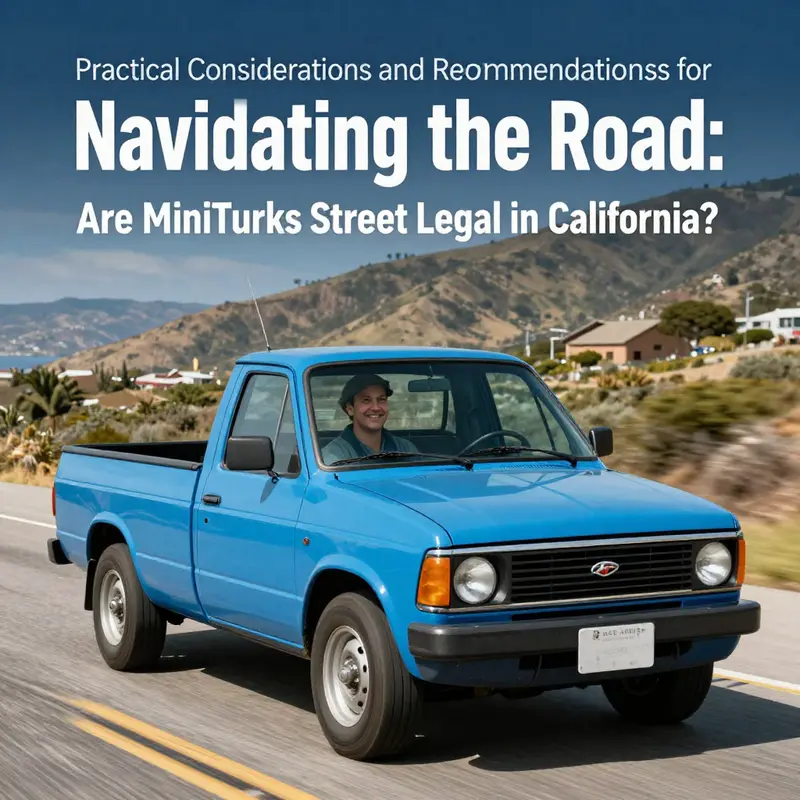
California presents a distinctive landscape for any vehicle that sits in the gray area between a car and a commercial truck. The state’s geography alone—coastal plains, high desert, mountain passes, and arid basins—creates a spectrum of operating conditions that a mini truck must contend with. Yet the regulatory framework adds a second, equally challenging layer: to drive on public roads, a compact utility vehicle must fit into a few workable classifications and satisfy a web of compliance requirements that are unique to California. This convergence of terrain, climate, and policy means that the question of whether mini trucks are street legal in California has no single answer. It depends on how the vehicle is built, how it is certified, and where and how it will be driven. What follows is a synthesis of practical realities tied to the state’s rules, with emphasis on how a small, utility-focused truck can either be a legally compliant workhorse on California streets or a regulated challenge that requires careful navigation before it ever leaves a driveway or a worksite.
To begin with, the core distinction many buyers encounter is between traditional, full size road vehicles and the various forms of low speed or neighborhood electric vehicles that claim street access when they meet particular standards. In California, a mini truck may attempt to slot into one of several categories, yet not every model automatically qualifies simply by virtue of small size or electric propulsion. The state requires that the vehicle be registered with the DMV, undergo an emissions inspection where applicable, and meet safety standards that align with both federal requirements and California’s own safety and environmental rules. In practice, then, a vehicle marketed as street legal in another market may still need to demonstrate FMVSS compliance for the United States and CARB compliance for California; that proof is not always provided by the seller, and it is not guaranteed by European or international certification alone. This is why prospective owners are advised to verify model eligibility with the DMV, request documentation showing adherence to FMVSS and CARB requirements, and determine whether the vehicle falls into the category of a low-speed vehicle (LSV) or a neighborhood electric vehicle (NEV). Those classifications come with speed limits, usage restrictions, and registration pathways that can materially affect how, where, and when the vehicle can be operated on public roadways.
Even as a prospective owner delves into compliance, the practical questions adapt to California’s climate. The state’s dramatic temperature shifts—from cool coastal mornings to desert heat and, at elevation, chilly nights—can alter how a mini truck performs in daily use. The battery or fuel system, the braking response on high-altitude or long-descend routes, and the integrity of lighting and signaling in humid coastal fog or desert dust—all these factors intersect with regulatory expectations. For a small electric or hybrid mini truck, the real-world question becomes not merely can it be registered but will it remain reliable under the daily rigors of California driving while continuing to meet the ongoing emissions and safety checks. This is where the choice of a vehicle’s configuration matters. In general, vehicles intended for rough terrain or worksite duty benefit from a robust drivetrain that can handle variable traction. Among four-wheel-drive configurations, there is a spectrum from permanent four-wheel drive to part-time systems that engage four wheels only when needed. The decision carries implications for wear, efficiency, and, ultimately, compliance with road-use standards. California’s environment rewards a vehicle that can cope with muddy access lanes on a farm, rocky desert washouts, or snow-dusted pass routes while maintaining predictable handling, stable braking, and compliant lighting. The challenge is balancing capability with long-term legality and cost.
A comprehensive path to legality begins with the DMV. The California DMV requires that the vehicle model be eligible for registration. This means confirming that the model has been certified for U.S. road use, or that the manufacturer or distributor can provide documentation proving compliance with FMVSS (the federal safety standards) and CARB (the state’s air quality standards). It also means identifying which regulatory track the vehicle would take—LSV or NEV versus a conventional passenger vehicle. An LSV is designed to operate at speeds up to 25 mph, typically on streets with posted speed limits at or below 35 mph where local ordinances permit such use. NEVs share some of the same constraints but may have different regulatory definitions depending on the local jurisdiction and the way the vehicle is marketed and certified. In practice, many mini trucks marketed globally either fit into the LSV/NEV pathway or are treated as off-road or non-compliant until a specific conversion, certification, or registration pathway is completed. The DMV’s official guidance and the manufacturer’s documentation together determine whether a model can be registered as a street-legal vehicle in California; in gray areas, engaging with a licensed DMV office is essential to confirm eligibility and to determine any steps required to bring the vehicle into compliance.
Another pillar of legality is emissions compliance. California’s environmental oversight is more stringent than many other states, and CARB enforcement plays a central role in the road-legal status of any small electric or hybrid vehicle. Even when the vehicle is zero-emission or ultra-low-emission, it must demonstrate that it meets the specific CARB requirements for the intended use class and that it can pass the state’s smog or emissions inspections where applicable. The four-year rule for smog checks—where vehicles beyond a certain age must undergo screening—adds a recurring compliance task for owners. For small, electric mini trucks, traditional exhaust-based emissions tests may be less of an issue, but CARB’s broader standards for evaporative emissions, battery safety, and electrical system integrity can still apply. The upshot is that buyers should seek documentation showing that the vehicle’s powertrain and energy storage systems meet CARB rules and that the necessary conformity statements exist for road use in California. Without such documentation, a vehicle risks being deemed non-compliant or non-registration-worthy by the DMV, even if it is technically street-legal in another jurisdiction.
Safety standards in California are intertwined with federal requirements, and the result is a layered verification process. Beyond emissions, a street-legal mini truck must satisfy safety criteria such as lighting, braking, and seat belt provisions. Federal Motor Vehicle Safety Standards (FMVSS) govern fundamental vehicle safety parameters in the United States. As California adopts and enforces federal standards, any model seeking registration will need to show alignment with FMVSS for its class. In addition, California may impose its own safety expectations around specific equipment customization, such as packaging for a cab-and-chassis configuration. The cab-and-chassis setup is not merely a preferred configuration for some commercial buyers; it is often a strategic choice in California because it provides the flexibility to install job-specific bodies—like refrigerated boxes for perishables or tool storage for service fleets—while still aiming for compliance with emissions and safety rules. However, any such customization is likely to be scrutinized for how it affects the vehicle’s overall safety performance, vehicular identification (including VIN assignment if required), and how it remains compliant with state lighting standards, signaling devices, and occupant protection.
Insurance and identification are the practical glue that holds the legality together. In California, vehicles operated on public roads require proper license plates and insurance. Even if a mini truck is classified as an LSV or NEV, the state demands appropriate registration and insurance coverage commensurate with the vehicle’s use, whether for commercial fleets, farm operations, or personal transport in rural areas where roads are shared with other traffic. The need for clear ownership records and proof of liability coverage cannot be overstated, since gaps can derail a registration at the DMV or result in penalties for unregistered operation. The broader lesson here is that road legality is not only about a stamp of approval on paper; it is about a complete, documented package that travels with the vehicle on every trip. This package includes the model’s compliance certification, the certifying documents provided by the manufacturer or distributor, the proof of insurance, and the license plates that show the vehicle’s authorized status on California roads.
In practice, the optimal path toward a legal, California-ready mini truck is to prioritize a configuration that supports both compliance and flexibility. A cab-and-chassis layout offers the adaptability needed for California’s diverse job sites and uses, from urban delivery nearby ports and urban farmers markets to remote work areas and construction zones. When such a vehicle is paired with a drivetrain option that provides sufficient traction for variable terrain—whether in the inland empire’s dusty corridors, the Sierra foothills after a late snow, or wet-season farmland—the operator gains not only practical capability but also a better case for continued compliance as standards evolve. The drivetrain choice, including nuanced questions about permanent four-wheel drive versus part-time four-wheel drive, should align with the typical work profile. If the job frequently involves mud, snow, or uneven off-road surfaces, a well-calibrated 4WD system can keep traction and control without sacrificing too much efficiency on paved roads. If the tasks are mostly on paved streets with occasional rough access, a part-time 4WD system that can be engaged as needed may provide a better balance between fuel economy and capability. The key is to select a system that does not compromise essential safety features or certification credentials while still meeting the practical demands of California’s road network.
The landscape of available mini trucks continues to evolve, and so do the regulatory expectations. It is reasonable to expect that as of early 2026, many small electric trucks still face classification challenges—labels like off-road or non-compliant can persist for models that have not secured comprehensive FMVSS and CARB certification. This reality reinforces the importance of due diligence: potential buyers should verify the model’s eligibility for registration with the DMV, request complete documentation of compliance with FMVSS and CARB requirements, and confirm whether the vehicle clearly fits an LSV or NEV designation with the appropriate speed and usage limitations. The DMV’s guidance and the manufacturer’s certification letters form the backbone of a registration decision. In cases where the vehicle cannot meet these criteria, an alternative path—such as using it in private property or pursuing a different model with a more transparent compliance package—may be the prudent choice.
California’s regulatory environment, geography, and climate converge to shape a practical framework for decision-making rather than a single universal rule. Those who pursue a street-legal mini truck should approach the process with a clear plan: confirm model eligibility with the DMV, obtain FMVSS and CARB compliance documentation, determine the best classification (LSV or NEV) and corresponding usage restrictions, secure proper insurance, and align the vehicle’s configuration with the intended operating environment. In doing so, the owner can achieve a balance between the vehicle’s specialized utility, such as on-site delivery, maintenance tasks, or farm work, and the legal realities of driving on public roads in California. The result is not just a vehicle that can be registered; it is a machine that remains compliant, reliable, and effective across the state’s varied landscapes. The road to legality is navigable, but it requires due diligence, precise documentation, and a thoughtful alignment of vehicle design with both current and anticipated regulations.
Final thoughts
Understanding the legality of mini trucks in California is essential for any potential owner or enthusiast. By grasping their classification, compliance with safety and emissions standards, and practical driving recommendations, you can navigate the legal landscape confidently. Always stay informed and proactive about regulations to enjoy your mini truck experience to the fullest—and remember, when in doubt, contact the DMV or consult relevant authorities to ensure you stay on the right side of the law.