

The allure of mini trucks, particularly the charming Kei trucks from Japan, is undeniable. Their compact size and unique design have piqued the interest of many Floridians—from local business owners looking for efficient transport solutions to enthusiastic hobbyists eager to add a distinctive vehicle to their collection. However, the question of legality looms large over potential mini truck owners in Florida. This article takes a comprehensive look at what it takes for mini trucks to be street legal in the Sunshine State. We’ll dissect legal requirements, emissions standards, and safety regulations that affect these vehicles. Additionally, we will explore the economic impact of mini trucks on local transportation and gauge community reception among Floridian drivers. Together, we aim to provide clarity on navigating the sometimes convoluted road to mini truck ownership in Florida.
From Port to Pavement: The Legal Roadmap for Florida’s Mini Trucks
When small, compact trucks from overseas arrive on Florida soil, they enter a legal landscape that looks different from their native showrooms. Florida relies on federal standards and the state registration process rather than a separate mini truck category. There is no Florida license specific to kei trucks; instead, a mini truck must meet federal emissions and safety requirements before it can be licensed for regular road use. The pathway has two doors: emissions and safety. The EPA and DOT certifications must be met, and if a model cannot be certified or reasonably modified to meet standards, it cannot be registered for street use in most counties. The process is not merely paperwork; it is a test of whether the vehicle can operate safely and reliably on American roads. Emissions come first. Florida aligns with EPA rules, and inspections verify that the powertrain and exhaust system meet those standards. Vehicles from abroad may require verification and modifications to bring engines, catalytic systems, and onboard diagnostics into compliance. Safety follows. DOT safety standards cover lighting, signaling, crashworthiness, and speedometer accuracy. The vehicle must be mechanically sound and demonstrably safe for everyday traffic. Seats, seat belts, airbags where applicable, working lighting, and a functional horn are part of the baseline inspectors expect to see. A common misunderstanding is that simply removing a governor or swapping tires makes a vehicle domestic-legal. In truth, cosmetic changes are not enough. Federal and state processes require formal compliance testing and approvals through the EPA and DOT. Even after modifications, a vehicle must prove it meets standardized criteria for emissions and crash safety. The goal is predictable behavior under a broad range of conditions, from Florida grades to busy urban stops. Because the pathway is demanding, many owners work with professional importers or specialists who understand federal FMVSS requirements and how to achieve certification. The importer coordinates with engineers and testing facilities to ensure the vehicle meets safety and reliability standards. The process can be costly and time-consuming, but it creates a legitimate, road-ready vehicle. Documentation to prove compliance—including braking, lighting, seat belts, and occupant protection—must be collected and presented to the DMV. Once approved, standard DMV proof of ownership, insurance, and identification steps apply for registration. For Florida residents and visitors, weight, dimensions, and registration class matter. There is no special mini truck category, but the vehicle must conform to general motor vehicle standards. Weight must align with the gross vehicle weight rating and road-use realities. A narrow width can aid clearance, but it does not exempt the vehicle from compliant brakes, lights, and crash protection. Dimensions must fit within typical highway expectations. The vehicle must be registered, insured, and operated within the norms of U.S. driving. Insurance is essential. Florida requires proof of liability coverage for any vehicle on public roads. The category may affect premiums, but the law treats the unit as a roadworthy object whose operator must be protected and insured. Importing a mini truck involves additional checks for FMVSS compliance and NHTSA rules. The importer coordinates with engineers and testing facilities to confirm steering, braking, lighting, and occupant protection meet U.S. standards. The process can require lab tests and road-course evaluations. The path to legality is rarely quick or inexpensive, and it depends on meeting federal and state requirements. The practical advice is clear: do not assume compliance from appearance or a vendor conversation. Seek a certified vehicle importer or a specialist in international vehicle compliance who can evaluate feasibility and outline costs and timelines. Consult official guidance from EPA and DOT for formal requirements. The EPA’s vehicle imports page provides official information on whether a vehicle qualifies for U.S. certification and under what conditions. Ultimately, Florida’s approach emphasizes registration and ongoing compliance: after EPA certification and DOT safety compliance, the DMV process involves presenting the title, proof of insurance, a valid driver’s license, and paying the fees. VIN verification, plate class confirmation, and mandated inspections ensure ongoing compliance. The journey may be challenging, but the reward is lawful operation, access to insurance, and the peace of mind that the vehicle has been evaluated to protect road users. For further context, consider connecting with communities and resources that discuss the practicalities of ownership and customization. Official EPA guidance and importer networks offer practical perspectives on feasibility and costs. See the EPA vehicle imports page for more details: https://www.epa.gov/otaq/vehicle-imports.htm
Beyond the Sticker: A Practical, Statewide Look at Florida’s Mini Truck Emissions and Street Legality
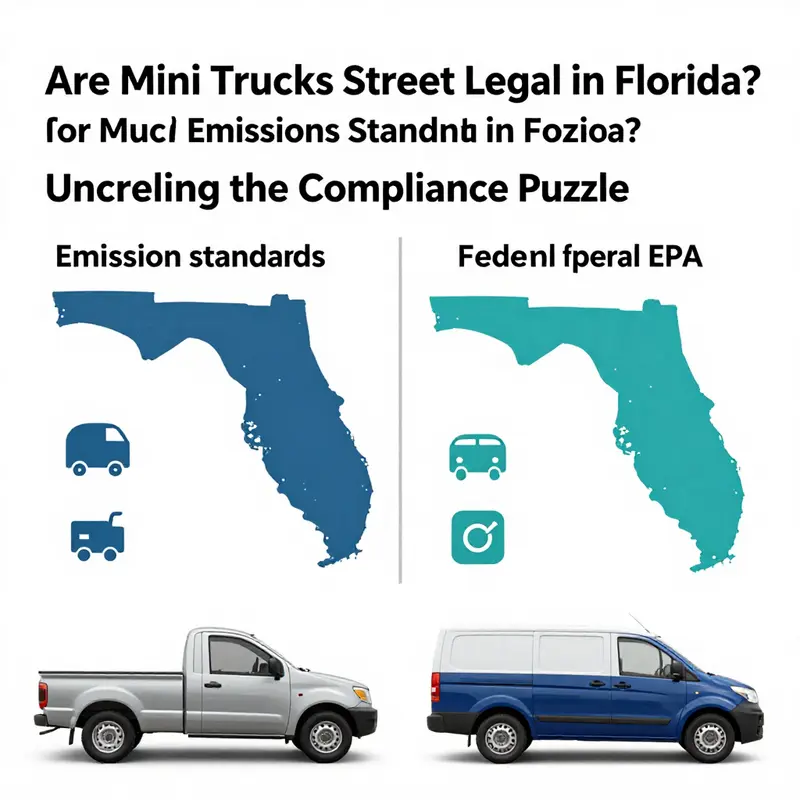
When readers ask whether mini trucks can legally roam Florida roads, they often imagine a straightforward yes or no. The real answer sits at the intersection of federal rules and state administration, where emissions, safety, and vehicle classification collide. Florida does not carve out its own emission standards for Kei trucks. Instead, the state aligns with federal requirements that govern all light-duty vehicles sold or operated on public highways, anchored by the EPA and the DOT. In practice, a Florida road-worthy mini truck must clear the same gates as any other light vehicle built to serve a wide market. It must either roll off the assembly line with EPA certification and DOT compliance, or undergo a federally recognized conversion and certification process after import. This distinction frames how the vehicle can legally exist on a Florida street, how it is insured, registered, and used by a driver who expects reliability and safety.
To understand why this matters, consider the core federal requirements that apply across states. First, emissions: the EPA sets tailpipe limits for pollutants and greenhouse gases through standards like Tier 3. These rules apply to new light-duty vehicles, including those marketed as mini trucks in the United States. Electric minis present a different calculus because their tailpipe emissions are zero. Florida’s stance toward these vehicles is welcoming in the sense that there are no Florida-only restrictions beyond the federal baseline, so the hurdle for an electric mini truck to be road-legal is framed by federal policy and how well a vehicle can be certified to meet those policies. The absence of state-only emissions mandates means incentives and infrastructure programs that Florida promotes for broader electric-vehicle adoption can apply to suitable electric minis.
Kei trucks and other imported mini trucks that originate outside U.S. safety and emissions regimes face a different path. Kei trucks, designed for Japan’s market, often fall outside the package of standards that U.S. regulators expect for products intended for broad sale here. The import path requires EPA emission certification, DOT safety compatibility, and alignment with U.S. design standards. Modifications such as removing a governor or swapping tires can alter performance, but they rarely substitute for genuine compliance. The vehicle must endure testing and approval through the EPA and DOT; a process that is costly and technical. Without certification, even a seemingly compliant Kei truck risks being deemed non-road-legal, with enforcement risks and potential insurance challenges if the vehicle lacks proper status on DMV records.
In Florida, the practical implication is that most Kei trucks do not become street-legal simply by being imported or retrofitted. The 25-year rule for antique imports does not neatly apply to Kei trucks, given their modern design. This means owners cannot rely on nostalgic exemptions; modern compliance is typically required. The most reliable route to legality involves a full compliance pathway rather than piecemeal alterations. The pathway begins with verification that the model can be certified, and ends with registration through the Florida Department of Highway Safety and Motor Vehicles (FLHSMV). That documentation will usually include proof of EPA emissions certification and DOT safety compliance, followed by standard registration procedures, title checks, and insurance arrangements. Even then, the cost and complexity of achieving federal certification can be prohibitive for many importers and buyers.
For Floridians weighing this path, the decision often hinges on the total investment required to achieve legal operation versus the appeal of an inexpensive or novel vehicle. It’s not enough to remove a governor or tweak the lighting; the vehicle must meet federal safety standards, including crashworthiness, seat belts, lighting, speedometer accuracy, and other expected features. Once the EPA and DOT sign off, the vehicle enters the state’s system through motor vehicle records, ensuring that a future owner can verify the vehicle’s legal status during registration, sale, or transfer. The verification process protects the public and the owner from fines or enforcement actions when equipment or certification do not align.
Readers who want a broader sense of how these debates play out in practice can seek community discussions and case studies that surface practical realities of mini truck ownership and customization. Enthusiasts pursuing niche builds document how far they can push a vehicle while preserving compliance. For related context on customization and legal limits, see discussions of truck camper setups and vehicle weight distribution as discussed in the Godzilla Truck Camper Review and Customization reference. The broader point is that the legality question sits alongside the realities of owning, maintaining, and using a micro-truck in everyday Florida life.
Ultimately, Florida’s stance is not about a special mini truck rule but about ensuring that any vehicle used on its roads meets nationwide safety and emissions expectations. The state’s approach aligns with a belief that a street-legal mini truck must perform on Florida highways and fit within a nationwide framework that makes registration, insurance, and resale predictable. For electric variants, Florida’s incentives and infrastructure landscape makes adoption more appealing, which can influence decisions toward an EV option that minimizes tailpipe emissions and simplifies compliance. The choice to pursue legal importation should be made with a clear-eyed appraisal of federal certification and the likelihood of success for a given model. By maintaining this perspective, Florida residents can avoid the trap of pursuing a low-cost project that becomes a costly legal puzzle.
As this chapter closes, the key takeaway remains that Florida does not impose unique state-level emissions constraints on mini trucks; instead, it enforces federal standards. Two broad paths exist: an electric mini truck that aligns with the federal zero-emission profile, or a conventional mini truck that must undergo EPA and DOT certification to be registered and driven on public roads. The latter remains feasible but resource-intensive, requiring planning, professional guidance, and a willingness to invest in compliance. The authoritative reference is the EPA’s vehicle and fuel standards page, which applies across states. The URL is https://www.epa.gov/vehicle-and-fuel-emissions-standards
Small, Street-Legal, and Florida-Ready: Navigating the Rules for Mini Trucks

The question of whether mini trucks can legally share Florida streets is not answered by wishful thinking or loopholes. It hinges on a careful alignment with federal safety and emissions standards, and then a matching weave of state regulations that govern how, where, and under what conditions such vehicles may operate in public traffic. In practice, most Kei-style mini trucks—those compact, 660cc-class vehicles familiar to many enthusiasts—enter the United States with a market design that does not automatically translate into street legality. They are engineered for a different regulatory landscape, where car size, power, and certain safety and environmental metrics are judged by a distinct set of standards. In Florida, though, there is a pathway for these vehicles to be operated legally, but it is a tightly bounded path that requires compliance at several levels and strict adherence to speeds, routes, and documentation. The practical takeaway is straightforward: being privately imported or personally assembled is not a license to roll onto any Florida road. A mini truck must first prove itself compliant with federal safety and emissions standards before state authorities will consider registration, insurance, and permissible operation on public streets.
At the federal level, the vehicle must satisfy the Federal Motor Vehicle Safety Standards (FMVSS) administered by the National Highway Traffic Safety Administration. The FMVSS establish baseline safety criteria for a wide range of vehicle components and systems—from lighting and occupant protection to crashworthiness and overall structural integrity. Compliance is not merely about mounting lights or adding seat belts; it is about an integrated safety profile that a vehicle must meet under standardized testing and certification procedures. For many mini trucks designed for the Japanese market, achieving FMVSS conformity involves substantial redesign or certification work. If a model cannot demonstrably meet these standards, the path to legality ends there.
On the environmental front, the Environmental Protection Agency requires vehicles imported into the United States to meet emissions standards. In the case of mini trucks, this often translates into a rigorous process of testing, certification, and potential modification to reduce pollutants to levels that exceed the capabilities of many off-the-shelf imports. This is where the reality of costs and timelines can become a significant hurdle. It is not uncommon for importers to encounter substantial expenses associated with engine tuning, aftertreatment strategies, and paperwork required to document compliance to EPA rules. The practical consequence for a Florida buyer is clear: even if a vehicle looks the part and runs well, the federal emissions bar remains a non-negotiable gate through which every vehicle must pass before any consideration of state registration.
Florida’s own regulatory landscape adds its own layer of specificity. Florida Statute 316.2122 is the anchor for low-speed vehicles and, by extension, for mini trucks seeking lawful operation on public roads within the state. It establishes a structured framework that deliberately narrows the field. The typical operational envelope for a mini truck under this statute places a ceiling on speed at 25 mph and restricts usage to roads where the posted speed limit is 35 mph or less. These numbers are not negotiable rhetoric; they define where a legally compliant mini truck can be used and how it must behave on everyday commutes, errands, or rural transit. But speed is only part of the story. The rule book requires certain safety equipment to be in place. Expect to see seat belts, windshield wipers, and functional headlights and taillights as baseline features that cannot be sacrificed in the name of convenience or aesthetics. The emphasis is on a vehicle that, while compact, offers a predictable safety profile that banks on visibility, occupant protection, and proper signaling.
Registration and insurance complete the trio of prerequisites for lawful operation. A mini truck that clears the federal gates and fits Florida’s speed and equipment requirements still must be properly registered with state authorities and insured. This is not a cosmetic or administrative formality; it is the concrete step that legitimizes the vehicle for road use and ensures the driver bears responsibility for safety and liability on public roads. Without registration and insurance, even a mechanically compliant mini truck remains in a regulatory grey zone, exposed to the risk of penalties and potential impoundment.
The route from import to on-road legality is seldom a quick or inexpensive one. Modifications—such as removing a speed governor or upgrading lighting—do not, by themselves, grant legality. They may be part of what a prospective owner might need to pursue in a broader compliance program, but they do not substitute for formal EPA and DOT compliance testing and approval. The authoritative pathway involves a formal, often costly, compliance process with the EPA and DOT, followed by state registration steps that confirm safety, emissions, and insurance readiness. In other words, Florida’s system rewards diligence and a comprehensive compliance strategy over ad-hoc hacks or cosmetic improvements. For anyone contemplating importing a mini truck, the prudent first step is to engage with a certified vehicle importer or a specialist who understands the nuanced choreography of international vehicle compliance. They can help interpret whether a particular model can be made compliant and what sequence of tests or modifications would be necessary to approach a feasible path to legal use.
The practical implications ripple beyond the garage and the DMV line. For daily driving, the speed cap of 25 mph and the 35 mph road-limit rule shape route planning. Traffic patterns, time-of-day considerations, and even school zones or construction corridors take on an outsized significance when the vehicle’s performance envelope is deliberately narrower than standard passenger cars. The need for consistent, robust safety features—seat belts that are not merely present but function reliably, wipers that respond to varying precipitation, headlights that meet brightness and alignment specifications—becomes a matter of habit and routine rather than a one-time installation. The occupation of a lane, the decision to pass or be overtaken, and the habit of signaling all become part of a disciplined driving practice tailored to a small, slower-moving vehicle.
For the Florida resident exploring the option, a thoughtful, evidence-based approach is essential. Begin with a candid assessment of the base model’s compatibility with FMVSS and EPA standards. Engage with a qualified importer who can forecast the regulatory journey, not just the immediate price tag. Build a checklist that includes anticipated testing, potential retrofits, and the estimated timeline from intake to registration. It is not enough to like the way a mini truck looks or feels in a driveway; the vehicle must demonstrate, to the satisfaction of federal and state authorities, that it is safe, clean-burning, and roadworthy by the same yardstick applied to every other passenger vehicle you see cruising Florida streets.
In the broader sense, the Florida model is not a prohibition on mini trucks but a gatekeeping system that rewards compliance. It recognizes the allure and practicality of these compact vehicles—especially for urban corridors, campus districts, or agricultural and light-industrial uses—while maintaining a commitment to safety, emissions responsibility, and clear vehicle identification on public roads. Those who embrace the rule set—soliciting professional guidance, investing in proper testing, and navigating the procedural steps—may, in time, find a legitimate foothold for their small-mobility ambitions within Florida’s road framework. Those who skip steps or fall back on informal arrangements risk penalties, insurance gaps, or a vehicle that is legally in limbo rather than legally in service.
As with any evolving field, resources and communities can offer valuable guidance. For ongoing updates, trends, and real-world experiences from fellow enthusiasts navigating the same regulatory terrain, consider engaging with the broader Mini Trucks community. A well-curated ongoing hub can help dial in what to expect, what to document, and how to prepare for the procedural realities that accompany import, compliance testing, and registration. See the Mini Trucks blog for a sense of the practical discussions, challenges, and milestones that come with pursuing legal operation in Florida. Mini Trucks blog.
For those who want to verify their understanding of the federal compliance pathway, the Environmental Protection Agency provides detailed guidance on vehicle imports, certifications, and regulatory expectations. This is not light-reading, but it is the authoritative map of what it takes to bring a nontraditional vehicle into U.S. roads in a compliant way. An explicit, formal resource to consult is the EPA’s vehicle imports guidance, which outlines the steps, testing, and approvals that matter most when the goal is durable, lawful operation across state lines and into Florida’s regulatory framework. External resource: https://www.epa.gov/otaq/vehicle-imports.htm
null

null
Street-Ready in the Sunshine State: Navigating Florida’s Rules for Mini Trucks

Across Florida’s sun-soaked streets and winding coastal byways, a compact, nimble truck often feels like the right tool for everyday life. It can slip through dense traffic, squeeze into tight parking spaces, and haul groceries, gear, or small loads with far less fuel and maintenance than a full-size pickup. The state’s climate, roadscape, and outdoor culture reward efficiency and versatility, so it isn’t hard to see why Floridians develop a particular fondness for smaller workhorses. On weekends, these little trucks can carry fishing rods, camping gear, or beach supplies, turning a simple trip into a light-adventure mission. In everyday corridors—from urban downtowns to the suburban cul-de-sacs that string along the coast—their practical footprint and lower operating costs make them practical, even appealing. All of this helps explain a steady curiosity about whether such vehicles can legally share Florida’s highways and byways. The question isn’t merely hypothetical chatter for gearheads; it’s a real consideration for households weighing budget, reliability, and the kinds of trips they take most often in a state that prizes flexibility and accessibility.
But the legality question is more nuanced than it might seem at first glance. In the United States, road-legal status hinges on a structured lattice of federal and state standards. A mini truck destined for Florida streets must first clear federal emissions requirements established by the Environmental Protection Agency. It must also meet the Department of Transportation’s safety standards, which cover a broad spectrum from lighting and seat belts to crashworthiness and the accuracy of the speedometer. Finally, the vehicle must be properly registered with the Florida Department of Highway Safety and Motor Vehicles, along with any title, insurance, and inspection steps that Florida law requires. The origin of many mini trucks—markets where regulatory frameworks differ dramatically from the United States—amplifies the challenge. The typical vehicle from overseas markets is designed to operate under a different set of safety and emissions tests, and its components, even when they look familiar on the surface, may not line up with American expectations for road use. As a result, a model’s path to legality is rarely a simple matter of cosmetic tweaks or a few bolt-on upgrades.
The core prerequisites are precise and non-negotiable. At the federal level, EPA certification verifies that a vehicle’s emissions profile conforms to U.S. air-quality standards. Without this certification, the vehicle cannot be sold or registered for street use in the United States. Parallel to emissions, DOT compliance checks ensure that a vehicle meets safety standards that the road system relies upon. This includes properly functioning lighting circuits, seat belts in all seating positions, and proven crashworthiness, along with a compliant, accurate speedometer and other instrumentation. These standards aren’t a checklist you can improvise your way through; they require formal testing, documentation, and approval processes that take time and cost money. In a practical sense, even thoughtful modifications—such as removing a governor to boost top speed or upgrading headlights for better illumination—do not substitute for the formal compliance path. The regulatory framework expects certification that the entire vehicle, in its final form, meets U.S. specifications, not just the parts in isolation.
The import journey adds another layer of complexity. Prospective Florida importers typically begin with a candid assessment of a model’s feasibility within the U.S. regulatory regime. If a given vehicle cannot be brought into federal compliance, its street-legal prospects in Florida fade quickly. If compliance looks feasible, the next steps involve an orchestrated sequence of testing, documentation, and approvals—often overseen by a certified vehicle importer or a specialist in international vehicle compliance. This path can be costly and slow, requiring a careful calculus of legal risk, potential remediation work, and the likelihood of eventual registration. The financial reality is rarely glamorous: the costs may include testing, compliance modifications, administrative fees, and the risk of an unsuccessful outcome even after substantial investment. This is why those who pursue a legal route frequently pair practical expectations with a pragmatic budget, recognizing that the process is as much regulatory marathon as it is mechanical tune-up.
Expert Tip: If you’re considering importing a mini truck into Florida, consult with a certified vehicle importer or a specialist in international vehicle compliance to determine if your specific model can be made compliant. A seasoned advisor can help you understand the likelihood of success, outline the necessary steps, and arrange a realistic budget before you invest in shipping and modifications. For readers who want to probe the issue further before engaging an expert, the U.S. EPA maintains official guidelines on vehicle imports that spell out eligibility rules and the testing processes involved. Understanding these rules up front can save time, money, and potential disappointment when a project runs into a regulatory wall.
Even with a clear path to compliance, Florida-specific realities shape how practical the option feels. The state’s DMV is the final gatekeeper for road use, and registration proves the vehicle’s conformance with state rules after federal approval. Insurance considerations, state inspections, and the need for clear documentation all matter, especially in a market where households may be weighing the cost of full ownership against the benefits of a lighter, more efficient utility vehicle. Local law enforcement and highway authorities are tasked with upholding the standards that keep traffic safe and air quality protected, which means the reality of enforcement can temper expectations just as much as the technical requirements do. When a vehicle fails to meet these benchmarks, it is not merely a matter of a rough edge or an outdated part; it is a signal that the project has crossed from experimental into nonconforming territory. The potential consequences—out-of-service status, fines, or ongoing compliance costs—underscore why a careful, well-informed approach matters more than a bold, impulsive one.
On the ground, the narrative around Florida’s mini trucks is not simply about legality; it’s also about the everyday art of balancing lifestyle with accountability. Floridians who prize maneuverability, low operating costs, and the ability to take gear to sunlit shorelines or inland parks understand the appeal of compact pickups. The market responds to this awareness with a mix of interest and caution. A rising demand for versatile, fuel-efficient, and easy-to-handle vehicles has emerged in the broader Southeast, with Florida contributing to a pattern that values practical capability without the burden of larger, harder-to-park trucks. This is more than a sentiment; it’s reflected in consumer behavior, the choices people make about how they commute, and what they consider a reasonable vehicle for daily life in a state defined by mobility, weather, and outdoor possibility.
For readers who want a broader sense of how communities discuss and share experiences with these vehicles, a good starting point is the broader online conversation found in the Mini Trucks Blog. Mini Trucks Blog. The blog serves as a touchpoint for enthusiasts and curious newcomers alike, offering perspectives on modifications, usage, and the evolving regulatory landscape that shapes what is possible in Florida and beyond. It is not a regulatory guide, but it helps illuminate the real-world considerations people face when they weigh the joys of a small, efficient truck against the demanding realities of federal and state compliance.
In sum, Florida’s climate and road network make small trucks an attractive option for many residents. But the path to street legality is anchored in a disciplined compliance process that begins with federal emissions certification and safety standards and ends, after careful documentation and testing, with state registration. Along the way, the practical appeal of a compact, efficient vehicle remains strong, especially for those who value the freedom to explore coastal landscapes, backcountry routes, and everyday errands with a vehicle that is affordable to run and easy to park. As regulations evolve and as import pathways adapt, the conversation in Florida will continue to blend the allure of small-truck utility with the steadfast requirements that keep roads safe and air clean. External resource: EPA vehicle-imports guidelines.
Final thoughts
Navigating the world of mini trucks in Florida, particularly Kei trucks, entails understanding a complex interplay of legal requirements, safety regulations, and community interests. While the potential for compact and efficient transportation is immense, ensuring compliance with EPA and DOT standards is critical for lawful operation on Florida roads. By connecting with fellow enthusiasts and local businesses, many Floridians have successfully found ways to incorporate these unique vehicles into their lives. Ultimately, awareness and proactive engagement with regulations will pave the way for a thriving mini truck community in the Sunshine State.