
Mini trucks, especially the charming Japanese Kei trucks, have sparked interest among small business owners, residential property owners, and enthusiasts in Indiana. However, navigating the legality of these vehicles on Indiana’s roads can be quite perplexing. Understanding the specific requirements for street legality, modifications needed to comply with state regulations, and protocols for importing and registering these trucks is essential for potential owners. This article will clarify what it takes to legally operate a mini truck in Indiana, ensuring you’re informed and ready to hit the road legally and safely.
Rough Roads, Clear Rules: Navigating Indiana’s Path to Legally Street-Eligible Mini Trucks
Indiana’s roadways welcome a wide mix of vehicles, but not every compact or off-road friendly pickup automatically earns a street-legal badge. The question of whether mini trucks—often compact, high-durability platforms originally built for off-road or rural work—can legally share Indiana’s public lanes hinges on a careful alignment with both state and federal standards. The answer isn’t a simple yes or no; it’s a nuanced assessment of safety, emissions, equipment, and registration that must be tailored to each vehicle as it moves from import or purchase into an everyday transport role. What looks like a clever workaround for a weekend project can quickly turn into a compliance puzzle unless the owner approaches the process with objective clarity and practical planning.
At the heart of Indiana’s approach is a commitment to road safety and environmental responsibility—principles that flow from federal guidelines administered by the Department of Transportation and the Environmental Protection Agency, down to the state’s Bureau of Motor Vehicles and its inspection procedures. Any vehicle operating on public roads in Indiana must meet a baseline of safety standards. These standards translate into a checklist that typically includes lighting, brakes, seat belts, mirrors, and a properly functioning braking system. Emissions controls form an equally critical axis for vehicles that might have an emissions footprint different from standard passenger cars. VIN verification, accurate labeling, and correct documentation are not mere formalities; they are the identifiers that connect a vehicle’s identity to its lawful operation on Indiana streets. For the mini truck operator, the path from import to road-legal is paved with these checkpoints, not with promises or convenient loopholes.
The practical challenge with mini trucks stems from their design intent. Many Kei-style or kei-influenced pickups from overseas markets were engineered to prioritize payload efficiency and urban maneuverability within a different regulatory framework. They may rely on modest lighting, simplified dashboards, and engine configurations that don’t line up neatly with Indiana’s safety and emissions enforcement. The mismatch isn’t always fatal—modifications can, in some cases, bring a vehicle into compliance. But the modifications, the sequencing of inspections, and the documentation required can be formidable. A vehicle that seems straightforward at first glance may encounter roadblocks that reveal themselves only after a closer regulatory look. The core issue is that street legality isn’t about age, size, or tribute to a certain aesthetic; it’s about meeting explicit, testable criteria that the state and the federal system require for every motor vehicle placed into service on public highways.
The import pathway is often the first hurdle. Importers must confront EPA emissions standards and the need to demonstrate that a vehicle complies with federal safety standards, as set forth by DOT. Indiana then adds its own layer through the BMV’s inspection and registration process. In practice, this can involve upgrading essential components that may be absent or underspecified on a vehicle designed for off-road or limited-use contexts. A typical list of upgrades might include installing a functioning speedometer that accurately reflects vehicle speed, ensuring headlights and turn signals meet brightness and visibility requirements, and providing rearview mirrors suitable for highway use. These changes aren’t cosmetic; they are functional modifications tied to a vehicle’s core operation on public roads.
The path to compliance often begins with a careful inventory of what the vehicle already has and what it lacks. The safety equipment set—lights, brakes, mirrors, and the ability to display a license plate—forms a minimum bar. Yet more subtle elements can become gating issues. Emissions controls must be active and verifiable. The absence of an EPA-compliant exhaust system, or the presence of a mismatch between a vehicle’s exhaust configuration and its emissions certification, can derail even a well-maintained import before the first inspection. Similarly, a vehicle’s identification number must correspond to its documentation; incongruities here can pause the process entirely and trigger a deeper audit of the vehicle’s origin and history.
For many prospective owners, the practical course is to work directly with the Indiana Bureau of Motor Vehicles. The BMV is the gatekeeper for vehicle eligibility, registration, and road use within the state. The guidance it provides—often summarized in public-facing materials and the state’s official website—helps residents understand whether their particular mini truck can be contemplated as a street-legal vehicle. This is not a generic invitation to import and modify; it is a structured process that requires alignment between vehicle capabilities and regulatory expectations. The official source remains the clearest path to verification, because rules can evolve and be interpreted differently depending on the vehicle’s specifics, such as engine size, weight, and configuration. As a practical matter, prospective buyers should not rely on assumptions or anecdotal experiences from other states or provinces. A direct confirmation from the BMV minimizes the risk of pursuing an import path that cannot successively reach the registration line.
One of the most important steps in this journey is documentation. Owners should assemble proof of ownership, documentation that demonstrates compliance with federal standards (or reasonable provisions for compliance through retrofit), and any manufacturer or retrofit certifications that can illuminate the changes performed to the vehicle. It is common for vehicles requiring attention to emissions to undergo a process in which the owner demonstrates that a modified exhaust, catalytic converter, or oxygen sensor configuration aligns with EPA expectations. This documentation often travels hand in hand with a state inspection that tests basic operations—functional lighting, reliable braking, proper signaling, along with seat belts and crash protection features that are appropriate for public roadway use. The exercise may sound procedural, but it is designed to ensure that the vehicle you drive to work, to run errands, or to access rural routes does so with predictable performance and without imposing unreasonable risk on others sharing the road.
For many readers, the core question remains: is it possible to make a small, import-driven truck street-legal in Indiana? The balanced answer is: sometimes, with significant, case-specific work. There is no universal guarantee that a given mini truck will pass the state’s muster. The variability of the starting point—different engine types, different weight profiles, various wake-up calls in the electrical and lighting systems—means that some vehicles require substantially more modification than others. The process hinges on a clear assessment of the vehicle’s baseline capabilities and the feasibility of bringing those capabilities into line with the state’s requirements. It also hinges on a realistic assessment of time, cost, and the likelihood of a successful outcome. Knowing that reality is essential before entering the import-or-buy-and-modify cycle.
To illustrate how prospective owners can approach this thoughtfully, consider the cadence of steps that typically unfolds when a kei-style vehicle enters Indiana’s regulatory orbit. First, confirm eligibility through the BMV with a candid presentation of the vehicle’s origin and its current configuration. Second, prepare for potential upgrades that might be necessary to satisfy basic safety standards—functional lighting, reliable brakes, clear signaling, and a viewable speed reference. Third, establish the emissions and safety narrative: what modifications exist, what additional components might be required, and how those changes will be certified and documented. Fourth, gather financial and time estimates: inspection fees, potential retrofit costs, and the anticipated timeline from import to registration. Throughout this sequence, the role of a knowledgeable administrator—whether the importer, the mechanic performing the retrofits, or the BMV examiner—becomes crucial. A well-informed path reduces the risk of surprises that slow progress or threaten compliance in the final inspection.
As readers explore this space, it can be helpful to see how others have approached similar questions within the broader world of compact, utility-oriented trucks. The principle that emerges is consistent: street legality is not a matter of size or origin; it is a matter of standardized eligibility and demonstrable safety. For those who want a practical, action-oriented look at these themes, a deeper dive into the ongoing discussions and practical experiences shared by the mini-truck community can be illuminating. For a practical overview of what it takes to bring a kei-style vehicle to the road, you can explore the Mini Trucks Blog. The site offers real-world perspectives on the specifics of importing, retrofitting, and navigating the regulatory landscape, which can provide valuable context for anyone weighing the pros and cons of pursuing a street-legal mini truck in Indiana.
And even with a clear plan, it remains essential to keep expectations grounded. A successful path to street legality in Indiana hinges on a combination of technical work, regulatory compliance, and procedural diligence. Each vehicle brings a unique story—one vehicle might pass after a straightforward upgrade to lights and a speedometer, while another may require more extensive exhaust modifications or a more complex set of emissions adaptations. In all cases, the process is safer when approached with transparency and a careful record of all modifications, all tests, and all communications with the BMV. This is not merely about crossing a line on a form; it is about verifying that your vehicle meets the same safety and environmental thresholds that govern every other vehicle on Indiana’s roads. That standard is the thread that ties together the initial desire for a nimble, utilitarian vehicle with the broader responsibility of sharing Indiana’s public space with other drivers, pedestrians, and travelers.
To reinforce the practical nature of this topic, consider the relationship between a vehicle’s design intent and the regulatory framework that governs its on-road status. Vehicles built for off-road or rural use often rely on simplified lighting schemes or fewer standard instrumentation. While those choices may optimize performance in specific conditions, they do not automatically translate into mass-market readiness. The critical question becomes whether the vehicle can be brought into alignment with the DOT’s safety expectations and Indiana’s own inspection criteria without compromising the structural integrity or the intended functionality of the original design. The answer, again, depends on the vehicle, the modifications, and the diligence with which those modifications are tested and documented. It is a reminder that the road to legality is a careful negotiation between engineering realities and regulatory requirements, rather than a shortcut to operation on public streets.
For readers seeking to connect the dots between the regulatory framework and the practical realities of ownership, it is valuable to approach the subject with a mindset of preparedness. Gather the relevant documents early, seek a preliminary assessment from a reputable mechanic familiar with both DOT standards and Indiana’s inspection practice, and set realistic expectations about timelines and costs. The goal is to move from a concept—how a compact truck can function as a daily driver in Indiana—to a verifiable, compliant reality that stands up to the BMV’s scrutiny and the expectations of other road users. The more methodical the approach, the higher the likelihood that the final result will be as safe as it is useful, delivering a vehicle that can perform its duties with confidence rather than presenting a regulatory headache at the moment of registration.
Finally, the broader takeaway is one of clarity and responsibility. Indiana’s framework ensures that every street-legal vehicle meets a baseline standard to protect occupants and others on the road. Mini trucks can, in some cases, meet those standards through thoughtful modification and careful documentation. But the pathway is not guaranteed and requires a committed plan grounded in regulatory understanding. The possibility exists, and with the right approach, a small, capable pickup can join Indiana’s mix of vehicles in a way that is lawful, safe, and predictable. For readers who want a practical entry point into this journey and a sense of the regulatory landscape, the Mini Trucks Blog provides a useful touchstone for ongoing dialogue and shared experience. And for the definitive regulatory reference, consult the Indiana Bureau of Motor Vehicles guidance and the federal standards that shape the compliance landscape: Official guidance from the Indiana BMV can be found at https://www.in.gov/bmv/.
External resource: Official Indiana BMV guidance: https://www.in.gov/bmv/.
Toward Legality on Indiana Streets: What It Takes for Japanese Kei Trucks to Be Street-Ready
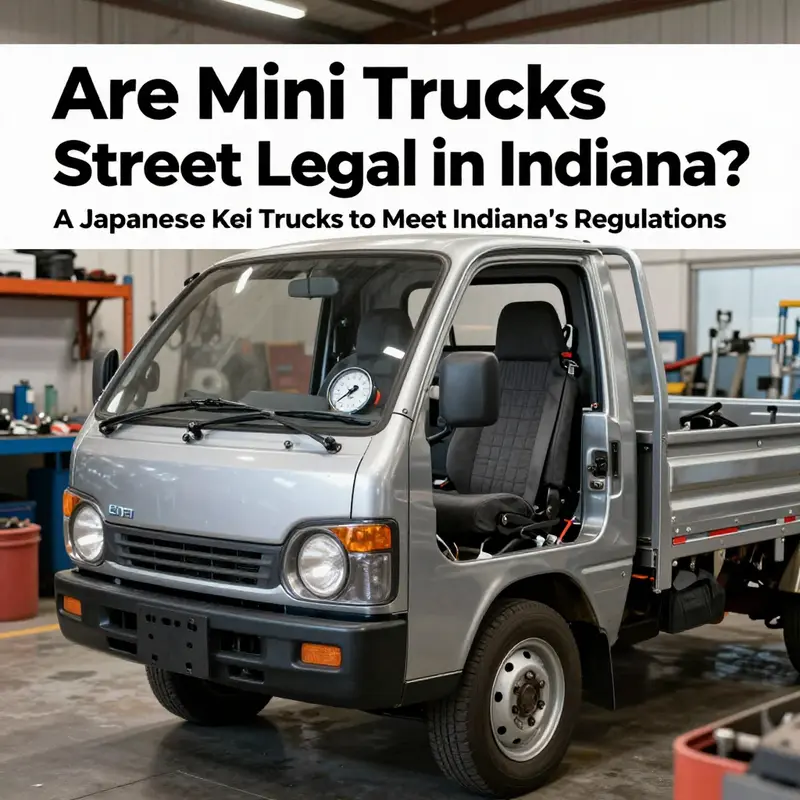
Interest in Japanese Kei trucks and similar mini trucks has grown as drivers seek practical, economical solutions for urban chores and light-duty work. Yet the path from a foreign, lightweight mini truck to a vehicle that can lawfully share Indiana roads is not a straight line.
Indiana’s rules for street operation sit at the intersection of state requirements and federal safety and environmental standards, a crosswalk that demands attention to a host of details before a vehicle can be registered, insured, and ultimately driven on public highways. What might seem like a straightforward import becomes, in practice, a careful negotiation of compliance, engineering, and paperwork. This chapter takes that negotiation seriously, tracing the regulatory terrain that governs whether a Kei-style mini truck can join Indiana’s traffic, and what it takes to push a potential import from curiosity to lawful, road-worthy reality. The discussion expands beyond generic buy-and-drive advice and centers on the concrete requirements that shape every decision an importer, mechanic, or new owner must confront when the subject is a small, lightweight truck that did not originate in the United States.
At the heart of the Indiana clearance process is a tripartite framework: safety standards, emissions controls, and the equipment that keeps a vehicle verifiably operable on public roads. Indiana, like every state, aligns with federal motor vehicle safety standards and emissions requirements administered by national authorities. In practical terms, that means any vehicle that will operate on a public road must meet the safety and environmental criteria established by the U.S. Department of Transportation (DOT) and the Environmental Protection Agency (EPA), in addition to meeting state inspection and registration tests. An imported Kei truck does not automatically become street-legal simply by being imported or by meeting a few localized requirements. It must be capable of meeting the same baseline expectations as any new or used vehicle sold or operated in Indiana. The process is especially exacting for lightweight, compact vehicles whose design and tested performance sit outside the typical profile of kinds of vehicles frequently seen on U.S. roads.
The regulatory perimeter begins with the basics of vehicle identity and compliance. A vehicle must have a valid Vehicle Identification Number (VIN) that corresponds to recognized federal standards, and it must be verifiable in Indiana’s records. The VIN is not merely a serial tag; it is the key to regulatory oversight, enabling the state to track safety recalls, emissions certifications, and compliance histories. The next layer involves a package of safety features and mechanical systems that must be present and functioning. Headlights, tail lights, turn signals, brake lights, and rearview mirrors are the visible symbols of compliance, but their presence must be complemented by correctly functioning seat belts for all seating positions, an operative braking system that can withstand ordinary road conditions, and a lighting system that meets the brightness and coverage requirements for public-road operation. In a Kei truck—designed for compact dimensions and, in many cases, a different regulatory environment—the gap between factory equipment and U.S. expectations can be substantial. It is not unusual to find that a vehicle’s lighting packages, signaling systems, or mirror configurations do not align with Indiana’s standards without modification. A related challenge is the speedometer and instrumentation: U.S. roadways assume certain tolerances and performance metrics, and if the original instrumentation does not provide accurate or compliant readings, upgrades may be necessary to ensure the operator can gauge speed and distance safely and within legal limits.
The emissions piece of the puzzle is equally critical. The EPA’s regulatory framework governs the environmental footprint of motor vehicles sold and operated in the United States. That means a Kei truck imported from abroad must meet applicable emissions standards for the model year or be certified accordingly. In practice, exporters and importers often confront a dissonance between the Kei design—where engines are tuned to a different regulatory regime and often optimized for minimal weight and frugal fuel consumption—and the more stringent U.S. requirements. The result is that emissions control systems may require reconfiguration or upgrades to ensure the vehicle’s exhaust, catalytic converters (where applicable), and related emission-control hardware can pass the EPA’s scrutiny during an inspection or testing process. In some scenarios, an importer might pursue an EPA certification or an EPA conformity pathway specific to the vehicle’s type and origin, but this is not a universal or guaranteed route, and it is rarely simple. The practical effect is that an Indiana buyer or importer must be prepared for detailed emissions testing or modification plans that align with federal expectations, in addition to the state inspection process.
The state inspection adds another layer of complexity. Indiana’s BMV (Bureau of Motor Vehicles) requires a vehicle to pass a state inspection to verify compliance with local safety and design norms. The inspection often includes checks for a working speedometer, proper lighting, turn signals, rearview mirrors, and other essential features. For imported Kei trucks, this is often the moment when the difference between the vehicle’s original design and the U.S. regulatory baseline becomes visible. The inspection can reveal gaps that necessitate modifications, which in turn affect the vehicle’s cost, reliability, and overall feasibility. The practical implication is clear: even before a vehicle arrives in Indiana, the importer must anticipate the kinds of upgrades likely to be necessary and build those costs into the assessment of whether the project is economically viable or not.
Driving down to the minutiae, the potential required modifications reveal the scale of the undertaking. The basic package typically involves ensuring a functioning speedometer, headlights that meet brightness and aim standards, properly functioning turn signals and brake lights, and adequate rearview mirrors. A vehicle born into a different regulatory milieu may lack one or more of these features, or present versions that do not align with U.S. standards. For instance, some Kei trucks may have lighting configurations that do not provide the required coverage or brightness levels, or mirrors placed at angles that do not accommodate U.S. viewing conventions. Addressing those gaps might involve hardware swaps, rewiring, or sensor and control-system upgrades, depending on the exact baseline of the vehicle and the scope of Indiana’s inspection expectations.
Beyond the basics, engine and emission-control specifics loom large. The EPA’s standards may require modifications to exhaust systems, catalytic conversion (if applicable), and other emissions-controlling elements to align with U.S. environmental rules. The path from a near-factory Kei setup to a compliant U.S. emissions profile can be long and technically involved. It can include adapting or installing components that the U.S. market requires, testing the vehicle to prove compliance, and obtaining the necessary certifications or documentation to prove the vehicle meets EPA expectations. In many cases, the combination of structural concerns, engine management, and emissions-system adaptation yields a substantial diversification of the vehicle’s cost and schedule.
The question of crashworthiness and occupant protection intensifies the discussion. FMVSS No. 208, which concerns occupant crash protection, is a core test of the fundamental safety profile of a vehicle operated on U.S. roads. Kei cars, by design, are lighter and often have different safety feature sets than typical U.S. market vehicles. The fundamental challenge is that the mass and construction of a Kei-class vehicle do not map easily onto U.S. crash-test assumptions. When a lighter vehicle is involved in a high-severity crash, the resulting energy dissipation, occupant protection performance, and the overall crash dynamics can differ noticeably from those of more massy U.S. vehicles. This does not automatically preclude a Kei truck from ever being compliant, but it does mean that achieving compliance could require additional reinforcement or added safety features to meet the standard’s intent. The cost and complexity of such reinforcement can be significant, depending on how the vehicle’s chassis, frame, and safety systems interact with U.S. testing expectations.
Adding to the regulatory maze is the evolving nature of safety regulations themselves. As of December 2025, NHTSA has been evaluating proposals to reclassify or create exemptions for very small, lightweight vehicles such as Kei Cars. The timing and outcome of any rulemaking remain uncertain, but the very existence of ongoing discussions signals a living regulatory environment. For Indiana residents and importers, this means that the legality prospects of a Kei truck can shift with federal regulatory developments. The dynamic is good to recognize early in any import plan. It is not merely a matter of static compliance but a moving target that can influence when and how a vehicle might become street-legal. The absence of a final rule does not render the effort moot, but it does inject a degree of risk into the investment.
Given the complexity of these requirements, a practical approach begins with a candid assessment of eligibility. Before purchasing or importing a mini truck, it is essential to contact the Indiana BMV to verify what documentation will be necessary and what the current expectations are for Kei vehicles or other light trucks. The BMV can provide the current interpretation of state requirements and help identify the documents needed for inspection, such as proof of EPA conformity, DOT compliance records, or other regulatory certifications. The consultation may also reveal that certain modifications, or an agreed-upon plan with a qualified mechanic, could align the vehicle with Indiana’s requirements. There is no universal guarantee of street legality for Kei trucks, but there is a path that can be navigated with careful documentation, professional planning, and a willingness to invest in the necessary upgrades.
In parallel with state processes, the federal dimension remains vital. NHTSA’s evolving stance on kei-type and small, lightweight vehicles informs the broader context in which Indiana operates. While state-level inspections determine the likelihood of a successful initial registration, federal-level compliance determines whether the vehicle can legally be marketed, sold, or operated in the United States at all. The interplay between these layers means that the journey to legality is not simply a matter of meeting a checklist at the state level; it requires alignment with federal safety standards and emissions requirements from the outset. This alignment is not guaranteed and may hinge on the specific vehicle’s design, year, and anticipated use. The most dependable path, therefore, is a methodical plan that considers the vehicle’s baseline differences from U.S. market norms, anticipates modifications across safety and emissions domains, and seeks early, authoritative guidance from BMV and, when necessary, from federal agencies.
From a user’s perspective, the practical implications stretch beyond compliance theory. The cost calculus inserts a reality check into the project. Structural reinforcement, upgraded lighting, and safety-system upgrades like airbag integration, rear-seat reminders, and more robust crash protection are not inexpensive. They require skilled labor and, in some cases, specialized aftermarket or OEM-equivalent parts with careful integration into an already compact chassis. The price tags can add up quickly, and the uncertain outcomes, given the lack of a finalized federal standard for Kei drivers at the time of writing, can prompt many buyers to pause and ask whether the dream of a street-legal Kei truck in Indiana is worth the financial and regulatory risk.
There is also a question of documentation reliability. A vehicle imported under a patchwork of compliance documents risks becoming a problem if any element of the documentation or the hardware fails to hold up under inspection. The VIN, the emissions certification, the safety-system inventory, and the alignment between the vehicle’s instrumentation and the state’s expectations all must be coherent. A mismatch can trigger delays, additional work, or even the rejection of registration. The practical cure for this is meticulous record-keeping, a clear plan for the modifications and testing, and a candid assessment of the vehicle’s overall feasibility given the budget and the timeline.
In this landscape, prospective buyers and importers should also examine the potential for alternative pathways. For some buyers, the more prudent route might be to consider vehicles that are already certified for U.S. markets or those engineered with a more straightforward compliance path. In education and practical experience terms, reading about the experiences of others who have navigated similar routes, and consulting with specialists who understand both Indiana’s inspection requirements and the federal safety and emissions framework, can be invaluable. An accessible way to begin this learning process is to explore broader information resources and community discussions that discuss mini trucks in the Indiana context. A wealth of practical commentary and updates is available through dedicated content hubs and community blogs, such as the Mini Trucks Kalala community, which maintains a repository of articles and discussions on the topic. For ongoing information, readers can consult the general blog hub at minitrucksocala.com/blog/, which offers a range of perspectives and real-world experiences that can illuminate the practicalities of importing and preparing a Kei truck for Indiana. This resource is not a substitute for regulatory guidance, but it provides useful context and a sense of how the process unfolds in the real world. When approaching a Kei-truck project, the dual emphasis on compliance and cost control matters most: a well-reasoned plan grounded in regulatory realities will help avoid expensive detours and disappointing surprises.
As this chapter has shown, the journey from import to street-legal status is anything but straightforward. The standard requirements for safety, emissions, and equipment apply to all vehicles, and Kei trucks must meet these tests just like any other vehicle seeking Indiana registration. The path may require substantial modifications, particularly in the areas of crash protection and emissions control, and it may depend on federal developments that remain unsettled. The bottom line is that Indiana does not automatically bless Kei trucks for public-road operation; instead, it invites a thoughtful, well-documented process that weighs the vehicle’s design against the state’s safety, environmental, and regulatory expectations. For a prospective owner, this means starting with clarity about what must be done, understanding the potential costs and timelines, and engaging with the right authorities from the outset. The aim is not to rush into a plan that promises street legality without a robust technical backbone but rather to craft a credible path that aligns the Kei truck’s design with the realities of U.S. safety and environmental standards, and with Indiana’s particular inspection and registration framework.
The broader implications extend beyond any single vehicle. They illuminate the ongoing tension between innovation in lightweight, compact vehicles and the time-tested safety conventions that govern U.S. roadways. They underscore the importance of diligent regulatory due diligence, professional engineering assessment, and candid budgeting. They remind us that the appeal of a tiny, economical truck must be weighed against the practical requirements that make highways safer for everyone. In that sense, Indiana’s street-legal landscape for mini trucks serves as a microcosm of how new or unconventional vehicle concepts must coexist with established safety and environmental protocols. The result is not a rejection of innovation, but a structured invitation to participate in a carefully regulated, safety-oriented process that ends, if all boxes are checked, with a vehicle that can be responsibly used in the state’s diverse driving environment.
For readers seeking more general background on related topics, a broader discussion can be found in industry and community resources that address mini trucks and their use in the United States. This includes related blogs and discussion threads that cover the import process, common modifications, and practical considerations when evaluating a Kei-truck project. Additionally, to stay informed about the current regulatory trajectory, you can consult official federal sources on safety standards and rulemaking, such as those maintained by the National Highway Traffic Safety Administration (NHTSA) and the EPA, which periodically publish notices, proposed rules, and final rules that shape how lightweight, compact vehicles are treated under U.S. law. For an overview of ongoing regulatory considerations and proposed developments, see the NHTSA kei-car proposal materials, which outline looming questions about how very small vehicles might be integrated into the existing safety framework. The conversations at the federal level can affect state practices, including Indiana’s, and staying abreast of these developments is a prudent step for any prospective importer or owner.
In closing, the question “are mini trucks street legal in Indiana?” does not admit a universal yes-or-no answer. It requires a careful calculus of engineering feasibility, regulatory compatibility, and economic viability. The reality is that many Kei trucks will require meaningful modifications to meet the state’s safety and emissions standards and to pass the state inspection. The path is predicated on sound documentation, compliant modifications, and timely navigation of both state and federal processes. The pursuit is not without risk, and it is not guaranteed to succeed for every vehicle or every owner. But with informed planning, professional guidance, and a readiness to invest in the requisite upgrades, a Kei-style mini truck can, in theory, be brought to Indiana roads in a compliant, permitted manner. The regulatory landscape is evolving, and those who engage early with Indiana’s BMV, along with federal authorities when necessary, stand the best chance of turning a curiosity into a legal, road-ready vehicle.
External resource: for further reading on evolving federal safety standards and the kei-car conversation, see the NHTSA kei car proposal at https://www.nhtsa.gov/vehicle-safety/fmvss/kei-car-proposal. To explore more about related topics, you may also consult the ongoing discussions and practical guidance available through the Mini Trucks Kalala community at the internal resource hub: minitrucksocala.com/blog/.
From Port to Pavement: Navigating Indiana’s Path to Street-Legal Mini Trucks
Indiana requires that street ready mini trucks meet federal FMVSS safety standards and, when applicable, EPA emissions rules, and be verified by the Indiana Bureau of Motor Vehicles. The journey begins with federal conformity documents and runs through state registration. Electric models may fall under low speed vehicle rules, while gas powered variants usually require emissions certification. Indiana does not simply approve a vehicle at the port; the state evaluates the vehicle against federal requirements and Indiana equipment and safety standards, plus any local restrictions. The inspection looks at the vehicle in total, including lighting, speedometer accuracy, mirrors, turn signals, seat belts, and overall safety. Local ordinances can add constraints on operation. A licensed importer or dealer often helps by assembling proof of conformity, coordinating customs, and sometimes installing compliant components. After the BMV approves the paperwork, the vehicle must be titled and insured before on road use. The process is case by case and demands thorough documentation and patience. Prospective buyers should verify eligibility with the BMV before purchase or import. The core message is that legality is earned by proving compliance at federal, state, and local levels, not by appearance alone.
Final thoughts
Understanding the legal landscape for mini trucks in Indiana ensures you can enjoy these unique vehicles responsibly and legally. With clear requirements, necessary modifications, and proper procedures for importing and registration, prospective mini truck owners can navigate the process with confidence. Particularly for local small business owners and hobbyists, having a mini truck can enhance mobility and provide practical benefits when fully compliant with Indiana’s regulations. Don’t overlook any steps to make sure you can hit the road without worry.