

Mini trucks, particularly the popular Kei trucks, have gained significant traction in various communities across Kentucky. Their unique features and compact form make them an attractive option for small business owners, residential property owners, and enthusiasts alike. However, before you hit the road with your mini truck, understanding the specific regulations that govern their street legality is essential. This article delves into the vital aspects of ownership and compliance, as well as the safety and emissions standards that must be met in Kentucky, ensuring you have all the necessary information to enjoy your mini truck legally and safely.
From Ownership to On‑Road Reality: Navigating Kentucky’s Rules for Mini Trucks
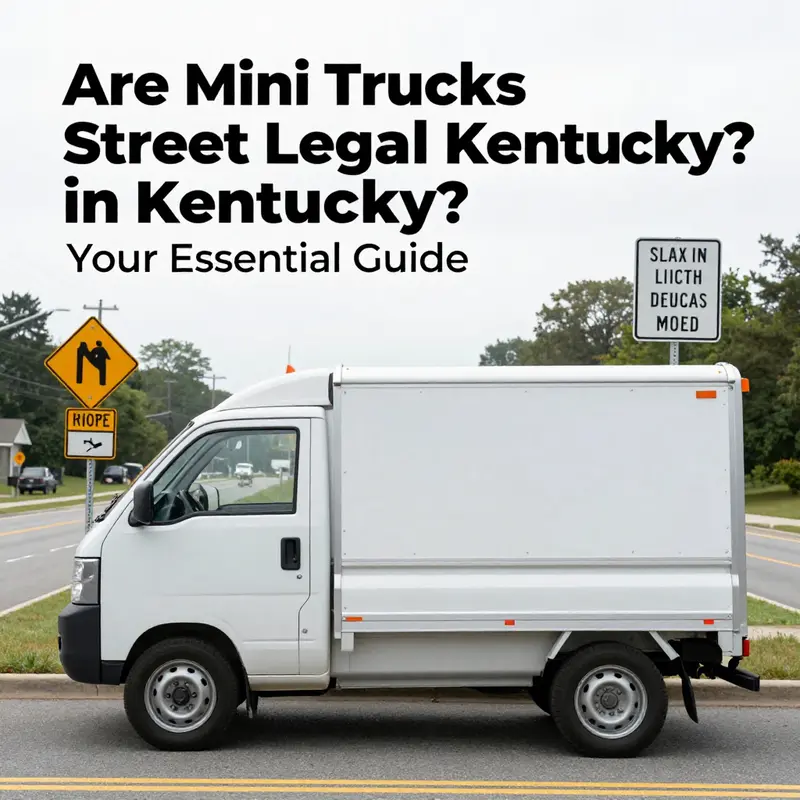
Owning a mini truck in Kentucky is a straightforward matter; operating one on public roads is not. The distinction between possession and use on active streets governs everything from how a vehicle is titled to how it must perform in traffic. In Kentucky, a person can legally own a small, compact truck, but to drive it on any public highway, county road, or city street, the vehicle must meet a set of state requirements that address safety, emissions, and physical dimensions. This layered framework recognizes the practical realities of a small, utilitarian vehicle while ensuring that the roads remain safe and navigable for all users. The best way to approach the topic is to treat ownership as the start of a process rather than the end of it. If your aim is to bring a mini truck from private property into the public lane, expect a careful review of standards and a path toward compliance rather than a simple exemption.
The core idea behind Kentucky’s approach is that road use is regulated, not merely ownership. The state’s guidance emphasizes that vehicles entering the public roadway must align with safety norms designed to protect drivers, passengers, and pedestrians. These norms cover a broad range of functionalities, from visibility and stopping power to occupant protection and signaling. In practice, this means confirming that lighting is complete and functional, brakes respond reliably, and seat belts in good working order are present and operable. These are not merely formalities; they are practical safeguards that help drivers anticipate the behavior of a small, nimble vehicle in everyday traffic. When a mini truck is properly equipped and maintained in this way, it stands a better chance of satisfying a regulator’s baseline expectations for roadworthiness, even if it is not a conventional full-sized pickup.
Beyond the safety envelope, registration and titling anchor the legal status of a mini truck in Kentucky. A vehicle that will traverse public streets must be titled and registered through the state’s transportation authorities. This process attaches a formal identity to the vehicle and creates a record that accompanies it on the road. The registration interacts with insurance requirements, which, in turn, influence how the vehicle is used and where it may be driven. While the specific forms and steps can vary by county, the underlying principle remains consistent: public-road operation hinges on official recognition of the vehicle’s existence, ownership, and conformity with state standards. The registration framework also provides a mechanism for authorities to track and verify that the vehicle continues to meet the ongoing requirements for road use, even as modifications or wear occur over time.
A crucial caveat in Kentucky’s framework concerns vehicles imported from outside the United States or configured in ways that depart from conventional passenger vehicles. The state’s rules align with federal safety and emissions standards, and they defer to federal mandates when assessing whether a vehicle may be operated on public roads. In short, even if a mini truck is legally owned and may be titled in Kentucky, it cannot be driven on the highway unless it satisfies federal Motor Vehicle Safety Standards (FMVSS) and the Environmental Protection Agency (EPA) emissions requirements. If a vehicle does not meet these federal criteria, no state-level adjustment can grant permission for on-road use. This federal-state interplay underscores the importance of a comprehensive compliance strategy that begins with the vehicle’s federal eligibility and then proceeds to state registration and road use permissions.
The practical upshot of this layered regulatory approach is that prospective owners should conduct a thorough, model-specific assessment before attempting to operate a mini truck on Kentucky’s roads. A useful starting point is recognizing that safety, emissions, and dimensional constraints can shape the feasibility of road use long before a vehicle is registered. Dimensions may include width, height, and wheelbase thresholds that influence a truck’s fit within lane lines and parking spaces. Emissions considerations are not merely about compliance with air-quality standards; they also affect whether a vehicle can be legally driven in certain zones or under particular seasonal restrictions that some jurisdictions may impose. In the absence of precise exemptions for nonstandard vehicles, these thresholds function as practical tests of whether a mini truck can be integrated into everyday traffic without creating safety or regulatory concerns.
For readers seeking a concise formulation of the road-use framework, the Kentucky Transportation Cabinet (KYTC) provides the most authoritative and up-to-date guidance. The KYTC site lays out the steps for titling and registration and clarifies the boundaries of what is needed to operate a nonstandard vehicle on public roads. It is wise to consult these official resources directly, as they reflect current policies and any recent amendments that affect compliance timelines, inspection requirements, or permitted configurations. The official documentation also helps avoid misinterpretations that can arise from anecdotal information or forum-based guidance. In addition to state-level resources, it can be helpful to engage local DMV offices or tax assessors who manage vehicle registration in your area, because regional offices sometimes navigate unique county-level practices alongside state rules.
As a bridge between personal experience and regulatory clarity, many readers find it valuable to explore community discussions and practical narratives that illuminate how others have navigated the process. A broad, reflective reading of the mini truck community can reveal common hurdles and the kinds of modifications or documentation that frequently appear in successful road-legal turnarounds. For those seeking a focused entry point into this ongoing conversation, consider visiting the blog discussions and case studies that capture a range of perspectives about ownership, compliance, and on-road realities. See, for instance, the blog hub that aggregates a wide spectrum of mini truck interests and practical considerations, which provides a useful context for what to expect during the compliance journey: minitrucksocala.com/blog/.
In terms of the regulatory sequence, the path often looks like this: confirm the vehicle’s status as a model that can meet safety, emissions, and dimensional requirements; verify federal compliance for imported or nonstandard configurations; obtain any necessary inspections or certifications required by KYTC or local authorities; secure a title and register the vehicle through the appropriate Kentucky channels; and finally, ensure ongoing compliance through periodic inspections and updates to registration records. This sequence, while it may seem procedural, is designed to prevent situations in which a compact, capable vehicle is either parked off the road or is suddenly deemed unroadworthy after purchase. The overarching aim is to foster a predictable framework in which motorists can enjoy a vehicle’s utility while preserving the integrity of the driving environment for everyone else on the road.
Ultimately, the journey from ownership to street legality is about aligning a tiny, practical transport solution with statewide expectations for safety, environmental stewardship, and public-order requirements. Kentucky’s approach does not aim to disqualify small, efficient vehicles; rather, it seeks to ensure that when such vehicles join the traffic mix, they do so in a way that is transparent, verifiable, and consistent with broader regulatory goals. Those who embark on this path should approach it with patience, gather the necessary documentation, and maintain an ongoing commitment to safety and compliance. The result can be a genuinely satisfying balance: the freedom and utility of a compact on-road vehicle that also respects the responsibilities that come with driving in a shared environment. For readers who want to connect the dots between policy and practice and to hear from others who have walked this path, the broader mini truck community offers a wealth of real-world insights, while always keeping in view the official requirements that regulate on-road use.
External guidance remains the most reliable compass. The Kentucky Transportation Cabinet’s official portal is the definitive source for current registration, titling, and compliance standards for all vehicles, including those that do not fit the typical passenger-car mold. Keeping a close eye on that channel helps ensure that a decision to bring a mini truck onto Kentucky roads is informed by up-to-date statutes, procedures, and any local nuances that may apply to your situation. This is the practical foundation upon which ownership transitions into lawful, on-road operation.
For a broader sense of practical context and ongoing community discussions around mini trucks, readers may explore related perspectives and experiences within the broader mini-truck ecosystem, while recognizing that the core requirements still stem from state and federal safety and emissions frameworks. The journey from curiosity to compliance is not a single leap; it is a series of careful steps that build a road-legal reality for a compact vehicle that otherwise serves as a versatile tool for work, travel, and recreation. By approaching the process with clarity about safety expectations, registration obligations, and federal standards, Kentucky’s framework becomes navigable rather than opaque. When questions arise, direct engagement with KYTC resources, supplemented by credible community discussions, offers a pragmatic path forward that respects both the letter of the law and the practical needs of owners and drivers alike.
To summarize, ownership of mini trucks is generally permissible in Kentucky, but street legality hinges on meeting specified safety, emissions, and dimensional criteria and on obtaining proper titling and registration through KYTC. The federal dimension—FMVSS and EPA compliance for imported or nonstandard vehicles—further constrains road use. In all cases, the official Kentucky Transportation Cabinet site should be your primary reference, and direct inquiries to state agencies can clarify anything model-dependent. The road to legality is concrete and achievable with the right documentation, inspections, and a willingness to align with established standards. As the regulatory landscape evolves, staying informed through official channels remains essential for anyone who envisions a mini truck sharing Kentucky’s roads with larger vehicles.
External resource for official guidance: https://www.kytc.gov/.
From Ownership to On-Road Legality: Navigating Kentucky’s Mini Truck Rules

From Ownership to On-Road Legality: Navigating Kentucky’s Mini Truck Rules
In Kentucky, the possibility of owning a mini truck is relatively straightforward. The state’s general stance toward small utility vehicles mirrors a wider national pattern: ownership is typically permitted, but operation on public roads is where the real regulatory work begins. The distinction between owning a compact workhorse and using it on a roadway is not merely cosmetic. It is a line drawn by safety standards, emissions requirements, vehicle dimensions, and the administrative steps that connect a person’s desire for a practical, nimble machine with the legal framework that governs every mile traveled on public asphalt. In practice, this means that a Kentucky resident can legally own a mini truck, but whether that vehicle can legally roar to life on a highway or a winding rural road depends on conformance to state rules. The most reliable path to clarity lies in consulting the official agencies that oversee vehicle regulation, registration, and compliance.
As readers of this topic already know, official guidance matters. The Kentucky Department of Vehicle Regulation (DVR) sits at the heart of the road-use puzzle. The DVR is tasked with establishing and enforcing the standards that determine whether a given mini truck can be titled, registered, and insured for road use. The Kentucky Transportation Cabinet also plays a central role, particularly when it comes to implementing classifications, inspections, and the public-facing rules that govern vehicle operation. The practical experience of owners who have navigated this terrain tends to converge on a core message: ownership is accessible; legality on the street is earned through a process. The process is not inherently opaque, but it is precise. It requires you to prove that your mini truck meets the state’s safety, emissions, and dimensional requirements. Without that proof, the vehicle will exist as a private, land-bound curiosity rather than a registered motor vehicle ready for street travel.
The landscape of rules is not designed to thwart ownership; it is designed to ensure that on-road use remains safe for drivers, passengers, pedestrians, and other road users. In Kentucky, as in many states, there is a spectrum of factors that determine a vehicle’s eligibility for road use. First and foremost is safety. A mini truck that will share lanes with full-size cars must meet the baseline safety standards that apply to standard passenger and light-duty vehicles. This encompasses the core elements: frame integrity, reliable braking systems, functioning steering, proper seat belts, secure seating, and a lighting system that makes the vehicle visible and predictable in traffic. The onus lies with the owner to verify that the vehicle’s critical safety components are in good working condition and that any modifications will not undermine those systems. For example, if a mini truck is fitted with aftermarket alterations that impact braking performance, steering geometry, or crash protection, those changes must be evaluated for compliance. The DVR and related authorities may require inspections or tests to confirm that safety performance remains within acceptable ranges.
Emissions standards form the second pillar of road-ability. Kentucky does not issue a blanket exemption for small, import-oriented vehicles simply because they are compact. Emissions compliance is tied to the engine, exhaust, and catalytic systems, and it is conditioned by the vehicle’s weight class and intended use. A mini truck that uses a modern powertrain with functioning exhaust aftertreatment generally faces fewer hurdles than one that relies on an older, higher-polluting setup. The overarching principle is straightforward: if the vehicle contributes to air pollution beyond what the state deems acceptable for a on-road vehicle, it cannot be used on public roads unless it is brought into compliance. This is where the process tends to hinge on practical steps, such as verifying engine family, testing results where required, and ensuring the exhaust system is in good condition. The path toward compliance often includes documentation showing that the powertrain and emissions controls meet state expectations. It is not unusual for owners to consult the DVR or a certified inspector to determine whether an emissions test is mandated and, if so, which version or standard applies to a given mini truck in a particular year and configuration.
Beyond safety and emissions lies the matter of dimensions. In many jurisdictions, the physical size and certain design traits of a vehicle can influence its regulatory treatment. While a details-only rule set for miniature trucks may not be spelled out in every public-facing document, the principle is familiar: there are limits on width, height, and sometimes wheelbase or gross vehicle weight that correlate with vehicle classes and the ability to travel on standard roadways. The state’s approach is to ensure that any vehicle operating on public streets is compatible with the roadway environment. A mini truck that is extremely narrow and light might be more forgiving in some contexts, while a larger, heavier, or unusually shaped unit could trigger stricter scrutiny or a different classification. Owners should be prepared to demonstrate that the vehicle’s dimensions align with state expectations for the category into which it falls. The required measurements are typically captured during the title, registration, and inspection processes, serving as a practical checkpoint before a vehicle is allowed onto the road.
The question of classification itself can feel nuanced. In Kentucky, like many states, vehicle classification determines the regulatory lens through which a vehicle is viewed—whether as a passenger vehicle, a light commercial vehicle, or a special category that calls for separate inspection or registration protocols. A mini truck with seating for two and a compact bed may intuitively resemble a light-duty pickup; yet, depending on the configuration and use, it could be treated differently for registration and insurance purposes. This is not a trap, but a real-world feature of the system: the same physical vehicle can be classified differently based on its intended use, its construction, and its method of registration. The practical consequence for owners is clear: the path to street legality may include selecting the proper registration category from the outset and ensuring that the vehicle’s systems and structure support the expectations of that category. The DVR and the Kentucky Transportation Cabinet can provide the precise criteria and guidance for making the most appropriate classification, and they can indicate whether a vehicle qualifies as a standard light-duty vehicle or requires a different approach.
To begin that process, owners typically start with documentation and a plan. Documentation includes proof of ownership, a clear title, and any available information about the vehicle’s origin, manufacture, and model designation. Because mini trucks are often imported or converted for use outside the traditional domestic market, owners may encounter questions about the vehicle’s origin, frame numbers, and compliance history. The DVR will expect evidence that the vehicle meets the state’s requirements for road use, and it may request a vehicle identification number check, a proof of emissions compliance, and an inspection certificate that attests to the unit’s roadworthiness. The concept is straightforward: the state wants to know that the vehicle you operate on its roads has been assessed and deemed safe and compliant. The process may involve a practical combination of self-certification, professional inspection, and, in some cases, emissions testing. The exact steps can vary by year, by the specifics of a particular mini truck, and by the county in which registration occurs, so the most reliable source is the official DVR and Transportation Cabinet guidance that is tailored to a given situation.
One practical way to frame the journey is to view ownership as a separate milestone from road registration. Owning a mini truck is a legal act of possession; registering it for on-road use is the legal act that confers the right to travel on public streets. The transition from ownership to road use hinges on meeting the standards described above. For individuals who purchase a mini truck as a hobby, a utility vehicle, or a commuter alternative, that transition can be unsettling if the owner expects a single, one-time approval. In reality, it is a stepwise process: confirm the vehicle’s essential safety components, verify emissions compliance, measure its dimensions, determine the correct registration category, and, if required, arrange for an inspection that verifies compliance in person. Each step reduces the risk of later disputes or penalties that could arise from noncompliance and ensures that the vehicle remains a predictable participant in the traffic mix.
The social and practical dimension of this topic also warrants attention. Kentucky’s roadways reflect a diverse ecosystem of vehicles, speeds, and driving cultures. A mini truck, compact and efficient, can be an appealing option for tasks around a rural or suburban property, a weekend project, or a specialized craft. Yet the roads impose a shared standard of performance and behavior. Operators must understand not just the letter of the law but the spirit of safe driving. This includes understanding how a tiny vehicle interacts with larger, faster traffic, how the braking system responds under road conditions, and how visibility is managed in daytime and nighttime contexts. It also means recognizing the responsibilities that come with insurance—coverage that is typically required when a vehicle has the ability to travel at highway or near-highway speeds on public roads. In many cases, insurance policies will ask whether the vehicle is street legal, whether it has undergone inspections, and whether it is registered in the appropriate category. While the financial side of ownership can be a practical barrier at times, it is not a barrier in principle. The state’s role is to ensure that the vehicle can be insured, registered, and operated safely, with the same accountability that applies to other motor vehicles.
A thread that runs through these considerations is the idea of due diligence. Prospective owners who approach Kentucky’s mini truck rules with careful preparation tend to navigate the process more smoothly. This starts with researching official resources. The DVR site is the anchor, offering the latest policies, forms, and contact pathways. The Kentucky Transportation Cabinet provides the regulatory context that helps a buyer understand classification implications and inspection expectations. Because language and interpretations can change, a direct consultation—whether through a phone call, a visit to a regional office, or a formal written inquiry—often yields the most precise answers for a given vehicle, year, and location. In parallel with official guidance, owners can gather practical information from communities and trusted sources that discuss real-world experiences with mini trucks. One such resource is the Minitrucks California blog, which offers a window into typical ownership considerations, maintenance practices, and the kind of planning that goes into keeping a compact truck road-ready. The link is provided here as a practical guide for those exploring how other regions think about mini trucks; the content, while not Kentucky-specific, can illuminate common maintenance routines, safety checks, and the kinds of documentation that often appear in the road-approval process. For a more general perspective on how these vehicles are used and adapted in everyday life, see the resource linked here: Minitrucks California blog.
Amid all the practical steps, a broader perspective often helps. The story of mini trucks on Kentucky roads is not only about compliance but about how people integrate compact utility vehicles into daily life. These vehicles can offer compelling value in terms of fuel efficiency, maneuverability, and affordability, especially for those who need a small, capable tool for farm chores, construction tasks, or tight urban environments. The decision to pursue road use involves weighing these benefits against the regulatory obligations that come with on-road travel. It is a decision that benefits from a calm, methodical approach: confirm the vehicle’s integrity, verify the regulatory path, and prepare the necessary paperwork for registration and insurance. By aligning practical use with formal requirements, a mini truck can move from a niche curiosity into a reliable, on-road companion that meets the standards of Kentucky’s driving community.
To illustrate how the process can unfold in real life, consider a hypothetical but typical scenario. A resident finds a compact truck from a nearby seller, one that is well-suited for farm work and occasional errands around town. The first step is to document the vehicle’s origin and secure a clear title. The next step is to contact the DVR or a local inspection facility to confirm whether the vehicle’s current configuration is eligible for street use or whether adjustments are needed—perhaps to lighting, braking, or emissions equipment. If the vehicle passes the required checks, the owner proceeds to register the mini truck in the appropriate category, obtain license plates, and secure insurance that recognizes the vehicle’s on-road status. If not, the owner must decide whether to modify the vehicle to bring it into compliance or to use the vehicle in settings that do not require street registration. This process may involve more detailed inspections or the adoption of specific standards for emissions and safety.
Throughout this journey, the role of reputable, up-to-date information cannot be overstated. The regulatory landscape can shift, and practical nuances may emerge depending on the vehicle’s year, the engine type, the region within Kentucky, or the vehicle’s intended use. Keeping a line of communication open with the DVR and the Kentucky Transportation Cabinet helps ensure that there are no unwelcome surprises at the point of registration or during a roadside stop. The goal, always, is simple: to enjoy the benefits of a small, versatile vehicle while maintaining full compliance with state laws and road safety expectations. With careful planning, honest appraisal of the vehicle’s systems, and a willingness to engage with official guidance, a mini truck can become a legitimate, reliable participant in Kentucky’s driving ecosystem.
For readers seeking a practical reference point beyond official documents, the Kentucky DVR and Transportation Cabinet’s online resources are the best starting place. They offer the current rules, forms, and contact information needed to move from ownership to on-road legality. Remember that the path is not a prohibition on small, efficient vehicles but a careful, precise process that aligns the unique attributes of mini trucks with the shared standards that keep Kentucky’s roads safe and predictable for everyone. The emphasis is on roadworthiness, proper documentation, and adherence to emissions and safety norms, all of which together define the state’s approach to mini trucks on public streets. As long as owners prepare accordingly, they can transform a compact vehicle into a practical, compliant, and welcome addition to Kentucky’s diverse driving landscape. For official guidance, consult the Kentucky Department of Vehicle Regulation at https://www.dvr.ky.gov.
On Kentucky Roads: The Legal Threshold for Mini Trucks, Safety, and Emissions

When people in Kentucky consider bringing a mini truck onto public streets, they quickly encounter a more complex landscape than mere ownership. The lighthearted appeal of a compact, efficient workhorse can clash with the realities of safety testing, emissions control, and the rules that govern what vehicles may legally share the state’s roadways. This chapter moves through the core idea that owning a mini truck in Kentucky is not the same as being allowed to drive one there. It is a journey through federal expectations, state enforcement, and the practical options that allow a driver to stay within the law while still enjoying the practical benefits of a small, nimble vehicle. The underlying structure is straightforward: ownership is a different gate than road eligibility, and Kentucky’s approach mirrors a broader national framework that the state enforces with care and consistency. In this sense, the discussion is less about novelty and more about compliance, and it is anchored in the interplay between federal safety standards and environmental protections, with Kentucky serving as a faithful steward of those standards on its own streets.
The first pillar in this landscape comes from federal regulators who set minimum performance and safety expectations for light vehicles sold or brought into the United States. The National Highway Traffic Safety Administration, known as NHTSA, operates through a set of safety standards that determine whether a vehicle can be registered for road use. These standards cover a range of criteria, from crashworthiness to occupant protection, and they are designed to ensure that vehicles, regardless of their size, offer a baseline level of safety to drivers, passengers, and others sharing the road. In practice, this means vehicles that are imported or assembled outside the United States must be evaluated against those standards to determine whether they can be legally registered and operated. For mini trucks, the implications are particularly stark if the vehicle is not built to the current generation of safety tests and restraint systems. A small truck that does not meet these stringent crash-test requirements or lacks essential safety equipment cannot be accommodated on public roads under normal circumstances. In addition to structural safety, the modern regulatory framework looks closely at occupant protection systems such as airbags and seat belt technology, as well as the overall crash dynamics of a vehicle. While the exact test regimes are intricate, the bottom line is clear: a significant portion of older or non-conforming mini trucks simply do not pass as legal roadworthy candidates in Kentucky or anywhere else in the United States.
Emissions are the second pillar that further narrows the field of eligible mini trucks. Here the Environmental Protection Agency, or EPA, sets limits intended to curb pollutants and minimize the environmental footprint of vehicles used for transportation. Modern emissions control technologies—catalytic converters, exhaust gas recirculation, and, in many cases, particulate filters—are part of the standard package that new vehicles from compliant manufacturers carry. The federal emission standards work in concert with the safety standards, and the combination has the practical effect of excluding a wide swath of imported mini trucks that do not carry certified emissions control systems or that rely on older, less effective technologies. The upshot is that unless a mini truck is built to meet contemporary emissions specifications or is a new, certified model, it remains outside the realm of legal operation on Kentucky roads. This is not simply a bureaucratic precaution; it is a coordinated approach designed to protect air quality while ensuring that all road users benefit from a consistent baseline of vehicle performance and environmental responsibility.
Kentucky does not impose a separate, state-specific set of rules for mini trucks that would deviate from federal standards. The state’s role is broader, enforcing compliance reviews to ensure vehicles meet the applicable federal requirements before they enter the registration system. In practice, this means that when a prospective owner brings a mini truck into Kentucky, the vehicle must present the documents and evidence necessary to prove it complies with federal safety and emissions standards. The Department of Vehicle Regulation, along with other state agencies, reviews these documents to determine if registration is permissible. The absence of license would not be a mere paperwork hurdle; it would reflect a fundamental incompatibility with the standards designed to ensure that all road-using vehicles pose an acceptable level of risk and environmental impact. The process underscores a broader truth: ownership does not automatically grant road legitimacy, and the path to road-legal use runs through a rigorous demonstration of compliance.
An important nuance emerges when considering the practical alternatives: the most reliable path to a legally operable mini truck on Kentucky streets is to choose a model that is designed and manufactured to meet federal safety and emissions requirements. This typically means purchasing a new mini truck from a manufacturer that certifies conformity with U.S. standards, rather than attempting to import an older vehicle that may have been optimized for markets with different regulatory regimes. While the romance of owning a vintage or uniquely configured mini truck can be compelling, the penalties for non-compliance are not just administrative. Illegally imported vehicles may be confiscated, and owners may face fines or other legal consequences if the vehicle is found to be unfit for public operation. The consequences of non-compliance extend beyond individual ownership; they can affect insurance validity, resale prospects, and even the ability to participate in local vehicle programs that require proof of compliance.
In Kentucky, as in many states, the demonstration of compliance involves more than the vehicle itself; it involves a chain of documentation that connects the vehicle to federal standards. Emissions control technology, like catalytic converters and particulate filters, becomes a key part of that chain. While the exact mechanisms of enforcement are complex, the practical effect is straightforward: if a vehicle is not equipped with modern exhaust after-treatment systems and cannot demonstrate that it meets the current EPA standards, it cannot be registered and cannot legally operate on public roads in Kentucky. This emphasis on compliance is reinforced by a growing body of industry-wide practice, wherein new vehicles entering the market are designed and equipped to satisfy the latest environmental regulations. Even within the state’s borders, the regulatory environment continues to evolve as manufacturers introduce models with increasingly sophisticated emissions control components. The broader implication for prospective buyers in Kentucky is clear: the path to legal operation lies in choosing vehicles that are designed and certified to meet the current standards, not in attempting to retrofit older or non-conforming mini trucks after purchase.
The reality of this policy landscape is not merely theoretical. It has practical implications for the daily decision-making of Kentucky residents who value the utility and economy of mini trucks. Some readers may wonder whether there is any room for older imported mini trucks, perhaps with a local, more permissive registration process or through specialized exemptions. The reality is that Kentucky aligns with national standards. The enforcement emphasis is on ensuring that every vehicle meets the minimum safety and emissions benchmarks before it can share asphalt and traffic with other drivers. Consequently, any attempt to circulate an older or non-compliant mini truck through unofficial channels is likely to encounter legal obstacles, and the risk of surprises in the form of confiscation or fines remains real. The prudent course, therefore, is to pursue the compliant approach: acquire a vehicle that already meets federal requirements, or consider a newer model that has been certified for U.S. road use. This is not a question of preference alone but of practical legality, insurance, and long-term reliability on Kentucky roads.
For readers eager to understand the practical paths forward, a useful compass is to explore models and configurations that are explicitly designed for the U.S. market. If you are weighing variants and trying to compare how different models stack up against federal criteria, a practical source of model-specific data is a comparison guide that highlights key specs and features. This resource can help you think through whether a given mini truck’s safety features, dimensions, and emissions equipment align with what the federal program demands. While the guide itself is not a substitute for official documentation, it can illuminate the elements that tend to be decisive in the compliance process. It also underscores the importance of reviewing model certifications and dealer documentation when evaluating a purchase for road use in Kentucky. In any case, the bottom line remains consistent: the only reliable and legally viable path to road-legal mini trucks in Kentucky is to choose vehicles that comply with federal safety and emissions standards and to secure the appropriate registrations and documentation that reflect that compliance. The law is designed to be clear, and the practical outcomes favor those who plan for compliance in advance rather than attempting to retrofit or circumvent the system after purchase.
For readers who want to take a deeper dive into model-specific considerations, the following internal resource can offer a practical, experience-based look at how certain models measure up in terms of specifications and features that matter for compliance. You can explore this comparison guide here: comparing Kingstar Kruzr models specs and features. The guide is not a substitute for official certification, but it can provide a concrete sense of how some models approach the questions of size, equipment, and performance that intersect with compliance. In addition to model-specific considerations, drivers should be mindful of the broader regulatory environment. The Kentucky Department of Transportation and the state’s Department of Vehicle Regulation provide official channels for checking current policies and the processes required to register a compliant mini truck. As standards evolve, these agencies update guidance and forms, and keeping an eye on those official resources ensures that buyers remain aligned with the most recent rules. The takeaway is simple and persistent: ownership is a starting point, but legal road use is earned through demonstrated compliance with federal standards and through engagement with state registration processes.
In the end, the road to a legally operable mini truck in Kentucky is less about a particular make or model and more about meeting the standards that the country has set for safety and emissions. The state’s role is to enforce, verify, and register vehicles that meet those standards, and to provide a predictable framework for drivers who value the practical benefits of small, efficient vehicles. For anyone contemplating this path, the prudent approach is to gather documentation, verify that the vehicle meets federal requirements, and consider choosing models that are certified for U.S. road use. The letters on the title and the stickers under the hood will tell a story centered on compliance, not just capability. And as the market continues to respond to stricter standards with more sophisticated emissions control technology and enhanced safety features, Kentucky remains in step, ensuring that the streets reflect a shared commitment to safety, environmental stewardship, and the orderly management of road access for all.
External resource: https://www.epa.gov/vehicles/vehicle-emission-standards
Final thoughts
Navigating the world of mini trucks in Kentucky can be both exciting and complex. By understanding the regulatory requirements for street legality, ensuring compliance during ownership, and adhering to safety and emissions standards, you can enjoy your mini truck fully while remaining on the right side of the law. With these tips in hand, you are well-prepared to hit the roads of Kentucky confidently. Whether for business or pleasure, your mini truck can be a valuable and delightful addition to your transportation options.