

For small business owners, residential property owners, and mini truck enthusiasts in Ohio, the legal status of mini trucks is an important topic that affects daily operations and hobbies alike. With the charm of practicality and utility that these vehicles bring, you may find yourself wondering: Are mini trucks street legal in Ohio? From understanding legal classifications to the necessary safety and emissions requirements, our guide offers clarity on navigating Ohio’s regulations. Each chapter will provide essential insights that help you get on the road confidently and safely with your mini truck, whether for work or leisure.
Steering Through Ohio’s Rules: The Road Map to Legality for Mini Trucks on Public Streets
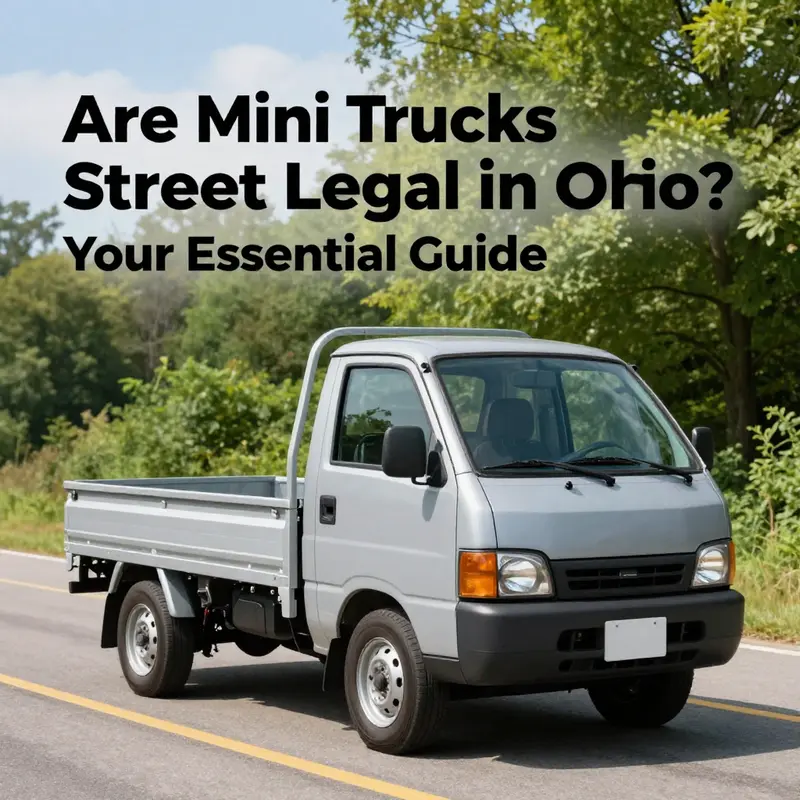
Mini trucks have a long appeal for drivers who want compact utility and nimble handling without giving up serious payload potential. They charm with their size, efficiency, and a sense of practical ruggedness that suits urban commutes, farm lanes, or weekend projects. But the question on many Ohio driveways remains: are these diminutive workhorses street legal in the Buckeye State? The short answer is nuanced, and the longer answer is built from an understanding of how Ohio treats any motor vehicle that travels on public roads. In Ohio, a mini truck is not a blanket exception to rules about registration, safety, and emissions. It is a vehicle that must meet a set of standards, be properly registered and insured, and be equipped to safely operate alongside the broader spectrum of cars, trucks, and SUVs. The path to legality is shaped by how the mini truck is designed, how it is built, and how it is classified in the eyes of state and federal authorities. This is not a tale of one-size-fits-all approval; it is a careful navigation of classifications and requirements that hinge on precise specifications like weight, safety features, and compliance with federal standards.
To begin, Ohio treats mini trucks as motor vehicles under state law. This classification carries with it the expectation that the vehicle will be registered, titled, insured, and operated in a manner consistent with other street-legal motor vehicles. The implication is direct: there is no automatic exemption from registration or from the obligation to meet basic safety and emissions standards simply because a vehicle is smaller than a traditional pickup. The entry point for most mini trucks is simple in theory but specific in practice: if the vehicle is under a defined gross vehicle weight rating (GVWR), it can be considered for standard registration processes through the Ohio Bureau of Motor Vehicles (BMV). The practical threshold commonly cited is a GVWR of 10,000 pounds or less. Vehicles that fall under this threshold align with the category that most people understand as light vehicles or passenger vehicles for purposes of registration and insurance. Above that weight, the path can tilt toward heavier-truck or commercial classifications, and with that shift come additional regulatory layers and potential restrictions. In other words, weight serves as a gatekeeper to how the vehicle will be treated under Ohio rules.
Yet weight alone does not seal the deal. A mini truck must also comply with safety standards that are universally applicable to motor vehicles. The Federal Motor Vehicle Safety Standards (FMVSS) apply nationwide and form a baseline for what it means to be street-legal in Ohio. These standards cover critical systems: lighting, braking, occupant protection, and overall vehicle integrity. A mini truck that is intended for daily street use must demonstrate compliance or equivalence to FMVSS requirements. In practice, that means the vehicle should be equipped with functioning headlights, taillights, turn signals, mandatory lights, proper braking performance, and the capacity to meet emissions requirements in place for the state. Ohio does not operate a separate, relaxed safety regime for micro-pickups; it aligns with federal safety expectations, then layers on state-specific checks such as title, registration, and emissions where applicable.
A key nuance lies in how the mini truck is designed and built. If a vehicle is manufactured as a mass-produced model that nonetheless falls into a compact utility category, it will normally pass through standard registration channels once it meets the GVWR threshold and safety criteria. But many mini trucks circulate on Ohio roads as either repurposed vehicles or custom builds—sometimes built on a passenger car chassis, or imported as a kit or as a lightly altered vehicle. In these cases, the question of legality becomes more delicate. A mini truck assembled on a passenger car platform may present challenges related to structural integrity, weight distribution, and the suitability of the chassis for load-bearing tasks. The state will scrutinize whether the vehicle was originally designed as a passenger car or as a light truck, and how the resulting configuration aligns with FMVSS expectations. If the modification pushes the vehicle into a category not originally intended for highway use, or if the chassis transformation undermines fundamental safety features, the Ohio BMV may impose restrictions or require additional inspections before granting highway eligibility. The underlying principle is clear: the more a mini truck diverges from a purpose-built or purpose-certified design, the more likely it is to require careful evaluation before it earns a place on Ohio’s roads.
For those who import mini trucks from abroad or who undertake substantial customization, there is another potential roadblock. Vehicles that arrive as “kit cars” or as “off-road” specimens often do not automatically qualify for street use. A kit car, in particular, is assembled from components that may not have undergone a single, coherent safety certification path through FMVSS. Because Ohio’s registration framework relies on safety certifications and a VIN-based determination, a kit-built mini truck typically faces a formal inspection process. The BMV, in coordination with safety and emissions standards, may require documentation or even an in-person assessment to certify that the vehicle is suitable for public highway operation. In some cases—especially with highly customized builds—the vehicle might be approved only after passing a safety inspection and obtaining street-legal certification. Those outcomes hinge on the specifics of the build, including the integrity of the braking system, lighting, seat belt installation, crashworthiness elements, and the vehicle’s overall compliance with FMVSS safety norms.
An important procedural note follows from these design realities: the vehicle’s Vehicle Identification Number (VIN) often plays a pivotal role in the formal determination of street-legal eligibility. The VIN is the primary credential that ties a specific vehicle to its safety history, manufacturing origin, and compliance profile. When there is uncertainty about a mini truck’s origin—whether it is a mass-manufactured model, a kit car, or a heavily modified vehicle—the BMV can perform VIN verification and seek corroborating safety documentation. In some situations, the VIN-based assessment is the decisive step to confirm whether the vehicle qualifies for standard registration on Ohio roads or whether it should be restricted to a non-highway designation or a special-registry status until a safety inspection is completed and the vehicle earns clearance for public use.
Registration and titling are the practical gates that grant access to the road. In Ohio, a mini truck that falls under the standard GVWR threshold and passes FMVSS-based safety checks will likely pursue the same registration and titling process as other motor vehicles. This process involves presenting proof of ownership, completing the appropriate title application, and obtaining insurance that meets state requirements. Insurance serves a dual purpose: it provides financial protection and demonstrates that the vehicle is being operated within the risk management framework that underpins Ohio’s roadways. For a vehicle that remains borderline on weight or design, the BMV may require additional confirmations of GVWR and may implement a staged registration path, perhaps starting with a special-use plate or a temporary permit, while the vehicle undergoes required inspections.
Emissions testing is another layer that cannot be overlooked in Ohio’s framework for street-legal vehicles. Depending on the county and the year of manufacture, a mini truck may be subject to state or local emissions requirements. Modern emissions regimes are designed to ensure that even smaller utility vehicles do not worsen air quality beyond established limits. The practical upshot is that a mini truck owner should anticipate potential emissions testing or certification steps, particularly if the vehicle is a vintage import or a non-standard build. Compliance with emissions standards is generally a prerequisite for ongoing road use; failure to meet emissions obligations can impede registration or renewal, even if the vehicle otherwise passes safety checks.
The specific path to legality often begins with a careful intake of the vehicle’s documentation. Prospective owners should gather the VIN, weight specifications (to confirm GVWR), documentation of any modifications or chassis changes, proof of safety-standard components, and any available certifications related to FMVSS compliance. In many cases, taking these materials to the BMV for a formal determination is the most reliable way to understand precisely what is required. The BMV’s own guidance emphasizes thorough documentation and proactive verification, and it points to a process that can be navigated successfully with a clear set of records and a patient, methodical approach to compliance. The Ohio BMV website offers a centralized gateway for vehicle registration and eligibility questions, which is invaluable when the path is less straightforward due to modifications or imports. This guidance helps bridge the gap between a compelling, practical vehicle concept and a legally operable street vehicle.
Owners who anticipate frequent highway use should also consider how their mini truck’s design affects everyday operation. Even when a vehicle is legally registered, daily use hinges on the reliability of critical systems: effective lighting for night operation, robust braking, secure seat belts, and a tire and suspension setup that can safely handle road conditions. In addition, routine maintenance and up-to-date safety recalls play a role in ongoing compliance. A vehicle that is frequently loaded or used for work tasks may experience dynamic stresses that reveal the importance of a chassis and suspension that align with the vehicle’s stated purpose. These considerations are not merely about passing a one-off inspection; they are about maintaining a legitimate, roadworthy vehicle over time. The practical reality is that the mini truck’s continued compatibility with Ohio roads depends on consistent adherence to safety and emissions standards, regular maintenance, and a willingness to engage with the BMV if questions arise about classification.
Where does that leave the consumer who wants a mini truck for daily driving in Ohio? The pragmatic approach is to verify GVWR, ensure FMVSS compliance for essential systems, confirm proper lighting and braking, understand whether the build qualifies for standard registration or requires a more specialized path, and prepare for potential inspections if the vehicle is a kit or heavily modified. For those who enjoy comparing different models and configurations, there is value in examining how various mini trucks are constructed and what that might imply for highway use. When evaluating options, readers can explore model comparisons that shed light on how different chassis choices, weight distributions, and design philosophies influence safety, handling, and regulatory posture. A thorough read of model-spec comparisons can illuminate the practical realities behind the legal framework, helping readers make informed decisions about both the vehicle they purchase and how they plan to use it on Ohio roads. See the ongoing exploration of mini truck models and features to gain a broader sense of how the design decisions in this space correlate with safety and compliance. comparing-kingstar-kruzr-models-specs-features
In the end, the question “are mini trucks street legal in Ohio?” does not have a single, universal yes or no. It has a thoughtful, conditional answer grounded in weight, safety compliance, vehicle configuration, and a clear process of registration and verification. The best path for most prospective owners is to start with the GVWR assessment and FMVSS alignment, then consult the Ohio BMV to confirm the vehicle’s eligibility based on the VIN and the vehicle’s particular build. The BMV’s guidance is not a bureaucratic hurdle; it is a road map that helps ensure that the mini truck you intend to drive is, indeed, legally configured for Ohio streets, with all necessary documents, certifications, and inspections in place. This careful, methodical approach helps prevent surprises at the registration counter or, worse, a compliance issue after months of use. For anyone who intends to bring a unique mini truck into Ohio or convert a vehicle into a compact utility runner, the process is the same in principle: document the build, verify the safety features, ensure emissions readiness, and secure registration and insurance. Throughout, maintain a collaborative posture with the BMV and pursue formal determinations when there is any doubt about how a specific build should be classified. The road to legality is not merely about the present moment of registration; it is about ongoing compliance and responsible ownership that respects both the vehicle’s capabilities and the safety of everyone sharing Ohio’s public roads.
For readers seeking authoritative information beyond the chapter’s discussion, the Ohio Bureau of Motor Vehicles (BMV) provides detailed guidance on vehicle registration and eligibility. Their portal is the starting point for official, VIN-based determinations and for understanding whether a given mini truck line qualifies for standard highway use under Ohio rules. In practice, this means that a vehicle owner should consult the BMV directly, or provide the VIN for a formal determination. The BMV’s resources are designed to help vehicles that sit at the intersection of hobbyist builds and everyday transportation to determine whether their configuration is road-ready under state law. The BMV’s guidance is complemented by the broader framework of federal safety standards, which remain a constant reference point for all passenger and utility vehicles seeking street use on Ohio roads. When in doubt, reach out to the BMV for clarification and ensure that every step—from weight verification to safety inspections and emissions compliance—is completed prior to mounting a license plate and taking to the street. Official resources can be found at the Ohio BMV’s website: https://www.bmv.ohio.gov.
In sum, Ohio’s approach to mini trucks reflects a careful balance: vehicles that fit within the GVWR threshold and carry FMVSS-compliant features can be treated much like conventional light vehicles. Vehicles that stray from standard configurations—kit cars, heavy conversions, or chassis-repurposed designs—face a more exacting path, often involving inspections and official certification. This is a chapter about possibility rather than absolutes. It invites practical steps, a clear eye for safety, and a direct engagement with the state’s regulatory framework. When these conditions are met, the mini truck you envision can share Ohio’s roads with the same liberties and responsibilities as any other street-legal vehicle. And, for those who love exploring different configurations and their implications, the ongoing conversations in model comparisons and customization projects help illuminate how design choices translate into real-world legality—an educational thread that binds the practical with the regulatory in one coherent journey.
External resource for further reading: For official, up-to-date guidance on vehicle registration and eligibility, consult the Ohio Bureau of Motor Vehicles at https://www.bmv.ohio.gov. Here, drivers can find specifics on how GVWR, safety features, emissions requirements, and VIN-related determinations influence the road-legal status of mini trucks in Ohio. This resource is essential for anyone pursuing a definitive, vehicle-specific answer and can serve as a helpful counterpart to the general discussion above.
null
null
Between Passengers and Freight: How Ohio Classifies Mini Trucks and What It Means for Street Legality
Ohio’s roads host a curious mix of vehicles, and among them, mini trucks occupy a niche where ownership dreams collide with strict regulatory lines. The question—are mini trucks street legal in Ohio?—doesn’t admit a single yes or no; the answer hinges on how the vehicle is designed, how it will be used, and how its legal status is interpreted by the state’s motor vehicle framework. The code that governs this space is not a page in a glossy brochure. It’s a network of federal safety standards, state registration rules, and usage-based classifications that together determine how a mini truck is categorized, taxed, insured, and, ultimately, allowed to ride on the same pavement as every other passenger car or commercial workhorse. In Ohio, like many states, the central axis around which this whole issue turns is classification: is the vehicle a passenger car by design and intent, or is it a commercial vehicle built for hauling goods and supporting a business? The distinction matters far beyond vanity plates or a different color badge. It affects the paperwork you file, the fees you owe, the license you need to operate it, and the inspections that might be required to keep it in operation on public roads. This isn’t a purely mechanical matter of engine size or wheelbase; it’s a legal framework that links the vehicle’s physical characteristics to its day-to-day life on Ohio streets and highways. At the heart of the classification system lies the Federal Motor Vehicle Safety Standards, known as FMVSS, and the state’s corresponding rules administered by the Bureau of Motor Vehicles (BMV). Vehicles must conform to FMVSS to be considered fit for highway use, and they must be properly registered with the BMV. Emissions compliance, too, enters the equation, aligning with federal and state air quality expectations to ensure that any vehicle sharing road space with others does not unduly worsen air quality. The practical upshot is that a modern mini truck can be street legal in Ohio, but only if it meets a confluence of criteria that the state views through the dual lenses of safety and utility. The design must be compatible with passenger or commercial classification, and the intended use must align with that classification. It sounds simple when phrased this way, but the reality is more nuanced, because the same physical vehicle could be legal in one role and not in another depending on how it is marketed, registered, and employed. The regulatory nuance begins with the weight that the state assigns to the vehicle. In Ohio, a key determinant for passenger-vehicle eligibility is the Gross Vehicle Weight Rating (GVWR). If a mini truck’s GVWR stays under 10,000 pounds and it isn’t built for heavy-duty commercial freight, the door remains open for passenger-vehicle status, assuming the vehicle design also aligns with passenger-car criteria in other respects. This threshold is not merely about spare tires and a small bed—it’s about how the state views the vehicle under its safety and highway-use framework. When the designation shifts toward a commercial category, the vehicle’s path on the road becomes more complex. Commercial vehicles trigger stricter registration requirements and are often subject to higher fees. They can also bring into play the possibility of Commercial Driver’s Licenses (CDLs) if weight and cargo thresholds exceed certain levels. The Ohio DOT and the BMV expect commercial operations to adhere to additional safety inspections and the other administrative obligations that support the movement of goods and services on public roads. The distinction between passenger and commercial is ultimately a question of use as much as design. The same mini truck that hauls a weekend lawn-care load for a homeowner will typically be treated differently from a similar vehicle used on a daily basis to transport tools, materials, and crews for a landscaping or construction business. The owner’s stated purpose matters because it informs the classification decision—and, in practice, this can lead to divergent registration fees, insurance obligations, and regulatory scrutiny based on how the vehicle is deployed. It is not the drivetrain alone that determines the category. A two-wheel-drive or four-wheel-drive configuration does not, by itself, decide whether the vehicle is a passenger car or a commercial vehicle. The determining factor rests with how the vehicle is intended to be used, how it was designed, and whether it meets the design criteria for the chosen classification. This distinction becomes particularly important for vehicles that sit at the edge of regulation—those imported from abroad, those assembled as kit cars, or those modified after purchase. In those scenarios, Ohio’s road-use rules may treat the vehicle as an off-road vehicle or as a special-purpose car, and the highway legality will depend on the vehicle’s inspection status and certification. The possibility that a mini truck is labeled a “kit car” or an “off-road vehicle” carries real consequences. Such classifications can qualify the vehicle for limited, non-highway use unless the owner can demonstrate, through safety inspections and formal certification by the BMV, that the vehicle is suitable for regular highway travel. The pathway to highway legality for these vehicles often runs through a formal evaluation of safety features, a review of the vehicle’s emissions profile, and a process that may include a title and registration that reflect a passenger or commercial use category. This is not an arcane distinction, but it is one that must be navigated carefully. Ohio’s BMV is the authoritative source for these determinations, and the most reliable path to clarity is to consult the official guidance and, when appropriate, present the vehicle’s VIN for a formal assessment. The BMV’s guidance emphasizes that vehicle classification affects licenses, fees, and insurance. It also underscores that strolling through a local parking lot with a tiny pickup that looks more like a personal utility vehicle than a heavy-duty freight hauler should not breed assumptions about its road legitimacy. It is best to treat each mini truck on its own terms, anchored in the vehicle’s GVWR, its intended use, and its conformity to FMVSS and emissions standards. For those who want to build a more complete picture or pursue a purchase with street-legal intent, a practical step often recommended by enthusiasts and professionals alike is to examine the vehicle’s registration pathway early in the process. The owner should check whether the mini truck can be registered as a passenger vehicle by its GVWR and design, and whether the design supports passenger-car classification through compliance with the relevant FMVSS elements. If the vehicle is intended for commercial use, owners should anticipate registration as a commercial vehicle, a different insurance regime, and the possibility of DOT compliance if required by the nature of the cargo. These distinctions shape the ongoing costs and obligations, including registration fees and the potential need for a commercial driver’s license if the vehicle’s use crosses the line into defined commercial operation with substantial weight or cargo. It is worth reiterating that the drivetrain—whether 2WD or 4WD—does not erase or create the classification. The same rule applies to the decision about whether to pursue a more typical passenger-vehicle route or a commercial path. The key is the function of the vehicle, not just its form. For those who imagine a mini truck as a clever, thrifty substitute for a full-size pickup in a home or garden enterprise, the prospect of street legality in Ohio remains favorable, so long as the vehicle conforms to the essential safety and environmental standards and is registered accordingly. Yet the street-legal journey is not guaranteed by a neat appearance or a nostalgic silhouette. The path is paved with formal checks: FMVSS compliance, emissions control alignment, and a proper registration that corresponds to the vehicle’s classification and use. In the end, it is not merely about whether a mini truck can physically fit on the road; it is about whether it has earned the right to be there through compliance, inspection, and official recognition by the state. The regulatory framework is designed to prevent a mismatch between the vehicle’s capabilities and its on-road responsibilities. The result is a balanced system that tolerates innovative, efficient, and compact transport options while preserving safety and accountability on crowded Ohio streets. For readers who want to see how these principles play out in practical terms, a useful path is to consult industry-focused resources and community discussions that explore the day-to-day realities of owning and operating mini trucks in Ohio. Such conversations often highlight the importance of documentation, the readiness to present a VIN for formal determination, and the ongoing responsibility of keeping the vehicle compliant with FMVSS and emissions standards. If you’re seeking a more experiential perspective, you can explore related discussions and practical considerations in industry blogs and forums, which sometimes offer granular details about registration processes, insurance considerations, and the realities of navigating the Ohio BMV’s guidance. For readers who prefer to see the broader regulatory landscape reflected in a dedicated resource, a visit to the official Ohio BMV site is a prudent step. This site provides the formal guidance on vehicle registration and eligibility that underpins every classification decision, every fee, and every compliance step that a mini truck owner must undertake. Meanwhile, those who want to situate these regulatory realities within a broader community conversation can turn to the broader online ecosystem that documents experiences, challenges, and solutions for owners of compact utility vehicles. A concise entry point that captures the spirit of these discussions is the minitrucks-focused blog, which aggregates practical stories, maintenance notes, and legal clarifications that help readers understand how other owners navigate registration and use. You can explore it here: minitrucksocala blog. This resource offers a sense of how people approach the question of street legality in a real-world context, complementing the formal regulations with observations from those who live with these vehicles. As with most regulatory questions, the definitive answer for a specific mini truck comes down to a precise, documentable determination from the Ohio BMV. If you own such a vehicle or are contemplating a purchase, you should prepare to provide the vehicle identification number (VIN) to receive an official classification and to confirm whether the vehicle can be legally operated on Ohio public roads. The BMV’s decision will hinge on the GVWR, the vehicle’s design, its intended use, and its compliance with FMVSS and emissions standards. It is this careful alignment of form, function, and formal approval that distinguishes a street-legal mini truck from a project that may require additional work or may not be eligible for highway use at all. For families and small businesses alike, this clarity can save time, money, and potential compliance headaches. The road ahead for mini trucks in Ohio is therefore not a single lane but a spectrum of possibilities shaped by the vehicle’s weight, its purpose, and the owner’s willingness to engage with the state’s regulatory framework. In that sense, the classification system is less a barrier and more a roadmap. It points toward a straightforward approach: determine the intended use, verify the GVWR and design meet passenger-car criteria, confirm emissions and safety compliance, and then pursue the appropriate registration route. If the vehicle changes hands or changes role—say, a personal-use vehicle becomes a small commercial tool—the classification may shift, and so too will the regulatory obligations. This dynamic is part of the practical reality of micro-trucks on Ohio roads. It reflects a mature balance between enabling efficient, versatile transportation options and maintaining a predictable safety regime for all road users. The bottom line is that mini trucks can be street legal in Ohio, but the pathway is contingent on a careful, documented alignment with federal and state standards, plus a clear indication of use on the part of the vehicle owner. The process may feel bureaucratic, but it exists to ensure that compact vehicles contribute to mobility without compromising the safety and reliability that Ohio drivers expect from every vehicle that shares the road. Readers interested in further practical considerations—including how to prepare a mini truck for a BMV inspection or how to interpret a VIN for classification—will find value in following the broader discussion in related community resources and official guidance. While the rules may seem dense, they are navigable with the right information and the right steps. The essential takeaway remains straightforward: street legality for mini trucks in Ohio is not a given by virtue of size. It is earned through compliance, appropriate registration, and a clear alignment between how the vehicle is designed to be used and how it is operated on public streets. For authoritative guidance, refer to the Ohio BMV and its formal registration resources. External resource: https://www.bmv.ohio.gov.
Registration as the Gatekeeper: How Ohio Keeps Mini Trucks Street‑Legal
On the surface, a compact-looking vehicle arriving in Ohio with the shape of a small pickup might seem ready to hit hometown streets. But legality in Ohio hinges on a careful alignment of federal safety standards, state registration, and the vehicle’s classification in the eyes of the Bureau of Motor Vehicles (BMV). The question of whether a mini truck is street legal in Ohio is not a simple yes or no; it is a puzzle whose pieces include the vehicle’s design, its weight and purpose, and the path its owner chooses to take through registration and inspection. The central thread running through this chapter is not the novelty of the vehicle but the sober logic of process: if a mini truck meets FMVSS criteria, if it can be properly identified and titled, and if it can be shown to meet Ohio’s safety and emissions expectations, it can join the network of legally operating vehicles. The highway system, after all, is not only about moving from point A to B; it is also about accountability, traceability, and the shared guarantee that vehicles on the road perform to established standards. That is the bedrock of what the Ohio BMV governs when it evaluates a vehicle that arrives in the state seeking a plate and a rightful place on the road.
The Ohio framework is built to accommodate a spectrum of vehicle types, including the compact and the uniquely configured mini trucks that have captured the interest of drivers seeking utilitarian versatility in a smaller footprint. The critical determinant is how the vehicle is classified. In Ohio, a mini truck can be treated as a passenger car, a light truck, or a commercial vehicle, depending on its construction, its weight, and its intended use. The classification is not a matter of fashion; it dictates the applicable FMVSS standards, the type of insurance required, the registration fees, and the inspection steps, if any. This is where many owners meet a practical truth: the same chassis can end up in different categories, each with its own set of standards. As a result, two nearly identical machines could face different road rules simply because one is considered a passenger car and the other a light truck. That distinction matters because it shapes what the BMV will require to issue a title, license plate, and certificate of compliance before the vehicle can circulate.
A practical way to imagine this is to consider the way the vehicle is built. When a mini truck is built on a traditional passenger car chassis—think of a compact platform repurposed into a pickup form—the design is often oriented toward lighter duty and urban practicality. It may still qualify for street use if it adheres to the FMVSS applicable to passenger cars and if the state recognizes it within the appropriate vehicle category. But when the same concept morphs into a machine built as a true light truck, or when it is imported with a configuration that resembles a commercial utility vehicle, the requirement set shifts. The weight threshold, the structural integrity, and the intended application can push the vehicle into a different regulatory lane. Ohio has long treated weight as a bright line: vehicles approaching certain gross vehicle weight ratings invite additional scrutiny. While most mini trucks hover well below the heavy end of the spectrum, the precise weight matters because it can trigger a more rigorous review, a separate registration category, or even restrictions on highway use if the vehicle diverges from its declared purpose. The intent behind these rules is not punitive but protective: ensuring that any vehicle occupying public roads behaves within predictable safety norms and that state authorities can accurately track ownership, accountability, and potential risk.
In practical terms, this means an owner must navigate a few essential steps before a mini truck can join the stream of traffic. First, the vehicle must meet FMVSS criteria. Federal standards govern basic safety features—from crashworthiness and restraint systems to lighting and braking performance. Meeting FMVSS is not optional; it is a prerequisite for any vehicle that will operate on public highways. Second, the vehicle must be properly registered with the Ohio BMV. Registration is more than a bureaucratic bell to ring; it is how the state confirms ownership and ensures the vehicle is identifiable through a VIN. The VIN is the frame’s social security number on paper, a unique sequence that ties the vehicle to a record in state and federal databases. The process of VIN assignment, verification, or documentation is often where people encounter the most practical friction, especially with custom builds or imported mini trucks that arrive as kit configurations or nonstandard assemblies.
The BMV’s role is clarifying rather than obstructive. It provides guidance on how a vehicle should be documented to achieve lawful operation. The BMV’s site lays out the official routes, from title and registration forms to the proof of insurance and any emissions or safety inspections that might be required in particular counties or for certain vehicle types. The emphasis is on verification: the state wants to confirm who owns the vehicle, what it is, and that it has met the rules in place for safety and environmental performance. In the real world, this translates into a sequence: gather ownership documents, obtain a VIN check if needed, secure appropriate insurance, and prepare for any inspections that Ohio or the county may require. The end goal is a certificate of registration and a plate that certifies the vehicle meets the state’s expectations for roadworthiness.
The question of inspections, too, matters. Ohio’s approach to inspections for mini trucks is not universal; it varies with classification and with the vehicle’s origin. A kit car or a vehicle imported as an off-road unit can fall into a gray area. In those cases, the BMV may require a safety inspection and perhaps a certification that the vehicle conforms to the FMVSS and to state emissions standards. For the owner, this means that a vehicle’s street legality is not guaranteed by its appearance or by a simple registration process; it depends on whether the vehicle can carry the necessary documentation and pass the checks the BMV or its inspectors perform. If a vehicle fails to meet inspection standards or if the documentation does not establish compliance, operating it on public roads can expose the owner to penalties, including fines, towing, and potential loss of driving privileges for the vehicle until the issues are resolved.
A central challenge for many owners is the classification question. The state’s approach to classification—passenger car, light truck, or commercial vehicle—can determine the amount and form of proof required for registration. The difference may seem technical, but it influences practical realities: how much insurance is needed, what kind of license plate is issued (if any special plate is required), and whether the vehicle is subject to weight-based restrictions or special routing limitations. In many communities, a properly registered mini truck is welcomed for its efficiency and utility; in others, misclassification can lead to unintended restrictions or more stringent oversight.
For those embarking on this path, the prudent move is to treat the registration process as an opportunity to establish a clear, auditable record from the outset. Gather ownership documents, secure a VIN, and confirm with the BMV which vehicle category applies to the mini truck you plan to operate. If there is any ambiguity—especially for a vehicle that blends elements of passenger transport with utility or commercial use—it is wise to seek a formal determination from the BMV, ideally by providing the VIN for a formal review. This approach minimizes the risk of later disputes with law enforcement or with road authorities. The BMV’s guidance, readily available online, emphasizes that staying within the framework of state rules is the surest path to continued, trouble-free operation.
The practical journey often begins with the owner leaning on the experience shared within the broader mini truck community. Enthusiasts and professionals who navigate the Ohio landscape regularly discuss the realities of registration, safety inspections, and the sometimes-complex intersections of federal and state requirements. They emphasize that while a mini truck may be a clever and capable vehicle, its street legality rests on the intersection of design, documentation, and due diligence in the registration process. In that sense, the BMV process is less a hurdle and more a framework that brings clarity to a specialized, enthusiast-driven segment of the automotive world. For readers who want a broader sense of the community’s practical considerations, the Mini Trucks OCala blog offers ongoing discussions about the realities and nuances of mini truck ownership and registration. See the Mini Trucks OCala blog for deeper context and practical perspectives on how other owners approach similar challenges in the registration and legal compliance journey.
The ultimate takeaway is that Ohio’s road-legal status for mini trucks is achieved not by a single feature or a clever argument, but by a chain of verifications that ties the vehicle to a registered owner, a compliant VIN, and a demonstration that the vehicle meets safety and environmental expectations. The process carries with it a sense of continuity and responsibility: a driver contributes to safety on the road, a vehicle carries a traceable history, and the state maintains a framework that allows for consistent enforcement and fair taxation. This shared responsibility is not a constraint; it is a pathway that helps ensure that the addition of mini trucks to Ohio’s roads does not undermine the broader safety and reliability of the transportation system. The state’s procedures reflect a balance between encouraging innovation and preserving uniform standards that protect all road users.
As with any nuanced regulatory landscape, the best course for any prospective mini truck owner is proactive engagement with the official channels. Begin with the Ohio BMV’s official resources to confirm classification, registration requirements, and any inspection prerequisites. If the vehicle is a conventional mini truck built on a standard chassis and intended for regular road use, the steps will typically involve standard title and registration work, proof of insurance, and any required emissions confirmations. If the vehicle’s configuration pushes it toward a more specialized category, a more targeted review may be necessary, potentially involving safety inspections or other documentation to demonstrate compliance with FMVSS and state rules. In all cases, documenting the vehicle’s build, maintenance, and how it aligns with the intended road use can prevent later complications and provide clear evidence should questions arise during registration or enforcement checks.
For readers seeking practical, person-to-person guidance on navigating these steps in Ohio, a useful starting point is the state’s official portal, which provides forms, guidelines, and contact options for hands-on assistance. The portal helps owners map out the precise sequence of actions tailored to their vehicle’s classification and condition. The process is not instantaneous; it can take time to gather documents, complete inspections if required, and obtain the necessary registrations and plates. But through patient preparation and adherence to the rules, a mini truck can become a legitimate, street-legal companion on Ohio highways.
In this broader arc of regulatory clarity, one should not overlook the role of local dealerships, mechanic networks, and commissioned inspection stations that specialize in niche vehicles. They can offer valuable guidance about what to expect in an inspection, what documentation is typically required, and how to address any discrepancies between a vehicle’s build and its declared classification. By approaching the process with openness to official guidance and a willingness to assemble the right paperwork, owners can avoid costly delays and move more smoothly through the BMV’s processes. The integration of federal safety standards with state registration requirements is not a bureaucratic pain point but a coherent system designed to preserve road safety while allowing legitimate, practical vehicles to exist in the public arena.
Ultimately, the street legality of a mini truck in Ohio rests on a clear, documented alignment of its design with applicable standards, its registration with the BMV under a suitable vehicle category, and its ability to pass any required safety or emissions checks. This is the gatekeeping function of the BMV in action: it is the gateway through which a vehicle that respects safety norms and proper ownership records can safely join Ohio’s roadways. For those who approach this path with thorough preparation and a respect for the rules, the prospect of driving a compact, versatile vehicle on Ohio streets becomes a straightforward, accountable reality rather than a speculative aim. The road to legality is not a matter of daring engineering alone; it is the convergence of design, documentation, and due diligence that keeps Ohio’s roads safe for everyone who shares them.
Internal resource for further practical perspectives: Mini Trucks OCala blog.
External resource: Ohio BMV official site: https://www.bmv.ohio.gov/
Final thoughts
Understanding the street legality of mini trucks in Ohio is essential for owners looking to utilize these versatile vehicles for work or play. By familiarizing yourself with the legal classifications, safety, and emissions requirements, and the importance of registration with the Ohio BMV, you can ensure you’re driving confidently on Ohio roads. Whether you’re using your mini truck for business or pleasure, keeping up with the regulations is key to enjoying all the benefits these compact vehicles have to offer.