
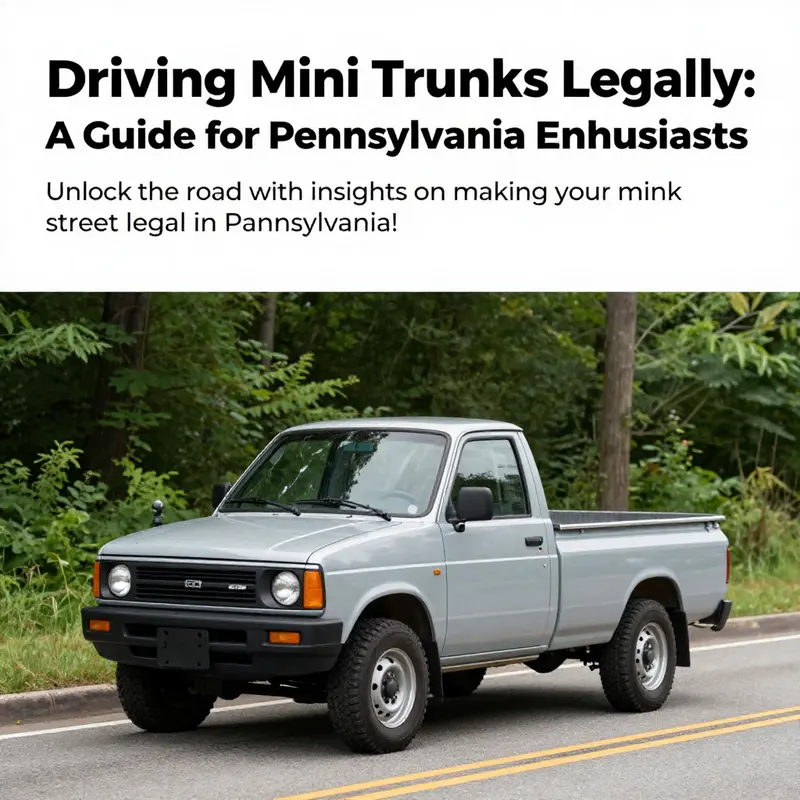
Mini trucks, known for their compact size and utility, have gained popularity among small business owners, residential property owners, and enthusiasts alike. However, many wonder, are these vehicles street legal in Pennsylvania? It’s essential to navigate the specific requirements and regulations outlined by the Pennsylvania Department of Transportation. This guide will walk you through the necessary steps to ensure your mini truck meets legal standards, its classification, possible restrictions on road usage, and how to keep it compliant with state laws. Each chapter offers vital insights tailored for local residents and mini truck enthusiasts, empowering you to drive with confidence and clarity.
From Off-Road Roots to Public Roads: The Legal Path for Pennsylvania Mini Trucks
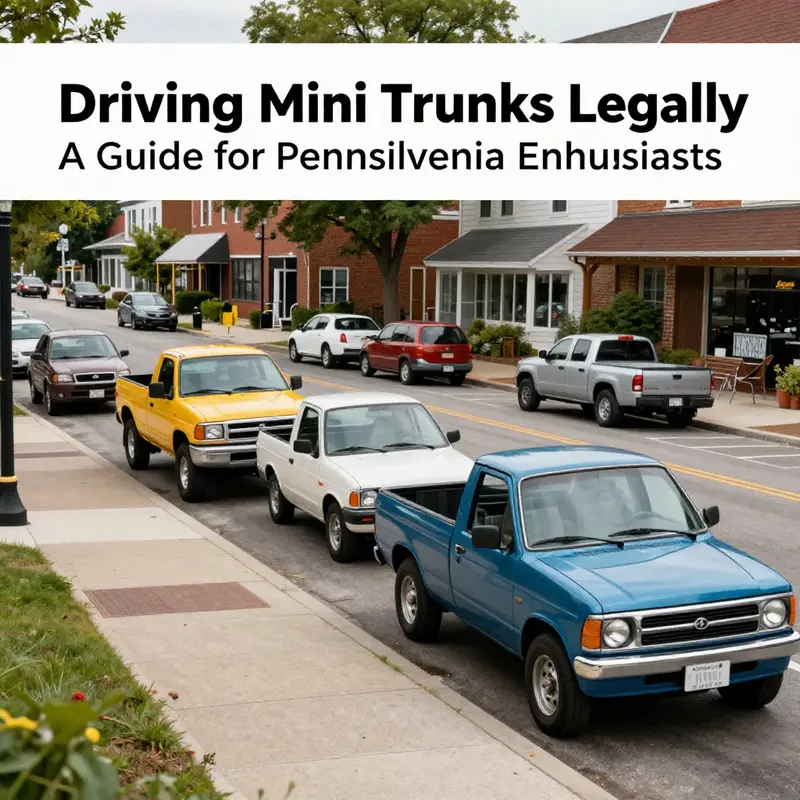
In Pennsylvania, the appeal of compact, versatile mini trucks sits at an intriguing crossroads between utility and the rules that govern public streets. The carport dream of a small, practical work vehicle often meets the real-world framework of safety, registration, and road-use limits. The journey from backyard play to street-legal operation is not merely a matter of tinkering; it is a careful alignment with state standards designed to ensure that any vehicle sharing lanes with other drivers meets broad-based safety expectations. This alignment begins with a clear understanding of how Pennsylvania classifies these machines and then follows through with the steps needed to make them compliant, insuring that what starts as an off-road fixture can be reliably and legally driven on public roads when the conditions are right.
At the heart of the question lies a simple but critical distinction. Mini trucks are not automatically granted street-legal status simply because they exist in a category that feels familiar to everyday driving. In Pennsylvania, many of these small utility vehicles are initially categorized as off-road vehicles or, more precisely, as vehicles that do not have highway-ready configurations by default. The state’s safety and emissions apparatus expects a certain baseline of features and performance before a vehicle can be admitted to the stream of traffic. The path to legality, then, is a two-part process: first ensure the vehicle can meet the roadworthiness requirements, and second complete the formalities that give the vehicle its identity on the road—title, registration, and insurance.
The practical realities of meeting that roadworthiness standard become evident when you examine the checklist laid out by the Pennsylvania Department of Transportation. A vehicle that will share roads must have proper lighting, functional brakes, appropriate tires for street use, reliable mirrors, and seat belts. These aren’t merely aesthetic or convenience features; they are core safety elements that enable drivers to signal intentions, control the vehicle, and respond to the dynamic environment of a shared roadway. The lighting system isn’t optional either. Headlights, taillights, and turn signals must operate correctly, ensuring visibility at night and in poor weather, while the omission of a horn or windshield wipers can quickly push a build into a grey area where law enforcement or insurance questions arise. Even the basics—like a valid title and current registration—anchor a mini truck in the system that tracks ownership, accountability, and compliance with state-wide vehicle standards.
Beyond these fundamental requirements, the classification nuance continues to shape how a mini truck can be operated. While many of these vehicles are designed with off-road use in mind, turning them into street-legal machines often requires converting or upgrading them to comply with motor vehicle safety standards set by PennDOT. This process can involve installing and validating a range of features that elevate the vehicle from a sport-utility profile into a compliant highway-capable form. For some builders, this means adding elements such as headlights, taillights, turn signals, a horn, and windshield wipers—components that are not merely for aesthetics but are essential for signaling, control, and safety in trafficked environments. It is a reminder that legality on Pennsylvania roads is as much about how a vehicle operates daily as it is about its structural pedigree.
Registration and insurance are the next essential pillars. Even when a mini truck meets the safety and emissions criteria, the owner must engage with PennDOT to title and register the vehicle. This process typically requires proof of ownership, a bill of sale, and a completed application form. Insurance, often a prerequisite for registration, adds another layer of protection and accountability for all road users. These steps do more than just grant a license plate. They place the vehicle within a formal system of record and financial responsibility, ensuring that the state can track compliance, address liability, and provide a framework for ongoing inspections and renewals.
A separate, sometimes overlooked dimension involves the possibility of a special inspection. For mini trucks not originally manufactured for highway use, Pennsylvania may require a special certification or inspection to verify that the vehicle meets the state’s on-road safety standards. This step is not merely administrative; it is a practical checkpoint that confirms significant systems—brakes, lighting, structure, and overall integrity—are robust enough to withstand normal roadway conditions. The inspection acts as a bridge between a modified, road-ready concept and the formal acknowledgement that the vehicle is fit for public use on Pennsylvania’s diverse road network.
The road-use realities, however, also shape what these vehicles can do once they are approved for street operation. A critical constraint to understand is tied to the classification of LSVs, or low-speed vehicles, and related off-road adaptations. LSVs tend to be restricted to roads with speed limits of 35 mph or less and are generally prohibited from highways and major interstates. This limitation isn’t a punitive barrier so much as a design and safety constraint grounded in the physics of speed, driver sightlines, and the mixing of traffic at higher velocities. On a practical level, even if a mini truck is street-legal in the sense of safety and registration, its on-road life may be bounded by where it can travel. The reality for owners is that many street-legal mini trucks serve well on local roads, rural byways, or business corridors where speeds stay moderate, while the thrill of a highway dash remains outside their realm.
A careful practitioner can see that legality is not a single checkbox but a living framework. It depends on the vehicle’s classification, any modifications completed to meet safety criteria, the registration and insurance status, and the specific roads on which the vehicle will operate. This means every owner coming out of the workshop with a vehicle intended for public streets should pause to verify the current classification with PennDOT before they set out. The state’s rules evolve, and compliance can hinge on nuances that shift with updates to regulations or interpretations of policy. The safest approach, then, is to navigate the process with up-to-date information and a willingness to adjust a build to satisfy the standards that Pennsylvania expects for all road users.
In this context, it is worth recalling that the broader mini truck ecosystem thrives on community knowledge and practical experience. For readers who want to connect with the ongoing conversation, a resource-rich hub exists in the micro-community around compact utility vehicles. A quick reference point for broader context and real-world examples is the community blog that discusses the culture, builds, and practical considerations for mini trucks. It offers perspectives on how enthusiasts approach projects, what features tend to gain approval, and how a thoughtful approach to compliance can align with the desire for utility and customization. See the minitrucksocala blog for a sense of the practical side of building and evaluating these vehicles in real-world settings while keeping legal considerations front and center.
Of course, when planning any move toward street-legal status in Pennsylvania, the best course is to consult authoritative sources. The Pennsylvania Department of Transportation’s official guidance remains the backbone of what is required. The agency outlines the foundational elements that determine whether a mini truck can be registered and legally operated on public streets. The road to compliance begins with a careful assessment of the vehicle’s lighting, braking, tires, mirrors, seating, and safety equipment, followed by the correct titling, registration, and proof of insurance. A driver should also prepare for a potential inspection to confirm that the vehicle meets emissions and safety standards. This process is not a mere bureaucratic obstacle but a framework designed to ensure that all road users share a consistent baseline of safety and accountability on Pennsylvania’s roadways.
As a thoughtfulness in practice, it helps to approach the journey with a clear plan and a respect for the constraints that govern motor vehicles. The ultimate goal is not simply to declare a mini truck street-legal but to integrate it into the traffic system as a reliable, predictable participant. That means passengers must be properly belted, signals must communicate intent clearly to other drivers, and the vehicle should respond consistently to the demands of the roads. It also means acknowledging that even a well-built, well-modified mini truck may have a constrained operating envelope—an on-paper legality that translates into practical use only on suitable roads. This balance—between the dream of a compact, versatile vehicle and the realities of state rules—defines the authentic path to legal street operation in Pennsylvania.
For readers seeking further context or practical examples of the kinds of modifications and configurations that tend to align with state standards, the broader online community offers a wealth of discussion. To explore more about the culture, customization, and practical considerations, you can visit the minitrucksocala blog, which compiles experiences from builders and drivers alike and can be a starting point for understanding how compliance intersects with everyday use. This reference is intended to complement official guidance rather than replace it, and it illustrates how enthusiasts navigate the boundary between a vehicle’s off-road heritage and its on-road life.
In short, mini trucks can be street legal in Pennsylvania, but achieving that status requires a deliberate, standards-driven approach. It’s not enough to own a small vehicle with off-road roots; the owner must also ensure the vehicle can meet the state’s safety, emissions, and road-use requirements. That means proper lighting, brakes, tires, mirrors, and seat belts, a valid title and registration, and any necessary inspections. It means understanding the limits of where the vehicle can be driven and recognizing that some streets and highways may be off-limits to low-speed configurations. It means embracing the process of verification with PennDOT and staying current with regulatory changes. And it means appreciating the broader ecosystem that surrounds these vehicles—the community stories, the practical builds, and the ongoing conversation about how a compact utility vehicle can responsibly become a legitimate part of Pennsylvania’s traffic mix.
External reference: https://www.penndot.pa.gov
Navigating the Road-Ready Route: Pennsylvania’s Rules for Mini Trucks on Public Streets
On a quiet stretch of Pennsylvania byways, the sight of a compact utility vehicle weaving between traffic stirs both curiosity and questions. The idea that a tiny truck with off-road roots can share the road with sedans and SUVs is appealing, especially for folks who use these nimble machines for work, farming, or weekend adventures. Yet the legality of such a vehicle on public streets is not a matter of personal preference. It rests on a carefully defined mix of classifications, registrations, and safety standards that PennDOT enforces to keep everyone on the road safer. Understanding this landscape means moving beyond assumptions and toward a clear, regulated pathway that can turn a weekend project into a street-legal vehicle, or reveal that some configurations simply won’t pass the test.
At the heart of Pennsylvania’s approach is classification. Mini trucks, often marketed as utility task vehicles (UTVs), off-road vehicles, or low-speed vehicles (LSVs), fall into categories that determine where and how they may be driven. The state does not grant blanket permission for all “mini trucks” to roam the public roadway. Instead, it requires owners to prove the vehicle meets the standards of a motor vehicle that is eligible for on-road operation. That distinction matters because it aligns with a broader framework in which any vehicle operated on public roads must be traceable to a title, a registration, and an insurance policy while meeting fundamental safety and environmental criteria. The practical effect is that a DIY conversion or a lightly modified OHV is not automatically street-legal; it must be carefully evaluated, registered, and equipped to satisfy PennDOT’s requirements.
Registration stands as a foundational element. In Pennsylvania, a vehicle operated on public roads must be registered with PennDOT and display valid license plates. This applies even if the vehicle began life as an off-road model and was later adapted for street use. Registration creates a legal link between the vehicle and its owner, providing a trackable record that helps authorities verify ownership, tax status, and compliance with safety and emissions standards. The process itself is not merely a bureaucratic hurdle; it is a critical step that clarifies the vehicle’s status under state law and determines the scope of road use that can be legally permitted. For owners, the registration path starts with confirming whether the particular mini truck can be treated as a standard motor vehicle for registration purposes, rather than an off-road exclusive machine. In practice, this often means presenting the vehicle for inspection, proof of ownership, and evidence that it meets the on-road requirements rather than staying permanently in off-road categories.
Safety requirements form the core of what it means to operate on Pennsylvania streets. A vehicle that is to be driven publicly must satisfy federal safety standards, which translates into a list of functional, on-board systems and components. Functional headlights must illuminate the road ahead, and brake lights should signal deceleration to trailing traffic. Turn signals are needed to communicate lane changes and turning intentions, reducing the chance of misreads that can lead to collisions. Rearview mirrors are essential for situational awareness, and seat belts provide occupant protection in the event of a sudden stop or collision. A working horn serves as a simple means of alerting nearby pedestrians and drivers in close quarters. Even something as seemingly minor as a speedometer has its place, offering drivers a clear sense of their actual speed and aiding decisions about lane position and acceleration in different traffic conditions. The overarching aim is to ensure that a vehicle, while perhaps smaller than a typical family car, behaves on the road in a way that other drivers can predict and respond to safely.
Another specific requirement concerns visibility at higher speeds. If a mini truck operates at speeds exceeding 25 miles per hour, Pennsylvania’s rules call for a windshield. This provision is about air-borne debris, wind pressure, and driver visibility—factors that affect control and reaction times on busy roads. The windshield serves as a shield and a sightline that keeps the driver focused on the roadway ahead, rather than on wind and dust. In practice, this means that some compact, open-air conversions may be limited to lower-speed avenues unless they are equipped with a compliant windshield and the associated mounting hardware. It is a reminder that road legality is often about adapting the vehicle to weather, road, and traffic realities rather than chasing a purely cosmetic modification.
Speed and road type present ongoing trade-offs for those seeking street-legal status. If a vehicle qualifies as a low-speed vehicle, its on-road opportunities become more restricted. LSVs in Pennsylvania are typically limited to roads with a posted speed limit of 35 mph or less. They cannot be operated on major highways or interstates, which are reserved for higher-speed traffic and larger, more crash-absorbent vehicles. This constraint reshapes how owners plan usage; a mini truck intended for farm work or campus mobility may be easy to place on a 25 or 30 mph street, but a route that dips into 45 mph zones requires a different configuration or even the choice to avoid those sections entirely. The practical implication is that the designation as an LSV does not merely reflect top speed; it defines the milieu in which the vehicle can safely exist and the kinds of trips it can realistically undertake on public streets.
Modifications play a pivotal role in how Pennsylvania treats a mini truck as a road vehicle. The vehicle must be approved as a motor vehicle under state law, which often entails modifications that align it with conventional road-legal standards. Typical changes include installing a roll bar or cage to enhance occupant protection, ensuring proper lighting and signaling, and achieving emissions compliance appropriate for on-road use. The emphasis is not on converting a vehicle into a high-speed sports machine but on creating a road-appropriate platform that maintains structural integrity and predictable handling. A critical point for owners is that modifications must be technically sound and professionally implemented to support registration rather than just cosmetic adaptation. In some cases, the modifications may demand third-party inspection or verification to assure PennDOT that the vehicle’s safety-related components meet minimum criteria and function under everyday driving conditions.
Inspection, too, matters. Vehicles not originally designed for highway use may face inspection requirements to confirm they meet safety and environmental standards. Passing an inspection is not guaranteed by the absence of a mechanical failure; it hinges on a holistic evaluation of the vehicle’s compliance with the applicable rules. The inspector’s job is to confirm that the vehicle’s essential systems—the lighting, brakes, steering, tires, and safety equipment—are in a roadworthy state and that the vehicle’s emissions controls align with state environmental expectations. The inspection is more than a formality; it is a checkpoint that can reveal earlier, possibly overlooked, mismatches between a vehicle’s on-road intent and its build specifics.
Emissions standards also shape the road-legal potential of mini trucks in Pennsylvania. The common expectation is that vehicles intended for public roads must comply with emissions criteria set by state and federal authorities. This is particularly relevant for vehicles that may have originated as off-road machines, where the exhaust and fuel systems must be calibrated to minimize harmful outputs while delivering reliable performance on public streets. Emissions compliance is not simply about passing a tailpipe test; it is about demonstrating that the vehicle’s overall configuration does not introduce excessive pollutants into the atmosphere. As environmental requirements evolve, owners may be asked to provide documentation or verification that modifications do not push emissions beyond permitted levels.
Beyond the technicalities, there is a practical, everyday dimension to legality. Insurance is a non-negotiable piece of the on-road equation. Without it, registration can be moot, and even the most carefully prepared vehicle can become a legal risk. Insurance coverage signals a commercial or personal commitment to responsible operation, offering protection to the driver and to others sharing the road. It also contributes to a smoother registration process, as PennDOT and insurance providers exchange information to confirm continuous compliance with state requirements. The reality is that the path to street legality is not a single milestone but a sequence of confirmations—title, registration, safety, emissions, and ongoing maintenance—that together sustain lawful operation over time.
For anyone considering the on-road journey with a mini truck, the steps are practical as well as legal. The initial move is to verify the vehicle’s classification with PennDOT and to determine whether it can be registered as a motor vehicle suitable for street use. This often requires a careful examination of the vehicle’s design, the modification work already completed, and the intended use. The next step is to secure the necessary documentation—proof of ownership, proof of insurance, and any technical specifications that demonstrate compliance with safety and emission standards. Once this package is assembled, the owner can pursue registration and, if required, a safety inspection. It is also prudent to consult the local PennDOT office or the official website for the latest guidance, since regulations can change and regional practices may differ.
As you map out your own project or purchase, remember that community resources can be valuable in navigating the do’s and don’ts of road legality. For a practical overview and real-world perspectives on builds that align with safety standards and local regulations, you can visit the Mini Trucks California blog. This resource offers insight into how enthusiasts approach upgrades, the kinds of modifications that tend to pass muster, and the considerations that arise when translating a hobby vehicle into a legal street machine. Mini Trucks California blog
In exploring these rules, it becomes clear that Pennsylvania’s approach balances freedom with accountability. The laws aim to preserve roadway safety while allowing owners to leverage small, efficient platforms for work and recreation. The process—registration, safety compliance, proper equipment, inspections, and ongoing responsibility—creates a framework where a mini truck can be more than a novelty. It can be a practical tool that rides alongside a family car and a city bus, sharing space on the same streets with predictable behavior and traceable accountability. For the curious reader or prospective owner, the path is not about finding a loophole but about aligning a vehicle’s build and operation with a clear set of standards designed to protect drivers, pedestrians, and other road users alike.
External resource: PennDOT Registration Requirements. For up-to-date guidance on vehicle registration, titling, and compliance with Pennsylvania motor vehicle laws, visit the official PennDOT page: https://www.penndot.gov/VehicleRegistration/RegistrationInformation/RegistrationRequirements.aspx
Roads, Rules, and Tiny Trucks: Interpreting OHV and LSV Classifications for Pennsylvania Mini Trucks
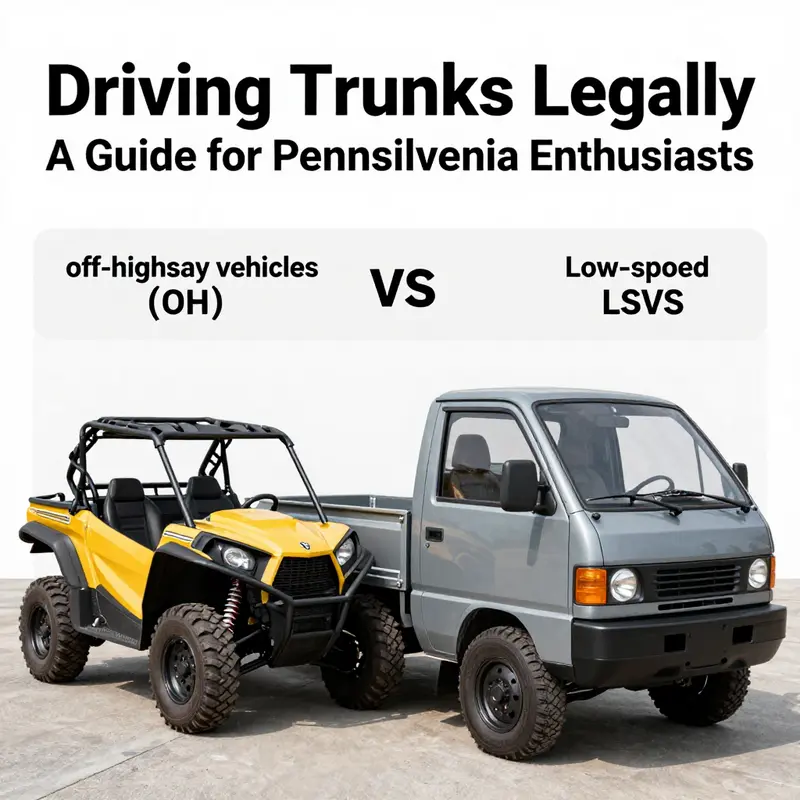
Pennsylvania does not treat mini trucks as a stand-alone class of vehicles with a single, one-size-fits-all rule. Instead, the legality of driving these small or compact utility vehicles on public streets hinges on how the vehicle is designed, how it is used, and how it is registered. The state’s approach reflects a practical balance: it recognizes the utility of small, low-speed vehicles while prioritizing roadway safety and the integrity of traffic systems. Because the law does not carve out a distinct niche for “mini trucks” per se, many of the questions surrounding their street legality come down to two broad classifications that the state uses for a variety of small, four-wheeled vehicles: off-highway vehicles (OHVs) and low-speed vehicles (LSVs). This framework frames the conversation not as a simple yes-or-no determination but as an assessment of the vehicle’s design, its performance envelope, and the permissions that accompany its registration and operation. Understanding this framework is crucial for anyone considering using a mini truck on Pennsylvania roads, whether for daily commuting, farm work, or business tasks that demand close-proximity travel in urban or suburban conditions.
Off-highway vehicles, the first category to consider, are defined by design intent and typical use rather than by a standard street-ready feature set. OHVs cover a broad family, including all-terrain vehicles, some utility task vehicles, and certain golf carts that are built for off-road terrain rather than public highways. In Pennsylvania, the default stance for OHVs on public roads is cautious: they are generally not permitted to operate on standard roadways unless a local municipality or specific state authorization grants permission. This is not a mere technicality; it reflects safety concerns about stability, braking performance, lighting, and the interaction between small, low-speed platforms and faster, larger vehicles sharing the same pavement. When a mini truck is designed predominantly for off-road use—carrying loads over uneven terrain or navigating rough trails—it is more likely to fall into the OHV category. In such cases, even if the vehicle is technically street-legal in another state under certain conditions, Pennsylvania typically requires meeting separate local ordinances or specialized authorizations before public-road operation is permissible. The practical implication is clear: the moment a consumer buys a mini truck that leans toward rugged, off-road utility rather than a street-focused profile, the question of legality becomes a matter of local permission and state-aligned regulations rather than a blanket authorization.
Yet the OHV pathway is not the whole story. The second major category—low-speed vehicles, or LSVs—offers a different route to street operation under Pennsylvania law. LSVs, sometimes called NEVs (Neighborhood Electric Vehicles), are four-wheeled, energy-efficient, relatively compact vehicles designed to operate at modest speeds. In Pennsylvania, an LSV is typically defined by a maximum speed range—commonly cited as between 20 and 25 miles per hour—and a set of safety and regulatory requirements that make them acceptable on certain public roads. The critical element here is speed: LSVs are intended to travel on roads where the posted speed limit does not exceed 35 miles per hour. This speed cap creates a meaningful boundary: LSVs can share local streets and some arterial segments with standard passenger cars, but they are not meant for use on major highways or interstates. The LSV classification brings with it a bundle of compliance expectations, including proper registration, the display of a license plate, and adherence to safety standards that may encompass lighting, reflectors, horn use, seat belts, and other equipment designed to safeguard occupants and other road users. The practical upshot is that, for a mini truck to be street-legal in Pennsylvania under the LSV path, it must be engineered, certified, and registered in a way that aligns with these standards while maintaining a top speed that fits within the LSV envelope.
The line between OHVs and LSVs is not merely academic. It shapes real-world decisions about how a mini truck is built, marketed, and used. A small electric truck with a top speed that sits squarely in the LSV range may, with proper approvals, qualify for LSV registration and be permitted on roads where the speed limit is 35 mph or lower. In contrast, a traditional or heavier-duty mini truck designed to haul cargo and tackle tougher work may resemble a modified or commercial vehicle by the time it reaches Pennsylvania’s doors. In such cases, the vehicle would likely be treated as a standard motor vehicle requiring conventional registration, insurance, and inspection—processes that carry their own sets of fees, compliance steps, and safety inspections.
For the practical-minded motorist or small business owner, the decision tree begins with a careful appraisal of the vehicle’s design and intended use. If the aim is to maximize street access and mobility on short trips through town, a compact, electric, low-speed vehicle with a certified top speed under 25 mph stands a reasonable chance of meeting LSV criteria, provided it can satisfy the state’s safety standards and registration requirements. If, however, the objective centers on robustness, payload capacity, or off-road versatility, the mini truck will more likely fall outside the LSV envelope and into the OHV or commercial-vehicle territory. In either scenario, pausing to confirm classification with PennDOT—the state agency responsible for motor vehicle safety and registration—helps avert missteps that could lead to fines, vehicle immobilization, or insurance gaps. The PennDOT pathway generally requires that the vehicle be registered, insured, and, in some cases, pass a state inspection to ensure compliance with emissions and safety norms.
To navigate these rules with greater clarity, owners and operators should also be mindful of the role that local ordinances play. Some municipalities have their own rules addressing OHVs on public streets, farm lanes, or park roads. Local authorities may permit limited-use operations on certain streets or require special permits for vehicles that do not conform to standard passenger-car specifications. In practice, this means that even a vehicle that could meet LSV criteria at the state level might still be constrained by city or township regulations when it comes to where it can be driven within a given jurisdiction. Conversely, some communities may offer streamlined use scenarios for low-speed vehicles that meet specific lighting and safety benchmarks, enabling residents to travel between neighborhoods or to adjacent commercial districts with fewer restrictions. The upshot is that the street legality of mini trucks in Pennsylvania often turns on a careful synthesis of state classifications, vehicle design, and the particular signposts of local governance.
The process of determining legality is not abstract paperwork; it translates into concrete steps that owners can take to move from question to compliance. First, verify the vehicle’s classification by cross-checking the design and speed characteristics with PennDOT. This is not about guessing based on appearance but about matching features to the formal definitions that govern OHVs and LSVs. Second, ensure that registration and insurance are in place. An LSV, once properly classified, should be registered and display a license plate, just as any other street-legal vehicle in Pennsylvania would. Third, confirm that the vehicle meets the relevant safety standards—headlights, brake lights, turn signals, mirrors, seat belts, and other equipment that support occupant protection and visibility. In practice, this means the vehicle should be able to pass any applicable state inspections and emissions tests, if those tests apply to the specific vehicle class. Fourth, assess the roads you intend to traverse. Even with LSV classification, the scope is limited to roads with 35 mph or lower speed limits, and high-speed roadways remain out of reach. On rural byways where vehicles may share space with farm equipment and quiet commuters, the lines can blur, making careful route planning essential.
As part of the broader landscape of culture and community around mini trucks, readers who seek practical wisdom beyond the statute often turn to dedicated enthusiast platforms and practical guides. These sources can illuminate how owners navigate the practical realities of ownership, maintenance, and legal compliance. For readers curious about firsthand experiences and community knowledge, the following resource offers a connected perspective: minitrucksocala.com/blog. Such chapters in a living conversation can help readers gauge how others interpret the law in everyday settings, from choosing the right vehicle form factor to understanding the trade-offs between payload, speed, and road access. While personal anecdotes are not a substitute for official guidance, they can illuminate common pitfalls and thoughtful strategies for aligning a tiny truck with Pennsylvania’s regulatory realities.
Ultimately, the question of whether mini trucks are street legal in Pennsylvania does not resolve to a single, universal rule. It resolves to a careful alignment of the vehicle’s design, its intended tasks, and the regulatory steps that enable lawful operation. For owners seeking the most straightforward path, aiming for an LSV classification—where feasible—offers a clear set of guidelines: stay within the 35 mph road-limit, meet the applicable safety standards, and secure the appropriate registration and insurance. For those whose work demands exceed the limitations of low-speed operation, embracing the OHV framework—or pursuing a traditional, commercial-vehicle registration—may be the more appropriate route, even if it comes with a more complex compliance regime. In all cases, due diligence with PennDOT, awareness of local ordinances, and a willingness to align with safety standards are essential. The evolving landscape of mini trucks on Pennsylvania streets reflects a broader trend: the blend of utility-focused, compact transport with modern safety expectations and local governance that recognizes the unique place these small machines occupy in Pennsylvania’s diverse roads and communities.
For readers who want a quick reference to regulatory distinctions while mapping out their own path, the Pennsylvania Department of Transportation and the state’s vehicle registration resources are the authoritative anchors. These channels provide the current classifications, the exact criteria for safety and emissions compliance, and the up-to-date processes for registration and inspections. As with any move toward legal operation, the goal is to pair practical needs with formal compliance, rather than to pursue shortcuts that could jeopardize safety or violate the law. By approaching mini trucks through the OHV and LSV lens, Pennsylvania offers a framework that respects both the utility of small vehicles and the shared responsibilities of a safe, orderly road system. The resulting balance helps ensure that these nimble machines remain a helpful, lawful part of the state’s transportation fabric.
External resource: For official guidance, see the Pennsylvania DMV’s low-speed vehicle page: https://www.dmv.pa.gov/Vehicle/Registration-Title/Registration-Requirements/Types-of-Vehicles-Registered-in-Pennsylvania/Pages/low-speed-vehicles.aspx
On the Line Between Convenience and Compliance: Navigating Pennsylvania’s Road Rules for Mini Trucks
In Pennsylvania, the idea of a mini truck sitting in the driveway as a practical everyday vehicle sits at an interesting crossroads between convenience and compliance. These compact workhorses can feel like a natural fit for hauling gear, navigating tight city streets, or skimming across rural lanes. Yet the path to using any mini truck on public roads is not a simple one. The state treats these vehicles through a framework that blends general motor vehicle standards with classifications that can sharply limit where and when they may be driven. The practical upshot is clear: a mini truck can be street legal in Pennsylvania, but legality is earned through meeting a set of specific requirements, understanding the vehicle’s classification, and staying attentive to seasonal rules that can swing into effect with weather events and road conditions.
At the core of the street-legal equation are the fundamental safety and regulatory standards that PennDOT enforces for all motor vehicles. A mini truck must come equipped with the basics that drivers expect on any road. That means reliable lighting, functional brakes, properly adjusted mirrors, and seat belts for all occupants. It also means a valid license plate and registration, since the vehicle is treated as a road-going asset rather than a private off-road toy. Emissions compliance is another component driven by state standards, ensuring that vehicles meet the environmental expectations Pennsylvania sets for on-road operation. Beyond the hardware, there may be needs for inspections, depending on the vehicle’s classification and the local regulatory environment. In short, being street legal is never purely about a sticker or a badge; it is about aligning the vehicle’s build and its official status with the state’s motor vehicle provisions.
A central distinction that shapes the street-legal path for mini trucks in Pennsylvania concerns how these vehicles are classified. Many mini trucks fall into categories such as off-highway vehicles (OHVs) or low-speed vehicles (LSVs). Each category carries its own set of allowed venues and restrictions. OHVs, for instance, are often intended for off-road use and may face tighter restrictions when pressed into on-road duties. LSVs, while designed to be driven on public roads at low speeds, come with explicit limitations on where they can be operated. The typical constraint is a maximum road speed—commonly a 35 mph limit on roads where LSVs may be used—and a prohibition on combining these vehicles with major highways and interstates. In practice, this means that even a well-equipped, properly registered mini truck could be legal to drive on certain local streets yet entirely disallowed on others that see faster traffic or higher-speed limitations.
For Pennsylvania owners, the crucial step is verification. Before a mini truck ever spends a moment on a public roadway, one must confirm how the vehicle is classified with PennDOT. This verification determines not only whether the vehicle qualifies for registration and insurance as a street-legal automobile, but also which routes are permissible. The process can feel arcane, because classifications can hinge on nuanced specifications of the vehicle’s construction, purpose, and performance. Once the classification is settled, the owner must ensure the vehicle meets the appropriate safety standards, emissions criteria, and any inspection requirements tied to that classification. This is not a one-size-fits-all stamp; it is a tailored assessment anchored in the PennDOT framework, designed to prevent mismatches between a vehicle’s capabilities and the road environment in which it travels.
Even when a mini truck clears the safety and regulatory hurdles, the road itself imposes limits that drivers must observe. The practical landscape is one of boundaries and permitted corridors. A common pattern is that LSVs may be allowed on smaller local roads and streets with lower speed limits, but they are generally barred from major arterials, highways, and interstates. OHVs, while sometimes street-legal in light traffic or specific circumstances, often face more pronounced restrictions, requiring drivers to stay on permitted routes and to avoid road types that would subject them to higher-speed traffic or more demanding lane dynamics. The overarching message is simple: legality is not a blanket permission to drive everywhere; it is a permission to drive in places that align with the vehicle’s classification and the law’s intent to maintain safety for all road users.
Another layer of the equation concerns the seasonal and weather-related rules that PennDOT enforces to preserve safety during adverse conditions. The state’s weather event vehicle restriction plan provides a tiered framework for limiting travel during significant storms. In particular, the plan may place prohibitions on mini trucks and other light-duty vehicles when winter weather creates high-risk conditions, such as widespread snow, ice, reduced visibility, or impaired traction. The rationale is straightforward: mini trucks, with their compact footprint and sometimes lighter tires, can exhibit limited traction and stability in slick conditions, which raises the likelihood of jackknifing, fishtailing, or immobilization in pileups. When Tier 3 restrictions are triggered, the directive aims to reduce traffic volumes to protect occupants and to ease snow removal and emergency response operations. The practical impact for drivers is clear: even if a mini truck is legally permitted on a determined set of roads under normal conditions, severe winter weather can shut that access down temporarily. To stay current, drivers should monitor PennDOT’s official updates and traffic information, because routes affected and enforcement details can shift with the weather forecast and real-time conditions.
This is where the balance between anticipation and adaptation becomes essential. Owners who depend on a mini truck for daily tasks—whether it is a commute through modest traffic, a weekend trip to a job site, or casual errands—must be prepared for the possibility of sudden restrictions. Part of that preparation is maintaining a strong understanding of the classification and proper registration. But it also means recognizing that seasonal restrictions may apply only to certain days or routes, and that enforcement can vary by county or municipality. Local police departments and highway patrol units enforce the rules, and they may interpret the state guidance in light of current conditions and traffic demands. In practice, that means a driver could wake up to a winter advisory and find that their usual route is temporarily off-limits, even if that route is typically within the allowed corridor for an LSV or OHV when the weather is fair.
A practical-minded approach to staying compliant blends proactive checks with flexible planning. First, confirm the vehicle’s classification with PennDOT and secure the correct registration and insurance based on that classification. Second, equip the vehicle with the required safety features and keep them in robust working order—lights including headlights, taillights, turn signals, mirrors, seat belts, and a braking system that responds predictably. Third, ensure an up-to-date state inspection if the vehicle’s category calls for it, and maintain documentation that proves the vehicle’s compliance with emissions standards. Fourth, stay informed about seasonal restrictions. PennDOT’s weather-related restrictions are not ad hoc; they are part of a formal plan designed to manage risk during storms. The best practice is to monitor the official channels for any adjustments to routes or times when restrictions apply.
All of this planning is about more than avoiding a ticket. It is about preserving safe travel parity on the roads that Pennsylvania shares with cars, SUVs, and trucks of all sizes. The reality is that even a street-legal mini truck must operate within the same ecosystem of traffic dynamics. Drivers should be mindful of the potential speed differentials with other vehicles, the need for clear signaling when turning or changing lanes, and the need to anticipate the behavior of larger, heavier vehicles that have longer stopping distances. In practice, compliance becomes a matter of habit: the habit of checking classifications, maintaining required safety gear, keeping registrations current, and staying alert to seasonal advisories that could alter the day’s plans.
For readers who want a broader sense of how these vehicles are discussed and navigated by enthusiasts and professionals in the wider community, a resource worth exploring is the Mini Trucks Cali Blog. It offers contextual perspectives on how owners approach practical challenges, customization considerations, and the realities of using mini trucks in varied environments. You can explore that broader dialogue here: Mini Trucks Cali Blog.
In keeping with the overarching topic of whether mini trucks can truly be street legal in Pennsylvania, the takeaway is that legality is dynamic and context-dependent. The state provides a clear framework, but within that framework lie a landscape of classifications, route-specific allowances, safety prerequisites, and seasonal rules that can reshape what is permissible on any given day. The path from registration to regular on-road operation is not a single step but a course of action that requires ongoing attention to classifications, compliance with safety standards, and vigilance in response to weather-driven restrictions. Drivers who embrace that mindset will find that a well-prepared mini truck can serve as a practical, legal, and efficient tool for a range of tasks on Pennsylvania’s diverse roads. They will also recognize that what is permitted on a calm afternoon may not be permitted on a winter morning, and that readiness to adapt is part of responsible ownership and operation.
Ultimately, the question of street legality in Pennsylvania is answered not by a single decree, but by a careful alignment of the vehicle’s design and capabilities with the state’s regulatory framework, complemented by a disciplined approach to compliance and situational awareness. The result is a nuanced but navigable path from driveway to driveway, where the promise of practical transport sits alongside the obligation to protect every traveler on every mile of road. For those who can meet that standard, the road remains a place where utility and law intersect in a way that serves both individual needs and public safety. And for those who cannot, the answer is straightforward: stay off the public lanes until the classification, registration, and conditions align with the rules that Pennsylvania enforces for everyone who shares the roadway.
External resource for official guidance: PennDOT Traffic Information.
Steering Through the Rules: A Practical Path to Keeping Your Mini Truck Street-Legal in Pennsylvania
People often wonder whether a compact utility vehicle, affectionately nicknamed mini truck, can share Pennsylvania’s streets without turning into a paperwork nightmare. The simple answer is usually yes, but only if the vehicle satisfies a handful of state standards designed to ensure everyone on the road remains safe and insured. In Pennsylvania, the path from off-road curiosity to boulevard practicality is less about a single permit and more about aligning the machine with the state’s definitions of a light-duty, road-going vehicle. The nuance lies in how the state classifies your mini truck, and then how that classification guides everything from registration to ongoing upkeep. For many owners, the journey begins with a cautious review of GVWR and vehicle type, because a small pickup-like machine can swing between categories depending on its weight, configuration, and intended use. Even a well-built, street-ready mini truck can become a problem at the checkpoint if its classification says OHV or low-speed vehicle, which carries different road permissions than a standard passenger car. That difference matters not only for legality but for where you may operate on PA roads, and for the level of compliance you must demonstrate to pass inspection and secure insurance.
At the heart of the Pennsylvania system is classification: GVWR under 10,000 pounds generally puts a vehicle in the light-duty family, subject to standard passenger-vehicle rules. But the moment those numbers tip, or the vehicle’s design skews toward cargo or commercial use, the classification can shift, pulling the mini truck into a different regulatory orbit with additional licensing, registration, and inspection demands. This is why a careful owner checks the official definitions before purchasing or converting. It isn’t just semantics; it’s the difference between a straightforward title and a heavier, more scrutinized set of legal obligations. Once classification is established, the subsequent steps follow a predictable arc, but each step must be completed in good order and with correct documentation to avoid delays or penalties.
Registration is the next gate. A mini truck that will operate on public roads must be registered through PennDOT, using the same process as any standard vehicle. This requires proof of ownership, typically a title, and often an emissions inspection, depending on the county. Registration fees apply, and the vehicle must carry valid plates. In practice, many PA residents discover that the color of the plate is far less consequential than the fact that it is present and legible on the front and rear of the vehicle. The requirement to display plates is part of the social contract that makes shared roadways predictable. Without plates, law enforcement has a quick signal that the vehicle is not properly integrated into the state’s motor-vehicle system, and the consequences can be as routine as a traffic stop or as serious as a citation for operating an unregistered vehicle. This is not a theoretical concern: it is the baseline expectation that applies even to a diminutive machine that looks more like a weekend toy than a daily driver.
Emissions and safety inspections bring a further layer of assurance. Pennsylvania imposes annual safety inspections on vehicles registered within certain counties and may require emissions testing in others. The inspection regime is designed to catch issues that could pose a risk—brake performance, lighting adequacy, seat-belt operation, mirror visibility, and overall structural integrity. Your mini truck, once declared street-legal through correct registration, must therefore demonstrate that it meets these standards. The process can be straightforward if the vehicle was built to modern norms or retrofitted with standard components. However, owners who have made nonconforming modifications—lifting the suspension, adding oversized tires, or altering lighting schemes beyond legal allowances—may encounter a failure at inspection or, worse, penalties that could complicate future registrations. The lesson is simple: every modification must be evaluated against the state’s vehicle code before it is treated as a permanent feature of your street-legal package.
Then there is the question of how to legally operate the vehicle day-to-day. In PA, liability insurance is a statutory requirement for all motor vehicles. The minimums reflect a balance of protecting drivers, other road users, and the unique risk profiles of smaller, lighter vehicles. For the average mini truck, a policy that provides at least the base levels of bodily injury and property damage coverage helps ensure that when distances are measured in seconds rather than miles, both you and others are protected. Insurance is not a bureaucratic hurdle to be endured; it is the financial backbone that completes the circle of legality. Without it, even a registered, properly plated mini truck is vulnerable to penalties and is often illegal to drive on public roads. The insurance relationship also creates a practical chain of accountability, linking the vehicle to a recognized risk management framework that underpins the state’s approach to road safety.
Documentation is the quiet backbone that supports every other step. A well-kept folder with registration certificates, title, current insurance card, inspection receipts, and any correspondence with PennDOT can be decisive when a plate is questioned or a vehicle is pulled for inspection. It is easy to underestimate the value of having these documents organized, but in reality, it reduces friction and protects you if a clerical discrepancy arises. A modern household often stores these papers in digital form as well, but the authorities typically require the physical or an official digital record to accompany the vehicle on the road. In short, the paperwork is not a formality; it is a living part of the vehicle’s ongoing legal status, a reminder that the mini truck is not merely a hobby but a regulated asset that must be maintained and renewed at regular intervals.
Verifying all of this with PennDOT is no afterthought. The agency’s own resources emphasize that the classification, licensing, registration, and compliance with inspection and emissions rules all flow from the initial determination of how the vehicle is defined in state law. Before you take the vehicle into traffic, a deliberate check of the classification and the requirements in your county will save time and avoid surprises at the inspection station. The prudent owner takes a moment to confirm whether a given mini truck qualifies as a light-duty or passenger vehicle, and to confirm whether their county requires emissions testing. A minor misstep—such as assuming a generic, unmodified mini truck can roll on public roads without the proper plate—can escalate into a ticket and a registration hold. The consistent thread through all of this is awareness: knowing how Pennsylvania law sees your specific mini truck, and then aligning the vehicle’s ownership, registration, and ongoing maintenance to that view, is what makes the dream of a practical daily driver possible.
For readers who want a broader sense of the community and ongoing conversation around compact utility vehicles, the Minitrucks Coala blog offers a range of perspectives and updates that can help readers see how other owners are approaching customization and use—always with attention to safety, legality, and practicality. Minitrucks Coala blog
Ultimately, the road to legality is not a single deed but a sequence of correct classifications, registrations, inspections, and coverage. If you pace yourself through the steps, you will find the process manageable and the result durable. The key is to treat the mini truck not as a toy but as a vehicle that exists within a shared system of rules designed to protect drivers and pedestrians alike. When you approach each requirement with patience and accuracy, the dream of bringing a compact, useful machine onto Pennsylvania streets becomes a practical everyday reality rather than an ongoing navigation of bureaucratic mazes.
External reference: https://www.penndot.gov
Final thoughts
Understanding the legal landscape for mini trucks in Pennsylvania is crucial for owners and enthusiasts alike. By following the guidelines presented in this guide, you can ensure your mini truck is compliant with state regulations, allowing responsible and worry-free usage on public roads. Always remember to stay updated on any changes from the Pennsylvania Department of Transportation to enjoy your mini truck and navigate the streets legally and safely.