
Mini trucks are gaining popularity across Washington State, admired for their versatility and compact size. But are these nifty vehicles street legal? The good news is yes! However, there are specific requirements to fulfill to ensure they are road-ready and compliant with state regulations. This article will dive into the registration requirements you must meet, the safety standards to fulfill, the necessary emissions compliance, and what you need to know if your mini truck is for commercial use. Whether you are a local business owner looking to expand your fleet, a resident considering a mini truck for personal use, or an enthusiast wanting to get the most out of your vehicle, this guide will help you navigate through the necessary steps effectively.
From Registration to Road: Making Mini Trucks Street-Ready in Washington State
On the surface, the compact silhouette of a mini truck invites a straightforward question: can it legally share the road with larger pickups and sedans in Washington state? The answer is yes, but only if the vehicle earns its street-legal status by meeting a precise set of requirements enforced by several state agencies. Washington does not ban small trucks from public streets; instead, it threads street legality through registration, safety standards, environmental rules, and occasional industry-specific inspections. This woven framework aims to balance the utility that small commercial vehicles offer with the responsibilities that come with operating on public highways. In practice, this means a mini truck can be street legal if it is properly registered with the Department of Licensing (DOL), equipped with the required safety features, and aligned with any applicable emissions and commercial-use regulations. The journey from garage project to road-ready vehicle begins with one critical step: understanding which rules apply to your intended use and configuration of the mini truck. The very first question is not just about whether the vehicle fits the gauge of a light-duty vehicle, but whether it qualifies as a vehicle that the state recognizes for on-road service in the straightest sense of the word. And that recognition comes through formal registration, followed by a chain of compliance that ensures the unit can be operated safely and efficiently within Washington’s transportation system.
From there, the path toward legality expands into a few essential domains. For any vehicle used in commerce—whether it is delivering goods, serving as a mobile food unit, or supporting service operations—the Washington DOL requires registration as a commercial vehicle. This is not a mere formality; it is a declaration that the vehicle will be employed to transport goods or provide services in a business context. The commercial-vehicle designation triggers a different set of paperwork, plates, and, potentially, insurance requirements compared to a privately used passenger vehicle. A reader stepping into this arena should make peace with the fact that commercial registration can determine the kind of inspections, permits, and fees that apply. It is the hinge on which the door to street-legal operation swings wide. The DOL’s guidance makes this distinction clear: if your mini truck is used to move goods or provide services, you are likely dealing with a commercial vehicle registration, and you should consult the relevant pages for registering commercial vehicles, including intrastate and interstate requirements and the possibility of obtaining temporary license plates during the transition. The Washington State Department of Licensing keeps a dedicated resource to help navigate these steps, and it is a critical reference point for anyone who wants to bring a mini truck onto public roads in a compliant way. For readers who want a practical, comparative sense of how different configurations might influence regulatory treatment, a useful anchor in the landscape is the article that compares various mini truck models, including specs and features. That resource offers a grounded sense of how dimension, payload, and design can interact with the regulatory framework. You can explore that comparison here: comparing Kingstar KruZR models, specs, and features.
A key thread running through Washington’s street-legal requirements is the vehicle’s size and how it is configured for use. The state’s regulations recognize that mini trucks come in different shapes and, occasionally, different purposes. A unit that is narrow and non-passenger-oriented may still fall within a plan-exempt category for certain mobile operations, such as a food unit that does not allow customers inside the vehicle. Washington keeps a careful eye on dimensional limits, and in cases where a unit is no more than 8.5 feet wide and does not permit public access for customers, it can qualify for what is described in industry terms as a plan-exempt mobile food unit. This nuance matters because it can influence not only registration but also the approval process with the Department of Labor & Industries (L&I) when the vehicle is configured as a mobile food service vehicle. Conversely, if the unit exceeds those dimensional boundaries or if customers are allowed inside, the regulatory path becomes more involved. It is not merely about the vehicle’s exterior footprint; it is about how the vehicle is used on the street and where it fits within state and local safety and consumer-protection regimes.
Even before a round of paperwork is filed, the vehicle’s condition must pass a series of safety checks that echo the same aims as for larger, conventional trucks. A street-legal mini truck must have functioning lights appropriate for its role, an operable braking system, tires that meet minimum tread and load requirements, and seat belts for all occupants. These are not cosmetic features; they are the bare minimum that keeps the vehicle visible, controllable, and safe for drivers and pedestrians alike. In a commercial setting, these safety features must be maintained consistently as the vehicle travels across county lines or city streets, and the owner/operator carries the responsibility to schedule regular maintenance and prompt repairs. Emissions regulation, while not described as universally burdensome, does apply in scenarios where the vehicle’s engine configuration falls under the state’s emission rules or is operating in counties or zones where air-quality programs apply. In practical terms, this means checking whether the unit’s engine is subject to testing, whether the exhaust system complies with state standards, and whether fuel-system components are in good repair. The exact applicability can depend on the vehicle’s weight class, its use, and the area’s environmental requirements, so an operator should confirm these details with the DOL and local air-regulation bodies.
When the mini truck doubles as a mobile business tool, additional layers of regulation come into play. For example, a mini truck used for delivery services, or one configured as a food truck or trailer, may fall under trucking operations rules, insurance requirements, and periodic inspections that are separate from basic vehicle registration. The food-truck scenario is particularly instructive because it brings together the licensing, inspection, and signage requirements into a cohesive package. Washington’s food-vehicle framework requires inspection and approval by the Washington State Department of Labor & Industries (L&I) to verify health and safety compliance, including food handling standards and equipment readiness. A DOL registration sticker is also part of the compliance picture, along with the display of any required insignia. In this context, a mobile food unit must also confront heating and cooling standards that ensure safe operation in open-air settings or during transport. The plan-review function at L&I can be a pivotal resource, including direct contact points for applicants seeking guidance on FAS (Facility Approval Standards) and related considerations. If you are contemplating a mobile-food-use scenario, this path is not merely a regulatory hurdle but a quality-control process that supports safe service and consumer protection.
The inspection regime for vehicles in Washington can be particular when a unit is rebuilt or salvaged. A VIN inspection may be required before registration, and the process is designed to ensure that the vehicle’s identity, title history, and critical components align with regulatory expectations. The Washington State Patrol oversees this function, and the inspection process requires a completed Inspection Request Form and the vehicle to be presented at a designated inspection lane. Rebuilding a vehicle—whether the engine, transmission, or other major systems—still falls under the vigilant eye of the regulatory body, which emphasizes that proper installation and documentation of major components are essential. In practical terms, this means maintaining an audit trail of parts, verifying that components meet safety standards, and preserving records that demonstrate a compliant rebuild process. Those who are navigating the rebuild path often find it helpful to begin the conversation with the relevant state offices, aligning their project with the procedural requirements before filing for registration.
For those who anticipate commercial use beyond basic registration, the installation of an authoritative verification layer is essential. But the story need not be overwhelming if approached methodically. If the mini truck is intended to serve as a mobile food unit, the path through L&I and DOL is well-lit by established steps. The business will typically need to secure L&I approval for food-service operations and maintain the vehicle’s condition to health-and-safety standards. The DOL will scrutinize registration needs for the type of operation—whether a conventional vehicle, a commercial vehicle, or a specialty unit that has a distinct status due to its non-standard configuration. Crucially, the unit must also display the appropriate inscriptions or insignia when required. The inspection and certification process is not merely bureaucratic theater; it is the practical framework that ensures a mobile business can operate legally, safely, and reliably within the state’s borders.
To gain a concrete sense of the steps involved, it helps to think through the lifecycle of a mini truck from purchase to on-road operation. First, determine the intended use—private transport, small-scale commercial delivery, or mobile-food service. Then, evaluate whether the unit’s dimensions align with plan-exempt categories; if not, you prepare for broader regulatory involvement. Next, arrange for a VIN inspection if the vehicle has a rebuilt or salvaged history or needs official verification of its identity. Once the VIN and identity are confirmed, proceed with registration through the DOL, specifying whether the vehicle will operate commercially. In parallel, if the vehicle is a mobile-food unit, begin the L&I path for health and safety compliance, including any required inspections, heating or cooling equipment standards, and the proper signage or insignia. Finally, secure the necessary insurance and understand any testing or emissions requirements that might apply based on engine type and location. The interplay between DOL and L&I is a recurring theme; neither agency operates in isolation from the other. They are complementary gates protecting safety, health, and environmental quality while enabling legitimate business activities. The result is a regulatory environment that, while intricate, is ultimately navigable for those who approach it with clarity and preparation.
An important practical note is that local jurisdictions can add layers of requirements beyond state rules. Some cities or counties may impose additional vehicle-permit requirements, parking restrictions for mobile units, or specific zoning rules that affect where a mini truck can operate. Before launching a planned service model, it is wise to consult local authorities and ensure the vehicle’s intended routes and operations comply with municipal codes. This step helps prevent surprises that could complicate registrations or inspections later in the process. The Washington regulatory landscape is dynamic, with changes that can affect signage, inspection thresholds, and even eligibility for certain mobile-unit configurations. Keeping a finger on the pulse of official guidance—via the DOL, L&I, and local agencies—helps prevent missteps and supports smoother compliance.
In summary, a mini truck can be street legal in Washington state when it fulfills several core criteria: proper registration with the DOL, valid license plates, and adherence to safety standards such as functional lights, brakes, tires, and seat belts. Emissions considerations apply as appropriate to the vehicle’s classification and location. If the unit is used for commercial purposes, the registration will typically be commercial, with related insurance and compliance considerations. For mobile food operations, an additional layer of inspection and insignia is required, alongside adherence to heating and cooling standards. VIN inspections may be necessary for rebuilt or salvaged vehicles, with the State Patrol handling inspection logistics. Food-truck operations must pass L&I review and meet state health and safety requirements. The process sometimes involves temporary registration or plates, and it often requires coordination between DOL and L&I across the lifecycle of the vehicle. For those who want to delve into the official procedures and current fees, the Washington State Department of Licensing provides the current steps and forms on its commercial-vehicle registration pages, and the experience of real-world operators underscores the importance of planning ahead and building in time for inspections and approvals. If your goal is to understand how to align a mini truck with Washington’s rules before you commit to a particular design or purchase, start with the official steps and use model considerations—such as those highlighted in model comparisons—to inform your planning strategy. The practical takeaway is straightforward: with the right registrations, inspections, and compliance, a mini truck can indeed share Washington’s roads in a responsible, regulated form. The road to legality is not a single hurdle but a sequence of checks that, when completed, opens a practical, versatile vehicle platform for small-scale business and personal use alike.
For readers who want a direct source of guidance on the commercial-vehicle registration process, the Washington State Department of Licensing offers detailed steps, required documents, and fee information. This is the gateway to formal recognition of your mini truck as a street-legal commercial vehicle and the first step toward using it in commerce or as a public-road asset. In addition to the DOL, the licensing and compliance landscape for specialty operations, including mobile food services, is coordinated with the Department of Labor & Industries to ensure public health and workplace safety standards are met. This integrated approach helps ensure that vehicles are not only legally registered but also maintained to a standard that minimizes risk to operators and the public, while supporting sustainable business practices.
If you are exploring a concrete path toward a compliant mini-truck operation, you will want to stay informed about updates to rules and thresholds that could affect your plan. The combination of registration, safety compliance, and emissions considerations requires careful preparation and documentation. It is not a one-off task but an ongoing process that accompanies the vehicle through its life on the road. The broader implication for prospective owners and operators is that a thoughtful, informed approach to registration and compliance can unlock the practical value of a mini truck while preserving safety, environmental integrity, and regulatory alignment. This is how Washington state ensures that even the smallest utility vehicles contribute positively to the transportation ecosystem, rather than becoming sources of risk or legal complication. In this sense, the question of street legality becomes a reflection of a well-managed, responsible use of compact mobility that respects both the public space and the regulatory framework that governs it.
For readers seeking official references, consult the Washington State Department of Licensing for commercial-vehicle registration steps and fees, and consider connecting with L&I for guidance on mobile food-unit standards if your mini truck will function as a food service vehicle. The combined knowledge of these agencies will help you chart a clear course from concept to road-ready operation. And for those who want to explore how different mini-truck configurations may influence regulatory considerations, the practical takeaway is that a thoughtful design can align with requirements, enabling you to choose a configuration that meets both business needs and safety standards. As you plan, remember that the landscape can evolve, thus staying current with official resources is essential for ongoing compliance and successful operation.
External resource for regulatory guidance is available through the Washington Department of Licensing and related agencies. To access the official requirements and procedures, refer to the Washington DOL site at https://www.dol.wa.gov. This site provides authoritative information on registration, commercial-vehicle classifications, and related processes that support a vehicle’s street-legal status in Washington. Additional contacts for vehicle inspections and specialized approvals can help you navigate the more nuanced paths, such as those required for rebuilt or salvaged units or for mobile-food operations where health and safety considerations come into play. While the road to legality may require patience and attention to detail, the end result is a fully compliant mini truck that can function as a practical, on-road asset for personal, business, or service-oriented use within the state’s regulatory framework.
Road-Ready in Washington: Safety, Compliance, and the Path to Street-Legal Mini Trucks
Washington state does not publish a distinct, stand-alone category called “mini truck” in its vehicle code, but its streets are nonetheless open to compact work vehicles that meet safety, emissions, and registration requirements. The appeal is practical: a small, maneuverable workhorse can navigate narrow alleys, service urban clients, and still haul tools or goods where a full-size truck would feel excessive. Yet the road-legal status of these diminutive units rests on a rigorous framework shared by every vehicle that wheels onto public roads. The path from yard-bound curiosity to road-ready asset is not a matter of preference; it hinges on a sequence of verifications and certifications administered by state authorities and aligned with federal standards. In Washington, the gatekeepers are the Department of Licensing and, where relevant, environmental and safety agencies that enforce emissions controls and crashworthiness norms. The result is not a loophole but a carefully calibrated system that can accommodate small, purpose-built vehicles while maintaining a level of safety and accountability that protects all road users.
The starting point is straightforward in principle, though the details can feel intricate in practice. An owner must establish clear proof of ownership and a ready-to-register status before any attempt to drive on public streets. The Department of Licensing (DOL) requires a valid title and proof of ownership, along with an applicant who can demonstrate a legitimate use case and a vehicle that is representational of Washington’s safety expectations. If the vehicle arrives from abroad or from another state, the paperwork becomes more involved, but the underlying requirements remain clear: a verifiable VIN, documentation that traces the vehicle’s history, and evidence that the unit can be registered and taxed as a street-legal automobile or light-duty vehicle. This is where many importers and private owners begin their journey. The DOL’s framework compels transparency about ownership, liens, and the vehicle’s identity, and it sets the stage for the next crucial step: safety and emissions conformity that proves the truck can share the road with larger, more conventional vehicles.
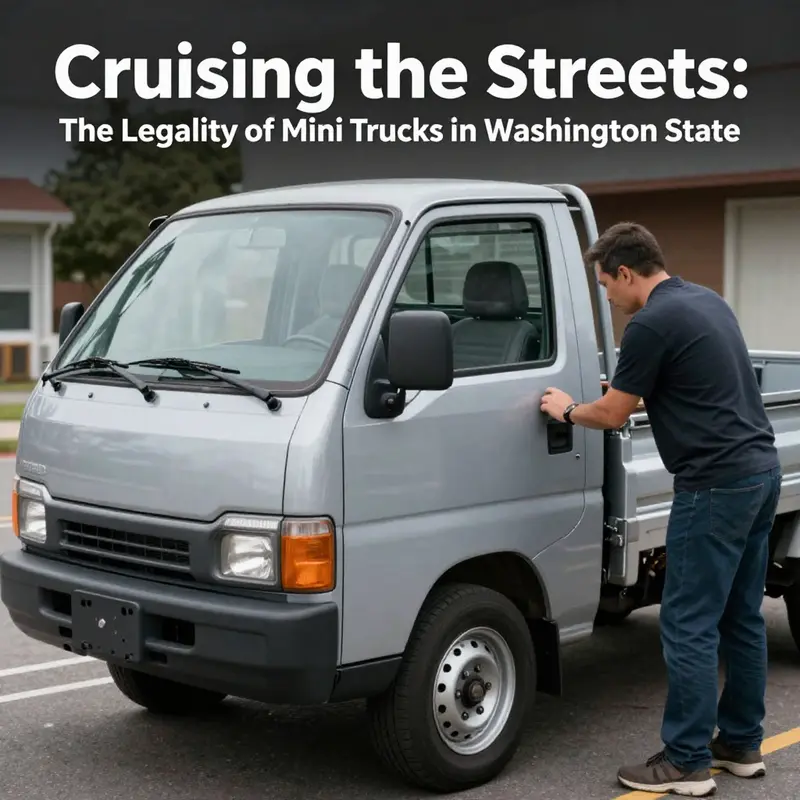
When the moment comes to demonstrate safety, the DOL inspection becomes decisive. The inspection is not a ceremonial check but a structured assessment of whether the vehicle’s systems will sustain safe operation in everyday traffic. Lights—headlights, tail lights, brake lights, and turn signals—are scrutinized for visibility, reliability, and compliance with code. Brakes and tires receive particular attention for wear, performance, and the vehicle’s ability to stop predictably under varied conditions. The inspection also examines the structural integrity of the frame, cab, and payload mounting, because a compromised structure can ripple into unsafe handling or failure during a sudden maneuver. Safety equipment such as seat belts, mirrors, and windshields is required to be functional, accessible, and properly maintained. The process is especially exacting for imported mini trucks, which may have been designed to meet different regulations and standards. Inspectors verify that non-U.S. components do not compromise overall safety and that any modifications required to align with U.S. standards are properly executed and documented. In this way, the DOL inspection becomes the formal acknowledgment that a compact vehicle, despite its diminutive footprint, can behave as a reliable participant in mixed-traffic conditions.
The conversation about safety does not stop at inspection day. Emissions compliance sits alongside safety as an essential pillar of street legality. The Environmental Protection Agency (EPA) sets national standards for tailpipe emissions, while the National Highway Traffic Safety Administration (NHTSA) outlines safety-related performance criteria for vehicles sold in the United States. For a mini truck that originates outside the U.S., the compliance path typically involves demonstrating that the engine and exhaust configuration meet applicable EPA criteria or that the vehicle can be certified under an exemption appropriate to its design and age. Modifications such as improving lighting, adjusting exhaust, or making changes to the fuel delivery system are not inherently disqualifying, provided they are performed within the boundaries of federal and state rules and do not undermine emissions controls or safety performance. In areas where air quality regulations are particularly strict, local authorities may require additional steps to ensure ongoing compliance, especially if the vehicle will operate in zones with heightened ozone or particulate matter concerns. The practical takeaway is that owners and technicians must balance performance desires with the obligation to maintain clean and consistent emissions, and to ensure that any alteration is fully documented and auditable for future inspections.
A critical distinction in Washington is the interplay between the tiny truck’s size and its use. While there is no formal “mini truck” category, the vehicle’s dimensions and weight influence how the DOL classifies it. Small, light-duty vehicles are treated within the same broad category as other light trucks or passenger-curated utility vehicles, provided their design and build meet safety and performance expectations for public road use. This means the chassis, suspension, and load-bearing elements must be robust enough to handle typical loads while preserving predictable handling. In practice, the vehicle must not only be technically legal but also reliable and reasonably durable under daily driving conditions. The result is a vehicle that feels purpose-built for tasks such as urban delivery, vendor services, or remote job sites, yet behaves consistently like a road-legal utility vehicle. The emphasis is on safety at the point of manufacture and safety during operation, reinforcing the idea that small can be practical without being reckless.
Beyond the technical checks, the licensing process imposes clear operational requirements. A driver’s license appropriate for the vehicle type is essential, and regardless of size, occupants must wear seat belts. The vehicle’s lighting, signaling systems, mirrors, and windshield wipers must be fully functional, ensuring visibility, communication with other road users, and protection against weather and road spray. Braking systems must demonstrate reliable performance, with tires in good condition and appropriate tread depth for the local climate and terrain. While many mini trucks are equipped with basic features, the license and equipment standards ensure that even compact work vehicles meet the same fundamental safety expectations as their larger counterparts. In this context, the practical objective is not to minimize safety requirements but to ensure that the smaller form factor does not come at the expense of roadworthiness.
For operators who intend to use mini trucks in a commercial capacity, the regulatory landscape becomes broader still. Commercial use—such as on-demand deliveries, service visits, or mobile food operations—introduces additional layers of oversight. In Washington, this can translate into more stringent trucking regulations, insurance requirements, and more frequent inspections. The practical implication is simple: a vehicle used for business must be documented, insured, and maintained with a level of diligence that reflects its public-facing role. In some sectors, vendors and service providers may be asked to display certain insignia or meet specific inspection criteria tied to the nature of their work. While these rules can feel burdensome, they are designed to protect workers, customers, and the general public by ensuring that commercial vehicles remain safe, predictable, and accountable on every trip. This broader regulatory context underscores a core truth: street legality is not a one-off checkbox but an ongoing program of compliance and vigilance.
The journey to compliance also encompasses practical steps that owners can follow to minimize friction and maximize the likelihood of success. It begins with assembling a complete portfolio of ownership documents, any prior import paperwork, and a maintenance history that demonstrates ongoing care. Before pursuing any cosmetic or performance modifications, it pays to consult with a professional who understands both Washington’s licensing framework and the federal standards that govern road-legal vehicles. A pre-inspection assessment with a knowledgeable mechanic or inspection service can reveal issues that would likely trigger a rejection at the formal DOL inspection. Common trouble areas include lighting configurations that diverge from standard patterns, exhaust systems that are out of compliance, or structural changes that compromise crashworthiness. Armed with this knowledge, owners can plan targeted improvements, prioritizing upgrades that enhance safety and reliability while remaining compliant with documentation practices. Typical enhancements include upgraded lighting for better night visibility, improved braking components for more predictable stopping, and suspension adjustments that ensure adequate ground clearance and stable handling when carrying payloads.
Yet even with a clear plan, the process is not purely technical. It is also about learning from a community of practitioners who have faced the same hurdles. The road to compliance is often smoother when owners engage with others who have traversed the same regulatory terrain. Community discussions and industry resources can provide practical, real-world guidance that complements the formal requirements. For broader context and practical reading, the community blog offers real-world insights and perspectives from people who have navigated the WA licensing maze with compact utility vehicles. You can explore this resource at the Mini Trucks USA blog. This kind of exchange helps new entrants anticipate common pitfalls, refine their modification plans, and approach the inspection with greater confidence. It is a reminder that the regulatory journey benefits from transparency, shared expertise, and careful documentation rather than isolated tinkering.
Insurance represents another essential pillar in the ongoing maintenance of street-legal status. It is not merely a backdrop to the process; it is a practical tool that supports safety and financial resilience. Insurance partners will typically ask for documentation detailing the vehicle’s modifications, its anticipated use, and the results of any inspections. For operators who plan to run the vehicle commercially, coverage terms may reflect fleet considerations and higher exposure, potentially requiring more robust liability limits and more frequent confirmations of compliance status. In some cases, an insurer may request ongoing vehicle inspections or periodic updates to reflect substantial modifications. The message is clear: a street-legal mini truck is a moving target if it continues to undergo changes after registration. The most prudent approach is to establish a baseline—an approved configuration—and then restrict future changes to what is allowed within that baseline, documenting every adjustment as part of the vehicle’s safety case and regulatory record. That discipline pays off when the inevitable renewal, inspection, or audit arises.
The Washington framework rewards this disciplined approach. Compliance is a process rather than a single moment, a view that aligns with the broader intent of vehicle safety and environmental stewardship. The sequence—title and ownership verification, registration, the DOL inspection, emissions alignment, and ongoing maintenance—establishes a lifecycle of responsibility. When the vehicle passes inspection and is registered, it becomes part of the state’s integrated transportation network, subject to the same expectations of safety, performance, and accountability that guide all road users. The ongoing maintenance habit—regular servicing, timely renewals, and meticulous record-keeping—ensures that the vehicle remains a dependable asset that can traverse a wide range of Washington’s landscapes, from congested urban streets to timbered rural routes. The small-but-steady philosophy here is critical: modest vehicles can be extraordinarily useful on public roads if they stay compliant enough to earn and maintain trust with regulators, insurers, and end users alike.
As the public conversation around vehicle diversity continues to evolve, Washington’s approach to street legality for compact utility vehicles leans into a pragmatic philosophy. It recognizes that small can be efficient and valuable, provided safety, emissions, and accountability are not traded for convenience. The practical challenge for owners is not to chase novelty but to pursue a responsible pathway that respects the state’s standards while enabling a flexible, productive use profile. In this sense, a mini truck can be an effective tool for small businesses, farmers, and individuals who need a nimble, economical vehicle that still upholds the clear expectations of a modern transportation system. The chapter that follows will further explore how to tailor these insights to specific counties and municipalities across Washington, focusing on local nuances, common enforcement patterns, and the practical best practices that help keep the process smooth, predictable, and within budget. External resources and official guidance are essential companions on this journey; they anchor the effort in verifiable requirements and provide explicit steps to take when the path forward becomes complicated. External resource: https://www.dol.wa.gov/vehicles/registration.html
Breathing Easy on Washington Roads: Emissions Compliance for Mini Trucks
In Washington State, the question of whether mini trucks can be street legal hinges on emissions rules as much as on registration and safety. These compact vehicles occupy a narrow lane between utility and policy, and their legality on public roads is shaped by a web of standards designed to curb air pollution while preserving the practical value these trucks offer. The layered approach to legality starts with basic roadworthiness and registration and extends into whether the vehicle meets the stringent emissions criteria that Washington adopts from California standards. That linkage to California-level controls may feel counterintuitive to owners who buy smaller, city-friendly vehicles precisely to dodge the red tape around heavier trucks. Yet in practice, the state’s emission framework treats mini trucks as light-duty passenger vehicles for purposes of air quality regulation, provided they meet the same benchmark in tailpipe cleanliness that other cars must meet when sold or registered in the state.
The backbone of Washington’s emissions framework is the Clean Car Law, codified as RCW 46.16A.060. This law requires that all new passenger vehicles sold in Washington be certified to meet California’s emission standards. Since 2009, this has applied to the model years and configurations that fall under the state’s passenger-vehicle category. The intention is clear: when a mini truck joins the street, it must demonstrate compliance with those California-level standards, which are among the strictest in the country. That means you aren’t just paying attention to exhaust pipes and catalytic converters; you’re looking at a vehicle that has a documented approval for the emissions profile it carries. The law’s reach is broad, touching vehicles newly sold in Washington and, by some regulatory interpretation, modeled through ongoing state partnership with California’s framework. In practice, this means a mini truck must be engineered, tested, and certified to meet those same stringent tailpipe requirements if it is to be registered as a street-legal vehicle.
Washington’s emphasis on clean air doesn’t stop at the Clean Car Law. The state’s Department of Ecology has taken steps to guide broader transportation policy through the Advanced Clean Trucks (ACT) rule. While the ACT rule is primarily aimed at medium- and heavy-duty trucks, its existence underscores a statewide commitment to reducing emissions across all vehicle classes. For mini trucks, the ACT rule signals that emission leadership and regulatory alignment are ongoing goals. The practical effect, however, remains focused on California-level standards as the principal pathway to compliance for light-duty mini trucks. The Ecology page dedicated to vehicle emissions standards provides the most authoritative, up-to-date articulation of how these rules are being implemented in Washington and how they interact with national and regional standards. In short, for a mini truck to roam the streets legally, its certification must align with California emission standards, and that certification must be verifiable through the appropriate state channels.
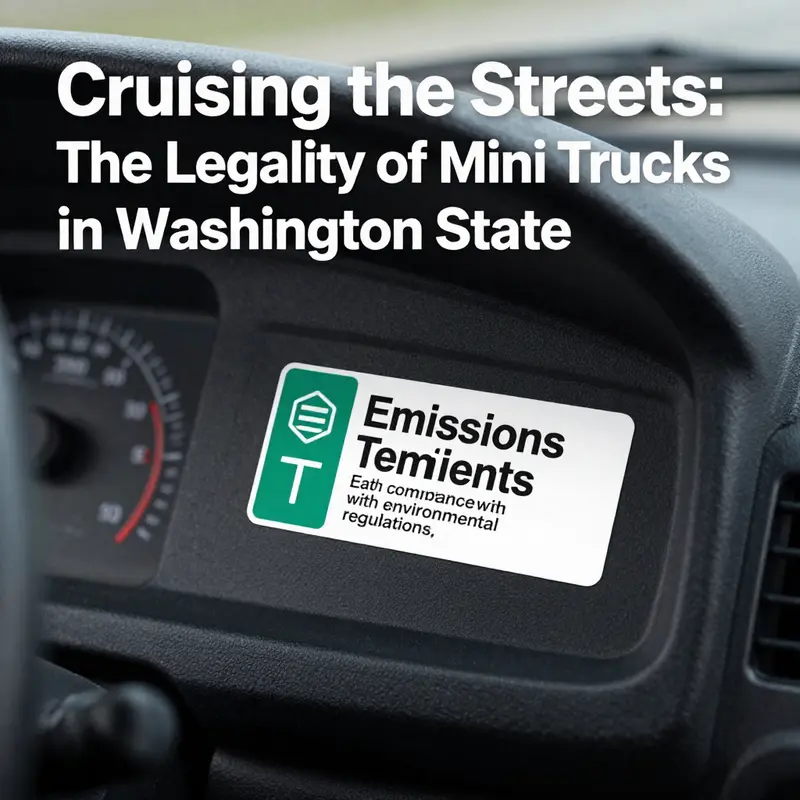
For readers seeking the precise legal language and the most current regulatory stance, the official Washington State Department of Ecology resource on vehicle emissions standards is the definitive reference. This source outlines the standards, the regulatory process, and how these rules apply to new and existing vehicles as the state approaches its broader clean transportation goals. The linkage between state policy and everyday driving is not abstract; it translates into the certification labels you see on the doorjamb, the paperwork you present during registration, and the ongoing requirements for compliance. The practical takeaway is straightforward: if a mini truck is to be registered and operated as a street vehicle in Washington, it must be certified to California-level emissions standards, and that certification must be supported by documentation recognized by state authorities.
The path to compliance is not merely about the engine’s cleanliness. Emissions standards sit alongside safety standards that govern lighting, braking, tires, and seat belts. A vehicle must be in good working order across these domains to earn and maintain street-legal status. Emissions compliance, however, is the gatekeeper that ensures the air a vehicle exhales aligns with the state’s environmental objectives. The combination of proper registration with the Department of Licensing (DOL), valid license plates, functioning safety systems, and confirmed emissions certification forms a robust baseline for legal operation. And when mini trucks are used for commercial purposes, additional regulatory layers can come into play—insurance, inspections, and even specific administrative considerations—depending on the scope of use. In some commercial contexts, like food-service operations, there are notices and requirements, such as those noted in the FAS 2021 Vendor Code Adoption Notice, which illustrate how businesses must navigate vehicle use, inspection, and permitted operation in practice. These examples remind us that street legality isn’t a static dot on a map; it’s a process that evolves with the vehicle’s role, its emissions profile, and the intent of its operation.
From a practical standpoint, owners and operators should begin by confirming basic registration and safety compliance. A mini truck must be properly registered with the Washington State Department of Licensing and carry valid license plates. The safety standards refer to a set of fundamental, demonstrable requirements: functioning headlights, taillights, turn signals, brakes that respond predictably, tires with adequate tread, and seat belts that work for all occupied seating positions. Emissions compliance is the more nuanced hurdle. For new registrations, the vehicle’s documentation must show compliance with California standards, and inspectors or licensing staff may verify the emissions label and related paperwork. For model years starting in 2009, the state’s approach reinforces a commitment to keeping mini trucks in Washington’s air cleaner than they would be if subject to looser standards. For older mini trucks, the situation can be more complicated if a model predates the California-standard framework altogether; in such cases, retrofitting or alternative compliance pathways would be explored under the oversight of the DOL and Ecology, and some older configurations may face constraints on registration or require specific alterations to align with current requirements.
The commercial-use angle adds another dimension to street legality. If a mini truck is employed for delivery, food service, or other business activities, it is subject to the broader regime governing trucking operations, insurance, and inspections. The regulatory framework can include specialized inspections and certifications tied to the vehicle’s role, operational footprint, and the nature of the cargo being carried. The essence is that the state treats the vehicle not only as a transport tool but also as a component of a larger commercial activity whose success depends on safety, reliability, and environmental responsibility. This is where the integration of emissions and commercial-regulatory requirements becomes most apparent. A seller or a fleet operator who intends to use mini trucks for regular business must ensure a comprehensive compliance package is in place, covering registration, emissions, safety, insurance, and inspections. The Washington state landscape is, in this sense, a system rather than a single hurdle, with each component reinforcing the others to promote public safety and cleaner air.
As readers explore the question of street legality, a useful way to frame the decision is to consider a practical checklist. Does the vehicle have a valid registration with the DOL? Are license plates clearly displayed? Do the lights, brakes, tires, and seat belts operate as intended? Is there documentation showing certification to California emission standards? If the vehicle will be used commercially, have the additional regulatory obligations—insurance, inspections, and possible fleet-operational requirements—been identified and planned for? These questions form a coherent path through the regulatory maze. They keep the focus on what must be true for a mini truck to be seen and recorded as a legitimate road-legal vehicle in Washington.
A note on community and resources can help bridge the gap between regulation and everyday practice. For readers who want to explore practical perspectives from fellow enthusiasts, hobbyists, and professional operators, a healthy source of insight exists in the broader mini-trucks community. The community blog, which aggregates discussions, updates, and practical advice, provides a space where readers can engage with questions about compatibility, modifications, and compliance from a practical, experience-based viewpoint. The blog serves as a companion resource to the formal regulatory guidance, offering real-world contexts that illuminate how rules are interpreted and applied in day-to-day operations. If you want to see how restyling, maintenance, and configuration choices influence readiness for Washington’s regulatory environment, the blog offers a friendly, informed perspective worth consulting as you plan a purchase, retrofit, or fleet deployment.
In addition to practical guidance, it’s important to anchor expectations in the most authoritative regulators. The Washington State Department of Ecology’s Vehicle Emissions Standards page provides the official articulation of how the state interprets California-based standards and how those standards are implemented in Washington. The page reflects ongoing policy evolution as the state moves toward broader clean transportation goals, reinforcing that compliance isn’t a one-time action but a continuing obligation. The Ecology resource clarifies who is responsible, what documents are required, and where to turn for updates when standards shift or new interpretations emerge. For the latest, most accurate information, consult the Ecology page on Vehicle Emissions Standards, which complements the Department of Licensing guidance and the state’s broader environmental objectives.
All of this adds up to a simple but important reality: if you want a mini truck to be street legal in Washington, you must align its emissions profile with California standards and maintain ongoing compliance documentation, all while meeting the standard safety and registration requirements. Emissions compliance is not a single checkbox; it is a framework that informs the vehicle’s design, production, modification, and ongoing usage. It governs what qualifies as street legal and what would disqualify a vehicle from public roads. The frame work ensures the vehicle remains a responsible choice for urban travel and light-duty work, balancing practical utility with environmental stewardship.
To explore a resource that discusses model comparisons and how different configurations can impact readiness for emission standards and road-legal status, readers can consult the minitrucks blog. This internal resource provides broader context and community-facing insights that complement regulatory materials without substituting for them. For more technical, rule-based guidance specific to Washington, you should refer to the Ecology page on Vehicle Emissions Standards, linked above. In all cases, the best course is to verify the vehicle’s certification status and to confirm with the Department of Licensing and Ecology what is required for your particular model year, configuration, and intended use. The state’s approach is designed to be clear and enforceable, with the goal of enabling practical access to compact trucks while safeguarding air quality and roadway safety.
External resource for precise current standards: https://ecology.wa.gov/Regulations-and-permits/Vehicle-emissions-standards
From Street-Ready to Permit-Ready: Navigating Commercial Use Regulations for Mini Trucks in Washington State
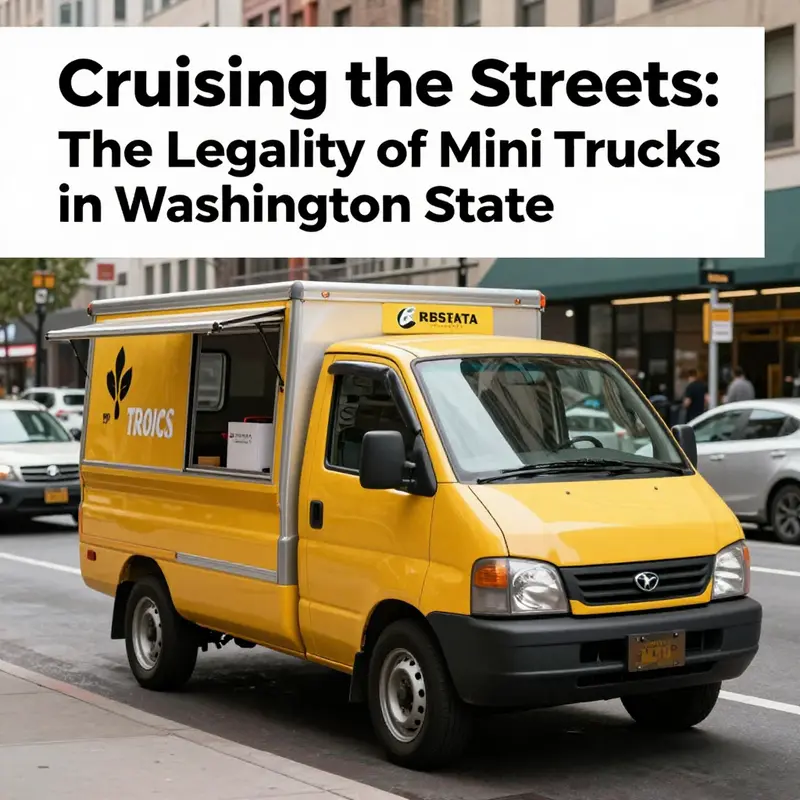
When people ask whether mini trucks can be street legal in Washington, the short answer is yes, but only if the vehicle satisfies a layered set of standards that extend far beyond mere registration. In Washington, being street legal means more than having a license plate on a tiny chassis. It requires alignment with the safety, emissions, and operator regulations that the state enforces through multiple agencies. The path from owning a compact truck to driving it on public roads, especially in a commercial context, runs through the Washington State Department of Licensing (DOL) and the Department of Labor & Industries (L&I), with local health departments and state police agencies ready to chime in as needed. When the vehicle is used for nonpersonal work—think mobile food service, on-the-road deliveries, or any enterprise that turns a mini truck into a business tool—the regulatory footprint grows larger, and the steps to compliance become more defined and potentially more demanding.
In practical terms, street legality in Washington begins with registration. The DOL requires that every vehicle that will travel publicly on state roads be properly registered and display valid license plates. This is the nonnegotiable baseline. Without registration and plates, a vehicle cannot be legally operated on public streets, regardless of its size or affordability. Yet registration is only the doorway to legality. The next layers demand proof that the mini truck meets safety standards—working lights, reliable brakes, appropriate tires, functional seat belts—and, for many vehicles, compliance with emissions regulations. These checks are not cosmetic; they are designed to ensure that a small work vehicle does not become a hazard to its operator or to other road users.
The commercial use path introduces a new cluster of considerations. If you intend to deploy a mini truck as part of a business—delivering goods, operating a mobile food service unit, or providing on-site service—the state’s regulatory apparatus treats the vehicle not just as a road machine but as a platform for public service. In food service scenarios, for instance, the vehicle becomes part of a health and safety regime overseen by L&I and the local health department. Here the focus shifts from the vehicle’s mechanical condition alone to the environment in which customers will interact with the unit. A mini truck used for food requires an L&I assigned manufacturer number, commonly referred to as the L&I sticker number. This tag, issued by the local Health Department, verifies that the unit has been evaluated for safety and hygiene standards appropriate to a food service operation.
The registration process for a commercial mini truck used to prepare or serve food is not merely a formality. It captures important operational details that influence ongoing compliance. The registration record includes the issue date of the L&I sticker, whether the unit has heating or cooling capabilities, and whether it qualifies as a plan-exempt unit. A plan-exempt designation can simplify operations in some cases, but it is not a universal pass. The existence of features such as refrigeration or heating affects how the unit must be built and maintained, and it can influence inspections and approvals at multiple stages of operation. If the vehicle allows customers inside or if it is used for commercial coaching or modular construction purposes, additional L&I approvals may be required. In such cases, it is prudent to contact L&I’s Plan Review staff. A quick call or email to plan review can clarify what is needed to keep a food truck, trailer, or similar unit compliant while on the road.
Beyond the specialized requirements for food services, general commercial operations impose a broader regime of regulatory duties. Employers that deploy mini trucks for commercial tasks must ensure that workers are covered by Washington’s industrial insurance program, or that they qualify for self-insurance through the state. This coverage protects workers in the event of injuries and aligns with the broader social safety net that governs work-related risk. Even when the vehicle is small, the staffing and operational structure of a commercial enterprise often trigger quarterly reporting. The quarterly reporting requirement exists to ensure ongoing transparency about trucking operations, regardless of the vehicle size. It keeps the state apprised of what vehicles are on the road, how they are used, and whether they comply with the evolving standards that regulate commercial transportation.
An area that often catches operators by surprise is the set of winter traction device regulations. In Washington, devices such as chains or snow tires are not simply optional add-ons when winter weather hits; they fall under the jurisdiction of the Washington State Patrol. These regulations apply to all vehicles, including smaller commercial trucks and passenger vehicles used for business purposes. The intent is straightforward: to ensure that a vehicle can be controlled safely under snow and ice and to reduce the risk of accidents that could spill over into other road users. Even if you operate a mini truck as a delivery vehicle in urban streets, the winter regulations can govern when and how you must equip your vehicle with chains, snow tires, or other traction devices during the colder months. The practical upshot is that a mini truck’s street-legal status in winter is conditional on the operator’s adherence to these traction requirements.
The interplay between the DOL and L&I is a hallmark of Washington’s approach to vehicle and workplace safety. The DOL handles the core framework of vehicle registration, license plates, and compliance with safety standards. L&I, on the other hand, sits at the nexus of health and safety for workers, food service units, and specialized commercial operations. When a mini truck crosses from personal use into a commercial enterprise, the line between “vehicle” and “worksite on wheels” blurs, and the regulatory chain responds accordingly. A mobile food unit becomes not just a vehicle but a workplace, with all the responsibilities that entails. The health department’s involvement through the L&I sticker number and related approvals ensures that the unit aligns with sanitation standards, ventilation requirements, and other health considerations that protect customers and staff alike. The plan review contact information—such as L&I’s plan review line and email—illustrates how straightforward intrusive questions can be whenever a unit’s configuration diverges from a standard, plan-exempt setup.
To the uninitiated, these requirements may seem daunting. Yet they are structured to support safe operation rather than to trap operators in a maze of paperwork. If your mini truck will be used commercially, start with a clear assessment of the intended use. Is it a straight delivery vehicle, a mobile food unit, or a modular service platform? Each path carries different requirements, and some may entail additional local or state approvals that are unique to your operation’s context. For example, a mobile food unit has to align with health code expectations and might require periodic inspections beyond the initial L&I sticker and registration. Even if the vehicle is technically street legal in a general sense, commercial use can introduce a layered compliance burden that ensures the vehicle remains safe for road use and safe for customers and workers.
One practical way to approach this landscape is to view compliance as an ongoing process rather than a one-time event. The initial registration and licensing establish the baseline for street legality, but the day-to-day use of a commercial mini truck requires ongoing attention to safety maintenance, insurance coverage, and regulatory changes. Insurance is a critical element in commercial operation. Employers must ensure workers are covered under the state’s industrial insurance program, or demonstrate self-insurance status. This requirement protects workers who might be exposed to occupational risks while driving, loading, or serving customers, and it provides a financial safety net should accidents occur. In addition, quarterly reporting keeps regulators informed about the operational footprint of the fleet, including the number of mini trucks used for commercial purposes, their routes, and any incidents or safety concerns that arise. The reporting rhythm fosters accountability and helps ensure that regulations reflect current operating realities rather than outdated assumptions.
For operators who lean into the food service or on-site service models, the regulatory dance becomes more intricate. The L&I framework, with its sticker numbers and plan review channels, ensures that the unit’s construction and operation meet health, safety, and sanitation expectations. If the unit features interior customer access or if it doubles as a coaching or modular building platform, there may be additional layers of approval to secure before customers can be served or before the unit can be used as a workspace. The process often begins with health department coordination, proceeds to plan review through L&I, and culminates in continued compliance checks that can occur at inspection time or during routine regulatory oversight.
A note on the practicalities of compliance that frequently helps new operators: many of the requirements revolve around verifiable documentation rather than abstract criteria. Maintain records of registration certificates, license plate eligibility, safety inspections, emissions compliance (where applicable), and the L&I sticker details. Keep a log of maintenance, repairs, and equipment status, especially for safety-critical systems like brakes, lighting, and tires. When your operation spans multiple counties or involves a retail or food service component, you may encounter additional locality-specific rules. The Washington regulatory framework acknowledges that small vehicles can operate in varied environments, from congested urban corridors to rural service routes. The key is to align your operational plan with the most stringent applicable rule set, then maintain the documentation and practices that demonstrate ongoing compliance.
Consider the broader narrative of street legality: it is not a single stamp of approval but a cumulative record of conformance to standards that protect road users and workers alike. A mini truck that is properly registered, equipped with functioning safety features, and compliant with emissions and health-related requirements if applicable, can indeed share the street with larger vehicles. The commercial dimension, however, adds a real-world layer of oversight that reflects Washington’s commitment to public safety and workplace welfare. This is why a tiny truck operating as a mobile business may carry a heavier regulatory weight than a similar unit used strictly for personal or hobbyist purposes. The state’s framework recognizes the different roles a mini truck can play and tailors the requirements accordingly, rather than applying a single, one-size-fits-all rule across every possible use case.
For readers seeking a concise roadmap, the essential milestones are straightforward, though they demand diligence. Start with determining your intended use. If it is purely personal transport, register with the DOL and secure plates, confirm compliance with safety standards, and address any emissions considerations as required. If the purpose is commercial, plan for a more comprehensive process that may involve L&I, the local health department, and possibly additional inspections or approvals. Obtain the L&I sticker number if you are engaged in food service and ensure the unit is plan-exempt or undergoes the appropriate plan review. Verify that your insurance coverage matches the size and risk profile of your operation and establish a quarterly reporting routine to keep regulators informed. Finally, stay mindful of seasonal traction device regulations in winter months and ensure your vehicle is prepared to meet those obligations when weather warrants.
Within this framework, an operator can still dream of a future in which a compact vehicle is both a practical work tool and a legally compliant presence on Washington’s streets. The beauty of the system lies in its clarity: the path to legality is defined, the steps are knowable, and the rules are designed to be navigated with careful preparation rather than reactive problem solving. As with any complex regulatory environment, the key is to stay informed and to keep the lines of communication open with the agencies that oversee these standards. If you are building or operating a mini truck within Washington’s borders, treat the vehicle not just as a machine but as a regulated workplace and a public safety element, and you will find that the road, though narrow, remains accessible to your small, capable tool.
For readers who want a practical, real-world sense of how these considerations show up in builds and in operation, a good next step is to explore community resources and practical guides that discuss builds, layouts, and day-to-day usage. See minitrucksocala.com/blog for a range of perspectives on how enthusiasts approach small-vehicle projects and how those projects interface with regulatory realities. As you plan, remember that the state’s emphasis on safety, health, and accountability translates into longer lead times and more meticulous documentation, but it also yields a robust framework that makes street-legal operation achievable for qualified mini trucks.
Ultimately, the question of whether mini trucks are street legal in Washington is answered not by the vehicle’s size but by the operator’s adherence to a set of defined standards. A mini truck can be legally driven on public roads, and it can function as a commercial platform, provided the vehicle is properly registered, safety-compliant, and, when applicable, aligned with health and labor regulations. The process rewards careful planning, accurate record-keeping, and proactive compliance, turning what could be a maze into a navigable course. And while this chapter has focused on commercial use and the regulatory contours that accompany it, the same disciplined approach underpins the broader question of street legality for any vehicle in Washington: success comes from meeting the standards, not from bending them.
External resource for further reference: https://www.dol.wa.gov
Final thoughts
Understanding the legality of mini trucks in Washington State involves navigating through registration, safety, emissions standards, and commercial regulations. By adhering to these requirements, mini truck owners can enjoy their vehicles on the streets while contributing to safe and environmentally friendly transportation. Whether you are planning to use your mini truck for personal adventures or business opportunities, knowing the ins and outs of these regulations ensures a smoother journey ahead.