
Mini trucks, especially those inspired by Japanese Kei designs, are appealing options for local small business owners and enthusiasts looking for affordable transportation. However, these compact vehicles face significant legal hurdles in Wisconsin due to state and federal regulations. This guide will walk you through understanding their legal status, safety, compliance modifications needed to drive legally, and various operational considerations to help you make informed decisions about using mini trucks in Wisconsin. Together, we’ll clear the confusion surrounding mini trucks so you can focus on reaping their practical benefits.
Are Mini Trucks Street Legal in Wisconsin? A Practical Guide
Wisconsin does not automatically classify mini trucks as street-legal motor vehicles. In Wisconsin, a mini truck is typically not deemed a standard motor vehicle under Wis. Stat. § 340.01(27), so crossing into on-road use requires meeting registration, safety, and inspection requirements. On public highways, a mini truck must be registered with WisDOT, display a valid license plate, and comply with lighting, braking, and seat belt standards. The operator must hold a valid driver’s license and follow all traffic laws, including speed limits and signaling. Vehicles that aren’t properly registered or modified for highway use may be restricted to private property or off-road venues. The process usually involves coordinating with WisDOT inspectors, ensuring compliance with FMVSS and EPA-related standards where applicable, and securing appropriate insurance. Modifications may include compliant lighting, proper license plates, and crashworthy seat belts, with potential adjustments to braking or emissions systems depending on the base vehicle. While the path can be costly and time-consuming, pursuing official registration provides a lawful avenue for using a compact vehicle in rural tasks, small deliveries, and farm operations. For precise, up-to-date requirements, consult WisDOT and review applicable statutes and inspection criteria before attempting to operate a mini truck on public roads. Official guidance and regulations are available through WisDOT’s website.
Crossing the Line: Navigating Safety and Emissions Requirements for Wisconsin’s Mini Trucks
Wisconsin’s roads invite a practical question for owners and would-be importers of compact, Kei-inspired mini pickup trucks: can these small workhorses legally share the same streets as full-size pickups, compact SUVs, and commuter cars? The answer hinges on a careful alignment with federal safety standards, federal emissions rules, and the state’s own inspection and registration processes. The broad framework is straightforward in concept but exacting in practice. Vehicles that are designed for other markets, particularly overseas imports with Kei-truck origins, exist in a regulatory space that demands conversion, certification, and ongoing compliance to be deemed street-legal. The core of this regulatory landscape rests on two pillars: safety and emissions. The safety standards come from the National Highway Traffic Safety Administration, which sets the Federal Motor Vehicle Safety Standards (FMVSS) that govern crashworthiness, occupant protection, lighting, crash structure, seat belts, seating configuration, and many miscellaneous components integral to a vehicle’s ability to protect its occupants in a crash. The emissions standards come from the Environmental Protection Agency, which defines what constitutes a controlled and verifiable exhaust system, fuel delivery, and catalytic conversion that reduces pollutants released into the atmosphere. Together, these federal benchmarks define what a vehicle must be able to demonstrate before a state will allow it on public roads. Wisconsin, like many states, does not rubber-stamp foreign-market mini trucks simply because they are small and efficient. Instead, it requires adherence to current U.S. safety and emissions regulations, with additional state requirements that ensure the vehicle remains compliant while in operation within Wisconsin’s borders. This means that any mini pickup under twenty-five years old faces a high bar. In practical terms, the under-25 rule creates a gateway period during which the vehicle must be brought up to modern standards in order to be registered for road use. The logic behind this approach is clear: newer vehicles, equipped with contemporary safety systems and cleaner emissions, are presumed to better protect occupants and reduce environmental impact on a modern road network. The consequence is that many overseas mini trucks, especially those that were never originally designed to meet U.S. standards, will not pass Wisconsin’s initial registration unless they undergo substantial modification. This is not merely a matter of swapping a few bulbs or adding a taller bumper. It can entail comprehensive changes to lighting systems to meet FMVSS 108 requirements for headlamps, tail lamps, turn signals, and reflectors; the installation of seat belts in every seating position and, in some cases, a crash-worthy interior; and the integration of engine control and emission-control systems that align with EPA rules for on-road use in the United States. The result is that the path to street-legal status is often as much about engineering and certification as it is about size and utility, especially for vehicles that were never designed with U.S. compliance in mind. The practical upshot is that Wisconsin’s regulatory environment rewards those who approach importation and modification with a plan that anticipates regulatory hurdles rather than a faith that the vehicle can be lightly adapted to fit a U.S. framework after purchase. For many potential owners, the most important early decision is to verify, before any purchase is finalized, whether the vehicle can meet or be adapted to meet federal standards, and whether Wisconsin’s WisDOT process can accommodate those changes within a reasonable budget. This is why best practices emphasize direct consultation with the Wisconsin Department of Transportation and a thorough review of the vehicle’s documentation, engineering changes, and testing results before any road use is contemplated. When the goal is a legal, year-round, all-weather utility vehicle, the preparation steps resemble a manufacturing qualification project more than a casual garage retrofit. The decision to bring a mini truck to Wisconsin streets, therefore, invites a longer horizon: a plan that accounts for engineering work, fees for testing and certification, inspection costs, and the ongoing obligations of insurance, registration, and periodic compliance checks. In many ways, the journey mirrors how a community negotiates the boundaries between affordability, practicality, and safety. The local farmer who uses a compact truck to shuttle tools across fields and nearby lanes may find the vehicle indispensable for its nimbleness and lower operating costs. Yet the same farmer will also appreciate that the practical benefits hinge on whether the vehicle can perform reliably within the standards designed to protect road users, pedestrians, and the environment. The tension between utility and compliance often becomes the central consideration in an owner’s decision to import, modify, or operate a mini truck. It is not a question of whether the vehicle can be made to serve a function; it is a question of whether that function can be performed in a way that satisfies federal and state safety expectations and can be demonstrated to WisDOT through documentation and testing. For those who want to explore real-world perspectives on lightweight, compact transport in the broader sense, community discussions and practical insights can be found in online forums and blogs dedicated to mini trucks. A useful reference point for readers seeking additional context is the Minitrucks SoCal blog, which collects practical considerations and user experiences related to compact trucks in everyday use. This resource offers a window into how owners think about retrofit challenges, reliability, and the day-to-day realities of keeping a small truck compliant and road-ready. While individual circumstances will vary, the throughline remains: the city, state, and federal rules are designed to safeguard drivers and others on the road, and any meaningful effort to import or operate a mini truck must start with a clear plan to meet those safeguards, rather than hoping that a successful ride on a rural gravel road will translate into a lawful ride down a Wisconsin highway. The overarching takeaway is not a definitive yes or no but a structured path. If a mini truck is to become a legal participant in Wisconsin traffic, it needs a jurisdictional stamp of approval that shows it conforms to FMVSS-equipped safety features, EPA-compliant emissions systems, and the state’s own inspection criteria. The WisDOT process for such a vehicle typically involves a candid assessment of the vehicle’s current condition and a plan for any required modifications, followed by official testing and certification, registration, and proof of insurance. It is a pathway defined by meticulous steps rather than quick fixes. This makes the decision to pursue legality a careful calculation of the costs, the engineering effort, and the likelihood of success. The practical realities bear repeating. First, the vehicle’s age matters. If the mini truck is under twenty-five years old, the bar is set high: it must meet current federal safety and emissions standards, with evidence to back up any claims of compliance. Second, for a vehicle that does not spring from a design intended for U.S. rules, the modifications required can be extensive and expensive. This can include structural changes to accommodate crash energy management, reconfiguration of seating to provide appropriate restraints, installation of proper lighting to FMVSS standards, and upgrades to the exhaust and engine management systems to meet EPA criteria. Third, the certification process itself adds a layer of complexity. Certification is not simply a matter of presenting a set of parts and a receipt; it involves verification that modifications have been installed correctly and that the vehicle complies across a spectrum of testing, inspection, and documentation requirements. This often means engaging qualified professionals to perform and document the work, financing the testing costs, and enduring a wait for WisDOT’s approval. In practical terms, this is where the dream of a budget-friendly, compact, urban-friendly utility vehicle may collide with the realities of federal and state regulations. There is no shortcut that preserves the essential safety and environmental promises embedded in the rules. The upshot for buyers, drivers, and enthusiasts is to approach the project with a clear compliance plan, a realistic budget, and an understanding that the payoff—reliable street-legal operation—depends on achieving demonstrable conformity with FMVSS and EPA standards. The social and economic context also matters. Wisconsin’s rural areas benefit from lighter, more maneuverable transport options for tasks like farm chores, small deliveries, or campus logistics where a full-size vehicle might be overkill. The appeal of reduced weight, ease of parking, and favorable fuel economy can’t be dismissed. Yet those benefits only translate into everyday practicality if the vehicle operates within the bounds of safety and environmental rules. For many people, that means a long-term project rather than a weekend conversion. It also means that the path to legality is often a collaborative process, one that may involve engineers, inspectors, insurance agents, and sometimes legal counsel to ensure that every step is properly documented and defensible under both federal and state law. The decision to invest in a compliant mini truck becomes, in effect, a decision about risk management and responsible ownership. It is a choice to do right by the road system, to acknowledge that a compact truck’s advantages must be balanced with the obligations that come with sharing Wisconsin’s public highways. As readers consider their own situation, a practical approach is to begin with a compliance map: identify the vehicle’s year, origin, and its current conformity to FMVSS and EPA standards; then chart the modifications needed, the anticipated costs, and the timeline for WisDOT inspection and documentation. The more transparent and thorough the plan, the smoother the journey from import to on-road operation. In some cases, that journey will reveal that the most economical path is not to force a historically non-conforming vehicle into service, but to pursue a design with U.S. regulatory alignment from the outset, even if it means choosing a vehicle that was intentionally built to meet U.S. standards. The broader lesson extends beyond the particular chassis or country of origin. It emphasizes a governing principle for any vehicle that crosses borders: safety and environmental protection are not optional add-ons; they are prerequisites for being part of the public road network. WisDOT’s role is to ensure those prerequisites are met, not to discourage small, practical transportation solutions. If the aim is straightforward road-legal operation, the route may be longer and more expensive than hoped, but it is also the route that minimizes risk, protects occupants, and preserves the integrity of Wisconsin’s road system for everyone. For readers who want a wider view of how compact, utilitarian vehicles fit into different regional driving ecosystems, the general discourse on small, budget-friendly transport and its regulatory implications can be explored through community conversations and related content. The internal discussion around the practicalities of small-scale trucking, utility use on rural roads, and the engineering realities of meeting regulatory standards often surfaces in online forums and blogs that cater to enthusiasts and professionals alike. A useful, non-promotional entry point for readers seeking context and shared experiences is the Minitrucks SoCal blog, which compiles practical perspectives on compact trucks, their maintenance, and the kinds of retrofit work commonly discussed among owners. This resource offers a broader look at how owners think about compliance challenges, what kinds of modifications are discussed in the community, and how people balance cost, performance, and legal risk when planning to operate a mini truck on public roads. As always, the key takeaway remains consistent: before attempting to drive a mini truck in Wisconsin, verify the current federal requirements with the U.S. Department of Transportation’s safety and environmental regulators and consult WisDOT to obtain a clear, written understanding of what must be accomplished for lawful operation. In the end, the chapter on safety and emissions is not only about the letter of the law but about the alignment of a vehicle’s design, its intended use, and the ongoing responsibility of the owner to maintain a safe, compliant, and environmentally respectful on-road presence. For those who wish to deepen their understanding of federal safety and emissions prerequisites and the certification pathways they entail, the official federal resources provide a definitive reference point. See the National Highway Traffic Safety Administration’s central hub for safety standards and related compliance information at https://www.nhtsa.gov. This resource helps anchor the practical Wisconsin-specific steps in a broader regulatory framework, ensuring readers grasp both the local registration implications and the universal safety commitments that govern any vehicle on U.S. public roadways.
Road-Ready in Wisconsin: Navigating Modification and Compliance for Mini Trucks
A mini truck, small and nimble, can seem like a practical answer to rural errands, farm chores, and compact urban deliveries. Yet in Wisconsin, turning that compact workhorse into a vehicle street-legal for public roads is less about clever hacks and more about a measured process of modification and certification. The journey from import to inspection reads like a checklist of federal and state requirements, each item designed to ensure the vehicle behaves like other passenger vehicles when it shares the same highway. This chapter threads the path from the moment a Wisconsin resident considers bringing in a compact truck to the point where the vehicle carries a proper plate, insurance, and the confidence that it will meet safety and emissions standards. It is a path that rewards planning, precision, and patience with a result that fits the state’s road environment while preserving the utility that drew a driver to a mini truck in the first place.
At the heart of the Wisconsin process is the recognition that these tiny, purpose-built vehicles were not designed for U.S. roadways from the start. They were built to meet overseas rules that emphasize compact dimensions and modest engine displacement. When such a vehicle enters the United States, it faces a regulatory gate—one that weighs safety features, lighting, crashworthiness, emissions systems, and overall conformity to standards that Wisconsin enforces through its regulatory ecosystem. The practical implication is that a mini truck will not automatically become street-legal simply by being registered somewhere or by passing a casual inspection. It requires demonstrating compliance with a spectrum of requirements that cover both federal and state dimensions. The result is a legal, safe, and road-worthy vehicle that can mingle with traffic without compromising other drivers or pedestrians.
To begin, a thoughtful owner undertakes a classification assessment. The vehicle may be treated as a low-speed vehicle (LSV) or, depending on its final configuration, as a conventional passenger vehicle. Each classification carries a different set of expectations for safety equipment, speed capabilities, lighting, and inspections. The classification decision is not merely bureaucratic; it influences the entire modification strategy. A vehicle destined to be an LSV, for instance, might emphasize different lighting and speed constraints than a fully compliant passenger vehicle. In Wisconsin, the distinction can determine whether certain safety features are required, whether the vehicle can operate on highways, and how it must be insured and registered. The safest approach is to verify the intended classification early in the plan by consulting WisDOT and, if needed, local regulatory offices. The aim is to avoid a scenario where later adjustments would require expensive retrofits or re-inspection.
One of the first practical steps in becoming street-legal is ensuring proper lighting. The combo of headlights, brake lights, and turn signals must align with the expectations of other drivers and northern climates that demand reliable illumination in snow and fog. Headlights must be properly aimed and bright enough to illuminate the road, while brake lights must clearly signal deceleration to trailing vehicles. Turn signals should operate in both front and rear corners with consistent color and intensity. These lighting components are not just cosmetic additions; they are safety-critical systems that help prevent collisions and improve visibility in variable Wisconsin weather. Without compliant lighting, a mini truck cannot be considered road-legal, regardless of other upgrades.
Beyond lighting, the vehicle needs functional components that are often taken for granted on standard passenger vehicles. A horn that is audible over ambient road noise, well-positioned mirrors that provide adequate field of view, and seat belts that engage correctly and remain secure during travel are all prerequisites for any vehicle that will share Wisconsin streets. The absence of these basics signals to inspectors that the vehicle is not prepared for public roads. Seat belts, in particular, are not optional in the regulatory sense; they are a core life-safety feature that protects occupants and reduces injury in crashes. The mirrors must provide enough coverage to minimize blind spots, and the horn must fulfill its signaling role consistently. These elements, while seemingly ordinary, form the minimum package that helps align a small, imported chassis with U.S. safety expectations.
Registration is the next logical milestone along the road to legality. A mini truck cannot simply roll into a DMV office and leave with a plate if it does not meet the core criteria. The process typically involves proving ownership through a valid title, presenting verification of compliance with federal and state safety standards, and demonstrating that emissions controls and other regulatory requirements are in place. In practice, this means compiling documentation that shows the vehicle’s emissions equipment is functioning or that appropriate modifications were installed to meet EPA standards. It also means ensuring the vehicle has a recognized Vehicle Identification Number (VIN) and that the title reflects its true status—whether as a traditional passenger vehicle after compliance adjustments or under a specific nontraditional category if applicable. The registry is not a mere formality; it serves as the official gateway that legitimizes the vehicle’s presence on Wisconsin roads and ties it to insurance requirements and lawful operation.
A key layer of complexity arises from emissions and safety compliance. Wisconsin aligns with federal safety standards administered by the National Highway Traffic Safety Administration (NHTSA) and with emissions controls under the Environmental Protection Agency (EPA). A mini truck arriving from overseas must integrate components that satisfy these standards. The engine, exhaust, and emissions-control systems may need upgrades or substitutions to achieve compliance. An unmodified engine or exhaust setup may trigger noncompliance flags, particularly if the vehicle’s ECU (engine control unit) or exhaust configuration fails to meet the expected levels for on-road use. This is not merely a question of horsepower or top speed; it is about ensuring that the vehicle’s emissions output, diagnostics, and related controls operate within established limits that protect air quality and public health. The reluctance to embrace noncompliant configurations is not a stance against innovation; it is a safeguard designed to maintain uniform standards that Wisconsin residents rely on for environmental and public safety.
Safety and emissions conformance culminate in an inspection that can be described as the final seal of approval before license plates are granted and the vehicle may legally share state roads. In Wisconsin, the road to inspection is navigated through the vehicle safety inspection framework overseen by WisDOT, with the ultimate check provided by the state’s inspection processes. The inspector looks for a coherent safety system: working lighting, functional brakes, proper seat belts, and a robust frame. The inspection also confirms the presence and functioning of essential mirrors, a horn that works, and any other safety attributes required for the vehicle’s classification. The process tests not only that components exist, but that they perform under road-like conditions. This is a practical acknowledgment that a vehicle designed for compact dimensions in another market must not only look the part but also perform in a manner that aligns with Wisconsin’s safety culture and driving norms.
Every step in this pathway—classification, lighting, safety equipment, emissions compliance, and inspection—works toward a single objective: giving Wisconsin drivers a vehicle that is predictable in behavior and verifiably compliant with the rules of the road. The cost and effort involved can be substantial, but the payoff is a vehicle that can be used for daily tasks, weekend projects, and occasional long-distance trips without the fear of regulatory friction or unexpected penalties. The process emphasizes planning and documentation, rather than improvisation, because the consequences of noncompliance can be costly and time-consuming. Importantly, this pathway is not a one-size-fits-all prescription. The exact modifications required will vary depending on the vehicle’s starting point, its final intended use, and its classification in Wisconsin law. A careful owner will seek clarity from WisDOT early in the process, ensuring that every retrofit aligns with current guidelines and that the plan remains adaptable should regulatory interpretations shift in the future.
For readers seeking a broader perspective on how enthusiasts approach these projects, there is value in looking at communities that document their adaptation journeys and share practical insights. A good starting point is the Minitrucks Cali blog, which offers a window into the customization culture surrounding compact trucks and the kinds of considerations that people weigh as they work toward road legality. This resource can provide context about the types of modifications commonly discussed in hobbyist circles, the trade-offs involved, and the challenges individuals face when aligning overseas designs with U.S. safety expectations. You can explore this broader conversation at the Minitrucks Cali blog.
The legal pathway described here also reinforces a simple, reliable principle: do not drive a mini truck on Wisconsin roads until you have verified compliance with federal and state specifications. The moment a vehicle fails to meet safety or emissions requirements, it becomes a risk to the operator and others on the road. The responsible approach is to consult the official WisDOT resources, which provide up-to-date guidance on registration, titling, safety inspections, and the specific requirements for non-traditional vehicles like mini trucks. A central takeaway is that the road to legality is a deliberate sequence of steps, each building on the previous one, rather than a single, catch-all change.
In practical terms, the journey from import to road-ready status often unfolds as a collaborative process. Owners may work with qualified technicians who understand how to preserve essential utility while adding the necessary safety and regulatory components. Some adjustments involve replacing or augmenting basic systems, such as upgrading lighting assemblies to conform to FMVSS standards, installing crash-rated seat belts, and integrating a compliant braking and signaling system. Other tasks may require more specialized work, such as ensuring the emissions control strategy aligns with EPA expectations or modifying the frame and crash structure to meet structural integrity standards. The balance is delicate: the modifications should not erode the vehicle’s utility or compact advantages while ensuring a predictable safety profile on Wisconsin roads. The overall aim remains clear—compatibility with state expectations so that the vehicle can be registered, insured, and operated with confidence.
As readers plan next steps, the reminder is practical and straightforward: start with a clear assessment of how the mini truck will be classified in Wisconsin, map out the required safety and emissions upgrades, prepare the necessary documentation for registration, and schedule an inspection with WisDOT-approved channels. Throughout this process, maintain open communication with the relevant authorities to verify that each modification aligns with current standards. The external resource below provides an official, up-to-date framework for these requirements, offering guidance on what to expect during registration and inspection.
External resource: For official guidelines and the most current requirements, consult WisDOT and related state resources. https://dot.wisconsin.gov
Steering Through Wisconsin’s Rules: The Realities of Owning and Legally Operating Mini Trucks on Public Roads
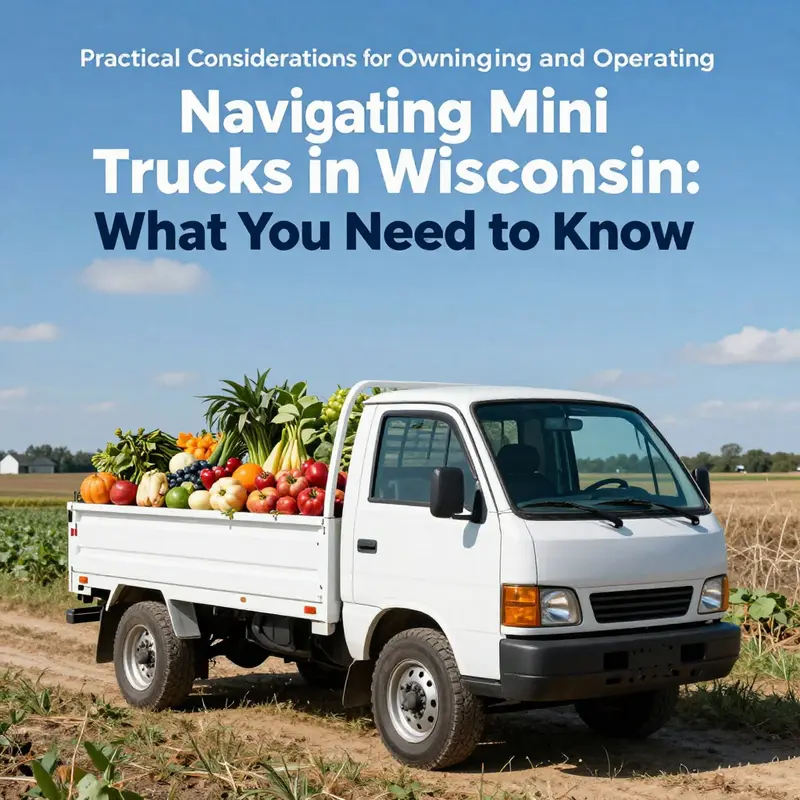
Curiosity often outpaces caution when people first glimpse a tiny, boxy vehicle perched in a lot or cruising down a rural lane. The appeal is undeniable: a compact footprint, lower running costs, and a sense that a mini truck can squeeze through gaps where a full-sized pickup would groan. Yet in Wisconsin, like many states, the question of road legality looms large. The answer hinges less on the vehicle’s charm and more on how it is classified, equipped, and registered. The practical reality is that mini trucks are not simply plug-and-play on Wisconsin roads. They are treated as a special category vehicle whose street legality depends on meeting a complex blend of federal, state, and local rules. Understanding that blend requires more than a quick checklist. It demands a careful read of WisDOT guidance, the state’s DMV processes, and the realities of operating in communities with their own street-use rules. Only then can a prospective owner anticipate what must be done to drive legally, safely, and without unplanned interruptions to daily use.
From the outset, the central classification issue matters most: is the vehicle an embodiment of a low-speed vehicle, or LSV, or is it an NEV—neighborhood electric vehicle? Wisconsin has clear distinctions for these categories, and those distinctions translate directly into where, when, and how the vehicle may travel. LSVs are designed to operate at relatively modest speeds, typically up to 25 mph, and are generally restricted to roads with speed limits of 35 mph or less. NEVs, by contrast, are intended for even slower operation, often capped at around 20 mph, and their use is typically limited to residential streets or private property, though local practice varies. To the uninitiated, these limits can seem abstract, but they determine corridors, not just lanes, where a mini truck may legally roam. To verify a specific machine’s classification, a careful comparison of the manufacturer’s specifications with WisDOT documentation is essential. The aim is not to assume but to confirm alignment with state rules that define where a vehicle can be driven and under what conditions the drive is sanctioned.
The practical consequence of this classification lies at the gateway of everyday use. If the mini truck is deemed an LSV, it can participate in road travel on qualifying surfaces, but it must comply with all the elements that support safe operation on those roads. That includes, among other things, visible and functional safety features, accurate lighting, proper signaling, and a braking system that can meet expectations on Wisconsin’s varied terrain and weather. If the vehicle falls into the NEV category, the operational envelope tightens further. In both cases, the road becomes a regulated space rather than an open invitation to drive as one pleases. The broader regulatory landscape also means that federal standards—such as those managed by the National Highway Traffic Safety Administration (NHTSA) and the Environmental Protection Agency (EPA)—interact with state requirements. In practice, a mini truck that remains within its original design parameters may still fail to meet U.S. safety or emission standards once it is imported and used on public roads. The path to legality thus often involves modifications intended to align the vehicle with FMVSS and EPA expectations, a process that can be substantial and sometimes costly. For any owner contemplating import or use on Wisconsin streets, a direct consultation with WisDOT remains the most reliable first step. It helps establish a concrete roadmap for what must be changed or certified before the keys are handed to a driver and the vehicle leaves a dealer or import lot.
The reality of registration and titling follows closely behind the classification. Wisconsin law requires that vehicles driven on public roads be registered with the DMV. This is not a mere formality; it is the gatekeeper step that records ownership, ensures accountability, and sets the framework for licensing, insurance, and ongoing compliance checks. Some mini trucks, depending on their classification, may require a special title endorsement or may not fit neatly into the standard passenger-vehicle titling category. In such cases, the vehicle could be assigned a “non-passenger” or a “special purpose” designation. These atypical titles can complicate resale and insurance coverage, adding another layer of consideration for anyone weighing long-term ownership. The key is to anticipate these implications early and discuss them with the DMV to avoid unexpected hitches at renewal time or when adding a family member as an operator.
Insurance sits at a similar crossroads. Wisconsin does not universally mandate liability insurance for every LSV or NEV, but most reputable insurers will require coverage for any vehicle that operates on public roads. In practice, that means even if the state rules allow operation at certain speeds or on certain road types, insurance providers will assess risk, demand coverage, and price accordingly. The range of available products designed specifically for mini trucks is narrow, reflecting both market demand and the relatively small footprint of these vehicles in traditional auto insurance portfolios. Consequently, owners often face higher premiums or more limited policy options, particularly if the vehicle occasionally exceeds the typical speed thresholds or is used in mixed-traffic conditions. The prudent course is to shop widely, obtain written confirmation of coverage for road use, and understand what would happen if a claim arises in a jurisdiction where a local ordinance restricts operation on certain streets.
Driver licensing and operation rules form another essential channel of compliance. In Wisconsin, the baseline expectation is that a driver possess a valid license. The exact class required can depend on the vehicle’s speed and its classification as an LSV or NEV. As a rule of thumb, an operator of an LSV (capable of up to 25 mph) should hold at least a Class D operator’s license. For NEVs (slower still), some municipalities may offer exemptions or more lenient local rules, but these exceptions vary widely. The local layer is critical: county or city clerks can impose additional licensing requirements, clarify whether a particular vehicle fits a local permit program, or set hours during which operation is permitted. In practice, that means the same mini truck might be perfectly legal to operate in one town but face restrictions in another. The only reliable way to avoid a licensing misstep is to check with local authorities and to confirm the license type and any restrictions before turning the ignition key.
Safety equipment and necessary modifications command serious attention as well. The baseline expectation is that mini trucks, like other roadworthy vehicles, should be equipped with essential safety equipment: seat belts, functional headlights and brake lights, mirrors, turn signals, and a horn. These systems are not decorative; they are the core language of road safety. Modifications aimed at increasing speed or payload capacity are not merely cosmetic changes. They can alter the vehicle’s classification and potentially void the status that allows road use under state rules. Any adjustment should be performed by a qualified mechanic who understands the regulatory implications and who can document changes for inspection or registration purposes. This is particularly important when importing from markets with different safety norms, as the vehicle’s original configuration may not align with FMVSS expectations without deliberate, traceable modifications. The emphasis on documented work cannot be overstated: it protects the owner from penalties and helps ensure that the vehicle remains a safe, predictable participant in Wisconsin traffic.
Beyond the mechanical and paperwork hurdles, road-use restrictions and local ordinances create a mosaic of permission and prohibition. Even when a vehicle meets state standards, cities and counties can decide where and how it can operate. Some communities limit or prohibit LSVs and NEVs from highways, freeways, or commercial zones, while others may require special permits or restrict operation to specific hours. The texture of local regulation means you cannot assume a blanket right to drive a mini truck on any Wisconsin road. A practical approach is to begin by confirming the vehicle’s classification and regulatory alignment at the state level and then actively verify local rules in the jurisdiction where the vehicle will be driven most often. Local ordinances are not mere footnotes; they shape the daily arithmetic of when and where the vehicle can legally participate in traffic and can influence decisions about route planning, driver assignments, and even the decision to use the vehicle strictly on private property or in controlled environments.
In this landscape, the most reliable playbook is a deliberate, proactive one. Begin with WisDOT to establish the vehicle’s official status, the required equipment, and the steps needed to bring the mini truck into legal compliance for Wisconsin roads. Then map out the DMV process for registration, titling, and any special endorsements that may apply. Parallel to that, engage a reputable insurer early to determine what policies will be needed for road use and to understand premium implications. Finally, talk to the local authorities in the areas where you plan to operate. The aim is to create a practical path that remains flexible for changes in local rules or in the vehicle itself due to necessary safety upgrades.
The broader takeaway for enthusiasts is neither defeatist nor sensational. It is a clear reminder that the law keeps pace with mobility, safety, and accountability. A mini truck can be a viable, economical tool for rural transport or restricted-traffic use when properly classified, equipped, registered, and licensed. The exact route to legality varies from one Wisconsin municipality to the next, and the road to compliance can involve substantial steps. Yet the destination—legal operation, safe driving, and predictable insurance—remains attainable with methodical planning and reliable guidance. For readers seeking a starting point, a practical next step is to engage with the state’s official resources and, if possible, to consult with individuals who have navigated the process themselves. For broader context and ongoing updates on related topics, you can explore the Mini Trucks CaLa blog. Mini Trucks CaLa blog.
As a reminder, the legal journey for mini trucks is not about a one-size-fits-all solution. It is about aligning a vehicle’s design and capabilities with Wisconsin’s safety, emissions, and traffic standards while respecting the constraints of local jurisdictions. The process may involve researching FMVSS compliance, verifying EPA-related aspects, and preparing for inspections by WisDOT or authorized inspectors. It also means recognizing that the road-use map is continually adjusted as technologies evolve and as communities refine their transportation policies. The careful reader will recognize that the core of the matter lies in information, verification, and documentation—and in maintaining a rigorous, proactive stance toward compliance rather than waiting for a surprise citation or a stalled registration.
External resource: https://dot.wi.gov/vehicles/lowspeedvehicles
Final thoughts
In summary, mini trucks can be a fantastic addition to your business or personal fleet if you’re aware of and comply with the necessary regulations in Wisconsin. The path to making them street legal might seem daunting due to safety and emission standards, but with the right modifications and a solid understanding of compliance, you can fully leverage these vehicles. Embrace the opportunity to elevate your daily transportation and operate confidently and legally within the state.