
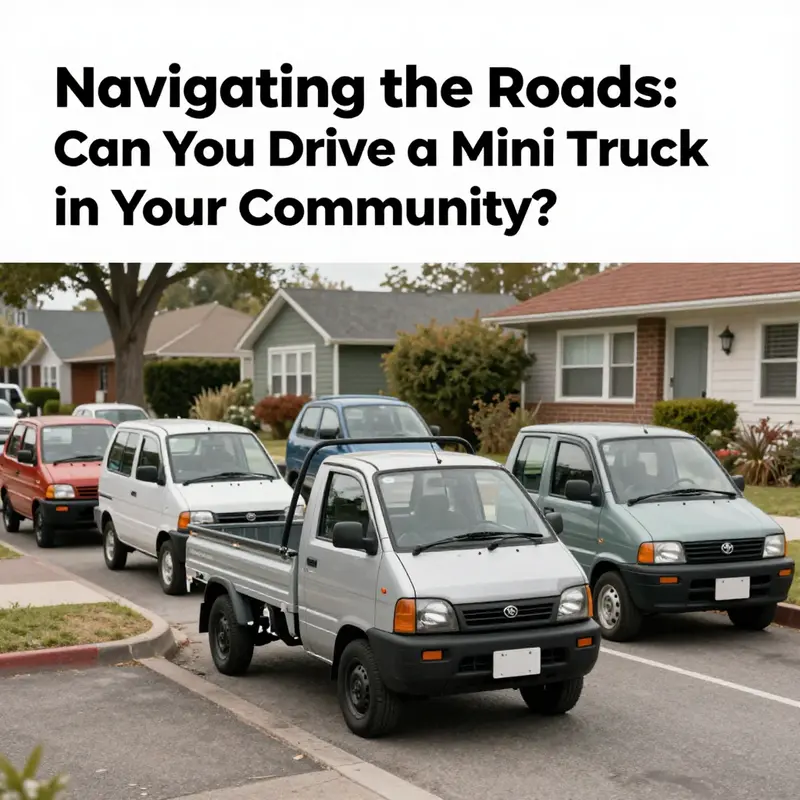
Driving a mini truck can be a fantastic way to navigate your local roads whether you’re a small business owner needing to transport goods, a residential property owner moving things around your neighborhood, or simply a mini truck enthusiast. However, understanding the specific requirements and regulations is crucial for staying compliant and ensuring safe operation. From obtaining the correct driving license to knowing the road use rules and vehicle compliance standards, this guide reveals everything you need to know about driving mini trucks on the road. Attention to these details will empower you to use your mini truck effectively while staying in line with the law. In the following chapters, we’ll explore license requirements, road usage rules, compliance standards, special permits, and local variations in regulations, providing you with a comprehensive understanding of how to drive your mini truck safely and legally.
Licensing the Tiny Freight: Navigating Road-Ready Requirements for Mini Trucks
Licensing the Tiny Freight begins with a simple recognition: a mini truck is not a universal license issue. Its road eligibility is a function of weight, configuration, and intended use, all interpreted through the lens of local regulations. In the United States, licensing is defined by gross vehicle weight ratings and how the vehicle is used. If a mini truck weighs under about 26,000 pounds GVWR and is for private purposes, most drivers operate it with a standard non-commercial license, commonly a Class D in many jurisdictions. When used for business or if it approaches the upper weight threshold, a commercial endorsement or a separate license class may be required. The process typically involves age requirements, vision tests, medical exams when applicable, and both written and practical evaluations that test vehicle control and safety awareness. The balance between license type and vehicle profile reflects the need for training when moving heavier or hazardous loads. This licensing question cannot be answered in a single line; it requires mapping the vehicle’s weight and planned use to the local framework. In the United States, the essential determinants are weight, configuration, and use. A private-use mini truck under a GVWR around 26,000 pounds is typically governed by a standard driver’s license; business use or heavier configurations may call for a CDL or a specialized endorsement. Age and fitness prerequisites are a constant: many states require at least 18 for non-commercial operation and 21 for most commercial operations. Vision standards are explicit—often 20/40 in each eye—and medical fitness may be screened for commercial driving. States vary, but the framework is consistent: license class, medical fitness, and testing align with use and risk profile. Drivers should check their state DMV for exact requirements. To understand broader patterns, sources like the Minitrucks Blog offer context on lightweight cargo mobility and licensing. Minitrucks Blog
Hong Kong presents a different approach, labeling mini trucks as light goods vehicles (LGVs). The entry bar is modest in age—18—to apply for an LGV license. The path emphasizes standard testing: a written theory exam followed by a practical road test, plus a medical examination. The LGV license is the gateway for most mini trucks; however, if the vehicle’s GVWR exceeds a threshold (around 3,500 kilograms in some cases), the regime tightens and additional steps may be needed. The shared thread is that licensing ensures drivers possess skills and fitness appropriate to the vehicle’s weight and tasks. For practical guidance, local authorities should be consulted to confirm the needed license class and steps to obtain it. A practical roadmap often includes a pre-licensing course and focused study of traffic rules for small cargo vehicles, followed by the theory exam, medical check if required, and the road test. Ensure the vehicle is properly registered and safe, as road legality hinges on operator credentials and vehicle compliance. See the Minitrucks Blog for related topics. Minitrucks Blog
China, as a cross-border reference, sketches a parallel framework: licensing scales with mass and length. Small trucks with total mass 4,500 kg or less and length up to about 6 meters often fall under a Class C1 license; if they exceed those dimensions, a Class B2 license may be required. Road-use rules follow standard traffic laws, but regional nuances exist. Oversized or heavy cargo may require a dedicated permit before operating on public roads. Compliance—registration, safety standards, and adherence to limits—is essential. The official guidance from the relevant ministry offers up-to-date details, but local rules vary by province. The overarching message is that licensing is earned by aligning weight, dimensions, and use with safety expectations. *
Practical steps: determine GVWR, length, width, height, and whether you will carry passengers or hazardous cargo. If used privately in the U.S., a standard license usually suffices, but verify with the state DMV because some states require additional endorsements for commercial use or specific configurations. If used for business or commercial operations or heavier loads, anticipate a CDL or a dedicated endorsement and prepare for age, medical, and testing requirements. In Hong Kong, the LGV framework governs licensing, with variations at higher GVWR thresholds. Always verify with the relevant authority. A practical roadmap includes focused study of traffic rules, theory test, medical check if needed, and road test. Ensure proper vehicle registration and safety. The shared message remains: licensing plus vehicle compliance are the twin tracks to lawful operation. For broader perspectives, the Minitrucks Blog can be a helpful starting point. Minitrucks Blog
Finally, consider official guidance such as the California DMV for general driver qualifications and vehicle classifications that are broadly relevant to mini-truck licensing. California DMV
null
null
Driving Light, Driving Legal: Navigating the Compliance Landscape for Mini Trucks on Public Roads
The appeal of a mini truck lies in its compact frame, nimble handling, and practical versatility. It is the kind of vehicle that can weave through crowded streets, yet still carry a meaningful load when needed. But the freedom to take a mini truck onto public roads is not universal. It rests on a framework of rules that differ by country, and even by region within a country. This chapter weaves together the regulatory threads that most commonly shape the daily reality of owning and operating a mini truck. The aim is to paint a coherent map—one that helps readers understand what it takes to drive legally, safely, and with fewer surprises as they navigate licensing, vehicle standards, and the often complex world of permits. What follows integrates the practical, on the ground knowledge that emerges from international experiences, with a close look at two contrasting regulatory environments that mirror the tensions and opportunities facing today’s mini truck enthusiasts.
In many places, licensing is the first hurdle. In a system modeled on licensing that separates vehicle classes by size and weight, the difference between a light, city-friendly mini truck and a heavier, longer model can determine the exact license required. Take a familiar scenario: a small truck with a total mass of four and a half tons or less and a length not exceeding six meters. In many jurisdictions, that combination is aligned with a lower tier license, designed to reflect the lower risk profile of smaller vehicles. The idea is straightforward: the heavier or longer the truck, the more training and oversight are deemed necessary to ensure the driver can handle a vehicle with greater momentum and stopping distance. Where such thresholds are enforced, a Class C1 license often suffices for the smaller end, while anything beyond tends to push a driver into a higher class, like a Class B2, with more stringent requirements and a broader set of scenarios to master.
Beyond licensing, the road rules themselves place an emphasis on how the vehicle is used in traffic. Mini trucks must still obey the same rules that govern all road users, but the practical application can vary with the vehicle’s size and weight. On highways, for example, the prevailing practice in many regions is for large, heavy trucks to stay in the rightmost lanes. Yet, for smaller trucks that meet legal dimensions and operating with proper safety features, there may be flexibility to use other lanes if speed keeps pace with surrounding traffic and the vehicle does not impede others. The underlying principle is simple: operate within the speed and lane rules, maintain appropriate following distances, and avoid obstructing flow. This is a reminder that public road space is a shared resource, and even small trucks must read the traffic around them and adjust accordingly to preserve safety margins for everyone.
A critical piece of the framework is vehicle compliance. A mini truck cannot simply be parked in a driveway and declared road-legal by virtue of its size. It must be registered, and it must meet safety standards that the jurisdiction assigns to it. There are concrete limits on the vehicle’s dimensions and weight. Width often has a ceiling around two and a half meters, height around four meters, and gross weight for a two-axle truck generally falls under an international threshold that excludes the need for special heavy-haul permits. When a vehicle crosses these thresholds, it triggers a separate category of transport that requires special permits for over-dimensional or overweight loads. Those permits are not mere formalities; they certify that the vehicle, its cargo, and the route have been assessed for safe operation and that the public infrastructure can accommodate the movement without compromising safety.
Where mini trucks carry oversized or particularly heavy cargo, the operator must obtain a permit designed specifically for over-dimensional transport. This permit acts as a legal bridge, ensuring that the design, routing, and timing of such movements have been scrutinized by authorities. The practical upshot is that the permits factor in everything from axle configuration to road closures, bridge clearances, and even the possibility of pilot cars guiding the convoy. For readers planning specialized use, this is not optional bureaucracy but a safety and feasibility calculation that can determine whether a plan is doable at all on public roads.
In parallel with these regulatory threads, the vehicle itself must be aligned with the standards that the jurisdiction requires. A modern, compliant mini truck is not just about weight and size. It must be properly registered and equipped with safety features that meet the expectations of regulators, insurers, and other drivers. When modern engineering meets the realities of a used market, however, a tension often appears: many mini trucks produced in recent decades were not designed with today’s stringent safety regulations in mind. This creates a practical barrier to registration and operation that can be expensive to resolve. The financial and logistical burden often outweighs the perceived benefits of a newer, bulkier platform, leading some owners to pursue older models that sit within a more forgiving regulatory envelope, or to implement thoughtful, circuit-tested upgrades that bring a vehicle into compliance without erasing its vintage character.
This is where the path becomes especially nuanced for readers who operate across borders or who imagine a future of cross-border mobility. The regulatory picture in one country may look quite different from another, even when the underlying vehicle remains similar. To illustrate, consider a framework that many readers will recognize through a widely cited set of federal standards: the United States. In the United States, there is a well-known 25-year safety and emissions standard rule. Vehicles that are 25 years old or older are generally exempt from current federal safety and emissions standards and thus can be legally driven on public roads without modification. For vehicles that are younger than 25 years, the story changes dramatically. They must comply with the current federal regulations set by the body responsible for vehicle safety and emissions—the standards cover crashworthiness, emissions controls, lighting, and other safety features. The practical implication is clear: most mini trucks produced in the last few decades were not designed with those modern standards in mind, making compliance difficult and often costly. As a result, while newer mini pickups may be legally drivable if they are properly certified, many are effectively non-compliant and difficult to register or operate without substantial modification.
This mix of federal standards and practical constraints leads to a vivid contrast in the ownership arc for retro and classic mini trucks. For buyers who want to preserve a more vintage profile, the 25-year rule offers a straightforward, widely recognized pathway to operation in many states. Vehicles manufactured before a specific cutoff date can be registered and operated with a straightforward compliance regime—often described as a green light for older designs that hew to pre-standards era safety expectations. It is a pathway that has cultivated a vibrant community of collectors and enthusiasts who prize the vintage aesthetic and the relative ease of legal operation. Yet this pathway does not imply a universal exemption; it is contingent on local interpretation of the federal framework and state-level adaptations that may apply. The result is a landscape where the decision to pursue a modern, compliant build versus a vintage, potentially exempt model depends on the reader’s goals, finance, and tolerance for regulatory complexity.
For readers who are actively evaluating a mini truck for daily use, two threads deserve emphasis. First, do not underestimate the licensing requirements. Confirm the exact license class with local licensing authorities and ensure your driving history and test readiness align with the licensing path that matches the vehicle’s weight and length. Second, assess registration and compliance costs up front. The registration process is more than a simple paperwork exercise; it’s a readiness check that touches on insurance options, vehicle inspection schedules, potential safety retrofits, and the feasibility of meeting periodic compliance renewals. It is also wise to map out a realistic route plan, including the possibility of specialized permits if you anticipate moving oversized cargo or operating in zones with weight restrictions.
For readers who want practical context that extends beyond general theory, the Minitrucks world offers a spectrum of real-life scenarios where people balance passion with regulation. A well-managed approach combines an informed understanding of local rules with practical, vehicle-specific decisions. If your interest leans toward ownership and daily usage, a visit to the Minitrucks Blog can provide a grounded sense of how these vehicles are used in everyday life, including stories of maintenance, customization, and road readiness. See the Minitrucks Blog for deeper explorations and community experiences: Minitrucks Blog.
In the end, driving a mini truck on public roads is as much about planning as it is about capability. It demands a careful appraisal of vehicle dimensions, weight, and safety systems; a clear understanding of the license class required for the vehicle; and awareness of any special permits needed for atypical loads or unusual routes. It requires a willingness to stay current with changing rules and a commitment to responsible, defensive driving that respects the safety of others on the road. The dialogue between vehicle design and road regulations is ongoing, shaped by evolving traffic policies, road infrastructure, and the needs of a growing segment of motorists who see mini trucks as adaptable tools rather than mere curiosities. As readers navigate their own journeys, keeping the focus on preparedness, accountability, and safety will ensure that the road remains a shared space where the compact, capable mini truck can thrive within the law.
External resource: for a broader overview of federal vehicle safety standards and how they influence vehicle modification and registration, see the National Highway Traffic Safety Administration’s Vehicle Safety Standards resource.
Size, Permits, and the Road: Mastering Special Approvals for Oversized Mini Trucks
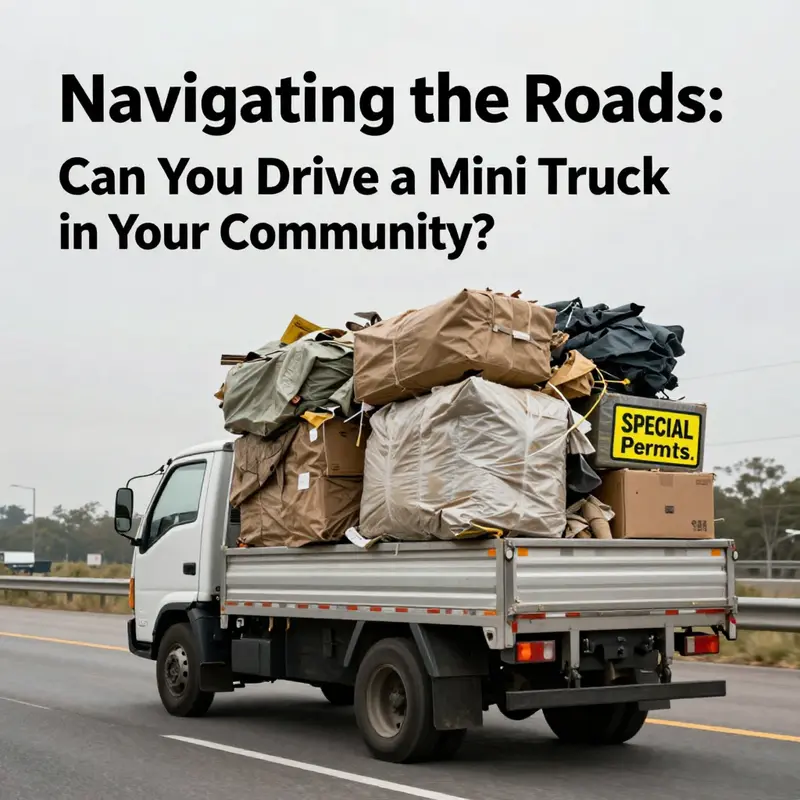
When you ask whether a mini truck can share the road with everyday traffic, the answer isn’t simply yes or no. It hinges on the rules that govern size, weight, and the cargo being carried. A machine that seems small in a city lot can become a regulatory big deal once it bears an oversized or heavy load, or when its overall dimensions push beyond standard limits. In many jurisdictions, legal compliance is not a single act of licensing but a sequence of checks that starts long before the ignition. You may need a special permit, a route approved by authorities, and, in some cases, an escort or pilot vehicle to accompany the haul. The practical upshot is straightforward: mini trucks can drive on public roads, but only when their movements are framed by formal permissions, safety plans, and a clear understanding of where and how they can operate.
Regulatory thresholds for licensing and vehicle classification vary by country and even by state or province. The general pattern is simple: if the vehicle remains within defined mass and length limits, a standard license class and basic registration suffice. Exceed those thresholds and authorities typically require a higher class license or a different permit category, reflecting greater risks on the road. The example from a large, globally engaged market shows that a light, compact cargo vehicle may fall under a lower license tier, such as a C-class category, while vehicles that are heavier or longer move into a B-class or an equivalent level. The exact mass, length, and axle configurations that trigger these changes differ, but the principle holds: licensing scales with the potential impact on road safety and infrastructure. The same logic informs whether a small truck qualifies for routine routes or must carry a special permit for oversized journeys.
That is where special permits come into play. Special hauling permits are designed to reconcile mobility with safety when standard rules would otherwise prohibit movement. In the United States, many states issue permits that authorize oversize and overweight trips, particularly for loads that cannot be broken down into smaller parts. A well-known state example frames these permits under a structured system that includes trip permits for single journeys and other permit types for longer or recurring movements. The aim is to ensure that the road system can absorb the extra weight or size without creating undue risk. For a mini truck that qualifies as oversized or overweight, obtaining the correct permit becomes the essential precondition to travel, not an afterthought. It anchors the movement in a documented plan, along with route and timing constraints that public agencies can oversee.
The permit process typically demands thorough documentation. Applicants must submit precise vehicle dimensions, weight distribution, and the route specifics, including origin, destination, and any intermediate points. A safety plan is often required, detailing braking performance, tire load, and contingency measures for emergencies. Review bodies may request additional information such as photos, engineering calculations, or a demonstration of how the weight will be managed at critical points like bridges or steep grades. Depending on the load and distance, the permit type could range from a one-off Trip Permit to a multi-trip or long-term authorization. Travel times, escort requirements, and routing guidelines are laid out to minimize disruption to traffic and to protect roadway assets. The end goal is predictable and safe movement, with clear consequences if the plan is not followed.
Effective planning becomes the real workhorse in oversized mini truck operations. Operators routinely screen routes to avoid low clearances, narrow underpasses, or bridges with weight restrictions. They factor weather, daylight windows, and the performance envelope of the truck and its load. The permit acts like a contract that aligns operational reality with public safety goals. It often imposes escorts, speed limits, or lane rules, and it may require the use of flags, lights, and high-visibility signage. When the load is non-divisible, or when special handling is required, the permit schedule becomes crucial to minimize the impact on other road users. This is not about slowing commerce but about ensuring that urgent deliveries, construction equipment, or specialty cargo can reach their destinations without compromising the roads that carry them.
From a practitioner’s view, the permit becomes part of a dynamic workflow. A typical process begins with a pre-application check to confirm basic configuration, followed by formal submission of dimensions and weight data. The review cycle may involve civil engineers or transportation authorities who can request clarifications or suggest additional safety measures. Once approval is granted, the operator adheres to the specified travel times, keeps within escorted routes, and complies with any required signage and lighting. If conditions change—unexpected weather, an accident on a corridor, or a refreshed weight limit—the permit framework allows for adjustments through official amendments rather than ad hoc safety compromises. This disciplined approach helps protect infrastructure and reduces delays that can cascade into project timelines and customer commitments.
To connect these ideas with real-world learning, many operators rely on community knowledge and practical exemplars. For readers seeking a broader, hands-on perspective about how mini trucks are used in different settings, a wealth of posts and field reports is available through a dedicated community blog. See the minitrucks blog for context on preparation, route planning, and post-move reflections that illuminate how a seemingly small vehicle can handle large tasks when rules and practice align.
Finally, when you want official guidance that anchors what you read in practice, consult the formal regulatory pages that govern oversized transport. The discipline of permits exists to protect the road and its users while enabling essential services to move efficiently. For a comprehensive official reference on oversize movements in a major state, the following resource provides authoritative guidance on permit types, application steps, and safety considerations: Oversize Transportation (NYSDOT)
Navigating Local Variations in Mini Truck Regulations
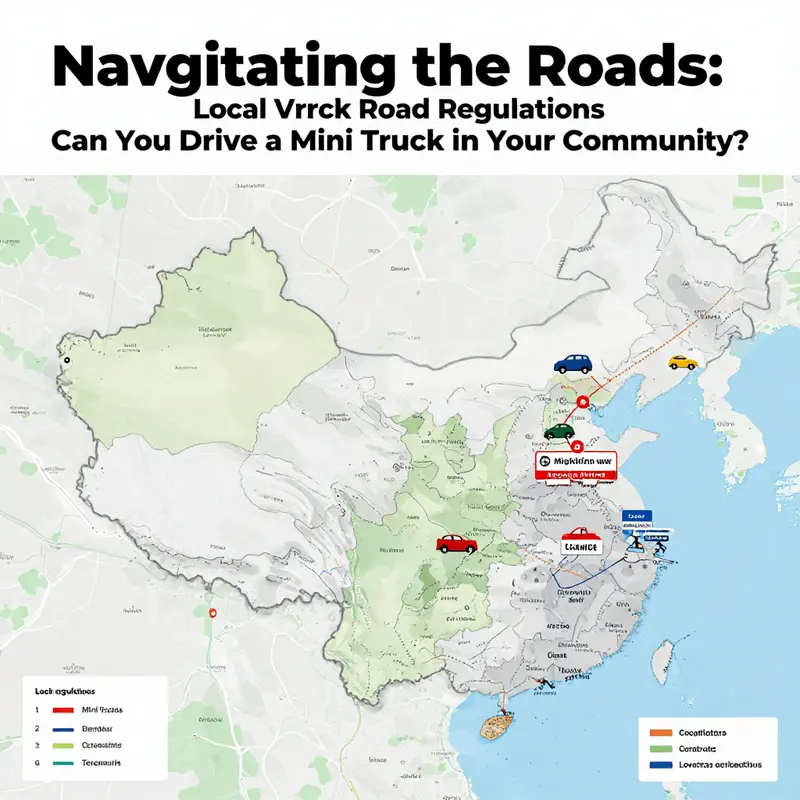
Local variations in mini truck road regulations form a mosaic that can surprise even seasoned drivers. The most essential takeaway is simple but powerful: legality is not universal. A mini truck that is street-legal in one neighborhood, city, or country can face very different requirements just a short drive away. This chapter explores how regional controls shape what you can drive, where you can drive it, and under which conditions. Understanding this nuance helps readers avoid detours, fines, or delays, and it clarifies why the answer is rarely uniform across borders or even across municipal lines.
Urban and rural realities offer the most visible contrasts. In dense urban centers, authorities commonly tighten emissions rules, limit engine noise, and restrict heavy vehicle activity to protect air quality and smooth traffic. Some cities introduce low-emission zones that favor electric or highly efficient micro-trucks for deliveries within the core. The logic is clear: urban air quality and congestion are shaped by the vehicle mix people see on the streets every day. With that focus, even a small, relatively lightweight mini truck may need to meet strict standards for tailpipe emissions, and it may be subject to time-bound access restrictions. The overall effect is not punitive in intent but practical: it nudges transport operators toward cleaner options and smarter routing while still allowing essential goods movement.
Rural and mountainous areas present a different calculus. There, the emphasis often shifts toward access and efficiency. Local authorities tend to afford more flexibility with dimensions and payload limits, recognizing the economic roles that mini trucks play in farming, forestry, and small-scale construction. Yet even in these regions, rules exist to protect road integrity and public safety. Bridges with weight limits, winding lanes, and seasonal weather conditions create hard boundaries that drivers must respect. A road that can handle a typical mini truck in a rural setting might become less suitable during mud season or when roads are under maintenance. The upshot is that local adaptability matters just as much as raw capability: the same vehicle is a better fit in some rural corridors and a poor fit in others, depending on the local road geometry and maintenance practices.
Another layer of variation arises in how regulators classify and register mini trucks. Jurisdictions differ in whether they frame the vehicle by engine displacement, total mass, or length. In some places, an engine size threshold—say, around 1500cc—decides whether a vehicle falls into a lighter licensing tier with simpler registration, or a heavier category that brings higher taxes or more stringent insurance obligations. Other regions rely on gross vehicle weight or overall length to determine licensing classes and permissible uses. These differences are not merely bureaucratic trivia; they shape the financial and practical feasibility of operating a mini truck as part of a regular fleet or as a personal work vehicle. A driver might find that a seemingly identical vehicle carries a very different price tag for insurance, or that a permit is required to operate beyond a specific route, even though the vehicle itself is compact and economical.
Local rules also determine where a mini truck can operate, not only what it can do. In some urban zones, trucks are confined to certain lanes or restricted from using central arterials at peak hours. In others, trucks may share lanes with passenger vehicles as long as they maintain safe speeds and do not impede traffic flow. The length and width of the vehicle influence which routes are permissible; a truck that barely fits within a corridor’s legal dimensions might be barred from routes reserved for smaller vehicles or from certain bridge approaches where clearance is limited. These operational realities underscore a broader principle: the road network is administered as a connected system, and each segment comes with its own set of constraints that must be respected to keep traffic moving smoothly.
Given this patchwork, the prudent driver treats regulations as dynamic rather than static. The practical steps start with a clear picture of local expectations. Before hitting the road, it helps to confirm the vehicle’s registration status, its assigned category, and any permit requirements tied to the planned trip. If the journey involves oversized or heavy cargo, the driver must obtain specific permits that authorize over-dimensional transport, along with any accompanying routing or escort requirements. Even routine deliveries can trigger local restrictions if the load approaches a jurisdiction’s dimensional or weight thresholds. The takeaway is straightforward: know the local rulebook, not just the vehicle’s specs.
To stay aligned with local variations, many operators maintain concise, location-specific checklists that cover licensing, documentation, route selection, and permissible hours. This approach reduces the risk of last-minute surprises and allows drivers to respond quickly to changes in road use policy, permit availability, or temporary restrictions due to events or weather. In practice, this means maintaining a portable packet of information: up-to-date registration papers, a current map of authorized routes, copies of relevant permits, and a contact channel for the local transport authority. It also means keeping a real-time eye on signage, as temporary restrictions can pop up during road work or local campaigns aimed at reducing traffic through certain neighborhoods.
For readers who want a more narrative sense of how these rules play out in everyday life, the local variations aren’t just about compliance; they’re about the choices and trade-offs operators face when balancing efficiency, cost, and responsibility. A driver choosing a route through a city’s periphery might opt for a shorter path with a higher toll that is permitted for a particular vehicle class, or they might select a longer, toll-free corridor that avoids restricted zones but requires more careful speed management. Decision-making becomes a blend of regulatory literacy and on-the-ground judgment, a skill that grows sharper with experience and regular exposure to local policy updates. The broader lesson remains: there is no one-size-fits-all rule, only a context-sensitive map of permissions, restrictions, and opportunities.
The discussion is not merely academic. For practitioners, it translates into practical guidance: invest in local knowledge, keep permits current, and plan routes with regulators’ expectations in mind. It also invites readers to explore community resources that compile region-specific experiences. For those who want a concise portal that aggregates general guidance while offering a window into how owners adapt to different rule sets, the Mini Truck Blog provides case studies, insights from fellow operators, and practical tips focused on staying compliant while maximizing utility. Mini Truck Blog
When we look specifically at the Chinese regulatory framework invoked in the overview, local variations still exist, even after a national baseline is set. Different provinces and municipalities may adapt licensing classes, registration categories, and route allowances to reflect local traffic conditions and enforcement priorities. The same mini truck can thus command a lower licensing hurdle in one district and require a more stringent licensing path or a separate permit in another. In practical terms, this means a driver who travels across provincial boundaries or through multiple urban jurisdictions should anticipate different regulatory surfaces at each stop. Tracking these surfaces becomes an ongoing habit rather than a one-off task before a single trip.
In a global context, the pattern repeats. Cities around the world balance the needs of commerce and mobility with environmental goals, safety standards, and infrastructure capacity. Some places encourage electrification and low-emission approaches for small cargo transport, while others focus on weight limits and route zoning to preserve road quality. The empirical takeaway for readers is straightforward: the ability to drive a mini truck on the road is contingent on understanding and aligning with local practice and policy rather than assuming universal permissiveness. This awareness not only reduces risk; it can also unlock opportunities for smarter planning and more productive use of the truck’s compact footprint.
For readers seeking official, country-specific guidance, it is essential to consult the appropriate regulatory authorities and official portals, as rules shift with policy changes and enforcement priorities. In the Chinese context referenced in the research overview, the national framework sets baseline licensing and road-use expectations, but local regulations shape the practical reality of daily operation. To ensure accuracy and timeliness, refer to the Ministry of Transport’s official website for authoritative, up-to-date guidelines on vehicle registration, licensing, and road usage: https://www.mot.gov.cn.
Final thoughts
Understanding the regulations associated with driving a mini truck is essential for both safety and legality. As we’ve explored throughout the chapters, obtaining the correct driving license, complying with road use rules, ensuring vehicle standards, knowing about special permits, and recognizing local regulations are critical steps for any mini truck driver. By staying informed and compliant, you can fully enjoy your mini truck experience in your community or business, avoid potential legal issues, and embrace the joy of driving your mini truck confidently. Remember, knowledge is power, especially when it comes to navigating the roads!