
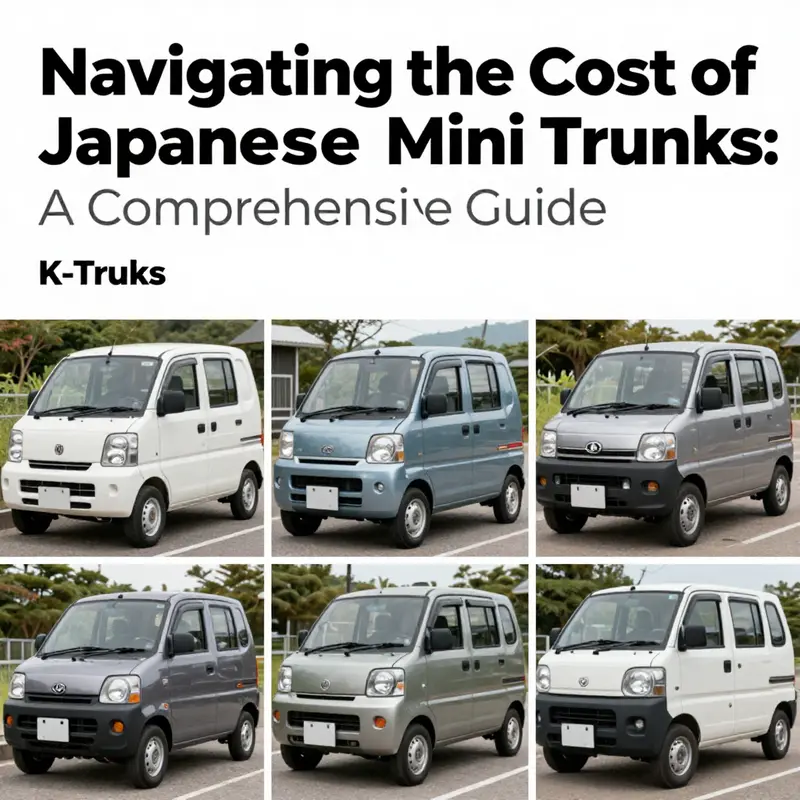
Japanese mini trucks, often known as K-Trucks, are compact workhorses perfect for local businesses, residential needs, and automotive enthusiasts. As the demand for these versatile vehicles continues to grow, understanding their price range becomes essential. In this guide, we’ll delve into the current prices for new mini trucks, examine market trends for used models, identify key factors that influence pricing, compare prices across different markets, and explore the economic impact of these unique vehicles. Whether you’re a small business owner looking for a delivery vehicle, a homeowner needing a reliable work truck, or an enthusiast eager to learn more, this guide will equip you with the knowledge you need.
null
null
Riding the Curve: Market Dynamics Shaping the Value of Used Japanese Mini Trucks
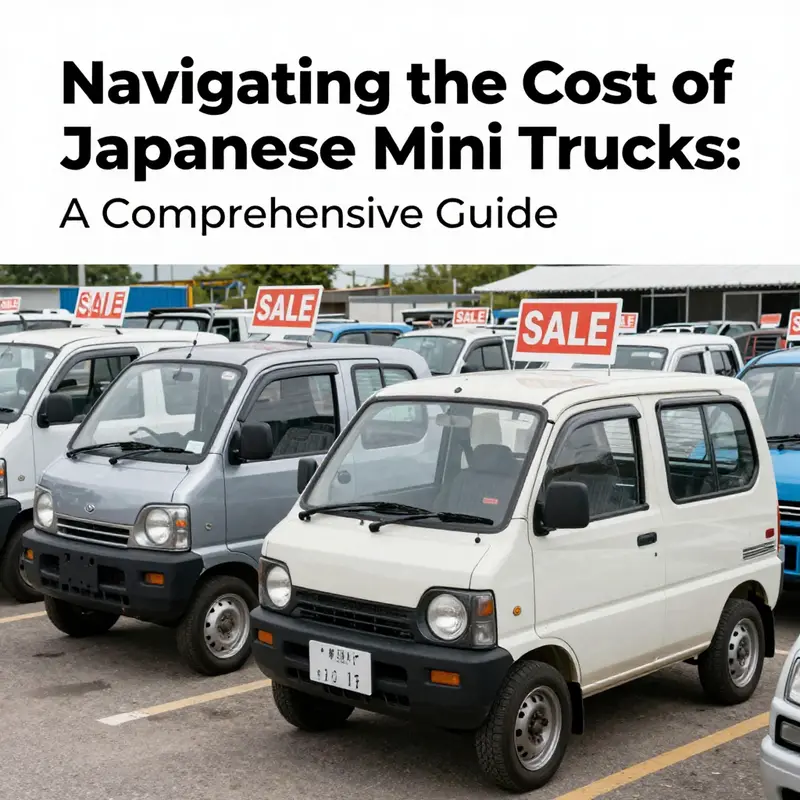
Used Japanese mini trucks, the kei-class workhorses of urban logistics, occupy a unique place in both domestic fleets and international used markets. They are small, rugged, and surprisingly versatile, designed to carry cargo through narrow streets and crowded alleys with a level of efficiency that larger trucks cannot match. The price of a used unit is not fixed; it shifts with age, mileage, condition, and the marketplace you’re aiming at—local buyers who know the territory, or exporters chasing depreciation curves in distant countries. For households and small businesses that move goods for a living, a well-kept mini truck can be a reliable first investment in a lean, low-capital operation. The same vehicle, resold after a few years, can retain most of its value if it has been cared for, serviced regularly, and kept in a minimal state of wear. In this sense, the value proposition goes beyond sticker price. It rests on total cost of ownership, maintenance accessibility, and resale confidence.
Domestically, these vehicles have shown unusual resilience even as other truck segments contract. In recent years the mini-truck category absorbed more than half of all truck sales in its mass class, signaling that urban deliveries, light-duty farming, and maintenance errands rely on compact payloads with nimble maneuverability. This domestic demand helps stabilize prices in the used sector, because a steady flow of late-model, low-mileage examples keeps the market liquid. However, the broader Japanese truck market did experience a downturn in 2024, with an overall drop around eleven percent. Even amid that contraction, the mini truck niche held up relatively well, underlining how essential these vehicles remain for daily operations. The early months of 2025 brought welcome momentum, as new registrations rose nearly ten percent year on year to around 287,000 units. While new-vehicle demand wobbled, the recalibration toward practical, cost-efficient transport supported a thriving secondary market where value is demonstrated more by reliability than novelty.
Understanding the pricing dynamics in the used market requires looking at brand concentration and the export workflow. In the first part of 2025, market data shows that the leading manufacturers together captured the vast majority of mini-truck sales in that period. Two brands alone accounted for roughly three-quarters of the segment, with the rest shared among a handful of others. This concentration matters because buyers trust these workhorses for their durability, low operating costs, and the breadth of service networks built around them. When a used model comes from one of these trusted names, buyers accept a predictable maintenance ecology, standardized parts, and familiar repair channels. Export demand then adds another layer: many units are produced with export durability in mind, engineered to endure varied climates and road conditions. This international appetite helps keep pre-owned prices stable in regions that value compact utility, even as new models migrate toward electrification or hybrid powertrains. In practice, that means a used mini truck in good condition can command a premium over a simple, higher-mileage example, reflecting both mechanical reliability and the strength of the brand’s durability narrative.
Electrification and policy shifts are reshaping the pricing outlook. Policy makers have signaled a targeted transition for the kei segment toward electric power starting in the mid-2020s, a move intended to curb emissions and modernize urban logistics. At present, electric versions remain a small portion of the market, but the share is expected to rise quickly as subsidies, charging infrastructure, and pilot programs mature. The current share of electrified kei vehicles sits well under two percent, with annual volumes in the tens of thousands range countrywide. As electrification accelerates, the depreciation path for older internal-combustion engine units will diverge from the newer, electrified cohorts. In the used market, that often translates into a sharper premium for late-model or hybridized examples, while older ICE workhorses become more affordable. For buyers focused on cost-per-mile, the near-term reality is a bifurcated market: robust, well-maintained ICE units will stay in circulation and fetch steady prices, while the early electrics will begin to command higher resale values as certified used options. The long horizon promises a more complex landscape, where battery life, charging compatibility, and warranty coverage become core price discriminants.
Economic and demographic forces also shape what buyers are willing to pay. Inflation and rising essentials pinch discretionary spending, which makes small business operators turn to affordable, dependable transportation. The appeal of used mini trucks lies not only in their lower upfront cost but in their efficiency and ease of use. They sit in small garages and tight loading zones, offering predictable fuel economy and straightforward maintenance. For micro-enterprises, farmers, and service providers delivering within cities, a compact truck is an instrument of productivity that does not demand a large working capital. In this context, a well-chosen used unit becomes a hedge against price volatility in newer equipment, while the ongoing cost of ownership—fuel, insurance, taxes, and maintenance—remains comparatively favorable. The market’s resilience also reflects broader trade patterns; Japan’s durable export infrastructure keeps compatible pre-owned models flowing to regions where small, maneuverable trucks fill critical roles. This is why the gap between a high-quality used example and a lower-mileage in poorer condition tends to widen as buyers become more discerning about overall condition and service history.
Price bands in the market reflect a spectrum of conditions and histories. New mini trucks on the Japanese market typically start at modest prices, rising with options such as transmission type and load configurations. In numerical terms, a brand-new light-duty kei truck usually begins around 1,200,000 yen and can rise to about 1,600,000 yen depending on features, with automatic transmissions nudging toward the upper end. The measured appeal, however, lies in the used space. A practical, well-maintained used example can be available around seven thousand to sixteen thousand dollars, depending on age and mileage, while scarcer, late-model, ultra-low-mileage units can fetch higher values in strong export markets. The global appetite for good-condition used units remains steady, particularly in regions where compact, efficient transportation is prized for congestion-laden urban centers or cost-sensitive logistics networks. The result is a price ladder that rewards longevity, regular servicing, and a transparent maintenance history. Buyers who understand the difference between cosmetic wear and critical mechanical wear tend to extract the most value from their investment, and sellers who document service histories can preserve more of their unit’s price over time. Mini Truck Blog provides a practical window into how enthusiasts and operators gauge these shifts.
Looking ahead, the market seems set to grow in a measured fashion. Projections call for the total used mini-truck market to stay resilient and expand gradually, with a long-run target somewhere in the mid-three hundred-thousand range by the end of the decade. The growth will be uneven, with electric and hybrid variants carving out a niche where buyers are willing to pay premiums for zero-emission assurances and reduced running costs despite higher upfront costs. A bifurcated landscape will likely emerge: affordable ICE models remain valuable for short-haul and budget-conscious buyers, while newer electrified examples attract buyers who prioritize environmental considerations, reliability, and lower operating costs. In the meantime, domestic logistics and consumer demand should keep the flow of second-hand inventory steady. Export markets, particularly in regions with favorable regulatory regimes for small, rugged vehicles, will continue to absorb much of the supply, supporting price stability for the core used cohort. The interplay of policy, technology, and appetite for compact, practical transport creates a dynamic that makes the used mini-truck market worth watching for buyers and sellers alike.
Amid this evolving landscape, price is less about a fixed tag and more about lifecycle expectations, total cost of ownership, and access to reliable maintenance networks. For readers tracking value, the signals point to opportunity in well-kept, mid-range units and in early, certified electrics as they become available on the second-hand market. External data and official statistics provide the broader context for these trends and help buyers calibrate expectations against national benchmarks. See the official data source for authoritative numbers: https://www.jaf.or.jp/.
null
null
Beyond Borders: The Global Price Landscape of Japanese Kei Trucks
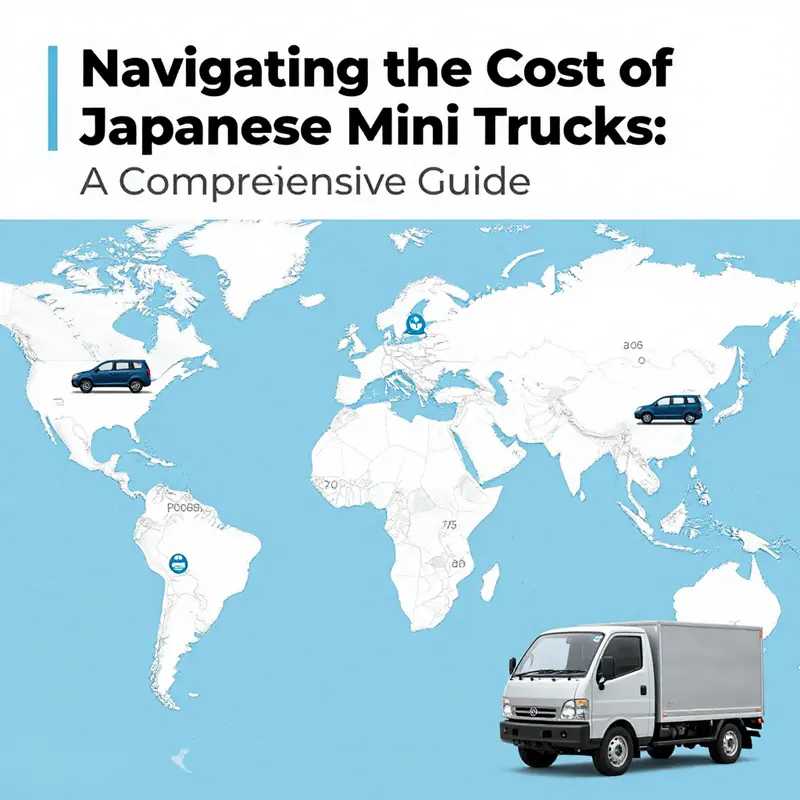
Kei trucks, small in size but surprisingly capable, occupy a unique niche in the world of light commercial transport. They are designed for urban logistics, carpentry deliveries, and farm chores where maneuverability and simplicity trump mass capacity. Their pricing echoes that practicality. In their home market, these compact workhorses are priced according to a familiar logic: condition, age, and the balance between maintenance needs and useful life. Yet once they cross into other markets, the same machines face a different set of gates—tariffs, compliance costs, and the dynamics of niche demand—that can send prices markedly higher. Reading the price signals across borders reveals not only what buyers pay, but why the market for these small trucks behaves the way it does, especially when considering both domestic and export contexts. The contrasts are instructive for anyone evaluating the total cost of ownership, whether for local use or cross-border trading.
In Japan itself, a used kei truck generally sits in a relatively accessible range, reflecting the lower operating costs and a mature domestic market that sustains steady turnover without inflating sticker prices. A practical reading of the domestic market shows prices commonly landing in a band roughly between three thousand and six thousand dollars USD. This spread captures the typical lifecycle stage: younger vehicles carry a higher premium, but strong competition among buyers helps keep values in check. The economics of Japan’s kei class reward maintenance discipline and known, compact parts sourcing. For a buyer working within Japan, the transactional friction is relatively modest compared with many larger markets. The ongoing availability of parts, the familiarity of local workshops with small-displacement engines, and a familiar regulatory environment all contribute to a lower per-mile ownership cost. These conditions make the Japanese market a stable base from which many buyers consider export or domestic use.
When kei trucks cross national borders, the price story shifts in notable ways. Imports into regions such as North America or parts of Europe face a cascade of adjustments. The most immediate factor is the tariff and tax regime of the destination country. Import duties can add a meaningful overhead, especially for vehicles that arrive as used and do not benefit from any favorable trade arrangements. Beyond tariffs, there is the compliance cost layer—the expense of bringing a vehicle up to local safety and emissions standards, which may require modifications or documentation entirely absent in the vehicle’s home market. These costs can be substantial because they are not merely cosmetic; they shape the vehicle’s fundamental suitability for street use, insurance calculation, and future resale value. In markets with strict emissions standards or additional safety requirements, the price impact compounds quickly.
A practical value lens shows that, once imported, the price of a kei truck often more than doubles, or at least rises by a wide margin, compared with its domestic price. Real-world ranges for well-maintained examples in export markets commonly fall into the ten-thousand-to-fifteen-thousand USD zone, and sometimes higher when the donor vehicle’s year, mileage, or bespoke modifications push the total higher. The range is not a hard cap or floor; rather, it reflects a matrix of factors, including the model year, the mileage accumulated on the odometer, the level of service history, and whether the vehicle has undergone any required adaptations for compliance with local rules. In many cases, diesel-powered kei trucks can command a premium in export markets because diesel variants are viewed as more robust for continuous, heavy use, though diesel availability in kei form remains comparatively limited by design. The bottom line: the sum of import duties, compliance costs, and market demand can push a vehicle’s price well beyond the domestic range, even when the same vehicle would be priced modestly at home.
Demand is another crucial variable. In export markets, the buyers often comprise a mix of small-business operators seeking a light-duty fleet alternative, off-road or overland enthusiasts attracted by the unusual combination of size and capability, and collectors who view kei trucks as a cultural or novelty entry point into lightweight, utilitarian machinery. The value proposition for such buyers hinges on a delicate balance between price, reliability, and the opportunity to customize. The allure of a tiny, efficient truck—easy parking, nimble handling, economical fuel use—keeps a floor on pricing in certain segments, while the fewer examples available in markets with stringent importing procedures can push prices upward. This demand structure, in turn, feeds back into the perception of value for export buyers and reshapes negotiating dynamics in the listing and bidding process. For traders and enthusiasts alike, knowing where the line sits between a fair price and overpayment becomes an essential skill, one sharpened by experience with how condition correlates with price once the vehicle has left its home market.
Another influence on pricing is transmission and engine configuration. In Japan, a broad mix of transmissions and fuel types exists, and the consumer’s preference for manual versus automatic can influence value even within the domestic market. Globally, however, the decision to source a particular engine configuration or a standard transmission can affect the total cost of ownership after import. Many buyers in export markets lean toward simpler, more familiar mechanical setups that minimize customization costs, but the availability of such configurations can vary by year and by batch of exports. This complexity is one reason why a seemingly identical truck might attract different bids or quotes in different markets, depending on how a given listing meets a buyer’s anticipated maintenance and repair profile. The practical takeaway is clear: price is not a single number but a function of condition, configuration, and the regulatory and logistical context in which a vehicle is sold.
The broader supply picture also matters. Market watchers note shifts in production and distribution patterns that ripple into pricing. A hypothetical but instructive scenario is a major producer moving the production of small, low-displacement trucks from a Japanese plant to another country. Such moves can ease export logistics over time, potentially stabilizing or lowering long-run costs by reducing shipping distances, import duties, or regulatory friction. The operational dynamics of this kind of shift have implications for availability and price discipline. In the short run, markets may experience tighter supply and upward pressure on prices as inventories adjust. In the longer term, if domestic manufacturing within a new hub achieves scale and efficiency, price pressure could ease. For buyers, this implies that timing and source country matter as much as the vehicle’s condition or age. It also underscores the importance of staying attuned to global supply chain signals when assessing price trajectories for kei trucks.
In navigating these price dynamics, buyers and sellers often turn to market listings and comparative data. Online marketplaces and vehicle-export channels offer a pulse on current affordability. For those seeking ongoing market context and current inventory and pricing trends, platforms that aggregate listings and provide regional comparisons can be especially informative. Additionally, exploring a central hub for broader reading can help orient a buyer toward a more strategic purchase trajectory. For readers who want a curated starting point, a concise, up-to-date window into the kei truck landscape can be found in the Mini Trucks Blog, which collects reviews, market observations, and practical tips for ownership across different regions. This internal resource provides a bridge between domestic pricing and export pricing, offering perspective on how local conditions translate into cross-border prices.
For deeper market comparisons and current listings, you can explore the broader landscape through a trusted automotive marketplace. While the numbers will shift with year and locale, the fundamental narrative remains consistent: import duties, compliance costs, and demand shape a price premium that often exceeds domestic values by a wide margin. The exact price tag hinges on the vehicle’s age, mileage, and technical condition, but the path from a modest domestic price to a substantial international price is driven by the practical realities of bringing a small, highly specialized vehicle into a new regulatory regime and a different consumer climate. The interplay of these forces means buyers should anticipate variability and plan for the total cost of ownership rather than the headline price alone.
In sum, the pricing of kei trucks across markets is a narrative written by tariff schedules, regulatory hurdles, and the very human dynamics of demand for compact, affordable mobility. Within Japan, the value is tempered by local competition and cost structures that favor reasonable resale prices and predictable maintenance costs. Abroad, the equations become more complex but also more interesting: the same steel-and-tire package can fetch dramatically different totals when the vehicle crosses borders. The result is a market that rewards buyers who approach purchases with a clear understanding of regulatory requirements, a careful appraisal of vehicle condition, and a readiness to compare regional listings. For those who approach the process with patience and literacy in these price signals, kei trucks offer a compelling blend of affordability, utility, and global intrigue.
External resource: For current listings and broad market context, see https://www.autotrader.com/ for current listings and market context.
Small Wheels, Broad Impact: How Japanese Mini Trucks Shape Local Economies and Export Markets

In dense urban grids and narrow alleyways, a compact workhorse has quietly redefined how goods move and how communities prosper. Japanese mini trucks—commonly referred to in shorthand as kei trucks or kei-class pickups—have become more than simple tools for delivery and light cargo. They are economic signals, performance benchmarks, and logistics levers that ripple through local trade and, increasingly, across distant markets. The question of price often serves as a doorway to a broader story: how affordability, reliability, and adaptability of these small vehicles influence the daily rhythm of cities at home and the strategic calculus of exporters who supply regions hungering for durable, fuel-efficient solutions. While prices vary with engine type, transmission, year, and whether a unit is new or used, the broader value proposition remains consistent. They represent a practical answer to the cost pressures of urban logistics and the constraints imposed by road networks not built for heavy-duty trucks. This alignment of form, function, and finance helps explain not only the domestic dominance of mini trucks but also their growing appeal in developing regions that prize maintenance simplicity, fuel economy, and low operating costs over raw payload capacity.
In the Japanese domestic market, the appeal of mini trucks is tied to a distinctive urban land-use pattern and demographic realities. The country’s cities are dense, their streets often snaking and compact, and their freight needs more about timely, last-mile efficiency than bulk transport. In such an environment, mini trucks excel. They are agile movers that can slip through tight circuits of delivery routes, make quick stops, and navigate streets where even compact vans might struggle. The market data from the mid-2020s highlight a remarkable preference: mini trucks captured a significant share of new truck registrations, underscoring their status as the practical backbone of urban logistics. This dominance is not simply about size; it reflects a convergence of cost structure, maintenance networks, and fuel efficiency that resonate with small businesses, family-run shops, and service providers who must balance price with reliability.
One enduring factor behind their domestic popularity is the evolving economics of urban supply chains. As logistics costs rise, the efficiency of each vehicle—how far it can travel on a given amount of fuel, how many trips it can complete within a workday, and how easily it can access customers in dense neighborhoods—translates directly into bottom-line savings. In this milieu, diesel variants and gasoline variants present different trade-offs. Diesel engines, when offered, can deliver higher torque at lower speeds and better endurance in steady, jobs-through-the-day service patterns. Gasoline variants, often paired with lighter transmissions, can be more economical upfront and simpler to maintain, appealing to smaller fleets and independent operators. The choice between a manual and an automatic transmission often runs along two parallel lines: driver preference and route profile. For some operators, a robust five-speed manual is a reliable, cost-effective workhorse for frequent stop-and-go tasks; for others, a four-speed automatic offers an easier, less fatiguing drive in stop-and-go city traffic. The end effect is a price-and-value mosaic rather than a single, one-size-fits-all answer.
But the local market story goes beyond pure economics. The aging population has subtly reshaped demand in ways that favor compact, versatile delivery solutions. As more people seek services that come to them—whether groceries, quick repair parts, or remote health supplies—the logistics system must adapt to smaller, more frequent deliveries rather than occasional large shipments. Mini trucks fit that model well. They can weave through residential streets, park in tight spaces, and perform routine deliveries with a nimbleness that larger trucks cannot replicate. This capacity to sustain frequent, efficient micro-deliveries helps explain why urban logistics costs, even as they rise, do not dampen demand for small, dependable workhorses. Consequently, the domestic market sustains a robust ecosystem of service and maintenance networks. Dealers, parts suppliers, and workshop centers become interwoven with local business communities, sustaining steady demand for routine upkeep that makes ownership predictable and manageable for small operators.
Turning to export markets, the appeal of Japanese mini trucks broadens as the world embraces leaner, more adaptable freight solutions for challenging terrains. In many developing nations and remote regions, the combination of a favorable purchase price, low operating costs, and excellent reliability makes these vehicles an attractive option for a wide range of tasks—from agricultural supply chains and rural construction to small-scale municipal maintenance and disaster-response logistics. A common pattern emerges: buyers in these markets look for a vehicle that is easy to repair, uses readily available parts, and can perform on rough roads with limited infrastructure. The lightweight chassis and compact footprint, paired with an efficient engine lineup, yield a compelling total-cost-of-ownership proposition. In practice, this translates to a market where there is a steady appetite for used trucks that are still young enough to feel modern in terms of emissions and fuel economy but inexpensive enough to allow for quick turnover and local adaptation. Price sensitivity is a defining feature in export considerations. While condition, mileage, and year clearly influence value, the flexibility of these vehicles—how easily they can be serviced and how effectively they perform under marginal road conditions—often outweighs the lure of higher horsepower or greater payload that larger trucks offer.
For exporters, the economics of price play a central role in shaping trade flows. The typical price spectrum for these light-duty vehicles reflects a blend of new versus used status, engine choice, and transmission type. On the new side, units in the kei-class category can be acquired at modest sticker prices by comparison with larger, more capable trucks, with cost structures that factor in import duties and regulatory compliance in destination markets. New units deliver immediate reliability, a guarantee of emissions conformity in certain regulatory regimes, and a shorter learning curve for maintenance staff. On the used side, a robust secondary market supports a broad range of buyers, from individual operators to small fleets. The market’s depth means that even early-model examples can serve as affordable, capable units when well maintained. In many regions, the low entry price is complemented by comparatively low running costs, such as fuel efficiency and the relative ease of parts replacement. Taken together, these factors help explain why export demand remains robust and why the price elasticity of these vehicles continues to work in favor of both sellers and buyers across a spectrum of economies.
The broader global trend toward sustainable urban logistics further amplifies the appeal of mini trucks in export markets. Cities around the world are revisiting freight strategies in response to congestion, emissions targets, and the practical realities of last-mile delivery. Small, fuel-efficient trucks offer a solution that aligns with municipal goals while maintaining cost-effectiveness for operators. In regions where road infrastructure is uneven or where emissions standards are tightening, the compact profile, combined with the potential for diesel or gasoline powertrains, makes these vehicles adaptable to a range of regulatory environments. The result is a market dance in which local business needs, national regulations, and global supply chains intersect. As demand grows in Europe and North America for micro-urban freight solutions, exporters find new opportunities to deploy these vehicles in pilot projects and scaled deployments that emphasize reliability and adaptable capacity over brute volume.
Within this complex dynamic, prices play a critical mediating role. The cost of new units versus used units helps define what segments of the market can participate in a given project. A business owner weighing a last-mile fleet might lean toward new units for uniformity and low maintenance risk, while a rural cooperative might opt for used stock to stretch a budget further, accepting a trade-off in long-term maintenance. The engine type and transmission choice further tailor cost of ownership. Diesel variants, where available, bring higher upfront cost but potential fuel savings and longevity that can offset initial expense in high-utilization scenarios. Gasoline engines, paired with efficient transmission options, can offer lower upfront costs and simpler maintenance paths in markets with robust service networks. The balance among these factors—price, reliability, serviceability, and regulatory compatibility—will continue to shape both domestic procurement decisions and export strategies for the foreseeable future.
The export ecosystem around mini trucks also tends to emphasize versatility. In remote and mountainous regions, these vehicles serve as essential tools for fire response, agricultural support, and light infrastructure work where larger trucks simply cannot access. Their lightweight construction means lower operating stress on infrastructure, and their modest fuel requirements keep running costs manageable in economies where fuel prices are volatile or where road maintenance is inconsistent. Consequently, the vehicles perform as adaptable platforms rather than single-purpose assets. This adaptability helps explain why export markets often favor models that balance practicality with durability, ensuring that the vehicles can be repurposed as market needs evolve with minimal capital outlay.
For readers who want a practical orientation to the wider ecosystem surrounding mini trucks, there are resources that trace the interplay of design, service, and market adoption. The MinitrucksCaLa blog offers perspectives on practical maintenance, regional adaptations, and case studies that illuminate how owners maximize value across different geographies. You can explore this broader discourse at the following link: MinitrucksCaLa blog.
Looking ahead, the economic calculus surrounding these vehicles will be shaped by a combination of policy, market access, and the evolution of urban logistics. As cities implement stricter emissions regimes and explore congestion pricing, the appeal of compact, fuel-efficient fleets will likely rise in both new and emerging markets. The pricing framework will continue to evolve as manufacturers refine their powertrains, transmissions, and build quality to meet diverse regulatory environments and user expectations. For analysts and practitioners, the challenge remains translating that evolving technology and regulatory landscape into tangible, affordable, and reliable choices for local operators and global buyers alike. The chapter of this story that remains most compelling is the way small vehicles sustain large, often overlooked networks of everyday commerce—networks that quietly keep communities supplied and that, in turn, support livelihoods and regional development across continents.
External reference for deeper context on the historical and technical backdrop of kei-class pickups can be found here: https://www.suzukijapan.com/vehicles/suzuki-carry-truck/
Final thoughts
Japanese mini trucks present an exciting blend of practicality and affordability, serving as essential tools for both small business operations and individual needs. Their pricing varies across the board, from new models to used options, influenced by various factors. As the market evolves, understanding these price dynamics enables buyers to make informed decisions, whether they are looking for a reliable work vehicle or indulging a passion for unique automobiles. By keeping an eye on market trends and continuously evaluating their applications, you can harness the full potential of these versatile vehicles.