
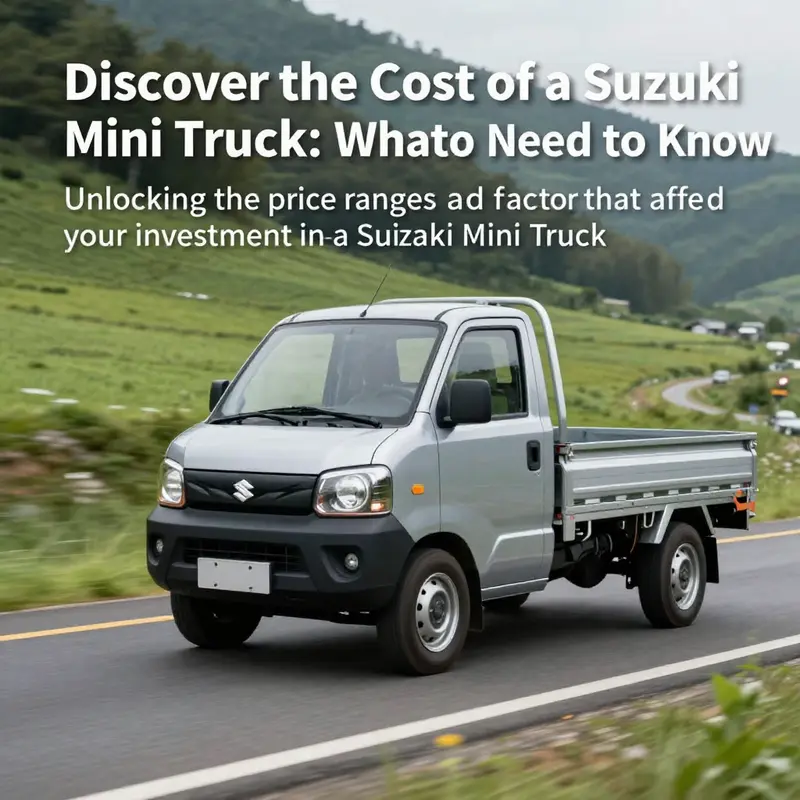
For small business owners, residential property owners, and mini truck enthusiasts alike, understanding the costs associated with a Suzuki mini truck is essential. These versatile vehicles offer functionality for various uses, but their pricing can vary widely. This article explores current pricing details, factors that influence costs, regional pricing comparisons, and the economic benefits of investing in these compact trucks. Each chapter is crafted to deliver insights that can aid you in making informed decisions, whether you’re considering a purchase for business purposes or personal enjoyment.
Pricing in Motion: How Much a Suzuki Mini Truck Costs Across Markets and Configurations

Prices for Suzuki mini trucks do not fall into a single, static bracket. They move with the same energy that powers the tiny workhorses themselves: a mix of model type, drivetrain, market incentives, and how the vehicle is configured. This chapter threads together the most concrete current figures and the broader context that shapes what buyers actually pay for a Suzuki mini truck, from brand-new four-by-four kei trucks to the smaller, electric and RC interpretations that sit at the margins of the category. The result is not a simple price tag but a landscape where a handful of clear anchors anchor a much larger spectrum of possibilities.
On the new-truck side, the most visible point of reference for many buyers is a brand-new 4×4 kei truck with manual transmission. Several listings place this category in roughly the eight-thousand-dollar range, with specific quotes often landing near US$8,399 to US$8,999 per piece. Those numbers come from standard configurations designed to emphasize durability and compact utility in constrained spaces, the kind that is valued in tight urban sites or narrow rural lanes where a larger pickup would be impractical. The precise price within that range frequently hinges on the seller, regional incentives, and any add-ons such as upgraded tires, payload packages, or dealer-prep fees. For buyers shopping across different suppliers, the numbers can drift a little higher or lower, but the eight-thousand-dollar zone remains the most commonly cited benchmark for a fresh, capable kei-class Suzuki mini truck that can squeeze into tight sites while delivering practical load capacity.
A closely related figure emerges from another source within the same family of small trucks: a variant marketed under the Dongfeng K01s brand, described as a 4×4 kei mini manual van light cargo truck based on the Suzuki Carry. For orders of 1 to 4 pieces, this model is priced at US$8,699. That price point sits squarely in the same neighborhood as the other nine-thousand-dollar targets, yet it carries its own regional engineering and branding footprint. It illustrates how the same fundamental vehicle concept—compact, efficient, and capable for light cargo tasks—can be packaged under different labels while still landing in a comparable price tier. In both cases, the 4×4 manual configuration is a common thread that tends to elevate the price above more basic two-wheel-drive or simpler, non-cabbed variants.
Beyond fully equipped new trucks, the market shows a broader tapestry of price signals that help explain why buyers encounter such a range. For those who are curious about the extreme ends of the spectrum, there is a reference point that sits far from the core road-legal truck but helps illuminate the scale of the category: electric mini utility trucks start at roughly $245 in some listings. This price bracket, while seemingly astonishingly low for a practical vehicle, reflects a different product category—light, electric platforms intended for resale or specialized utility tasks. They can serve as energy-efficient辅助 vehicles in controlled environments or as conversion platforms when a business wants to prototype last-mile solutions. These ultra-low-cost electric units are not direct competitors to a four-wheel-drive kei truck in terms of payload, range, or road compliance, but they do demonstrate the spectrum of what “mini truck” can mean in a broader sense. They remind buyers that the market is not a single lane but a highway with exits on practical utility and cost.
To widen the frame a bit further, the catalog of scale models that sit well outside the road-legal sphere includes the Suzuki CARRY RC Car—a 1:10 scale, four-wheel-drive model with metal construction and a generous 30-meter range. Priced between $19.80 and $21.00 per unit with a minimum order, this item is a toy or collector’s item rather than a transportation tool. Yet it serves a useful conceptual purpose: it anchors the lower extreme of the price spectrum in a way that helps buyers calibrate expectations for real vehicles. If a grown-up hobbyist can purchase a nearly compliant, scale-model version for a few dollars more than a fancy coffee, that contrast highlights how wide the category’s price range truly is. The RC model also illuminates how price signals tend to shift with purpose.
When buyers move from toy impresario to practical procurement, the next logical reference is the market for larger commercial mini pickup trucks that sits alongside full-size trucks in the global trade arena. Listings on major trading platforms often show a category of compact pickups from brands that include Suzuki and Isuzu, with specifications that feature 2.5- to 3.0-liter engines and the option of diesel or electric propulsion. In many cases, these are presented as global-trade options with sophisticated drivetrains designed for higher payloads and longer service lives. Yet, crucially, the precise final prices are not always revealed in listings. The absence of a fixed price in these cases highlights the reality of a market where volume, export regulations, and regional certifications can heavily influence the bottom line. A buyer evaluating these options must be prepared to engage in a price negotiation or request a formal quote that factors in freight, tariffs, and compliance costs. This lack of a published price, while less convenient for the casual shopper, is part of the broader truth about modern mini-truck procurement: the base price is just the starting point, and the total landed cost can be shaped by a dozen country-specific factors.
Across all these points, a core takeaway emerges: the Suzuki mini truck category is defined by a spectrum rather than a fixed number. The most concrete current figure for a production model—the Suzuki Carry in its Dongfeng K01s variant—appears at US$8,699 for small-quantity orders of 1–4 units. That price is the most explicit, auditable data point for a production-level, road-legal mini truck in the current market, and it sits comfortably within the broader eight- to nine-thousand-dollar range that many dealers cite for new, functional four-by-four kei trucks. It’s worth noting that this exact quote belongs to a specific supplier and regional configuration, so buyers should treat it as a precise point within a larger curve rather than a universal price tag.
Why does this price spread exist? A few threads weave through the explanation. First, the Kei class, by design, concentrates compact dimensions and light weight to deliver urban agility and low operating costs. Even within the same class, wheelbase, payload rating, and drivetrain choices—manual versus automatic transmission, two-wheel drive versus four-wheel drive, or a more robust 4×4 transfer case—impact cost. Second, the market context matters. Regional import rules, tax regimes, and currency fluctuations can push a given model’s negotiated price up or down by several hundred dollars. Third, the configuration matters: including or excluding features such as power steering, air conditioning, upgraded brakes, or reinforced cargo beds adds tangible value and raises the ticket price. Finally, after-sales services and reseller warranties factor into the total ownership proposition and can tilt the price in the buyer’s favor if backed by a reliable network. Taken together, these dynamics explain why a single model name can appear in multiple listings with slightly different price tags across different markets.
For buyers who want a quick, practical takeaway, the most dependable yardstick remains the eight- to nine-thousand-dollar band for a brand-new four-by-four kei truck in its most common configurations. The concrete quote of US$8,699 for the Dongfeng K01s variant provides a precise, auditable reference point within that band. For those who are pricing into a broader strategic plan—perhaps weighing a new mini truck against a refurbished or electric alternative—the landscape offers a wider range of options that can satisfy different needs, budgets, and timelines. The lower end of the spectrum—electric mini trucks starting around $245—illustrates the market’s willingness to cater to energy efficiency and price sensitivity, while the RC car’s modest pricing highlights how price signals can differ dramatically when the product’s function shifts from transport to display or hobbyist value. And for those who need scale and payload in a commercial context, Alibaba’s listings for larger mini pickups with 2.5–3.0L engines and diesel or electric variants indicate the potential for more substantial configurations, even as they tend to withhold final prices until a quote is requested, underscoring the negotiation-heavy reality of global trade.
In the end, price is a compass, not a verdict. It points you toward the kind of Suzuki mini truck that fits your intended use—compact, nimble, and economical in a typical urban or light-duty setting—while also signaling the broader set of choices that exist if you need more power, more capacity, or a different powertrain solution. For readers who want to explore these dynamics in a living collection of real-world examples, the ongoing coverage on industry-focused hubs and product catalogs provides a continually updated map of this evolving niche. If you’re looking to deepen your understanding of how price interacts with model choice, regional availability, and the shifting sands of global trade, the Minitrucks blog offers regular insights and market snapshots that complement the figures discussed here. Minitrucks blog.
While the exact price you will pay for a Suzuki mini truck depends on the market you inhabit, the configuration you select, and the terms you negotiate, the core logic remains consistent: buyers are weighing compact capability against total ownership costs, and the price signals you see—whether in the eight-thousand-dollar neighborhood for a new 4×4 kei truck or the sub-two-hundred-dollar range for a miniature electric platform—reflect a market that understands small-scale utility as a flexible, multi-faceted proposition. If you’re shopping seriously, you’ll want to collect several quotes, scrutinize what’s included in the base price, and compare landed costs after shipping, taxes, and compliance obligations are accounted for. And as you map your options, remember that price is only one axis. Reliability, service availability, spare-parts logistics, and the vehicle’s ability to fit your work site are the other axes that determine true value over the life of the machine. For those who want a longer horizon on this topic, a quick browse through the blog catalog linked above can help contextualize how pricing trends have shifted over time and what those shifts imply for future purchases.
External reference for further context: https://www.alibaba.com
Price Gates: How Model, Market, and Rules Shape Suzuki Mini Truck Costs

When people ask how much a Suzuki mini truck costs, they usually expect a single number. Yet the reality is a moving target. Price in this sector reflects a web of choices and constraints that shift with each model, each market, and every new regulation or promotion. The Suzuki Carry, the familiar emblem of the kei size class, sits at the center of this dynamic. It represents a family of small workhorses whose value is defined as much by capability as by context. To understand what you might pay, it helps to follow the logic that governs price rather than chase a single tag. Commodity economics, regional tastes, and regulatory hurdles all converge to shape the final outlay. In practice, this means the sticker price on a brand new kei truck differs across continents, while used units move on a slower, more idiosyncratic clock that factors condition, mileage, and reputation for reliability into the math. The range, from modest hobbyist purchases to serious commercial investments, illustrates how price serves as a signal about utility, risk, and opportunity rather than a mere number to memorize.
A concrete starting point is helpful. For a brand new, manual transmission, 4×4 kei truck—the kind that embodies short-axle efficiency and rugged minimalism—the published window can land around eight thousand dollars in some markets. Specific listings place this at US 8,399 to 8,999 per unit, which is a price tolerance that pays for four-wheel drive, compact dimensions, and new-car appeal. Yet that sticker contrasts sharply with what a used example costs. Older models carry a depreciation curve shaped by wear, maintenance history, and remaining life. A vehicle that has logged more miles, undergone repairs, or endured hars operating conditions will fetch a lower price, even within the same model year. In such cases, buyers should not simply chase the lowest price but instead weigh the total condition, service records, and the likelihood of future expenditures. The used market, especially for smaller, niche trucks, rewards buyers who understand maintenance footprints and can read a vehicle history with a critical eye.
The second axis is market demand and supply. Demand is not uniform; it throbs in regions with strong small-business activity, agricultural needs, or front-line utility demands that favor nimble, low-running-cost trucks. Conversely, in markets where similar capabilities exist in alternative forms—larger pickups, UTVs, or even electric micro-trucks—the relative appeal of a compact Suzuki diminishes. When demand outpaces supply, prices creep up. When supply grows faster than demand, sellers may compete with incentives or price cuts. Dealers do not set prices in a vacuum. They adjust for inventory levels, regional competition, and macroeconomic conditions. A modern dealership, aware of how parity shifts with financing, trade-ins, and after-sales packages, can nudge the final price with promotions, extended warranties, or maintenance plans that change the consumer’s perceived value rather than the upfront number alone.
Geography matters as much as machinery. The cost to bring a Suzuki mini truck to a specific driveway depends on local taxes, import duties, and the practical steps required to ensure road legality. In some regions, a vehicle that originates far away carries a tariff that materially alters the landing price. In others, duty-free programs and streamlined clearance can keep the outlay close to the base price. The cost of doing business in a city center also seeps in. Higher rents, local labor costs in inspection and certification, and the need for compliance modifications to meet local emissions or safety standards can all lift the overall expense. Even the terrain in which the truck is expected to operate matters. A 4×4 equipped for rough terrain might carry a premium in markets that prize off-road capability for construction, farming, or remote logistics, while the same model could be discounted in areas where urban use dominates and 4×4 is purely a luxury feature.
Import costs and regulations play a starring role in the pricing drama. For vehicles not sold directly in a country, the shipping bill can range from roughly a thousand to two thousand dollars, adding a sizable layer to the initial price. Then there are compliance costs: emissions certifications, safety spec adjustments, lighting and signaling adjustments, and the potential need for modifications to meet highway code or homologation rules. These steps translate into real dollars and real delays. Buyers who anticipate import routes and regulatory hurdles can plan for a longer lead time and a larger total investment than the sticker price alone would suggest. This is not merely about the chassis and engine; it is about the ecosystem that surrounds a vehicle before it ever leaves the showroom or the exporting dock.
Dealership pricing and promotional tactics further shape the bottom line. Individual dealers are not passive price-takers; they calibrate their asks based on how fast they need to move inventory, how their competition prices, and what kind of financing or trade-in arrangements they can offer. A dealer might present a higher up-front price in exchange for favorable financing terms, a longer warranty, or bundled maintenance, effectively changing the cost of ownership over time. Promotions can compress the price, but the catch is often in the fine print: mileage limits on warranties, service requirements, or mandatory add-ons. The interplay between upfront price and lifetime value suggests that the transaction should be evaluated as a multi-part contract rather than a single price tag.
All of this helps explain the spectrum observed in the research materials. At one extreme, a compact RC model or a toy-scale analogy might be priced at a fraction of a typical truck’s cost, highlighting the vast range in what people mean by price under the umbrella of ‘mini truck.’ At the other extreme, a brand new, practical kei truck with four-wheel drive and modern conveniences can eclipse eight thousand dollars, depending on the market. Between these poles lies a continuum shaped by the six levers discussed above: model year and condition, market demand and supply, geographical location, import costs and regulations, and dealer pricing practices. The lesson for prospective buyers is not to fixate on a single number but to chart the likely total outlay across the stages of acquisition, registration, and after-sales investment.
Within this framework, the concrete numbers from the source material should be interpreted as anchors rather than endpoints. The current landscape acknowledges that newer models command higher prices due to updated technology and safety additions. Yet premiums for newness are balanced by the buyer’s willingness to bear higher upfront payments in exchange for longer service life and potentially lower maintenance costs in the early years. Conversely, the used market rewards discernment. A vehicle with exemplary maintenance records, documented service, and a history free of major repairs can hold value better than a similarly aged unit with a murkier past. The difference can be substantial, and it underlines why experienced buyers spend as much time assessing history as they do negotiating price. The central point remains firm: price is a signal of value, risk, and function, not a static figure printed on a sticker.
In crafting a practical approach to price, consider starting with the highest-quality reference point you can access in your region. This often means connecting with official Suzuki dealerships or reputable online marketplaces that carry a consistent, transparent listing history. They can provide a baseline for new models, a comparative framework for similar configurations, and visibility into current promotions or financing options. From there, surveying the used market for models with matching specifications, mileage ranges, and service histories can reveal how much value a buyer is able to extract. It is worth noting that regional variation will inevitably reintroduce subtle differences in price, sometimes in ways that are not obvious at first glance. A near-identical vehicle in one country may appear more attractive on paper because of a more favorable tax regime, while in another place the same model could incur higher registration costs or emissions fees that offset the apparent price advantage. For readers who want a broader sense of how pricing can align with broader vehicle markets, a general reference on vehicle price guidance can be informative. See the Mini Trucks blog for context on how different models compare and differ in practical use, including notes on capacity, fuel efficiency, and maintenance considerations. the Mini Trucks blog.
In the end, the price you pay for a Suzuki mini truck depends on how you choose to value the trade-off between upfront affordability and long-term reliability. The model year and condition set the stage, while market dynamics, geographic realities, and regulatory requirements determine the script that follows. Dealer strategies and promotional incentives write the final lines of the act, sometimes altering the curve with a limited-time deal or a bundled maintenance package. What remains constant is that price is not merely a number to memorize; it is a lens through which you assess risk, opportunity, and practicality in small, capable workhorses designed for narrow roads and big ambitions. For anyone negotiating in this space, patience and due diligence are as valuable as horsepower. Take time to compare the total cost of ownership, seek clarity on any import or registration costs, and evaluate how long you intend to keep the vehicle and how you will use it day to day. The path to a sound purchase is less about chasing a single price and more about understanding how the price emerges from a broad landscape of choices, constraints, and practical needs.
External reference material can help place these dynamics in a wider context. For general guidance on vehicle pricing and value, consult established price guides that summarize how market conditions influence price across light utility vehicles. Kelley Blue Book price guides.
Global Price Tides for Suzuki-Style Mini Trucks: How Much They Cost Across Markets

Prices for Suzuki mini trucks travel in a spectrum that mirrors global economics as much as they mirror engineering. The same compact workhorse platform, designed for light-duty tasks and tight spaces, finds itself priced very differently depending on where it lands, the local tax regime, import duties, and the fiscal appetite of buyers in that market. In one country a basic, manual, four-wheel-drive version can sit in the mid-tens of thousands in U.S. dollars, while in another region the same class of vehicle might be available for a fraction of that price, thanks to localized production, favorable duties, or different consumer expectations. For readers exploring how much a Suzuki mini truck costs, the answer is less about a single sticker price and more about a price landscape shaped by demand, policy, and supply chains that stretch from factory floor to showroom floor. A practical way to think about this is to view price as a composite of configuration, local regulation, and the economics of distribution, rather than as a single global figure. The data compiled across markets shows clear patterns even when the underlying vehicle remains the same in core capability. Electric variants, while still a minority in many regions, begin to tilt the price curve in a different direction altogether, appealing to buyers who weigh energy costs, maintenance, and resale as part of total ownership. The resulting picture is not merely about margins at the dealership; it is about how a brand positions a vehicle in a landscape of taxes, duties, and consumer preference. On a practical level, this means that a shopper in one country can encounter a price that roughly doubles or halves when compared with another country, even if both are looking at the same class of compact utility truck. In this sense, the price of a Suzuki mini truck becomes a story about regional economies as much as it is about the vehicle’s utility credentials.
Measuring Value on Four Wheels: The Economic Case for a Brand’s Mini Truck in Micro-Fleet Logistics

Prices for a brand’s mini truck sit on a broad spectrum, reflecting choices that go far beyond sticker price. In the most modest corner of the market, a remote-control replica can be found for well under two hundred fifty dollars. Yet, when entrepreneurs look at the workhorse category for urban delivery and service tasks, the range shifts decisively upward. A new, kei-class mini truck with four-wheel drive and a manual transmission typically trades somewhere around eight thousand four hundred to nine thousand dollars per unit. Electric variants enter the scene with a different arithmetic altogether, starting near two hundred forty-five dollars in some listings, representing a pathway to energy efficiency and potentially lower operating costs over time—though these electrics are generally intended for lighter utility use rather than full-size road transport. Prices in this space also reflect regional market realities and the availability of larger, more capable commercial models, which are not always priced in a simple, transparent manner in every listing. For buyers who pursue scale or international procurement, sources on global trade platforms may show higher or lower numbers, depending on configuration, financing terms, and after-sales support. Taken together, the price ceiling for a new, fully capable urban mini truck easily surpasses eight thousand dollars, while the floor for a non-vehicle, energy-efficient alternative sits in the hundreds. This spectrum matters because it frames the decision not as a single purchase but as an ongoing calculus of value, reliability, and total cost of ownership.
The broad price spread invites buyers to think about what they truly need in a compact vehicle. Model choice, payload requirements, and the intended operating environment all pull in opposite directions. A 4×4 drive configuration, for instance, enhances capability in adverse weather and rough roads but adds to the upfront price and maintenance footprint. Manual transmissions are often cheaper to repair and simpler to sustain in the long run, yet some fleets prefer automatics for driver comfort and productivity. Market dynamics also matter: in some regions, kei-class regulations bring tax relief and insurance advantages that shrink ownership costs and improve fleet economics, while in others the same regulations may be less favorable or harder to qualify for. The price of electric mini trucks, though initially higher than certain gasoline-powered variants, can yield savings through lower fuel costs and simpler maintenance regimes. These contrasts underscore a critical point for buyers: the sticker price is only part of the story. The value lies in how the vehicle performs during daily operations, how often it returns to the driveway or depot, and how its ongoing costs compare to the revenue it helps generate.
Operational realities help explain why a seemingly modest price difference can translate into meaningful financial outcomes. The compact footprint of a brand’s mini truck makes it exceptionally nimble in congested urban cores, where time spent navigating traffic and searching for loading docks translates directly into more deliveries completed and faster service cycles. This improved throughput matters because each trip represents a potential increment to revenue, especially in service-oriented sectors or light logistics tasks where speed and reliability are prized. When payload efficiency reaches its peak, the ratio of cargo moved per trip to fuel and labor costs becomes a persuasive argument for owning rather than renting or relying on third-party carriers. A vehicle engineered for efficient urban operation tends to excel in two key areas: it can complete more tasks per shift, and it can do so with lower incremental costs per unit delivered. In such cases, the incremental cost of a larger or less efficient vehicle can erode profit margins even if the purchase price appears modest at first glance. The decision to invest thus benefits from a holistic view of the operating cycle, not merely a snapshot of purchase price.
From a long-term cost perspective, durability and maintenance play starring roles. A compact, purpose-built vehicle in this category is designed to optimize uptime and minimize downtime. Fewer breakdowns and lower repair expenses translate into predictable revenue streams and steadier cash flow. This reliability matters when the vehicle is part of a small fleet or a sole proprietor’s daily income. In practice, a vehicle that remains on the road more days per year delivers more opportunities to generate income, and that uptime compounds over months and years. Lower maintenance needs also reduce the administrative burden of managing a fleet across busy work weeks. When a fleet can avoid costly downtime, it preserves scheduling integrity and protects customer commitments. These operational attributes—efficiency, payload optimization, and reliability—interlock to reduce the cost per delivered unit and to improve margins over time, reinforcing the economic appeal of a well-chosen mini truck within a small business or micro-Fleet context.
Market dynamics further shape the price-to-value equation. In markets where kei car regulations exist, owners can access tax and insurance advantages that reduce the total cost of ownership beyond the purchase price. Such incentives effectively tilt the economics toward fleets that anticipate steady, predictable utilization in dense urban settings or in regional service networks. Conversely, in regions without this incentive structure, the same vehicle may face higher ownership costs, demanding a tighter optimization of routes, schedules, and utilization to hit break-even on a shorter horizon. The balance between upfront cost and ongoing savings becomes especially important for fleets that consider growth, seasonal demand, or diversification of service lines. Businesses eyeing a small but scalable fleet often weigh the potential tax reliefs, insurance savings, and depreciation benefits against the price tag and financing terms when crafting a procurement roadmap.
In keeping with practical decision-making, the online price landscape includes broader options that can influence both capex and opex. For buyers who intend to stage a small operation with a test phase, an electric variant may offer the most compelling long-term economics, especially in urban routes where stop-and-go driving dominates and idle energy costs accumulate. The lower energy cost per mile, when combined with simpler drive systems and fewer moving parts, can yield favorable maintenance and fuel expense projections. For buyers prioritizing raw payload capacity or off-road capability, a gasoline-powered variant with four-wheel drive may justify a higher upfront investment if it aligns with the expected workload and service commitments. In both cases, the ultimate measure remains the same: how quickly the investment returns through increased deliveries, faster service cycles, and consistent uptime that reduces scheduling risk.
To illuminate how this investment calculus plays out in practice, consider the micro-level economics of a small delivery or service operation that relies on a fleet of compact trucks. If a business can complete more trips per day due to improved maneuverability and faster loading, and if each trip reliably delivers a unit of revenue, the incremental value of each additional trip compounds over a month. When fuel, maintenance, and insurance costs are contained—whether through a durable design, a straightforward maintenance program, or regulatory incentives—the net income per month rises. The result is a shorter payback period and a more robust contribution to profits, even when upfront capital is modest by comparison to larger fleet purchases. This is the essence of the economic argument for investing in a compact, purpose-built mini truck within a small business context: the vehicle is not merely a tool but a strategic asset that strengthens route optimization, service reliability, and cost control.
For readers seeking broader context on the market and fleet implications, the minitrucksocala blog offers longer analyses and practical case studies that explore how fleets size and utilization patterns shift the calculus of when and what to buy. You can visit the blog at minitrucksocala.com/blog and explore perspectives that complement the data presented here.
As for the most current model-year details and official specifications, decision-makers will want to consult manufacturer materials for the latest numbers and regulatory context. The 2025-era specifications available through the manufacturer’s overview provide a reference point for how improvements in efficiency, payload, and reliability may influence total-cost-of-ownership calculations. In practice, the exact performance figures depend on configuration, drive system choice, and regional calibration, but the overarching message remains stable: the value of a mini truck for a micro-fleet rests on a careful match between workload, operating costs, and available incentives—not merely on the headline price.
For readers who want direct, reputable sources beyond the general market discussion, the official manufacturer overview offers the most authoritative reference on 2025 specifications and market performance, including how these vehicles are positioned within a broader portfolio of compact utility options. This external resource presents an evidence-based baseline for comparing the expected life-cycle costs and potential revenue impact of an investment in this class of vehicle.
In sum, the economic case for a brand’s mini truck in micro-fleet logistics hinges on a disciplined assessment of purchase price, operating costs, and revenue potential across the lifecycle of the vehicle. The broad price range reflects divergent use cases, configurations, and regional incentives. Break-even timelines are driven not only by upfront costs but by uptime, fuel or energy savings, and the ability to complete more service tasks within a given period. Smart fleet planning—combining the right configuration with an eye toward incentives, maintenance strategy, and utilization patterns—turns a modest sticker price into a powerful driver of growth and resilience for small businesses choosing to compete in dense urban markets.
External reference for official specifications: https://www.suzuki.co.jp/vehicles/super-carry/2025/
Final thoughts
Investing in a Suzuki mini truck can be a rewarding venture, providing unmatched utility for a variety of needs, whether for business or personal use. Understanding the pricing structure, factors affecting costs, and economic impacts can help you make an informed decision. Remember, each potential buyer must consider local market conditions and personal needs to ensure the best fit. As you contemplate your next move, keep in mind that a Suzuki mini truck could be your key to unlocking new operational efficiencies or simply boosting your leisure activities.