
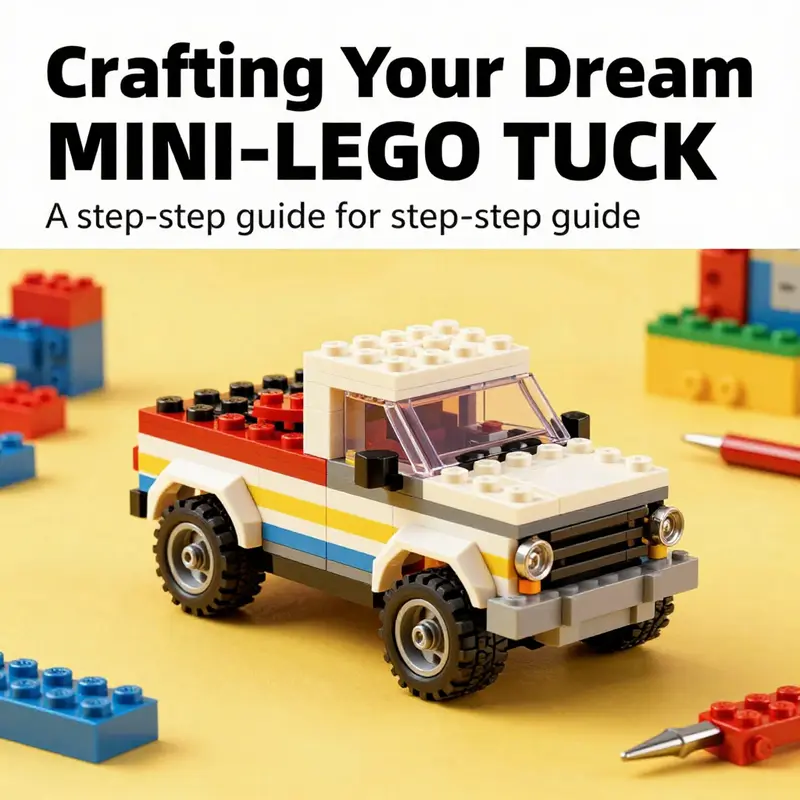
Building a mini LEGO truck is not just a fun project; it’s an exciting way to express your creativity while honing your building skills. Whether you’re a local small business owner looking for something to do in your downtime, a residential property owner excited about engaging your kids, or a mini truck enthusiast, constructing a mini truck can be a satisfying endeavor. This guide will walk you through the process, starting from laying a solid base to piecing together intricate components that bring your truck to life. Each chapter will dive deeper into specific building steps, ensuring that every detail is addressed. So, grab your LEGO bricks, and let’s get started on crafting your mini masterpiece!
Foundations First: Crafting a Rock-Solid Base for a Mini LEGO Truck
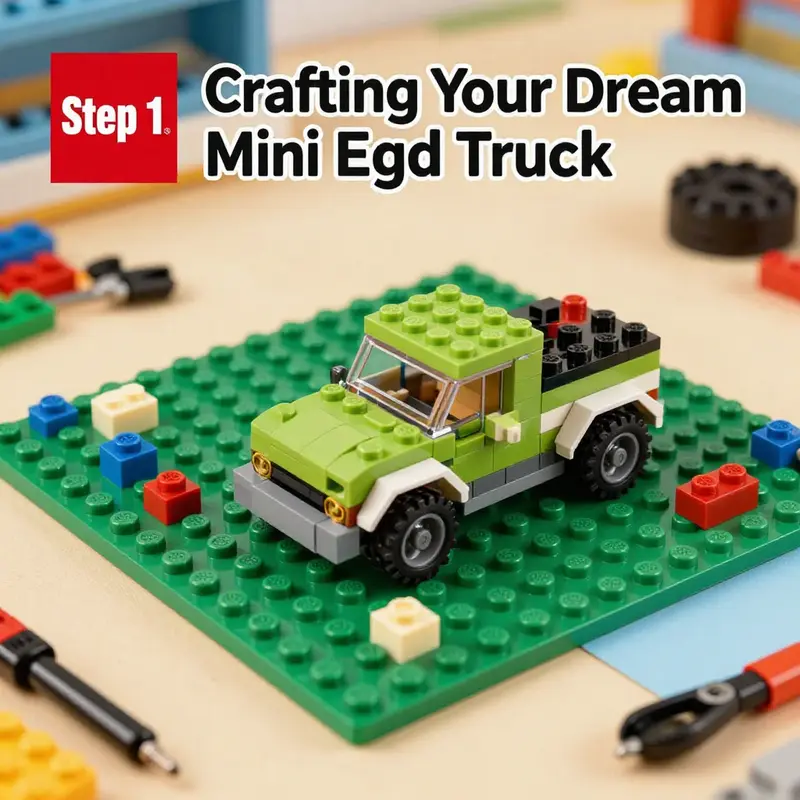
The base of a mini LEGO truck is more than a flat stage for the rest of the model; it is the spine that determines how the entire build behaves under use, how freely wheels turn, and how well the body sits on top without wobble. Think of the base as a promise you make to your future self: you will not sacrifice stability for a showy silhouette, because every panel, every hinge, and every tile will rely on this foundational plane to stay true. Begin by choosing bricks that set a sturdy, level platform. The recommended starting point is not a single oversized piece but a deliberate blend of plates that spread load evenly. Two simple choices set the tone: 2×4 plates and 2×6 plates. These sizes give you a wide, flat surface that resists flex while keeping the footprint compact enough for a miniature truck. The goal is a seamless, uninterrupted plane, so arrange the plates in a way that their seams lie within the chassis where they won’t interfere with wheel wells or cargo space. If you’re working with a 6×6 baseplate, you can still pursue the same principle, but the emphasis remains on flattening the surface rather than merely placing pieces on top. Lay out the arrangement first, then press the pieces together only after you’re confident the footprint is square and the edge lines meet squarely. When the plane finally locks into place, you unlock the potential for a chassis that will support all the clever details to come without hiding behind a misaligned foundation.
A strong base isn’t flashy, but it launches every subsequent maneuver—the smooth roll of the wheels, the precise fit of the cab, and the clean lines of the cargo bay—by offering a stable, repeatable starting point. The more consistently you align the plates, the easier it will be to add layers above without probing for hidden wobble later. In practice, the base becomes a quiet instructor, reminding you to value even, flush joints and to resist the rush to add height before you’ve secured flatness. Take your time here, because precision at this stage pays dividends in every maneuver and keeps your final miniature truck looking balanced from any angle.
As you place each plate, think about the distribution of weight across the chassis. A base that favors a slightly heavier rear can affect how a loaded cargo bed behaves when you tilt the model or park it on a small incline. If you expect to feature a hinged tailgate or an extendable bed, you’ll want the base to provide not just a flat surface but anchor points for those mechanisms. It’s not about adding more bricks to solve a problem; it’s about orchestrating a few well-chosen pieces to create a surface that behaves predictably under load. The attention to distribution teaches a beginner a deeper lesson in modeling: the visible elegance of a mini truck is often born from the unseen geometry that keeps every piece aligned. In the end, the base is less about what you can see now and more about what you can safely build upon later.
With a solid plane established, the next layer of thought is how to connect that plane to a robust internal frame. The idea isn’t to craft a skeleton that steals space from the road but to weave a lattice that supports both the chassis and any moving parts. You’ll find that a combination of brick connectors and Technic elements—axles and pins—provides the kind of rigid yet adaptable framework that small-scale builds crave. The frame acts as a bridge between the stable base and the dynamic components that follow, such as the wheels, the cargo bed, and the potential suspension. As you assemble, visualize the path of each axle and how the pins will lock cross-braces into place without creating bulky joints that snag on the interior. The result is a chassis that resists twist, distributes force evenly, and remains forgiving enough to allow for future modifications. A well-considered frame helps you avoid the common trap of a base that looks solid but buckles when you push the model lightly or attempt a simple wheel turn.
In practice, start by locating corner reinforcements at regular intervals to maintain square corners under stress. Then place diagonal braces to counteract any lateral bending that might occur when the truck carries a tiny load. The frame should align with the wheel wells so that every wheel sits perfectly on the same plane. Don’t hesitate to dry-fit the pieces first; it’s a quick, forgiving step that reveals misalignments without committing you to permanent connections. When you’re satisfied, lock the structure with final bricks, ensuring that each joint seats fully and that nothing is left loose or uneven. This internal skeleton is the quiet engine of your build, a structure that lets you realize creative ideas later without fear of collapse under the smallest bump or an enthusiastic play session.
Alignment and stability, then, become habits rather than tasks. The careful builder will constantly check for straight edges, equal margins, and parallel planes as the chassis grows. A little attention to geometry at this stage prevents a cascade of issues later: wheels that rub, panels that misfit, or a body that refuses to sit flush. The technique is simple yet precise: count studs, verify the corners, and maintain a consistent rhythm of checks as you add new sections. If a part slips out of place, pause, re-seat, and confirm that the frame remains true to the original footprint. The payoffs aren’t purely aesthetic; they translate into a more predictable building process, a smoother assembly line for the body and accessories, and a model that holds up to repeated handling during play or display. The base, once a humble assortment of parts, becomes the foundation of character—the stability that makes a tiny truck feel real when you roll it across a tabletop city.
In keeping with this careful approach, it helps to reference a clear set of guidelines that can translate across projects. The official LEGO Vehicle Building Instructions offer step-by-step diagrams and notation that map the relationships among bricks, plates, and Technic pieces. Even if you’re scaling down, the logic behind these diagrams—how parts align, how internal supports knit together, and how to foresee the demands of a chassis under load—remains valuable. They remind builders that the craft is not merely stacking pieces but engineering them to endure. For readers who want to explore deeper, these instructions serve as a dependable compass when you start to sketch your own micro-truck layout or refine a current design. The path they illuminate is universal: a strong base enables the body to solder in place with confidence, turning a rough concept into a sturdy miniature vehicle.
To help you dive deeper while keeping the momentum of your current build, consider exploring related projects and practical tips on the site’s dedicated space for modelers. For broader build ideas, see minitrucksocala.com/blog. The blog offers snapshots of community projects, notes on piece selection, and profiles of clever solutions others have used to stabilize tiny frames while leaving room for wheels and cargo. This kind of peer insight makes a real difference when you’re trying to translate a concept into a concrete, buildable form. As you read, you’ll start to notice how subtle choices—like the spacing of cross-braces or the orientation of a hinge—can dramatically alter both the stability and the potential for future customization. The base teaches you to see ahead, to anticipate how your eventual body will align with the chassis, and to plan for the cargo bed’s depth, the cab’s silhouette, and the tiny details that give the final model a personality that looks both deliberate and durable.
With the foundational plane set and a solid internal frame taking shape, you’re ready to transition into the body and aesthetics that will define the truck’s character. The base’s geometry guides every subsequent decision, ensuring that panels sit true, wheels roll freely, and the whole assembly remains rigid, even when you insert a little extra weight into the cargo space. The discipline of precise alignment you practice now becomes the axis around which your future mini-vehicle projects revolve, letting you approach each new model with a confident expectation that good foundations yield enduring builds.
External resource: https://www.lego.com/en-us/service/buildinginstructions
Framing the Mini: Crafting a Stable Internal Skeleton and Realistic Seats for Your LEGO Truck
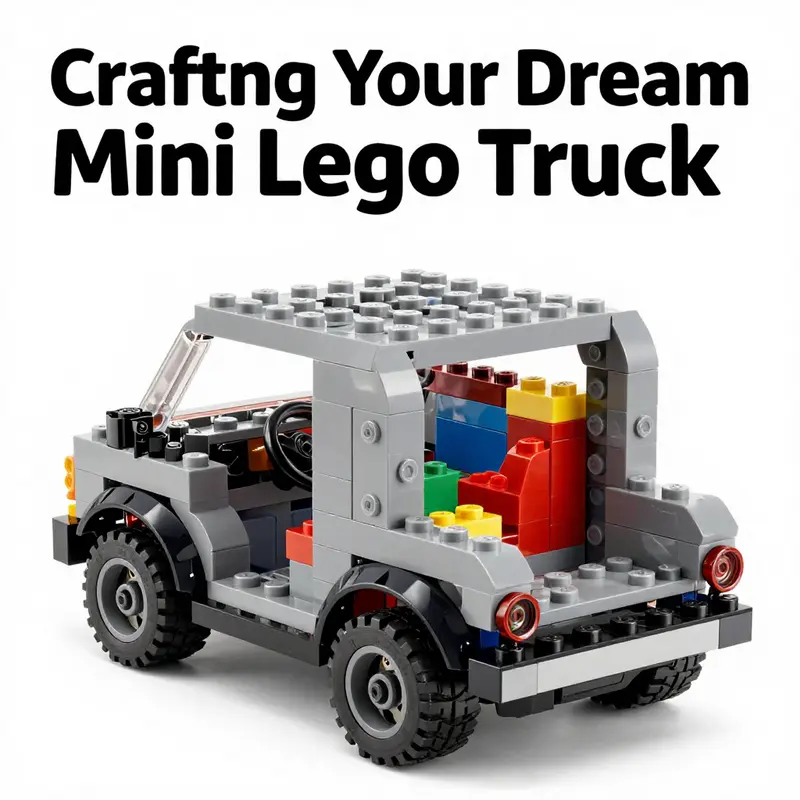
When you start constructing the internal frame, the first priority is durability. Build a chassis using strong bricks, beams, and stabilizing plates that form a rigid yet not overly heavy skeleton. Horizontal beams and vertical supports should interlock with the base so weight transfers efficiently from the roof and panels down into the ground contact points. The design philosophy is simple: use pieces with good friction and multiple contact points to minimize wobbles. It helps to imagine the frame as a small structural diagram in a scale you can handle with hand tools and patience. A robust bottom frame will pay dividends as you add the body panels, the engine bay, and the driver’s cabin. The reference to clever tolerances from the early two wide truck concepts is useful here. In those builds, the steering mechanism relies on a tiny, almost invisible gap between circular plates that is just enough to permit a lively, responsive turn without introducing play that can rattle through the entire model. Translating that idea, you can design your frame so that the steering axle has a small, controlled clearance. It keeps the wheels responsive while ensuring the rest of the chassis remains rigid. The aim is to avoid overt gaps that look unfinished and to let the mechanics work under the hood without compromising the visual compactness of the model.
A layered approach to layout helps manage space and function. Divide the interior into three zones: the engine bay at the front, the driving cabin in the middle, and a cargo area toward the rear. The engine bay can be a shallow cavity created with a handful of bricks and plates that imply mechanical mass without taking up precious cabin space. If you plan to simulate an engine, you can place a small block of plates in a shallow well and cover it with a smooth tile to keep the exterior clean and unbroken. The cabin area should be designed with seating and a simple dashboard, leaving room behind the seats for potential gear shifters or smaller control levers that can be moved by a hinge or slider. The cargo bay benefits from a flat floor and slightly raised side walls, giving the truck a sense of purpose as a transport vehicle. This segmentation mirrors real life where people expect functional separation between engine, cockpit, and payload. It also makes the model easier to build and adjust later on if you decide to modify dimensions or swap colors.
Seat design offers a surprising amount of character if treated with intention. To achieve true-to-size proportions, scale down seats from your main body in a way that preserves the silhouettes of headrests and backrests. The use of seats as modular elements—pieces that can be swapped or repositioned—breaks the monotony of a rigid interior and invites play. When fashioning the seat, think in terms of surface texture as well as shape. A few carefully chosen smooth tiles or curved slopes can convey the look of leather or fabric without complicating the assembly. The backrest can be a slightly raised plate with a gentle angle that suggests support, while the seat cushion might use a pair of thin bricks or a flatter tile to simulate a surface that invites sitting. If you want an extra layer of realism, introduce a tiny mechanism that allows the seat to slide forward or lock into a couple of distinct positions. A straightforward sliding track can be achieved with a small plate on rails or by using a couple of 1×2 bricks with offset pins that allow the seat to glide a stud or two along the interior. Simple, quiet motion adds a sense of interactivity without pressing you into a full mechanical system.
Color and texture further enhance realism. Choose a consistent color language that harmonizes with the car’s body. If the chassis is red or dark blue, consider seats in a complementary shade that signals a classic or sporty vibe. The texture of the seat area can be varied with a combination of smooth tiles, grippy grill tiles for upholstery feel, and slightly curved slopes that mimic the natural contour of a person sitting. The small details matter here; even a tiny armrest made from a slender brick or plate can alter the perception of scale and comfort, inviting viewers to imagine real hands gripping a steering wheel. The aim is not to overcommit to photo-realistic features but to provide enough cues so the model communicates its purpose at a glance. A well-crafted interior can elevate your build from a simple toy to a thoughtful replica with a believable weight distribution and an earned sense of purpose.
The design sources you consult can influence how you approach the frame. Official vehicle building guidance published for diverse age groups stresses the importance of structural rationality and assembly logic. This guidance emphasizes the value of planning before snapping bricks together, especially when you are attempting to fit a working steering mechanism, chassis panels, and a passenger area within a compact footprint. The techniques highlighted in those documents translate well to a mini truck project, where every plate you add has a ripple effect on future steps and the overall silhouette. In practice, you can apply these principles by laying out a scale diagram on your work surface, marking the intended locations of the engine bay, cabin, and cargo hold, and then iterating on the frame in layers. Such a method helps you keep track of part counts, spacing, and alignment as the build expands. As you gain confidence, you might even permit yourself a small amount of experimentation with new connector types or alternate panel angles, knowing that the core frame remains solid and true.
Realistic seating is complemented by functional touches that do not overcomplicate the build. Keep seat attachments simple but secure. A couple of plates anchored to the cabin floor can hold the seats in place while leaving enough room for a dash of cockpit detail. If you wish to imply a steering system beyond a decorative wheel, consider a minimalist linkage using a pair of hollow pins or a short axle that connects to the front wheels. The goal is to create a sense of mobility without introducing heavy mechanical demands that would derail the basic mini truck concept. The results should feel natural, as if the truck could roll into a scene, the driver ready to take charge, and the cargo box waiting for a thoughtful payload. It is this blend of stability, space management, and visual cues that makes your interior believable and satisfying to build.
Finally, draw inspiration from the broader LEGO design community. The LEGO official vehicle building guide and the thriving community of MOC creators offer a wealth of practical tricks for internal layouts and seat realism. Not all ideas will fit your particular model, but the best ones adapt well to the small scale and still deliver the sense of function you want. When you read these resources, look for how others solve spacing challenges, how they angle seats for ergonomic comfort even in miniature, and how they place steering and control features without compromising the exterior form. You can also see how a compact truck resembles a tiny version of a larger commercial model, where every interior detail echoes the overall purpose of the vehicle. If you want to explore related building ideas and keep your creative momentum high, the minitrucks blog offers fresh real-world examples that align with this chapter. minitrucksocala blog
As you finish this phase, test the chassis by placing the body panels and gently rolling the model. Look for any flex in the hull when applying light pressure and check that the seats stay fixed or slide smoothly as designed. The more you iterate, the more confident you become in your measurements and tolerances, and the more coherent the final truck will feel. The internal frame is not merely a skeleton; it is the stage where your imagination comes alive, linking structural integrity with human-scale details. The better the frame supports the seats, the more expressive the entire build becomes, inviting longer storytelling through play or display. External cues such as the alignment of the seating area with the dashboard, or the way the cabin edges meet the cargo bay with a clean seam, contribute to a well balanced appearance. When all these elements click, you will feel the satisfying moment that signals a successful step in building a mini LEGO truck, a project that can be refined in countless ways as your design language grows. External resource: https://www.lego.com/zh-cn/service/help/vehicles
Carving the Cab and Crafting the Cargo Bed: The Art of Building the Body in a Mini LEGO Truck

Now that the chassis has taken form, the heart of your miniature work begins to appear—the body of the truck. This phase is where precision and imagination converge. The cab, where the driver would sit, becomes a display of how small measurements and smart connections can create a sense of scale that feels both sturdy and alive. The cargo bed, meanwhile, adds character and function, turning the model from a simple block into a believable vehicle with space for imagination and play. The work you do here will influence not only aesthetics but the overall balance and compatibility with the wheelbase you’ve already prepared. The careful sequencing matters too: building the cab with a solid inner frame gives the outer walls something to cling to, while shaping the cargo area around a robust base ensures there’s a trusted home for whatever you plan to carry in your imagined loads. A successful build comes down to how well the two sections align, how the weight is distributed, and how the tiny details work together to tell a coherent story of a real vehicle reduced to a few dozen brick widths. Begin with the cab, the space where the driver will appear to occupy a real seat in a real car-sized world. The use of 2×4 bricks and plates forms a reliable frame that resists flex as you add more elements. The front windshield deserves particular attention: a transparent panel or a pair of clear slopes can form a convincing pane, but it is the surrounding bricks that hold the glass securely and give the cab its forward-facing silhouette. SNOT, or studs not on top, becomes a powerful technique here, letting you push bricks sideways to shave angles and create curves without losing surface area for attachment. Brick separators or small clips can anchor side mirrors in place without crowding the edges of the cabin, aligning with the way real vehicles rely on clean, compact attachments. For headlights, a combination of small round bricks or flat tiles placed just off the main wall provides a glint of realism while staying within the scale you’ve chosen. The mirrors, too, deserve attention not as mere decorations but as functional-looking details that reinforce the illusion of a working vehicle. Their placement should reflect the geometry of the cab: low enough to clear the windshield line and outward enough to catch the light from any angle. When you position them, remember to test-fit the door opening to ensure a comfortable, believable space for the driver’s imagined silhouette. Texture and depth on the cab can be enhanced by a layered wall approach: an inner frame, then a skin of plates, with tiles along the lower edge to mimic a bumper and radiate a sense of grounded realism. The cab’s roof can be a simple plate stack or a more refined slope build to imitate a real vehicle’s aerodynamic top without compromising the interior space. The result should feel compact yet sturdy, a small vehicle that respects the proportions of the base you laid out earlier. As you finalize the cab’s exterior, check the symmetry along the vertical axis. A small misalignment can throw off the entire perception of balance, especially when you peer at the model from the sides or from behind. If the mirrors or lights skew slightly, adjust by a plate or two, keeping the lines clean and continuous. This kind of micro-adjustment is where patience pays off; it’s easier to refine mid-project than to fix a lopsided finish after the cargo area is attached. With the cab underway, turn to the cargo area, which has its own set of demands. A rectangular frame built from longer bricks—2×8 or 2×10 pieces—establishes a solid base that can bear weight and host the bed’s texture. If your design calls for a hinged or sliding cargo door, you’ll want to integrate hinges or a light sliding mechanism early on, not as an afterthought. LEGO Technic elements shine here: pins, axles, and small beams can create a smooth door that opens and closes with a satisfying snap. A hinged cargo door should feel almost as smooth as a real truck’s gate; the mechanism should operate without wedging or catching on interior bricks. The interior floor can be finished with a sequence of flat tiles to simulate a cargo bed’s surface. Running a row of small bricks or tiles along the sides not only adds texture but also helps define the bed’s depth, making the whole vehicle appear more substantial despite its miniature scale. Texture matters beyond the floor. The sides of the cargo bed can benefit from alternating levels of bricks and plates to suggest panels, ridges, or the faint hints of weathered metal. If you want a more finished look, introduce a few carefully chosen accents—perhaps a contrasting color strip along the rail or a row of small tiles that mimic a taillight housing. For a more ambitious model, a simple crane arm or a winch mechanism can be integrated using Technic beams and cords. These elements can be kept purely decorative or activated to demonstrate a fetch-and-carry scenario, aligning with designs seen in larger-scale city or Technic sets. The key is to maintain the bed’s rigidity so that any added features do not compromise the structure’s strength. The mechanical charm of a well-built cargo area comes from how it attaches to the cab. Structural reinforcement is essential here; think of the connection as the spine that keeps the entire model upright during play. Two-by-two plates with studs on top placed at key junctions offer a grid of robust attachment points, while Technic axles can serve as hidden supports that resist torsion when the model is handled from the sides. As you connect the cab and cargo area, verify alignment from multiple angles. The goal is a harmonious assembly where the two sections meet with a clean seam and a sense of continuity in color and shape. If the alignment looks off, adjust with careful shims of bricks or slight repositioning of the hinge points until the lines run true. This moment of alignment refinement matters; it is the difference between a toy that wobbles and a miniature you can confidently place on a shelf or in a display. At this stage, your mini truck begins to reveal its personality. The body’s silhouette should balance a compact cab with a practical cargo bed, echoing the proportions of real-world trucks even in a scaled-down form. The color scheme should feel deliberate rather than random. If you started with a single base color, consider introducing a secondary hue in minimal accents to emphasize edges, mirrors, or door handles. The trick is to keep the contrasts subtle enough to read at a distance but interesting up close. The process also invites you to imagine variations. Perhaps this chassis supports a flatbed for a specific payload, or the cab is extended with a longer roof to suggest a different model. These are the variations that transform a straightforward build into a family of designs, ready to be customized to taste. As you push toward the final detailing, think about practicalities beyond looks. Will the model sit evenly on its wheels when the cargo bed is loaded with imaginary crates? Do the doors or hinges clear any part of the base when opened? Does the cab retain a shape that communicates speed, utilitarian purpose, or a touch of whimsy? The most satisfying results come when function and form reinforce each other. Even the act of testing playability—the way doors open, how the crane arm glides, how the weight shifts as the bed is pulled—teaches you about the delicate balance required in miniature construction. In the end, the cab and cargo bed should feel inseparable, two connected modules that together tell a story of a working machine built from small, careful decisions. For builders who want to see a detailed visual reference that captures modular assembly, SNOT detailing, and functional cargo doors, a well-known instructional project offers a model you can study and adapt. It demonstrates how modular sections can be designed to detach or reconfigure while preserving stability and flow. And while your own model will be uniquely yours, this kind of reference can help calibrate expectations about scale, proportion, and the kinds of joints that hold up under use. If you’re seeking broader context for future modifications, you can explore additional ideas and variants in related build projects and community discussions. If you’d like to consult more build ideas or share progress, you can visit the Mini Trucks blog for inspiration and tips. minitrucksocala.com/blog/. For a detailed visual guide on constructing a realistic truck body using bricks and a mix of system and Technic elements, refer to the official project instructions that demonstrate modular assembly, SNOT detailing, and functional cargo doors: https://www.lego.com/en-us/service/buildinginstructions/60198.
Fronts, Sides, and Subtle Mechanics: Crafting Realism in a Mini LEGO Truck

When you reach the fourth phase of building a mini LEGO truck, the work shifts from solid structure to the language of faces and lines. The front of the vehicle is the first thing a viewer reads, and the sides are where the eye travels to catch tiny decisions that give a model character.
In this chapter we explore how to translate a concept into small, tactile details that look authentic and invite interaction. This isn’t just about cosmetics; every tiny feature you add has a purpose, whether it’s to suggest function, improve balance, or heighten the sense of play.
As with the rest of the build, the foundation is a careful balance between geometry, material availability, and the joy of improvisation. The goal is not to clone a real truck but to evoke the same feel in a compact, kid-friendly form.
When designing the front, consider movable components that reveal an interior rhythm as the model is manipulated. A front that folds, hinges, or slides in a controlled way invites the observer to witness the gears and linkages that stay hidden in a larger build, creating a subtle sense of depth and motion.
For the sides, aim for a readable silhouette with a few well-chosen details – door lines, sills, a hint of fender – and optional retractable support legs that stabilize the chassis on uneven surfaces. This duality – hidden functionality that becomes visible on demand – adds storytelling and play value without cluttering the exterior.
The trick is to balance detail with legibility. Too many tiny parts can read as noise from a distance; a handful of well-placed elements can read as doors, windows, and wheel arches, anchoring the model in a believable scale.
Final Assembly: Bringing Your Mini LEGO Truck to Life with Function and Flair
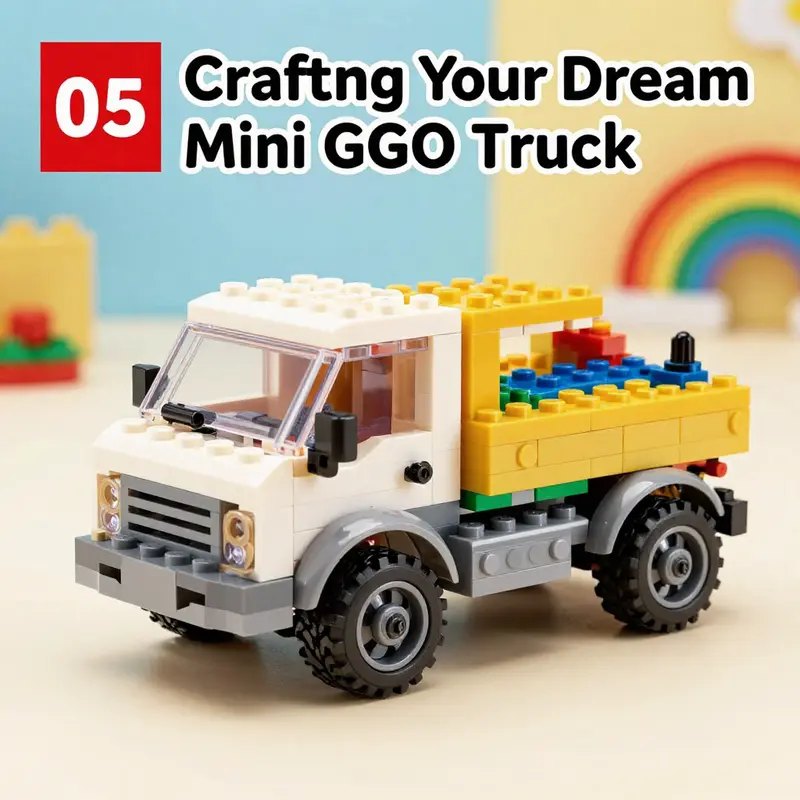
With the frame set and the body formed, the final assembly phase becomes a careful choreography of precision and purpose. This is the moment when the blueprint you imagined takes on three-dimensional life, when every connection earns its keep and every hinge earns its smoothness. Start by revisiting the foundation: your 6×6 baseplate provides the flat, stable heart of the model, but the real strength comes from the internal frame you’ve built to carry the cab, the cargo bed, and any functional components you’ve chosen to weave into the design. As you begin attaching the cab to the chassis, go slowly and align meticulously. The cab should sit squarely atop the frame, matching the lines of the side panels and the top edges of the wheel arches. When you press the connections, you should hear a confident click rather than a hollow thud or a soft, uncertain sag. If anything feels misaligned, pause and reset. It’s preferable to realign now than to watch fitment loosen after your truck rolls across a surface or through a playful tilt test later on. The aesthetic payoff is immediate: the cab should look like an intentional piece in a cohesive whole, not a loose add-on struggling to stay in place.
Beyond the visual alignment, the engineering focus shifts to the interplay of components that define how the truck behaves. The chassis must cradle the axles with just enough grip to prevent unwanted wobble while allowing free turning and smooth suspension travel where you’ve included it. Check the front and rear axles in a seated position, then rotate each wheel by hand. You’re listening for resistance or binding that would indicate a misplaced brick, a pin that hasn’t seated correctly, or a plate that’s shifted by a fraction of a stud. Even a minor misfit can translate into a noticeable drag when the truck is pushed or pulled during play. The guidance you followed earlier—precise connections, deliberate spacing, and secure locking elements—now pays off in the feel of the model. A well-assembled chassis resonates with a confident rigidity, yet not so stiff that the wheels can’t move freely when you test-drive the completed truck on a smooth surface.
The next crucial focus is the cargo area and any functional features you’ve chosen to integrate. If your design includes a dump mechanism or a deployable crane arm, the priority is smooth operation across all stages of motion. Begin by routing linkages and cables in a way that avoids interference with the doors, the cab’s movement, or the wheels. The dumping lever or hydraulic substitute needs a clear path from its control point to the moving part of the bed. As you assemble, test the pathway with the mechanism in the mid-range position first. If the system binds or binds suddenly when you move to extreme positions, there’s likely a skew in alignment that needs correction. The benefit of doing this during final assembly is that you can observe how the mechanism behaves under typical use, rather than discovering an issue after hours of work have gone into perfecting the exterior. A neat, uninterrupted range of motion is as essential to play value as it is to a display-worthy finish.
A subtle but essential consideration arises from the way the body panels meet the chassis. It’s easy to focus on the big, dramatic elements—the cab’s silhouette, the cargo bed’s depth, the wheel wells—but the small joints, latches, and plate-to-plate connections matter just as much. The integrity of the seams affects not only aesthetics but the truck’s ability to bear handle-worthy play without coming apart at the joints. Use the thinnest possible spacers where they’re needed to maintain alignment without creating extra gaps. The result should be a seamless dialogue between form and function, where the truck’s lines are clean, the corners crisp, and the surfaces ready for a little creative detailing such as emergency stripes, dashboard hints, or tiny accessories that tell a story about what this vehicle transports.
As you complete the assembly, the pattern of how you’ve chosen to connect parts—pins, studs, and clips—will determine both durability and serviceability. Take a tour around the model, inspecting every interface where two components touch. Wiggle gently to confirm that nothing shifts under light pressure. If you sense any looseness, tighten the connection by adjusting the pin placement or adding a supporting brick behind a vulnerable joint. It’s often a small tweak that yields a robust finish, and the patience you invest here pays off in the long run with fewer repairs during play or display. The goal is a truck that can stand up to curious hands, handle gentle dragging across a table, and still retain its symmetry after repeated movements and small, accidental bumps.
Now and again, you’ll reach moments where you pause to consider the broader design intent. You may decide to modify a panel here for a cleaner line, or shift a beam there to allow a slightly larger cargo space. The beauty of constructing a mini LEGO truck lies not only in the end product but also in the iterative thinking that accompanies it. Each adjustment, if measured and purposeful, sharpens your understanding of how the pieces interlock to create a believable vehicle. Throughout this stage, keep a mental note of how the model would perform in a real-world scenario: how quickly can the dump bed rise and lower; how smoothly do the wheels roll; does the cab door close with a satisfying snap? Those reflections help you reconcile the constraints of a compact build with the ambitions of a functional miniature.
For ongoing exploration, you can draw inspiration from the broader community of builders and enthusiasts who share their approaches to similar projects. A good way to stay connected is to visit the main builder blog where practical tips, problem-solving notes, and new ideas circulate. You can explore this resource at minitrucksocala.com/blog/. Reading about others’ practical tweaks can spark fresh ideas for small refinements on your own model, from altering the cargo bed’s geometry to adjusting the lever’s ratio for a more responsive dump action. The key is to keep the mood of curiosity alive while maintaining a disciplined approach to testing and verification. If you’re following a particular guide or a favorite creator, view their demonstrations with a critical eye, noting how they handle the interplay between stiffness, weight distribution, and visual balance. The best final assemblies emerge not from ad hoc improvisation but from a thoughtful blend of tested technique and personal customization, all guided by dedicated hands-on practice.
As you finish the final checks, perform a full-function test that brings together every feature you’ve included. Operate the dump mechanism from start to finish to ensure smooth, predictable movement without jamming. Roll the truck forward and backward to confirm consistent steering and stable wheel alignment. If your design incorporates a movable cargo bed or a crane arm, deploy and retract these elements several times to verify reliable operation through cycles. A successful test confirms not only the vehicle’s feasibility for play or display but also the resilience of the underlying construction under routine handling. The satisfaction you feel at this moment is part of what makes the process rewarding: the blend of careful planning, precise execution, and purposeful testing that transforms a handful of bricks into a believable, functional miniature truck.
To round out the experience, keep in mind the value of documenting your build. Take notes on the exact pieces used, the order of assembly, and any adjustments you made to improve performance. A well-documented process makes it easier to reproduce the model later or to share your approach with others who may want to adapt it for their own projects. The final image you present to friends or followers becomes a tangible record of a journey—from baseplate and frame to a complete, functioning miniature truck that you can proudly display or use in imaginative play. The beauty of this journey lies not just in the destination but in the careful, methodical steps that carried you there. And as you continue to explore, you’ll likely discover new variations—different cab shapes, alternate cargo configurations, or even a compact crane—that extend the core concept into a family of models that echo your growing curiosity and growing skill.
For a detailed visual reference that complements this approach, consult the official build video for the type of project you’re emulating. It provides clear footage of each build stage and a sense of the rhythm of assembly that helps you calibrate your own pace. You can view that resource here: https://www.lego.com/zh-hk/product/dump-truck-42203. Remember, the goal is to finish with a model that is visually cohesive, mechanically reliable, and ready for the next chapter of customization and experimentation.
Final thoughts
Building a mini LEGO truck is a rewarding experience that showcases your creativity and technical skills. By following these structured steps, you not only bring a mini truck to life but also set the stage for numerous customization opportunities. Remember, each truck can tell its own story. So spare some time, gather your materials, and most importantly, have fun! Your quirky mini truck awaits!