
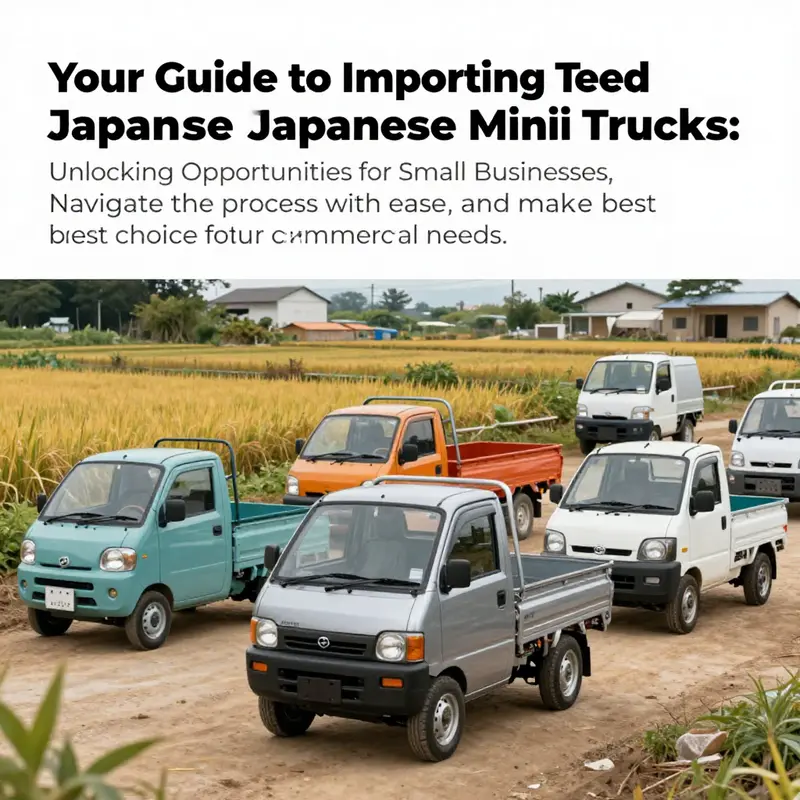
Importing Japanese mini trucks can be an exciting opportunity for small business owners, residential property owners, and mini truck enthusiasts. These versatile vehicles are ideal for a range of applications—from deliveries to landscaping. However, the process of importing them into China involves a series of regulations and careful planning. In the forthcoming chapters, we’ll delve into the legal framework that governs vehicle imports, the importance of selecting the right licensed agents who can guide you through the complexities, and ensure you clear customs properly and register your vehicle without a hitch. Let’s embark on this journey together!
null
null
Choosing Licensed Import Agents for Japanese Mini Trucks: Navigating Regulations, Partners, and Proven Expertise
Choosing licensed import agents for Japanese mini trucks is more than a checkbox; it is a prerequisite for regulatory clarity and reliable operation. Importing small commercial vehicles from Japan into China requires licensing, documentation, shipment planning, and post arrival checks. A licensed agent serves as the interlocutor with government authorities, ensuring that the vehicle complies with safety and emissions standards, that paperwork is complete, and that registration and licensing steps can proceed smoothly. The agent should hold a MOFCOM import license and have demonstrated experience with regulated vehicle categories and the corresponding environmental and safety standards. Their role is to transform cross-border procurement into a traceable workflow: sourcing, export, shipment, customs clearance, inspection, and registration. The benefit is a transparent, auditable process that regulators can follow.
In practice, the licensing framework defines who may import and under what conditions. Personal import is generally not permitted for individuals; import qualifications are held by enterprises or authorized entities. A credible agent maintains a portfolio of licenses, understands import quotas, and knows how to obtain the 批文 that unlocks entry for a given vehicle type. The vehicle itself must meet Chinese standards for technical requirements, safety, and emissions. An agent with strong in-country and cross-border networks can source a compliant used mini truck in Japan, verify its eligibility, and arrange export logistics with clean paperwork and a clear title. The journey from Japan to a Chinese port involves multiple checkpoints, with deregistration, export documentation, transport insurance, and pre-shipment inspections all playing a role.
A robust agent offers more than paperwork. They provide integrated sourcing, screening, and compliance practices. Sourcing should emphasize environmental compliance and verifiable history, not simply age or mileage. Third-party checks in Japan and a transparent vehicle history reduce the risk of later inspection or registration issues. The documentation package should include the MOFCOM license, a Certificate of Origin, commercial invoices and packing lists, the Bill of Lading, a vehicle inspection report after arrival, a pre-shipment inspection certificate, and the Single Window import declaration. The agent coordinates data alignment across documents to avoid mismatches that could trigger delays or penalties. A well-run process typically uses a standardized checklist but retains flexibility for anomalies.
Logistics and risk management are central. The agent advises on the best transport mode, balancing cost, risk, and transit time, considering roll-on/roll-off versus containerized shipments. Insurance must cover the period from departure in Japan through arrival in China. Knowledge of export deregistration in Japan and export certificates supports smooth customs clearance. Credible agents also publish performance metrics, such as time to obtain the 批文, port dwell times, and typical duties and taxes by category, and they demonstrate how post-entry compliance is managed, including safety and emissions testing and vehicle registration processes at local authorities. Even after clearance, inspections and registration remain.
A credible agent stays current with policy movements and platform developments. They monitor MOFCOM licensing measures and Customs rules for Imported Vehicles, translating changes into practical steps. Strong agents maintain relationships with Chinese and Japanese officials and cultivate a domestic post-sale network of repair facilities, genuine parts channels, and service manuals to support ongoing operation and lower total cost of ownership. For buyers, engagement with industry forums and events such as the Japan Truck Show can help assess an agent’s network and regulatory fluency. Public verifications of exhibitors and partners at the show provide a signal of reliability and disciplined risk management.
Due diligence should be a collaborative process. Start with your objectives, volumes, and timeline; invite the agent to present a detailed workflow from sourcing to registration; request copies of the MOFCOM license, sample 批文 applications, and tax/duty calculation methodologies that reflect duty fluctuations; review how the Single Window declaration is managed, and how data is aligned across documents. Ask who oversees post-entry requirements, including post-shipment inspections and ongoing compliance. Consider a staged approach, such as a trial shipment, to validate the process before committing to a larger program.
In summary, a licensed import agent is foundational. The right partner provides regulatory clarity, operational reliability, and access to official channels and industry networks. They coordinate sourcing, documentation, logistics, and post-entry compliance, while staying aligned with policy changes. The best agents can demonstrate licensing competency, a track record with regulated vehicle imports, robust post-entry support, and direct engagement with industry platforms that certify best practices. This combination reduces risk and yields a smoother, safer path from Japan to China.
Beyond the Dock: Mastering Customs Clearance and Registration for Japanese Mini Trucks in China
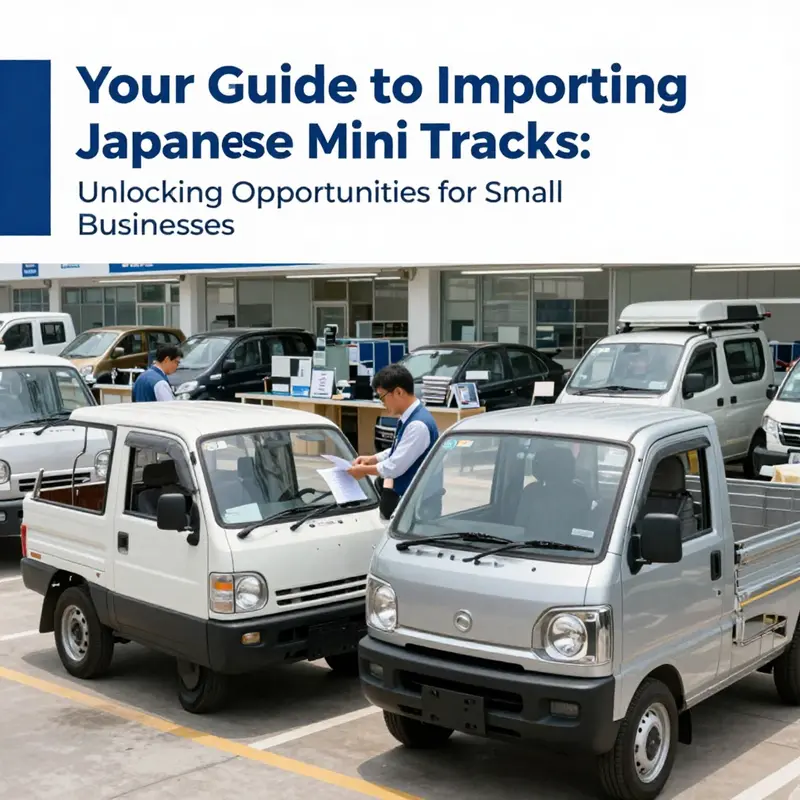
Clearing a Japanese mini truck through Chinese borders is a pivotal moment in the import journey. It is the juncture where regulatory rigor meets practical logistics, and where the right preparation can mean the difference between a ready-to-operate vehicle and a costly bottleneck. The process is not merely a paperwork hurdle; it is a gatekeeper that ensures safety, environmental compliance, and alignment with national policies on vehicle imports. For anyone eyeing a fleet of compact light-duty trucks for urban logistics, last-mile delivery, or rural service in China, understanding customs clearance and registration is not optional—it’s essential. The terrain is shaped by a combination of national rules and local practices, and while the steps can seem daunting, they follow a logical sequence when approached with a licensed importer or an authorized dealership partnership. A key point to anchor the entire discussion is the governance framework: personal import of complete vehicles is typically restricted in China, and only entities with valid import qualifications can legally bring in Japanese mini trucks. This separation between private ownership and commercial import is not merely bureaucratic; it defines the practical path forward. The process relies on qualified intermediaries who can source compliant vehicles in Japan, manage the international transport, secure the necessary approvals, and navigate the complex customs and registration landscape on the Chinese side. In the flow that follows, the emphasis stays on the steps, the documents, and the decision points that determine whether a vehicle travels from port to road with a legitimate license plate or languishes in a bonded facility awaiting clearance. The narrative here integrates the core requirements from the legal framework with the practical tasks of documentation, inspection, taxation, and registration, all while keeping a sharp eye on the unique challenges posed by mini trucks operating in a vast market with diverse regional rules. To frame the path clearly, imagine the import journey as a corridor with a series of checkpoints: permits and licenses originate at the policy level, the vehicle itself must meet safety and emission standards, and the vehicle eventually earns its permit to circulate through a formal registration at the local traffic authority. At each stage, meticulous record-keeping matters. The documents that accompany the shipment—from initial sourcing to final registration—are more than paperwork; they are the proof that the vehicle conforms to standards, that ownership is legitimate, and that tax obligations have been accurately calculated and paid. An experienced importer or agent handles this continuum—from the moment a compliant Japanese mini truck is identified for purchase to the moment the license plate appears on the chassis. The key is to approach clearance as a coordinated operation rather than a series of isolated filings. The tone of the process remains consistent: compliance, traceability, and timely execution. With this orientation, the journey through customs becomes not a battlefield of rules but a well-managed workflow that aligns with business objectives and operational needs. In practice, the first and most strategic decision is to work with a licensed import agent or an authorized dealer who can navigate the regulatory labyrinth on your behalf. This step is not a mere convenience; it is a practical necessity in the Chinese context. Personal import of complete vehicles is generally not permitted, and the import license, often referred to as a 批文, is issued to entities that can demonstrate qualification and intent to operate commercially. The licensed partner brings the capacity to source in Japan, verify vehicle eligibility against environmental and safety standards, and marshal the export and import paperwork in a way that stands up to verification at the port of entry. The agent also coordinates with shipping lines and ensures that export documentation from Japan is complete, accurate, and aligned with the agreed terms for RoRo or containerized transport. The journey from Japan to a Chinese port—whether Shanghai, Tianjin, Guangzhou, or another designated terminal—begins with a transparent understanding of the requirements that follow. Upon arrival, the vehicle is subject to a sequence of checks designed to confirm conformity to GB safety standards, emission norms, and the China Compulsory Certification framework when applicable. Emissions standards have evolved to National VI in many jurisdictions, and vehicles must meet or demonstrate equivalence to these standards. The inspection process is thorough and can involve certified testing centers that verify parameters such as exhaust emissions, braking performance, lighting, and structural integrity. In addition, the 3C certification framework, which covers essential components and systems, remains a benchmark for vehicles imported into China. The combination of GB safety compliance, emission conformity, and 3C certification forms the triad of gatekeeping criteria for registration eligibility. The sequence of actions at the port is clear: customs declaration, inspection, and the calculation of duties and taxes based on the CIF value—the sum of cost, insurance, and freight. The duty range for vehicles can be broad, typically cited as a spectrum from about 10% to 25%, depending on engine displacement, vehicle type, and the specific tariff line that applies to commercial light vehicles. In parallel, a value-added tax (VAT) is levied, commonly around 13%, calculated on the total value including the duty. There may also be a consumption tax, particularly if the engine size or configuration falls into higher brackets. The practical takeaway is that the tax burden is not a fixed flat amount; it is a function of the declared value and the tariff classification, which makes precise valuation and documentation vitally important. The import declaration is submitted through the Single Window mechanism—a digital platform designed to streamline border procedures by consolidating sometimes disparate filings. The agent’s role here is not just one of submission; it is the orchestrator who ensures that each document aligns with the others, reducing the risk of delays caused by mismatches or missing information. The required documents typically include the import license (批文) issued by MOFCOM, a certificate of origin, a commercial invoice and packing list, the bill of lading, the vehicle inspection report issued by Chinese authorities, and a pre-shipment inspection certificate from an accredited body such as SGS or BV. The import declaration, supported by these documents, triggers customs clearance, after which the vehicle must pass the necessary safety and emissions inspections. Once clearance is obtained and duties are paid, the vehicle proceeds to the post-clearance phase, which centers on registration. This stage often reveals a critical reality: permanent registration for foreign-owned vehicles on the mainland is not readily available in most circumstances. Even when a company has obtained the import license and secured customs clearance, the path to permanent registration is constrained by regional policies and the applicant’s status. In many cases, a temporary inbound solution is employed, particularly for demonstrations, exhibitions, or other temporary uses. A temporary inbound license plate can be issued by the local public security bureau’s traffic management department, enabling controlled use for a defined period while compliance or conversion steps are finalized. The paperwork for temporary plates typically includes proof of insurance, a valid passport and visa, and in some instances an approved purpose or invitation letter from a relevant organization. The ultimate goal is to secure a legitimate pathway for the vehicle to be driven on public roads, but more often the city or province will require additional tests, conformity checks, or proof of local usage plans before granting long-term access. It is at this juncture that the registration landscape becomes notably nuanced for mini trucks. Many regions maintain strict rules about the types of vehicles permitted for general road use, and the majority of imported RHD (right-hand drive) models encounter additional scrutiny or restrictions. In practice, RHD mini trucks face a higher hurdle, and exceptions are rare unless vehicles are confined to specialized zones or abide by temporary-use provisions. The absence of 3C certification for many imported small trucks compounds the difficulty. Without 3C certification, a vehicle may struggle to obtain registration for sale or use on public roads. Some would-be importers explore alternative channels such as using the vehicle for non-public road purposes or in environments where exemptions apply, but these routes are limited and tightly regulated. The practical implication is that the pathway to road use is not simply a matter of bringing in a compliant vehicle; it requires alignment with national standards, local approval, and a clear, permissible plan for where and how the vehicle will operate. For many businesses, the operational payoff is worth the complexity, but only when approached with a comprehensive plan and a trusted partner who can coordinate across agencies. When a licensed importer or dealer handles the process, their advantage lies in their established relationships with customs, test centers, and DMV-like authorities in various regions. They can anticipate common sticking points, prepare the appropriate documentation, and negotiate timelines that align with fleet deployment schedules. The document ecosystem is not static; regulatory updates can tighten or relax certain requirements, particularly around emissions and safety testing. Thus, it is prudent to maintain ongoing communication with the importer and monitor official guidance. A practical course of action is to begin with a clear definition of intended use and an honest assessment of regional acceptance. Some operators find that the most reliable route is to integrate the importation into a broader fleet management program, with a single licensed entity overseeing all regulatory steps. This approach reduces fragmentation and ensures that each stage—from source selection in Japan to final registration—is synchronized with the company’s compliance framework. For readers exploring the practicalities of this process, one useful resource that consolidates practical considerations and real-world experiences is available through the Minitrucks Cola blog. It offers insights into how serious importers navigate field-specific questions, timelines, and documentation nuances. You can visit the blog at minitrucksocala.com/blog/. This internal reference is not a substitute for official guidance, but it can provide descriptive context and case-oriented thinking that complements formal procedures. As you weigh the next steps, remember that the pathway through customs clearance and registration is not just about meeting a checklist; it is about building a compliant, auditable, and audienced-focused process that supports your fleet objectives. The highest return on effort comes from a disciplined approach: engage a licensed importer, secure a legally valid import permit, ensure the vehicle and components meet GB and 3C standards, prepare a robust package of documentation that documents the journey from Japan to China, and coordinate with local authorities to align registration plans with the intended use of the vehicle. In parallel, keep a careful eye on the tax implications. Duties and taxes are not merely costs; they can influence the total landed cost of ownership and the economic feasibility of using Japanese mini trucks for particular applications. The CIF-based valuation requires precise invoicing and agreed-upon freight terms. Discrepancies between declared values and actual costs can trigger audits, delays, or penalties, so accuracy is essential. The broader reality for importers is that the regulatory landscape in China is designed to ensure vehicles entering the market meet safety and environmental expectations while clarifying ownership and use. The standards-driven framework has evolved in response to urban air quality concerns, road safety priorities, and consumer protections. For the importer, this translates into a dynamic but navigable set of requirements that reward meticulous due diligence and professional handling. In summary, customs clearance and registration for Japanese mini trucks in China demand a clear understanding of eligibility, a disciplined document flow, and a proactive relationship with licensed professionals who can execute the process. The steps, while many, form a contiguous pathway from sourcing in Japan to the moment the vehicle finds legal standing on the Chinese road. The journey emphasizes three recurring themes: compliance, transparency, and timeliness. When these themes guide decisions, the import process becomes a manageable project rather than a perpetual regulatory maze. The chapter that follows will continue the broader narrative by examining practical deployment considerations—how to plan for dispatch, how to manage a mixed fleet with Chinese-assembled alternatives, and how to ensure ongoing compliance after registration. For now, the emphasis remains on the gatekeeping stage: the gate must be navigated with accuracy, legitimacy, and a partner who can translate policy into practice. Official guidance continues to evolve, and readers are encouraged to consult the General Administration of Customs of China for current rules and forms at https://www.customs.gov.cn. The path through customs clearance and registration is navigable, and with disciplined execution, a Japanese mini truck can become a productive asset within China’s growing logistics landscape.
Final thoughts
Importing Japanese mini trucks is not just a process; it’s a gateway to expanding your business capabilities or enhancing your property management. By understanding the legal framework, carefully selecting experienced import agents, and managing the customs clearance effectively, you can streamline your import journey. With the right knowledge and partners by your side, the process can be rewarding and beneficial for your personal or commercial needs. Embrace this opportunity to own a versatile mini truck that meets your requirements and elevates your operations.