
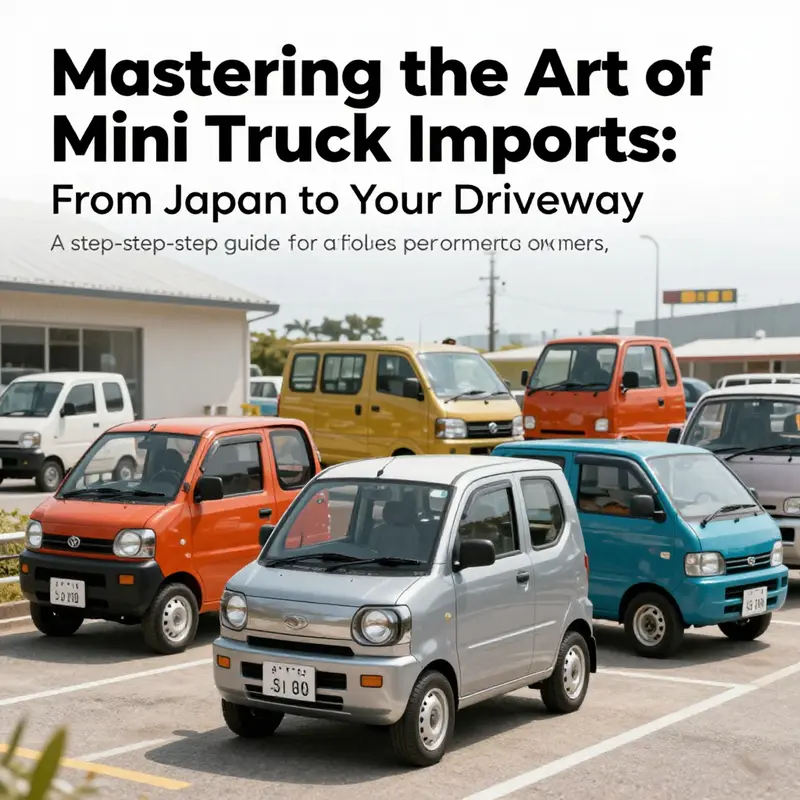
If you’re a local small business owner, a residential property owner, or a mini truck enthusiast, the idea of importing a mini truck from Japan may sound daunting but rewarding! Japan is renowned for its high-quality mini trucks, and importing one can bolster your business, enhance your property maintenance, or just serve as a delightful hobby vehicle. However, navigating the import process involves understanding vehicle regulations, sourcing the right truck, arranging logistics, clearing customs, and ensuring everything complies with local laws. This guide will walk you through each fundamental chapter, helping you seamlessly bring a mini truck from Japan into your life and meet all necessary regulations.
From Japan to the United States: Demystifying the Rules for Importing Mini Trucks
The appeal of compact, nimble mini trucks from Japan sits at the intersection of practicality and a global market that prizes efficiency. Yet turning that appeal into a street-legal vehicle in the United States requires navigating a web of federal safety and emissions standards, dealer documentation, and port-specific procedures. The journey from a dealer lot in Japan to a license plate on a U.S. street is not simply a matter of payment and shipping; it is a careful compliance process designed to ensure vehicles entering the U.S. road system meet the expectations of federal agencies, state regulators, and the consumer who will eventually drive them. Understanding the federal framework is essential before you ever press the purchase button or commit to a shipment, because the rules you encounter in import paperwork determine whether a vehicle can ever be driven legally or must be kept as a showpiece or project.
The backbone of U.S. import regulation for small, light-duty vehicles rests on two agencies: the Department of Transportation (DOT) and the Environmental Protection Agency (EPA). DOT enforces the Federal Motor Vehicle Safety Standards (FMVSS), the set of rules that address crashworthiness, occupant protection, lighting, braking, and a host of other safety features. EPA, on the other hand, governs emissions and fuel system integrity, including evaporative emissions and catalytic converters. For most Japanese mini trucks, these standards were designed around the needs of the Japanese market and its different safety and emissions expectations. In practical terms, that means many vehicles simply do not conform to the FMVSS as-built, and their emissions systems may not align with U.S. testing and certification requirements. This is not just a paperwork hurdle; it is a real barrier to road use unless a vehicle qualifies under one of the specific exemptions or pathways the regulations provide.
Two routes define the core path to legality. The first is straightforward but narrow: the 25-year age exemption. If a vehicle is at least 25 years old, it can be imported without meeting the modern FMVSS and EPA standards, because older models are considered pre-approved for import under a historical compliance framework. Determining whether a truck meets the 25-year requirement hinges on the vehicle’s model year and the production date. It is essential to verify the exact age and cross-check the model year with the build date, rather than relying on the year listed on a bill of sale alone. When a vehicle clears this criterion, the road-legal hurdles become significantly lighter, though not entirely absent. States may still impose registration or inspection requirements that government bodies at the local level will enforce at the point of registration.
The second path is more intricate but open to a wider set of vehicles: the Show or Display exemption. This option exists for certain vehicles under 25 years old that are intended for exhibition, display, or limited use and not for general street driving. Show or Display requires a carefully documented demonstration of purpose and an approval pathway involving EPA and DOT processes. In practice, this means assembling a substantial dossier that explains the vehicle’s intended use, provides technical specifications, and presents compliance evidence. The review is rigorous because the agencies must confirm that the vehicle will not be put into regular service in a manner that would undermine the safety or environmental safeguards that standard import routes uphold. For enthusiasts, this can be a viable route, but it demands patience, precise record-keeping, and a willingness to accept restrictions on how the vehicle may be operated.
Beyond the age-based avenues, a few general principles keep importers focused. The vehicle must be compatible with U.S. safety concepts, even when exemptions apply. Evaporative emissions controls, fuel system design, and catalytic converter presence are evaluative touchpoints. If a vehicle does not comply with EPA standards, owners may seek retrofit options or other modifications to satisfy emissions requirements. However, retrofitting in a way that restores or substitutes U.S.-compliant systems can be technically complex and costly, and not every vehicle will be a viable restoration project. The overarching takeaway is clear: the path to import starts with a clear determination of eligibility under FMVSS and EPA rules, then moves through documentation and logistics with a partner who understands the nuances of U.S. federal and state processes.
With eligibility mapped, the practicalhandshake of import begins. The first step is thorough documentation. A bill of lading, an invoice, and a certificate of origin are standard pieces that accompany international shipments. The importer then coordinates with a licensed customs broker who understands how to align these documents with U.S. customs expectations, including any agency-specific forms that may accompany a Show or Display application. The broker’s role is not mere form-filling; it is risk management. They help anticipate potential questions from U.S. customs, prepare for the possibility of product-specific inquiries, and guide the importer through the sequencing of submission for the vehicle’s entry. As part of the paperwork, you should be ready to present evidence of ownership, a purchase price, and a clear statement of the vehicle’s intended use if you are pursuing Show or Display status. This is not a case for DIY paper trails when federal agencies are watching closely.
Once the paperwork is in order, the vehicle can be shipped. The typical route for cost efficiency and safety is ocean freight, using RoRo or container shipping. RoRo is often favored for trucks because it minimizes handling damage: the vehicle simply drives onto the vessel and can be secured for transit. Containers offer higher protection, though at a higher cost. The choice of departure ports—Yokohama, Kobe, Osaka, or Nagoya—and destination ports in the United States will influence transit time and inland logistics. The role of experienced freight forwarders becomes crucial here. They translate the language of bills, insurance requirements, and port duties into a coherent, auditable trail that the U.S. side can follow without surprises. As a practical note, some importers explore temporary import options for testing or display purposes, a strategy that can delay permanent registration but may suit limited schedules and research projects. The key is to align expectations with the chosen pathway and the accompanying tax and fee structure.
Upon arrival, the vehicle enters a staged process at the port of entry. Customs clearance, facilitated by the broker, initiates a sequence of inspections and verifications. If the vehicle is older than 25 years, the path through federal compliance is simplified, but the vehicle will still be subject to a basic post-entry workflow: ensure ownership documents match the vehicle’s VIN, confirm that the vehicle’s title and registration data align with the import declaration, and prepare for state or provincial vehicle inspections as applicable. If the Show or Display route is chosen, additional agency-facing reviews and potential post-entry limitations on usage will apply. In all cases, after import, a state or local registration process will determine whether the vehicle can be driven on public roads, which may include safety inspections, emissions checks, and plate issuance. The overall arc—from eligibility determination to post-entry registration—highlights why pre-agreement with a knowledgeable broker and a clear plan for compliance are worth the upfront cost and effort.
The practical takeaway is not simply about finding a seller in Japan or a shipper with a good price; it is about mapping the regulatory terrain before money changes hands. A well-documented age analysis, a realistic plan for compliance testing or exemptions, and the engagement of a qualified customs broker can turn a complex regulatory landscape into a navigable voyage. For readers seeking a broader sense of how real-world importers manage this journey and to see practical commentary on ongoing import experiences, consider visiting the Minitrucks Cali blog. It offers accessible perspectives on the day-to-day realities of importing and adapting these vehicles for U.S. roads. Minitrucks Cali blog
For a deeper, technical understanding of federal requirements, you can consult the EPA’s formal guidance on vehicle import regulations, which outlines the standards and processes that govern emissions and fuel systems for imported vehicles. This resource is essential for anyone weighing the Show or Display option or the 25-year age exemption as part of a broader compliance strategy. https://www.epa.gov/transportation/federal-vehicle-import-regulations
Sourcing Japanese Mini Trucks with Confidence: From Licensed Partners to Purchase and Compliance
Choosing to import a Japanese mini truck begins long before a price tag or a port of departure. It starts with clarity about your operation, the regulatory boundaries that govern cross-border vehicle movement, and the path you will follow with a trusted partner. The sourcing and purchasing stage is not a one-off transaction but a comprehensive setup that aligns your needs with a vehicle that can legally move from Japan to your market, and then be registered and insured for everyday use. In practice, this means engaging with a licensed import agent or an authorized dealer who has established relationships with Japanese exporters and with the domestic authorities that scrutinize every vehicle before it reaches its first mile in your country. This point of entry matters as much as the vehicle itself, because the right intermediary can turn a complex maze of paperwork into a clear, auditable sequence of steps that minimizes risk and delay. To proceed with confidence, you weigh not only the price of the truck but also the credibility of the channel through which you acquire it, the reliability of the paperwork, and the track record of the logistics and compliance partners who will shepherd the shipment through export, transit, and eventual import clearance.
Eligibility and intent shape the entire course. In many markets, private individuals cannot import a vehicle directly from abroad; regulatory authorities require that vehicle imports come via a business entity with the appropriate licenses and purpose. The essence is to ensure that the vehicle enters circulation in a controlled framework that accounts for safety standards, emissions, taxation, and road-use rules. If you operate a business—whether it’s a logistics company, a fleet for local deliveries, or a small manufacturing unit with a transport arm—your eligibility hinges on having a legitimate import permit or an equivalent license, plus the ability to demonstrate that the vehicle will be used for compliant commercial activity. With this foundation, your next move is to engage with a licensed importer or dealer who can act as a steward through the transaction. A reputable partner will verify that the chosen mini truck has clear ownership history, that it has been deregistered in Japan in accordance with export regulations, and that it can be accompanied by export documents that withstand scrutiny from customs and the receiving market. The goal is not only to secure a good deal but to lock in a chain of custody that ensures the vehicle’s provenance and legal status across borders. In the sourcing phase, it pays to insist on a clean vehicle history and a dependable export trail, with documentation that can be traced back to Japan’s deregistration record and something that aligns with the import requirements of your country. The process is easier to navigate when your intermediary has established procedures for confirming not only the vehicle’s condition but also its compliance posture for emissions and safety.
Once you have identified a credible sourcing route, the due diligence shifts to documentation and conformity. The core documents you and your importer partner must assemble include a Certificate of Origin and a Bill of Lading to prove manufacture and shipment, respectively, plus an Import License or equivalent permit issued by the authorities in your market. A Vehicle Inspection Certificate from the exporting country’s regulatory body confirms that the vehicle met national standards before departure, and a range of test reports ensures compliance with the target market’s environmental and safety requirements. For markets emphasizing environmental performance, a certificate confirming alignment with local emission standards is essential. In addition, the vehicle’s technical data—engine size, model designation, weight, and dimensions—must be harmonized with the paperwork to avoid mismatches that could trigger delays during inspection or at the point of registration. Your importer should also verify the presence of a proper CCC or other localization certifications if required by your market, ensuring that the vehicle’s electrical systems, airbags, braking components, and other critical safety features will operate seamlessly when the truck enters the local network of roads and highways. The careful alignment of these documents is a backbone of a smooth import and is frequently a decisive factor in whether the vehicle can be registered without friction.
With documentation in place, the logistical choreography begins. The most common and cost-effective option for a single or a small handful of mini trucks is sea freight, using either roll-on/roll-off (RoRo) or container shipping. RoRo is often favored for trucks because it minimizes handling and lowers the risk of damage by allowing the vehicle to drive onto the vessel and off again at the destination. Containers provide additional protection and may be preferred when multiple units are shipped together or when a higher level of cargo security is desired. The choice of departure ports in Japan—such as Yokohama, Kobe, Osaka, or Nagoya—and destination ports in the import country—typically major logistics hubs with established car-traffic infrastructure—helps determine transit times, which commonly range from about ten to fifteen days for standard routes, depending on port congestion and weather. A reputable forwarder or freight forwarder will handle export documentation in Japan, manage the sea leg, and provide visibility from pickup to delivery, including door-to-door options if required. The decision to use RoRo or container shipping should be guided by the balance between cost, risk, and the level of protection the buyer desires for the vehicle’s exterior and critical components.
As the vehicle travels, the importance of a competent logistics partner cannot be overstated. A partner with automotive export experience can anticipate issues that general freight handlers might not, such as managing the vehicle’s fuel and battery considerations, ensuring proper securing during transit, and coordinating with customs brokers on both ends to prepare for the intended import regime. The value of a fixed-price engagement with such a partner is also worth noting: hidden charges can skew total costs and complicate budget planning. In addition, the partner should offer transparent tracking and reliable communication channels so you are not left guessing about the shipment’s status or the likelihood of delays. Keeping the paperwork consistent with the shipment’s status—matching bills of lading to invoices, ensuring the export declaration is properly filed, and confirming the vehicle’s VIN aligns with the declared specifications—is a critical habit for avoiding last-minute snags at the port of arrival.
On arrival, the road toward ownership is paved by the import clearance and inspection processes. In many markets, customs clearance will demand that the vehicle’s import duties and value-added taxes are calculated and paid before the vehicle can be released. The specific duty rates and tax calculations vary by model and valuation, but a typical framework often features a combination of import duty and VAT, with possible excise or consumption taxes depending on the vehicle’s engine size or intended use. Working closely with a licensed customs broker who understands automotive imports can prevent missteps that lead to costly delays. After duties are paid and the vehicle clears customs, the next step is the vehicle inspection and certification process, which verifies that the vehicle still conforms to local safety and environmental standards and that all documentation matches the physical vehicle. A successfully issued Vehicle Inspection Certificate, along with proof of ownership and import compliance, enables the vehicle to proceed to registration with the local vehicle management authorities. The registration process includes presenting the registration documents, proof of insurance, and the original import documents, and it culminates in the issuance of license plates. In major cities, where plate quotas or restrictions can complicate timing, early planning with your importer and the local authorities is prudent to avoid protracted waits.
The sourcing and purchasing phase, though transactional in appearance, is deeply strategic. A well-chosen intermediary will not only source a vehicle that suits your operational needs but will also align the vehicle’s specifications with regulatory expectations in your market. They will verify the vehicle’s history to minimize the risk of hidden liabilities such as unresolved title issues or prior tampering, ensure export deregistration in Japan, and manage the chain of paperwork that accompanies a compliant sale. They will also coordinate the pre-shipment checks that bolster confidence in the vehicle’s condition and ensure that a robust set of documents travels with the truck, ready for swift customs processing on arrival. Finally, they will safeguard the integrity of the entire journey by planning for the post-import steps—the inspection, registration, and eventual integration into your fleet—so that the vehicle can perform its intended functions with minimal disruption and maximum reliability. For readers seeking additional practical pointers, the ongoing discussion on our internal resources can offer further context about how to vet an importer, how to read vehicle history reports, and how to handle common pitfalls in cross-border automotive trades. See the minitrucksocala blog for more background and perspectives.
In parallel, staying informed through official channels remains essential. The regulations governing vehicle imports can evolve quickly, especially as emission standards and safety benchmarks tighten. For updated guidance and policy specifics, consult the relevant national authorities and official portals; planning with a compliant framework from the outset helps avert costly missteps later. External resources provide current policy details and procedural checklists that you can reference during the sourcing journey. External resource: http://www.customs.gov.cn
From Yokohama to Your Yard: Mastering the International Logistics of Importing Japanese Mini Trucks
When you decide to import a Japanese mini truck, the journey begins long before the vehicle leaves the showroom. It pivots on a carefully choreographed sequence of international logistics that links the moment a dealer settles on a sale with the day the truck finally rolls off a port gate in your country. The heart of this chapter is not the vehicle itself but the pathways that move it—the RoRo decks, the paperwork corridors, and the customs lanes that determine whether a truck arrives on time, intact, and legally ready to hit the road. The process hinges on understanding both sides of the fence: Japanese export practices and the host country’s import regime. It requires disciplined planning, a trusted logistics partner, and a readiness to adapt to shifting deadlines, port congestion, and evolving compliance rules. Every mile of the journey, from the moment the vehicle is cleared for departure in Japan to the moment a license plate is attached in your city, matters for cost, risk, and reliability.
In practice, the first decisive move is confirming that the specific mini truck you intend to import is eligible for entry into your market. This is more than a clearance checklist; it is a recognition that not all models fit under local safety and environmental mandates. The vehicle must align with the host country’s mandatory technical standards, often codified in national GB standards, and it must satisfy emission targets that translate into practical inspection results once the truck crosses customs. A miscalculation here can derail the entire project, turning a straightforward purchase into a costly holdover. The prudent importer works with a reputable exporter who can provide documentation that proves the model’s compliance trajectory, including pre-export checks and a clear certificate of origin. The most reliable routes come with a transparent export history, a clean deregistration in Japan, and a documented path to the vehicle’s compliance status in the destination country.
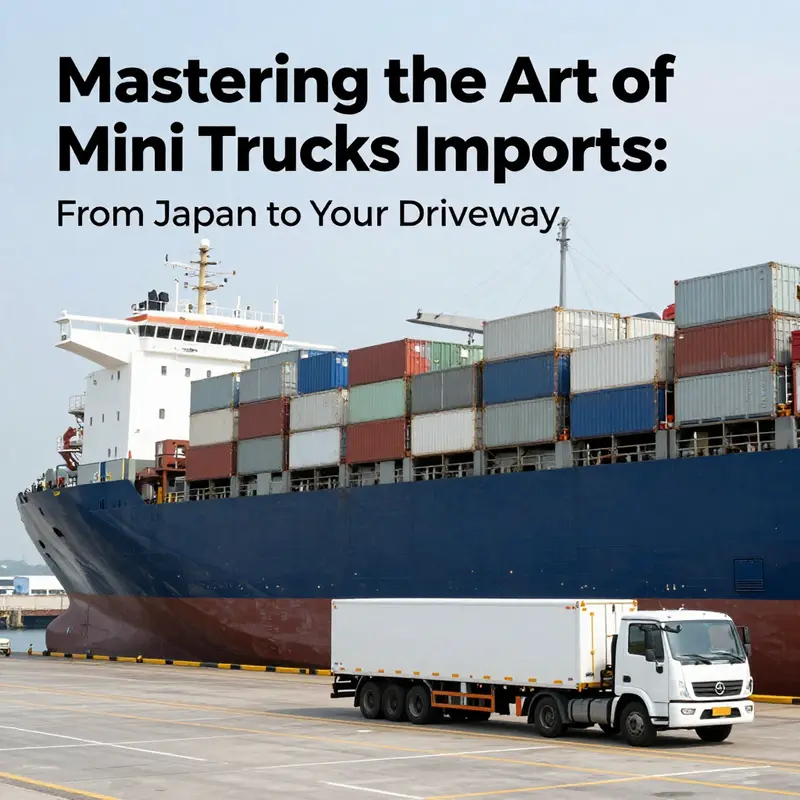
With eligibility confirmed, the next frontier is choosing the right logistics mode. For bulky vehicles like mini trucks, sea freight stands out as the cost-effective backbone of international movement. The RoRo method is especially well suited: the truck drives onto the vessel, minimizing handling and reducing dockside damage—a practical advantage when every scratch or dent translates into additional costs upon arrival. Containerized shipping remains a viable option for those who seek the highest level of protection, but it adds substantial per-vehicle costs that often don’t justify the risk profile of a utilitarian work truck. The typical maritime route departs from major Japanese gateways such as Yokohama, Kobe, Osaka, or Nagoya, sailing to Chinese ports like Shanghai, Shenzhen, Guangzhou, Tianjin, or Qingdao. Transit times can vary with season and port efficiency, but buyers commonly budget in the range of two to five weeks. The variability of freight rates, port congestion, and the occasional delay due to weather or vessel schedules makes it essential to secure space early and work with a forwarder who can provide anticipated windows rather than fixed dates.
This is where a professional freight forwarder becomes indispensable. A forwarder is not merely a customs broker; they are the conductor of a multi-actor orchestra. They handle export clearance in Japan, coordinate RoRo space on a vessel, reserve loading slots, and then carry the baton into China, preparing the import paperwork, arranging customs brokerage, and coordinating inland movement once the ship docks. Their scope often includes arranging insurance to cover the transit, calculating landed costs, and ensuring that all documents align with the demands of both Japanese authorities and Chinese customs. A trustworthy forwarder will also oversee export declarations in Japan, ensuring the vehicle leaves under proper deregistration, and they will facilitate import clearance in China by compiling the commercial invoice, packing list, bill of lading, certificate of origin, and any required test reports that prove the vehicle meets local emission and safety standards. In other words, the forwarder’s diligence directly translates into smoother port clearance, fewer delays, and a more predictable cash flow as duties and taxes come due.
No matter who handles the movement, the documentation trail is the backbone of a predictable import. The journey from truck to title is paved with documents that must faithfully reflect the reality of the motion. In Japan, the export package typically includes an export permit, proof of ownership, a commercial invoice, a packing list, and the certificate of deregistration. In China, the import dossier expands to include the commercial invoice, bill of lading, certificate of origin, import declaration, vehicle inspection report, and a license where required. The precise mix can vary by port and by the specifics of the vehicle, but the principle remains constant: accuracy, consistency, and timeliness. Any mismatch between the declared value, the product description, or the engine specification across documents invites delays, rechecks, and, in some cases, audits or penalties. A seasoned forwarder helps coordinate these elements, ensuring the numbers in the invoice match what is loaded on the ship and what is declared to customs upon entry. As the cargo sails, the owner should anticipate duties and taxes, which are calculated on a CIF basis and can include a customs duty, a value-added tax, and, for vehicles, a consumption tax that scales with engine displacement. Planning for these costs early is not just prudent; it is essential for maintaining a realistic budget and avoiding a souring surprise when the cargo lands.
The financial dimension of import logistics is often the most dynamic. In practice, the total landed cost can escalate quickly, because duties, VAT, and consumption taxes are assessed at or near port of entry and may be calculated on a value that includes insurance and freight. A rule of thumb you will hear from experienced importers is to budget for a total that can be 50 percent higher than the base vehicle price, depending on the engine size and the exact route. This is not a cynical projection; it acknowledges that the taxes, customs processing fees, and possible inspection charges accumulate in a compressed window just as the cargo is arriving. The forwarder’s role in this phase extends beyond paperwork to true financial coordination. They consolidate the different duty regimes, help with secure payment of duties and taxes, and provide clarity on how the landed cost breaks down. The better the visibility into these numbers, the easier it is to negotiate terms with the seller, plan capital, and space risk for the buyer’s business case.
As the cargo reaches the port and clears customs, a new stage opens: the vehicle’s physical inspection and certification. In jurisdictions where aligning with national standards is mandatory, Chinese authorities will conduct an on-site or documentary check to ensure the vehicle matches its declared description and complies with safety, crash-test, and emission requirements. Thereafter, the vehicle may be subjected to an emissions test and, crucially, an anti-theft system verification that confirms the VIN is consistent with records. If the inspection passes, the vehicle gains a certificate that unlocks the final doors to registration. It is at this moment that the import process transitions from the realm of international commerce to the more locally governed territory of vehicle licensing and road use. In many cases, the vehicle will then be forwarded to an inland destination for final delivery and on-site checks, before the paperwork is presented to the local Vehicle Management Office for registration and plate issuance. Even here, the forwarder often remains involved, arranging inland transport and ensuring the vehicle’s arrival aligns with the PSB or municipal traffic authorities’ schedules.
The endgame is registration, the culmination of months of careful planning, precise documentation, and a steady hand on the timeline. The local steps can differ by city, and quotas or restrictions in large metropolises can affect timing. Nevertheless, once the proof of compliance lands on the right desk—the original import permit, the vehicle inspection certificate, the purchase invoice, a valid insurance policy, and the correct identity documents—the road ahead becomes straightforward: you secure the plate, settle the last fees, and complete the transfer to roadworthy status. It is here that a well-executed international logistics plan shows its true value, turning a distant transaction into a functioning asset. For ongoing operations, this means you can count on predictable maintenance windows, access to parts through connected dealers, and the reassurance that your import channel remains compliant under evolving rules. If you want a practical touchstone as you refine your approach, consider perusing the broader resources on the Minitrucks blog for related insights and case studies that illustrate how logistics decisions ripple through procurement, delivery timelines, and post-sale support. minitrucksocala blog
In sum, arranging international logistics for Japanese mini trucks demands a disciplined, end-to-end perspective. From validating model eligibility and selecting a RoRo pathway to partnering with a capable freight forwarder, assembling a complete, accurate documentation package, and navigating the duty-loaded gate at entry, every link in the chain matters. The goal is not merely to transport a truck from one country to another; it is to shape a frictionless gateway that preserves value, minimizes risk, and ensures timely availability for the next phase—testing, registration, and, ultimately, dependable operation on your local roads. As you prepare to move forward, you will be well served by building a clear budget, choosing experienced partners, and maintaining open channels of communication with suppliers, freight forwarders, and the local authorities who will sign off on the final paperwork. If you keep the flow steady and the data accurate, the long odyssey from Yokohama to your yard can be a model of predictable, compliant, and cost-conscious international logistics.
External resource note: For officials’ guidelines and up-to-date regulatory details, you can consult the China Customs site and related regulatory bodies. China Customs
From Ship to Street: Demystifying Customs Clearance for Importing Japanese Mini Trucks
Bringing a compact Japanese mini truck into China hinges on more than a good deal or a solid shipping quote. It is a careful choreography of export documentation, destination regulations, and the practical steps that convert a shipment from a container or RoRo deck into a street-legal vehicle. The core idea is to treat the journey as a compliance project as much as a logistics exercise. Start with a reliable seller in Japan who can provide the essential export documents, and then align every subsequent step with the specific rules that govern what can enter the market, how it must be documented, and which inspections will be required before a plate is ever issued. In this space, the paperwork is not merely procedural; it is a representation of the vehicle’s history, its conformity with local standards, and the legitimacy of the transaction. For ongoing practical insights, many buyers turn to resources like the Minitrucks Blog, which distills real-world experiences and regulatory nuances into accessible guidance. https://minitrucksocala.com/blog/. The first and most obvious objective is to confirm that the seller can supply export-ready paperwork and that the vehicle itself is eligible for the destination market, a question that travels back to the basics: the documents that travel with the truck and the standards that will shape its fate when it lands on Chinese soil. The essential export documents are straightforward in theory but must be exact in practice. A Bill of Lading proves shipment, a Commercial Invoice details the sale price and terms, and a Certificate of Origin confirms where the vehicle was made. These documents form the backbone of clearance and duties calculations, and their accuracy prevents delays that can cascade into missed delivery slots or unexpected storage costs. The seller’s ability to provide an accurate export declaration and a vehicle inspection report from Japan also matters, because customs authorities want assurance that the vehicle was legally deregistered and that the export process complied with both domestic rules and the rules of the destination country. In practice, it is customary to work with an experienced exporter or broker who can assemble these documents with precision, reducing the risk of mismatches that trigger compliance flags. The import journey continues once the ship’s manifest arrives, and the vehicle begins its transition from Japanese docks toward the Chinese border. The destination’s customs framework then takes center stage, and here the role of a licensed Chinese customs broker becomes indispensable. A broker manages the maze of declarations, classifications, and value determinations that drive duties and taxes. Without that professional support, the chance of errors grows, and errors tend to multiply with the complexity of mixed documentation, language differences, and the many agencies involved. The broker’s scope covers not only the formal declarations but also the harmonized codes that determine tariff rates and the required pre-entry checks. In parallel with these formalities, the importer must pay attention to the destination’s environmental and safety standards. China typically requires that imported vehicles meet its latest emission standards, along with safety and technical regulations that govern crash-test criteria and the compatibility of electronic systems. For many years, the regulatory thrust has been toward a stringent assessment of emissions to align with urban air-quality objectives, so a vehicle that is out of step with China VI or its evolving equivalents may fail the inspection stage or require costly retrofits. The emphasis on compliance means that before a single bolt is removed at the port, a clear plan must exist for verifying the vehicle’s conformity. This is not merely a matter of post-arrival testing but a pre-emptive effort to ensure that the vehicle can pass the inspections that follow import clearance. The journey does not end with clearance; it must carry forward through the mandatory vehicle inspection and the final registration. In practice, the vehicle will undergo a safety inspection that checks brakes, lights, steering, tires, and structural integrity, followed by an emission test to verify compatibility with the destination’s standards. Anti-theft system checks are routine, and the VIN is matched against records to confirm consistency across the entire chain of custody. If these tests are passed, the vehicle receives a Vehicle Inspection Certificate, a cornerstone document that powers the registration step. The registration process then moves to the local Vehicle Management Office or Public Security Bureau, where a familiar set of documents is reviewed in person. The original Import Permit, the Vehicle Inspection Certificate, the purchase invoice, the owner’s identity documents, the insurance policy, and the customs clearance certificate sit at the heart of the file. The process is procedural, but it is also a test of the importer’s preparedness. Registration fees are modest, but the broader picture includes potential quotas in dense cities and regional differences in how aggressively authorities enforce foreign-vehicle imports. The practical thread that runs through all of this is the reality that the journey from ship to street is a continuum of checks rather than a single moment of compliance. Each stage depends on the previous one, and the risk profile rises when documents are incomplete or mismatched. A key reality is that the age of the vehicle matters. In many markets, there is a defined cut-off age beyond which imports are restricted or prohibited. The most reliable way to avoid surprises is to verify the latest regulations through official channels and with a trusted customs broker who understands both the export environment in Japan and the import landscape in China. The literature around these procedures consistently highlights the importance of planning, documentation discipline, and professional guidance to navigate the layers of government agencies. Beyond the borders, the vehicle’s in-market support remains a practical concern. Importers should consider spare parts availability, local service networks, and warranty options that can smooth the transition from a Japanese plate to a Chinese one. In this sense, the import event is not just about moving a vehicle; it is about establishing a long-term relationship among the seller, the broker, the customs authorities, and the local dealer network that will handle maintenance and parts over time. For readers eager to deepen their understanding of ongoing regulation and policy developments, the broad guidance of official resources—such as national customs and regulatory agencies—remains essential, and cross-checking updates ensures that a new shipment remains compliant as rules evolve. The external regulatory bedrock can be explored through authoritative sources that describe how vehicle importation and emission compliance standards are evolving in real time. A foundational reference is the Federal Register document on vehicle importation and emission compliance standards, which offers a formal interpretation of how countries balance trade facilitation with environmental and safety expectations. This document provides a baseline for understanding the regulatory context that underpins every import decision, from the selection of a seller in Japan to the moment the plate is issued in China. See the Federal Register resource for a broader perspective on how emission and safety requirements shape import policy and enforcement in major markets. https://www.federalregister.gov/documents/2023/07/12/2023-14679/vehicle-importation-and-emission-compliance-standards
From Japan to the American Road: Inspection, Registration, and After-Sales Support for Importing Mini Trucks
Bringing a Japanese mini truck onto American roads is as much about patience and precision as it is about practicality. The appeal of these compact workhorses—skid-steady in urban lots, surprisingly capable on light construction jobs, and easy to park—draws buyers who want efficiency without sacrificing utility. Yet the journey from a harbor in Japan to a private driveway or a job site in the U.S. is framed by safety rules, environmental standards, and a web of paperwork that requires careful navigation. This chapter explores the core realities that shape the path, with a focus on inspection, registration, and the after-sales environment that follows a successful import. It connects the excitement of acquiring a truck with the sober, practical steps that protect your investment over the long haul, while acknowledging that the exact process can vary by state and by the vehicle’s age and origin. The aim is not to overwhelm but to illuminate how a well-planned approach translates into a compliant, dependable machine on the road in a reasonable time.
For most Japanese kei trucks, the critical dividing line is the age of the vehicle. Vehicles manufactured within the last 25 years face a set of federal requirements designed to ensure they meet modern safety and emission standards. In practice, this means a two-path reality. If the truck is younger than 25 years, it must be verified for federal safety standards and emissions compliance before it can be driven legally in most states. A typical route involves a formal proof of conformity, often in the form of a Certificate of Conformity or an equivalent document, plus a thorough inspection program that confirms the vehicle meets the Federal Motor Vehicle Safety Standards (FMVSS) and applicable Environmental Protection Agency (EPA) emission requirements. An authorized inspector, recognized by the relevant federal agencies, conducts a comprehensive 30-point assessment. This examination goes beyond the engine and exhaust to cover braking, lighting, steering, seat belts, airbag systems if present, and the integrity of the structural frame. The inspector also checks odometer integrity and confirms that the vehicle’s identification numbers align with the paperwork. A positive outcome yields a formal certification or a clear path to compliance, and it becomes a central prerequisite for registration in most states.
For vehicles that are 25 years old or more, the path becomes notably simpler. The U.S. regulatory landscape has long provided a practical exemption known as the 25-year rule. Vehicles that are at least 25 years old can be imported without meeting the current FMVSS and EPA standards, provided that the owner can demonstrate proper documentation and proceed with the standard state registration process. This does not remove the need for accurate paperwork or verification that the vehicle existed before the cutoff, but it does remove the hurdle of achieving modern compliance. Even so, a 25-year-old truck still requires a clean bill of ownership, a valid bill of lading, customs entry documents, and the typical registration steps at the state level. In practice, importing older kei trucks can be an excellent way to access classic and practical hardware while avoiding some of the most demanding federal conformity requirements. It is crucial, however, to consult state guidelines because some states impose additional inspections or emissions testing as part of the registration process, even for vehicles under the 25-year threshold or for certain import categories.
Beyond age-related rules, the paperwork backbone of any import is the chain of documentation that travels with the vehicle from yard to garage. Expect to assemble and submit evidence of ownership, the entry into the country, and the clearance through customs, along with any supporting inspection reports from Japan that verify pre-export conditions. You will typically need the bill of lading, the commercial invoice, the certificate of origin, an export declaration, and a precise vehicle identification record, all of which should align with the VIN on the truck. For newer imports, a detailed declaration of conformity or an equivalent safety and emissions statement will accompany the vehicle. The breadth of documents mirrors the complexity of the process: each paper is a critical link in establishing a valid, legal chain of custody from Japan to a U.S. registration office. An orderly package minimizes delays and reduces the risk of later rework.
The inspection phase is not merely a checkpoint; it is the moment when a vehicle’s story becomes legally legible to the U.S. authorities. If the truck qualifies for the 25-year exemption, you’ll still want to document its condition and provenance with care. For younger trucks, expect a rigorous review by an EPA/DOT-approved facility. The inspector will examine the braking system, steering geometry, lighting, tires, structural integrity, and the overall operability of mechanical and electronic subsystems. The odometer and VIN must match the paperwork to prevent any misalignment that could stall registration. The outcome of the inspection often determines whether the vehicle can be imported in its current form or whether modifications are necessary to address safety concerns, such as brake upgrades, lighting retrofits, or seatbelt configurations that comply with FMVSS. In all cases, the goal of the inspection is to ensure the vehicle can be operated safely and reliably on American roads, and to confirm that the vehicle’s documentation lines up with the actual vehicle in question.
Registration, the final gateway to road legality, varies by state but follows a familiar rhythm. You will submit proof of ownership, the customs clearance documentation, and the inspection results to your state’s motor vehicle department. In many states, you must also provide evidence of insurance, a proof of address, and, for newer imports, a conformity certificate or the EPA/DOT compliance documents that accompany the vehicle. Fees are modest but not trivial, and they often cover issuance of license plates, registration certificates, and sometimes a vehicle inspection report as part of the process. Some states apply emissions or inspections that can incur additional costs or operational steps, so early planning helps manage expectations. It is also important to consider local quotas or restrictions, since some urban areas have stricter controls on foreign-imported light-duty vehicles. The practical takeaway is simple: begin the registration process early, gather all documentation, and be prepared for a queue that reflects the variability of state regulations and the specifics of your truck’s age and origin.
After registration, the story continues with after-sales support and ongoing maintenance. The availability of parts and service for Japanese kei trucks in the United States is inherently more limited than for domestically produced vehicles. Warranties rarely transfer across borders, and dealers may not stock every component. Consequently, buyers often rely on a network of sympathetic mechanics who understand the quirks of Japanese light-duty vehicles, a set of parts suppliers with access to importable components, and a willingness to improvise while preserving safety and reliability. A well-chosen import path prioritizes a partner who can coordinate maintenance, sourcing, and repairs as a package—an approach that keeps downtime low and uptime high. It also means budgeting for occasional specialty work, even as routine maintenance remains straightforward when parts are available. A practical mindset is to view every purchase as a long-term relationship: the vehicle, the importer, the workshop, and the parts chain all contribute to the vehicle’s lifecycle, from roadworthy inspection to resale or redeployment on a new project.
For readers who want to deepen their understanding as you plan, remember that the regulatory environment and the practical realities of importing can shift. A reliable, up-to-date reference is never a luxury; it’s a prerequisite. The broader guidance offered through public resources and industry-facing checklists can help keep your project on track. If you’re exploring this path seriously, you can follow a practical route that acknowledges both the regulatory spine and the hands-on realities of keeping a kei truck healthy after it arrives. For ongoing updates, check minitrucksocala.com/blog/. As you build your plan, keep this balance in mind: compliance reduces risk, but preparation and partnerships reduce cost and downtime, turning a complex import into a workable, repeatable process.
External resource for official guidance on import rules is available from the U.S. Customs and Border Protection. For authoritative, current information on vehicle imports, refer to https://www.cbp.gov/trade/basic-importer-information/vehicle-imports. This link provides the official framework that underpins every step described here, from eligibility and paperwork to what inspectors look for during the entry process. Keeping these references at hand helps ensure your plan remains aligned with federal requirements as you move from Japan to the open road.
Final thoughts
Bringing a mini truck from Japan to your driveway doesn’t have to be a complicated process. By understanding the various regulations and steps involved—from sourcing to registration—you can streamline your import experience. This guide has laid out each vital step, empowering you to navigate the complexities confidently. Whether it’s to support your business, enhance your property utility, or indulge in a passion for mini trucks, following the outlined steps will lead you to a successful import journey. Remember to continuously stay informed about regulations and develop strong relationships with local service providers for ongoing support.