
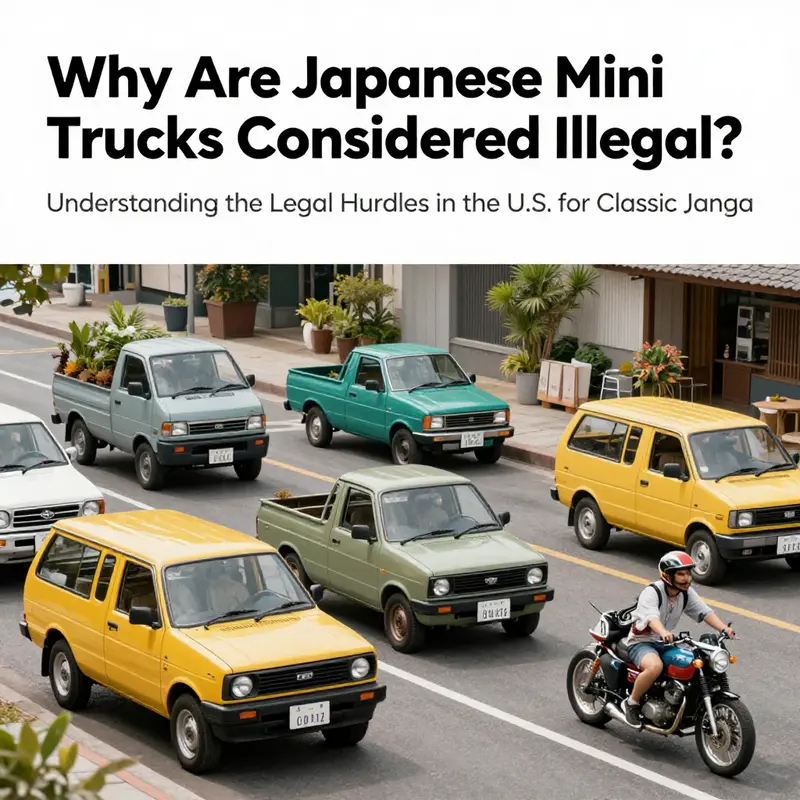
The allure of Japanese mini trucks like the Honda Acty and Suzuki Carry is undeniable, combining practicality with a unique charm that appeals to small business owners, residential property owners, and enthusiasts alike. However, these vehicles face significant legal barriers when it comes to operation in the United States. This article delves into the complexities surrounding the legality of these trucks, exploring critical aspects like federal compliance issues, varying state regulations, and the misclassification that often traps these vehicles in a legal quagmire. By understanding these factors, you can better navigate the landscape for owning and using Japanese mini trucks in the U.S.
Tiny Trucks, Heavy Barriers: Unraveling the Legal Web Keeping Japanese Kei Trucks Off American Roads
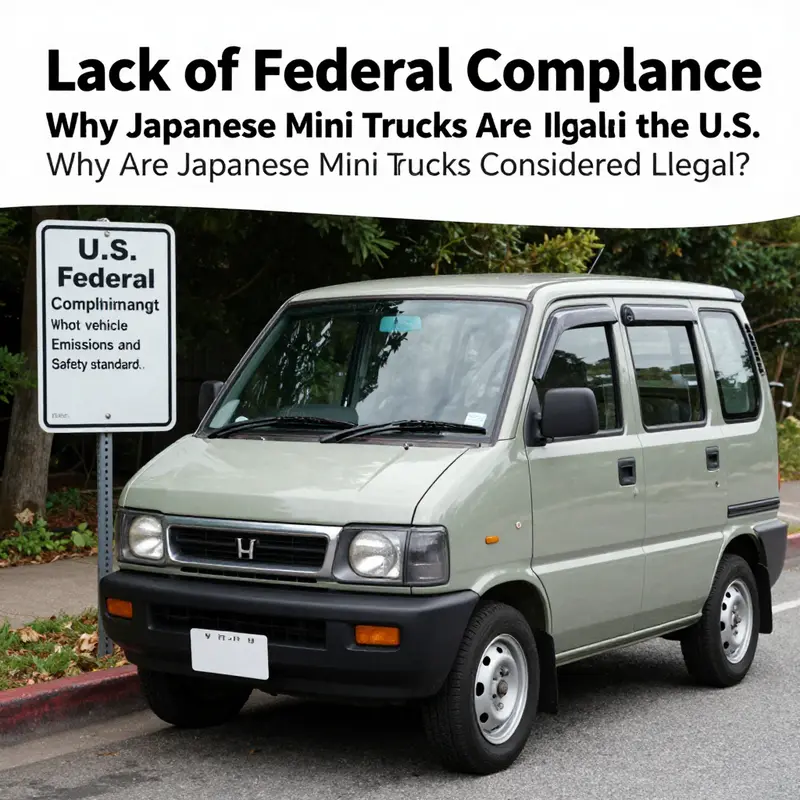
On the surface, the Japanese kei truck—the diminutive, boxy workhorse that moves goods through tight city streets and rural lanes with a surprising steadiness—seems almost comically undersized for the vast landscapes and fast lanes of the United States. Yet when enthusiasts, collectors, and small-business operators look to bring these nimble machines into a U.S. market, they encounter a maze of rules that makes the idea of a straightforward import seem almost reckless. The core tension is simple to state but difficult to resolve in practice: these tiny trucks, designed for very different roads, speeds, and urban rhythms, do not fit neatly into the U.S. framework for motor vehicle safety and certification. The result is not a federal ban on all kei trucks, but a layered, often opaque constellation of standards, classifications, and enforcement choices that treat them as effectively unregistrable for regular road use in many jurisdictions. To understand why, one must follow the threads from federal standards through state interpretations, and finally into the practical realities faced by owners who dare to dream of using a Japanese mini truck on public highways. The narrative is not about a single country’s appetite for regulation versus a niche import. It is about how a specific class of vehicle, with its own history and its own engineering logic, comes to be defined, tested, and sometimes rejected within a system built for a very different kind of mobility. The story begins with safety, a term that sounds straightforward but which becomes slippery once it leaves the realm of consumer preference and enters the legal calculus of a national transportation regime. In the United States, safety standards are codified in federal regulations designed to ensure that any vehicle sold for highway use can protect its occupants and other road users under a wide range of crash scenarios, weather conditions, and everyday wear. These rules, commonly known as the Federal Motor Vehicle Safety Standards, were developed through decades of testing, litigation, and reform, reflecting a philosophy that every vehicle on public roads should meet a baseline of crashworthiness, restraint effectiveness, and structural integrity. The number and complexity of these standards are not incidental. They catalog how vehicles are built, what components must be present, how those components must perform, and the ways in which a vehicle must behave in the event of a collision, a rollover, or a sudden maneuver. For newcomers to the import scene, 그것은 a world where a tiny, highly efficient Japanese design that excels in narrow alleys and fuel economy may clash with expectations about weight distribution, crash zones, airbag coverage, and electronic stability control. The kei trucks that fill many Japanese industrial neighborhoods emphasize compactness and versatility rather than mass, momentum, and megapascal-strength frames. They are designed to be affordable to produce and easy to repair within a market with different safety allocations and social risk calculations. The result is a fundamental mismatch with U.S. regulatory assumptions about average vehicle dimensions, the kinetic energy generated by collisions between light and heavy vehicles, and the way a vehicle should behave at highway speeds. In practice, the absence of compliance with specific FMVSS provisions means that new kei trucks, produced for markets with different engineering priorities, fail to meet the formal safety prerequisites for sale as new vehicles in the United States. The federal government’s position is not a blanket prohibition on the class; rather, it’s a particular insistence that any vehicle offered for sale in the U.S. must demonstrate adherence to a particular safety language that has evolved to reflect American traffic realities. The consequences of this policy are not only technical; they shape the economics and feasibility of bringing kei trucks to the U.S. market. When manufacturers or distributors consider a formal import route, they must confront a regulatory framework that requires substantial compliance costs, a process of certification testing, and the possibility that certain design choices will trigger noncompliance in ways that are not trivial to remediate. The result is a calculus weighed by risk, expense, and time. Yet even for vehicles that bypass the showroom, there remains a substantial barrier: the way states interpret or reinterpret federal concepts within their own vehicle codes. This is where the term gray market becomes more than a broker’s buzzword. It becomes a descriptor of a supply chain and a regulatory status that is not harmonized across the country. In some states, the practical effect of importation is to treat a kei truck as if it were a vehicle intended for off-road or utility use, rather than one meant for everyday highway travel. This misalignment has real consequences. Laws crafted to govern what can be registered, what must be inspected, and what safety equipment is mandatory can be read in ways that exclude the imported machine from the road not because it cannot meet any federal standard, but because it does not fit the exact language in a state’s registration or inspection statutes. The danger, in this schema, is not merely a technical disqualification; it is a political and bureaucratic one. For the owners who have navigated these waters, the journey can include a revocation of existing registrations, insurance complications, or even lawsuits over what constitutes fair treatment of owners who choose to import a vehicle that did not originate in their country of residence. The rhetoric around how kei trucks should be classified becomes a focal point for broader debates about trade, sovereignty, and the role of consumer choice in the face of public safety obligations. In some state contexts, a vehicle that is compact, efficient, and capable of road travel can be labeled as an “off-road” or “specialty” vehicle for policy purposes. The label might seem merely semantic, yet it carries practical weight: it can determine whether a vehicle is eligible for standard registration or subject to restrictions that effectively bar its operation on public roads. Advocates for owners of these imports have argued, with varying degrees of success, that the misclassification arises from a mismatch between the design intent for Japanese markets and the statutory language used in the United States. They point to the fact that these trucks were designed to reach highway speeds in Japan and to operate on road networks that include long, well-maintained highways with traffic patterns not dissimilar to those found in some U.S. corridors. They further argue that, when properly outfitted with the necessary safety equipment that is legally required in the United States, these vehicles can be operated responsibly on comparable roadways. The core counterpoint from regulators and many safety advocates centers on the structural realities of kei trucks. While they may be compact, their small frame, light weight, and relatively minimal crumple zones translate into crash dynamics that differ substantially from larger, heavier vehicles typical on American highways. The absence of high-strength, energy-absorbing structures, multiple airbags, advanced electronic stability control, and other modern safety features raises concerns about occupant protection in multi-vehicle crashes. The regulatory stance is not that every kei truck is inherently unsafe, but that the design philosophy embedded in these vehicles, coupled with the level of safety technology they typically carry, fails to meet the comprehensive expectations set by FMVSS for a broad highway environment. The gray-market pathway offers a sort of workaround for those who value the aesthetic and practical appeal of kei trucks, yet it does not erase the fundamental safety questions, nor does it guarantee a straightforward path to legal road use in the United States. An important nuance in this landscape is the well-known 25-year rule that governs many classic and collector vehicles. This exemption, existent in federal practice, allows certain vehicles older than a quarter of a century to be imported without compliance with current FMVSS requirements. The logic behind this policy is practical and appeals to historic and enthusiast communities: aging fleets, vintage designs, and the cultural value attached to older automobiles can be preserved and enjoyed in the United States without the heavy cost of reengineering to meet modern safety criteria. Importantly, this rule operates as a door rather than a guarantee. It does not create a market for new kei trucks produced for informal import into the United States. It does, however, open a legitimate lane for older Japanese mini trucks that already meet older safety norms, or simply for those with the means to claim collector status under the law. It is at this juncture that the distinction between new-model importation and the import of classic vehicles becomes most visible. Enthusiasts who are drawn to kei trucks for reasons of space efficiency, maneuverability, fuel economy, and the unique charm of their compact form often cluster around the idea of a “classic” kei truck—a vehicle that pre-dates modern OEM safety expectations, and for which the importer can claim compliance under the 25-year rule. The gray-market reality, however, remains stubbornly persistent. Importers frequently assemble a vehicle that carries a Japanese designation, but the lack of official certification for the U.S. market creates an enduring fog around its status. Without a formal channel that aligns with a U.S. registration framework, the vehicle remains effectively unregistrable, even if it can be legally imported under a collector’s category. This tension fuels the sense among many that the system is working at cross purposes: it preserves certain historical vehicles while simultaneously creating a catch-22 for modern Japanese mini trucks that do not meet the same exemptions. The outcome in practice is that many potential users find themselves asking whether the dream of a kei truck on U.S. roads is a dream at all, or merely a dream that must be pursued in a parallel world—one of private properties, private roads, and carefully managed insurance arrangements. Yet there is another dimension to this conversation, which speaks to the lived experience of owners who navigate these constraints with care and persistence. Some argue that kei trucks, when properly documented, maintained, and operated with safety in mind, can offer a level of practicality unmatched by many alternative small work vehicles. They emphasize that the urban and suburban grid in certain parts of the country can accommodate a vehicle with a narrow turning circle, minimal parking footprint, and surprisingly adequate payload for light-duty tasks. They remind regulators that the American road system already contains a mosaic of vehicle types, each with its own history of adaptation and risk management. The question, then, becomes not merely whether a kei truck can or cannot be made to conform to FMVSS, but how policy makers may evolve the regulatory landscape to reflect realities of shifting mobility, urban density, and the wisdom of preserving cultural and mechanical diversity. The answer is not a single reform nor a single trumpet call for openness. It would likely involve a careful calibration of safety standards to address the most salient risks associated with these vehicles, while preserving room for legitimate imports under a more precise regulatory framework. Some observers propose a pathway that would allow limited or conditional entry for kei trucks with explicit modifications, standardized testing, or a streamlined conformity assessment process that recognizes the distinctive design profile of these vehicles. Others argue for a more conservative approach, advocating that any new entrants must demonstrate compliance with a baseline suite of safety features and performance criteria before they can share the American roadway with much larger and faster vehicles. The reality is that any meaningful policy shift would require cross-branch collaboration among federal regulators, state transportation agencies, consumer safety advocates, and the communities of kei truck enthusiasts who have learned to live with the uncertainties. The debate is broader than the import question; it touches the sensibilities of road safety, trade policy, and the public interest in ensuring that what arrives on American roads can be confidently trusted to behave as expected in a complex traffic system. For readers who want to explore the cultural resonance of these tiny trucks and the way communities have built a hobby and a lifestyle around them, the Minitrucksacola Blog offers stories, project builds, and practical long-form reflections that shed light on why people are drawn to these machines and how they think about safety, legality, and the romance of small-vehicle engineering. You can find more about the community and its projects at https://minitrucksocala.com/blog/. While this chapter has focused on the legal anatomy of the problem, the human dimension should not be overlooked. Owners, dealerships, and repair shops have learned to navigate a system that can feel capricious, with regulations that sometimes seem to change as a function of political winds and budget priorities rather than the clear, consistent logic of engineering safety alone. The car-ownership ideology in many places prizes choice, portability, and the ability to operate a vehicle in urban environments without excessive cost or complexity. Kei trucks offer a particular combination of capabilities that appeal to people with those values; they provide practical loading space in a compact package, excellent fuel economy, and a level of nimbleness that makes them ideal for markets where parking is tight and road space is precious. This appeal, however, remains undercut by the fact that the rules written to govern American roads were not written with kei trucks in mind, and thus require careful interpretation, negotiation, and, in many cases, acceptance of a pragmatic limit: the right to operate these vehicles on public streets is not guaranteed; it is earned through the friction of policy, the patience of compliance, and the readiness to adapt to a system designed for very different kinds of mobility. In the end, the question of legality is not simply a binary verdict. It is a spectrum that includes federal restrictions, state implementations, the vagaries of gray-market transmission, and the evolving conversation about what safety looks like in a world where vehicle designs are changing faster than the statutes that govern them. The current configuration does not ban the class outright, but it does ensure that, in many places, these vehicles will not be seen routinely on public roads unless someone successfully navigates a constellation of hurdles that can feel opaque to a buyer, a hobbyist, or a small business owner. Reading the regulatory tea leaves, one can detect a cautious recognition of the transport value and the cultural significance of these compact machines, alongside a stubborn insistence that public safety cannot be compromised. The path forward remains unresolved, but several core threads are clear. Any meaningful change would require a harmonized approach that acknowledges the safety gaps while offering a transparent, predictable pathway for compliant imports or domestically produced equivalents. It would require ongoing dialogue among federal agencies, state lawmakers, and the public about how much risk is acceptable when weighed against the benefits of smaller, more efficient work vehicles in a country with vast road networks and diverse driving conditions. And it would demand a shared commitment to clarity—so that a person who loves the idea of a tiny Japanese truck can understand, with confidence, what it would take to legally own and operate one on a U.S. road. For readers seeking further context on how the kei truck phenomenon has evolved within the broader automotive culture, the linked internal resource offers a window into community perspectives and practical experiences that often illuminate unanswered questions in policy debates: Minitrucksacola Blog. Beyond the confines of any single chapter, the conversation continues in forums, workshops, and the back seats of small businesses that find value in utilitarian design, compact maneuverability, and the stubborn appeal of a vehicle that can squeeze through a city block, haul a surprising payload, and waste little fuel while doing it. For official, encyclopedic guidance on the safety standards that shape these discussions, readers are invited to consult the National Highway Traffic Safety Administration’s resources, which provide a formal frame for how such vehicles are evaluated and what it would take to change the status quo: https://www.nhtsa.gov/.
State Regimes and the Road-Right Paradox: Why Japanese Mini Trucks Hover on the Edge of Legality in the United States
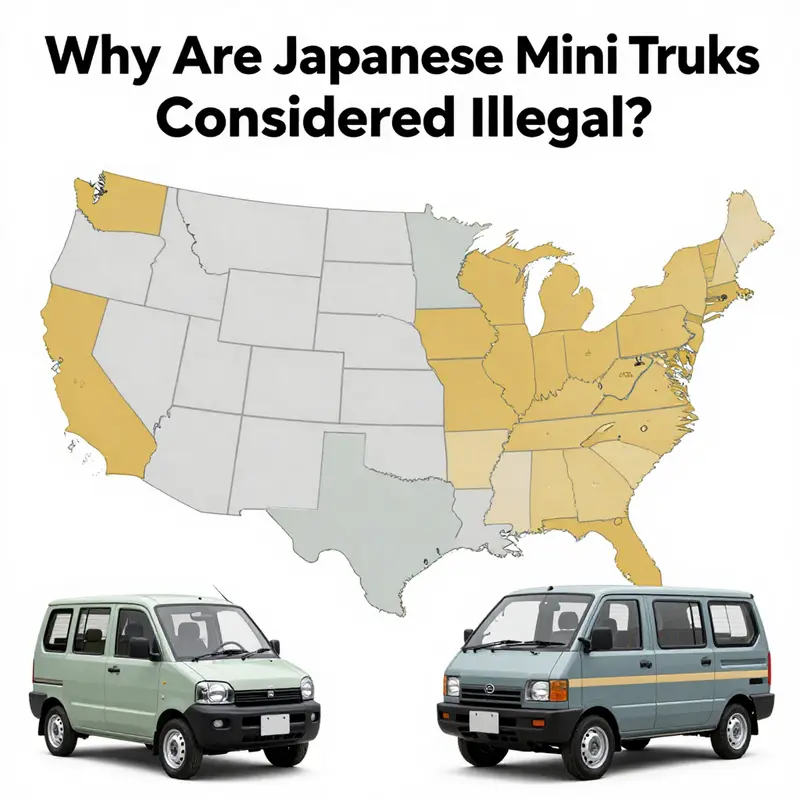
When people first encounter the idea of Japanese mini trucks crossing oceans to sit in a driveway or zip along suburban streets, the question often lands with a blunt verdict: these vehicles are illegal in America. Yet the reality is more intricate and far less binary. There is no universal federal ban that blankets the country. Instead, a mosaic of state regulations, old classifications, and safety-and-emissions hurdles creates a legal quagmire that makes many of these imports effectively unregistrable for public-road use. What begins as a curiosity about a compact, fuel-efficient workhorse quickly reveals the friction between a nation with a long safety and testing regime and a market that prized small, nimble urban mobility in another corner of the world. The result is a phenomenon that looks like illegality from a distance but, on closer inspection, is better described as a patchwork of regulatory gaps, where different jurisdictions treat the same vehicle as if it belonged to entirely different worlds.
At the heart of this tapestry sits a fundamental distinction: the federal system in the United States does set baseline safety and emissions expectations for vehicles sold domestically. But there is a carved-out accommodation that can shield older vehicles from those modern requirements. Vehicles that are over 25 years old—counted by the calendar year and not by the moment of import—can escape the hurdle of meeting current federal safety and emissions standards. This 25-year exemption, a feature of the US approach to imported vehicles, is often cited as a doorway for classic or vintage models to be legally driven on American roads. However, the door is not a one-way pass for every vehicle that crosses the Atlantic. States retain significant authority to interpret, regulate, and sometimes restrict what can be registered, insured, and operated within their borders. In practical terms, the federal exemption shifts compliance questions from the national government to the states, where a series of ambiguous definitions and local enforcement practices can still bar a vehicle from the road.
This tension is not abstract. It turns on a handful of core ambiguities that repeatedly surface when a gray-market kei-style truck seeks to join America’s highway system. First, many states rely on their own definitions of what constitutes a “motor vehicle” or what is considered a vehicle that is suitable for on-road use. When a vehicle arrives from abroad in a form that did not originate in the U.S. market, its paperwork can fail to align with the domestic definitions that govern registration. The resulting mismatch opens a regulatory corridor ripe for misinterpretation. If a vehicle is categorized, rightly or wrongly, as an off-road or utility vehicle, states may apply a distinct set of rules—or refuse registration outright. In this framework, a once-typical highway vehicle in another country can become an unregistrable object under American law, not because it fails some universal safety hurdle, but because it sits in a legal limbo created by language, intent, and administrative practice.
The history of this situation in some states is a case study in how legislative text can outpace real-world mobility. A notable instance often cited in discussions about gray-market imports involves language that explicitly or implicitly targets certain classes of vehicles—such as so-called gray-market off-road mini-trucks—by defining terms in ways that exclude them from standard registration pathways. Advocates arguing for a more inclusive approach point to the fact that these tiny trucks were designed to operate at speeds compatible with regular roads in their home market, with a wheelbase and power-to-weight ratio that enable safe highway travel under Japan’s urban and rural road regimes. The counterpoint emphasizes the safety architecture of modern roadways and the risk calculus that states apply when granting road-use permissions to any non-domestic vehicle. The result is not a clean, binary choice between legal and illegal; it is a spectrum in which ownership can be legal on paper but impossible to translate into actual road-use without a carefully navigated lane of compliance that may not exist in every state.
To illustrate the layered complexity, one can look at how the federal framework and state codes interact with the concept of “gray-market” imports. These are vehicles that did not go through official channels for the U.S. market and, therefore, do not carry the same certification or conformity documentation as domestically marketed models. The gray-market problem compounds the issue of registration because it relies on documentary routes that can be tenuous or insufficient for standard DMV procedures. When a vehicle lacks the official certification that U.S. regulators typically expect, a state can treat it as noncompliant by default, regardless of the vehicle’s age or its potential suitability for public roads. The practical effect for an owner is dissonance: a car or truck you can legally own in one country may not be able to be registered in another, even when it would adhere to the same basic driving requirements in everyday operation.
Beyond the federal exemption and the gray market narrative, another layer of regulatory action centers on how these vehicles are classified at the state level. A key argument advanced by owners’ advocates hinges on misclassification—these compact trucks were designed and intended for regular highway use in their home market, not strictly as off-road or utility vehicles. If a vehicle can reach highway speeds and carry payloads on public roads in Japan, why should it be treated as if it has no legitimate place on American roads simply because the domestic regulatory program didn’t anticipate its arrival? The practical challenge, of course, is that even if a vehicle is physically capable of safe highway operation, the safety standards and testing procedures the U.S. requires may diverge significantly from those Japan imposes, or from the interpretations of state regulators who must reconcile imported vehicles with local road-safety expectations.
A feature that frequently enters the conversation is the concept of the “gray market” itself. Importers have historically used gray-market channels to bring in vehicles that could pose a unique compliance challenge for U.S. authorities. Because these vehicles were not officially certified for sale in the United States, they often lack the conformity paperwork, crash-test results, and other documentation that American regulators require to ensure that a vehicle, once registered, meets current safety and environmental standards. The absence of these formal assurances makes the registration process more vulnerable to state-by-state interpretation and enforcement discretion. The upshot is that the same vehicle could be treated as a legal, road-usable asset in one state, and an outright registration barrier in another. This patchwork is not just a curiosity; it translates into real consequences for owners, including the revocation of licenses, insurance hurdles, and even small-scale legal action in some cases where owners claim unfair treatment or discriminatory application of the rules.
To understand why this topic lives at the center of the debate, it helps to step into the regulatory framework that governs the Japanese kei truck category itself. Kei trucks, as they are known in Japan, are governed by the Road Vehicle Act and related administrative ordinances under the supervision of the Ministry of Land, Infrastructure, Transport and Tourism. They are compact by design because the regulatory limits in Japan are strict: engine displacement capped at 660 cubic centimeters, length not exceeding 3.4 meters, width restricted to 1.48 meters, and height not to exceed 2.0 meters. These specifications are not cosmetic; they are the core of a system aimed at preserving urban efficiency and minimizing congestion while keeping safety within a predictable envelope. When a vehicle from that system makes its way across the Pacific, it arrives with those same dimensions, the same displacement, and the same particularities that made it well-suited for Japanese streets. The disconnect occurs when a U.S. regulator, operating under different safety philosophies and testing regimes, must evaluate whether those exact specifications can be reconciled with American road-use expectations. The challenge is not merely about whether the engine is undersized relative to U.S. expectations; it is about whether other regulatory elements—crashworthiness, occupant protection, structure, lighting, emissions control—align with federal and state standards. In practice, compliance maintenance in the home country helps keep the vehicle within its regulatory lane, but maintaining this alignment once in the United States often requires bridging gaps that the original design did not anticipate.
Within Japan, compliance is a living process. Kei trucks must pass periodic inspections, and owners must maintain the vehicle so that it remains within the approved specifications. These inspections, historically called Shin Kenshū, occur at defined intervals and verify both the mechanical condition and the dimensional integrity of the vehicle. The system emphasizes consistency: dimensions and mechanical condition must be within limits at inspection time. When a vehicle diverges from its approved configuration—whether by modifying the body, increasing displacement, or altering fundamental safety components—compliance can be lost, and with it the right to operate on public roads. The penalties are tangible: fines, vehicle impoundment, or denial of license renewal. The Japanese regulatory approach underscores how seriously the system treats even small deviations from the original specifications, reflecting a broader orientation toward predictable road safety and environmental performance.
The evolving regulatory landscape around kei trucks also hints at how technology is nudging the conversation forward. Modern models, where they exist in Japan, have begun to incorporate safety innovations such as electronic stability control and automated braking features. While not yet universal or mandatory, these features illustrate how the regulatory framework in Japan is gradually accommodating new safety technologies without compromising the core dimensional and displacement limits that define kei trucks. For someone operating or studying these vehicles, it becomes clear that the U.S. challenge is not simply about finding a model that matches a threshold; it is about understanding how American safety philosophies and state-specific interpretations can converge or diverge from those Japanese standards, and how this convergence—or lack thereof—shapes the road-legal status of imported kei trucks.
The practical takeaway for would-be owners, scholars, or policymakers is that legality in the United States hinges as much on the nuance of state law as on federal exemptions. Some states have enacted laws that explicitly block registration for certain categories of gray-market vehicles or have created definitions that exclude these imports from the standard pathways that would lead to on-road use. This is not a banner that says, in a blanket sense, “illegal.” It is a banner that signals caution, a reminder that the road-right status of a foreign-built, compact pickup depends on the particular text of a state’s vehicle code, the interpretation of that text by local regulators, and the willingness of owners to navigate an often opaque enforcement environment. Those who advocate for broader access emphasize the pair of levers that could unlock mobility: aligning state definitions to international practice or, at minimum, creating a recognized compliance pathway that can bridge the gap between a vehicle’s original design and a state’s safety expectations.
In this context, the community perspective matters. Enthusiasts and small-business operators who rely on compact transport for dense urban logistics have built a body of knowledge about how these vehicles are treated across states. They stress that the issue is not a uniform rejection of Japanese technology or a critique of their engineering; it is a governance problem rooted in the friction between cross-border trade, evolving safety regimes, and the inertia of long-standing domestic vehicle classifications. The dialogue often moves beyond rigid legal categories and toward pragmatic questions: Can a vehicle built to navigate narrow Japanese streets be made to meet U.S. highway safety expectations without destroying one of its most attractive virtues—its compact size and fuel efficiency? What are the costs, the paperwork, and the time required to attempt a compliant registration process in a given state? How do insurers view coverage for such imports if the vehicle’s on-road eligibility is contested in court or before a DMV board? The answers to these inquiries vary widely and depend on the precise jurisdiction, the vehicle’s age, and the willingness of owners and regulators to engage in a rational, evidence-based discussion about risk, safety, and mobility.
For readers seeking a broader sense of the community’s take and ongoing discussions, a good place to start is the Mini Truck Socala blog. It compiles reflections from owners who have navigated registration, inspection, and ownership amid this intricate regulatory landscape. Mini Truck Socala blog offers a sense of how people frame the problem—balancing practical utility with concerns about safety, legality, and the long-term viability of gray-market imports in the American regulatory environment.
The chapter that follows this discussion cannot pretend to resolve every jurisdictional nuance in a single sweep. Instead, it offers a map of the terrain—how federal exemptions, state definitions, and the Japanese kei-truck regulatory framework intersect to create a situation where legality is highly contingent rather than universal. The core message is simple in form but complex in practice: the legality of Japanese mini trucks in the United States is less about a straightforward prohibition and more about a constellation of rules that must be navigated to turn a foreign concept of urban transport into a legally compliant American vehicle. As the regulatory landscape continues to evolve—with new technologies, new interpretations, and new incentives for urban efficiency—the discussion will undoubtedly shift. The intersection of global vehicle design, local road safety priorities, and cross-border commerce will continue to shape what is permissible, what remains precariously allowed, and what must wait until reform arrives at the state capitol or agency hearing room.
External resources and regulatory references remain essential to understanding the full picture. For authoritative information on the regulatory framework governing kei trucks in Japan, the official authority—the Ministry of Land, Infrastructure, Transport and Tourism—provides foundational context about the core specifications and compliance expectations that define kei vehicles. See the official MLIT site for current, authoritative regulations and procedures: https://www.mlit.go.jp
Roads, Rules, and the Misclassification Trap: Why Kei Trucks Face Legal Barriers
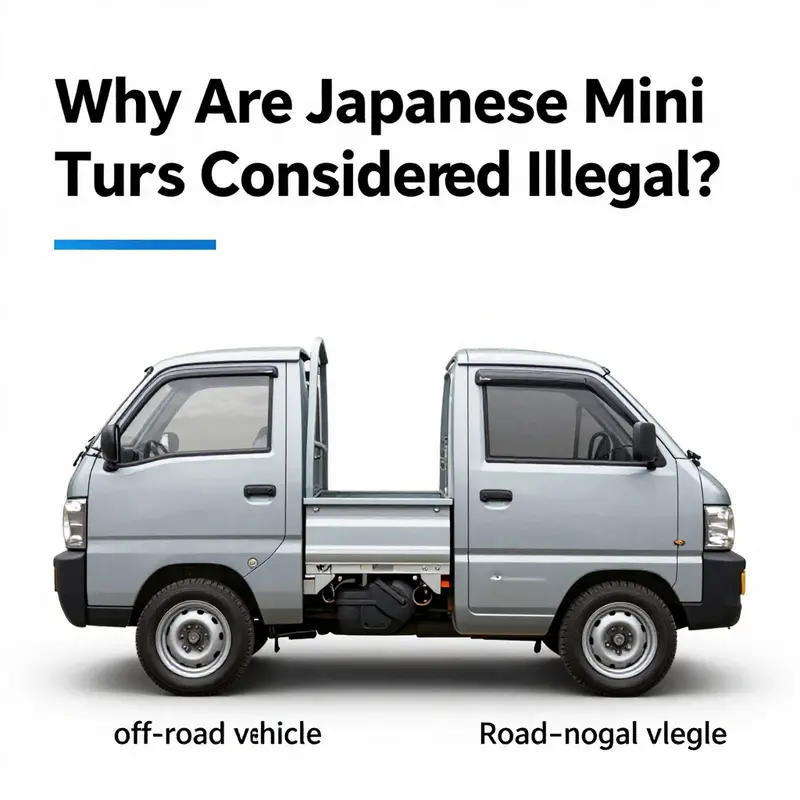
A patchwork of rules, not a single federal ban, governs whether Japanese mini trucks can travel on American roads. In the public narrative, these small, efficient trucks are often painted as relics of a distant market, easy to import yet nearly impossible to license for street use. The reality runs deeper and more complicated. The core of the challenge lies not in a uniform prohibition but in a complex web of state level definitions, outdated classifications, and safety and emissions regimes that grew up in a different era and different context. What begins as a straightforward question about legality quickly reveals a regulatory ecosystem that does not recognize the intended purpose and the actual performance of these vehicles. The result is a practical barrier that, in many states, makes road use effectively unlawful even though there is no sweeping federal prohibition. This is the misclassification trap at the heart of the debate over these kei style trucks. The federal framework is not silent on the matter. There is a widely known exemption for vehicles over a certain age, which applies to many imports from the late 20th century. As of 2026 that age threshold has moved into the mid to late 1990s, meaning vehicles from 1998 and earlier qualify for certain federal exemptions from modern safety and emissions standards. In practice, that federal leniency is not a green light for every state to register every gray market import. The federal exemption speaks to the spirit of allowing historic, classic, and often lightly used vehicles to participate in private ownership and hobbyist use without being forced into expensive conformity testing. It does not, on its own, rewrite a state motor vehicle code that was written to address a much different set of market realities and safety concerns. State departments of motor vehicles retain broad authority to define what counts as a motor vehicle and to set the roadworthiness standards that vehicles must meet to be registered and insured. Where the federal landscape provides a grace period for certain old vehicles, state lawmakers decide whether that grace period translates into road legal status in their jurisdiction. And it is here that misclassification arises with the most forceful clarity. When a state statute uses broad, evergreen language to describe the kinds of vehicles that may be registered, it creates space for interpretation, and interpretation often trends toward categorizing a vehicle as off road, or as a utility vehicle, or as some variant that is not designed for highway use. In practice, many of these kei trucks entered the United States from abroad through what is commonly described as the gray market. They arrived without the label of official certification for U S road use, and they were introduced into a legal system that is not designed to accommodate their specific design and performance profile. The gray market status matters not because gray market status itself is illegal, but because it creates a lack of official certification that makes standard registration processes in many states ambiguous or unavailable. The result is a double bind: the federal exemption protects a door into private ownership and occasional hobby use, while state level misclassification blocks or complicates the doorway to road use. In this sense, the misclassification problem is less about a universal ban than about a stubborn policy misalignment. It is about the way states define a motor vehicle, and the way they determine whether a vehicle can be used on public roads. The problem intensifies when the vehicle in question was designed for on road use in its home market but is then imported in a form that does not fit neatly into the state definitions of what constitutes a normal highway vehicle. The narrative is not simply about dimensions, or about engine displacement, or about whether the vehicle has a full set of modern airbags and crash structure. It is about the language of the law and how it interprets the function of a vehicle as a transportation device designed to operate safely in public traffic. The tension becomes visible in states that approach the issue with cautious, deliberate language, and in states that update their statutes with broader definitions that themselves can become outdated once the practical realities of highway travel in the United States are considered. In that sense misclassification is not a minor drafting error. It is a structural feature of a legal system that is simultaneously seeking to preserve safety and to honor the spirit of the 25 year exemption while also accommodating a wide range of vehicle types and usage patterns. The result is inconsistent enforcement, legal challenges, and a collection of owner experiences that feel simultaneously frustrating and hopeful. From the perspective of many owners and advocates, the core issue is that these trucks were designed and marketed for regular highway use in their home country. They were built with the capability to travel at highway speeds, to handle long distance routes, and to perform the tasks one would expect of light commercial transport. Yet in the United States, the roadworthiness and registration are measured by a framework that sometimes reads as if it were designed for larger, more conventional trucks or for entirely different classes of utility vehicles. The misclassification becomes more than just a bureaucratic quirk. It becomes a fundamental barrier to ownership, and in some cases a reason for revocation of registrations, the lack of refunds for fees paid, and the initiation of disputes over due process. The implications of this are not purely financial. They touch on the practicalities of daily life, on the ability of small business operators, hobbyists, and rural residents to access affordable, capable transport that can meet a range of tasks from short urban deliveries to agricultural or maintenance work. They also raise questions about how a legal system should adapt to older, simpler vehicles that nonetheless deliver reliable performance on the road. The tension is not simply a matter of policy or theory. It is lived in the experiences of people who have attempted to register a classic foreign vehicle, only to confront an interpretation that labels the same machine as an off road or a non highway vehicle. Advocates have highlighted the inconsistencies and the potential unfairness in the way statutes are applied. They point to the fact that other provisions in state law permit the registration of antique vehicles and the use of classic imports that meet certain age and historical criteria. The contradiction can be stark: a vehicle that clearly qualifies for antique status under age considerations may still be denied road use under definitions that equate it with a different category. In practice this often plays out in court through disputes over fees, licensing, and the right to operate on public streets. The human dimension of misclassification is rarely invisible. It is felt in garages where cars sit waiting for a solution, in small businesses that contemplate the costs of legal disputes, and in communities that debate the value of maintaining open access to older, affordable forms of transportation. For many drivers and owners, the appeal of these kei trucks lies in their compact size, their efficient use of fuel, and their suitability for crowded urban environments or narrow rural roads. They represent a practical solution in a world where urban planning increasingly emphasizes low emissions, space efficiency, and the need for versatile, small-capacity work vehicles. Yet the legal system often treats them as something else, a category that does not belong on the normal road network, a vehicle that should either be restricted to off road or placed in a narrow, antiquated category that does not reflect its functional capacity. The mismatch is not just regulatory. It reflects broader questions about how laws adapt to changing mobility needs and how they accommodate vehicles that do not fit the standard mold. The stories of individual owners—people who have invested in a vehicle that meets their needs and who want to exercise their right to use it on public roads—points toward a need for more precise, flexible language within state statutes. It points toward a system that is capable of recognizing the subtle but real differences between a vehicle that is old in age and one that is old in design, between a model that was intended for shared roads and one that was repurposed for private, off road recreational use. The path forward lies in a careful balancing act. States can preserve safety by maintaining clear requirements for registration and roadworthiness, while also recognizing that a vehicle over a certain age may be exempt from the most intrusive modern standards. They can align their definitions with the practical realities of the diverse fleet on their roads, while resisting the urge to blanket classify every gray market import as non highway. This is where the misclassification debate becomes more than a legal argument. It becomes a question of how to steward a transportation system that remains accessible, affordable, and safe for a broad cross section of users. To the extent that policy makers listen to owners and advocates, there is potential for reform. Some states have explored targeted exemptions or special plates for antique or heritage vehicles that otherwise meet functional standards. Some have established registration pathways that acknowledge the unique nature of gray market imports while imposing appropriate safety checks. These options require careful drafting, clear criteria, and robust dispute resolution processes so that misunderstandings do not escalate into repeated litigation or confiscation of vehicles and fees. The literature and the docket show that the path to resolution is not simple. It requires collaboration among legislators, regulators, legal practitioners, and the communities that rely on these vehicles. It also demands a careful, evidence-based approach to road safety, where the practical performance of these trucks on public roads is weighed against the safety expectations embedded in modern standards. In this sense misclassification becomes a catalyst for a broader conversation about how the United States regulates vehicle use in a changing mobility landscape. It invites a deeper assessment of how to harmonize federal exemptions with state realities, and how to create a more predictable, fair, and transparent process for individuals who want to participate in the gray market without compromising the integrity of the road network. The discussion is ongoing, and it is not purely academic. It has a direct impact on the lives of owners, on the costs of compliance, and on the everyday choice to pursue a specific kind of transportation that distances itself from the dominant market players. For readers who want to explore the regulatory landscape in more depth, there are resources that offer a window into how states approach these questions, including how definitions get crafted and how enforcement priorities shape the practical experiences of owners. For more on how hobbyist communities discuss these issues and share practical guidance, see minitrucksocala.com/blog/. This kind of community conversation helps illuminate the real world consequences of misclassification and offers a glimpse into the practical and legal strategies that people use to navigate the system. Ultimately the misclassification issue is not about whether a specific vehicle is legal or illegal in every state. It is about the alignment between the laws that regulate road use and the vehicles that exist in the market. When those laws lag behind or misinterpret, legitimate, roadworthy, time tested vehicles face barriers that do not reflect their function or their impact on safety. The challenge is to craft a governance approach that respects safety standards, values the practical capabilities of older vehicles, and preserves access to affordable, capable transportation. The road ahead will require both careful legislative design and a willingness to adapt to new information and new mobility patterns. It will require dialogue among regulators, legal scholars, and the communities who rely on these vehicles for work and mobility. It will require a robust, evidence based approach that weighs the real world performance of these trucks against the safety objectives that law and policy are designed to protect. In short, misclassification is less a verdict about the vehicles themselves and more a reflection of the alignment between a legal framework and the lived reality of road use. The more accurately a state defines what constitutes a highway vehicle and the more precisely it targets genuine non highway vehicles, the more fair and predictable the system will become for owners and for the public. The current moment is an invitation to rethink and to refine. A state that can acknowledge the practical highway readiness of these trucks, while still maintaining necessary safety protections, could offer a pathway toward lawful road use that respects both the federal aging exemption and the legitimate regulatory aims of the state. It is not a call to abandon safety or to dilute standards. It is a call to apply them with clarity, consistency, and a more nuanced understanding of how different kinds of vehicles function in real world traffic. For now, the misclassification trap remains a real obstacle that many confront. It is the product of a legal imagination that has not kept pace with the way people move in communities that span urban cores and rural lanes. Yet it is also a challenge that can be addressed with thoughtful policy design, precise statutory language, and a constructive approach to interstate and intrastate regulation. The outcome may be a more accessible and more appropriately regulated fleet of small, efficient vehicles that can contribute to affordable mobility while maintaining the safety standards that all road users deserve. As readers consider following the thread into the next chapter, the central takeaway remains: the legality challenge is not a simple prohibition, but a nuanced, evolving conversation about how to fit a diverse world of vehicles into a single, sometimes inflexible legal framework. The chapter thus moves forward by examining how different jurisdictions respond to these questions and how owners can engage in the process with clarity, patience, and a shared commitment to safe and lawful road use. The story, in other words, continues to unfold in real time, with every new statute, hearing, or court decision shaping the lived experience of the people at the heart of this issue. For further context and practical insight into the regulatory landscape, consult state level resources and engage with the broader community of enthusiasts and experts who keep the dialogue grounded in experience and safety. External reference for deeper regulatory context can be found at the state source linked here. https://www.michigan.gov/opa/0,1607,14032–13768–,00.html
Final thoughts
Navigating the legalities surrounding Japanese mini trucks can feel like maneuvering through a maze. From federal compliance issues to state-specific regulations and misclassifications, these factors create a complex landscape for owners and enthusiasts alike. However, with understanding and advocacy, there is potential for change. By staying informed and engaged with local regulations, you can take proactive steps toward enjoying these unique vehicles legally.