
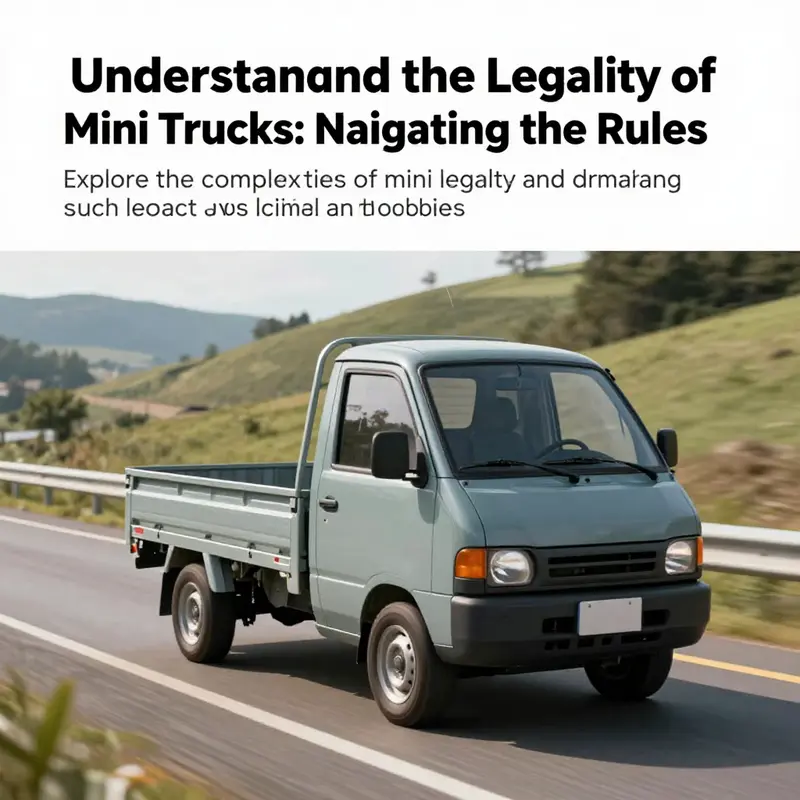
Mini trucks, especially the charming Japanese kei trucks, often face legal scrutiny in various regions. Their legality isn’t black and white; it hinges on a mix of safety regulations, modifications, and local laws. For local small business owners, property owners, and mini truck enthusiasts, understanding the nuances of mini truck legality is crucial. In the following chapters, we will delve into safety compliance issues that impact legality, the role of illegal modifications, the grey areas surrounding registration, and lastly, the implications of local laws and regulations—all essential pieces to the puzzle for anyone passionate about or involved with mini trucks.
Between Road Worthiness and Red Tape: How Safety Standards Decide the Legality of Mini Trucks
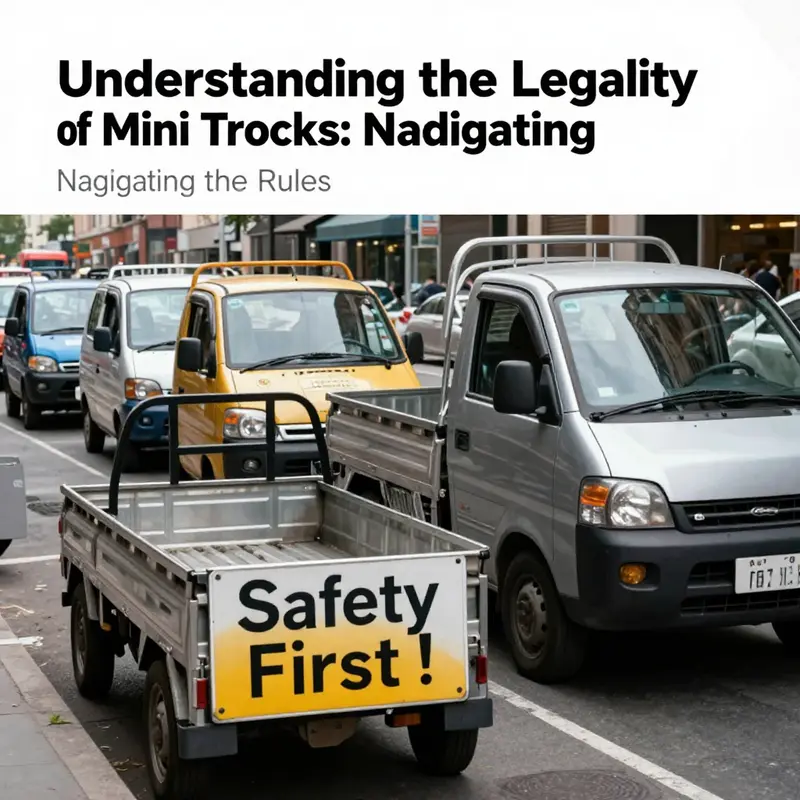
Many readers arrive at discussions of mini trucks with a preconception: they are simply illegal in some places and perfectly acceptable in others. The reality is subtler. Mini trucks are not universally illegal, but their legality is almost always conditioned by safety and regulatory compliance. They sit at the intersection of vehicle classification, crash standards, emissions requirements, and the bureaucratic realities of road use. The same little truck that can squeak through a narrow alley and haul a surprising load can also trigger a web of rules that might prevent it from sharing the same lane as a conventional sedan. The core issue, then, is not merely the size of the vehicle, but how well it fits into the safety and regulatory framework that governs roadworthy vehicles. When a jurisdiction cannot neatly categorize a tiny imported truck, or when a design relies on older specifications that do not align with contemporary standards, the result is a landscape of permits, exemptions, gray areas, and, in some cases, outright prohibitions. The conversation about legality begins with a fundamental question: what does the law require of a vehicle that is designed to operate on public roads, and how does a miniature utility vehicle measure up to those expectations?
In the United States, the tension is especially visible between federal standards and state implementations. The federal government, through agencies like the National Highway Traffic Safety Administration, sets broad safety and emissions expectations for light-duty vehicles. Some of these expectations reflect crashworthiness, occupant protection, and structural integrity that are designed with a certain class of vehicles in mind—the conventional cars and light trucks that dominate the roadways. Mini trucks, especially older or imported models, can struggle to meet these standards in a direct, apples-to-apples sense. The possibility of a vehicle not conforming to federal safety designs can complicate its ability to be registered for road use. Yet federal policy also recognizes a practical exception: vehicles that are older than a certain age may fall outside evolving standards and can be exempt from some newer requirements. The 25-year threshold often cited in discussions about gray-market imports is a focal point of debate, because it creates a moving line between what is considered legacy design and what is deemed current technology. Still, even when a vintage vehicle clears federal scrutiny by age, state regulators frequently apply their own rules, and these rules can diverge significantly from neighboring states. This divergence is precisely what Maine-sized regulatory questions look like when a state, company, or individual tries to bridge the gap between a classic, road-legal persona in Japan and the legal realities of U.S. roadways. Michigan, in particular, has emerged in public discourse as a case study for the friction between opinion on road-worthiness and the mechanics of registration. Critics argue that the state’s stance on certain gray-market, non-highway vehicles veers into overreach, arguing that these trucks were engineered for road use and capable of highway speeds in their original context. Proponents of broader registrability emphasize the practical needs of users who rely on compact utility vehicles for work and mobility. The debates in Michigan—and similar debates in other states—illustrate a broader truth: legality can hinge on how a vehicle is categorized, not solely on its physical dimensions or its speedometer reading.
Beyond the United States, similar dynamics appear in other regulatory ecosystems, where the definition of the right vehicle for the road becomes the center of the conversation. The Philippines offers a striking, if unsettling, reminder that legality often sits alongside the consequences of how a vehicle is used. A tragic crash in the Sulu-Kudarat province highlighted how a mini dump truck, originally a cargo vehicle, was illegally modified to carry passengers—21 people. The danger did not lie in the design of the vehicle as a cargo carrier per se, but in the decision to repurpose it without adhering to safety protocols, including appropriate seating arrangements, restraints, and structural reinforcement for carrying passengers. When a vehicle is modified in ways that conflict with its original safety design, and when overloading compounds the risk, the outcome can be catastrophic. The incident underscores a broader principle: legality is often contingent on both the act of use and the integrity of the modification. A vehicle may be perfectly legal within a jurisdiction’s registration framework, yet once misused or inappropriately modified, it can become illegal in practice through enforcement or through a regulator’s safety assessment. In such contexts, the distinction between a vehicle’s inherent legality and its practical safety on the road becomes blurred, and lawmakers must step in with clear guidelines to prevent a repeat of such tragedies.
The problem of legal status is not solely a matter of whether a vehicle meets a checklist of safety features. It also involves how a vehicle is classified within a country’s regulatory architecture. Some jurisdictions lack a precise category for small imported vehicles that straddle conventional car, truck, and van classifications. If a vehicle does not neatly fit existing categories, authorities may be reluctant to register it, effectively rendering it illegal on public roads even though it was originally designed for highway use in another country. This kind of regulatory ambiguity feeds a real-world hesitation among buyers and fleet operators. When the rules do not offer a clear path to compliance, people may prefer to avoid the risk and pursue more conventional, easily registered vehicles. Those who still pursue mini trucks must navigate a patchwork of local ordinances—dimensional constraints, weight limits, engine displacements, or even absolute bans on certain classes of vehicles in particular zones. Local governments can impose additional restrictions in the name of rights-of-way management, environmental concerns, or noise and emissions policies. In some urban areas, a vehicle’s size does not guarantee access to all roads or access to certain zones; rather, it becomes another factor in the calculus that seems to privilege larger, standard-format vehicles that already have established, codified routes to legitimacy.
The regulatory landscape is further complicated by the evolving emphasis on safety and environmental standards. The UNECE regulations and the EU type-approval regime anchor a rigorous approach to homologation, emphasizing crash tests, emissions compliance, and overall conformity to established technical standards. For mini trucks manufactured outside the EU and imported into member states, the bar can be unforgiving. The process of passing UNECE-type approvals is designed to ensure that every component—from crashworthiness to emissions—meets objective criteria. Vehicles that fail to satisfy these tests face non-registration and an inoperability on public roads within the European bloc. The consequence is not merely a bureaucratic delay; it is a systemic barrier that prevents potentially useful, small, economical vehicles from entering the market or from being used in daily operations. The broader picture reveals a tension between the benefits of small, efficient transportation and the safety-oriented culture that emphasizes standardized testing and regulatory certainty. In this environment, the question becomes how to reconcile innovation and local needs with the universal imperative to keep roads safe for all users.
Emerging regulatory trends add another layer of complexity. As governments accelerate toward electrification, the emphasis on emissions and energy efficiency shifts the calculus for all vehicles, including mini trucks. Some regions may pursue adapted standards for lightweight electric variants, while others may insist on full compliance with current emissions regimes for any new or re-registered vehicle. This dynamic keeps the question of legality in motion; what is legal today may require an update tomorrow as policy priorities shift. Manufacturers and consumers alike must stay informed about these changes, because a vehicle that is permitted today may face disqualification or additional compliance requirements in the near future. The practical effect is a need for ongoing diligence: review local rules before purchase, and maintain awareness about how changes in environmental policy can ripple through the road-legal status of small utility vehicles.
In practice, the line between legality and illegality often comes down to responsible use and adherence to established safety norms. A mini truck that remains within payload limits, maintains proper restraint systems for passenger transport when allowed, and avoids modifications that introduce structural or safety risks can operate on public roads where the regulatory framework supports such use. Conversely, the same vehicle that is overloaded, altered to bypass safety features, or registered under dubious classifications enters a regulatory zone where enforcement action becomes more likely. The essential takeaway for readers is that the challenge is not simply about whether a certain truck is “mini” or “lightweight.” It is about whether the vehicle, in its current configuration and in its intended role, aligns with the safety expectations and registration pathways that exist in a given jurisdiction. This alignment is what ultimately determines legality in practice, even when the vehicle’s physical size would seem to invite a simpler path to road use.
To connect these threads to the lived experiences of people who rely on small, efficient vehicles for work and daily mobility, consider how one might navigate this landscape with a careful approach to compliance, rather than a blanket need to “get around the system.” The process often begins with a clear understanding of classification and testing requirements, followed by a rigorous assessment of modifications, loads, and intended usage. It also requires engagement with regulatory authorities to obtain the appropriate permissions, permits, or exemptions. In some cases, communities have found that a collaborative approach—where regulators and users jointly assess risk, gather data on real-world use, and establish agreed-upon best practices—can reduce uncertainty and create a path to legitimate operation. Such approaches underscore a central message for readers: safety-first, compliance-forward thinking is essential when dealing with tiny, highly capable vehicles that nonetheless sit in a legal gray zone. And for those who are eager to learn how these issues play out in different locales, a deeper dive into specific regulatory frameworks, case studies, and evolving standards can shed light on why the legality of mini trucks is not a simple yes-or-no proposition, but a nuanced decision shaped by safety priorities, bureaucratic structures, and the practical needs of users.
For readers who want to explore further how these rules play out in real life and how communities address the practical realities of small-truck utility, a look at broader discussions around small-scale mobility and vehicle classification can be illuminating. Minis on the Minitrucks Cola blog offers perspectives from enthusiasts and operators who grapple with registration, modifications, and the everyday choices that influence compliance. This resource provides context on how people approach legal pathways, how they weigh risks, and how they adapt to regulatory environments without sacrificing the utility that these vehicles deliver. It is a useful companion piece for anyone who wants to understand the human side of this regulatory puzzle while keeping a clear eye on safety and the law. Minis on the Minitrucks Cola blog
The landscape will continue to evolve as policymakers balance the advantages of small, efficient mobility with the fundamental demand for road safety. The regulatory dialogue is not a static negotiation but a dynamic process in which safety standards, local ordinances, and cross-border import rules interact with the lived realities of drivers and fleets. As researchers and policymakers refine classification schemes and update homologation practices, the prospects for legally operating mini trucks become less about a singular rule and more about a coherent framework that recognizes a vehicle’s intended use, its safety profile, and its capacity to meet established performance standards. This is why the conversation about whether mini trucks are illegal is not a simple accusation or defense; it is a continuous discussion about how best to harmonize innovation with safety, how to translate international designs into domestically acceptable road equipment, and how to ensure that a vehicle that can perform meaningful work does so without compromising the safety of others on the road. The challenge—and the opportunity—lies in building a regulatory environment that respects the utility of small trucks while upholding the shared responsibilities that come with driving on public roads. With thoughtful policy design, informed owners, and transparent enforcement, communities can keep roads safe and accessible for a broader range of efficient, capable vehicles that serve the needs of modern economies without sacrificing the essential protections that road users rely on every day. External resource: https://www.nhtsa.gov
On the Edge of Compliance: Illegal Modifications, Overloading, and the Legality of Mini Trucks
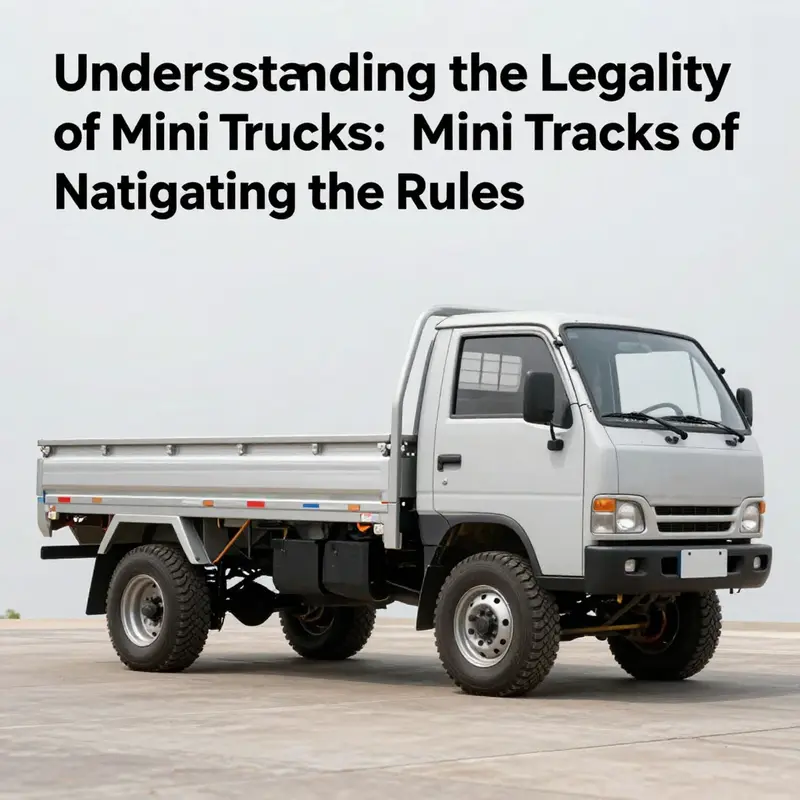
The visibility of mini trucks on roads around the world often invites a quick assumption: they are illegal or inherently unlawful. That conclusion is tempting because headlines frequently tie these compact vehicles to accidents, to unregistered imports, or to reckless modifications. Yet the reality runs deeper and more nuanced. In many places, mini trucks are not banned outright; they merely fall into a regulatory net that some jurisdictions find too narrow to accommodate them cleanly. The result is a patchwork of rules, tests, and classifications that can make a road-legal future for a small, capable vehicle feel fragile, almost provisional. The heart of the issue is not the trucks’ size but the way safety, emissions, and use are defined and enforced in each jurisdiction. When a vehicle can meet a roadworthiness standard, it stands a chance of legal operation; when it cannot, or when the standard is unclear, the doors to the public roadway swing shut for that particular build or model. This is why the conversation around mini trucks often centers on regulatory compliance, the integrity of modifications, and the administrative pathways to registration rather than on the mere physics of a compact chassis.
One primary thread binding the disparate rules across countries and states is safety and regulatory compliance. In jurisdictions like the United States, the federal framework codifies a general pathway: older imported vehicles, typically those exceeding a 25-year threshold, can be exempt from certain safety and emissions standards that would otherwise apply. This exemption is a doorway, not a guarantee. States retain the right to impose additional requirements, and many have chosen to scrutinize these vehicles more closely than others. Take the state-level debates that occasionally surface in places like Michigan, where authorities have argued that certain gray market or non-highway vehicles do not neatly fit existing categories. The underlying tension is straightforward. These mini trucks were designed for road use in their country of origin and can reach highway speeds in many cases. Yet the question becomes whether they are properly classified as off-road, non-highway, or something else entirely, and whether they can be registered for public road use without undermining safety standards. The result is a liminal status: not illegal everywhere, but potentially unlawful in specific contexts where the framework cannot accommodate them without revision.
The regulatory gap is not merely a bureaucratic snag; it translates into real-world risk when vehicles drift through the gray zone without a clear roadworthiness determination. In some regions, the absence of a clear pathway to registration means a legally imported vehicle sits in a legal limbo, effectively illegal to operate because authorities cannot grant a matching title or plate. A key observer here is that the problem is not the truck’s footprint, but the match (or mismatch) between the truck’s design and the jurisdiction’s safety, crashworthiness, and inspection criteria. When a vehicle cannot be demonstrated to meet local expectations for crash protection, braking, lighting, emissions, and occupant safety, it can be designated non-compliant, even if it is functionally roadworthy in its home market. This monotone logic—compliance leads to legitimacy, non-compliance to deterrence—frames how the public understands mini trucks and why many observers insist the issue is regulatory, not fundamental to the vehicle’s size.
A second thread in this tapestry concerns how mini trucks are often modified or repurposed in ways that push them beyond what authorities deem safe. Overloading is a pervasive and dangerous practice that has recurred in multiple contexts, from overloaded cargo trucks that morph into passenger carriers to the more subtle tweaks that push the vehicle beyond its intended engineering envelope. The case in the Philippines, though not a direct indictment of the vehicle category itself, illustrates a stark principle: when basic safety norms are ignored—overloading, illegal modifications, and maintenance neglect—the result can be catastrophic. A mini dump truck that is legally a cargo vehicle if used as designed becomes a hazard when it is converted into a passenger transporter for a crowd, especially in challenging road conditions. The danger multiplies when the vehicle’s structural integrity is not recalibrated to handle the added load, or when safety features such as seat belts, proper seating, and exits are not scaled to the actual occupancy. The tragic incident underscores a simple truth embedded in the broader debate: regulation is not about stopping innovation; it is about aligning innovation with a proven safety framework that protects occupants and other road users alike.
Across the spectrum of jurisdictions, the methods by which a mini truck can become illegal are often more about modifications and conditions than about the base platform itself. Excessive height, for instance, is a modifier that can turn a compact utility vehicle into a rolling hazard. A taller stance can alter the dynamics of a collision, increasing the probability that a larger vehicle will overwhelm the crash protection designed for a smaller counterpart. In the event of a crash, an inappropriately tall vehicle can intrude into the passenger cell of a smaller car, potentially bypassing critical safety features like seatbelts and airbags. The safety calculus shifts when aftermarket suspensions, altered springs, or non-standard tires are introduced without corresponding reevaluations of handling, stability, and braking. These modifications do not simply change aesthetics; they reweight the risk profile in ways that regulators are trained to interpret, and many jurisdictions treat such alterations as grounds for non-compliance or outright illegality if they undermine safety or violate weight and dimension limits established to preserve road safety.
The failure to register or license a vehicle properly adds another layer of complexity. When a small, imported, or modified vehicle does not fit neatly into conventional categories—car, truck, van—authorities may refuse registration because the existing classifications do not capture the vehicle’s true purpose or configuration. The absence of a clear path to lawful use on public roads turns a technically legal import into a practical restriction; the vehicle remains usable only in private spaces or under begrudging, informal permissions. This lack of a clear regulatory niche is not merely an administrative obstacle. It creates a disincentive for owners to pursue legitimate pathways to road use, encouraging a culture of workarounds rather than compliance. And where workarounds exist, enforcement agencies gain a pretext to crack down, citing non-compliance with standards designed to regulate more conventional vehicles.
In the midst of these regulatory pressures, there is a growing need for a more precise articulation of what roadworthiness means for small, imported, and modified vehicles. The rhetoric surrounding safety is not about shrinking consumer choice; it is about ensuring that every vehicle on the road, regardless of its size, adheres to a baseline of crash protection, stability, emissions control, and occupant safety. The modern safety conversation places emphasis on crash performance and the integrity of the vehicle under typical operating conditions, not solely on the ability to accelerate or reach a top speed. Research and testing bodies have begun to illuminate how modifications can compromise these safety attributes. The Insurance Institute for Highway Safety, for example, has conducted and published targeted assessments of mini trucks, focusing on how aftermarket changes—ranging from engine tuning to suspension alterations—can erode structural performance and safety outcomes. These assessments highlight why modifications are frequently treated as regulatory liabilities, often leading to enforcement actions that classify otherwise roadworthy vehicles as non-compliant when they fail to meet established standards.
The IIHS findings sit at the core of why many jurisdictions treat illegal modifications as a primary driver of illegality for mini trucks. When a vehicle’s safety performance is tested, alterations can disrupt crumple zones, degrade restraint system function, or increase the risk of rollover. The practical upshot is that a vehicle may pass the basic mechanical checks in some circumstances but fail to meet the more nuanced demands of real-world crashes. The resulting policy implication is clear: safety standards must be applied consistently to all road-using vehicles, including those that fall below typical size categories. The IIHS analysis reinforces the message that modifications are not mere accessories; they are potential modifiers of risk that regulators cannot ignore. For readers who want to examine these issues through a rigorous data lens, the IIHS site offers detailed ratings and analyses focused on mini trucks, demonstrating how real-world performance is shaped by engineering choices and regulatory oversight. See the authoritative measurements and discussions at the IIHS mini trucks ratings page for further context and nuance.
Beyond the technical and regulatory layers, the legality question for mini trucks cannot be fully understood without recognizing how public perception and administrative practice interact. Where communities see a tiny vehicle, they often anticipate the same operating standard as larger vehicles. When reality diverges due to a lack of a clear registration pathway or due to the risk-laden consequences of modifications, the result is a regulatory friction that feeds into cultural attitudes about safety and legality. In such environments, the line between permissible customization and unlawful alteration becomes blurred, inviting misinterpretation by owners and sometimes even by officials who are tasked with enforcement. The way forward, in many places, lies in creating well-defined categories that acknowledge the existence and purpose of compact imports while preserving the core safety protections that road users rely on. It is a balancing act—one that seeks to retain the freedom to innovate and adapt small vehicles to different climates, economies, and roads, while upholding a shared standard of safety that keeps all travelers secure.
For readers seeking a direct route to broader discussions that balance enthusiast interests with regulatory realities, the mini trucks community maintains a robust online space that aggregates practical insights, legal interpretations, and experiential knowledge. See the community blog for ongoing conversations about the practicalities of owning, modifying, and operating small imports in various jurisdictions. You can find the central hub at the mini trucks blog, which offers a wide range of perspectives that complement the policy-focused material discussed here: https://minitrucksocala.com/blog/. This reference point helps connect the legal framework described above to the lived experience of owners who navigate these rules on a day-to-day basis.
In sum, mini trucks are not intrinsically illegal. Their status—whether lawful on public roads or pushed into a gray zone or outright prohibited—depends on a triad of factors: the jurisdiction’s safety and emissions standards, how the vehicle is used, and whether it has been modified in ways that compromise crashworthiness or stability. The most insistent thread in this tapestry is safety. If a vehicle can be demonstrated to meet a jurisdiction’s baseline safety expectations, it can be registered and operated with the same legitimacy as other roadworthy vehicles. If it cannot, enforcement actions often follow, sometimes rightly, sometimes contentiously, but always with safety as the central rationale. The discussion of mini trucks thus becomes a case study in how modern road safety frameworks adapt to the diversity of vehicle design, use, and origin, rather than a simple verdict on a particular chassis size.
External resource: For a rigorous, ongoing examination of safety performance and modifications in mini trucks, see the IIHS mini trucks ratings page: https://www.iihs.org/ratings/mini-trucks
Registration Grey Zones: How Rules, Classifications, and Modifications Turn Mini Trucks Illegal
Registration defines legality. For mini trucks, that short fact determines whether a vehicle is a practical, insured tool or an immobile liability. These compact cargo vehicles occupy a peculiar regulatory niche. They are small, often imported, and built for markets with different safety and emissions rules. Because of that, they frequently collide with a patchwork of laws. Where federal standards leave gaps, state agencies fill them with different answers. The result is a spectrum: fully legal and registered, restricted to private property, or effectively banned from public roads.
The heart of the matter is standards compliance. In the United States, vehicle eligibility for registration depends largely on meeting the Federal Motor Vehicle Safety Standards and federal emissions requirements. Many of the mini trucks that arrive from abroad were not certified to those standards for the U.S. market. Some trucks are exempted by age under an import rule that allows older vehicles to enter without full compliance. Still, exemption from federal certification does not automatically guarantee state registration. States interpret their own statutes and administrative codes differently, and that produces inconsistent outcomes. A vehicle one state will accept may be refused by another.
Beyond federal and state friction sits classification. Regulators often fall back on categories when the vehicle does not neatly fit an existing box. Is the vehicle a low-speed vehicle? Is it an off-road utility vehicle? Is it a commercial truck or a passenger vehicle? These labels matter because they carry separate equipment and use rules. Vehicles classified as low-speed units may be allowed only on roads with low speed limits, limited to certain lanes, or barred from highways. If a vehicle is classified as off-road or non-highway, registration for routine public use can be denied. That classification debate is not hypothetical. It has real consequences: titling agencies can refuse to issue license plates. Law enforcement can cite drivers. Insurance companies may deny coverage.
Another major source of legal trouble arises when owners modify a vehicle. Many mini trucks are popular with hobbyists, tradespeople, and small business owners because they are light, efficient, and customizable. However, changes such as engine swaps, suspension lifts, structural alterations, or conversions from cargo to passenger use can void any remaining route to compliance. Engine swaps often alter emissions profiles. Structural changes can affect crashworthiness. Converting a cargo bed into a passenger area without adding proper restraints, seating, and crash protection transforms a utility vehicle into a danger zone. Where modifications increase height or change bumper geometry, the vehicle can create a mismatched collision dynamic with conventional passenger cars. These mismatches produce significant safety risks, which regulators aim to minimize by restricting modified vehicles.
Enforcement and interpretation vary. Some states have taken permissive approaches and established pathways to register older imports or specialty units. Others have rigid rules and long-standing policies that effectively prevent registration. The result is unpredictability. A model considered roadworthy in one jurisdiction might be categorized as a gray-market vehicle and refused registration in another. These inconsistencies create financial and legal hazards for owners who assume an imported vehicle will be usable across state lines.
A practical example helps clarify the stakes. Vehicles that were originally built for foreign markets and later imported often lack U.S.-certified documentation. Without manufacturer compliance letters or homologation documentation, titling agencies have difficulty applying federal standards. In some cases, the absence of clear paperwork leads to a default denial. In others, states allow the vehicle to be registered with caveats: it must be used only on roads with low speed limits, or it must carry specific safety equipment. Those caveats may be acceptable for occasional local use but ruin the vehicle’s utility for daily commuting or interstate travel.
Commercial misuse and illegal conversions amplify the problem. Tiny cargo trucks are sometimes repurposed to carry more passengers than they were designed for. That conversion can be done without necessary reinforcements or safety gear. Overloading and illegal retrofits have contributed to tragic outcomes in several countries. These incidents underscore why regulators are cautious when they see vehicles that have been altered from their intended configurations. Jurisdictions will often refuse registration when modifications raise an obvious safety concern.
Insurance is another piece of the puzzle. Insurers base coverage on a vehicle’s legal classification and expected use. If a vehicle can not be registered or is flagged as off-road only, insurers are likely to deny coverage for on-road incidents. Even when an insurer offers a policy, premiums may be higher for a vehicle with an unclear safety profile. The prospect of being personally liable after an accident—if coverage is voided—adds a layer of practical risk that goes beyond fines and impoundment.
Administrative remedies and routes exist, but they require effort and money. For some owners, the path to registration involves reverting illegal modifications, adding certified safety features, or submitting engineering reports that demonstrate compliance. This can be costly. For others, reclassification as a farm vehicle or an implement of husbandry offers a narrow legal route in certain states. That path typically imposes operational limits, like restricting use to agricultural land or specific local roads. Where these options are unavailable, owners may choose to operate the vehicle on private property only, thereby avoiding public-road legal issues.
Because the rules are decentralized, owner due diligence is essential. Before purchasing, it is important to verify local vehicle laws and to speak with the state motor vehicle department. Even within a state, practices can shift if the agency updates guidance, changes inspection procedures, or responds to a high-profile incident. Local dealer groups, clubs, and enthusiast forums often track changes closely. As a resource, owners can consult community-focused sites and local blogs for practical experience and strategies used by others. For readers looking for local community insight and owner experiences, the MiniTrucks SoCal blog is one such resource that documents ownership, modifications, and local registration experiences: MiniTrucks SoCal blog.
Liability and civil exposure are critical to understand. If an owner drives a vehicle that law enforcement has deemed unregistered or illegal, they may face fines, impoundment, and criminal charges in severe cases. If an accident occurs, the legal consequences multiply. A court or jury may view a vehicle operating outside regulatory approvals as negligent per se. That means the owner could be held fully responsible for damages, and insurance might refuse to cover claims. In jurisdictions where death or serious injury occurs from overloaded or modified vehicles, courts and legislators often respond with stricter enforcement and new rules.
Policy debates continue. Advocates for clearer federal guidance argue that a unified baseline would reduce the current patchwork and provide predictable pathways for safely modifying and registering specialty vehicles. Opponents counter that states must retain flexibility to protect public safety based on local road conditions and traffic mixes. Until consensus emerges, owners and buyers must operate within the existing mosaic of rules.
For would-be owners, a sensible approach reduces the risk of buying a vehicle that cannot be used legally. First, check federal import rules regarding age exemptions and certification needs. Second, consult your state motor vehicle department about registration, titling, and emissions testing. Third, avoid major structural or drivetrain changes that could trigger noncompliance. Fourth, retain documentation for any modifications and obtain professional engineering certification where possible. Fifth, confirm insurance availability prior to purchase. Following those steps will minimize surprises and potential legal exposure.
The problem of mini truck legality is not a single ban or blanket prohibition. It is a network of classification questions, federal standards, state interpretations, and private modifications. Each layer influences whether a specific vehicle will be road-legal. Where the law is silent, agencies create rules. Where modifications alter safety, regulators act. Where an owner seeks to stretch a vehicle beyond its intended use, public safety concerns quickly follow. Understanding these dynamics makes the difference between owning a useful, street-legal compact utility vehicle and possessing an attractive but unusable machine.
As these small trucks grow in popularity, expect continued regulatory attention. Lawmakers and safety agencies may tighten enforcement or create clearer classification categories. Until that happens, the practical reality will remain: a mini truck’s legal status depends less on its size and more on paperwork, classification, and how it is used. For any owner, dealer, or buyer, the most reliable strategy is to treat registration as the core legal requirement. Start there, and build compliance into any plan for acquisition or modification.
For authoritative federal guidance on vehicle compliance and importation rules, consult the National Highway Traffic Safety Administration at https://www.nhtsa.gov.
On the Edge of the Road: How Local Laws Determine Whether Mini Trucks Can Wait at the Curb or Chase the Highway
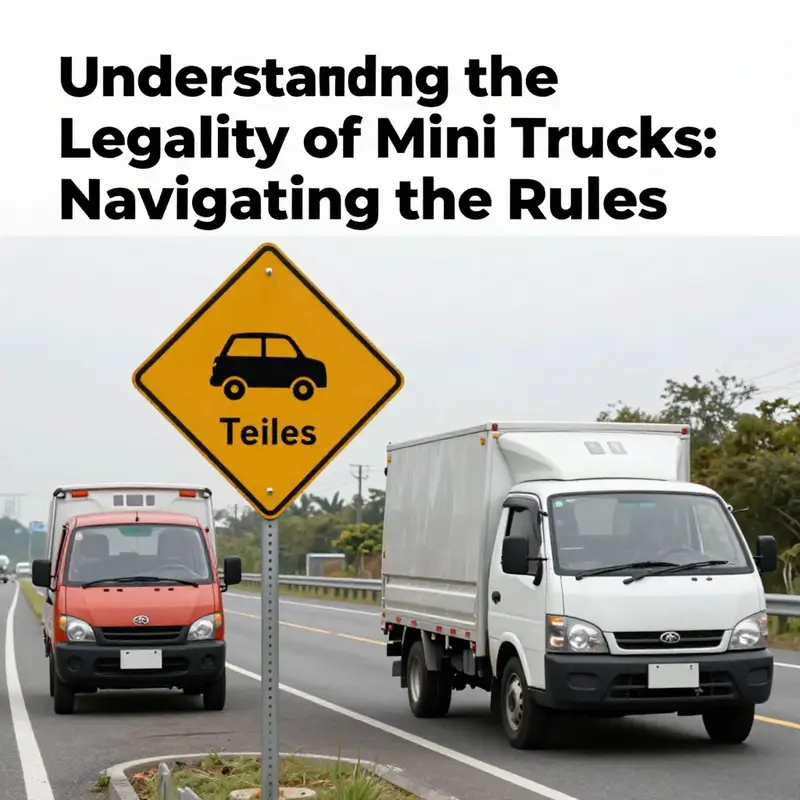
The question of whether mini trucks are illegal is less a statement about the vehicles themselves and more a reflection of the patchwork of laws that govern where, how, and for what purpose any vehicle may operate. Across countries and within many states, these compact freight machines sit at the intersection of practicality and policy. They are typically designed to carry small loads in tight spaces, navigate narrow streets, and adapt to urban and semi-rural workflows where larger trucks would be inefficient or costly. Yet when policy makers turn their attention to safety, licensing, and road use, the status of these diminutive workhorses becomes contested. The reality is not a simple yes or no; it is a nuanced grid of regulations that frames what is allowed, what is restricted, and what counts as a legitimate road vehicle at all. In explaining why mini trucks encounter legal challenges, we begin with the most common focal point of road policy: safety and regulatory compliance.
In many jurisdictions, the essential concern is not the size of the vehicle per se, but whether it conforms to the same safety and emissions expectations that apply to conventional passenger cars and larger commercial trucks. The United States illustrates this tension through a federal framework that allows certain older, imported vehicles to dodge some safety and emissions criteria by virtue of age. However, this federal latitude collides with a state-level reality: some states resist recognizing gray-market arrivals when the vehicles do not neatly fit established categories. A notable instance of this friction occurs when a state refuses to register a classic kei-style mini truck, insisting that it cannot be deemed purely off-road or non-highway, even though the vehicle was intended for road use where people live and work. The dispute is not about whether the truck can physically reach highway speeds; it centers on whether it should be considered a consumer road vehicle by the letter of state law. The result is a kind of legal limbo—an inspection, a debate, and often a protracted battle over whether the vehicle meets the precise definitions that govern what can legally be plated, insured, and operated on public streets.
Across the Pacific and into other regions, the reason for the apparent illegality of mini trucks can take a different shape. In places with stringent regulatory regimes, the problem is not always that the vehicle is unsafe by its design, but that its use contravenes the permitted scope for that vehicle class. A poignant case from a Southeast Asian context, though anchored in a broader pattern, underscores how danger arises not from the machine itself but from how it is employed. An overloaded mini dump truck, repurposed to carry passengers rather than freight, may be legal in some senses as a factory-assembled vehicle but becomes illicit when the local rules prohibit such a conversion. A tragic accident can then stigmatize the entire class of vehicles, overshadowing the fact that it was illegal modification and overloading that caused the catastrophe. This distinction matters because it points to the same core threshold in many jurisdictions: the legality of the vehicle on the road is inseparable from how it is used and what safety features are installed to support that use. When a vehicle is overloaded, lacks appropriate restraint and warning devices for passengers, or carries people in a manner not contemplated by its original design, it crosses from permissible operation into a breach of safety norms.
The second broad axis of legality concerns illegal modifications and overloading. Across the globe, the story is familiar: owners modify small trucks to gain additional height, widen wheel arches, or install aftermarket features that push the vehicle beyond the limits the manufacturer and regulator deem safe. A tall profile, in particular, changes the vehicle’s center of gravity and alters its collision dynamics in ways that can devastate occupants of smaller vehicles in a crash. Beyond height, there is the problem of overloading. When a compact chassis is pressed to haul heavier cargo than its certification allows, the risk of tire blowouts, brake failure, and structural fatigue increases sharply. The same applies if non-compliant equipment—such as window tint beyond legal limits, or tires that protrude beyond the fenders—becomes part of the daily operation. In many places, such modifications are not merely accessories; they redefine the vehicle’s classification and can render it illegal, with penalties designed to deter unsafe configurations. These realities show why many regulators treat age or origin of the vehicle as only part of the problem. A modern, well-maintained mini truck could meet stringent regulatory standards, but once it is heavy-loaded, or altered in ways that compromise stability, it becomes a safety hazard—an offense against the standards designed to protect all road users.
A third crucial axis concerns registration and licensing. A mini truck may be legally produced and imported, but if it does not cleanly fit into a conventional category—car, truck, van, or off-road utility vehicle—official registration can become a problem. The result is a gray area that prevents lawful operation on public roads. The absence of a clear registration pathway means many otherwise road-worthy vehicles fall into a legal intermediate state. This is not merely a bureaucratic inconvenience; it is a barrier to all drivers who rely on these vehicles for daily work. When a vehicle cannot be registered, it cannot be insured or legally operated on the public road network. In practice, this means that ownership or possession of a mini truck does not guarantee lawful road use. The vehicle’s legal status rests as much on the transparency and precision of the regulatory framework as on the truck’s mechanical condition.
Beyond these general frameworks, the detailed texture of regulation becomes particularly vivid when translated into localized rules. The composite picture is not uniform; it is a mosaic of national standards, regional enforcement practices, and the specific uses to which vehicles are put. The Chinese regulatory experience provides a sharply articulated example of how the system can tighten rules around light-duty cargo vehicles to prevent what regulators call large tonnage, small label practices. The concept 大吨小标 refers to registering a vehicle with a payload rating that is smaller than what its structural capabilities would allow. In practice, this discrepancy fosters safety hazards because it obscures the true load lines a vehicle can safely carry. To address this, the Ministry of Industry and Information Technology and the Ministry of Public Security issued a joint notice in January 2022 that imposes stricter production and registration controls. The aim is to strip away illegal modifications and to ensure that light-duty cargo vehicles comply with precise technical standards for weight, dimensions, and component specifications. In short, even when a mini truck looks perfectly suitable for rough terrain or noisy urban corridors, its legal status on the road hinges on the exactness of its official certification and the government’s ability to enforce that certification in daily operations.
China’s framework also differentiates how the vehicle can be used and under what conditions. Non-commercial use, for instance, is not always permissible for vehicles that the operator intends to profit from. The Road Transport Regulations clearly distinguish between private transport and commercial freight activity. If an individual uses a personal mini truck to haul goods for payment, this is treated as unlicensed commercial transportation. The penalties are stiff: fines can reach tens of thousands of yuan, and any illicit earnings may be confiscated. That dual emphasis—on use and on certification—means the status of a mini truck is inseparable from its intended function. A vehicle registered as private may be perfectly legitimate for personal errands and neighborhood deliveries, but the moment it becomes a commercial workhorse, it triggers a different regulatory pathway. The loading rules add further layers of constraint. Even when a vehicle is permitted to carry a certain amount of cargo, improper loading—such as over-height, over-width, or over-length shipments—can incur fines and require corrective action. The system is designed to prevent dangerous configurations and to ensure that the vehicle’s structural and safety systems are capable of handling the loads they are tasked with managing.
Urban areas illustrate another practical dimension of this regulatory landscape. In dense metropolises, multiple layers of control tighten the leash on what can operate where and when. For example, a foreign-registered cargo vehicle heavier than a specified threshold may need a temporary permit to access restricted zones. This demonstrates how local authorities respond to traffic density, pedestrian safety, and the need to protect critical urban arteries from disruption caused by excessive or unsafe freight movement. Such restrictions underscore a broader principle: the legal status of a mini truck is not static. It shifts with geography, time of day, and the evolving priorities of transport policy. The net effect is that the same vehicle that might be street-legal in one jurisdiction can be effectively barred in another, simply because the regulatory matrix around weight, use, and safety is differently calibrated.
All of this points to a critical takeaway: the legal status of mini trucks is not a fixed trait of the vehicle, but a dynamic outcome of how systems design, implement, and enforce rules. The core concerns that regulators aim to address—safety standards, proper use, and adherence to registration and licensing pathways—are universal. Yet the way those concerns are operationalized differs. The practical result for drivers, fleet operators, and policymakers is that there is no universal answer to whether mini trucks are illegal. There is, instead, a continually evolving conversation about whether a given vehicle on a given road complies with the precise, locally applicable standards for weight, height, ballast, and usage. This is not about suppressing a form of transport; it is about integrating a diverse family of small freight vehicles into a road network that must account for speed differentials, vehicle dynamics, and the safety of everyone sharing the pavement.
For readers seeking a concise sense of how to navigate this landscape, a practical cue lies in recognizing that legality hinges on three interlocking facets. First, the vehicle must meet a defined set of weight, dimension, braking, and lighting specifications. Second, the way the vehicle is used must stay within permitted categories—private transport versus commercial transport—and stay within licensing frameworks. Third, local enforcement authorities have the latitude to seize, restrict, or penalize non-compliant configurations or uses, often with fines and potential vehicle impoundment. Taken together, these facets illuminate why mini trucks are not uniformly illegal. They are subject to a complex regulatory regime that can declare a particular vehicle road-legal in one place and otherwise in another, depending on how closely the vehicle aligns with safety expectations and the permitted modes of operation.
To stay oriented in this shifting terrain, prospective operators should consult official notices and local enforcement guidance, since the needle of legality can move with policy updates, safety campaigns, and the emergence of new vehicle categories. For readers who want a practical touchstone and broad context for how policy discussions unfold in the real world, a visit to the Mini Trucks Blog can offer accessible summaries, case studies, and community discussions that illuminate how people respond to these regulatory realities. For a broader sense of the regulatory architecture discussed here, see the official government notice and policy resources that guide how light-duty cargo vehicles are treated in practice. As the policy environment continues to evolve, the central lesson remains constant: the legality of mini trucks derives from careful alignment of design, use, and governance, rather than from the intrinsic properties of the machines themselves. They can be perfectly lawful work partners when they comply with the letter and spirit of the law; they become illegal when those agreements break down, either through modifications that push a vehicle beyond its certified capabilities, or through uses that fall outside the permitted scope of operation.
For readers seeking one practical, integrated source on the topic, the Mini Trucks Blog provides a broad overview that can help bridge the gap between mechanical feasibility and regulatory feasibility. See the blog here: https://minitrucksocala.com/blog/. The chapter’s broader argument should now feel clearer: the legality of mini trucks is a function of local law, not of size. It is a reminder that safety standards, proper classification, and legitimate use are the central anchors of road policy, guiding which small workhorses can legally share the road and under what conditions. Where these anchors are clear and enforced, mini trucks can operate with the same responsibility expected of any road vehicle. Where they are not, the result is a regulatory gray area that appears, to the uninitiated, as if the trucks themselves are illegal, even though the underlying issue is a misalignment with local standards and enforcement practices.
External resource: For the official regulatory framework that shapes these outcomes in a national context, see the government notice detailing stricter production and registration controls for light-duty cargo vehicles and the related prohibitions on certain commercial uses at https://www.gov.cn/zhengce/zhengceku/2022-01/14/content_5669738.htm.
Final thoughts
Navigating the complex landscape of mini truck legality is essential for small business owners and enthusiasts alike. The interplay of safety, modifications, registration, and local laws shapes the road ahead. By staying informed about these factors, you can ensure that your mini truck experience is both enjoyable and compliant. Whether you’re looking to purchase your first mini truck or modify an existing one, understanding the laws can lead to better decisions and a safer driving experience.