
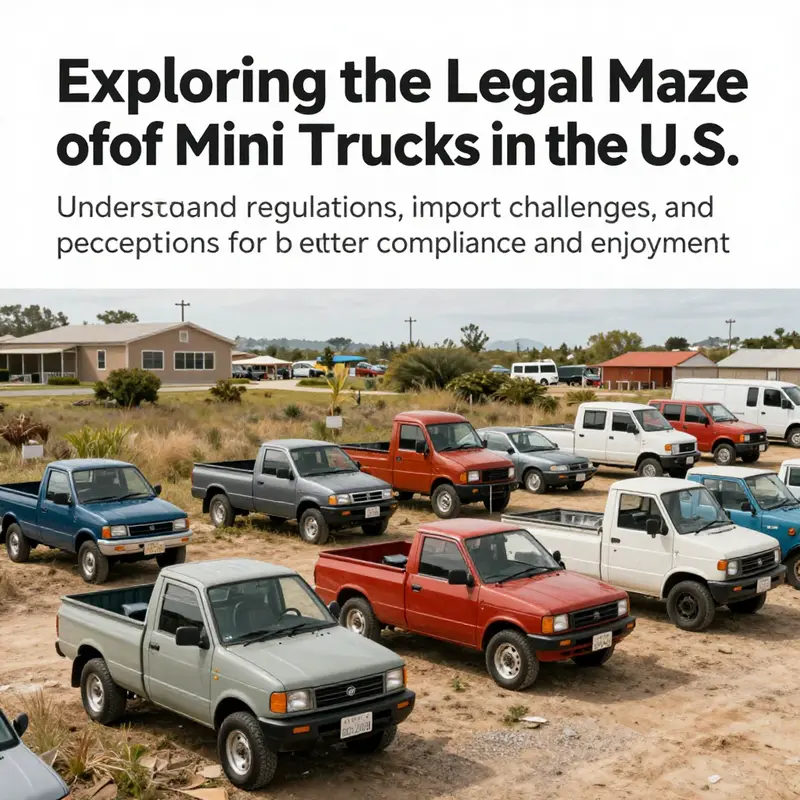
Delving into the world of mini trucks in the U.S. unveils a tangled web of regulations and perceptions that may leave many local small business owners, residential property owners, and mini truck enthusiasts puzzled. While the notion that mini trucks are illegal is widespread, the truth is far more nuanced. This article provides insights into how Federal Motor Vehicle Safety Standards shape their legality, the hurdles facing importation from overseas, the evolving strategies of manufacturers, and the misunderstandings that result from public perception. Each chapter aims to shed light on these interrelated aspects, guiding you toward a clearer understanding of the legal landscape surrounding mini trucks in the United States.
How Federal Safety Rules Decide Whether a Mini Truck Can Drive on U.S. Roads
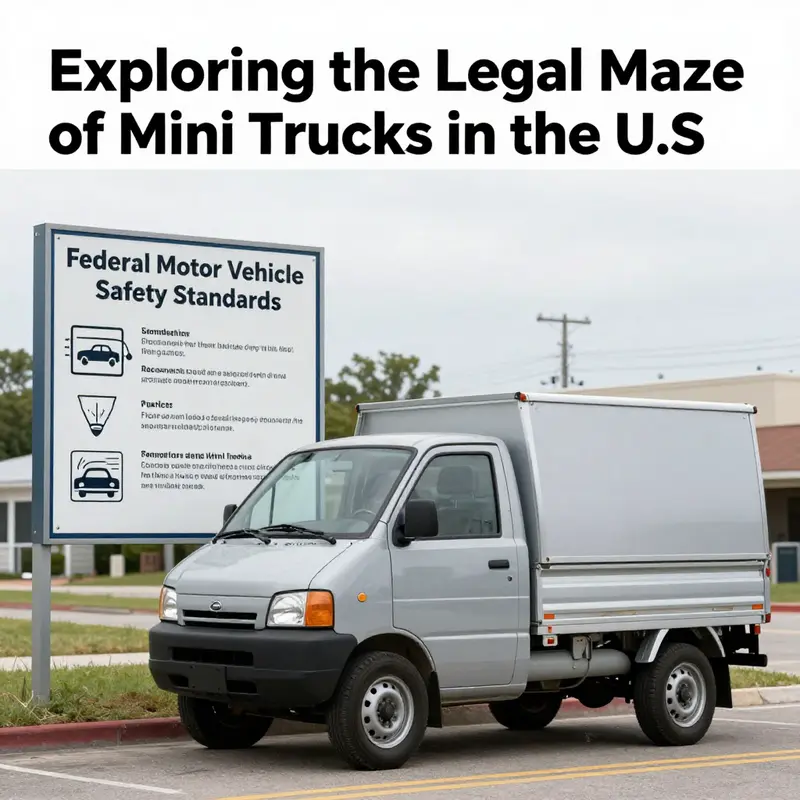
Federal standards are the gatekeeper between a small utility vehicle and a legal highway-ready truck. For mini trucks, those compact, often economical utility vehicles designed for light hauling and narrow spaces, the difference between a model being a useful work tool and being effectively barred from public roads usually comes down to compliance with federal safety requirements.
The National Highway Traffic Safety Administration sets mandatory minimums called the Federal Motor Vehicle Safety Standards, or FMVSS. These rules cover a broad set of safety features and systems. They define how a vehicle must perform in a crash. They require lighting and signaling equipment to meet visibility standards. They mandate occupant protection systems like seat belts and airbags. They set requirements for braking, steering, and electronics such as electronic stability control. When a vehicle model does not meet these standards, it cannot be certified for sale or normal operation on public highways in the United States.
Mini trucks present a special case. Their compact size, low mass, and simple construction create real engineering challenges when systems designed for larger vehicles are applied. A crumple zone that works in a full-size pickup does not scale proportionally to a vehicle that weighs a fraction of that amount. Roof structure standards designed to protect occupants in rollovers require a different set of design choices for a small cab. Lighting and mirror-placement standards that assume certain bumper heights and chassis widths may force redesigns to maintain proper sight lines and beam patterns. All of these changes cost money, time, and engineering resources.
The FMVSS themselves are not arbitrary. They are based on crash testing and research that reveal which features consistently reduce injuries. FMVSS 208, for example, governs occupant crash protection. It requires vehicles to demonstrate adequate performance in frontal and side impacts. It sets rules for airbag deployment and seat belt installation. FMVSS 108 controls lamps and reflectors, ensuring vehicles are visible and properly signaled. FMVSS 111 addresses rear visibility and mirror systems. FMVSS 126 requires electronic stability control on many light vehicles, a technology shown to reduce loss-of-control crashes. Roof crush resistance is covered under standards intended to improve occupant survival in rollovers. Seat belt assembly strength and anchorages fall under their own requirements. Each of these standards applies to most vehicles intended for public roads.
Meeting the standards is a technical and regulatory process. Manufacturers certify compliance before sale. For a new model to be sold as road-legal, the manufacturer must perform testing and submit documentation. That includes crash testing, component testing, and validation of lighting, brakes, and restraint systems. For vehicles built outside the United States, importers must either show that the foreign manufacturer certified the same standards or they must modify the vehicle so it conforms after import. Those modifications are often substantial. They can include structural reinforcements, addition or modification of airbags and seat belts, revised lighting and mirror systems, and changes to brake and stability control systems. The cost of these changes can make low-cost mini trucks economically unattractive for official certification and sale.
Import complications add another layer. The U.S. has import rules that require vehicles to meet FMVSS or be exempt. One common route around FMVSS is the age-based exemption. Vehicles that are more than 25 years old typically fall outside the FMVSS certification requirements and can be imported more freely. That exemption is why some classic or niche vehicles find a path onto American roads, albeit under different conditions. Newer models, however, must conform. When a foreign-built mini truck arrives at a U.S. port without certification, customs and the appropriate federal agencies can prevent its release until compliance is shown. Importers may opt to send vehicles to registered repair facilities that perform the necessary modifications. Those facilities are familiar with the process, but they often add high costs that erase any price advantage the mini truck once offered.
Beyond federal safety rules, emissions and clean-air requirements complicate legality. The Environmental Protection Agency and state air agencies set emission standards that differ from safety standards. A vehicle that meets FMVSS may still fail to meet U.S. emission requirements. Compliance with both sets of rules is necessary for normal registration. Meeting federal emissions limits often requires different engine calibrations, catalytic control systems, or even engine replacements. For a low-cost mini truck, retrofitting an engine system to meet stringent emissions rules frequently becomes impractical.
State-level enforcement is the final step. Even if a vehicle clears federal requirements or qualifies for an exemption, registering it for public-road use depends on state departments of motor vehicles. States require proof of title, safety inspections, and emissions tests where applicable. They have discretion in how they interpret federal standards for registration. That is why a vehicle considered road-legal in one state may not be registerable in another. State law also provides pathways for specialty registrations. Some owners register converted mini trucks as farm vehicles, off-road equipment, or low-speed vehicles, depending on the vehicle’s use and local statutes. These categories limit where and how the vehicle may be driven, but they provide legal routes for some owners.
The practical outcome is that many imported mini truck models are simply never offered for mainstream sale in the United States in their original form. The engineering changes required to meet FMVSS, plus emissions compliance, often raise the vehicle’s price above a threshold where it loses market competitiveness. For manufacturers and importers, the decision comes down to market size versus compliance cost. Reworking a vehicle’s structure and systems can require retooling production lines or investing in compliance testing. For higher-volume markets, those investments make sense. For niche, low-cost segments, they often do not.
That leads to several common misconceptions. First, mini trucks are not categorically illegal. The vehicle class is not banned by name. Second, many individual mini trucks are legal in certain contexts and under certain conditions. Vehicles that meet FMVSS, or that fall under exemptions, can be legally registered. Third, perceived illegality usually stems from a lack of certification and the high cost of bringing a vehicle into compliance.
Regulatory trends also shape the future. Safety expectations are rising. New rules and guidance emphasize electronic stability, automated emergency braking, and enhanced occupant protection. These advancements increase the technical threshold mini trucks must clear. At the same time, manufacturers exploring domestic production or shifting assembly to meet tariff and regulatory challenges can change the picture. Building to local standards from the outset reduces the need for post-production modification. If a manufacturer chooses to design a mini truck specifically for the U.S. market, compliance hurdles become design targets rather than afterthoughts.
For prospective buyers and regulators, there are practical steps to navigate the landscape. Consult federal sources, like the agency that publishes FMVSS, to determine whether a model has been certified. Check state DMV rules to learn about registration pathways and exemptions. Investigate whether a vehicle might qualify for classification as a low-speed vehicle, farm vehicle, or historic vehicle, if those categories align with intended use. When considering an imported mini truck that lacks certification, factor in the full cost of modifications, testing, and state inspection fees. Many buyers learn that a seemingly cheap import becomes expensive once compliance work begins.
Owners and small-fleet operators who already use mini trucks often adapt their expectations. They may limit road use to private property or jobsites. They keep mini trucks for on-site logistics, where federal highway standards do not apply. Others invest in conversion and certification through registered specialists, accepting higher costs for the benefit of legal on-road operation. Community groups and specialty dealers sometimes work together to create legal pathways for niche vehicles, but those arrangements require careful documentation and coordination with regulatory bodies.
The interplay between safety standards and market realities explains why mini trucks occupy a gray area in the United States. The standards exist to protect occupants and other road users. Meeting them is often straightforward for manufacturers focused on the U.S. market. For foreign-built mini trucks, however, certification can be technically complex and costly. That complexity drives many models out of the mainstream market.
For those who want deeper, authoritative detail on the FMVSS that apply to these vehicles, the federal agency that sets the standards maintains a comprehensive resource online. For community perspective, local specialty resources explain how enthusiasts and businesses work within the rules; see the MiniTrucks SoCal blog for examples of how owners and dealers navigate adaptation and use of small utility trucks.
Official FMVSS information is available from the following federal resource: https://www.nhtsa.gov/federal-motor-vehicle-safety-standards
Compliance, Not Bans: How Import Rules Shape Mini Truck Legality in the United States
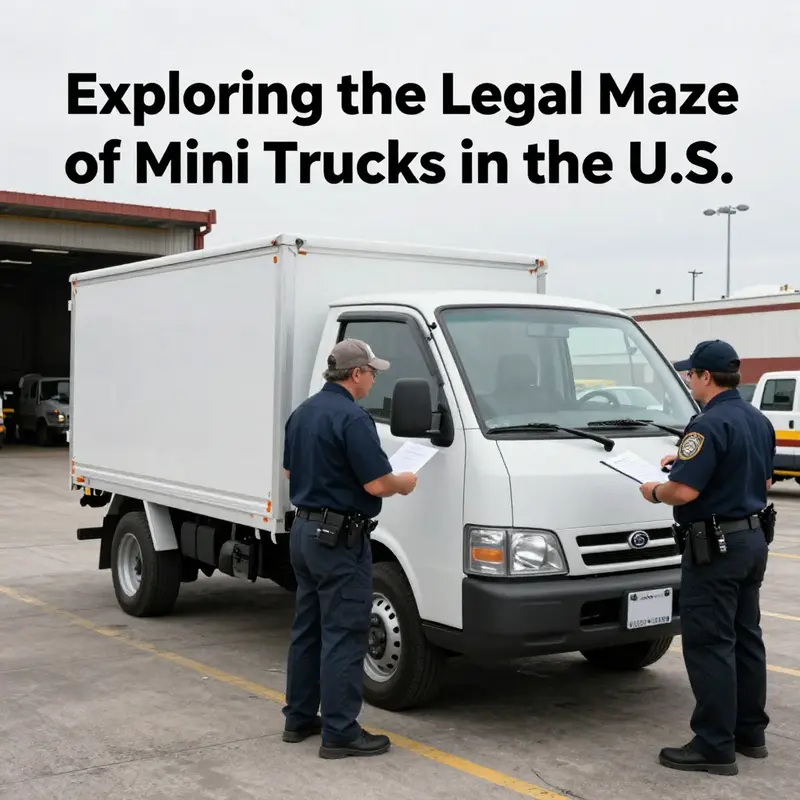
The idea that mini trucks are simply illegal on American roads rests on a misreading of how the United States treats imported, small utility vehicles. In truth, there is no blanket ban that sweeps these tiny workhorses off the street. What exists are a set of tightly drawn rules that distinguish between what can be sold and what can be driven, and these rules hinge on compliance rather than prohibition. To understand why enthusiasts encounter hurdles rather than straightforward access, one must follow the thread from federal safety standards to emissions policy, and then to the practical realities of importation and domestic production. The arc is not about bans but about meticulous alignment with a regulatory matrix that rewards safety, clean air, and accountable design. The result is a landscape where mini trucks can exist in the United States, but only if they have cleared the relevant gates, or in some cases, if they arrive under specific exemptions that apply to older vehicles or to particular use cases. The story, therefore, is one of regulatory gates, not closed doors; of compliance as the gatekeeper of legality.
The most widely cited misunderstanding concerns the nature of legality itself. A vehicle is not illegal by virtue of its size or its origin; it becomes legally restricted when it fails to satisfy federal motor vehicle safety standards, or FMVSS, or when it cannot demonstrate conformance with environmental rules and import requirements. These standards, administered by the National Highway Traffic Safety Administration (NHTSA) and enforced through the Environmental Protection Agency (EPA) and other federal agencies, set benchmarks for crashworthiness, lighting, visibility, occupant protection, and emissions. They are not crafted to target a niche vehicle category because of its origin, but to ensure that any vehicle that operates on U.S. roads does not endanger drivers, pedestrians, or the broader environment. When a mini truck model from overseas cannot prove compliance with these standards, or cannot be modified to meet them without erasing its fundamental character, its on-road life becomes uncertain. Importers may face the consequence that a model cannot be registered for highway use, and owners may find that even private or commercial use outside the public right of way is limited by jurisdictional rules and enforcement practices.
A critical and often overlooked lever in this conversation is the so-called 25-year rule. This rule provides a practical, historical gateway for those who want to bring older, smaller work vehicles into the United States. Vehicles that are 25 years old or more are exempt from some of the federal safety and emissions standards that govern newer models. The allure is obvious: as cars age, they drift into a zone where the federal gatekeeping softens, and import is permitted under the umbrella of a more permissive regulatory regime. Yet even this exemption is not a free pass. It does not erase all enforcement of emissions controls or safety obligations; rather, it creates an exception from certain provisions while remaining subject to others. In practice, this means that a 25-year-old mini truck might be allowed entry, but if the vehicle fails to satisfy applicable federal requirements in the areas that still apply, its ownership rights on American streets can still be challenged. The practical message is that the 25-year rule lowers one obstacle, but it does not remove the entire regulatory hurdle course. This nuance matters because the enforcement landscape under the EPA has grown more scrupulous in recent years. The agency has sharpened its focus on imports that do not conform to Clean Air Act standards, stepping up audits, penalties, and seizure risks for noncompliant vehicles. The goal is clear: curb emissions violations while allowing reasonable pathways for collectors and businesses that rely on older or specialized vehicles.
The import pipeline itself reveals another dimension of this puzzle. While the numbers vary by year and by enforcement intensity, a sizable tranche of mini trucks moving into U.S. ports originates from overseas markets that historically favored smaller, more utilitarian designs. Importers must navigate a labyrinth of documentation, testing, and potential modifications to bring a vehicle into alignment with U.S. rules. Some models may require substantial changes to meet FMVSS criteria or to demonstrate compliance with emissions and fuel-system standards. Others may rely on the 25-year window as their route to entry, using the passage of time to erase certain regulatory objections. The sheer volume of shipments—thousands, even per month in some estimates—creates a dynamic tension: a steady stream of units that reflects ongoing demand and practical utility on worksites, campuses, and rural properties, against a backdrop of heightened regulatory oversight and the risk of seizure or denial of registration for noncompliant entries.
This regulatory tension is not purely a federal phenomenon. States and local jurisdictions can layer additional requirements that influence how mini trucks can be used on their roads. Some states maintain strict on-road certification rules or require proof of compliance with FMVSS and EPA standards before a vehicle can be registered for highway use. Others may be more permissive, permitting on-road operation for certain agricultural or commercial applications with limited or conditional use. The practical implication is that a model which is deemed legal in one state may encounter hurdles in another. This patchwork of rules means buyers and operators must think not only about the federal gate but also about the gatekeeper at the state level. In the spaces between safety and emissions compliance, the legal status of a mini truck becomes a negotiation: how closely can the vehicle approach standard definitions of roadworthiness, and what alterations, if any, are warranted to fit a specific regulatory stance? The answer often hinges on professional consultation, a careful review of the vehicle’s documentation, and a willingness to adapt the vehicle’s configuration to local requirements.
All of this comes into sharper relief when considering the practical uses that drive demand for mini trucks in the United States. Their compact dimensions, tight turning radii, and low overall mass make them ideal for controlled environments where maneuverability outweighs high-speed capability. Campuses, golf courses, factories, and warehouses benefit from fleets that can traverse tight corridors and steep passages with ease. Ranches, dairies, stables, and equestrian facilities rely on the ability to haul feed, tools, and equipment without the bulk of a larger pickup. Theme parks, airports, and cemeteries value the quiet efficiency of these small workhorses. In such contexts, the vehicles’ on-road legality is less central than their off-road or on-site utility, yet even for off-road use the same regulatory skeleton applies. If a company intends to operate mini trucks on public streets, those vehicles must be certified accordingly. If they are kept to private property or controlled grounds, the regulatory risk shifts but does not disappear; enforcement officials and auditors may still scrutinize whether a vehicle in use meets pollution and safety standards appropriate to its operation. The practical takeaway is that the appeal of mini trucks often sits at the border between on-road utility and off-road practicality, with regulation acting as the line that determines where a vehicle can travel and how freely it can work.
The market dimension adds another layer of complexity. In the public imagination, the appeal of these compact machines rests on their efficiency and their ability to access spaces that larger trucks cannot. In policy and industry circles, the question becomes how to reconcile demand with the responsibilities that accompany vehicle use on public roadways and in shared ecosystems. To reduce regulatory friction, some manufacturers and importers have looked to adapt strategies that align product design with the U.S. regulatory framework. This can include reconfiguring safety systems, updating lighting and crash-structure elements, and ensuring fuel systems meet current standards. More strategically, there are conversations about locating production facilities domestically to smooth the path to compliance and to mitigate tariff-related complications. When a manufacturer considers shifting production to a U.S. site, the conversation shifts from “how do I import and certify?” to “how do I design a product that fits naturally within the U.S. regulatory landscape from the outset?” The shift toward domestic production is not a simple relocation; it is a rethinking of vehicle architecture, supply chains, and the regulatory narrative around safety, emissions, and long-term maintainability. While such moves may appear as responses to regulatory pressures, they are, in effect, market reorganizations that reflect the intricate relationship between policy goals and business strategy. They illustrate how legal and economic incentives weave together to shape what becomes available to U.S. buyers and what stays on the shelves abroad.
For buyers and operators, the path through this landscape often requires careful navigation rather than a shortcut. Given the potential consequences of non-compliance—seizure of vehicles, fines, or denial of registration—buyers need to develop a robust due diligence process. This includes a meticulous review of the vehicle’s compliance documentation, an assessment of whether emissions and safety systems meet applicable federal requirements, and an understanding of the state-specific rules that might govern use and registration. It also means recognizing when a vehicle’s intended use aligns with a legal on-road pathway and when it does not. In many cases, off-road or private-property applications present fewer regulatory obstacles, allowing organizations to leverage the vehicle’s core advantages while staying within the bounds of the law.
The broader narrative around mini trucks, then, becomes one about clarity and alignment. The perception of illegality often evaporates when the import and regulatory pathways are understood and respected. This is not to diminish the friction or the risk involved in crossing borders with a nonconforming vehicle; rather, it emphasizes that legality emerges from a precise alignment with FMVSS, DOT, and EPA requirements, and, for imports, from navigating the 25-year rule with eyes open to ongoing emissions enforcement. The takeaway for policymakers, manufacturers, and users alike is that the space remains viable for legitimate, properly certified use, but it requires a disciplined approach to compliance, documentation, and, where relevant, domestic production strategies that reduce regulatory friction.
An internal pathway worth noting as part of ongoing industry discourse is the exchange of information through dedicated community and trade discussions. These conversations often explore practical experiences with certification processes, and they surface practical considerations about how to prepare vehicles for on-road use. For readers seeking practical perspectives on the daily realities of owning and operating mini trucks within the United States, a broad, collaborative stream of knowledge exists on the web, including resources that collect user experiences, regulatory updates, and step-by-step guidance on compliance. More context and ongoing discussions can be found in the community resources at minitrucksocala.com/blog.
To stay grounded in the regulatory frame, it is essential to anchor these debates in authoritative sources. The U.S. government maintains a safety and compliance ecosystem that is accessible to buyers and operators alike. The NHTSA provides clear guidance on FMVSS requirements and enforcement expectations, while the EPA outlines emission standards and compliance expectations for imported vehicles. Beyond the federal layer, state motor vehicle agencies add their own checks and registrations criteria, which means that a vehicle’s journey from the port to the street is a multi-stage process that requires diligence, patience, and professional counsel when needed. In practice, this is not a story of loopholes but a story of navigable channels—channels that, when followed, allow a mini truck’s practical benefits to be realized within a framework designed to protect people and the environment.
The import and regulatory landscape is dynamic. Policy shifts, new interpretation of standards, and changes in enforcement priorities can change the calculus for buyers and importers overnight. This reality underscores the importance of up-to-date information and of consulting regulatory resources directly. It also highlights why some players in the field advocate for domestic production as a pragmatic response to tariff regimes and compliance overhead. Such strategic moves do not erase regulatory hurdles; they reframes them as questions of design, manufacturing, and supply-chain choices that naturally align with U.S. standards. In this sense, the legality of mini trucks in the United States is less a fixed verdict and more a moving protocol—a protocol that rewards thorough preparation, transparent documentation, and a willingness to adapt to the regulatory climate as it evolves.
In the end, this is a chapter about how legality is built, not about an abrupt prohibition. It is about recognizing that mini trucks can be legal on U.S. roads and in U.S. yards and facilities, so long as they meet the standards set by federal authorities and are correctly registered in accordance with state rules. The path is more nuanced than a simple yes-or-no verdict; it is a disciplined journey through standards, exemptions, documentation, and, where applicable, domestic production strategies. For readers who want to explore further nuances or pursue a specific import plan, the conversation is ongoing, and it stays anchored in concrete regulatory guidance rather than rumor. The broader implication is clear: the legality of mini trucks in the United States rests on compliance, not on the absence of a ban. That distinction matters because it reframes the challenge from defeating a prohibition to meeting a set of well-defined requirements. It also invites a more constructive dialogue about how these vehicles can serve legitimate uses while contributing to safety, air quality, and consumer choice.
External reference to deepen this understanding can be found in a detailed buyer’s guide that outlines the on-the-ground considerations for mini pickup trucks in the U.S., including safety, emissions, and registration aspects. For further reading, see https://www.carinterior.com/mini-pickup-trucks-legal-in-the-us-a-buyers-guide/
How Manufacturers Play by the Rules: Market Tactics and Compliance Paths for Mini Trucks in the U.S.
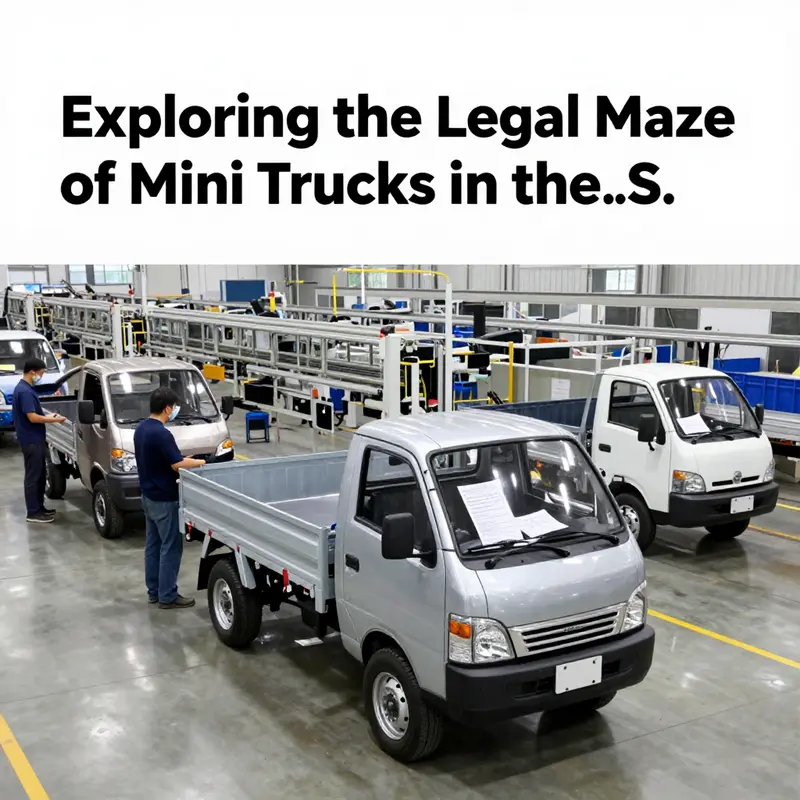
Market moves and regulatory reality collide when mini truck makers seek U.S. buyers. The interplay of safety rules, emissions mandates, import controls, and shifting consumer demand shapes every strategic decision. Manufacturers must navigate a dense regulatory landscape while keeping prices attractive and features modern. Their success depends on aligning product design, production location, and dealer networks with legal pathways that allow these small work trucks to reach American customers.
Manufacturers begin with clear priorities: meet customer needs, control costs, and avoid legal bottlenecks. Product innovation sits at the center. Engineers redesign cabins, lighting, and restraint systems to meet federal safety standards where necessary. At the same time, powertrain choices change. Companies increasingly develop electric and hybrid variants to address emissions rules and appeal to sustainability-minded buyers. These changes are not cosmetic. They are technical and costly, involving new components, software, and testing cycles.
Production strategy follows regulatory logic. Building vehicles domestically or within compliant trade zones reduces import friction. Local assembly lines can circumvent some certification hurdles and tariffs. They also enable faster adaptation to state laws and regional customer preferences. For example, close ties to a U.S. facility make emission calibration and safety testing more manageable. Conversely, importing fully built units from overseas often requires expensive compliance work or limits how those vehicles can be used on public roads.
Distribution and sales tactics reflect this same thinking. A broader distribution network increases market access but demands a stronger compliance infrastructure. Dealers and regional distributors must be trained on registration nuances and local restrictions. Some companies adopt a direct-sales model to control messaging and streamline paperwork. Others partner with logistics firms and last-mile providers to add value, offering integrated fleet solutions tailored to specific industries, such as campuses, resorts, and light-construction sites.
Technology partners are also central. Strategic alliances with software and AI firms enable vehicle features that regulators increasingly expect. Telemetry, remote diagnostics, and geofencing can improve safety and help demonstrate compliance. Fleet managers can use data to ensure vehicles operate within designated speed limits or zones. These capabilities are attractive to regulators and customers alike. They show that mini trucks are not simple imports but modern, managed assets suited to today’s logistics needs.
Electrification is more than a marketing line. It is a compliance strategy. As emission standards tighten and incentives for zero-emission vehicles grow, electric mini trucks avoid many diesel-related hurdles. Electrified models sidestep certain federal and state diesel regulations altogether. They still face safety standards, but electric platforms can be designed from the ground up to incorporate modern crash mitigation and electronic stability aids. Investing in battery systems, charging strategies, and thermal management becomes an investment in long-term market access.
Yet compliance extends beyond emission controls and electric powertrains. Federal safety standards set by the national highway regulator govern crashworthiness, restraint systems, lighting, and electronic architecture. Meeting these standards often requires redesigning structural elements and adding certified safety components. Certification testing can be long and expensive. Small manufacturers must weigh the cost of compliance testing against potential market size. For many, the most efficient path is a blend of approaches: producing compliant variants for public roads while offering off-road or private-use models for farms, campuses, and industrial sites.
Regulatory engagement is a deliberate practice. Successful firms maintain active lines of communication with regulatory bodies. Early engagement reduces surprises. It clarifies testing expectations and reveals paths for exemptions or alternative compliance. These firms also invest heavily in research and development to anticipate future mandates. They build modular platforms that can accept safety or emissions hardware with minimal rework. This flexibility shortens time-to-market and reduces retrofit costs when new rules arrive.
Quality assurance multiplies the effect of good design. Robust QA processes ensure vehicles meet regulatory requirements during production and after. Traceable parts sourcing, consistent manufacturing tolerances, and documented test records are essential. Regulators scrutinize not only the vehicle design but also the production controls. A manufacturer with weak QA faces recalls and compliance losses that erode brand trust quickly. By contrast, a tight QA regime speeds certification and supports dealer confidence.
Cost management remains the constant constraint. Compliance adds cost in development, testing, and parts. Companies offset this burden through scale, platform sharing, and supplier partnerships. Consolidating parts across models reduces inventory complexity. Strategic alliances with component suppliers can secure lower prices for certified parts. Moreover, producing variants that meet multiple markets’ needs spreads the fixed costs of testing across higher volume. These tactics make compliant mini trucks financially viable in the U.S.
Market segmentation also directs compliance choices. Some customers require full highway capability. Others need low-speed utility within private facilities. Manufacturers can offer a range of options designed for each use. Vehicles intended for private property avoid the highest levels of federal certification, reducing cost and time to market. Road-legal variants are produced with the additional hardware and documentation required for registration. This dual-path approach balances regulatory burdens with market opportunity.
Another important legal avenue involves age-based import exemptions. Certain older vehicles can enter without meeting modern federal standards. While this path is narrow, it offers a route for enthusiasts and collectors to legally import vintage mini trucks. It is not a scalable commercial strategy but it does influence demand patterns and aftermarket ecosystems. Companies monitoring this segment can identify styling cues and durable design elements that appeal to retro-minded buyers.
State-level variations complicate planning. While federal agencies set baseline safety and emissions rules, states handle registration, titles, and local road use. Some states permit limited use of low-speed or neighborhood vehicles on designated streets. Others allow mini trucks in agricultural or industrial districts with fewer restrictions. Manufacturers must craft compliant documentation and optional equipment lists to satisfy various state DMVs. This patchwork requires careful legal and logistical planning when launching a national sales program.
Marketing and education are part of the compliance strategy. Prospective buyers often misunderstand the legal status of mini trucks. They mistake registration hurdles for outright bans. Clear communication about legal pathways, vehicle capabilities, and intended use prevents disappointment and legal missteps. Dealers and manufacturers provide paperwork support, registration guidance, and aftermarket modification options that keep vehicles within legal limits.
The dealer experience matters. Dealers act as the bridge between engineered compliance and real-world operation. They must be trained to explain warranty coverage, registration processes, and limits tied to specific models. A dealer network that can handle customization and compliance paperwork increases conversion rates. Some manufacturers embed compliance consultants within their dealer teams during launches. This reduces friction and improves customer satisfaction.
Finally, public policy trends shape long-term strategy. Anticipation of stricter emissions targets and zero-emission mandates drives earlier electrification. Pending rules on automated driving aids push manufacturers to add compatible electronic architectures. Being proactive means investing before rules are finalized. That investment can be risky, but it pays off if it gives first-mover advantage in compliance-ready product lines.
Manufacturers that align product strategy with regulatory realities build a legal and commercial pathway for mini trucks in the U.S. They do not treat regulation as a barrier alone. Instead, they view it as an input to design, production, and market deployment. This shift—from reactive to strategic compliance—allows small trucks to operate legally in more roles and places. It also lowers the chance that customers will buy vehicles they cannot legally use on public roads.
For those tracking industry shifts, ongoing analysis of market forecasts and compliance trends is essential. Publicly available market research details expected growth, adoption patterns, and the rising role of electric models. These reports help manufacturers prioritize investments in R&D and production. Readers who want deeper industry projections can consult the market report here: https://www.marketresearchfuture.com/reports/usa-truck-market-18746.
If you want practical examples and owner-level perspectives about how these strategies play out in real sales and customization, the Mini Trucks SoCal blog offers local insights and dealer-level guidance. That resource helps bridge the gap between regulatory frameworks and the vehicles people actually use: Mini Trucks SoCal blog.
Overall, market strategy and regulatory compliance are inseparable. Manufacturers that plan production, technology, and distribution around legal requirements will expand access to mini trucks. Those that ignore compliance will face delayed launches, limited markets, and legal exposure. The path to broader legal use is clear: design smart, engage regulators early, invest in cleaner technology, and build dealer networks that can navigate state-by-state rules.
Unraveling the Myth: Compliance, Not Prohibition, Shapes Mini Trucks on American Roads
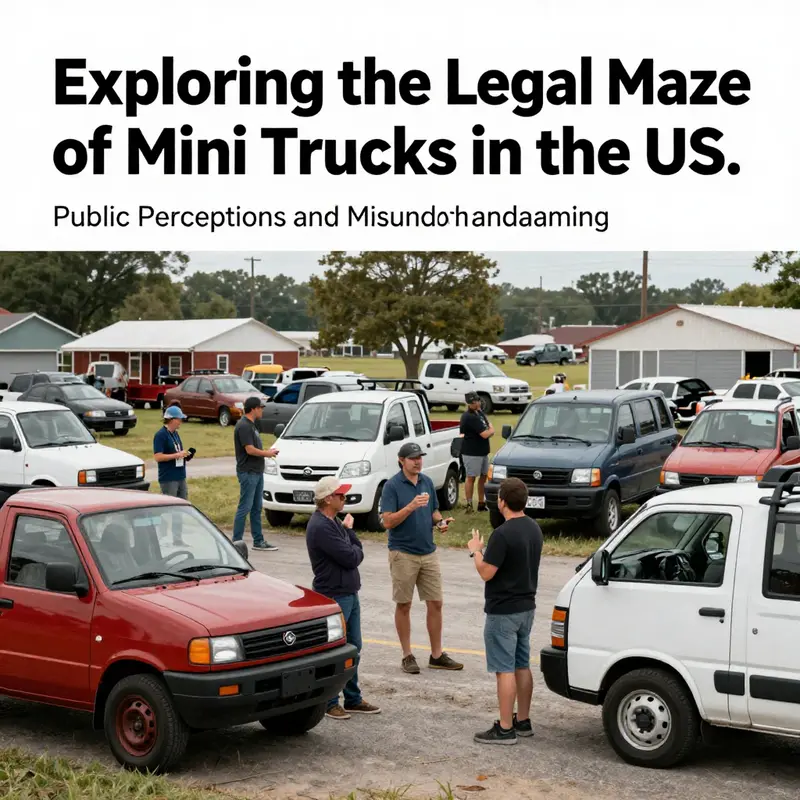
Public perception often starts with a quick assumption: a mini truck is small, therefore it should be street-legal. Yet legality on American roads does not hinge on size alone. It rests on a layered structure of federal safety rules, emissions commitments, and the practical realities of how imported vehicles are certified and entered into the market. The layer cake of regulation is not about banning a category so much as ensuring every vehicle that shares the road meets minimum standards designed to protect occupants, pedestrians, and other road users. In this sense, the discourse around mini trucks in the United States is less a tale of prohibition and more a longstanding negotiation between economic opportunities, safety concerns, and bureaucratic processes that determine which models can be sold, which can be registered, and which can survive the switch from showroom floor to public highway.
At the core of this negotiation is a set of federal standards known as the Federal Motor Vehicle Safety Standards, or FMVSS, administered by the agency charged with highway safety in the United States. These standards cover a broad spectrum of vehicle behavior and construction, from crashworthiness and airbag systems to lighting, braking performance, and the reliability of occupant restraints. They also touch on the emissions regime that governs how clean a vehicle must be when it rolls down the road. It is not enough for a vehicle to exist; it must also demonstrate that it can be operated safely and within environmental bounds that respect air quality and public health. For many mini trucks that originate outside the United States, the hurdle is not merely that they exist in compact form, but that their design, components, and performance characteristics align with FMVSS criteria. If a model does not satisfy these benchmarks, it may neither be legally sold nor legally operated on public highways. The consequence is not a dramatic public ban, but a practical prohibition that arises from the vehicle failing to pass the regulatory test bed.
The importation dimension adds a second layer of complexity. A substantial number of mini trucks available abroad are designed for markets with different regulatory cultures and testing methodologies. When these vehicles are brought into the United States, they typically encounter a stringent approval process. Importers may need to demonstrate compliance through testing, documentation, or even substantial modifications to meet FMVSS and related emissions standards. Sometimes, this means remanufacturing or refurbishing certain components, such as lighting systems, safety recognition devices, or exhaust configurations, so that the vehicle meets U.S. expectations. In the worst-case scenario, a model may be accepted only after a costly and time-consuming transformation, while in other cases it may be restricted to use in limited contexts until compliance is achieved. This reality helps explain the perception that mini trucks are “illegal” or “unavailable” on U.S. roads, when in truth the barrier is about regulatory alignment rather than a blanket prohibition.
Beyond the regulatory gates, the commercial and political landscape also shapes what is feasible in the market. In recent market chatter and industry analyses, there has been mention of efforts by a major manufacturer to relocate production activities to the United States as part of a broader strategy. The aim is not simply tariff avoidance; it is also to bring products into closer alignment with domestic regulatory expectations and the U.S. manufacturing ecosystem. A move of this kind would likely streamline certification and reduce the friction associated with import compliance, making it easier for certain vehicle designs to meet FMVSS and emissions standards with fewer concessions. While such strategic discussions underscore how closely regulation and market strategy are intertwined, they also remind readers that legality in the United States is not a fixed verdict handed down to a vehicle type. It is a moving target shaped by policy, industry decisions, and the evolving interpretive lens of safety and environmental stewardship.
For any consumer or prospective owner trying to understand whether a specific mini truck can be operated legally on public roads, the answer lies in a layered verification process. First, one must determine how the vehicle is classified in terms of wheelbase, weight, and intended use. A longer wheelbase or heavier curb weight might push the vehicle into a different class with different compliance expectations. Second, the vehicle must carry appropriate emissions certifications and demonstrate that its propulsion and exhaust systems meet the applicable standards. Third, safety features—such as seat belts, appropriate lighting, turn signals, and crashworthiness characteristics—must be verifiable. Finally, the vehicle’s overall design must reflect a configuration that aligns with FMVSS safety criteria rather than a pure off-road or industrial-use model. If any of these elements fall short, the vehicle may be deemed illegal to operate on public streets despite its compact appearance and its resemblance to a conventional pickup.
These considerations are not merely technical; they shape real-world outcomes for buyers and sellers. It is common for people to assume that a small footprint automatically equates to road-compatibility. In practice, that assumption can lead to missteps, including operating a vehicle that is not properly registered or failing to meet state-specific requirements for insurance or licensing. The administrative consequences can be significant—fines, penalties, or even vehicle impoundment—depending on the jurisdiction and the exact nature of the noncompliance. The risk is not a universal, across-the-board ban but rather a real possibility that a given mini truck, if not properly certified or registered, becomes a regulatory impediment in disguise. This nuance matters because the same public that cherishes the practicality and economy of tiny trucks may unknowingly generate legal trouble by overlooking the compliance framework on which the entire system relies.
A crucial distinction that often gets blurred in popular discourse is the difference between vehicles intended for on-road use and those designated for off-road or industrial tasks. Some manufacturers label their machines as “mini trucks,” but the underlying design intent might be for specialized service, agricultural work, or limited-use applications where road-legal requirements are either abridged or deferred. In those cases, the on-road legality must still be reconciled with FMVSS and emissions rules if the vehicle is to be driven on public highways. The tension between niche utility and broad accessibility underscores why the public conversation about mini trucks tends to swing between enthusiasm and caution. Consumers who want the best of both worlds—compact dimensions and road-legal freedom—must navigate a legal and regulatory path that is not inherently obstructive but is certainly exacting.
The consumer guidance embedded in this landscape is practical and specific. Rather than assuming that a vehicle’s size guarantees permissibility, buyers are advised to consult official resources that govern vehicle classification, registration requirements, and compliance statements. The National Highway Traffic Safety Administration, or NHTSA, maintains authoritative guidance on FMVSS compliance and how it applies to different vehicle configurations. In addition, state-level departments of motor vehicles provide registration and inspection rules that can alter whether a given mini truck can be legally driven in a particular locale. The best approach for a potential buyer is to treat the situation as a compliance puzzle rather than a premise of inevitability. Verify the model’s safety features and crashworthiness data, confirm that the emissions system is certified to U.S. standards, and ensure the vehicle can be legally registered in your state before considering operation on public roads. This careful due diligence helps prevent the unintentional consequences of misinterpretation and aligns the purchase with a longer-term plan that respects both public safety and personal mobility.
To illuminate the practical realities of these processes and to offer another perspective from the market, readers may explore broader discussions in community-focused automotive spaces. For readers seeking a source that frames the consumer experience, the following resource provides a grounded look at the community, the constraints, and the evolving conversation around mini trucks in the U.S.: minitrucksocala.com/blog/. This internal reference serves as a complement to official regulatory guidance, offering a sense of how enthusiasts, buyers, and small-business operators navigate the terrain where legality intersects with everyday use. The emphasis across such community discussions is not a call to ignoring rules but a practical orientation toward understanding which vehicles can be responsibly integrated into daily life and which require more investment in compliance.
In the end, the critical takeaway is that the notion of illegality around mini trucks in the United States is better understood as a negotiation with compliance than as a blanket prohibition. The FMVSS framework, together with emissions and importation standards, creates a disciplined pathway that any model must traverse to be legally operable on public roads. This is not a static verdict but an ongoing conversation among regulators, manufacturers, importers, and consumers about how small, efficient vehicles can fit into a safety-conscious and environmentally responsible transportation system. It is a conversation that will continue to evolve as the market introduces new designs, as production strategies adapt to regulatory realities, and as policymakers refine the edges of what it means to operate a modern vehicle on U.S. highways. For those who want to stay informed, official channels such as the NHTSA website remain the most reliable compass, and state DMVs provide the practical registration framework that translates compliance into road-going reality. See official guidance at https://www.nhtsa.gov for detailed information on how safety standards apply to individual vehicles and how to verify whether a given mini truck can legally be used on public roads.
External reference: For a comprehensive overview of regulatory guidance, you can consult the National Highway Traffic Safety Administration’s official site at https://www.nhtsa.gov. As the regulatory landscape continues to mature and as market strategies adapt, the core message remains: legality is rooted in compliance, not in a blanket assumption about size or intent. The practical implication for buyers is straightforward—verify the vehicle’s alignment with FMVSS and emissions requirements, confirm its on-road classification with your state DMV, and use trusted sources to navigate the path from showroom concept to everyday mobility, armed with accurate information rather than assumptions. This deliberate approach helps ensure that the appeal of compact design does not collide with the responsibilities that come with sharing the road.
Final thoughts
Navigating the world of mini trucks in the United States requires a keen understanding of regulations, importation challenges, and public perceptions. While they are not outrightly illegal, compliance with safety and emissions standards is critical for their legal operation. By engaging with responsible manufacturers and staying informed about regulatory criteria, local small business owners, residential property owners, and enthusiasts can advocate for their passion with clarity and confidence. Together, we can reshape misunderstandings and embrace the functionality of mini trucks in our daily lives.