
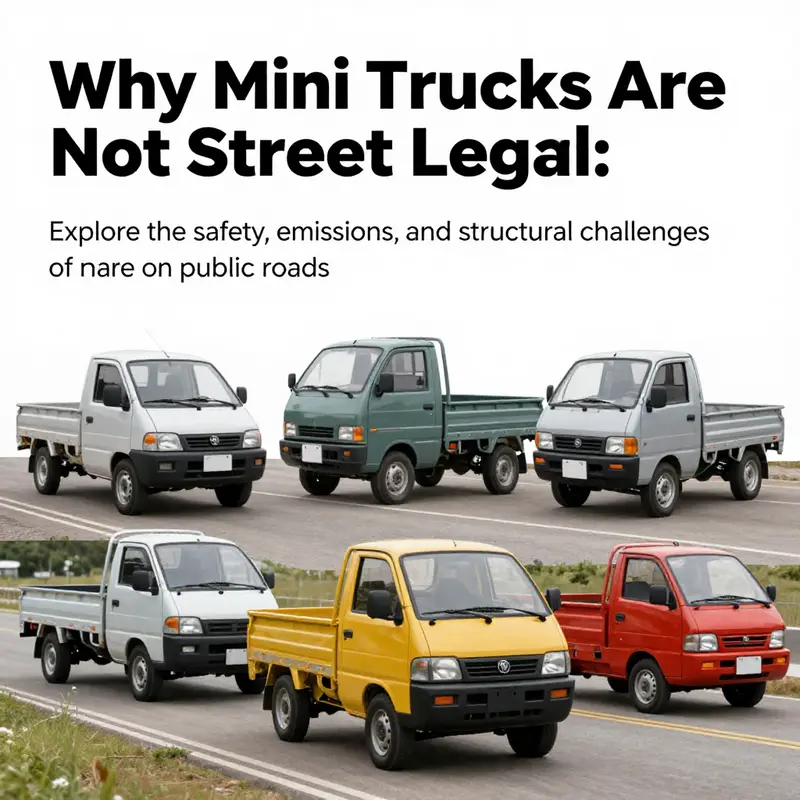
Mini trucks have gained popularity for local transport and small business use, but many still wonder why they can’t hit the streets legally. These compact vehicles, often designed for off-road or industrial purposes, face a maze of legal hurdles that prevent them from being street-legal in various regions. In the chapters to follow, we will delve into the reasons behind this issue, starting with the essential safety features many mini trucks lack, followed by strict emissions and noise standards they must comply with, and concluding with the challenges regarding structural integrity and performance when on public roadways.
When Compact Design Collides with Safety Rules: Why Mini Trucks Often Fail Street-Legal Standards
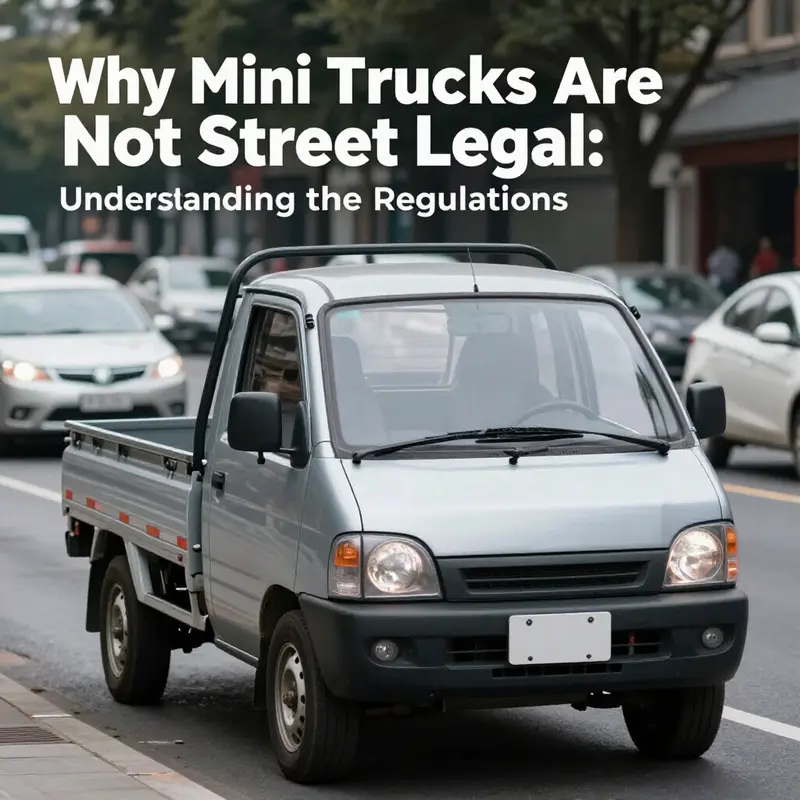
Why compact street use is a safety challenge
Mini trucks were conceived to do work in tight spaces. Their compact dimensions, light weight, and simple mechanical systems make them ideal for farms, warehouses, construction sites, and last-mile deliveries. Those same traits, however, create fundamental conflicts with the safety assumptions underlying modern road regulations. Lawmakers craft vehicle rules around occupant protection, crash compatibility, and predictable behavior at highway speeds. Mini trucks usually do not match those design assumptions. The result is a small vehicle that looks useful but often lacks the mass, protective structure, and certified safety systems that regulators require for public-road use.
At the heart of the issue is a mismatch between intended environment and regulatory environment. Off-road and light-duty industrial vehicles are optimized for low speeds, low exposure, and site-specific hazards. Public roads expose vehicles to faster-moving traffic, varying crash scenarios, and a greater diversity of road users. When a light mini truck meets a heavier passenger car at 45 to 65 miles per hour, the physics are unforgiving. Energy transferred in a crash grows with mass and speed. A vehicle with low structural mass and limited crumple zones simply cannot absorb crash forces in the way modern safety regulations assume. That shortfall is not cosmetic. It translates into higher risk of severe injury or death for occupants and other road users.
Structural mass, crumple zones, and crash compatibility
Crashworthiness is a concept regulators use to describe how a vehicle protects its occupants during impacts. It depends on a combination of structure, engineered deformation zones, restraint systems, and occupant space. Mini trucks typically have thin, lightweight body panels and compact frames. They may have simple ladder-type chassis or unibody constructions optimized for load capacity rather than crash energy management. As a result, they lack the deep, calculated crumple zones engineered into modern passenger cars. These crumple zones spread and dissipate crash energy away from the passenger cell.
In a crash, a heavier vehicle will often intrude less into the passenger compartment of a lighter vehicle. The lighter vehicle’s restraint systems and structural supports must be designed to compensate for that disadvantage. Most mini trucks were never designed with multiple, coordinated airbags, reinforced pillars, or occupant cell structures that meet tougher homologation tests. In regions with strict crash-testing protocols, such as frontal offset tests and side-impact evaluations, mini trucks can fail to meet minimum performance requirements.
Seat belts, airbags, and occupant restraints
Regulations in many countries mandate advanced restraint systems. Seat belt pretensioners, load limiters, and multiple airbags are now standard in many passenger vehicles. Mini trucks may have basic lap or lap-shoulder belts, or older models might lack pretensioners and load limiters. Airbags, where present, are often limited to a driver bag at best. The absence of coordinated restraint systems means occupants have less protection in high-energy collisions. Even when airbags exist, the sensor networks and deployment algorithms might not be tuned to crash dynamics typical on public roads. Without holistic restraint design, airbags can be ineffective or even harmful in some crash scenarios.
Visibility, lighting, and signaling
Public-road regulations require specific lighting and signaling performance. Headlights must deliver a certain luminous intensity and beam pattern. Brake lights, turn signals, daytime running lights, and reflectors must meet durability and visibility standards. Mini trucks built for private or industrial use sometimes have lighting optimized for low-speed site operations, not highway speeds. Mirrors and sightlines matter too. Compact cabins and limited mirror placement can create visibility blind spots for both occupants and other road users. Rearview camera systems and blind-spot detection are modern aids that many mini trucks lack, particularly older models. Those missing features degrade the vehicle’s ability to communicate intent and detect hazards in busy traffic.
Electronic stability, braking, and handling
Electronic Stability Control (ESC) and robust antilock braking systems are now common safety minima in many jurisdictions. ESC helps prevent loss-of-control events such as spinouts and rollovers by selectively braking wheels and modulating engine torque. Mini trucks often have simple braking and suspension systems designed for low-speed, loaded hauling rather than high-speed emergency maneuvers. Limited stopping power, long brake fade under repeated use, and tuning that prioritizes load capacity over road-holding compromise performance in mixed traffic. Without ESC, mini trucks are more vulnerable to skidding and rollover in abrupt avoidance maneuvers.
Rollover risks and roof strength
Mini trucks sometimes have a high center of gravity when loaded, because cargo sits in a small bed on a short wheelbase. That configuration increases the risk of rollover during sudden steering inputs or side impacts. Regulations often include roof crush resistance requirements and rollover protection standards. Mini trucks with lightweight roofs or minimal frame reinforcement can fail those tests, offering inadequate protection if the vehicle flips. In many regions, improved rollover performance is a prerequisite for road use.
Pedestrian safety and crash structures
Modern safety standards consider not only vehicle occupants, but also pedestrians and cyclists. Bumpers, hood profiles, and front-end geometry can reduce the severity of injuries to pedestrians in a collision. Many mini trucks have upright, utilitarian fronts or exposed chassis components that do not meet pedestrian-impact criteria. Absent energy-absorbing designs or tested front-end behavior, collisions with pedestrians or cyclists carry a greater risk of serious harm.
Space constraints and the integration of modern safety technologies
Mini trucks are small by definition. Their cabins and engine bays offer limited room to install complex safety hardware. Space constraints can make it difficult to fit multiple airbags, reinforcement beams, or sophisticated sensor arrays used by advanced driver-assistance systems (ADAS). Adding these features might require fundamental redesigns of the cab, steering column, and dashboard. Many manufacturers of mini trucks prioritize affordability and simplicity over retrofitting costly safety systems. The physical inability to incorporate essential equipment becomes a practical barrier to meeting street-legal safety standards.
Homologation, testing, and the certification gap
Regulatory approval involves more than adding parts. Vehicles must undergo official testing and certification. That process proves that a design consistently meets standards under controlled conditions. Mini-truck makers that focus on niche markets rarely pay for the exhaustive crash testing and engineering validation required for full road homologation in stricter jurisdictions. The cost of crash testing, redesign, and bureaucratic approval is high. For many small manufacturers, the market size in those regions does not justify the expense.
Even if a mini truck is modified to add safety features, it must still pass structural tests and systems validation. Simple bolt-on modifications rarely suffice. Authorities require documented evidence that the vehicle will behave predictably in crashes and that all safety systems integrate correctly. That integration often exposes deeper design issues, such as weak mounting points, inadequate airbag deployment profiles, or unsuitable electrical systems.
Differences across regions: why Kei rules don’t translate everywhere
Japan’s Kei-class vehicles are a prime example of how regulatory frameworks shape design. Kei trucks meet Japanese safety and environmental rules tailored to their size and role. Those regulations accept trade-offs in mass and structural design in exchange for benefits like reduced taxes and easier urban parking. However, standards in some Western markets assume larger vehicle sizes and impose more rigorous crash testing and equipment mandates. A Kei vehicle that is perfectly legal and insured in Japan may not qualify for homologation in other countries without significant redesign. The same structural attributes that make Kei trucks nimble also limit their ability to meet those wider standards.
The practical cost barrier to street-legal conversion
Owners and small importers sometimes explore converting mini trucks for road use. That process is rarely simple or cheap. Typical required upgrades include stronger chassis reinforcement, certified airbags and seat belts, improved braking systems, upgraded lighting and mirrors, and electronic stability control. Electrical systems may need rewiring to support modern sensors. Suspension geometry and tire ratings often require recalibration. Each of these changes involves engineering work, crash-test validation, and documentation for registration authorities.
Even when shops perform individual modifications, registration offices may still refuse certification if the vehicle lacks homologation documentation from the original manufacturer. In many jurisdictions, obtaining a one-off road-legal certificate involves a detailed, bureaucratic process and inspection. The cumulative cost of engineering, parts, and testing can exceed the value of the vehicle itself.
Insurance, liability, and enforcement
Regulatory and design shortfalls create downstream consequences. Insurers base premiums and eligibility on crashworthiness and certified safety features. An uncertified mini truck may be uninsurable for road use, or insurers may exclude coverage for certain risks. Liability exposure increases for drivers, importers, and sellers if a vehicle is involved in an accident while illegally on public roads. Law enforcement officers routinely stop vehicles that lack registration, required lighting, or visible safety equipment. Repeated enforcement actions can lead to fines, impoundment, and civil liability.
Modern improvements and the evolving landscape
The landscape is not static. Newer mini truck generations increasingly incorporate safety improvements. Manufacturers aiming at urban delivery fleets are fitting stronger frames, better brakes, and more effective lighting. Some electric mini trucks ship with modern electronics more easily adaptable to ADAS platforms. These changes close the safety gap, but they seldom progress fast enough to match the stringent homologation regimes in every market. Regulators also adapt, sometimes creating special-use categories that allow limited public-road access under controlled conditions, such as speed-limited zones or local permits for neighborhood deliveries.
Why regulators insist on high safety baselines
Regulators prioritize predictable, measurable protection for all road users. Standards ensure that vehicles perform within known limits during crashes and emergencies. A vehicle class with inconsistent protection can create unacceptable cost in human lives and injuries. When mini trucks lack certified safety systems, the predictable baseline evaporates. That uncertainty drives regulators to deny blanket street legality.
For many jurisdictions, the choice is not to ban small vehicles per se, but to require that any vehicle entering public roads meet the same safety expectations as other traffic. This levels the playing field and protects the public from design choices that are acceptable on private property but hazardous in mixed traffic.
Where this leaves owners and policymakers
Owners who value the utility of mini trucks have a few pragmatic options. Buy models already certified for the intended market. Seek vehicles designed for mixed traffic that include certified safety features. For commercial fleets, work with manufacturers who invest in homologation and crash testing. Policymakers can also consider targeted regulations that permit limited road use for small, low-speed electric delivery vehicles with stringent operational restrictions. Such policies balance the economic benefits of compact vehicles with the imperative of public safety.
If you want a concise source on how vehicle regulations differ by market, Japan’s transport authority provides official guidance on vehicle standards and approval processes. For more on how Kei-class and other small vehicles are regulated in Japan, see the Ministry of Land, Infrastructure, Transport and Tourism: https://www.mlit.go.jp/.
For additional context and community resources about mini trucks, consult the Mini Truck SoCal blog for practical posts and owner perspectives: Mini Truck SoCal blog.
Silenced Engines and Tighter Limits: How Emissions and Noise Rules Keep Mini Trucks Off Public Roads
Emissions and Noise Standards: The Legal Limitations for Mini Trucks
Mini trucks face a complex barrier to legal road use that goes beyond simple registration. At the heart of that barrier are emissions and noise rules designed to protect public health and preserve urban livability. These rules are technical, exacting, and enforced through certification regimes that many mini truck models never enter. The result is straightforward: even where a mini truck seems safe and useful, it often cannot legally share public lanes until it meets the same standards larger vehicles must meet. This chapter explains why those standards matter, how they apply, and what it takes for a small utility vehicle to leave a private site and travel on public streets.
Regulatory systems in places like the United States and the European Union focus on reducing harmful pollutants and limiting disruptive sound. Emissions rules target gases and particulates that damage lungs and degrade air quality. Noise rules prevent constant engine and exhaust sound from eroding urban life. Both sets of rules depend on testing protocols. Those tests measure a vehicle’s performance through specific cycles or under real-world conditions. For manufacturers to legally sell a vehicle for road use, that vehicle must pass these tests and receive certification. Mini trucks rarely undergo that process because they are typically designed for closed-site tasks. They are built to be light, simple, and inexpensive, not to carry the hardware necessary to meet strict emissions or sound limits.
In the United States, emissions standards are set and enforced by a federal agency charged with controlling vehicle pollution. The rules list regulated pollutants such as nitrogen oxides, carbon monoxide, and particulate matter. These substances have clear links to asthma, cardiovascular issues, and other respiratory illnesses. Federal testing measures exhaust outputs across a range of operating conditions. Vehicles must also limit evaporative emissions that let fuel vapors escape. Meeting these standards often requires catalytic converters, advanced fuel injection systems, sealed fuel systems, and onboard diagnostics that monitor emission-control performance. Those components add cost, complexity, and weight, and they require engineering work that small mini truck designs rarely include.
In the European Union, the approach is similarly stringent but follows a different technical path. The Euro emissions framework sets stepwise limits with progressively tighter thresholds for nitrogen oxides and particulate matter. Recent rules also require measurements under real driving conditions. This prevents manufacturers from optimizing only for lab tests. For a mini truck to comply with Euro standards, it must demonstrate low emissions not only on a dyno, but also on the road. That often necessitates sophisticated after-treatment systems, particulate filters, and finely tuned engine controls. These systems are expensive and can conflict with the compact, low-cost ethos of many mini truck platforms.
Noise standards mirror the logic behind emission controls. In the United States, vehicle noise requirements specify maximum sound levels measured under controlled conditions. The aim is to limit intrusive engine and exhaust noise in cities and suburban streets. In the EU, directives set allowable sound levels and emphasize quieter vehicle design for urban areas. Testing protocols define how far from the vehicle noise will be measured and at what operating points. Small utility vehicles often prioritize engine simplicity and low manufacturing cost over acoustical engineering. Their small-displacement engines and compact exhaust systems can generate sharp, high-frequency sounds that are louder at close range. Aftermarket exhausts and poorly tuned mufflers can make things worse.
Certification is the hinge that connects engineering to legality. A vehicle without proof of emissions compliance cannot be registered for road use in many jurisdictions. The certification process requires documented test results and, frequently, factory-installed hardware that cannot be easily retrofitted. For imported mini trucks, importers must supply this documentation. If they cannot, the vehicle remains classified as off-road or for private-property use only. The classification matters because it dictates whether the vehicle needs license plates, safety inspections, or insurance coverage. Where mini trucks remain in the off-road category, they can operate on farms, industrial sites, and private estates without meeting the same environmental standards as highway vehicles.
Electric mini trucks complicate the picture in another way. They produce no tailpipe emissions, which seems like a straightforward path to compliance. However, zero tailpipe emissions do not automatically exempt a vehicle from regulation. Authorities still require certification of overall vehicle safety, battery management systems, and sometimes lifecycle environmental data. Noise regulations also apply differently to electric vehicles. While they are quiet at low speeds, regulations in many regions require electric vehicles to produce artificial sound at pedestrian speeds to prevent collisions. Compliance requires additional hardware and testing. Without that work, an electric mini truck can be greener yet still noncompliant for road use.
Enforcement and consequences reinforce the practical limits on mini truck use. Where vehicles fail to meet emissions or noise requirements, they may not be registered. Authorities can block their sale for road use. Importers may face fines. Local regulators can require recalls or retrofits if noncompliant batches reach consumers. Owners who alter emissions equipment, tamper with catalytic converters, or install louder exhausts risk penalties and failed inspections. In short, the legal framework is structured to deter the casual conversion of an off-road utility vehicle into a daily street vehicle.
Beyond certification, the technical reality of bringing a mini truck up to street standards is often prohibitive. Meeting emissions limits usually entails adding or improving engine controls, installing or upgrading catalytic converters, fitting reliable evaporative-control hardware, and integrating an onboard diagnostic system. Noise compliance may require redesigned exhaust paths, mufflers, and panel insulation. These changes add cost and complexity. They can alter payload capacity, change vehicle balance, and reduce the very attributes that make mini trucks attractive for their original roles. For many manufacturers and buyers, the economics do not justify these upgrades.
Some jurisdictions offer narrow pathways to street use through specific subcategories. Low-speed vehicle (LSV) or neighborhood electric vehicle (NEV) classifications exist in some places. These categories allow road access under strict conditions, often limiting vehicles to low-speed roads and requiring particular safety features. However, these pathways still demand compliance with a distinct set of emissions, safety, and noise rules. They also restrict where and how the vehicle can be driven. Mini trucks that might qualify for LSV status often require modifications to lighting, signaling, and braking systems to meet those standards. The limited speed and restricted access make the conversion worthwhile only for specialized uses such as campus transport or short urban deliveries.
There is also a practical safety intersection between emissions, noise, and road integration. A vehicle that runs louder than its neighbors can mask important traffic sounds. Excessive noise also signals mechanical stress or poorly tuned combustion, which can be linked to higher emissions. Regulators view noise as both an environmental nuisance and an indirect indicator of potential air-quality issues. Addressing one problem without the other rarely satisfies inspectors or legislators. Therefore, a holistic upgrade is usually necessary to gain legal recognition for street use.
Grey markets and informal solutions have emerged where enforcement is light. In some areas, mini trucks are imported and used on public streets without formal approval. That practice invites risk. Owners may face fines during checks. Insurers may refuse coverage after incidents. More importantly, unregulated vehicles can contribute disproportionately to local air pollution and noise complaints. These community effects have driven stricter enforcement in many urban zones, reducing tolerance for noncompliant vehicles.
Manufacturers and importers who aim for lawful street use must plan early. They need to design or adapt platforms around the emissions and noise frameworks of target markets. That means investing in engine management, exhaust after-treatment, and acoustic packaging. It also means compiling the testing evidence regulators require. For many low-volume producers, those costs are insurmountable without scale. For buyers, the result is predictable: most mini trucks remain confined to off-road roles, while a minority are purpose-built for legal street use.
For owners considering what it would take to make a mini truck street-legal, the checklist is clear but demanding. Certification of emissions performance. Noise compliance demonstrated under official protocols. Proper safety equipment integrated and verified. Functional onboard diagnostics and sealed evaporative systems. Documentation and paperwork for registration and insurance. Each item carries cost and technical hurdles. Retrofits sometimes work, but they must match the original regulatory test conditions. Amateur modifications rarely meet those standards.
The debate over whether the rules are too strict misses the point of their intent. Emissions and noise standards protect public health and community quality of life. They level a playing field so that vehicle users, manufacturers, and importers all meet a baseline expectation. Mini trucks collide with that baseline because they were engineered for a different environment. They can be brilliant tools on private property but problematic on open roads.
For readers who want to follow local developments or community discussions about small utility vehicles, a region-focused resource can be useful. The local mini truck community maintains updates and discussions about legal pathways and modifications at minitrucksocala.com/blog. That resource collects practical experiences and clarifies how local rules are enforced.
Regulators provide more technical detail on testing and certification requirements. For authoritative guidance on vehicle emissions testing in the United States, see the Environmental Protection Agency’s vehicle emissions testing information at https://www.epa.gov/vehicle-emissions-testing.
Understanding these regulatory realities explains a crucial part of why mini trucks are often not street-legal. It is not about arbitrary bans. It is about matching vehicle capabilities and design to standards that control what enters the air and what fills the soundscape. Where these matches cannot be made cost-effectively, street legality remains out of reach.
Built for Work, Not for Highways: Structural and Performance Barriers Keeping Mini Trucks Off Public Roads
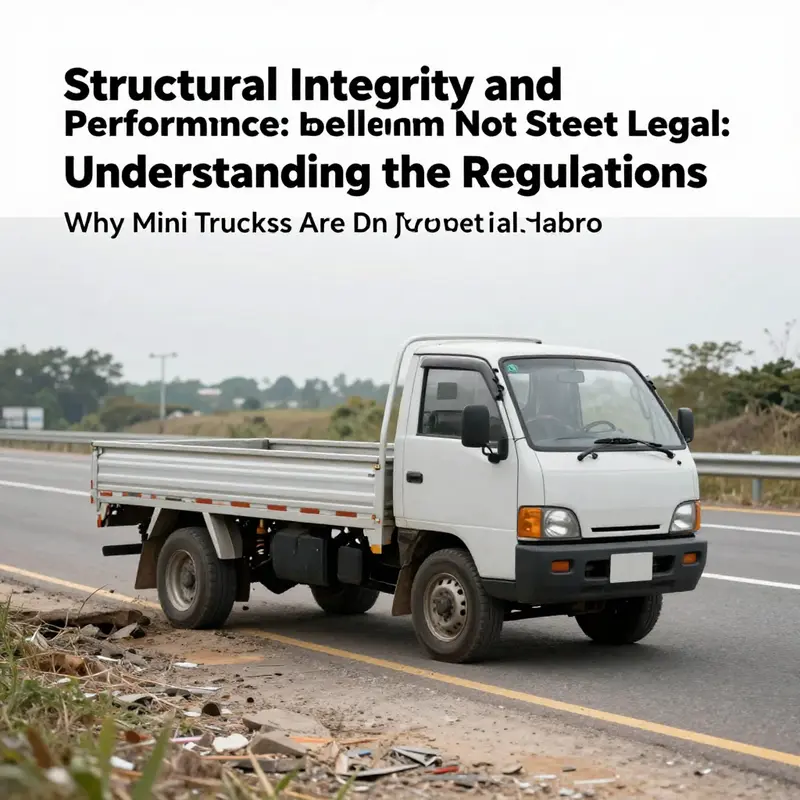
Tiny, efficient, and nimble by design, mini trucks occupy a curious niche where utility meets limitation. They are machines built to move payloads through tight spaces, along narrow lanes, and across terrain that larger vehicles would struggle to navigate. Yet when the same machines are pressed into service on public roads at conventional traffic speeds, their core strengths become a set of vulnerabilities. The tension between the form that makes them ideal for farms, construction yards, and rural routes and the form that road authorities require for safe, predictable street use is not a philosophical debate. It is a practical accounting of structural integrity, performance envelopes, and regulatory expectations. What looks like an advantage in a controlled work environment can quickly become a liability on a bustling street where speed, stability, braking, and occupant protection must all perform to standardized thresholds. In this light, the barriers to street legality for these compact but capable machines emerge as a coherent picture rather than a scattered set of critiques, each related to the others and reinforcing the overarching reality: mini trucks were designed for a specific set of tasks, not for the unpredictable dynamics of public roadways.
From the outset, the central question about street legality is one of balance. A vehicle intended to haul payloads in a compact frame must rediscover safety in a way that does not compromise efficiency. That balance is difficult to achieve when the payload burden, the geometry of the chassis, and the dynamics of steering and braking converge under load at highway speeds. Payload capacity, the most obvious variable, acts as a barometer for the entire system. When a mini truck carries more than its recommended load, the suspension components, which are tuned for light duty and quick response, begin to suffer. Springs, dampers, and control arms experience greater stress, and the result can be a chain of effects that compromise braking performance, steering precision, and tire contact with the road. On a road with uneven surfaces, the extra weight compounds jostling and wobble, translating into longer stopping distances and less predictable handling. The vehicle’s lightweight construction may help it accelerate quickly and climb grades on a farm lane or a short urban stretch, but it is precisely that lightness that becomes a liability when heavy payloads are paired with road irregularities and higher travel speeds. In practical terms, the weight a driver adds through cargo alters the vehicle’s center of gravity, weight distribution, and roll stiffness, all of which shape how the vehicle reacts to braking, cornering, and lane changes. This is not merely a theoretical concern. It is observed in incident reports and real-world experience where even modest payloads on compact platforms degrade cornering stability, brake fade becomes more likely, and the risk of tire slip at highway speeds rises notably. A vehicle that is already near the lower end of a legitimate braking—and absorbing—capacity finds itself pressed to the edge when loads rise, and that edge is precisely where road users expect reliability and predictability.
The structural and geometric constraints that define mini trucks are not incidental features but intentional design choices. They reflect regulatory boundaries, manufacturing targets, and the practical realities of urban and rural work. In many jurisdictions, compact trucks must conform to dimensions and engine specifications designed to maintain maneuverability in crowded streets and allow safe neighborhoods to share space with small, economical work vehicles. These constraints include engine displacement limits, width and length caps, and height restrictions that are stringent enough to keep these vehicles from encroaching on typical highway volumes and speeds. On one hand, such limits support a nimble footprint. They allow these machines to squeeze through tight gaps, park in narrow stalls, and deliver in dense urban cores where larger vehicles simply cannot operate. On the other hand, they cap the potential payload and structural robustness that a vehicle would need to perform reliably on public roads over a long service life. When a vehicle is engineered with a maximum engine size and a narrow chassis, the consequence is a chassis and powertrain that are less capable of absorbing the shocks and sustaining the loads associated with road travel at higher speeds. The short wheelbase that helps it hustle through city traffic also reduces straight-line stability. A broader stance, which would usually improve cornering and high-speed stability, is often incompatible with the compact design language that makes these vehicles so attractive for specific tasks.
Design choices that favor maneuverability and economy tend to trade off long-term resilience. The suspension, when tuned for flat, predictable surfaces and light payloads, may lack the travel and robustness needed to cope with potholes, speed bumps, and uneven rural roads. A low ground clearance—an asset when navigating rough, narrow paths—becomes a liability when tall obstructions present themselves or when an unexpected road irregularity meets a vehicle with limited deflection capability. The result is a vehicle that can handle a farm lane just fine but is more vulnerable when confronted with the kind of street profile that includes rough asphalt, wheel ruts, or abrupt changes in grade. This susceptibility to road hazards is not a minor concern. It translates into a higher risk of damage to the undercarriage, alignment problems, and, in a worst-case scenario, impact to the safety-critical systems that keep a vehicle stable or controllable in traffic. The tightly tuned suspension, while excellent for efficiency and low-speed work, may not have the headroom to absorb repeated hits at expressway or arterial speeds. That reality is part of what regulators and engineers weigh when they evaluate whether a vehicle is suitable for public road use.
Manufacturers themselves confront a delicate set of trade-offs. To make a vehicle both affordable and practical, they must balance weight, strength, and efficiency. Heavier frames can improve durability and payload stability, but they erode fuel economy and erase some of the compact appeal that makes mini trucks viable in congested centers. Lighter frames save fuel and preserve the vehicle’s characteristic agility, but they demand more precise engineering to withstand the repeated strains of daily road use. This balancing act extends to the choice of materials, the layout of cross-members, and the design of attachment points for payloads. The challenge is not simply to survive a short hop from a loading dock to a worksite. It is to survive a lifetime of daily cycles on roads that include everything from smooth expressway surfaces to rough rural lanes. The structural integrity of the chassis and the reliability of the suspension are tested not only by the weight carried but by the frequency and severity of the road conditions encountered. In practice, this means that a mini truck engineered for optimized fuel use and urban deftness may require additional reinforcement if it starts to see highway duty. Conversely, a vehicle designed to be rugged and capable at speed would lose its edge in city tasks if it becomes too heavy or too stiff to absorb everyday bumps without transmitting that energy to the occupants.
The practical implications of these design and regulatory realities become clear when considering the everyday life of a vehicle that travels between a farm gate, a construction site, and a city street. On a public road, the vehicle must meet a floor of performance that includes reliable braking, predictable turning, adequate acceleration, and reasonable ride comfort for occupants. Each of these elements is typically tested within a framework of standardized performance metrics and safety protocols. A mini truck that excels at delivering a limited payload along a flat, smooth route may struggle when confronted with a road that taxes the suspension, demands swift deceleration, or requires stable handling at the upper end of its operating speed range. The numbers behind these issues—payload rating, payload distribution, braking performance, and stability margins—are not abstract. They map directly to the capabilities of a city driver negotiating a busy intersection or a rural resident traveling at pace along a two-lane road. A slight shift in weight distribution or a minor decrease in tire grip can ripple outward, affecting steering response, brake balance, and overall vehicle control. To an observer, these relationships look straightforward: heavier payloads demand more from the brakes; a shorter wheelbase reduces directional stability; modest speed on rough surfaces increases the risk of losing control. But the consequences are cumulative. The same small vehicle that shines in tight spaces becomes a liability when asked to perform across a varied road network where drivers expect consistent performance under unpredictable conditions.
Regulatory pathways further shape what is possible in the street-legal realm. In many jurisdictions, the process of making a vehicle street-legal includes a comprehensive set of checks that touch on safety equipment, emissions, crash protection, and structural conformity. Vehicles that were designed for controlled environments—like farms or construction sites—often fail to meet these criteria without substantial modification. The consequence is a classification that places them outside the normal highway-legal category, requiring either a significant certification program or a conversion that redefines the vehicle’s use case. The hurdles are not merely bureaucratic. They embody a public-policy calculus: how to balance the benefits of a narrow, highly maneuverable vehicle against the risks it poses when integrated into congested traffic. The answer, in most places, leans toward caution. Vehicles that lack essential safety features—seat belts, crash protection structures, and compliant lighting—face a heightened risk of injury or harm in the event of an accident. Lights and signaling must be robust enough to inform other drivers of intent and presence, a baseline that becomes harder to achieve when a vehicle’s suspension travel is limited and its lighting system is scaled for a different operating regime. Even emissions and noise standards, which might appear tangential to structural concerns, become binding once a vehicle is expected to operate widely. An efficient, low-emission city runner may still fail to meet the normative standards if its certification testing was conducted in a restricted context or if it cannot demonstrate consistent compliance across the full range of environmental conditions. In short, the street-legal path is not just about adding safety gadgets. It is about proving that the entire system—engine, drivetrain, chassis, and safety architecture—can operate within the same, well-defined envelope as the other vehicles on the road.
One can imagine a scenario in which a mini truck is transformed to meet these standards through a sequence of carefully planned changes. The modifications would need to address structural reinforcement, improved suspension travel, upgraded steering geometry, enhanced braking capacity, and a body that accommodates occupant protection without inflating the weight beyond what the platform can tolerate. Also essential would be a certified safety system that includes properly installed seat belts and crash protection, plus a lighting scheme that meets the jurisdiction’s visibility and signaling requirements. Then there are the regulatory steps: vehicle inspections, emissions testing, and the procurement of insurance and registration that recognize the vehicle as a road-enabled instrument rather than an off-road specialty. Each stage adds cost, complexity, and time, and for many manufacturers and operators, the calculus does not favor transformation when the same resources could yield better return by focusing on purpose-built road-legal designs from the outset. This is not to say that street legality is unattainable for mini trucks. Rather, it is to acknowledge that any path toward legalization has to acknowledge a deep set of engineering, economic, and regulatory realities that are rarely trivial to overcome. The result is a pragmatic conclusion that, for many users, these vehicles remain best suited to the environments for which they were originally conceived and certified.
From a community perspective, the conversation about whether mini trucks should ever be street-legal in broader markets often centers on the questions of purpose and value. The core appeal of these vehicles lies in their compact footprint, their affordability, and their ability to perform targeted tasks in spaces where larger trucks cannot operate. Yet those same virtues can raise practical concerns when a vehicle moves from a controlled work site into mixed traffic. The narrow track width and relatively high maneuverability, for instance, can be a blessing in tight alleys but become a liability on a multi-lane road where lane discipline, braking distance, and cross-traffic gaps demand a more forgiving balance of mass and momentum. The same vehicle’s minimal aerodynamic drag and efficient powertrain may offer city energy savings, but the same efficiency cannot compensate for the safety margins demanded by road authorities when the vehicle is subject to the dynamic demands of a full urban or highway network. The tension is not unusual in the broader conversation about micro-mobility and small utility vehicles. It mirrors similar debates about how best to reconcile the benefits of compact, low-cost machinery with the protected, standardized environment of street travel. The practical upshot, however, remains stubbornly concrete: without substantial redesign to meet road-going standards, mini trucks in their current configurations belong to a niche rather than a broad public-road category. Those who study or work with these vehicles—fleet managers, municipal planners, and safety engineers—tend to emphasize that the road experience requires more than clever packaging and efficient powertrains. It requires a verified record of performance under diverse, real-world conditions and a regulatory status that confirms that the vehicle can be counted on to behave within accepted safety envelopes.
For readers who want a more community-centered sense of how these discussions unfold, a visit to industry forums and blogs provides context about the practical realities of owning and operating compact work vehicles in varied environments. These conversations commonly highlight the everyday trade-offs: the appeal of a small footprint for narrow streets, the hassle of obtaining street-legal status, and the ongoing balancing act between efficiency, payload, and safety. The forum threads illuminate how operators adapt to the constraints of the rules while still seeking to maximize the utility of their compact machines. They offer case studies in decision-making, showing how fleets decide whether to invest in high-demand, road-ready variants or to keep these vehicles strictly on site where they perform most effectively. For readers seeking a starting point to explore such perspectives, the Minitrucks Ocala blog provides a useful entry point to discussions about how these vehicles are used in real-world settings and how communities think about their place on public roads. Minitrucks Ocala blog offers a window into the practical considerations, the compromises, and the optimism that accompanies the continued use of compact, work-focused vehicles in regions where space, cost, and efficiency shape everyday choices.
In sum, the structural integrity and performance story of mini trucks on public roads is not a simple tale of “good” or “bad.” It is a layered narrative about capacity, durability, and the responsibilities that come with sharing space with higher-speed traffic. The payload limits that give these vehicles their distinct advantage in controlled environments also constrain their ability to operate safely in more demanding road contexts. Regulatory standards exist not to prevent innovation but to ensure that when a vehicle enters the street, it does so with a known and manageable risk profile. The engineering choices that give mini trucks their speed, steering agility, and energy efficiency can be compatible with public-road use—provided the design includes sufficient structural resilience, appropriate safety systems, and an identification as a vehicle that can be tested, certified, and insured as roadworthy. Absent those elements, the gaps between a vehicle’s performance in a yard or on a farm lane and its behavior in mixed traffic become a clear and persistent safety concern. The wider conversation continues to evolve as engineers, regulators, and operators weigh the benefits of compact, low-cost mobility against the obligations of highway safety. And while the current reality is that many mini trucks remain outside the street-legal framework in many markets, the underlying engineering challenge remains a unifying thread: to deliver the trusted reliability of a work vehicle without compromising the safety and predictability that the public road demands. For those who want to explore further, the National Highway Traffic Safety Administration’s official guidelines offer a detailed grounding in the standards that govern street-legal requirements and the pathways for compliance. https://www.nhtsa.gov
Final thoughts
Understanding the reasons behind the non-street legal status of mini trucks highlights the multifaceted nature of vehicle regulations. From lacking essential safety features to strict emissions standards and structural limitations, these hurdles prevent mini trucks from being integrated into regular traffic safely. While mini trucks serve vital roles in agriculture and local businesses, addressing these challenges is necessary for their road use. For enthusiasts, focusing on compliance and potential modifications can pave the way for increased usability in the future.