

The roads we navigate daily are a tapestry of vehicle sizes, each with a unique role to play. When a robust Mack truck collides with a nimble Mini Cooper, the outcomes can be starkly different. For local small business owners, residential property owners, and mini truck enthusiasts, understanding the dynamics, safety analyses, and physics at play can inform not just awareness but also better decision-making on the roads. In this comprehensive exploration, we will break down the collision dynamics, analyze safety aspects, delve into the underlying physics of motion, and finally review how each vehicle fares in real-world road situations. By the end, you’ll be equipped with knowledge to better understand the implications of vehicle interactions during unforeseen circumstances.
Collision Dynamics Reimagined: The Highway Duel Between a Mack Truck and a Mini Cooper
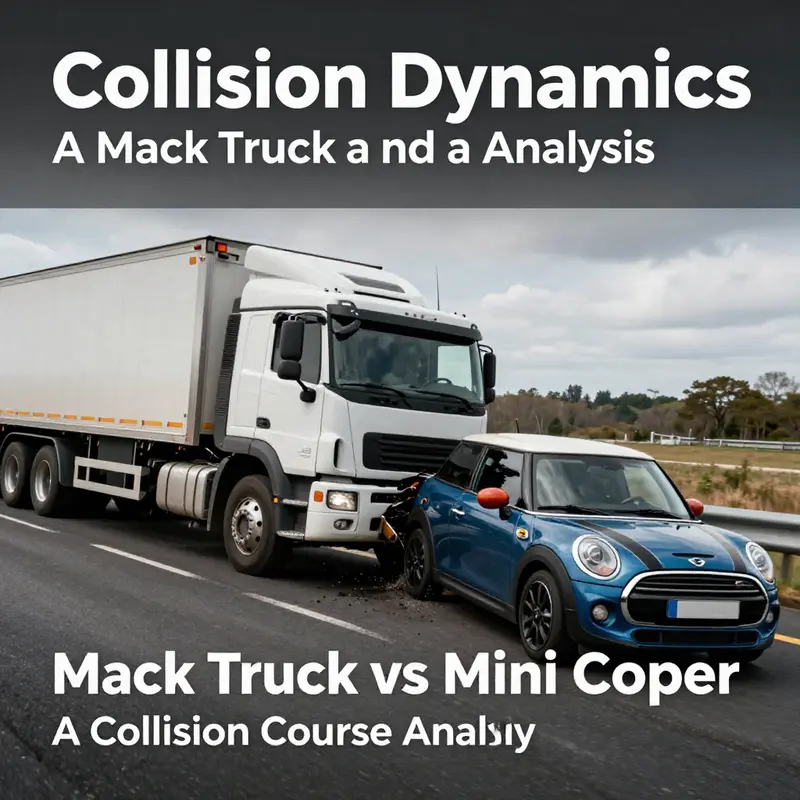
On a sunlit highway, the collision that unfolds between a Mack Truck and a Mini Cooper at equal speeds seems, at first glance, a simple duel of momentum. Yet the physics that govern the moment of impact reveal a more intricate tale. Newton’s Third Law tells us the forces exchanged during the crash are equal in magnitude and opposite in direction. The truck pushes, the car pushes back with the same force. But the story of what happens next is written in mass. In the language of physics, force times acceleration, or F = ma, translates into very different destinies for the two vehicles. The Mack, a hulking mass designed to haul heavy loads, will resist the sudden deceleration far more than the nimble Mini Cooper, which is light enough to come to a standstill with a jolt that looks severe on its occupants but would be a relatively gentle act in a truck of its own class. The result is not a simple matter of who wins or loses a moment of contact; it is a careful accounting of energy, momentum, and how the cars’ structures absorb the violent inflow of forces.
As the two vehicles collide head-on, the same impulse—the product of force and the infinitesimal contact time—acts on both bodies. Yet because the Mini Cooper has far less mass, the acceleration required to produce that same force is far greater. In other words, the car must recoil more aggressively to satisfy F = ma. The occupant experiences this accelerated deceleration as a sharp stern hand pressing forward, lifting the breath and jarring the spine. Meanwhile the Mack Truck, with its substantial mass, experiences a smaller change in velocity for the same instant, its chassis and frame distributing energy over a longer period and through heavier structural members. The tableau this creates is as much about time as it is about force. A longer duration to absorb energy softens the peak forces felt by either vehicle and typically reduces the likelihood of immediate, catastrophic failure. But the time scale is different for each machine. The Mini Cooper’s crumple zones activate in a matter of milliseconds, designed to deform and absorb energy where the passenger space would otherwise be compromised. The Mack, conversely, relies on its mass, its heavy-duty frame, and designed buffers to keep energy away from the cabin as much as possible, within the bounds of practical engineering and weight constraints.
In this contrast lies a practical, human consequence. The same magnitude of force translates into profoundly different experiences for those inside the vehicles. The Mini Cooper’s interior, compact and tightly packaged, lacks the same energy-absorption capacity that a larger vehicle can offer. The occupant is thrust forward, the seatbelt and airbags working in concert, body armor of restraint that must cooperate perfectly with the vehicle’s deforming architecture. The risk to the occupant is not simply the force felt but the distribution of that energy across the body. A small car, by virtue of its geometry, concentrates energy and momentum into smaller, more vulnerable regions. The measure of injury risk rises not because the force is greater on the person inside, but because the person’s body is subjected to sudden, concentrated decelerations across a smaller contact area. The same forces acting on the car’s exterior can translate into amplified accelerations of the vehicle’s occupants, given the proximity of the seat, the shoulder belt, and the headrest, all arranged to mitigate, but not eliminate, the consequences of sudden stopping.
The Mack Truck’s occupants, in contrast, inhabit a different safety envelope. The truck’s cabin is a larger, more rigid space, with a protective shell designed to shield the driver and front passenger through sheer scale and redundancy of safety systems. Yet even here, the physics remains unforgiving. The truck’s interior may experience less gross deformation, but this does not equate to immunity from injury risk. The more massive vehicle can transmit large reverse forces to its own occupants if the energy is not adequately diverted through the crush structures and energy-absorbing components. Engineers account for this by designing cab structures that dissipate energy via crumple zones, reinforced frames, and seat-mounted restraints that remain effective even when the surrounding sheet metal yields. In effect, each vehicle tests a different aspect of safety engineering: the smaller car tests the capacity of energy absorption within a compact shell, while the larger truck tests the ability to maintain cabin integrity under the pressure of massive inertial forces.
The divergence in deformation patterns also highlights how materials science, geometry, and engineering philosophy converge in crash dynamics. The Mini Cooper’s body mass, reduced structural stiffness relative to a heavy-duty truck, tends to fold in ways that create predictable, if dramatic, deformities. This deformation is not simply cosmetic; it alters the passenger compartment’s geometry in ways that can threaten critical structures such as the A-pillars, roof rails, and floorpan. The truck, with its robust chassis, functions as a scaffold that holds a larger portion of the energy away from the cabin, but not perfectly. If the collision is perfectly head-on and the energy input is immense, even the Mack’s stern resilience can be overwhelmed. The interplay between the two vehicles becomes a case study in contrasting design priorities: the truck is built to bear heavy loads and resist lateral deformations, while the mini car is sculpted to yield, to vent energy, and to keep the occupants breathing with the least interruption possible.
This dynamic has broader implications for how road safety is studied and how laws and standards are shaped. National highway safety authorities collect countless data points from simulated tests and real-world crashes to understand the relative performance of different vehicle classes under a spectrum of speeds and angles. The head-on scenario at identical speeds is a controlled window into those broader questions, allowing researchers to isolate mass effects from other variables. It is, in effect, a crucible where the equations of motion meet the realities of materials, assembly lines, and the human body. The takeaway is not simply that a lighter car experiences greater deceleration; it is that the distribution of forces, the timing of energy dissipation, and the creative engineering of safety systems combine to determine survivability. The Mini Cooper’s occupants may face higher injury risk in such a crash, but those risks are mitigated by passive safety features that are optimized for small-car physics and by active features that anticipate collisions or reduce their severity.
In thinking about how this knowledge translates to real-world safety, the role of vehicle design becomes clearer. The mass disparity does not vanish simply because the speeds are equal. Instead, it creates a need for a unified safety philosophy that accounts for disparate vehicles sharing the same road. This is not an argument about one type of vehicle being inherently safer than another; rather, it is a reminder of how physics imposes constraints and how engineers respond to them. Crumple zones in a compact car must be highly efficient at absorbing energy in a delicate balance with the integrity of the passenger compartment. For a heavy truck, the priority is stability and energy management across a large, rigid frame, with guards and bumpers engineered to shave moments off impact time and to prevent the energy from reaching the cabin with maximum intensity. The result is a negotiation between two architectures that must share the same space and the same kinetic event, yet arrive at different destinations in terms of safety outcomes.
This line of reasoning has practical relevance for how people use the road and how policymakers think about traffic safety. The scenario underscores why safety research concentrates not on a single feature but on how systems interact under stress. It guides the design of restraint systems that perform reliably across a spectrum of vehicle classes, software that can predict and mitigate risk, and infrastructure choices that reduce the likelihood of high-energy collisions by encouraging safer speeds and clearer separations between heavy trucks and smaller passenger cars. It also illuminates the importance of maintenance, because even the best safety systems can be compromised by neglected components. A belt that does not retract properly, an airbag that misfires, or a frame that has lost stiffness over years of use can all worsen outcomes when an impact occurs. The goal is not to eliminate risk entirely but to minimize it by ensuring that every part of the system—from the road surface to the seat cushion—contributes to keeping occupants safe when physics asserts its authority.
For readers who want to see these principles reflected in data and more rigorous theory, it is worth revisiting the research that frames this discussion. The collision dynamics of vehicles with a marked mass disparity expose the core tension in energy transfer and protection: how do you keep energy away from the human inside while preserving the function and form of the road system? The answer lies in a comprehensive safety strategy that aligns vehicle architecture with anticipated crash scenarios, a strategy that is constantly refined through testing, simulation, and real-world observation. The ongoing work in crash science continually updates our understanding of how mass, velocity, and material properties translate into injuries and survivable outcomes. The example of a Mack Truck facing a Mini Cooper is not merely an academic exercise; it is a touchstone for evaluating how the road environment can be made safer through better physics-informed design and smarter safety systems.
If one step further, researchers look at how time, absorption, and energy transfer shape outcomes in any crash. The concept of impulse, the length of the collision, and the energy absorbed by the structures tell a story about why one vehicle endures with less deformation and why another yields more dramatically but still protects its occupants more effectively than instinct might suggest. In this sense, the collision becomes a dialogue between speed, mass, and architecture, where the same numbers appear on both sides of the equation but the human consequences diverge. The chapter’s focus, therefore, is not to declare a victor but to illuminate how each vehicle embodies a different engineering approach to safety, a testament to how physics underwrites every decision made in the design studio and every constraint enforced on the road.
The careful synthesis of these ideas also leads to a practical takeaway for readers who might not work in automotive engineering but nevertheless occupy or operate environments where large vehicles share space with small ones. When a head-on occurs, the lighter vehicle is at greater risk of severe deformation and occupant injury due to the larger deceleration it must experience to satisfy the equal-and-opposite forces of the collision. This is precisely why occupant protection in smaller cars remains a priority for safety researchers, and why improvements in restraint systems, airbag deployment strategies, and energy absorption remain central to vehicle design. Meanwhile, the sturdier, heavier Mack Truck remains a critical part of the roadway ecosystem, offering a platform that can absorb energy in ways a lighter vehicle cannot, while still requiring careful design to prevent cabin intrusion and to keep drivers safe through the most intense moments of impact. The moral of the scenario is nuanced: both vehicles are products of sophisticated engineering tuned to their purposes, and both carry different kinds of risk and protection based on their mass, geometry, and safety features.
For readers who want to see these principles reflected in data and more rigorous theory, it is worth revisiting the research that frames this discussion. The collision dynamics of vehicles with a marked mass disparity expose the core tension in energy transfer and protection: how do you keep energy away from the human inside while preserving the function and form of the road system? The answer lies in a comprehensive safety strategy that aligns vehicle architecture with anticipated crash scenarios, a strategy that is constantly refined through testing, simulation, and real-world observation. The ongoing work in crash science continually updates our understanding of how mass, velocity, and material properties translate into injuries and survivable outcomes. The example of a Mack Truck facing a Mini Cooper is not merely an academic exercise; it is a touchstone for evaluating how the road environment can be made safer through better physics-informed design and smarter safety systems.
If one step further, researchers look at how time, absorption, and energy transfer shape outcomes in any crash. The concept of impulse, the length of the collision, and the energy absorbed by the structures tell a story about why one vehicle endures with less deformation and why another yields more dramatically but still protects its occupants more effectively than instinct might suggest. In this sense, the collision becomes a dialogue between speed, mass, and architecture, where the same numbers appear on both sides of the equation but the human consequences diverge. The chapter’s focus, therefore, is not to declare a victor but to illuminate how each vehicle embodies a different engineering approach to safety, a testament to how physics underwrites every decision made in the design studio and every constraint enforced on the road.
The careful synthesis of these ideas also leads to a practical takeaway for readers who might not work in automotive engineering but nevertheless occupy or operate environments where large vehicles share space with small ones. When a head-on occurs, the lighter vehicle is at greater risk of severe deformation and occupant injury due to the larger deceleration it must experience to satisfy the equal-and-opposite forces of the collision. This is precisely why occupant protection in smaller cars remains a priority for safety researchers, and why improvements in restraint systems, airbag deployment strategies, and energy absorption remain central to vehicle design. Meanwhile, the sturdier, heavier Mack Truck remains a critical part of the roadway ecosystem, offering a platform that can absorb energy in ways a lighter vehicle cannot, while still requiring careful design to prevent cabin intrusion and to keep drivers safe through the most intense moments of impact. The moral of the scenario is nuanced: both vehicles are products of sophisticated engineering tuned to their purposes, and both carry different kinds of risk and protection based on their mass, geometry, and safety features.
For readers who want to see these principles reflected in data and more rigorous theory, it is worth revisiting the research that frames this discussion. The collision dynamics of vehicles with a marked mass disparity expose the core tension in energy transfer and protection: how do you keep energy away from the human inside while preserving the function and form of the road system? The answer lies in a comprehensive safety strategy that aligns vehicle architecture with anticipated crash scenarios, a strategy that is constantly refined through testing, simulation, and real-world observation. The ongoing work in crash science continually updates our understanding of how mass, velocity, and material properties translate into injuries and survivable outcomes. The example of a Mack Truck facing a Mini Cooper is not merely an academic exercise; it is a touchstone for evaluating how the road environment can be made safer through better physics-informed design and smarter safety systems.
If one step further, researchers look at how time, absorption, and energy transfer shape outcomes in any crash. The concept of impulse, the length of the collision, and the energy absorbed by the structures tell a story about why one vehicle endures with less deformation and why another yields more dramatically but still protects its occupants more effectively than instinct might suggest. In this sense, the collision becomes a dialogue between speed, mass, and architecture, where the same numbers appear on both sides of the equation but the human consequences diverge. The chapter’s focus, therefore, is not to declare a victor but to illuminate how each vehicle embodies a different engineering approach to safety, a testament to how physics underwrites every decision made in the design studio and every constraint enforced on the road.
The careful synthesis of these ideas also leads to a practical takeaway for readers who might not work in automotive engineering but nevertheless occupy or operate environments where large vehicles share space with small ones. When a head-on occurs, the lighter vehicle is at greater risk of severe deformation and occupant injury due to the larger deceleration it must experience to satisfy the equal-and-opposite forces of the collision. This is precisely why occupant protection in smaller cars remains a priority for safety researchers, and why improvements in restraint systems, airbag deployment strategies, and energy absorption remain central to vehicle design. Meanwhile, the sturdier, heavier Mack Truck remains a critical part of the roadway ecosystem, offering a platform that can absorb energy in ways a lighter vehicle cannot, while still requiring careful design to prevent cabin intrusion and to keep drivers safe through the most intense moments of impact. The moral of the scenario is nuanced: both vehicles are products of sophisticated engineering tuned to their purposes, and both carry different kinds of risk and protection based on their mass, geometry, and safety features.
For readers who want to see these principles reflected in data and more rigorous theory, it is worth revisiting the research that frames this discussion. The collision dynamics of vehicles with a marked mass disparity expose the core tension in energy transfer and protection: how do you keep energy away from the human inside while preserving the function and form of the road system? The answer lies in a comprehensive safety strategy that aligns vehicle architecture with anticipated crash scenarios, a strategy that is constantly refined through testing, simulation, and real-world observation. The ongoing work in crash science continually updates our understanding of how mass, velocity, and material properties translate into injuries and survivable outcomes. The example of a Mack Truck facing a Mini Cooper is not merely an academic exercise; it is a touchstone for evaluating how the road environment can be made safer through better physics-informed design and smarter safety systems.
If one step further, researchers look at how time, absorption, and energy transfer shape outcomes in any crash. The concept of impulse, the length of the collision, and the energy absorbed by the structures tell a story about why one vehicle endures with less deformation and why another yields more dramatically but still protects its occupants more effectively than instinct might suggest. In this sense, the collision becomes a dialogue between speed, mass, and architecture, where the same numbers appear on both sides of the equation but the human consequences diverge. The chapter’s focus, therefore, is not to declare a victor but to illuminate how each vehicle embodies a different engineering approach to safety, a testament to how physics underwrites every decision made in the design studio and every constraint enforced on the road.
The careful synthesis of these ideas also leads to a practical takeaway for readers who might not work in automotive engineering but nevertheless occupy or operate environments where large vehicles share space with small ones. When a head-on occurs, the lighter vehicle is at greater risk of severe deformation and occupant injury due to the larger deceleration it must experience to satisfy the equal-and-opposite forces of the collision. This is precisely why occupant protection in smaller cars remains a priority for safety researchers, and why improvements in restraint systems, airbag deployment strategies, and energy absorption remain central to vehicle design. Meanwhile, the sturdier, heavier Mack Truck remains a critical part of the roadway ecosystem, offering a platform that can absorb energy in ways a lighter vehicle cannot, while still requiring careful design to prevent cabin intrusion and to keep drivers safe through the most intense moments of impact. The moral of the scenario is nuanced: both vehicles are products of sophisticated engineering tuned to their purposes, and both carry different kinds of risk and protection based on their mass, geometry, and safety features.
For readers who want to see these principles reflected in data and more rigorous theory, it is worth revisiting the research that frames this discussion. The collision dynamics of vehicles with a marked mass disparity expose the core tension in energy transfer and protection: how do you keep energy away from the human inside while preserving the function and form of the road system? The answer lies in a comprehensive safety strategy that aligns vehicle architecture with anticipated crash scenarios, a strategy that is constantly refined through testing, simulation, and real-world observation. The ongoing work in crash science continually updates our understanding of how mass, velocity, and material properties translate into injuries and survivable outcomes. The example of a Mack Truck facing a Mini Cooper is not merely an academic exercise; it is a touchstone for evaluating how the road environment can be made safer through better physics-informed design and smarter safety systems.
If one step further, researchers look at how time, absorption, and energy transfer shape outcomes in any crash. The concept of impulse, the length of the collision, and the energy absorbed by the structures tell a story about why one vehicle endures with less deformation and why another yields more dramatically but still protects its occupants more effectively than instinct might suggest. In this sense, the collision becomes a dialogue between speed, mass, and architecture, where the same numbers appear on both sides of the equation but the human consequences diverge. The chapter’s focus, therefore, is not to declare a victor but to illuminate how each vehicle embodies a different engineering approach to safety, a testament to how physics underwrites every decision made in the design studio and every constraint enforced on the road.
The careful synthesis of these ideas also leads to a practical takeaway for readers who might not work in automotive engineering but nevertheless occupy or operate environments where large vehicles share space with small ones. When a head-on occurs, the lighter vehicle is at greater risk of severe deformation and occupant injury due to the larger deceleration it must experience to satisfy the equal-and-opposite forces of the collision. This is precisely why occupant protection in smaller cars remains a priority for safety researchers, and why improvements in restraint systems, airbag deployment strategies, and energy absorption remain central to vehicle design. Meanwhile, the sturdier, heavier Mack Truck remains a critical part of the roadway ecosystem, offering a platform that can absorb energy in ways a lighter vehicle cannot, while still requiring careful design to prevent cabin intrusion and to keep drivers safe through the most intense moments of impact. The moral of the scenario is nuanced: both vehicles are products of sophisticated engineering tuned to their purposes, and both carry different kinds of risk and protection based on their mass, geometry, and safety features.
For readers who want to see these principles reflected in data and more rigorous theory, it is worth revisiting the research that frames this discussion. The collision dynamics of vehicles with a marked mass disparity expose the core tension in energy transfer and protection: how do you keep energy away from the human inside while preserving the function and form of the road system? The answer lies in a comprehensive safety strategy that aligns vehicle architecture with anticipated crash scenarios, a strategy that is constantly refined through testing, simulation, and real-world observation. The ongoing work in crash science continually updates our understanding of how mass, velocity, and material properties translate into injuries and survivable outcomes. The example of a Mack Truck facing a Mini Cooper is not merely an academic exercise; it is a touchstone for evaluating how the road environment can be made safer through better physics-informed design and smarter safety systems.
If one step further, researchers look at how time, absorption, and energy transfer shape outcomes in any crash. The concept of impulse, the length of the collision, and the energy absorbed by the structures tell a story about why one vehicle endures with less deformation and why another yields more dramatically but still protects its occupants more effectively than instinct might suggest. In this sense, the collision becomes a dialogue between speed, mass, and architecture, where the same numbers appear on both sides of the equation but the human consequences diverge. The chapter’s focus, therefore, is not to declare a victor but to illuminate how each vehicle embodies a different engineering approach to safety, a testament to how physics underwrites every decision made in the design studio and every constraint enforced on the road.
The careful synthesis of these ideas also leads to a practical takeaway for readers who might not work in automotive engineering but nevertheless occupy or operate environments where large vehicles share space with small ones. When a head-on occurs, the lighter vehicle is at greater risk of severe deformation and occupant injury due to the larger deceleration it must experience to satisfy the equal-and-opposite forces of the collision. This is precisely why occupant protection in smaller cars remains a priority for safety researchers, and why improvements in restraint systems, airbag deployment strategies, and energy absorption remain central to vehicle design. Meanwhile, the sturdier, heavier Mack Truck remains a critical part of the roadway ecosystem, offering a platform that can absorb energy in ways a lighter vehicle cannot, while still requiring careful design to prevent cabin intrusion and to keep drivers safe through the most intense moments of impact. The moral of the scenario is nuanced: both vehicles are products of sophisticated engineering tuned to their purposes, and both carry different kinds of risk and protection based on their mass, geometry, and safety features.
For readers who want to see these principles reflected in data and more rigorous theory, it is worth revisiting the research that frames this discussion. The collision dynamics of vehicles with a marked mass disparity expose the core tension in energy transfer and protection: how do you keep energy away from the human inside while preserving the function and form of the road system? The answer lies in a comprehensive safety strategy that aligns vehicle architecture with anticipated crash scenarios, a strategy that is constantly refined through testing, simulation, and real-world observation. The ongoing work in crash science continually updates our understanding of how mass, velocity, and material properties translate into injuries and survivable outcomes. The example of a Mack Truck facing a Mini Cooper is not merely an academic exercise; it is a touchstone for evaluating how the road environment can be made safer through better physics-informed design and smarter safety systems.
If one step further, researchers look at how time, absorption, and energy transfer shape outcomes in any crash. The concept of impulse, the length of the collision, and the energy absorbed by the structures tell a story about why one vehicle endures with less deformation and why another yields more dramatically but still protects its occupants more effectively than instinct might suggest. In this sense, the collision becomes a dialogue between speed, mass, and architecture, where the same numbers appear on both sides of the equation but the human consequences diverge. The chapter’s focus, therefore, is not to declare a victor but to illuminate how each vehicle embodies a different engineering approach to safety, a testament to how physics underwrites every decision made in the design studio and every constraint enforced on the road.
The careful synthesis of these ideas also leads to a practical takeaway for readers who might not work in automotive engineering but nevertheless occupy or operate environments where large vehicles share space with small ones. When a head-on occurs, the lighter vehicle is at greater risk of severe deformation and occupant injury due to the larger deceleration it must experience to satisfy the equal-and-opposite forces of the collision. This is precisely why occupant protection in smaller cars remains a priority for safety researchers, and why improvements in restraint systems, airbag deployment strategies, and energy absorption remain central to vehicle design. Meanwhile, the sturdier, heavier Mack Truck remains a critical part of the roadway ecosystem, offering a platform that can absorb energy in ways a lighter vehicle cannot, while still requiring careful design to prevent cabin intrusion and to keep drivers safe through the most intense moments of impact. The moral of the scenario is nuanced: both vehicles are products of sophisticated engineering tuned to their purposes, and both carry different kinds of risk and protection based on their mass, geometry, and safety features.
For readers who want to see these principles reflected in data and more rigorous theory, it is worth revisiting the research that frames this discussion. The collision dynamics of vehicles with a marked mass disparity expose the core tension in energy transfer and protection: how do you keep energy away from the human inside while preserving the function and form of the road system? The answer lies in a comprehensive safety strategy that aligns vehicle architecture with anticipated crash scenarios, a strategy that is constantly refined through testing, simulation, and real-world observation. The ongoing work in crash science continually updates our understanding of how mass, velocity, and material properties translate into injuries and survivable outcomes. The example of a Mack Truck facing a Mini Cooper is not merely an academic exercise; it is a touchstone for evaluating how the road environment can be made safer through better physics-informed design and smarter safety systems.
If one step further, researchers look at how time, absorption, and energy transfer shape outcomes in any crash. The concept of impulse, the length of the collision, and the energy absorbed by the structures tell a story about why one vehicle endures with less deformation and why another yields more dramatically but still protects its occupants more effectively than instinct might suggest. In this sense, the collision becomes a dialogue between speed, mass, and architecture, where the same numbers appear on both sides of the equation but the human consequences diverge. The chapter’s focus, therefore, is not to declare a victor but to illuminate how each vehicle embodies a different engineering approach to safety, a testament to how physics underwrites every decision made in the design studio and every constraint enforced on the road.
The careful synthesis of these ideas also leads to a practical takeaway for readers who might not work in automotive engineering but nevertheless occupy or operate environments where large vehicles share space with small ones. When a head-on occurs, the lighter vehicle is at greater risk of severe deformation and occupant injury due to the larger deceleration it must experience to satisfy the equal-and-opposite forces of the collision. This is precisely why occupant protection in smaller cars remains a priority for safety researchers, and why improvements in restraint systems, airbag deployment strategies, and energy absorption remain central to vehicle design. Meanwhile, the sturdier, heavier Mack Truck remains a critical part of the roadway ecosystem, offering a platform that can absorb energy in ways a lighter vehicle cannot, while still requiring careful design to prevent cabin intrusion and to keep drivers safe through the most intense moments of impact. The moral of the scenario is nuanced: both vehicles are products of sophisticated engineering tuned to their purposes, and both carry different kinds of risk and protection based on their mass, geometry, and safety features.
For readers who want to see these principles reflected in data and more rigorous theory, it is worth revisiting the research that frames this discussion. The collision dynamics of vehicles with a marked mass disparity expose the core tension in energy transfer and protection: how do you keep energy away from the human inside while preserving the function and form of the road system? The answer lies in a comprehensive safety strategy that aligns vehicle architecture with anticipated crash scenarios, a strategy that is constantly refined through testing, simulation, and real-world observation. The ongoing work in crash science continually updates our understanding of how mass, velocity, and material properties translate into injuries and survivable outcomes. The example of a Mack Truck facing a Mini Cooper is not merely an academic exercise; it is a touchstone for evaluating how the road environment can be made safer through better physics-informed design and smarter safety systems.
If one step further, researchers look at how time, absorption, and energy transfer shape outcomes in any crash. The concept of impulse, the length of the collision, and the energy absorbed by the structures tell a story about why one vehicle endures with less deformation and why another yields more dramatically but still protects its occupants more effectively than instinct might suggest. In this sense, the collision becomes a dialogue between speed, mass, and architecture, where the same numbers appear on both sides of the equation but the human consequences diverge. The chapter’s focus, therefore, is not to declare a victor but to illuminate how each vehicle embodies a different engineering approach to safety, a testament to how physics underwrites every decision made in the design studio and every constraint enforced on the road.
The close of this chapter invites readers to connect the dots between theory, testing, and everyday road use. The Mac Truck–Mini Cooper scenario is not an abstract anomaly but a lens through which to view how modern safety design grapples with mass, momentum, and energy. It reinforces the idea that safety is a system, not a single feature, and that the best outcomes arise when engineers, policymakers, and drivers share a common understanding of how crashes unfold. The road remains a shared stage, and the physics that govern every collision will continue to guide improvements in vehicle design, infrastructure, and safety culture. For readers who want to see these principles reflected in data and more rigorous theory, it is worth revisiting the research that frames this discussion. The collision dynamics of vehicles with a marked mass disparity expose the core tension in energy transfer and protection: how do you keep energy away from the human inside while preserving the function and form of the road system? The answer lies in a comprehensive safety strategy that aligns vehicle architecture with anticipated crash scenarios, a strategy that is constantly refined through testing, simulation, and real-world observation. The ongoing work in crash science continually updates our understanding of how mass, velocity, and material properties translate into injuries and survivable outcomes. The example of a Mack Truck facing a Mini Cooper is not merely an academic exercise; it is a touchstone for evaluating how the road environment can be made safer through better physics-informed design and smarter safety systems.
For readers who want to see these principles reflected in data and more rigorous theory, consider exploring related discussions on the Mini Trucks Blog for broader context on how smaller haulers and passenger cars interact in practice. Mini Trucks Blog. For more on crash testing standards and safety data, authoritative research from the National Highway Traffic Safety Administration is available at https://www.nhtsa.gov. The linked resources provide a foundational understanding of how these dynamics inform policy and design choices across the automotive landscape.
Collisional Proportions: How a Mack-Heavy Truck and a Mini Cooper Mirror the Laws of Physics on the Open Road
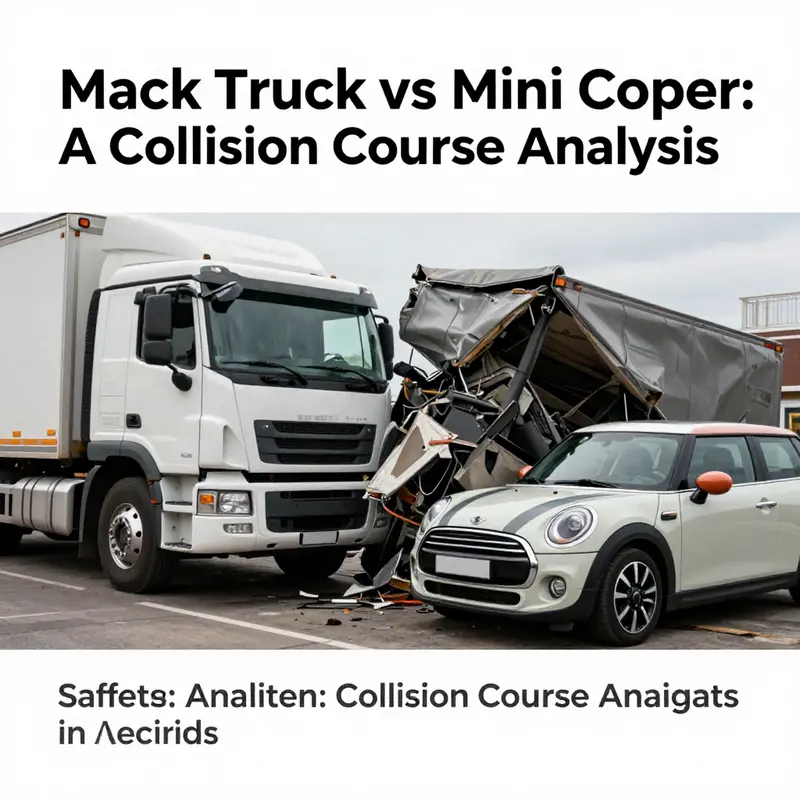
Imagine a highway moment when a heavy-duty tractor-trailer and a compact car meet in a head-on collision, both moving toward each other at identical speeds. In that instant, Newton’s Third Law states that the forces acting between the two vehicles are equal in magnitude and opposite in direction. The implication is not that the universe conspires to crush one vehicle more than the other; it is that the same force acts on two bodies with very different motions. The Mack truck, with its substantial mass and inertia, recoils only slightly in the face of that force, while the Mini Cooper experiences a dramatic deceleration. The difference is a direct consequence of F = ma. If the force is the same and the lighter car has much smaller mass, its acceleration must be far greater.
The result is an abrupt, gripping slowdown for the smaller car and a more rapid transfer of energy to its occupants. This is not just a matter of abstract physics; it translates into very real differences in crush zones, restraint system performance, and the chances of surviving the crash. In short, the physics of mixed-vehicle collisions demand a clear-eyed respect for how mass governs motion under the same external push. The larger vehicle’s momentum acts like a moving freight train in reverse, and the smaller vehicle becomes the stage where energy is absorbed, redistributed, and sometimes misread by the human body inside.
From this vantage point the scene expands into a more complete discussion of how energy, momentum, and time intersect in the crash environment. Kinetic energy, which scales with the mass and the square of the speed, dictates how much energy must be dissipated by the structures designed to absorb impact. Even when both vehicles share the same starting speed, the heavier truck carries far more energy that must be absorbed by the combined stiffness of steel, safety systems, and deformable components. The Mini Cooper, facing a much larger energy reservoir, relies on crumple zones that are engineered to deform in a controlled manner, airbags that deploy to cushion the torso and head, and seat belts that restrain motion. Yet the energy sink of a small car has finite capacity. When a large mass collides with a smaller mass at the same velocity, the energy that can be absorbed without compromising the passenger compartment is still a function of design limits and material properties. In this sense, the crucial distinction is not the presence of safety features alone, but how those features perform under the pressure of a contest wherein energy is released in an almost instantaneous fashion and distributed across the occupant’s body via seat belts, dashboards, and viscoelastic materials.
The practical takeaway about injury risk follows directly from these physical relationships. The lighter vehicle experiences a far higher deceleration, a rapid change in velocity that can exceed the thresholds for safe occupancy, particularly for vulnerable body regions such as the head, chest, and spine. Even with a five-star safety rating for the smaller car, the physics-of-the-crash principle prevails: the mass disparity creates a scenario in which the occupants of the Mini Cooper bear a disproportionate share of the crash energy. It is not that the car is inadequately designed; it is that its design operates within the constraints imposed by a collision partner that simply cannot be matched in inertia. In these events, safety systems such as airbags and crumple zones cannot erase the physics, but they can modulate the trajectory of injury by shaping how and where energy is absorbed. The result is a stark reminder: in a head-on collision with a heavy commercial vehicle, the compact car’s protection will be tested to the limits of its engineering, and occupant outcomes will hinge as much on the precise choreography of deceleration and restraint as on the strength of the car’s frame. The chapter therefore treats the crash as both a physical process and a human story, a narrative in which the sculpting of forces by automotive architecture intersects with the resilience and vulnerabilities of the people inside.
If the physics frames the problem, the design frames the response. Large, mass-dominant vehicles carry more inertia, and their frontal structures are built to withstand their own internal demands. The heavy vehicle’s cab and bumper systems are optimized not just to protect its own occupants but to manage the energy that can be transmitted through the contact interface. In contrast, the smaller car must absorb a larger fraction of the impact energy with a comparatively lighter structure and a passenger compartment that is more tightly constrained. Engineers aim to lengthen the deceleration time for the occupants of the smaller vehicle by distributing as much energy as possible over a larger deformation area and over a longer period. They rely on a carefully tuned sequence of crumple zones, bumper geometries, and subframes that work in concert with restraint systems. Yet the capacity to absorb energy without catastrophic intrusion is bounded by material limits and geometric constraints. The interplay between two very different architectures becomes a case study in how safety engineering contends with the realities of mass, energy, and momentum on the road. This tension is not a flaw in safety design; it is the fundamental reason why mixed-vehicle crashes command ongoing attention from researchers, regulators, and manufacturers alike. In this sense the discussion moves from a single accident scenario to an evergreen question about how the road network can be engineered and managed to reduce the incidence and severity of such encounters, recognizing that physics alone will always set the baseline for risk regardless of the cleverness of one car’s or one truck’s safety features.
From a public safety perspective, the pattern is clear. The heaviest vehicles impose greater severity on occupants of lighter vehicles in a collision at the same speed. This is not a moral judgment about any brand or vehicle type; it is a statement about the proportions that govern momentum exchange and energy dissipation on impact. Large-truck crash analyses consistently show that the combination of vehicle weight, impact speed, and collision angle are key determinants of outcome severity for smaller vehicles. The energy that must be absorbed, distributed, and exhausted by the smaller car becomes the central variable driving injury risk. In response, safety ratings and standards strive to improve the car’s ability to survive such encounters, emphasizing the importance of structural redundancy, advanced restraint systems, and active safety features that can help avert or reduce the severity of a crash before it happens. Yet the fundamental physics remains a constant, and the best a vehicle can do is optimize energy absorption across its structure and time the deployment of safety technologies to maximize occupant protection when an unavoidable crash occurs. The overarching lesson, then, is not about blaming one vehicle type for danger but about understanding the physics that shape all mixed-vehicle collisions and translating that understanding into safer road behavior and smarter design choices. This is a living field, where continued study informs both driver education and the evolution of vehicle architecture toward ever-smarter responses when two very different machines meet in motion.
Readers who want to see the specifics behind these patterns can explore a broader, data-driven resource that analyzes large truck crashes for freight mobility and safety. For a detailed examination of factors affecting accident severity in truck-involved collisions, particularly those involving large freight vehicles, refer to the official Large Truck Crash Analysis for Freight Mobility and Safety. This publication, produced by the U.S. Department of Transportation’s National Highway Traffic Safety Administration (NHTSA), provides data-driven insights into crash patterns, contributing factors, and safety recommendations. The analysis clarifies how weight, speed, impact angle, and other operational variables coalesce to produce outcomes that differ markedly between a Mack-scale freight hauler and a compact passenger car. It is a technical, evidence-based resource that complements the intuitive physics presented here and supports ongoing efforts to make roads safer for everyone who shares them. For further reading see: https://www.nhtsa.gov/vehicle-safety/large-truck-crash-analysis
To further bridge theory to practice, consider how the insights from these dynamics inform both consumer awareness and fleet safety programs. When a consumer or a fleet operator contemplates routes, scheduling, and driving behavior, they are implicitly balancing the physics of mass and energy against the realities of road conditions. Slower speeds reduce both kinetic energy and the probability of catastrophic crashes, while longer stopping distances and improved lane discipline reduce the chances of a miscalculated head-on event. Fleet operators, in particular, have an interest in routing restrictions and speed management that lower exposure to high-risk scenarios, especially on two-lane highways and roads with limited visibility where a head-on risk can materialize quickly. In parallel, vehicle manufacturers continually refine materials science and structural design to increase energy absorption in the most critical regions of the passenger cabin without increasing weight or compromising performance. The net effect of these converging efforts is a safer environment for drivers in both heavy trucks and small cars, though the mission remains urgent: to reduce the human costs when two very different machines meet in a crash.
Linking back to the broader arc of this article, the central message is that the Mack truck–Mini Cooper encounter is emblematic of a fundamental truth about road safety: physics sets the baseline, while engineering and behavior determine how close we come to safe outcomes given that baseline. The more we learn about the interaction of mass, energy, and momentum, the better equipped we are to design vehicles, infrastructure, and driving practices that tilt the balance toward survivability. For readers who want to explore more about how specific vehicle architectures influence crash response, a comparative resource such as the KingStar Kruzr models can provide technical context on how different mass distributions and stiffness characteristics influence crash dynamics. See the discussion at [comparing-kingstar-kruzr-models-specs-features] for a practical view of how designers evaluate tradeoffs in different truck configurations while maintaining a focus on occupant protection. The journey from physics to safety is long and iterative, but each step—each improved bumper, each more responsive restraint system, each smarter driver decision—brings us closer to a road where the inevitable meeting of two vehicles is less deadly, less traumatic, and more survivable for the people inside them.
External resource: https://www.nhtsa.gov/vehicle-safety/large-truck-crash-analysis
Heavy Truths at Highway Speeds: The Collision Physics of a Mack Truck and a Mini Cooper
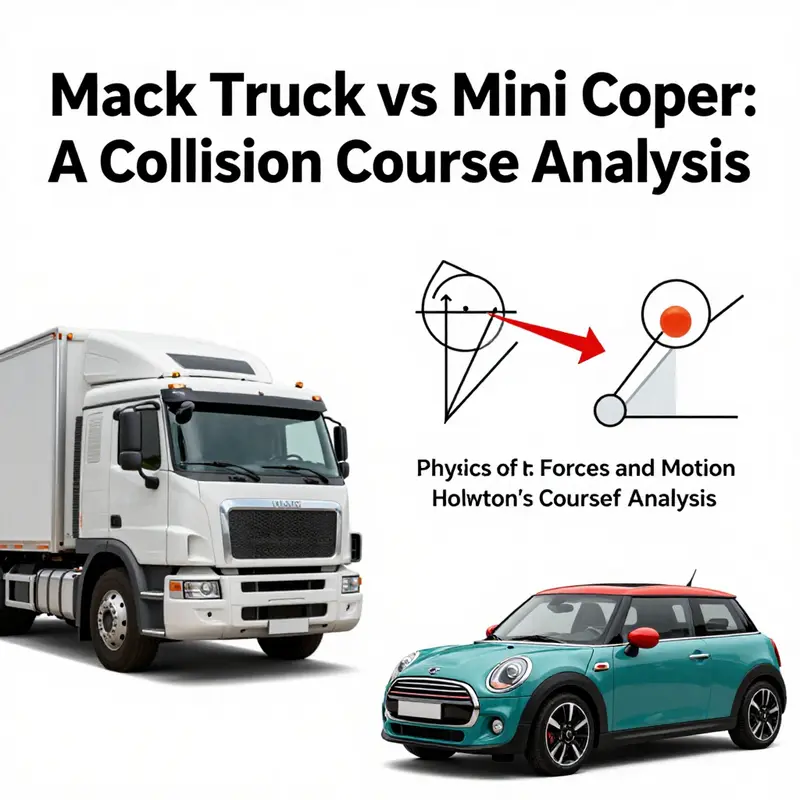
On a quiet stretch of highway, a Mack truck and a Mini Cooper converge at the same speed, their paths destined to cross in a crash that will feel almost personal to the occupants of the lighter car. In the moment of impact, the two vehicles press against each other with forces that are equal in magnitude and opposite in direction. This is the everyday theater of Newton’s Third Law in action: action and reaction occur in tandem, two hands pushing against each other with the same push, the same shove, the same time interval. Yet the outcome of that single moment is not identical for both vehicles. Mass, that quiet reservoir of inertia, plays the dominant role in how each machine responds to the shared force. The heavier Mack truck, with its towering mass, would seem to shrug off a portion of the energy more gracefully than the lighter Mini Cooper, which would bear the brunt of the deceleration. The consequence is not a paradox but a demonstration of how the same force, applied for the same duration, translates into radically different accelerations depending on how much the body being pushed can resist the shove. In this way, the collision becomes a vivid classroom for the interaction between force, mass, and motion, a narrative where the same act has different consequences for different actors on the stage of the road.
If one closes the eyes and pictures the moment of contact, the first principle to land is that the forces are identical in size, yet their effects diverge because the vehicles carry different loads of mass. The impulse delivered in that fleeting instant is equally shared: J equals the product of the force and the contact time, FΔt, for both vehicles. The impulse is the same for the Mack and the Mini, and so their changes in momentum, Δp, must be equal in magnitude and opposite in direction. But momentum is the product of mass and velocity, so the same momentum change manifests differently. The Mini Cooper, with its smaller mass, experiences a larger change in velocity—the rapid deceleration that is the signature of a front-end collision for a compact passenger car. The Mack, bearing a much larger mass, undergoes a far more modest shift in velocity, even though the force is the same and the crash unfolds over an identical interval. This is not a contradiction; it is a direct consequence of F = ma. When the same force acts on two bodies, the lighter one must accelerate more quickly, while the heavier one accelerates more slowly. In the carcrash lexicon, that difference in acceleration becomes a difference in deformation and, crucially, in occupant risk.
The heart of the matter lies in what happens to the movement of each vehicle, how their speeds fade away and then remain altered as a result of the collision. The Mini Cooper’s velocity is tumbled by a much larger deceleration, a rapid negative acceleration that can exceed comfortable thresholds for safety systems designed to absorb energy and protect the occupants. Crumple zones, airbag deployment, seat belts—all the tools engineered to extend the duration of the crash and spread the forces over a longer time—are working to convert a sharp, abrupt change in velocity into a more gradual, survivable event. In the Mack truck, the deceleration is far more restrained, simply because the truck’s mass resists the same force more effectively. Yet the energy involved in a collision does not vanish; it is transformed. The car’s body absorbs a portion of the kinetic energy through deformation, the truck’s structure absorbing some as well, but the relative difference in how much energy each vehicle must dissipate is significant. The Mini Cooper’s occupants confront a sharper deceleration curve, and thus a higher potential for injury, than those inside the heavy vehicle that lumbers through the moment with steadier momentum.
To unpack this more rigorously, imagine the collision as a transfer of energy and momentum governed by the same physical laws that govern a swinging pendulum or a rolling ball. The energy each vehicle carries before impact is proportional to its mass and the square of its velocity. At equal speeds, the Mini Cooper has far less mass and therefore far less kinetic energy than the Mack truck. When the two forces collide, a portion of the lighter car’s energy must be absorbed in a much shorter time frame, producing large forces over a short duration. The heavier vehicle, by contrast, borrows strength from its mass, causing a longer, gentler energy dissipation in practice, though the collision is by no means painless for anyone inside either vehicle. The consequence is visible in the deformation patterns one might see in a real crash test: the Mini’s front end collapses more dramatically, the Mack’s front end resists a harder, more skeletal reshaping as metal yields to the applied load.
This interplay of force, impulse, and momentum is not merely a theoretical exercise; it informs how drivers experience the event and how engineers design protections. When the same force is exerted for the same interval, the resulting acceleration is inversely proportional to mass. In human terms, this translates to the Mini Cooper’s passengers experiencing a far greater jolt, a harsher push against seat belts and airbags, than the occupants of the Mack truck who, due to the greater inertia of their vehicle, see a comparatively softer change in velocity. The safety systems in a car are calibrated to extend the time over which the force acts, reducing peak accelerations and the instantaneous g-forces that subjects must endure. In a light vehicle, those systems must work harder to stretch the same impulse across a longer duration, a challenge that becomes even more acute when weight and stiffness are at odds with the energy to be absorbed. The heavier vehicle, reinforcing its own safety through mass and rigid structure, still carries risk for its drivers, especially in a head-on collision where the forces are not merely aligning with forward motion but also colliding with the opposing energy from the other mass.
The concept of impulse further clarifies why the collisions of a Mack truck and a Mini Cooper are so asymmetric in their effects. Since J = FΔt is the same for both vehicles, but their masses differ, the resulting accelerations—both the deceleration of the Mini and the gentle change in the Mack’s velocity—must diverge. The impulse must also correspond to the momentum change; both vehicles experience identical momentum changes in magnitude, but the Mini’s momentum shifts more dramatically because its mass multiplies a larger velocity change. In a practical sense, this means that the same crash event yields a larger percentage change in the Mini’s motion, translating into more severe deformation and a higher likelihood of injury for its occupants. The Mack truck, with its formidable mass, can be seen as absorbing more of the collision’s energy by virtue of its lower acceleration, a consequence of its inertia and design. Yet the scene remains a stark reminder that even the most robust machines cannot perfectly shield their passengers from the moral of Newton’s laws when the forces are shared and the masses differ so starkly.
From a broader perspective, the physics of such a collision emphasizes why modern vehicle safety design emphasizes not only stronger bodies but smarter energy management. The Mini Cooper relies on carefully engineered crumple zones to create a longer, more forgiving period of deceleration, a strategy aimed at reducing peak forces transmitted to the occupants. The truck relies on a combination of mass, structural integrity, and, increasingly, controlled energy dissipation through design choices that help manage the collision’s progression. The outcome for any crash speaks to a balance among several factors: the speed at impact, the masses of the vehicles, the stiffness of their frames, and the effectiveness of safety systems that spread energy over time. In the end, the same fundamental physics explains both the universality of the forces and the variability of the consequences. Understanding that duality helps explain why small cars, while efficient and nimble, face a higher inherent danger in head-on crashes with heavy trucks moving at identical speeds. It is a sober reminder that the road is a platform where simple laws have complex, tangible consequences.
For readers who wish to explore practical readings on the dynamics of momentum and impulse beyond this chapter, consider the Mini Trucks Cali blog for accessible discussions that connect real-world driving experiences with classroom concepts. Mini Trucks Cali blog. This bridge between theory and practice helps anchor the physics in everyday decisions—how closely we follow, how fast we drive, and how we respond when the unexpected happens. The broader point remains clear: when a Mack truck meets a Mini Cooper head-on, equal and opposite forces collide with unequal histories of motion, and the outcome is a vivid demonstration of Newton’s enduring legacy on the asphalt.
For readers who want a more formal, step-by-step primer on impulse and momentum change, the Physics Classroom offers a thorough exploration that can deepen the understanding of these collision dynamics: https://www.physicsclassroom.com/class/momentum/Lesson-2/Impulse-and-Momentum-Change
Collision Physics on the Open Road: What a Mack Truck and a Mini Cooper Reveal About Mass, Momentum, and Safety
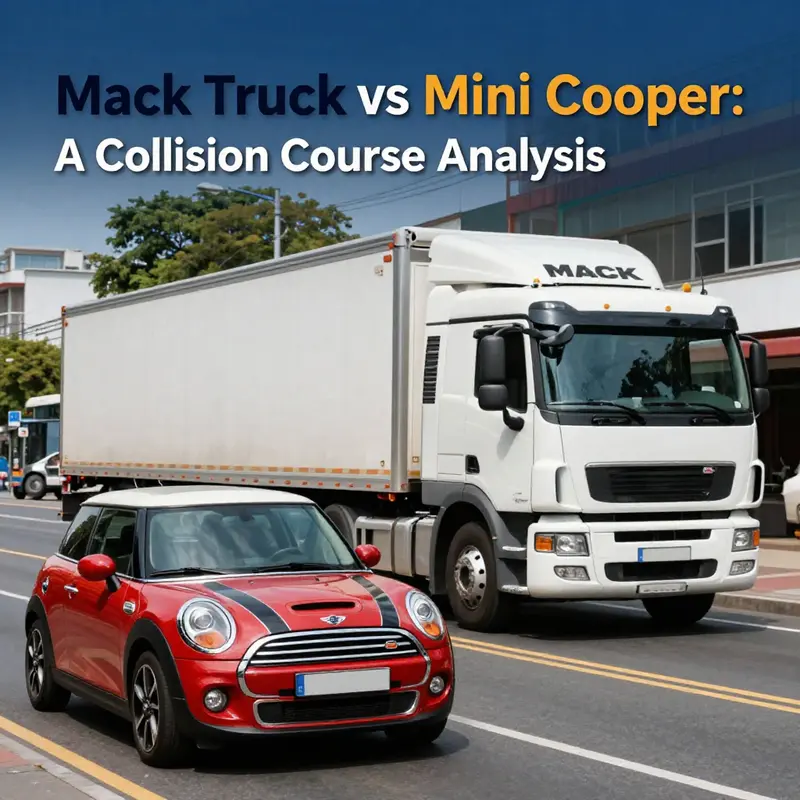
On a highway where the hum of normal traffic suddenly becomes a classroom for physics, a collision between a heavy, purpose built truck and a compact, agile car unfolds as a revealing case study. When the two vehicles meet head on at the same speed, the interaction is governed by Newtons third law: the forces that act on each vehicle are equal in magnitude and opposite in direction. In other words, the instant of impact imposes the same force on both bodies. Yet the consequences feel wildly different to the people inside each vehicle because the masses are so unequal. The smaller mass experiences a much larger deceleration, while the heavier mass changes its velocity far less. This simple truth, F = ma, and the energy perspective captured by E = 1/2 mv^2, explain why the same collision can feel almost ceremonial to one vehicle and catastrophic to another. The front end may grind and peel, the passenger cell may buckle, and the contrast in outcomes becomes a stark reminder that road interactions are not symmetric in their effects, even when the forces are equal in that moment of contact.
Beyond the raw forces, the road environment and vehicle design determine how such exchanges of energy and momentum play out in real life. A heavy truck is engineered for durability, high payloads, and long hauls. Its frame is built to resist bending, and its suspension is tuned to support heavy loads rather than to chase nimble handling on tight city streets. This kind of vehicle excels in tasks that demand steadiness over time, such as moving bulk goods across states, supporting construction sites, or serving as a backbone for municipal fleets. In practice, those design priorities translate to characteristic road behavior: generous front and rear mass, substantial ground clearance to clear rough surfaces, and a braking system that prioritizes sustained performance under heavy loads. The tradeoffs emerge in everyday driving where maneuverability, turn radius, and visibility become paramount. On narrow urban roads or in dense traffic, the very strengths that enable a Mack truck to perform its jobs can complicate interactions with smaller vehicles that operate in a more dynamic, rapid tempo.
The Mini Cooper—compact, light, and highly maneuverable—embodies a different set of design goals. It is engineered to excel in city driving, with a small turning radius, responsive steering, and efficient fuel economy. Its light weight is a double edged sword. It allows for quick acceleration and easy parking, but it also means the car must absorb and dissipate impact energy with far less internal mass to resist deformation. On the road, this translates into a high level of agility and a bonus of safety features that rely on rapid deceleration to keep occupants in a controlled trajectory. Yet when confronted with the blunt forces unleashed by a much heavier vehicle, the lighter car faces a dramatic deceleration profile. The energy it must absorb in a collision is enormous relative to its own capacity to manage it through structural deformation and occupant protection systems. This is not a judgment on either vehicle type but a reminder that the physics of an impact can override everyday performance expectations. The lighter vehicle is compelled to decelerate much more quickly, which elevates the risk to its occupants even when seat belts, airbags, and crumple zones are doing their essential jobs.
To connect these ideas with road realities that affect millions of daily trips, consider how a truck and a compact car share the same lanes, intersections, and onramps. The truck’s high mass and energy mean that, at the limit, it may carry more momentum forward after a collision. The car, with far less mass, must shed its kinetic energy more aggressively during the crash, often at the cost of a larger share of occupant protection in the form of crumple zones and airbags working in concert with restraint systems. The net effect is that, even when both vehicles strike at identical speeds, the damage patterns follow the mass landscape: the truck tends to experience less severe crumpling relative to its size, while the passenger compartment of the smaller car can experience severe intrusion into the cabin area. In practical terms, this means that two vehicles colliding at the same relative speed do not fare the same in terms of occupant risk. The human element—age, seat position, restraint use, and overall physical health—enters the equation, amplifying or dampening the real world outcomes in ways that the purely mechanical picture only begins to outline.
The road is a shared stage, and its design plays a critical role in how these scenes unfold. Heavy duty trucks, by their nature, are built to operate with a high degree of stability while under load. They benefit from robust frames, heavy front axles, and suspension systems that prioritize strength and durability over soft, nimble handling. This translates to a road presence that is hard to misread: a truck occupies more visual space, requires longer distances to stop, and dominates the lane geometry in ways that smaller cars cannot match. But the same qualities that protect a truck when it carries heavy payloads can complicate safety within the vehicle when a collision becomes unavoidable. The rider and the structure of the cab must contend with the possibility that the load itself shifts during abrupt deceleration, altering the center of gravity and the distribution of forces through the frame. In contrast, the Mini Cooper is designed to slip through gaps, to absorb speed with efficiency, and to make quick evasive moves that reduce the likelihood of a direct, high severity impact. Its safety engineering leans on lightness as a benefit, using crumple zones, energy absorbing materials, and compact geometry to mitigate the consequences of a crash. Yet the reality remains that in a head on scenario with a much heavier vehicle, the lighter car bears the brunt of the deceleration, testing the limits of how much energy a passenger compartment can absorb without compromising occupant safety.
These dynamics are not mere abstractions. They anchor the guidance drivers receive about following distances, lane discipline, and speed selection in mixed traffic. A driver behind a heavy truck learns to appreciate the mass at play—how a small miscalculation in distance can translate into a sightline that narrows the window for reaction. The camera systems and braking technologies that modern vehicles employ still must contend with the uncompromising physics of a collision. Anti lock brakes, electronic stability control, and advanced restraint systems help, but they cannot negate the energy that must be managed in the event of a direct impact. In the compact car, where the occupant protection system is integrated within a smaller, lighter frame, those safety features operate in a very different regime of force and displacement. The result is a narrative of safety that is both reassuring and sobering: vehicles can be engineered to reduce the probability of a collision and to soften its consequences, but when a collision is unavoidable, the outcomes are heavily conditioned by mass, geometry, and how energy is allowed to flow through the structure.
For readers who want to explore this topic through additional perspectives, a concise way to broaden the context is to follow discussions in general automotive safety discussions and crash analysis resources, such as the long standing body of work that explains how mass and stiffness shape collision outcomes. One practical way to connect this chapter to broader discussions is to browse a dedicated automotive blog that compiles reflections on vehicle dynamics and real world tests. You can visit the minitrucks blog for a digest of related comparisons and case studies, which often illuminate how design choices influence road safety in everyday driving. minitrucksocala blog
The crux of the matter remains clear: when a heavy load bearing vehicle and a light passenger car cross paths in a collision, the equal and opposite forces at the moment of contact do not erase the asymmetry of the aftermath. The larger mass governs the pace at which energy is dissipated and momentum is redirected, while the lighter vehicle bears the brunt of deceleration and deformation that can translate into a higher risk of injury for its occupants. This is not merely a technical observation but a lived reality on roads everywhere. It underscores the importance of maintaining safe distances, choosing appropriate speeds for the traffic mix, and recognizing that vehicle design is a negotiation between utility and safety under the law of physics. The roadway is a shared system, and each class of vehicle contributes its own constraints to the dance of motion, interruption, and consequence that defines every drive.
In a broader view, the chapter highlights how road compatibility is measured not by the ability of a single vehicle to perform in isolation but by how well the system accommodates the diversity of vehicles sharing the same space. A Mack truck wins in terms of payload capacity, durability, and endurance. The Mini Cooper wins in terms of maneuverability, efficiency, and urban practicality. The safety implications emerge not by detaching the two worlds but by understanding the collision physics that separate them when their paths converge. The real lesson for drivers, operators, and safety designers is that mass matters, energy matters, and the geometry of impact matters just as much as the speed at which it occurs. The road, with its lanes, ramps, and signals, is a physics classroom in motion, where every decision is a cue in a script written by the immutable laws of nature. For those seeking a tangible reminder, the broader literature on vehicle dynamics and crash energy management offers a map of what happens when two vehicles of such different pedigrees collide head on. It is a sobering reminder of why urban planning, fleet operation standards, and personal driving discipline must respect the realities of mass and momentum even as they celebrate the best engineering that modern automotive design can offer.
External resource for further reading on the engineering background behind these dynamics can be found at the official site of heavy duty vehicle manufacturers, which provides context on frame design, safety engineering, and energy management in large vehicles. This external resource offers a broader frame of reference for those who wish to connect the collision physics described here with the standards and practices that govern real world heavy trucking and safety protocols.
External resource: https://www.macktrucks.com
Final thoughts
In understanding the collision dynamics, safety impacts, physics, and road compatibility of a Mack truck and a Mini Cooper, it’s clear that these vehicles, while both vital to our transportation ecosystem, operate under vastly different parameters. Small business owners, property owners, and enthusiasts alike should remain aware of the inherent risks and mechanics of such interactions. Knowledge is empowerment; it arms us with insights to navigate our roads more safely and responsibly, ensuring a harmonious coexistence of all vehicle types. As we share our roads, let’s commit to being informed and prepared.