
For local small business owners, residential property owners, and mini truck enthusiasts, understanding the cubic meter capacity of a mini dump truck is vital. Whether you need to transport sand, gravel, or other materials, knowing how many cubic meters can fit in your truck can help you make informed decisions. In this article, we dive into the different capacities of mini dump trucks, explore the variations among models, and discuss how these capacities affect your construction projects. With clear insights and practical applications, we aim to equip you with the knowledge needed for your next hauling endeavor. Let’s get started!
Sizing the Load: What “One Mini Dump Truck” Really Holds in Cubic Meters
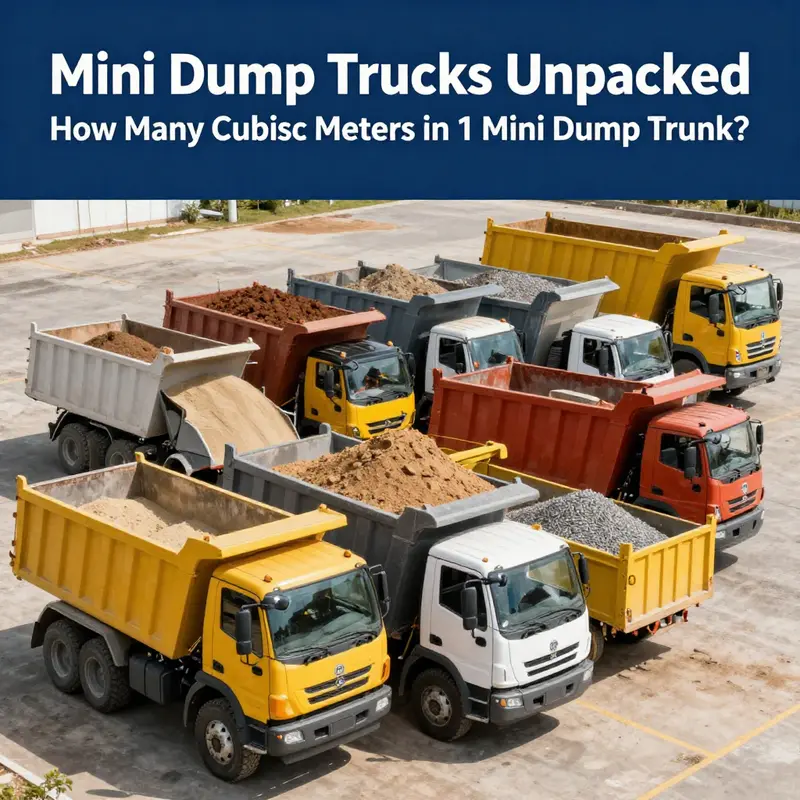
Understanding the phrase “one mini dump truck” means more than quoting a number. The word “mini” covers a wide variety of vehicles, and the cubic meter capacity depends on design, purpose, and how the load is measured. For practical planning, bidding, or ordering materials, knowing the differences between volumetric capacity and payload limits is essential. This chapter ties those differences together so you can translate a quoted capacity into real-world expectations.
A useful starting point is to separate the two common senses of “mini.” In one sense, mini dump trucks are small utility trucks, often built on light truck or pickup frames. These are used for landscaping, urban construction, and small deliveries. Their cargo boxes are compact, and usable volumes typically fall between about 2.2 and 3.0 cubic meters. In the other sense, some manufacturers market compact or “mini” models that are much larger than the pickup-based units. Those vehicles can have volumes well beyond 5 cubic meters, sometimes reaching 6, 8, or even 20 cubic meters in industrial contexts. The takeaway: the single phrase masks a broad range of capacities.
Volume and weight are two different limiting factors. A cubic meter measures space, not mass. When planning, you must compare the cargo box volume (in m³) with the vehicle’s payload rating (in kilograms or tons). A small dump bed might hold 3 m³ of a light material but exceed the vehicle’s safe payload when loaded with dense material. Conversely, a larger, heavier truck might be weight-limited and unable to use its full volumetric capacity without breaching axle or chassis limits.
Material density determines the practical load. Loose sand typically weighs around 1.5 to 1.7 tonnes per cubic meter, gravel ranges from about 1.6 to 1.9 tonnes per cubic meter, and topsoil or compost can be 0.9 to 1.2 tonnes per cubic meter, depending on moisture. Wood chips and mulch are significantly lighter. To plan correctly, multiply the cargo volume by the material density to estimate gross cargo mass. If that mass exceeds the vehicle’s payload rating, you must reduce the volume per trip.
How manufacturers report volume varies. Some list the geometric internal volume of the bed, derived from internal length × width × height. Others quote nominal volume based on a standard heaped load. A heaped measurement allows the material to form a cone above the bed walls and can add roughly 10–25% to the net internal volume. Because heaped volumes are less precise, specs that do not clarify whether they refer to heaped or level loads can be misleading.
Practical measurement helps. To calculate the nominal cubic meters of any dump bed, measure the internal length, width, and usable height in meters. Multiply those three dimensions for the internal volume. Remember to subtract any wheel arch intrusions or built-in ribs that reduce usable space. If you expect heaped loads, apply a commonly used heaped factor—for sand and gravel, add about 10–15% for a level heap, or up to 25% for a larger crown—only when regulations and safety permit.
Dimensions illustrate typical capacities. A pickup-based small mini dump with an internal bed say 1.6 m long, 1.2 m wide and 1.1 m high will yield roughly 2.1 m³, which aligns with the 2.2–3.0 m³ range. Mid-sized compact dump beds used in general construction often measure closer to 2.8–3.5 m long and 1.6–1.9 m wide with wall heights that produce 5–8 m³ of internal volume. Larger compact units intended for heavy construction or mining use deeper and longer beds, with volumes that can reach 20 m³ or more. These larger “compact” units are not small in mass or power despite the label.
Regulatory and road limits affect usable loads. Even if the bed can physically hold a certain number of cubic meters, laws about axle loads, total vehicle weight, and overhang or height restrictions can limit how much you can legally transport on public roads. Always compare the material mass per m³ with the vehicle’s Gross Vehicle Weight Rating (GVWR) and the allowable axle loads in your region. Fines and liability arise when overloaded vehicles damage roads or tip under transport.
Loading technique alters both safety and practical capacity. Loose piles that are compacted or watered can change density. Heaped loads that exceed the cab or bed specification create stability and visibility problems. Properly distributing material over the bed and between axles reduces the likelihood of exceeding axle limits. Remember that front axle weight diminishes as the bed fills toward the rear, which can reduce steering control. For short hauls on private sites, operators sometimes load near capacity, but on-road transport should adhere to legal and safe limits.
How many loads for a job? Break the project volume by the effective usable volume per trip. For example, if you need 20 m³ of topsoil and your chosen mini dump truck can safely carry 2.5 m³ per load of that soil, you will need eight trips. If you instead use a larger compact truck with an effective capacity of 6 m³ for the same dense material, you need just four trips. Always use the effective usable volume—not the theoretical geometric volume—because internal design, wheel arch intrusion, and safety margins reduce usable space.
Real-world decisions weigh volume against convenience. Smaller units are easier to maneuver in tight spaces, simpler to load and unload, and often cheaper to run. They are the sensible choice for many urban projects, where deliveries to narrow sites with delicate surfaces are common. Larger compact units reduce cycle counts and per-cubic-meter driving time for larger jobs. Choosing wrong can cost time, fuel, and labor.
Estimating payload from volume examples clarifies choices. Take sand at 1.6 tonnes per m³. A 3 m³ bed fully used holds roughly 4.8 tonnes of sand. If the truck’s payload rating is 3.5 tonnes, the theoretical three cubic meters cannot be legally transported in a single load. Either the load must be reduced, or a heavier-duty vehicle is required. The same 3 m³ bed carrying mulch at 0.6 tonnes per m³ yields only 1.8 tonnes, comfortably within the small truck’s payload.
Consider the compact “mini” segment used in heavy industries. These chassis are built stronger and use larger powertrains, allowing internal volumes of 6–8 m³ or more, and even models pushing toward 20 m³ exist for specialized work. Those vehicles often come with robust suspension and higher GVWRs, meaning they can carry larger masses without violating legal limits. For many buyers, the key question is not whether a vehicle is called “mini,” but whether its chassis rating matches the materials you intend to haul.
Maintenance and longevity tie to load practices. Repeatedly overloading a truck shortens life of the suspension, brakes, tires, and body. Even when the bed looks capable of holding extra material, stress fractures and frame deformation can develop. When you match material density and volume to the vehicle’s rated payload, you extend service life and reduce downtime.
When comparing capacities across manufacturers, look beyond a raw m³ number. Examine payload rating, axle ratings, bed geometry, and whether the quoted volume is for a level or heaped load. Ask for the vehicle’s empty weight to calculate remaining payload. Request the internal dimensions to verify geometric volume. These measurements will let you compute an accurate, job-specific capacity.
If you work across different job sites, plan with both worst- and best-case densities. Keep a simple reference table on hand, listing common densities (wet sand, dry sand, gravel, crushed stone, topsoil, mulch). Use it to convert cubic meters to tonnes quickly. Doing so prevents surprises during a delivery and helps you decide whether to rely on volume or on weight-limited planning.
A few practical tips wrap up the discussion. First, always verify manufacturer specifications and ask whether volume figures refer to level or heaped loads. Second, measure the bed yourself if precise planning matters; internal dimensions reveal the real story. Third, consider whether your routes and job sites impose weight or size restrictions that affect how much you can carry. Finally, factor loading and unloading time into your planning; more smaller loads can mean greater labor and longer job durations.
For additional context on compact truck use and capabilities, a reliable resource is a commercial listing of various compact dump truck models, which illustrates how “mini” is sometimes used to describe a broad range of sizes and powers. For examples of such listings, see: https://www.alibaba.com/product-detail/Buy-Mini-Dump-Truck-New-Used-4×2-4x4_1600587926837.html
If you want broader reading on small truck applications, site features and customization examples are useful. For ongoing updates and practical articles about small trucks and their adaptations, visit the editorial blog dedicated to mini truck topics available here: mini trucks blog.
Understanding “one mini dump truck” therefore requires translating a quoted cubic meter number into the realities of material density, vehicle payload, bed geometry, and regulatory limits. Use measured internal dimensions, check payload ratings, and convert volumes to mass using realistic densities. This approach guarantees the quoted cubic meter capacity becomes a dependable planning figure for any job.
Reading the Bed: How Cubic Meters Define Mini Dump Truck Capacity Across Models
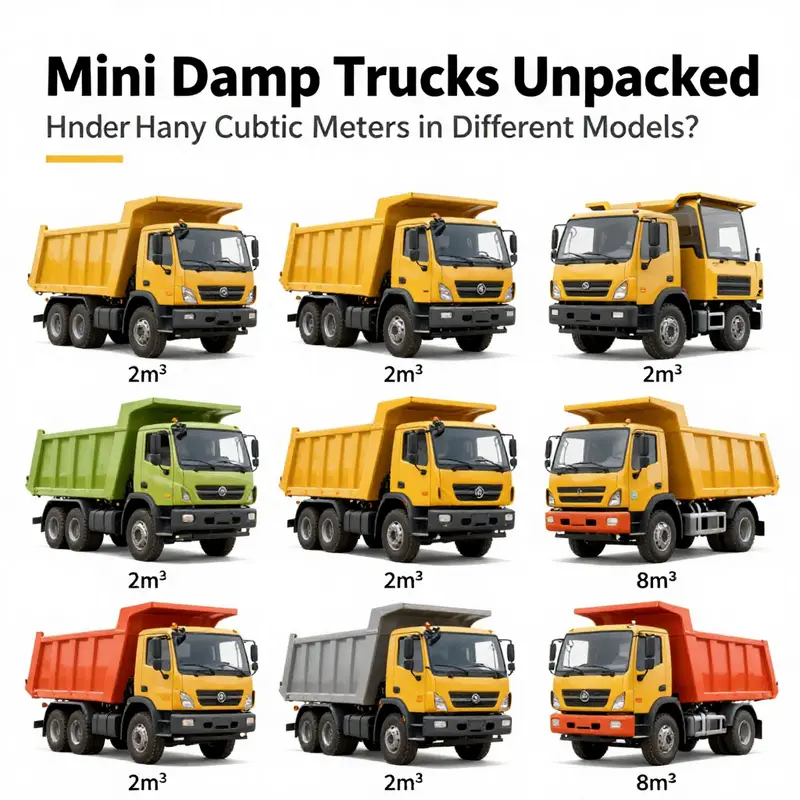
When people ask how many cubic meters a mini dump truck can carry, they are really seeking a practical sense of the bed’s real volume and how that space translates into usable capacity for a given project. The answer is not a single number, but a spectrum. Mini dump trucks come in a range of sizes, shapes, and hydraulic configurations, and each variation shifts the amount of material that can be loaded, hauled, and deposited in a way that reflects both physical constraints and the demands of specific work sites. In this chapter, we move beyond shorthand claims of “small” or “big” and delve into how cubic meters—the measure of space inside the bed—are determined, what influences them, and why the same nominal vehicle can deliver very different results in practice. The goal is to illuminate how capacity is built, measured, and applied so that planners, operators, and supervisors can make smarter choices without getting trapped by vague generalizations.
At the heart of the matter lies a simple fact: the bed’s volume sets the theoretical ceiling for how much material can be loaded. This volume is a spatial measure and depends on the bed’s length, width, and height, as well as the shape of the bed corners and the allowances made for internal structures such as bulkheads, liners, or container attachments. Yet the bed volume does not tell the whole story. The actual payload—that is, the weight of material the truck can legally and safely carry—depends on density. Two beds with identical geometric volumes, one loaded with loose soil and the other with wet gravel, will occupy the same space but weigh very differently. Consequently, the practical, usable cubic meters of material a mini dump can transport in a given trip is a function of both the volume available inside the bed and the permissible weight the chassis and axles can support.
This interplay between volume and weight is the first important concept to grasp. In many operations, the weight limit governs how full the bed can be before loading begins to risk overloading the powertrain, the suspension, or the tires. On the other hand, when the density of the material is low, operators may find themselves with unused bed space long before the weight limit is reached. In tight, controlled environments—underground sections, trench work, or confined urban sites—the agility of a compact bed often takes precedence over raw mass, and the bed may be sized to maximize maneuverability rather than to maximize payload. Conversely, on larger sites with stable ground, a longer, wider bed paired with a robust hydraulic system can push the volume to the fore, yielding significant gains in cycle times and overall productivity. Understanding where a particular model sits on this spectrum helps explain why a seemingly similar vehicle can behave so differently from one job to the next.
The survey of commonly encountered configurations reveals a wide but practical range. On the smaller end, many mini dump trucks are designed for tight spaces and light-to-moderate tasks. In this realm, bed volumes are typically modest, with capacities around a half to one cubic meter per trip. That range aligns with operations where the vehicle’s primary advantage is navigability rather than outright bulk transport. In this segment, hollow cores of the bed and the geometry of the tipping mechanism matter as much as the bed’s raw footprint. A bed that is slightly narrower or a tailgate that opens in a logistically efficient way can squeeze extra capacity from the same chassis, especially when site constraints demand precise placement of material or when loading from awkward angles. The important takeaway is that even within a small bed, the exact dimensions are critical. A quarter-meter difference in interior height or a few centimeters of length can translate into meaningful shifts in cubic meters, and therefore in the number of trips required to complete a task.
Moving into the mid-range, the beds grow, and so does the potential volume. A typical mid-range mini dumper may offer roughly three to six cubic meters of space, depending on the chassis, the bed design, and the height to which material can be raised safely. This is the range where many operators find the optimal balance between maneuverability and payload. The bed geometry becomes more complex here because manufacturers tailor the side walls, floor thickness, and tipping angle to optimize the flow of granular materials, rocks, or mixed debris. A bed with sloped sides, for instance, can improve release efficiency for loose soils or sand, allowing more of the bulk to be discharged per cycle. The tipping mechanism itself comes under scrutiny, not as a showpiece of engineering but as a practical limiter: a stronger hydraulic system can raise heavier loads more quickly, but it also introduces taller, heavier components that must be accommodated within the vehicle’s weight and space envelope.
There is also a category of larger mini or compact models that push into eight cubic meters and, in some cases, slightly beyond. These machines are typically deployed in applications where the ground support and the fleet’s schedule require fewer trips and larger batches. The trade-off is introduced by the fact that bigger beds demand heavier frames, more robust axles, and more substantial lifting capabilities. The driver’s ability to maneuver with a bigger bed is equally important; a larger bed changes center of gravity, which in turn influences how the vehicle behaves when loaded and during the tipping process. In practical terms, the driver learns to anticipate the bed’s momentum as it tilts, ensuring that the load is released safely and efficiently without compromising the surrounding equipment or the work site infrastructure.
To translate bed geometry into real-world numbers, one must consider the material’s characteristics. Loose fill density plays a central role, but so does compaction during loading, moisture content, and the degree to which the material settles during transport. For example, wet soil is denser than dry soil, which means that the same bed could reach its weight limit with less volume of water-saturated material than with dry soil. Even within the same material category, the presence of fines, moisture, or fines-heavy fractions can alter the bulk density. Operators and site engineers often estimate volume in practical terms by taking initial measurements of bed dimensions and applying a standard volume calculation (length × width × height), then cross-checking with the truck’s rated payload. The difference between theoretical volume and practical, safe payload is where the art and science of capacity management converge. On a well-run site, this is not merely an academic exercise. It translates into fewer trips, lower fuel consumption, reduced wear on the vehicle, and improved safety margins for workers near the load area.
The design language of mini dump trucks reflects this balance between volume and weight. A compact model may trade some bed volume for a lighter, more nimble frame, enabling quicker turns and easier handling on tight routes. A larger compact variant may sacrifice some agility to gain bed depth and width, increasing the material carried per cycle but requiring more careful control in confined spaces. In both cases, the bed’s shape matters. A rectangular bed with flat side walls can simplify the process of loading and unloading because it aligns with standard pallet and debris flows. A bed with rounded corners, integrated bulkheads, or a multi-chamber layout can be advantageous for certain materials or separation processes on site. The result is not a single magic number but a design philosophy: volume is king, but weight, balance, and flow behavior determine the actual efficiency of how that volume is used.
Another layer in this discussion concerns how the vehicle’s overall mass and wheelbase influence capacity in practice. The curb weight and the gross vehicle weight rating (GVWR) set hard limits on how much total mass, including payload, can be carried. A shorter wheelbase often improves turning radius, which is a practical advantage in restricted spaces. However, a very short wheelbase with a heavy payload can degrade stability during tipping. In contrast, longer wheelbases improve stability but reduce maneuverability in tight corridors. Engineers must reconcile these aspects with the expected payload volumes, ensuring that the design remains robust enough to handle off-road or uneven terrain while still delivering predictable unloading behavior on a job site. These considerations are not abstract; they determine whether a particular mini dump truck is the right instrument for a given operation or whether a different size class would yield better efficiency and safety outcomes.
In practice, then, the question of “how many cubic meters in 1 mini dump truck?” becomes a question of “which model fits this job’s volume needs without compromising weight limits or maneuverability?” The answer depends on the nature of the material, the geometry of the bed, and how the vehicle will be used on site. For some tasks, a bed around 0.5 to 1.0 m³ is perfectly adequate when the work is tightly constrained and the material is light. For others, a bed in the 3 to 6 m³ range delivers measurable improvements in cycle time and material throughput. On larger, more open sites where the terrain permits heavier loads and trips to consolidate material delivery, beds approaching 8 m³ or more may align with the project’s logistics and procurement strategies. What remains constant across all these scenarios is the necessity of aligning the bed’s capacity with the density and behavior of the material, the operating environment, and the vehicle’s driving and tipping dynamics.
Engineers and operators frequently emphasize the value of explicit, model-specific specifications. While the broad ranges outlined here reflect typical industry practice, the exact volume and weight limits should always be verified with the manufacturer’s data sheets and field test results. The bed’s interior volume is the theoretical maximum; the real-world usable volume will be shaped by lining, bed geometry, loading procedures, and the quality of the loading equipment. On-site measurements can be a surprisingly straightforward and accurate way to forecast performance. By measuring the bed’s interior length, width, and height and factoring in any design features that reduce the effective volume, a team can estimate how many cubic meters a truck can deliver per trip under typical conditions. Such calculations are especially valuable when coordinating multiple machines or planning a day’s sequence of material movement. This approach helps ensure that the operation maintains a predictable rhythm, avoids bottlenecks, and reduces the risk of overloading or destabilizing the vehicle during tipping.
The broader takeaway is that cubic meters in mini dump trucks are not a fixed property of a single vehicle category. They are the outcome of a tailored integration of geometry, weight limits, materials science, and site logistics. A given truck could offer a low-volume, high-flexibility solution for compact sites or a higher-volume option for open work areas where the same chassis can be leveraged to move more material in fewer trips. The decision hinges on understanding the task’s physical realities and translating them into a bed design and load strategy that harmonizes with the vehicle’s strengths. For readers who want to drill deeper into practical guidance, a broader look at mining dump truck standards and industrial applications can provide additional context and nuance. This overview of capacity variation is meant to empower readers to read a bed’s real capacity more accurately, to plan more confidently, and to communicate more clearly with suppliers and operators about what the vehicle can and cannot do on a given site.
For readers seeking further practical perspectives aligned with industry practice, see the Mini Trucks Blog for on-the-ground discussions of vehicle selection, bed design considerations, and operational tips. Mini Trucks Blog
External reading and broader context on the standards and properties of mining dump trucks can enhance understanding of how these machines are specified and used across different environments. A detailed external resource provides broader background on how payload capacity, bed geometry, and hydraulic systems interact in industrial applications. External resource: https://www.china-mining-truck.com/guide-to-mining-dump-trucks/
Size, Speed, and Scope: How Mini Dump Truck Capacities Shape Construction Workflows
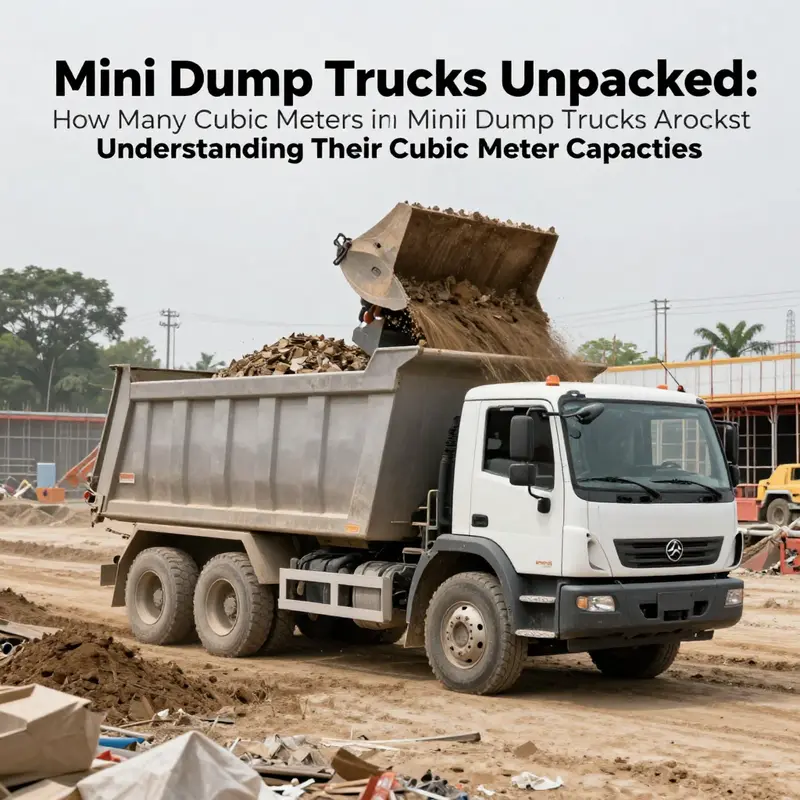
Capacity is the quiet driver of a construction site’s rhythm. When teams plan the day, the question of how much a mini dump truck can haul becomes a practical compass for decisions around sequence, manpower, and even safety corridors. Unlike larger trucks, where capacity and range are often built into standardized fleets, mini dumpers occupy a broader spectrum. They operate in a delicate balance between maneuverability and load, between tight urban access and the need to move material efficiently across a site. In this sense, the number of cubic meters a mini dump truck can carry is not merely a specification; it is a thread that ties together site layout, material choice, and the cadence of work. The research landscape shows a market where capacities can start at modest levels and extend into larger micro-dump ranges, but there is no single universal standard that all projects follow. What remains constant is the way capacity interacts with density, distance, and the geometry of the job site.
At the most intuitive level, capacity is about volume. It determines how many loose loads must be moved to accomplish the same daily objective. The literature and field data suggest that the practical range tends to cluster around two to three cubic meters for many mid-sized mini dump configurations, with smaller, urban-friendly variants hovering around the one to two cubic meter mark. In other words, a typical job site that relies on compact dumpers for material handling will often optimize around a 1–3 m³ doughnut of capacity. This is not to say that all mini dumpers conform to this band, but it is a common anchor for planning discussions. When a project calls for heavier or more frequent material movements, teams consider larger micro-dumpers that push toward the upper end of the mini class—still compact enough to fit within constrained spaces, yet capable of delivering more material per trip. The practical takeaway is clear: capacity must be matched to the site’s geometry and the material’s density, because the same volume can translate into very different payloads depending on what is being moved.
From a logistics perspective, the volume within the truck bed interacts directly with a second pivotal factor: the weight the vehicle can safely carry—its payload rating. The weight constraint may be tighter than the volume in cases where the material is dense or moisture-laden, and it can be looser for lighter, bulkier loads like dry sand. In some scenarios, operators discover that the physical volume of material they can load is limited by the truck’s weight limit rather than the lateral capacity of the dump body. This nuance matters on projects such as earthworks in restricted zones or where material’s moisture content shifts rapidly. The end result is a simple, dual constraint: the volume the bed can hold, and the weight the chassis can bear. Respecting both ensures the truck performs reliably without compromising safety, traction, or tire wear. A broader takeaway emerges: capacity is not a stand-alone precision tool. It is a lever that must be balanced with density, distance, site terrain, and the trip cadence needed to meet daily targets.
The choreography of a material move is more complex than merely filling a bed. Dump height, dumping angle, and unloading height are ancillary yet influential factors that escalate or diminish the value of a given cubic capacity. On many sites, the ability to unload directly into a hopper, a preformed pile, or a low-walled containment area changes the efficiency calculus. Some off-road capable models offer elevated dumping mechanisms that can discharge over a barrier or into height-restricted containers, reducing the need for additional handling or multiple staging areas. Even when a site has generous headroom, an optimized hydraulic dump can shave minutes off each cycle, and those minutes accumulate into meaningful gains across a shift. The practical implication is that capacity should be evaluated not only in terms of how much space exists in the bed, but also how that space interacts with the unloading process. A modest bed with a favorable dump geometry can outperform a larger bed if it unloads faster or more precisely into the target location.
Urban environments illustrate the sometimes paradoxical nature of capacity. In crowded streets or tight site entrances, maneuverability often trumps raw volume. A compact unit with a slightly smaller bed may deliver greater throughput simply because it can operate with less friction around corners, through gateways, or in alley-ways where access is restricted. In these contexts, a 1 m³ unit can maintain a steady rhythm of short, rapid trips, enabling precise material placement and minimizing disruption to neighboring activities. Conversely, on a larger construction footprint with open access and stable ground, a 2–3 m³ model can reduce the number of trips by a meaningful margin, assuming the density of the material and the weight limit permit it. The lesson here is counterintuitive but essential: higher volume does not automatically translate to higher productivity on every site. The site’s geometry, the material’s properties, and the operational tempo all dictate whether a larger bed truly delivers a faster overall flow.
Decision-makers benefit from a practical heuristic that translates volume into daily impact. First, estimate the total volume of material that must be moved in a day, broken down by material type if possible. Then, select a bed capacity that minimizes the number of trips while staying within the payload limit. A simple rule of thumb emerges: daily material volume divided by unit capacity yields the approximate number of trips; this figure, when adjusted for cycle time, loading and unloading delays, and the time spent mobilizing between locations, informs the expected duration of the day. If the daily target is high and the site permits longer cycles, a larger bed can reduce labor hours and fuel burn. If the site is dense and time is eaten by maneuvering, a smaller bed with faster cycle times may be preferable. This balancing act is where capacity becomes strategic rather than مجرد a numeric value.
Another layer to this decision is the material’s nature. Wet or cohesive materials, such as damp soil or clay-like aggregates, can behave differently than dry sand. They may require gentler loading, better tipping control, or additional containment to prevent spillage when turning, which indirectly affects the effective use of capacity. The density of the material—how heavy a given volume is—can also modulo the choice of vehicle. In some cases, two loads of equal volume may represent different grades of productivity if one type of material slows unload or requires longer stabilization time before reuse. The interplay between volume and density underscores the importance of field experience: operators learn to gauge not just how much a bed can hold, but how much they can move efficiently given the material’s behavior on that day. It is in these operational subtleties that the chapter’s central theme finds its practical expression—the capacity matters, but only as it interacts with the site’s topology, the material’s character, and the crew’s workflow.
The broader implications for construction planning are clear. The choice of capacity feeds into the project’s logistics model, which is a living estimation of how quickly material moves, how many hauls are needed, and how much time is allocated for turning, grading, or reloading. That model also informs risk management: if a site can move material quickly, it reduces the exposure time for tasks that could be delayed by weather, traffic restrictions, or procurement hiccups. Conversely, overcommitting to a larger bed in a narrow zone can create bottlenecks, reduce the maintenance window for equipment, and invite unnecessary dwell time. The capacity decision, therefore, becomes an essential thread in the larger fabric of site planning, procurement, labor deployment, and safety protocols.
For readers seeking a concrete anchor in the literature, a representative external reference demonstrates the kind of practical specifications engineers review when evaluating compact dumpers in relation to a project’s scale and constraints. While this chapter refrains from naming specific models, the linked resource illustrates how a 3-tonne class mini dumper can fit into a project’s transport plan, including typical load volumes and unloading configurations. This context helps translate the abstract range of 1–3 m³ into a real-world framework where the decision is grounded in measurable throughput, predictable cycle times, and actual site conditions. If you want to explore a model-focused specification in a real-world catalog, you can consult the external source provided at the end of this chapter.
The narrative here is not about chasing the largest bed possible; it is about harmonizing capacity with space, material behavior, and workflow tempo. When teams approach capacity with this integrated mindset, they begin to see how a careful choice in cubic meters reverberates through daily productivity, energy use, and even safety outcomes. A mid-sized site handled with a 2–3 m³ bed can optimize trips and fuel efficiency in a way that compounds into tangible cost savings, while a compact urban project may gain more value from a nimble 1 m³ unit that can squeeze into tight corridors and perform precise placements. The overarching message remains consistent: selecting the right volume is not a one-off decision. It is an ongoing calibration that reflects the project’s evolving needs, the material’s character, and the crew’s capacity to execute with speed, accuracy, and care.
On this topic of practical calibration, one can further explore the broader ecosystem of information on mini trucks and their role in site operations by visiting industry-focused resources such as the Mini Trucks blog, where discussions about equipment capabilities, field performance, and site-specific considerations often surface. This kind of resource can provide a grounded sense of how professionals frame capacity decisions in relation to other operational levers. Mini Trucks blog is a place where practitioners share insights about tool selection and site logistics, which can help teams contextualize the numbers discussed here within real-world workflows.
Finally, the core takeaway centers on balance. Capacity matters because it is the most tangible driver of throughput on many sites, but it must be matched to the site’s geometry, the material’s nature, and the project’s cadence. The optimal cubic meter figure sits at the intersection of these considerations, where the number of trips, the cycle time, and the unloading dynamics converge to deliver reliable progress without sacrificing safety or increasing costs through unnecessary downtime. In that sense, capacity is not a standalone metric but a hinge point that unlocks better planning, smoother execution, and more predictable project outcomes. For readers who want to see a concrete specification in the context of supplier catalogs and density-related constraints, the external reference at the end of this chapter provides a representative example of what a 3-tonne class mini dumper looks like in practice, including typical bed volumes and loading configurations. This is a useful reminder that the single question—how many cubic meters in a mini dump truck—unfolds into a broader conversation about how projects move material most effectively on the ground.
External reference for further detail: https://www.alibaba.com/product-detail/3-tons-mini-dumper-4×4-off-road-dumper1600758739437.html?spm=a2700.productlist.search_result.1.6d4a3b2fBmQgXt&searchText=3+tons+mini+dumper
Final thoughts
Understanding the cubic meter capacity of mini dump trucks can significantly impact your operations, whether you’re a small business owner handling materials or a hobbyist enthusiast. From grasping the basics of truck volume to recognizing how different models serve unique needs, this knowledge empowers you to choose the right truck for your projects. With capacities ranging from 2m³ to 8m³, the right mini dump truck can improve your efficiency and effectiveness in hauling. Make informed choices, and let these insights guide your next steps in the world of mini dump trucks.