
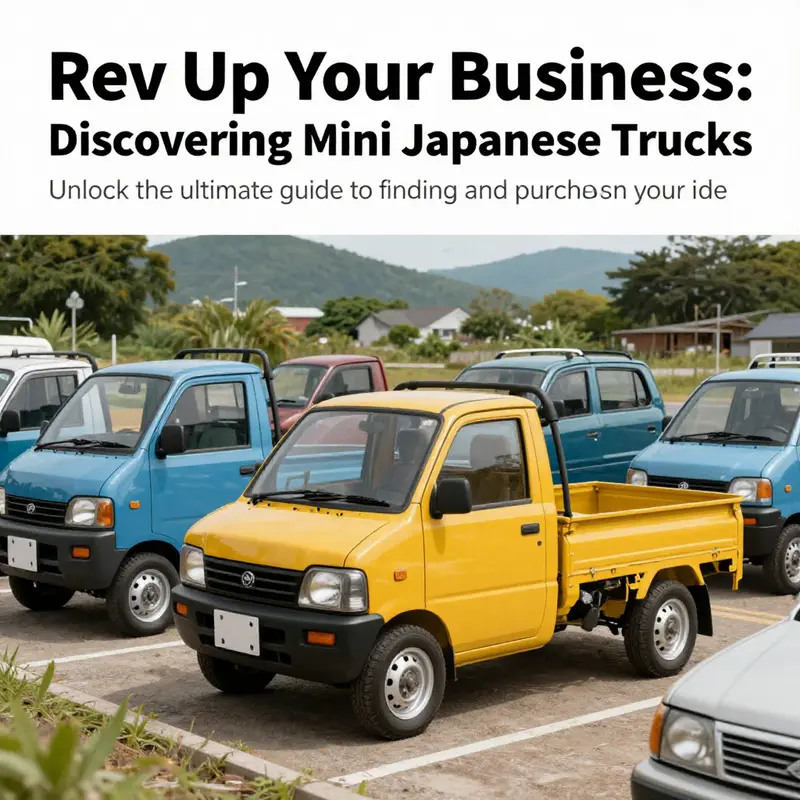
Are you a local small business owner in need of a versatile vehicle, a residential property owner looking for efficient transport, or a mini truck enthusiast searching for your next ride? This article is tailored just for you! Understanding where to buy a mini Japanese truck can significantly enhance your operational efficiency, whether you need it for commercial use, landscaping, or recreational fun. We will dive into three key areas: the best online marketplaces where you can source these compact powerhouses, a comparison of reliable suppliers to ensure you make a wise choice, and a thorough exploration of costs and options to fit your budget. Get ready to discover all you need to know about acquiring your very own mini Japanese truck!
From Search to Shipment: Mastering the Online Quest for a Mini Japanese Truck

The appeal of a compact, highly capable workhorse from Japan has a long shadow in the stories of farmers, small contractors, and DIY enthusiasts who needed a truck that could maneuver tight alleys, carry a surprising payload, and sip fuel rather than gulp it. In today’s global marketplace, the first trail to that utility vehicle usually runs through online marketplaces and supplier platforms that connect buyers with sellers across oceans, borders, and time zones. Finding a mini Japanese truck online is not simply a matter of typing a keyword into a search bar; it is a careful journey that blends market insight, logistical planning, and a clear sense of what you truly need from a compact work vehicle. The chapters of this journey intertwine price, condition, and compatibility, weaving a path from curiosity to ownership that many buyers find both challenging and deeply rewarding.
The entry point into this market is typically a broad, inclusive platform that hosts a spectrum of listings—new, used, and sometimes repurposed work vehicles adapted for different industries. On a platform of this breadth, you will encounter a mix of compact cargo vans, small delivery trucks, and a range of utility vehicles that are built to endure the rougher edges of real-world use. The listings speak in a language of capacity and performance rather than gleaming showroom gloss. You will see advertisements that emphasize load rating, bed dimensions, and drivetrain configuration—fundamental attributes that determine whether a vehicle can function as a daily workhorse or merely a weekend novelty. For international buyers, this blend of options is especially valuable because it opens the door to a robust second-hand market and, in some cases, to direct-from-manufacturer or wholesale listings that can yield more favorable pricing when purchased in quantity or with flexible delivery terms.
Among the platforms available, one site rises as particularly prominent for those who want to compare a spectrum of options in one place while still negotiating the realities of cross-border trade. It hosts a mix of models and configurations that can feel almost exhaustive to someone new to importing. The breadth of listings often includes compact delivery vans, small-scale dump trucks, and right-hand drive variants that have become popular in jurisdictions that favor or require a right-side steering wheel. This arrangement makes the platform especially useful for buyers who want to evaluate whether a vehicle’s geometry, payload, and drive feel align with local needs before arranging transport to a new home base. The listings can also reveal how different sellers approach documentation: some offer comprehensive product sheets with maintenance histories, while others provide a more limited snapshot of condition. The contrast between these approaches is not merely an academic point; it matters when you are coordinating freight, import duties, and local compliance.
One of the recurring realities in this marketplace is price dispersion. You will encounter a broad range—from the very attainable end of the spectrum to entries that sit well into higher territory, and the factors that push prices up or down are straightforward but not always obvious at first glance. A handful of drivers underlie the spread: model age, vehicle condition, engine type, and the presence or absence of certain equipment such as a diesel powertrain or a four-wheel-drive system. The condition variable, in particular, deserves close attention. A vehicle with clean sheet metal may still be showing signs of heavy use in other critical systems, and a seller may be offering a vehicle that has been refurbished but not fully documented. Conversely, a well-documented unit with clean maintenance records can deliver meaningful value, especially if its history includes regular service, a recent brake overhaul, or a proven record of routine inspections. The buyer’s challenge, then, becomes one of weighing price against reliability, future repair costs, and the certainty of obtaining spare parts that will be necessary long after the purchase is complete.
The price bands you see reflect a web of variables that are often more nuanced than simply “new” versus “used.” In many markets, buyers can find listings that begin around a few thousand dollars and climb toward the upper tens of thousands for units that have modernized features or that come from a more recent model year. The same platform may also indicate wholesale pricing or minimum order quantities, offering a pathway for buyers who are purchasing more than one unit for a fleet or a business with a stable demand. For the international buyer, the economics of a purchase often hinges on the broader logistics: shipping costs, insurance, import duties, and the time and paperwork required to clear a container through a customs corridor. The calculus here is not abstract. It translates directly into how soon a vehicle can begin work, how much a buyer will need to invest upfront, and how the monthly cost of ownership maps to the expected return on investment.
Part of the appeal of the online marketplace is also its ability to offer access to a diverse array of vehicle configurations that have proven themselves in the field. For example, buyers can encounter listings for compact, four-wheel-drive platforms that lend themselves to use as small, agile farming or work-site delivery vehicles. There are also dedicated utility configurations, such as small dump trucks, that are designed to move gravel, soil, or other light construction materials efficiently. The right-hand drive variants, which are popular in specific jurisdictions, show up in a handful of listings with a variety of documentation. The availability of such variants makes the platform a useful testing ground for buyers who are weighing whether a left-hand drive or a right-hand drive configuration makes more sense for their operations, access routes, and regulatory environment.
Beyond the mechanical and logistical specifications, the listings also tell a story about durability and the realities of maintenance. A compact vehicle with a simple, modular drivetrain can be easier and cheaper to service than more complex freight carriers. At the same time, the compact footprint usually comes with a tradeoff in payload and comfort, especially on longer daily routes or in high-demand application contexts. The savvy buyer learns to read the market’s signs: a robust service history, consistent maintenance intervals, and a clear record of part availability all signal a vehicle that can be sustained with reasonable downtime and predictable repair costs. Conversely, a listing that promises outstanding performance yet provides sparse service information should raise caution. In this market, the prudent buyer asks for detailed photographs, a walk-around video, or a live walkthrough with the seller to verify critical components such as the chassis, bed integrity, hydraulic systems (where applicable), and electrical harnesses. These checks matter because where a vehicle has spent its life is often reflected in its core structure as much as in its cosmetic condition.
The strategic questions that accompany any online search for a mini Japanese truck revolve around what you intend to do with the vehicle, how far you are willing to travel to pick it up, and how you plan to integrate it into your existing fleet or operations. If your aim is to acquire a platform that you can customize for a specific task—such as a small delivery operation, a mobile workshop, or a compact hauling solution—the platform’s breadth is a significant advantage. It allows you to compare the trade-offs between a base model and a more specialized configuration without committing to a single listing. If, on the other hand, your priority is a straightforward, robust workhorse that can be put into service with minimal downtime, you may tilt toward listings that emphasize reliability and documented service history, even if that comes at a higher initial price. The dynamic here is always the same: the market rewards clarity, reproducible condition data, and a seller who can demonstrate a plausible path from purchase to active service.
For international buyers, the journey also involves the practicalities of shipping and entry. Shipping a compact vehicle across oceans introduces a different kind of cost calculus. Sea freight, port handling, containerization, and insurance each contribute to the total landed cost. Buyers must consider not only the base purchase price but also the freight tariff and the potential for damage during transport, which is a nontrivial probability given the roughness that can accompany long-haul movement and weather exposure. The documentation tail is long as well: a clean title, export certificates, and a bill of lading are essential pieces, but local import documentation, vehicle registration, and inspection requirements can vary by country and even by region within a country. A well-prepared buyer knows where to find reliable guidance on these procedures and is prepared to work with a broker or freight forwarder who can translate the language of international shipping into a practical, executable plan. This is not a casual online purchase; it is a carefully choreographed sequence of checks, negotiations, and logistical alignments designed to bring a vehicle from a distant market into a local fleet that will rely on it daily.
The online journey is not a one-way street. It is a dialogue between buyer and seller, an exchange that tests expectations and improves the clarity of the eventual agreement. A seller’s responsiveness, the completeness of the product information, and the speed at which a seller can arrange a live demonstration or a detailed video walk-through can dramatically influence a buyer’s confidence. In many cases, buyers look for a seller who can provide not just a current snapshot of the vehicle but a reasoned narrative about its operational history. A transparent seller offers maintenance records, a clear account of any repairs, and a reasonable explanation of any outstanding issues. The value here is the reduction of risk and the acceleration of the path from inquiry to shipper’s lane. Some buyers elect to build a short-term, low-risk relationship with a single trusted supplier that can deliver multiple units over time. There is comfort in consistency, especially when market conditions shift or when you decide to upgrade your fleet in response to workload fluctuations.
A practical approach for buyers to manage this online exploration is to sequence their evaluation steps so they are manageable rather than overwhelming. Start with a broad search to assemble a mental map of what types of configurations are commonly available and what the typical price range looks like in your target region. Then narrow the field by setting non-negotiables—payload capacity, drive type, bed dimensions, and a minimum level of documentation. It helps to imagine your daily tasks and simulate how each candidate would perform. If a vehicle’s stated payload aligns with your needs but the bed length feels cramped for your work, you can deprioritize that listing even if it looks attractive on paper. If a vehicle’s documentation looks thin, you can request the missing pieces and weigh whether the risk premium is worth bearing against the potential savings on the sticker price. The beauty of the online marketplace is that it invites those kinds of disciplined comparisons, and the best buyers learn to translate scattered data into a clear scorecard.
As this scorecard matures, you begin to sense how a practical purchase might unfold. The negotiation phase becomes less about haggling over a number and more about clarifying the path to a binding agreement that includes the vehicle’s current condition, the exact terms of sale, and a delivery plan that matches your schedule. In some markets, you can negotiate around a staged delivery: a smaller down payment to secure the unit, followed by additional payments tied to inspection milestones or minor repairs that the seller agrees to complete before shipment. Others may prefer a straightforward, all-in price with a fixed delivery date and a package of warranties or post-sale support. Each approach carries its own set of risks and protections, and the buyer should align the chosen approach with their own risk tolerance and the degree of certainty they require before committing funds.
The most important practical reminder for buyers is to treat the online listing as a starting point, not a guarantee. A vehicle found on a marketplace is not the same as a vehicle seen in person. The next phase—a video call, a live walkthrough, or, if possible, an in-person inspection—serves as the bridge from digital curiosity to physical reality. In situations where an on-site inspection is impractical, a reputable agent or broker who can perform a remote assessment has become a common and valuable ally. The diligent buyer keeps an open channel for questions about wear patterns, rust indications, and structural integrity. They seek verifiable evidence of service history and current mechanical condition, and they confirm the accuracy of key figures like payload capacity, wheelbase, bed length, and overall dimensions. The more details a seller can provide, the more trustworthy the listing appears and the more confident the buyer can be about proceeding toward shipment with fewer surprises.
For those who want to deepen their understanding of how these vehicles can fit into a broader lifestyle or business plan, look to resources that explore practical conversions, customization, and the real-world uses of compact utility vehicles. A relevant example comes from a detailed piece that explores how a mini truck can be adapted into a camper platform and integrated into family trips or remote work setups. That article emphasizes the transformation journey—from a practical work truck to a versatile mobile workspace or a weekend-ready expedition vehicle—while also highlighting the kinds of considerations a buyer should keep in mind when contemplating aftermarket modifications, space utilization, and weight distribution. This kind of exploration helps buyers imagine beyond the raw capability of a stock vehicle and toward the broader possibilities that come with the right platform. Reading material that threads these ideas together can be a useful companion to the marketplace hunt, helping buyers visualize the end use while they evaluate listings.
For readers who want to see a concrete example of how a practical camper conversion can be approached on a related platform, there is a resource that profiles the customization process and offers a look at the end-to-end transformation. You can explore that exploration here: Godzilla Truck Camper Review & Customization. The piece sheds light on how a compact work truck can be repurposed into a rugged, off-road-capable camper, illustrating both the potential and the constraints of customization. It serves as a useful reference point for buyers who are contemplating not only the purchase itself but the kinds of future projects they may want to pursue to maximize the vehicle’s utility in their own operations. It also helps to anchor the broader narrative in a tangible example that captures the imagination while grounding it in practical considerations.
The last piece of the puzzle is the recognition that the online market is a living ecosystem. It evolves as new listings appear, as shifting regulations alter import viability, and as buyers exchange experiences about what has worked and what has not. A healthy approach is to remain engaged with the market over time, revisiting listings, updating your criteria in light of new information, and maintaining a dialog with sellers who respond constructively to questions and requests for documentation. The world of online purchasing for mini Japanese trucks rewards patience, method, and a willingness to learn. It rewards buyers who calibrate their expectations to the realities of cross-border trade and who approach the process with a well-considered plan that prioritizes reliability and long-term value over immediate discounts.
If you are building a plan for your own purchase, a final set of practical steps can guide you toward a confident decision. Start with a broad survey of available configurations and price ranges on your platform of choice. Narrow your list by identifying non-negotiables in payload, drivetrain, and bed geometry. Request comprehensive documentation from sellers and insist on clear, recent evidence of maintenance and a history of use. Schedule live demonstrations or video walkthroughs to verify the vehicle’s condition, and consider engaging a trusted broker or freight forwarder who can translate the terms of the deal into a concrete shipment timeline and a transparent landed-cost estimate. Throughout this process, blend the rational analysis of numbers with the intuition that comes from evaluating a vehicle’s real-world function. The goal is not merely to acquire a thing but to secure a workhorse that will reliably support your daily tasks, your business, and your ambitions for what that compact truck can accomplish in the years ahead.
External resource for further exploration and real-world guidance on platform dynamics and cross-border procurement can be found here: https://www.alibaba.com
Where to Buy a Mini Japanese Truck and How to Choose the Right Supplier
Practical sources and how to choose the right supplier for a mini Japanese truck
If you want to buy a mini Japanese truck, your choices shape everything that follows: cost, time to delivery, legal compliance, and long-term ownership. There are clear paths to obtain one. Each path has predictable strengths and trade-offs. Read through this chapter as a single, practical narrative that guides you from source selection to the moment the truck arrives at your gate.
Start with where these trucks come from. In their country of origin, compact commercial trucks are available new through authorized dealerships. These dealers provide factory-backed specifications, authorized servicing, and warranty options. They are the easiest route for buyers who can purchase locally and who need the latest model year features. For buyers based outside the country of manufacture, however, direct purchase from a domestic dealer is rarely practical without a broker. That is where specialist importers and used-vehicle exporters play their role.
Specialist importers and used-vehicle exporters focus on these compact trucks. Their business model centers on sourcing vehicles, verifying condition and documentation, arranging export procedures, and coordinating international transport. Working with an established importer reduces the risk that often accompanies long-distance purchases. Importers typically offer inspection reports, export certificates, and a clear chain of custody. They can also advise on whether a specific truck complies with your country’s emissions or safety regulations. If you need a functional work truck, a vetted importer is often the most efficient path.
Online marketplaces and auction platforms are another major channel. These range from broad, multi-category marketplaces to vehicle-specific auction sites that list hundreds or thousands of compact trucks. Marketplaces give a wide view of availability and price fluctuations. Auctions can produce bargains, especially if you’re comfortable assessing condition remotely or pay for a professional inspection. The tradeoff is that auctions often leave buyers responsible for arranging export, shipping, and compliance paperwork, unless the seller offers those services.
When comparing suppliers, focus on four critical criteria: transparency, documentation, logistics support, and after-sales service. Transparency means accurate photos, detailed description of mechanical condition, and a full maintenance and ownership history where possible. Documentation should include export paperwork, odometer readings, inspection certificates, and, when relevant, a record of any major repairs. Logistics support covers shipping options, packaging, and customs clearance assistance. After-sales service may include spares sourcing, remote technical advice, or recommended local workshops. A supplier who scores well on all four is worth the premium they might charge.
Pricing differs widely depending on the truck’s age, model, condition, and whether it is new or used. New trucks obtained through a dealer will carry the manufacturer’s price plus local taxes and fees. Used trucks sourced through importers or auctions can cost far less, but account for hidden costs. These include shipping, customs duties, currency conversion fees, and any required modifications to meet local standards. Factor in reconditioning costs, too. Even a low-mileage but aged truck might need tires, brake components, and fresh fluids before it’s road-ready. Make a realistic total-cost estimate before committing to a purchase.
Import regulations drive many buying decisions. Several countries require vehicles to meet specific emissions or safety standards. Some allow older vehicles through exemptions, while others demand modern compliance. Age-based restrictions are common; if your jurisdiction allows relaxed rules for vehicles over a certain age, that can open more options and reduce compliance cost. Your supplier should be able to tell you whether a candidate truck satisfies the rules where you live. If they cannot, pause and get independent confirmation.
Shipping and customs are predictable complications. International transport routes and carriers can be dependable, but delays and additional handling fees occur. Roll-on/roll-off services handle vehicles economically, while container shipping provides extra protection at higher cost. Customs duties vary by country and vehicle type. Some nations tax vehicles heavily for commercial imports. Others offer leniency for agricultural or municipal use. Build a buffer into your timeline and budget for clearance delays, port handling charges, and inland transport from the arrival port to your address.
Vehicle inspection is the buyer’s most important tool. Ask suppliers for recent, time-stamped photos of the vehicle from multiple angles. Request a mechanical checklist with specifics: engine condition, transmission behavior, rust presence, frame integrity, and brake system status. If possible, commission an independent inspection by a local agent in the vehicle’s country of origin. Inspections cost extra, but they pay off when you avoid an unseen, expensive problem. When inspections are not feasible, prioritize sellers that provide certified pre-inspection reports.
When assessing a supplier, consider their years in the trade and customer feedback. Experienced exporters have refined their logistics and can anticipate paperwork bottlenecks. Newer players may offer lower prices but may not manage problems as effectively. Read previous buyer testimonials and look for patterns. Positive reports that mention smooth delivery, accurate descriptions, and effective resolution of post-sale issues indicate a reliable supplier. Be cautious of sellers with minimal references or only new listings without a verifiable track record.
Payment terms and risk mitigation go hand in hand. Never wire money to unknown accounts without escrow protection. Reputable suppliers offer secure payment methods, deposits with documented milestones, and balance payments at delivery. Use escrow or an intermediary when feasible. Keep a paper trail including invoices, receipts, and shipment tracking numbers. If a deal seems to demand full prepayment without safeguards, treat it as high risk.
Parts supply and local support matter after purchase. Mini Japanese trucks are compact and often rely on region-specific components. Before you buy, verify the availability of common spare parts locally or via the importer. If parts are scarce, determine lead times and alternative suppliers. Also check whether local mechanics are familiar with these trucks. A common maintenance issue can become a long, frustrating search for expertise if local technicians are inexperienced with this vehicle type.
Registration, titling, and compliance vary by jurisdiction. Some governments require structural modifications, such as upgraded lighting or emission-control additions, before registration. Others insist on inspections by a certified entity. Your supplier should provide the necessary documents to begin registration, like export certificates and original registration documents. Still, expect additional steps when the truck lands. Budget for modifications and local inspection fees.
Negotiation and value extraction matter. When dealing with private sellers or auctions, know the typical price ranges for the model and age you want. For importer quotes, ask for itemized breakdowns of costs: vehicle price, export handling, shipping, insurance, customs duties, and local delivery. Itemized quotes reveal where there is room to negotiate. Small concessions, like free pre-shipment inspection or reduced inland delivery fees, can add measurable value without a direct discount on the vehicle price.
Timing is part of strategy. Buying at the right season can lower purchase and shipping costs. Demand for small commercial trucks spikes during agricultural cycles and busy construction seasons, which can raise prices. Conversely, quieter months may bring better deals and faster shipping slots. If you are not in a hurry, monitor listings and auction patterns for several weeks. That gives you leverage and time to assemble full-cost estimates.
Insurance and risk on transit should not be overlooked. Ensure the shipping contract includes adequate cargo insurance. Low-cost shipping often omits coverage for inland handling or port-to-port damage. Consult with your insurance broker about the right policy during transit and immediately after the truck arrives. Coverage should encompass transport damage, theft, and any accidental damage during pre-registration handling.
There are ongoing operational considerations that influence where you buy. If you plan to convert the truck into a specialized utility vehicle, buy from a supplier willing to accommodate pre-shipment customization. Some export specialists offer options like reinforced beds, toolboxes, or climate control units fitted before shipping. Pre-shipment customization eliminates the need for local modification, which can be costlier and harder to coordinate.
Warranties and return policies differ. New trucks bought through official dealers often include manufacturer warranties. Used vehicles sold internationally rarely carry long guarantees. Some importers offer limited short-term warranties on key mechanical systems. Read fine print. Understand what warranty covers and whether it is enforceable in your country. A warranty that requires return to the origin country is often impractical.
A practical buying path looks like this. First, decide on the model parameters you need: payload, bed configuration, drivetrain, and any special equipment. Second, choose your acquisition channel based on risk tolerance, budget, and timeline. Third, vet suppliers thoroughly with a focus on documentation, logistics capability, and references. Fourth, request itemized quotes and insist on inspection reports. Fifth, confirm export, shipping, and customs processes. Sixth, arrange secure payment and insurance. Seventh, prepare for local compliance and registration tasks. If you follow these steps, the purchase process becomes a sequence of manageable tasks instead of a single risky leap.
One last practical tip: use a local resource to reduce friction once the truck arrives. A nearby workshop familiar with compact imported trucks can speed up inspections, reconditioning, and registration. Local specialists save time and money over trying to manage unfamiliar tasks on your own. If you have a planning window, arrange a relationship with a local shop before the truck lands.
For a direct, authoritative source of official specifications, dealer locators, and model information, check the manufacturer website linked here: https://www.hino.com
For community-driven tips, local modification ideas, and practical owner experiences, consult this regional mini truck blog for hands-on articles and owner stories: mini truck community blog
This chapter aims to leave you with a clear map of where to buy and how to decide. Choose the channel that matches your appetite for risk and your budget. Verify documentation, protect payments, and plan for shipping and compliance. With the right supplier and preparation, a mini Japanese truck becomes a dependable tool rather than a logistical headache.
Where to Buy a Mini Japanese Truck: Costs, Channels, and the Practical Path to Your Kei Carry
The allure of a mini Japanese truck lies in its compact footprint, exemplary fuel efficiency, and surprising versatility. These small workhorses, designed to navigate narrow urban lanes and tight job sites, have earned a reputation for hard-witting reliability and simple mechanical design. They excel at urban delivery, farm tasks, light construction, and even hobby pursuits that require a nimble, capable carrier. Yet the same appeal that makes them desirable also creates a practical puzzle: where should a buyer look, how much should be spent, and what are the real costs beyond the sticker price? This chapter threads a coherent path through those questions, offering a grounded view of how to acquire a mini Japanese truck without losing sight of risk, legality, and long-term value. It is a journey through channels, costs, and practical judgment that helps you translate curiosity into a road-ready vehicle.
To begin, the channels through which a buyer can obtain a kei truck are varied, and each has its own mix of advantages and caveats. One broad category is the traditional auction and market route in Japan. Here, private buyers and small businesses participate in regular auctions that move a steady stream of kei trucks, dump bodies, and small cargo carriers. The prices in this domain are influenced by age, condition, mileage, provenance, and the specific configuration of the vehicle. A used kei truck from a Japanese auction can be a rational starting point for a cost-conscious purchaser who values originality and a straightforward platform to vet a motorized asset. In the auction ecosystem, you’ll typically encounter trucks that have seen urban or rural service, and you’ll be weighing whether to accept a unit that has modest wear against one that has more robust maintenance history from the outset.
Beyond auctions, many buyers turn to import channels that connect directly with overseas buyers and fleets. These channels can include dedicated importers, brokers, or distributors who specialize in arranging inspection, shipping, and compliance steps. The appeal of these routes often lies in a more curated experience: pre-shipment inspections, documentation handling, and professional logistics can reduce the friction that comes with buying an older, foreign-market vehicle. A careful buyer will still want to scrutinize condition reports, photos, and any available service histories, because a vehicle manufactured for a radically different regulatory and maintenance context will require careful due diligence before it becomes a reliable tool in a home market.
A third broad route—less glamorous but frequently pragmatic—involves online marketplaces that present a spectrum of kei trucks, from small fleets to individual sellers. These platforms can serve as a one-stop discovery ground, letting a buyer compare configurations such as four-wheel drive versus two-wheel drive, bed lengths, cab style, and transmission type. The upside is breadth and competitive pricing; the downside is variability in seller reliability and the absence of a guaranteed pre-purchase inspection. A buyer who pursues this path should budget thoroughly for inspection costs, transportation, and any post-arrival service that may be necessary to bring the vehicle up to the intended standard.
The price story for mini Japanese trucks is as nuanced as the channels themselves. In Japan, where kei trucks are a well-established segment, used examples commonly fetch prices that reflect condition, rotor and engine wear, and the general state of the chassis. A well-maintained unit can be found in a broad range, but the spectrum typically sits in a few thousands to under ten thousand dollars, depending on condition, age, and configuration. When you broaden the net to include import or export channels, the headline price can be misleading if you don’t account for the full landed cost. Import duties, value-added taxes, inspection fees, compliance modifications, freight charges, and broker or handling fees all accumulate. Shipping methods matter too. Roll-on/roll-off shipping can be more economical for vehicles that run and steer, but it may not protect delicate components the way container shipping does. Each option has implications for transit time, risk, and ultimately total cost of ownership.
The economics of a mini Japanese truck also hinge on a broader ecosystem of maintenance and parts. Parts availability, access to a competent technician, and the cost of routine upkeep can vary substantially between regions. For buyers who intend to operate in urban settings where efficiency and maneuverability are prized, the long-run maintenance narrative becomes central to value. Vehicles in the kei class are designed around compact, simple mechanical architectures, and their popularity has nurtured a global supplier base for common wears such as belts, filters, steering components, and brake assemblies. Still, the precise availability of parts, especially for less common chassis configurations or imported variants, will depend on the buyer’s locale and the existing aftermarket network. A practical approach is to map out a short list of common maintenance tasks you anticipate in the first year and verify the ease with which parts can be sourced locally or through a trusted importer.
Price is not the only factor. Other dimensions—weight, balance, and engine behavior—shape long-term satisfaction. Kei trucks are designed to be light and compact, which contributes to nimble handling and excellent fuel economy. However, the lighter mass also means the engine bears a higher relative load when the truck is tasked with heavier or uneven cargo. In practical terms, this translates to potentially higher maintenance demand if the vehicle is frequently used in more demanding applications. The weight considerations also influence how a vehicle behaves when loaded, especially on uneven surfaces or steep grades. Buyers should consider not only the payload rating but also the distribution of weight within the cargo bed and its impact on braking, steering, and overall road manners.
Understanding the cost picture requires a structured approach that begins with a budget and ends with a plan for integration into daily operations. The initial price tag, especially in a cross-border purchase, is just the first line item. You must add shipping and handling, duties, inspection costs, and any import or compliance fees that your jurisdiction requires. Then estimate the ongoing costs: registration, insurance, fuel, tires, and a rough forecast of maintenance. If you plan to lease or finance, you’ll need to factor in interest and possible depreciation over a fixed horizon. A practical method is to build a landed-cost model that includes a base purchase price, a conservative shipping estimate, duties, a compliance allowance, and a contingency for unforeseen costs. This model helps a buyer compare different channels on an apples-to-apples basis and to set expectations for the total investment required to bring the truck into service.
When assessing a specific listing, it helps to calibrate expectations with a simple set of questions. What is the vehicle’s year and mileage, and what is its service history? Is the cab integrity and bed structure sound, with no obvious frame damage? Are there alerts for rust, coolant leaks, or electrical gremlins that could signal deeper issues? How complete is the documentation—title, bill of sale, and any export paperwork that might be required by your country? What is the stated condition in terms of engine start and driveability, and what is the seller’s history of repairs? A buyer who politely pushes for detailed information and requests additional photos or a video of a startup from cold will often uncover early signals about the reliability and risk profile of the purchase.
To connect practical buying decisions with the deeper knowledge base, consider consulting a technical guide that consolidates grade, specification, and application data for kei trucks. A robust reference can anchor your decisions in engineering realities—payload, wheelbase, ground clearance, steering geometry, and the relationship between engine size and regulatory constraints. Such resources help translate your intended use into a technical profile that guides your search and reduces the likelihood of misalignment between expectation and reality. They also tend to remind buyers that the kei class sits under a specific regulatory envelope in Japan, where size and engine class define access, licensing, and compliance pathways. These realities matter because they shape not just the price you pay, but how readily you can operate and maintain the vehicle once it lands in your market.
With the channels, costs, and technical realities in mind, a buyer can shape a concrete plan. Start by clarifying what you need the truck to accomplish. Is it for daily urban runs, for light construction, or as a dedicated cargo hauler for a specific set of routes? Your answer influences the configuration you pursue—two-wheel drive for efficiency, or four-wheel drive for traction in mixed terrain. Consider also the operating environment: if you’ll be navigating narrow streets or loading in tight spaces, a smaller bed or a particular door arrangement may offer practical benefits that outweigh marginal gains in payload. As you refine this profile, you begin to see how your channel choice aligns with your goals. Auctions in Japan offer affordable entry points for those who are willing to research, inspect, and manage the logistics chain. Importers can provide a smoother, more predictable process, especially for buyers who want pre-arrangements around inspection and shipping. Online marketplaces offer breadth but require diligence to mitigate risks and to verify reliability. Each route has trade-offs, and a careful buyer weighs them against their own operational needs, tolerance for risk, and budget.
An important facet of this whole process is the recognition that you are not just purchasing a vehicle; you’re procuring a tool whose performance, maintenance, and replacement parts will shape your long-term cost of ownership. For example, the simple mechanics and compact dimensions that make kei trucks so attractive also mean that certain maintenance tasks are not always as straightforward as they would be for a more common passenger vehicle in your region. Access to skilled technicians who understand the kei class can be uneven outside Japan, and that reality should factor into your planning. In some cases, shoppers find it advantageous to partner with a local workshop that has prior experience with imported kei trucks, or to designate a preferred importer who can source parts and arrange repairs through a trusted network. The practical upshot is that a well-planned procurement pathway yields a vehicle that remains useful and economical long after the initial purchase has been completed.
As you move from concept to purchase, the narrative tightens around a few essential steps. First, define a credible budget that accounts for the landed cost and a conservative maintenance reserve. Next, decide whether your priority is the lowest possible upfront price or a smoother, more predictable ownership experience through a managed import channel. If you choose the latter, you gain a level of assurance in inspection protocols and logistical coordination, though you may pay a premium for that convenience. Third, build a dossier of what you expect in terms of configuration: drive system, bed size, door type, and cabin access. Finally, prepare for post-purchase tasks: registration, compliance adjustments, and the logistics of bringing the vehicle into service in your jurisdiction. This practical framework helps you navigate the complexity without becoming paralyzed by it.
To keep the narrative grounded, consider the following scenario as a heuristic guide. Suppose you identify a kei truck with a clean exterior, modest mileage, and a clear maintenance history, offered through a reputable channel. The base price in a Japanese context might be modest—reflecting the vehicle’s age and usage. Add shipping, export paperwork, and all applicable duties to your landed-cost estimate. Overlay a conservative maintenance reserve, say a few thousand dollars, to cover tires, brakes, and potential fluid system refreshes. If the vehicle requires any modifications to meet your local compliance standards, include those costs as well. In many cases, the total investment lands in a band that is still competitive with smaller, purpose-built trucks available domestically, while delivering the unique advantages of compact dimensions and efficient operation. The precise math depends on your locale, the exact configuration you pursue, and the current market dynamics across the channels you consider.
An essential part of the buying decision is the risk posture you’re willing to accept. A direct-from-Japan auction, while potentially the most cost-efficient on a per-unit basis, requires considerable due diligence, reliable inspection, and strong risk management around timing, logistics, and post-arrival compliance. Using a professional intermediary can significantly reduce this risk, but at the cost of additional handling fees and a potential lag in communication. Online marketplaces offer speed and variety, yet demand a disciplined approach to verify seller credibility, ensure accurate representation of vehicle condition, and confirm the availability of necessary export documents. In all cases, educating yourself about the typical life cycle of kei trucks—their common failure points, the kinds of maintenance most likely to be necessary, and the practical realities of sourcing parts—greatly increases your odds of a satisfying purchase.
The decision to pursue a mini Japanese truck should be anchored in a clear picture of its role in your operation. If your goal is urban light logistics, the kei truck’s compact size, good fuel economy, and tight turning radius offer tangible productivity benefits. If your work requires occasional heavier payloads, you may emphasize a sturdier chassis and a well-documented service history to reduce the likelihood of unscheduled downtime. If you’re using the vehicle for a mixed job site with uneven terrain, four-wheel drive configurations and robust tires become more important, even if they push up the purchase price a bit. Across these scenarios, the common thread is alignment: your channel, your costs, and your vehicle’s capabilities should fit your intended use like a tailored tool. Any misalignment generates friction—whether in maintenance costs, downtime, or, ultimately, the vehicle’s usefulness in your day-to-day operations.
As you close the loop on the purchasing plan, you may want to anchor the discussion with reliable, practical resources that bring together practical tips with technical nuance. For readers seeking a grounded, experience-based overview that complements the price and channel discussion, a respected industry resource compiles grades, specifications, and applications in a way that translates directly into how you evaluate a candidate truck. This kind of guidance helps you translate top-line budgets into a decision framework that remains useful after you take possession of the vehicle. It’s one thing to know what a vehicle can do in theory; it’s another to see how those capabilities translate into everyday work across the specific tasks you expect the truck to perform.
If you’re curious to explore practical considerations and real-world scenarios further, the Minitrucks Cala blog offers a thoughtful companion perspective, which you can visit here: minitrucksocala.com/blog/. This resource can provide deeper context about ongoing experiences, customization ideas, and community-driven insights that enrich your understanding of these compact workhorses.
All told, buying a mini Japanese truck is less a single decision and more a sequence of well-considered choices. You begin with a clear sense of your use case and a pragmatic budget. You study channels—auctions, importers, and online marketplaces—and weigh the trade-offs for price, risk, and convenience. You scrutinize vehicle condition and maintenance history with a discerning eye. You plan for landed costs with a realistic view of duties, shipping, and compliance. You prepare for ongoing ownership with an appreciation of parts availability and technician capability in your region. And you stay receptive to practical knowledge from seasoned buyers and trusted sources. In that synthesis lies the real value of a mini Japanese truck: a compact, efficient, and capable tool that can function as a daily partner in a surprisingly diverse array of tasks. The path to owning one is not a single transaction but a carefully managed process that rewards disciplined planning, thorough due diligence, and a readiness to adapt to the realities of cross-border procurement. The final choice—whether to pursue the lowest headline price or to invest in a smoother, more supported journey—will reveal itself as you align your needs with a channel and a configuration that together offer the most reliable return in your specific context.
External resource: For a concrete case study of listings and the pricing landscape encountered in cross-border procurement, see a representative listing on a major global marketplace platform that aggregates kei truck options and related freight terms. This example illustrates how base price, shipping, and compliance come together in a single quote that buyers often compare when evaluating channels. https://www.alibaba.com/product-detail/Japanese-Mini-Truck-For-Sale-4×4-4WD_1600927598741.html
Final thoughts
In conclusion, buying a mini Japanese truck is a smart move for any local small business, residential property owner, or enthusiast. By exploring various online marketplaces, comparing trusted suppliers, and understanding the associated costs and options, you will be well-equipped to make a confident purchase decision. Mini trucks offer the perfect blend of flexibility, utility, and fun, making them a valuable addition to your life. Start your journey today and find the mini truck that suits your needs the best!