
Japanese mini trucks, or kei trucks, have captured the imagination of many local small business owners, hobbyists, and property owners seeking efficient, compact vehicles. However, navigating their legal status in Georgia can be a bit perplexing. With relevant safety and emissions standards, ongoing legislative efforts, and cultural implications, understanding the dynamics of kei trucks is crucial for anyone considering their use or ownership. This article will shed light on the legality of these quirky vehicles, the safety and registration standards they must meet, legislative attempts to regulate them, and the broader economic and cultural factors at play in Georgia.
On the Margin of Georgia’s Roads: The Legal Reality of Japanese Kei Trucks
Among enthusiasts and small-business operators, Japanese mini trucks—often called Kei trucks for their compact dimensions and economical design—arouse a mix of admiration and practical curiosity. They are celebrated for their nimble handling, tight turning radii, and surprisingly capable payloads for their size. In Japan, these vehicles are purpose-built for urban deliveries, light cargo runs, and narrow streets where bigger trucks struggle to maneuver. Yet when the conversation shifts from admiration to traffic laws, the United States and Georgia in particular place the Kei truck on a very different terrain. The short version is stark: under current Georgia regulations, these vehicles are not street legal for public-road use. For many readers, this realization lands like a jolt, especially when the vehicles themselves glow with character and promise. The longer story, however, is a study in how safety standards, emissions controls, vehicle aging, and the federal framework interact with state sovereignty to shape what can actually be driven down a Georgia highway.
The heart of the matter lies in safety and environmental standards that are more exacting in the United States than in Japan. The U.S. safety framework rests on Federal Motor Vehicle Safety Standards (FMVSS), enforced by NHTSA, and the environmental standards administered by the Environmental Protection Agency (EPA). Kei trucks coming from Japan are typically designed to meet Japan’s regulatory landscape, which is not equivalent to FMVSS in coverage or stringency. The structural design, restraint systems, crash compatibility, airbag configurations, bumper standards, and side-impact protection—each element is a piece of a larger compliance puzzle. In Georgia, as in all states, to operate on public roads, a vehicle must satisfy these federal benchmarks or obtain a mechanism that compels compliance. Absent this, the vehicle remains outside the lane lines of legality. The reality is that many Kei trucks arrive with features that are routine in their domestic market but lack the explicit certification or proof of conformance that the U.S. system requires. Even if a vehicle is perfectly functional, that function alone does not translate into a lawful pass on a Georgia highway.
Another piece of the story is how import rules interact with state rules and how the federal government frames what may be brought into the country at all. The U.S. has a specific path for importing older vehicles that may circumvent some federal requirements through what is called a 25-year import rule. In practice, this rule creates an opening for vehicles manufactured before a certain year to be imported with less stringent federal oversight. However, this does not grant universal entry or street legality the moment the vehicle touches American soil. Importers must still satisfy state inspection regimes, registration processes, emissions testing where applicable, and safety verifications before a vehicle can be titled and plated. Georgia’s regulations mirror this multi-layered reality. Even if a Kei truck could technically qualify for a 25-year exemption, it would still need to pass state safety inspection standards, emissions requirements, and the registration framework that governs which vehicles are allowed to ply Georgia’s roads. It is this layered gatekeeping—federal rules, state enforcement, and the practical realities of vehicle modification—that often makes the path to legality in Georgia more of a maze than a straight highway.
The practical upshot of these regulatory realities is that the Kei truck’s reputation as a versatile urban cargo carrier must contend with the fact that Georgia officials, like those in most states, prioritize a baseline of safety and environmental responsibility that these compact Japanese vehicles cannot automatically meet. The vehicles’ typical construction favors lightweight frames, small-displacement engines, and simple crash structures, which may not align with FMVSS crash-test outcomes. The tires, lighting systems, and bumpers are sized with a different regulatory expectation in mind, and the interior safety equipment—airbags, advanced restraint systems, and occupant protection measures—does not always align with U.S. standards without substantial retrofit work. In practical terms, this means that even if a Kei truck could legally be registered, the process often requires extensive certification, modification, or both, raising the total cost and complexity well beyond the average budget of a casual collector or a small business owner seeking a fuel-efficient delivery solution.
The governor’s veto in May 2025—that is, the veto of a bill intended to reinstate road use for Kei cars—caps a notable moment in this ongoing policy conversation. The veto signals a political and regulatory preference to maintain current safety and emissions barriers rather than to create a pathway that would allow these vehicles to share Georgia’s public roads. It is not a general indictment of Kei trucks’ utility; rather, it is a decision about the pace and scope of regulatory adaptation. For Georgians who hoped to see a legal compromise emerge that would permit certain Kei trucks to operate under a defined framework—perhaps with standardized inspections, emissions controls, and a dedicated use-case—the veto represents a setback. Yet it also clarifies the boundary within which any future proposals must operate: they must address how to align Kei trucks with FMVSS and EPA standards, or provide a credible mechanism for a selective, time-limited exemption that holds up under Georgia’s inspection regime.
For readers who live near the urban fringes or who maintain a fleet that depends on small, efficient transport, the practical implications are clear. Until regulatory changes occur, the standard answer remains: a Kei truck is not legally drivable on Georgia’s public roads. This does not preclude private property use, off-road adventures, or display at car shows, but it does mean that a street-legal license plate, insurance, and title are substantive hurdles that a vehicle of this kind cannot readily secure. It also means the market for these vehicles in Georgia tends to skew toward non-street uses, such as private property utility, off-road recreational applications, or purely collector’s items rather than everyday transportation. The ongoing tension between the appeal of these compact workhorses and the safety-first posture of state and federal agencies shapes a unique regional dynamic where enthusiasts must balance passion with compliance.
Within this landscape, there are plausible, carefully framed avenues that interests in Kei trucks might explore if they want to move toward legality or at least toward safer, more compliant operation. One path is to explore the federal exemption framework with rigorous adherence to U.S. safety and emission standards, potentially through importing vehicles that have already earned FMVSS certification or through certified modification programs that bring a vehicle up to U.S. standards. This approach would require substantial engineering work, professional testing, and a willingness to invest significant resources. A second avenue is to pursue a narrowly tailored use regime outside the public road—such as municipal fleets operating on private rights of way, or business operations conducted within controlled environments where the safety requirements may be different from general public streets. A third route, often discussed in enthusiasts’ circles, is to support incremental legislative amendments that address specific characteristics of Kei trucks, perhaps focusing on lighter curb weights and simplified safety packages that can be validated under FMVSS without compromising the cost-efficiency that makes these vehicles appealing in the first place. Any of these paths would demand a thorough, transparent dialogue among policymakers, safety advocates, importers, and the Georgia public.
In the meantime, for readers who want to explore the broader social and cultural aspects of the Kei truck phenomenon, communities and online platforms offer a space to share experiences, build knowledge, and discuss practical workarounds. A reliable starting point for ongoing discussions and updates is the general Kei truck community hub that maintains a repository of news, debates, and retrofit stories. This resource functions as a bridge between the theoretical regulatory landscape and the hands-on realities of owning and operating a Kei truck in a state like Georgia. It’s the kind of space where readers can learn about how different ownership models address the mismatch between market demand and regulatory feasibility, and where they can gauge how local lawmakers respond to new information and constituent interests. For readers who want a centralized, continually refreshed source of community commentary, the dedicated blog offers a narrative thread that complements the regulatory texts with practical perspectives from people who have walked parts of the road that currently remains closed to public driving.
The path forward will likely continue to be shaped by a blend of policy, technology, and community advocacy. Policymakers weigh safety, emissions, and interstate consistency, while manufacturers and enthusiasts push for innovations that could reconcile Kei trucks’ compact design with U.S. regulatory expectations. Meanwhile, Georgia residents who enjoy small-footprint transportation or who operate small businesses that prioritise maneuverability and low cost may need to reframe expectations. The question, then, becomes not only about whether a Kei truck can legally join the flow of traffic on a Georgia highway, but about what constitutes practical mobility in a state with diverse geography, busy urban corridors, and a commitment to uniform safety standards. Until the regulatory environment changes, the most responsible choice for those who value compliance is to pursue vehicles that already meet FMVSS and EPA criteria or to use Kei-inspired concepts within contexts that do not require street-legal status.
This nuanced stance does not diminish the appeal of Kei trucks. It merely situates that appeal within the constraints and responsibilities that come with driving on public roads in Georgia. The vehicles’ provenance, their engineering philosophy, and their efficiency remain compelling. What changes is the understanding that legality is not something inherent to a vehicle’s design; it is a condition imposed by a framework of rules. Those rules are designed to balance mobility with public safety, environmental stewardship, and the integrity of the road network. For the person who still wants to stay connected with the Kei truck community while respecting the law, engaging with public forums and official sources becomes part of the journey. It is here, in the intersection of passion and policy, that new ideas may emerge about how Georgia could, in the future, adjust its approach to these unique vehicles while preserving the vehicle safety standards that protect all road users.
As the dialogue continues, it is useful to reference the most authoritative sources for current federal and state requirements. The official NHTSA vehicle imports page provides the core framework for understanding federal eligibility, certification, and the path to legalization that could, in theory, apply to future cases. While the veto on Kei car road use in 2025 signals a clear stop sign for a straightforward adoption of Kei trucks on Georgia roads today, the conversation is far from over. The interplay between 25-year exemptions, state inspections, and potential regulatory pilots means interested readers should monitor legislative developments and regulatory notices closely. For readers who want to connect theory with community experience, a look at the broader discussion in the Kei truck community blog can offer context about how hobbyists and small business operators navigate the tension between desire and compliance. You can explore updates and discussions there to better understand how people in Georgia and surrounding regions are thinking about these vehicles, their uses, and the evolving legal landscape. Mini Trucks GA Blog remains one of the most accessible venues for current debates, retrofit ideas, and practical considerations as Georgia ponders the future of Kei trucks on its roads.
Readers seeking formal, external guidance on import eligibility and federal requirements should consult the NHTSA resource at https://www.nhtsa.gov/vehicle-imports. It is the definitive source for understanding what it takes to legally bring a vehicle into the United States and what standards must be met for on-road operation. The state-level reality, including Georgia’s current stance, can then be interpreted against this federal backdrop. The two sources together offer a comprehensive view: the federal framework that sets the baseline for importability, and the state framework that determines how, when, and whether those vehicles can actually be used on public streets. The gap between these layers—created by safety, emissions, and conformity requirements—defines the central question of the chapter: are Japanese mini trucks street legal in Georgia? The answer, grounded in current law and policy, is still no, with the strong caveat that this could change if a future regulatory shift aligns standards without compromising safety and environmental goals.
Between Compliance and Convenience: How Safety, Emissions, and Legislation Shape Kei Trucks on Georgia Roads
The idea of a tiny workhorse rolling along Georgia’s highways sounds almost quaint, a frictionless answer to urban congestion and seasonal hauling alike. Yet safety, emissions, and the rules that govern who may share the open road create a tangled landscape for Japanese mini trucks, commonly called kei vehicles. In Georgia, the question—are these pint-sized pickups street legal—has to balance the pragmatic appeal of affordable, fuel-efficient transportation with a stubborn insistence on standards that protect drivers, passengers, pedestrians, and the broader environment. The chapter that follows threads these considerations together, showing how legislative attempts, regulatory barriers, and the realities of federal and state requirements converge to determine whether kei trucks can ever be more than curiosities on Georgia asphalt. It is a topic that sits at the intersection of policy, technology, and the everyday needs of motorists seeking practical, economical solutions in a state known for its diverse driving landscapes, from urban cores to rural byways.
At the heart of the discussion is a formal distinction between what a vehicle is designed to do and what a state is willing to permit on public roads. Kei vehicles, as they are traditionally engineered in Japan, emphasize compact dimensions, light weight, and efficiency. They are built around the domestic expectations of Japan’s regulatory environment, including its own safety test regimes and emissions controls. When such vehicles are introduced to the American market, they encounter a different regulatory grammar. Georgia, like other states, adheres to federal motor vehicle safety standards and environmental regulations administered by agencies such as the Department of Transportation and the Environmental Protection Agency. These standards exist to ensure that any vehicle that travels on public roads meets a baseline of crashworthiness, occupant protection, braking performance, lighting, and control of emissions that align with national expectations. The result is that a kei truck, designed for a different regulatory climate, often fails to meet one or more of these requirements without substantial modification. The practical implication is that a kei vehicle cannot be registered, insured, and operated on Georgia highways in the same way as a vehicle built to meet FMVSS (Federal Motor Vehicle Safety Standards) and EPA standards.
The legislative arc over the last few years has underscored how policymakers weigh innovation against public safety and environmental protection. In 2025, Georgia’s General Assembly considered a bill intended to reintegrate kei vehicles into the state’s road system. Lawmakers highlighted the potential benefits of kei trucks: their compact size can be advantageous in city traffic, their lighter weight can translate to lower fuel consumption, and their modest costs could broaden access to essential transportation for residents who rely on affordable work vehicles. This legislative proposal reflected a broader national conversation about whether and how to accommodate nontraditional vehicles within the existing regulatory framework. Proponents argued that thoughtful standards alignment and modernization could unlock new mobility options for small-business owners, tradespeople, and rural residents who face limited access to larger trucks or unreliable transit options. Yet, even as the idea gained initial momentum, it collided with concerns about safety and environmental integrity.
The center of gravity for the debate rested on two pillars: safety and emissions. Safety concerns dominated discussions among regulators, insurers, and safety advocates. Critics warned that kei vehicles often rely on smaller structures, lighter materials, and different crash-test philosophies than their U.S. counterparts. The fear is not only about occupant protection in a collision but also about crash compatibility with larger, heavier vehicles sharing the road. The risk of a mismatch between vehicle mass, crumple zones, and airbag deployment strategies becomes more pronounced as speeds and traffic densities vary widely across Georgia’s road networks. In a state with vibrant urban regions where street parking and mixed-use streets prevail, the interaction between kei vehicles and conventional cars, trucks, and buses raises questions about pedestrian safety, visibility, and the behavior of these compact machines under typical driving stressors such as sudden lane changes or highway merge maneuvers. Emissions, the other half of the equation, emphasize the environmental health of Georgia’s air. The EPA’s regulatory framework requires emissions controls appropriate to a vehicle’s engine design, fuel system, and exhaust treatment. Kei vehicles, often tuned to smaller displacement engines for efficiency, may rely on older or Japan-specific emission profiles that do not align neatly with U.S. regulatory expectations. The potential mismatch can manifest in higher tailpipe emissions in certain operating conditions or in the absence of advanced technologies that U.S. standards increasingly expect, such as specific catalytic converters or diagnostics that support maintenance and repair in the field. The consequence, in the eyes of regulators, can be a higher barrier to entry for kei trucks on public roads without substantial modification and testing.
The governor’s veto in May 2025 crystallized the state’s preference for maintaining robust safety and environmental guardrails. Governor Kemp’s decision, returning the bill to the legislature without passage, signaled a clear message: Georgia would not dilute its standards to accommodate a class of vehicles that could complicate enforcement, maintenance, and long-term accountability for road safety and air quality. The veto did not just kill a single policy idea; it reinforced a framework in which any future consideration of kei trucks would have to demonstrate that the vehicles could meet or exceed federal and state safety and emissions thresholds, that there is a practical and enforceable path to conformity, and that Georgia’s transportation ecosystem would not be compromised by a regulatory loophole. It is important to recognize that this outcome does not stem from a rejection of smaller, efficient mobility per se. Instead, it reflects a deliberate, data-informed stance that prioritizes uniform safety standards, verifiable emissions performance, and the integrity of Georgia’s vehicle inspection and registration processes.
From a practical standpoint, the current status remains consistent with a broad regulatory posture: kei vehicles are not street-legal in Georgia under existing rules. They are not accepted for standard registration, and they cannot be operated legally on public roads without a pathway to compliance that satisfies FMVSS and EPA criteria. The consequence for individuals who might be attracted to the kei form factor—whether for daily commuting, light hauling, or business use—is that alternative solutions must be sought. These alternatives can include conventional small cars or trucks that are designed, certified, and marketed for the U.S. market, vehicles that have undergone the required safety testing, emissions certification, and state regulatory checks. For some, that may mean choosing a lightly used or compact model that already conforms to U.S. standards, thereby delivering many of the same practical benefits that kei trucks offer, such as maneuverability and efficiency, without compromising safety or regulatory compliance.
The regulatory framework in Georgia inevitably interacts with the broader national context. The U.S. regulatory environment is not built to accommodate a patchwork of imported, unmodified vehicles that originate from other markets with different safety and emissions philosophies. The FMVSS standards create a baseline for crashworthiness that is not easily waived or adapted to domestic needs without comprehensive testing and certification. Similarly, the EPA’s emissions standards mandate that any vehicle entering U.S. roads must meet certain performance criteria, a requirement that can be difficult to reconcile with the engineering of kei vehicles calibrated for a different regulatory culture and environmental baseline. That interplay between federal requirements and state enforcement shapes the practical reality of what kind of vehicle can legally circulate on Georgia’s streets. Even when a legislative window exists for trial or pilot programs, those initiatives must be structured to guarantee that all participating vehicles can demonstrate compliance across the spectrum of safety and environmental performance.
One of the more subtle aspects of this dynamic is how inspectors and law enforcement officers, who administer and enforce vehicle compliance, navigate gray areas. The daily operation of roadways depends on a stable, well-understood standard: a vehicle must be properly titled, registered, insured, and pass on-road safety and emissions checks to remain lawful. When kei vehicles do not meet FMVSS or EPA standards, the risk of enforcement action increases, not merely on a theoretical level but in concrete terms for drivers who may find themselves confronted with fines, vehicle impoundment, or the inconvenience of retrofitting. Georgia’s approach, as signaled by the veto, points toward preserving the integrity of the registration system and maintaining alignment with established federal guidelines. The legislative debate, the veto, and the prolonged ambiguity surrounding kei trucks all illustrate a broader truth: policy debates around niche vehicle categories tend to revolve around whether the benefits can be realized without undermining the core public safety and environmental protections that the state and country rely on.
For readers who want to grapple with this issue beyond the headlines, it helps to approach it as a matter of policy coherence. If kei trucks are to be allowed on Georgia roads in the future, lawmakers would need to craft a multi-layered framework. This framework would likely require independent testing of kei vehicle safety characteristics, validation of emissions performance under U.S. driving cycles, and a robust mechanism for ongoing compliance monitoring. It would also require clear guidelines for registration, insurance, and enforcement that minimize loopholes while preserving consumer access to affordable, efficient transportation. A thoughtful pathway might involve establishing a temporary or limited-use program under strict criteria, much like other regulated pilot programs that test the feasibility of new vehicle types in a controlled, observable environment. Such a program would need to demonstrate that kei trucks can operate safely in diverse Georgia contexts—urban, suburban, and rural—while meeting emission ceilings, facilitating repair and maintenance under U.S. standards, and enabling consistent enforcement.
In the absence of such a pathway, the status quo remains the most predictable guide for Georgia drivers and fleet managers. For those who operate small businesses or require frequent short hauls, the temptation to pursue an alternative that resembles a kei vehicle is obvious. Yet the risk of operating an unregistered vehicle on public roads is substantial, both legally and from a consumer protection angle. The state’s emphasis on rigorous safety and environmental regulations helps ensure that vehicles on Georgia roads can be reliably maintained, repaired, and supported by a lawful network of dealers, mechanics, and insurers. It also supports a consistent standard for emissions, contributing to the broader state and regional air quality goals. The balance Georgia seeks is not born of resistance to innovation; it is grounded in a long-standing commitment to road safety, regulatory clarity, and the shared responsibility of keeping transportation systems reliable for everyone who uses them.
Beyond Georgia’s borders, car aficionados and logistical operators often watch these regulatory developments with interest. The kei vehicle narrative in Georgia is part of a larger dialogue about how societies adapt to new mobility forms without compromising safety or environmental stewardship. The experience in Georgia underscores a practical lesson for other states considering similar policies: when the road to legality involves aligning multiple regulatory streams—federal safety standards, state inspection and registration regimes, and environmental regulations—the path to real-world adoption becomes marked by a series of checks, tests, and public accountability mechanisms. It is a reminder that the promise of innovative, space-saving transport does not automatically translate into immediate road access. It requires a deliberate, transparent process that respects both the value of new mobility and the responsibilities of safeguarding the public.
For readers seeking further context on how industry observers and journalists have framed this issue, a broader perspective can be gained through ongoing commentary and industry insights, such as the LinkedIn update by Steven Lefkoff on Kei Vehicles. While not a policy document, such discussions illuminate the practical and regulatory signals that influence legislative decisions and public perception of kei trucks in the United States. External analyses can help readers understand the evolving landscape, even as Georgia’s veto reminds us that bold proposals must contend with a suite of established standards before they can become reality on the state’s streets. If you want a concise overview that captures the current status and the motivation behind the legislative debate, this linked discussion offers an accessible entry point: https://www.linkedin.com/pulse/kei-vehicle-japanese-mini-truck-update-steven-lefkoff-4xq7b/.
For those who want to explore related content about how smaller, purpose-built vehicles fit into Georgia’s mobility ecosystem, several internal resources can illuminate broader themes without duplicating this chapter’s core argument. The state’s own discussions about alternative vehicle categories and related affordability considerations are discussed in various industry-focused entries and policy briefs available on the Minitrucks Cali ecosystem. A concise way to dip into that material is to visit the general hub at the Minitrucks Cali blog, which aggregates a range of topics from practical vehicle maintenance to comparative model assessments and regulatory updates. See the Minitrucks Cali Blog for broader context and concrete case studies that illuminate how compact, efficient vehicles are evolving in a market that prizes practicality, reliability, and compliance. Minitrucks Cali Blog.
The central takeaway from Georgia’s current stance is that the state prioritizes a baseline of safety and environmental integrity when structuring road access for any vehicle type. Kei trucks represent a compelling case study in how mobility innovation can outpace regulatory frameworks, and how policymakers, industry stakeholders, and the public must work together to craft pathways that do not sacrifice road safety or environmental health in the name of progress. The veto does not close the door on future possibilities; rather, it frames a more deliberate, standards-driven route that would need to be navigated before kei vehicles could become a familiar sight on Georgia’s highways. In the meantime, residents and fleets seeking practical, efficient transport in Georgia will continue to rely on vehicles that already meet or exceed the standards demanded by the state and the country, knowing that the road to future policy reform is likely to require careful alignment of engineering, testing, and regulatory compliance across multiple jurisdictions.
Internal link note: For readers who want to engage with a broader collection of related content from this ecosystem, the Minitrucks Cali blog is a valuable starting point for exploring practical topics such as maintenance, customization, and comparisons among compact vehicles in the market today. This resource provides a broad spectrum of perspectives that can help readers understand how small, efficient vehicles fit into real-world transportation needs, even if Georgia currently maintains a strict stance on kei vehicles on public streets. Minitrucks Cali Blog.
null
null
Kei on the Road: Culture, Commerce, and the Georgia Kei-Truck Question
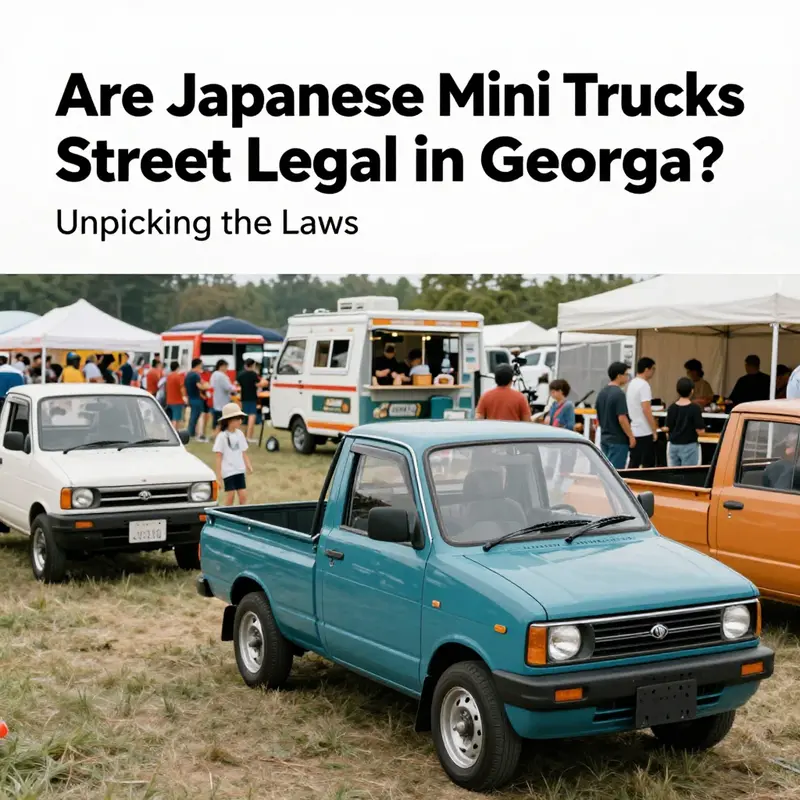
The question of whether Japanese mini trucks, or kei vehicles, can smoothly enter Georgia’s public-road ecosystem is more than a legal puzzle. It is a lens on how a modern community negotiates novelty, safety, and opportunity. In the wake of political efforts to reinstate road use for kei cars and a veto that halted those plans in May 2025, Georgia stands at a crossroads where culture and commerce brush up against federal standards and state regulatory pragmatism. Kei trucks embody a paradox: they are celebrated for their compact efficiency and urban adaptability, while they are scrutinized for their fit with U.S. roadways, safety expectations, and emission profiles. The debate that followed the legislative attempt mirrors broader conversations about mobility in small, dense cities and in rural corridors where last-mile service and micro-enterprise can flourish, but not without a clear, enforceable framework. The current status, then, is less a verdict on a single vehicle and more a reflection of how a state weighs innovation against established safety and environmental commitments.
For residents and business owners who understand Georgia’s patchwork of road types—from winding rural lanes to congested urban arteries—the appeal of kei vehicles is not merely nostalgia for a compact, fuel-efficient design. It is a practical answer to everyday logistics and urban living in a state where growth often outpaces traditional fleet capacity. These vehicles are designed to be nimble. They offer tight turning radii, the ability to maneuver through narrow streets, and extraordinarily low operating costs. To imagine their popular use is to imagine a transportation landscape that values resilience and adaptability. Yet imagining and approving are two different acts, especially when a vehicle’s origin, certification, and performance envelope diverge from what the state recognizes as standard equipment for public highways. The veto in 2025 underscored a willingness to pause and reassess rather than to rush toward a solution that could require substantial adjustments in how Georgia enforces safety, licensing, and insurance for non-traditional vehicles on shared roadways.
Culturally, kei vehicles resonate with a growing cohort of Georgia residents who prize practical, economy-minded transportation. Enthusiasts describe kei trucks as symbols of inventive engineering and global connectivity. They are associated with a narrative of sustainable mobility—vehicles that sip gasoline, occupy little parking space, and boast a smaller carbon footprint per mile than many traditional larger vehicles. This narrative aligns with broader civic conversations about traffic congestion, air quality, and the urban design implications of lighter, more efficient mobility. At the same time, the adoption of kei vehicles raises questions that communities are reluctant to ignore. How do such vehicles behave in heavy rain or at highway speeds? How do first responders assess and engage with a vehicle that differs markedly from typical passenger cars or larger trucks? What does it mean for neighborhoods that expect predictable vehicle behavior when a city’s emergency services plan for a different fleet mix? These questions illuminate a social contract: new mobility technologies require not only a market appetite but a governance framework that makes safety and predictability a shared priority.
The cultural tension is not merely about fear of the unknown. It is also about how Georgia’s communities interpret risk and responsibility. Some residents perceive kei trucks as empowering tools for small-scale entrepreneurs, from mobile vendors to last-mile couriers and service technicians who want to reach underserved neighborhoods with efficiency. The logic here is straightforward: a small, easy-to-maintain vehicle can lower entry barriers to entrepreneurship in regions where traditional delivery fleets are costlier to deploy. Yet the same logic rests on a careful calibration of risk. Insurance policies, vehicle registration, and the potential for liability must align with state standards so that both operators and the public remain protected. In an environment where a legislative veto can suspend the path to legality, many would-be operators must weigh the immediate gains in productivity against the longer-term consequences of operating in a gray zone. The balance is delicate. A vehicle that seems economically attractive can become a liability if it is not clearly understood by insurers, buyers, and local authorities.
Economically, the allure of kei vehicles lies in simple mathematics that resonate across small businesses and independent operators. The fixed costs of ownership are lower, the maintenance cycles are straightforward, and fuel consumption is typically modest. In a state like Georgia, where diverse geographies demand flexible transportation strategies, kei vehicles offer a potential solution for specific niches. For instance, compact trucks can complement a micro-delivery model in dense neighborhoods or serve as mobile service platforms where space constraints or zoning rules limit the use of larger trucks. They can also support seasonal vendors who need a low-cost platform to reach customers in town centers or on college campuses. When paired with efficient scheduling and route optimization, these vehicles can reduce per-stop costs and expand service reach without the capital penalties associated with larger fleets. The upside, however, hinges on a stable regulatory environment. Without a clear path to registration and city or state compliance, the economic advantages remain theoretical. The veto not only left a vacuum for business planning but also increased perceived risk among lenders and insurers. Banks and insurance carriers tend to favor certainty; a vehicle with unclear legal status on Georgia roads makes financing more expensive or unlikely. Small businesses respond to this signal in two ways: some pause their pilots, while others pivot to more conventional fleets that can be registered without ambiguity. In either scenario, the momentum generated by a compelling business case for kei vehicles is tempered by the political and legal landscape that frames what is possible on the road.
A closer look at the regulatory environment helps illuminate why the conversation has remained cautious rather than explosive with adoption. Federal standards set the baseline for safety, emissions, crashworthiness, and overall vehicle performance. States, in turn, implement registration processes and inspections that reflect these standards while adding their own requirements. For Georgia, this means alignment with federal vehicle safety regulations, emissions criteria, and road-use rules. Vehicles designed primarily for a different regulatory context—such as kei trucks built for Japan’s urban density and different highway speeds—often lack the necessary certifications and compliance labels that U.S. authorities require. In practice, that translates to hurdles in crash test data, lighting and signaling standards, bumpers and pedestrian-protection criteria, and emissions certifications. The gap between a vehicle’s intended design and the state’s compliance expectations is not merely a paperwork issue. It is a health-and-safety calculus that influences the speed and feasibility of legal adoption.
The veto in May 2025 did more than prevent a bill from becoming law; it signaled a more cautious approach to integrating non-traditional vehicles into Georgia’s public-road system. It underscored that the state prioritized a thorough assessment of potential impacts on highway safety, emergency response operations, and infrastructure wear, all of which must be reconciled with the goals of economic experimentation and user convenience. In practical terms, the veto meant that businesses and individuals who might have built a local supply chain around kei trucks faced ongoing regulatory uncertainty. They had to consider not just the upfront purchase price or the freight savings, but the cascading costs of registration, insurance, and potential liability if a vehicle operated in a manner inconsistent with Georgia’s expectations for on-road operations. In a broader sense, the veto catalyzed a conversation about how Georgia can balance the desire for innovation with the responsibility to maintain a predictable and safe road network. It prompted policymakers, insurers, and road-safety advocates to revisit the standards by which new mobility forms are evaluated and integrated.
One of the enduring questions is how Georgia can create pathways that accommodate productive, low-impact mobility while preserving lane discipline, traffic flow, and the readiness of first responders. A practical path forward could involve phased pilots, clear safety protocols, and standardized documentation that demonstrates compliance with federal and state requirements. Any future approach would likely require collaboration among several stakeholders: agencies responsible for transportation safety, environmental protections, insurance providers, and, crucially, the communities that would live with these vehicles on a daily basis. In such a scenario, kei vehicles would not merely be curiosities or hobbyist toys; they would become considered components of a diversified mobility ecosystem. The essential ingredient would be public confidence, built through transparent testing, verifiable compliance, and a clear, enforceable set of rules that delineate where and when these vehicles can operate, what modifications are permissible, and how drivers should be certified. Creating such a framework would reduce risk for operators and insurers alike, enabling more informed decisions that align with Georgia’s broader goals for sustainable, efficient transportation.
Amid the policy discussions, the economic promise of kei vehicles remains a relevant and tangible consideration for many in Georgia. Their low operating costs and compact footprint could empower small businesses in ways that traditional fleets might not. This is not merely a matter of cost savings; it is a question of business strategy in a state where regional markets differ dramatically in demand patterns. In rural counties, for example, kei trucks could support agricultural supply chains, school-located services, and community outreach programs that require light-duty transport with a modest environmental footprint. In urban and suburban zones, they could support last-mile services that reduce traffic congestion and parking strain, provided they comply with safety and emissions requirements. The potential is real, but it is contingent on legislative clarity, a robust regulatory framework, and the availability of affordable insurance products that reflect the unique risk profile of these vehicles. Without those elements, the economic advantages risk remaining theoretical or vulnerable to policy reversals that could happen again if road safety concerns become salient in the public discourse.
The cultural and economic dimensions are not separate tracks. They inform each other in a feedback loop that shapes public opinion, business planning, and policy formation. When communities hear stories about kei vehicles, they imagine both the possibilities and the safeguards. They see stories of small business owners who could reach customers more efficiently and of neighbors who worry about unfamiliar handling characteristics. They weigh the environmental appeal of lower emissions against the practical realities of maintenance regimes and the feasibility of integrating such vehicles into an existing emergency response framework. In this space, the narrative around kei vehicles becomes a broader story about Georgia’s orientation toward innovation, safety, and shared responsibility. The debate is not simply about allowing a new class of vehicle onto the public roads; it is about building an ecosystem where people, policymakers, and providers can explore new mobility formats without compromising the safety and reliability of Georgia’s transportation network.
For readers who want to explore ongoing conversations and evolving perspectives, there are resources that capture the texture of kei vehicle discussions from different angles. A good starting point is the broader automotive and mobility discourse featured on regional industry spaces, where practitioners document pilot programs, regulatory responses, and community feedback. These sources can offer a window into how similar debates unfold in other states and how those experiences inform Georgia’s path forward. For those who want a concise primer on kei vehicles and their regulatory status, the following external resource provides context and analysis that helps illuminate the road ahead. https://www.linkedin.com/pulse/kei-vehicle-japanese-mini-truck-update-steven-lefkoff-20250519/ . The article discusses the challenges, opportunities, and policy considerations that accompany kei vehicles as they move through regulatory decision processes in various jurisdictions. It is one piece of a much larger puzzle, but it underscores the complexity of aligning global design ideals with local road norms.
Reading the public and professional conversations around kei vehicles, one sees a pattern: communities crave practical solutions to urban and rural mobility, but they also want predictable rules that keep roads safe for everyone. The Georgia case is not unique in that sense. It echoes a broader global tension between rapid adoption of efficient, low-cost vehicles and the structured, sometimes conservative, regulatory responses that ensure a level playing field for all road users. The challenge for Georgia—and for any state watching this space—is to translate innovation into a lawful and administratively manageable framework. This means clear registration pathways, standardized safety and emissions criteria, and predictable enforcement practices. It also means acknowledging the legitimate economic and cultural questions that emerge when a novel vehicle class enters the public sphere. If the state can bridge these considerations with transparent communication and well-designed pilot programs, kei vehicles could become part of a diversified mobility portfolio that serves Georgia’s varied geographies without undermining the safety and reliability that residents expect.
In the meantime, businesses and individuals contemplating kei vehicles should proceed with due diligence. They should research not only the purchase price and operating costs but also the regulatory landscape, insurance options, and potential incentives for compliant adoption. They should engage with local officials and community associations to understand the concerns and opportunities in their neighborhoods. They should also consider how adding a kei vehicle to an operation could affect employee training, customer perception, and liability coverage. The conversation is not a one-off policy snapshot but an ongoing dialogue that will evolve as regulators, insurers, and the public chart a shared future for mobility in Georgia. The kei-truck question thus remains a barometer of how Georgia balances the lure of lower-cost, more adaptable transportation with the hard realities of safety, accountability, and infrastructure compatibility. It is a chapter in a longer narrative about how states navigate the tension between embracing international design innovations and enforcing standards that safeguard the roads for all users.
For readers seeking further practical context that connects to ongoing conversations about kei vehicles and related mobility experiments, the Georgia landscape has online resources that follow the topic and offer community perspectives. The linked blog hub provides accessible entries on local developments, repair practices, and post-legalization discussions that can inform readers about how enthusiasts and small operators interpret change over time. You can visit the Minitrucksocala blog to explore more about kei vehicles and their growing footprint in regional markets. Minitrucksocala blog
Final thoughts
The journey of understanding whether Japanese mini trucks are street legal in Georgia reveals a complex web of safety standards, ongoing legislative discussions, and the cultural fabric tied to these vehicles. Although kei trucks currently do not meet legal requirements for road use in the state, the enthusiasm surrounding them suggests a demand for change. Local small businesses, hobbyists, and property owners are encouraged to stay engaged with local legislative efforts, as perceptions and laws may evolve in favor of recognizing these delightful vehicles in the future.