
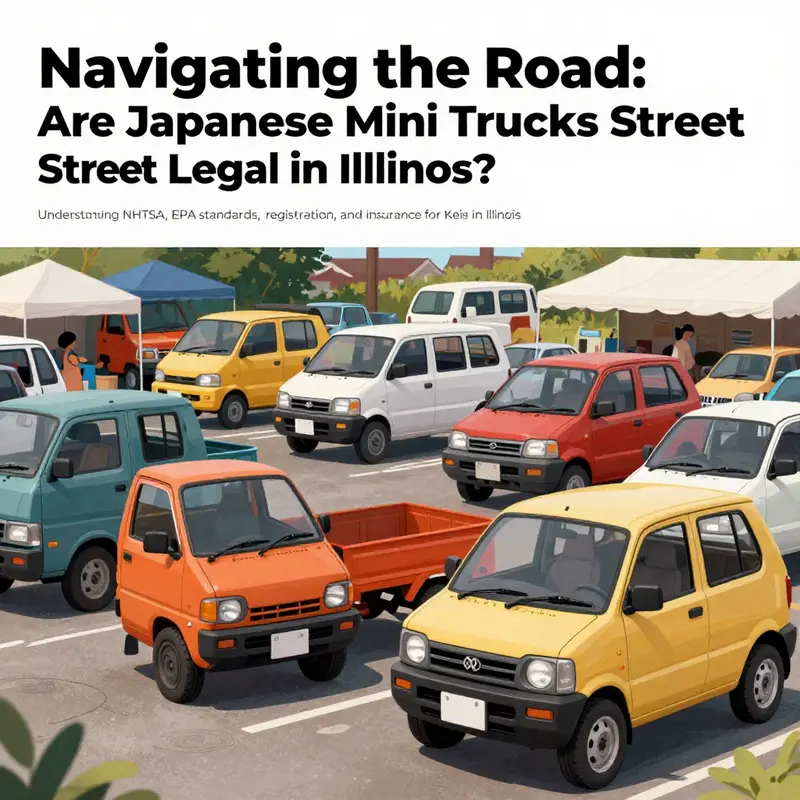
For small business owners, residential property owners, and mini truck enthusiasts alike, having a street-legal Japanese mini truck, such as a Kei truck, can open new avenues for utility and joy. But navigating the requirements for these unique vehicles in Illinois can be challenging. From compliance with federal safety standards set by the National Highway Traffic Safety Administration (NHTSA) to understanding emissions regulations mandated by the Environmental Protection Agency (EPA), each aspect plays a crucial role in determining whether your favorite mini truck can legally hit the streets. Throughout this article, we will explore the critical considerations that ensure your mini truck is street legal in Illinois, making it easy for locals to get behind the wheel of these versatile vehicles.
How NHTSA Rules Control Whether a Japanese Mini Truck Can Be Street Legal in Illinois
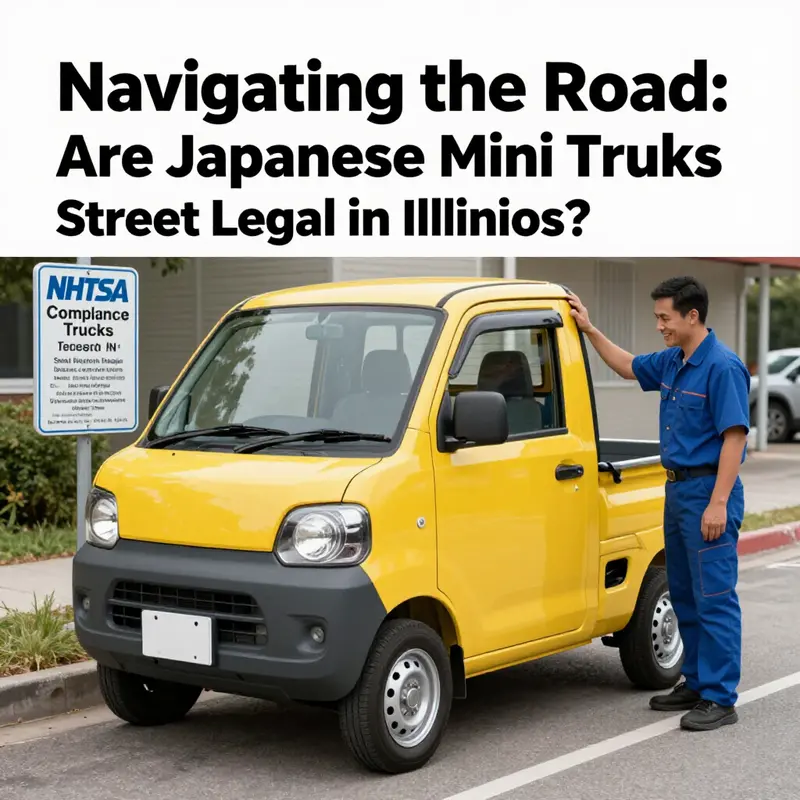
How federal safety rules determine street legality for Japanese mini trucks in Illinois
The National Highway Traffic Safety Administration (NHTSA) is the decisive federal body when it comes to whether a foreign-built vehicle can lawfully join American roads. NHTSA enforces the Federal Motor Vehicle Safety Standards (FMVSS), a set of detailed crashworthiness and equipment regulations designed to protect vehicle occupants and other road users. For small Japanese mini trucks—often called Kei trucks—NHTSA requirements are the single largest barrier to registering and driving them on public roads in Illinois and across the United States.
Most Kei trucks were built to Japanese domestic regulations. Those rules favor compact dimensions, low engine displacement, and low weight. They do not match the FMVSS categories or test procedures used in the U.S. Kei trucks typically lack the structural reinforcements and safety systems the FMVSS mandates. That mismatch is why, under current federal law, newer Kei trucks cannot be imported for general road use unless they are certified by the manufacturer as meeting U.S. standards. In practice, Japanese manufacturers have not certified Kei trucks for the U.S. market. As a result, most of these vehicles cannot be sold or registered here without going through a complex compliance or exemption pathway.
At the heart of the issue are specific safety expectations. FMVSS includes crash tests and equipment rules that address frontal crash energy management, side impact protection, roof crush resistance, occupant restraints, airbags, seat belt anchorages, and lighting performance. Many Kei trucks are simply too small to absorb crash energy the way U.S.-spec vehicles do. They often lack curtain or side airbags, reinforced occupant cages, and crash-tested bumpers. Lighting systems and reflectors may not meet U.S. photometric standards. Tires and rims are sized for low speeds and light loads. Speedometers and vehicle controls may not align with American norms. Those physical and design differences translate into nonconformance with FMVSS.
NHTSA enforces compliance both at the border and afterward. Customs and Border Protection can detain vehicles that lack the proper paperwork. NHTSA itself has procedures for importation if a vehicle meets FMVSS, or if a registered importer can modify and certify the vehicle to meet federal standards. That path requires documented engineering work and laboratory testing in many cases. Modifying a mini truck to meet FMVSS is usually impractical because the required changes go to the vehicle’s basic crash structure. Adding airbags or reinforcing crumple zones is more than a bolt-on task. Given the cost and technical hurdles, certification through modification rarely makes economic sense for most private owners.
There is, however, a clear federal exception that many prospective owners rely on. Under federal law, vehicles older than 25 years may be imported and registered without meeting all current FMVSS requirements. This policy recognizes historic and collector vehicles. If a Kei truck was manufactured at least 25 years before its importation date, it can be brought into the U.S. under that exemption. For a vehicle to qualify, the importer must establish the vehicle’s age and follow the importation paperwork and notification processes. The 25-year rule effectively creates a legal path for older Japanese mini trucks to become street legal, subject to state registration rules.
How does the 25-year exemption play out in Illinois? Even when NHTSA allows importation under the age-based exception, Illinois still requires the vehicle to meet state registration and inspection requirements. That means an importer must provide the necessary documentation to the Illinois Secretary of State, show a valid title or foreign ownership paperwork, and satisfy any state-mandated safety or emissions inspections that apply to the vehicle’s age and use. The federal exemption does not remove all obligations. It simply allows the vehicle to cross the border without full FMVSS compliance.
For Kei truck owners in Illinois, the NHTSA rules therefore create two distinct legal realities. Brand-new and recent Kei trucks remain barred from standard import and registration routes because they do not meet FMVSS. For eligible classic models—those over 25 years old—NHTSA’s age-based allowance opens the door. Still, a successful transition to state registration requires attention to additional federal and state controls, most notably emissions oversight from the Environmental Protection Agency, and Illinois’ own titling and inspection procedures.
EPA rules intersect with NHTSA requirements. The EPA mandates emissions controls for imported vehicles. Like safety standards, U.S. emissions rules reflect model-year specific requirements. The same 25-year principle often applies for emissions enforcement as well: vehicles older than 25 years are typically exempt from contemporary emissions certification. Importers should be prepared to demonstrate the vehicle’s age to both NHTSA and EPA officials when seeking entry and later when registering the vehicle in Illinois.
A practical implication of all this is that most modern Kei trucks cannot be legally driven on Illinois streets if imported after manufacture. Owners sometimes explore alternate pathways, such as restricted-use registration or classification as agricultural equipment. But those categories limit where and how the vehicle may be used. Vehicles registered for farm or off-road use often face restrictions on mileage and road access. Using a non-compliant vehicle in daily urban driving or on highways would risk enforcement action, fines, and impoundment.
For would-be importers, the paperwork trail matters. Successful importation of a qualifying classic Kei truck requires a clear title or export certificate, a bill of sale, and documentation proving the production year. Importers must complete NHTSA and EPA entry forms and often work with a Registered Importer if any modifications are necessary to meet particular federal requirements. At the state level, Illinois requires proof of ownership, an application for title and registration, liability insurance, and may require safety or emissions inspections. Expect additional scrutiny when the vehicle is atypical for U.S. roads.
Even when a Kei truck is old enough to qualify under the 25-year rule, safety remains a concern. A vehicle imported under the age exemption is not suddenly held to the same crash test standards as a new U.S. vehicle. Illinois will register the vehicle based on the paperwork and any applicable inspections. But owners must recognize the vehicle’s inherent limitations in mixed traffic with larger, heavier vehicles. Practical safety upgrades—seat belts in good condition, effective brakes, proper tires, clear lighting—are prudent even when not federally mandated. Some owners invest in discrete modifications to improve occupant protection, braking, and lighting. Those changes can improve real-world safety but rarely bring an older mini truck to FMVSS-equivalent standards.
A separate issue is the classification and titling of converted or modified vehicles. Some importers take an older Kei truck and convert it for a specialized role, such as a show vehicle, farm utility truck, or limited-access recreational vehicle. Illinois provides mechanisms for titling and registering custom-built and modified vehicles. The state’s procedures require appropriate documentation and sometimes inspections to confirm that key systems function safely. When modifications are extensive, working with a knowledgeable local title officer or mechanic can smooth the path to registration.
For people who want to use a Kei truck in a limited context—private property, farms, or events—NHTSA’s rules are less restrictive because those uses often avoid public roads altogether. But once a vehicle appears on a public highway, the legal framework of NHTSA and the EPA applies. Small exceptions exist for low-speed vehicles or specially built off-road vehicles. These exceptions have narrow definitions and do not generally apply to imported mini trucks intended for everyday road use.
Enforcement trends also matter. Customs and NHTSA enforcement priorities can shift over time. Historically, agencies have targeted commercial importers who attempt to bring large numbers of non-compliant foreign vehicles into the U.S. for resale. Private imports of older vehicles typically draw less attention if the paperwork is in order. Nevertheless, importing a non-compliant recent model risks seizure and loss of the vehicle. Anyone considering this route should factor in the potential costs of seizure, legal fees, and vehicle return or disposal.
Given the complexity, many prospective owners consult resources that focus on small trucks and conversions to learn practical steps and pitfalls. For perspectives and buyer experiences, the Mini Trucks SoCal blog offers helpful community insight into ownership and customization paths. That site collects owner stories and practical tips that can illuminate the realities of owning a mini truck in the United States: https://minitrucksocala.com/blog/
To summarize the NHTSA-centric reality for Illinois: NHTSA’s FMVSS are the pivotal barrier for Japanese mini trucks. Most modern Kei trucks do not meet these federal standards and cannot be legally imported and registered for general road use. The primary legal pathway is the 25-year age exemption, which allows older vehicles to be imported without full FMVSS compliance. Even under that exemption, EPA and Illinois requirements apply for emissions, titling, and registration. Modifying a current-production Kei truck to achieve FMVSS compliance is complex and generally impractical. Limited-use registrations, conversions, and off-road use remain alternative but restrictive options.
If you are exploring ownership, treat NHTSA compliance as the key legal question. Confirm the vehicle’s production year and documentation early. Understand that age-based exemptions allow importation, but not automatic equivalence to modern safety standards. Prepare for inspections, paperwork, and state-level registration steps in Illinois. And remember that responsible ownership includes sensible safety upgrades and an honest assessment of where and how the vehicle will be driven.
For authoritative federal guidance on vehicle importation and NHTSA compliance, consult the NHTSA importation information page: https://www.nhtsa.gov/vehicle-imports
Can a Japanese Kei Truck Be Street-Legal in Illinois? Navigating EPA, FMVSS, and State Registration
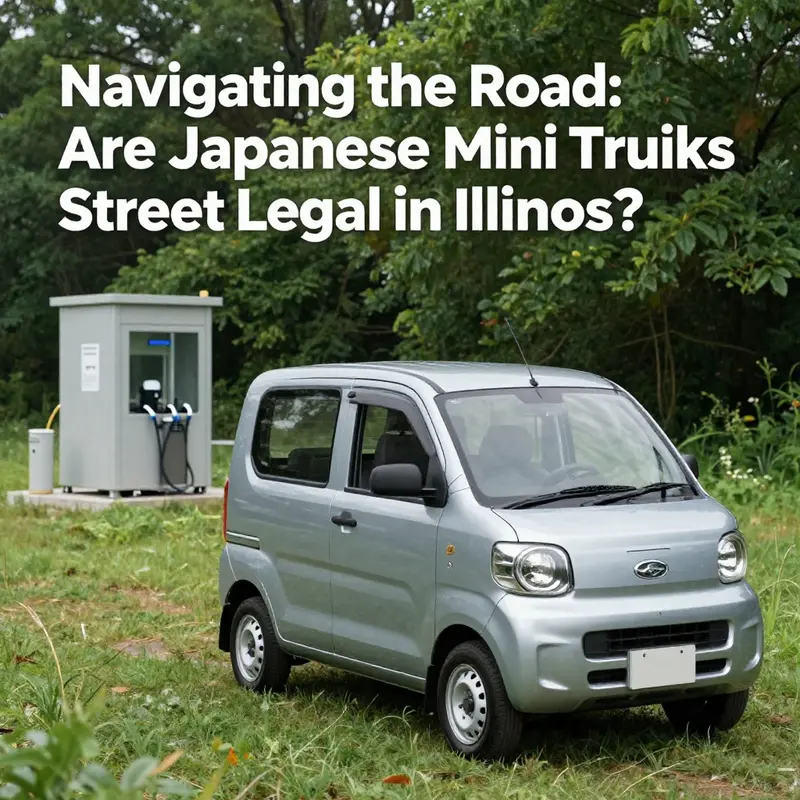
A Japanese kei truck can be imported and registered in Illinois, but the path is governed by federal vehicle safety and emissions rules plus state registration requirements. The key gatekeepers are the EPA emissions standards and the NHTSA FMVSS safety standards, which vehicles built for other markets do not automatically meet. Kei trucks with 660 cc engines are often outside the standard U.S. engine families and may require exemptions or full compliance work.
Two practical routes exist. If the vehicle is at least 25 years old, it may qualify for import under classic or historic exemptions, which reduces or removes some federal conformity testing. Even with this lane, Illinois requires proper registration, proof of ownership, insurance, and a vehicle that meets state safety expectations as far as the law allows. The broader emissions scrutiny in Illinois may still apply in practice, especially in metropolitan areas that conduct inspections or verify air quality compliance.
A second route is full FMVSS and EPA conformity. This path can involve substantial modifications, testing, and documentation to demonstrate safety equipment, crash protection, and compliant emissions. Cost and complexity are high, and success depends on the specific vehicle configuration and up to date federal and state guidance. Some owners hire specialists who understand both U.S. standards and kei truck designs to manage the project.
In Illinois you should plan for registration, insurance, taxes, and periodic inspections. Always verify current requirements with federal agencies and the Illinois DMV before purchasing, and use official guidance to avoid surprises. Resources from the EPA, NHTSA, and the Illinois DMV provide the latest rules and step by step instructions for importing and registering foreign vehicles.
Crossing Borders, Crossing Lanes: Navigating Registration and Insurance for Japanese Mini Trucks on Illinois Streets
A Kei truck moves through a quiet Illinois street, its compact silhouette a curiosity as much as a work vehicle. Its potential appeal—fuel efficiency, nimble handling, and surprising cargo capacity—presents a practical puzzle: how to legally register and insure a vehicle built for a different market. The road to legality in Illinois begins with federal safety and emissions considerations, and then moves through state registration requirements. In practice, importers must navigate FMVSS compliance and EPA emissions rules, often via exemptions or Show or Display pathways that apply to older vehicles. The 25-year rule, meaning vehicles manufactured before a cutoff year can qualify for historic or show exemptions, has a moving threshold that changes with policy.
Even when a Kei truck qualifies for an exemption, Illinois adds its own checks. Federal approval must be matched with proof of ownership, insurance, and typically a vehicle inspection to verify basic safety features. Some vehicles may require lighting, signaling, or equipment adjustments to meet state standards. The combined cost of compliance and potential modifications can rival the purchase price, so a careful cost–benefit calculation is essential before proceeding.
Insurance is the next hurdle. Some insurers cover imported or classic vehicles, while others decline or offer limited terms at higher premiums. Working with brokers who understand non-standard imports can simplify the process and clarify coverage options, limits, and exclusions. Every policy should align with how the vehicle will be used, including any mileage restrictions or special usage provisions that reflect its regulatory status.
The best approach is methodical: verify the vehicle’s age, gather documentation that supports a historic or display designation, engage with the Illinois Secretary of State guidance, and consult with professionals who have navigated these routes before. Keeping up to date with federal and state changes helps prevent surprises at registration time. If the plan is clear, the journey from fascination to lawful operation becomes a structured, attainable project rather than a bureaucratic maze.
For more context on import rules and registration procedures, official sources such as the NHTSA and state guidance are valuable anchors. Prospective owners should seek authoritative guidance early and prepare a well-documented plan that reflects both the vehicle’s heritage and the responsibilities of sharing the road in Illinois.
Final thoughts
In closing, understanding the process of making Japanese mini trucks street legal in Illinois involves navigating through NHTSA compliance, EPA emissions standards, and local registration and insurance requirements. It’s a journey worth embarking on for local business owners, property owners, and enthusiasts who appreciate the unique blend of practicality and style that Japanese mini trucks embody. Before hitting the roads, ensure that your Kei truck meets all necessary regulations, keeping your experience both joyful and legal. Embrace the adventure of owning a mini truck, and enjoy the convenience it brings to your lifestyle.