
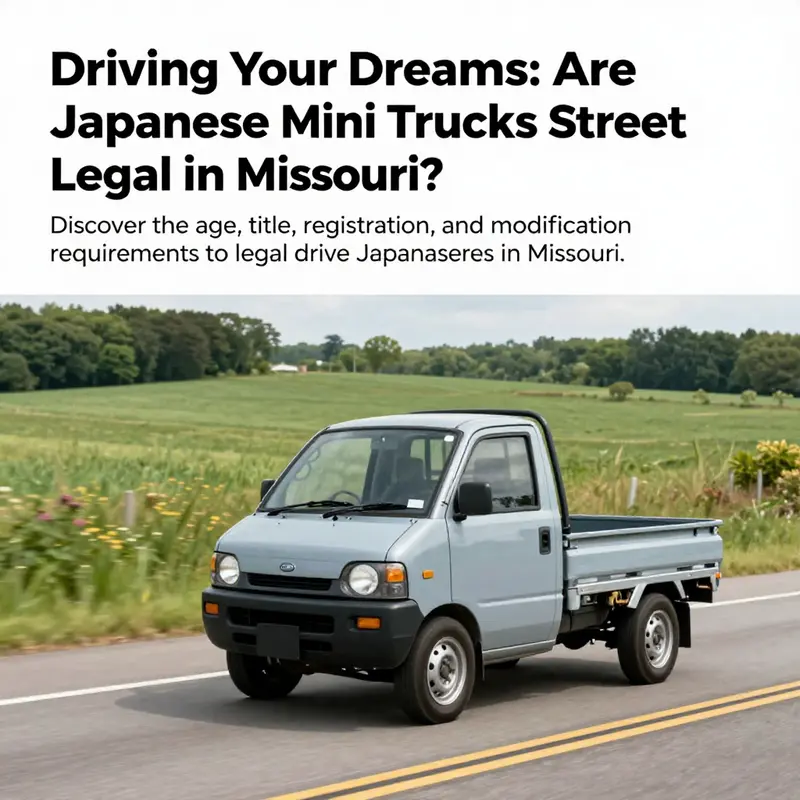
Japanese mini trucks have caught the eye of local small business owners, residential property owners, and enthusiasts across Missouri. These compact and versatile vehicles are not only practical for daily tasks but also offer a unique charm that captivates hobbyists. However, before hitting the Missouri roads, it’s essential to understand the specific requirements to make these mini trucks street legal. In this article, we will guide you through age requirements, the ins and outs of title and registration processes, and the necessary custom modifications and import documentation, ensuring you’re well-prepared to enjoy your mini truck safely and legally.
The 25-Year Gate: Turning Japanese Mini Trucks into Missouri Road-Ready Vehicles

In Missouri, as in many states, the line between a hobbyist’s curiosity and a street-legal vehicle hinges on a single, stubborn rule: age. The age that matters here is not how old a truck looks or how many miles it has logged but the year it rolled off the factory floor. For Japanese mini trucks, the road to legality in Missouri is paved with a 25-year threshold that acts as a gatekeeper. If a vehicle is at least 25 years old, it may be exempt from some of the more stringent U.S. safety and emissions standards that apply to newer imports. This exemption is a cornerstone of the import process and, when paired with proper paperwork and a commitment to safety, can unlock the door to legitimate operation on public roads. The threshold itself is simple enough in theory, but the practical path to registration is layered, purposeful, and must be navigated with care to stay on the right side of state and federal requirements.
To begin with, the 25-year rule is not a blanket invitation to drive any old Japanese mini truck anywhere. It is a federal framework that Missouri, through its Department of Revenue (MoDOR), translates into state practice. Vehicles manufactured before 2001 meet the 25-year criterion, meaning that a Japanese mini truck built in the late 1990s or earlier, when imported to the United States, can, in many cases, bypass some of the modern safety and emissions upgrades required of newer vehicles. However, the exemption does not erase all responsibilities. The vehicle must still be legally and physically fit for the road, which means more than just being old enough. The MoDOR’s interpretation of the federal standard is that while the car may be exempt from some DOT and EPA prerequisites, it must still pass the state’s safety inspection to prove it is roadworthy. The practical effect is that age can open the door, but it does not provide a free pass to bypass crucial checks conducted at the state level.
The first checkpoint is ownership and documentation. Missouri requires a proper title and registration with the Department of Revenue. This process anchors the vehicle in the state’s system and creates a record that spans the vehicle’s life—from import, through any modifications, to its daily use on Missouri roads. Proof of ownership, typically a title or bill of sale, forms the backbone of this stage. In practice, the paperwork must show a clear chain of title and a legitimate transfer of ownership. Some applicants may encounter additional requirements, such as an inspection report, depending on the specifics of the vehicle’s history and the details of the import process. This is not an arcane hurdle; it is a straightforward step that helps the state verify that the vehicle is not stolen and that the ownership is legitimate.
The beauty—and the nuance—of the 25-year gate lies in its relationship to safety. Even when a vehicle qualifies as 25 years old and, therefore, potentially exempt from certain federal standards, Missouri does not surrender its own safety obligations. All vehicles operating on public streets in Missouri must meet basic safety requirements, a standard that translates into a safety inspection. The inspection is a comprehensive check designed to ensure the vehicle is roadworthy. It covers critical systems: lights, brakes, tires, steering, suspension, and other safety-critical components. A 25-year-old mini truck can be a marvel of mechanical reliability, yet if a light is out of alignment or a brake line shows signs of wear, the inspector will flag the vehicle. The moral is simple: age can exempt the vehicle from some emissions or modern safety upgrades, but it does not excuse the need for a carefully maintained and functional vehicle. The responsibility here is to the driver, other road users, and the state’s commitment to keeping roads safe for everyone.
Even when age grants relief from certain federal standards, some modifications may still be necessary to ensure compliance with U.S. norms. Imported Japanese mini trucks were designed for a different regulatory landscape, one that did not mandate the same configurations as U.S.-market light trucks. As a result, some vehicles require modest adaptations to meet expectations such as turning signals on both sides, properly positioned headlights, seat belts, and appropriate seating configurations. A thoughtful approach to this step is essential. The goal is not to alter the vehicle’s essence but to align its safety features with what Missouri drivers rely on daily. Installing dual turn signals, ensuring seat belts are functional, and tuning headlights for the legal beam pattern are practical, cost-conscious adjustments that often make the difference between a vehicle that merely exists in a state file and a vehicle that earns steady street use.
The import process itself is a careful orchestration of paperwork, compliance, and timing. While the federal rule sets the stage, the Missouri registration process is the final act that grants permission to operate on public roads. Import documentation begins at the federal level with U.S. Customs and Border Protection (CBP). Key forms, such as Form 7501 (Entry Summary) and a completed Vehicle Import Application (Form 2609), establish the vehicle’s entry into the United States and its intended use. These forms document the vehicle’s country of origin, age, and compliance status, among other details. It is here that the federal framework begins to translate into state action, guiding MoDOR in how to treat the vehicle within Missouri’s borders.
In practice, the journey might resemble a relay race, with multiple checkpoints that require attention to detail, accurate records, and timely submissions. A responsible importer or owner will begin with a clear understanding of the vehicle’s age and its eligibility under the 25-year rule. From there, the applicant gathers title documents, proof of ownership, and any prior inspection records. An essential stage is the interagency communication among the importer, CBP, and MoDOR. This triad ensures that what arrives at the state line is not only physically present but also legally recognized as a registered vehicle ready for the road. The process is not an automated rite of passage. It demands diligence, patience, and a willingness to address any gaps the authorities identify, whether they concern paperwork, mechanical condition, or compliance with state standards.
For enthusiasts and owners, the narrative often travels through the wider community of importers and hobbyists who share their experiences and guidance. A reference point in this journey can be found in the broader online discussions and information repositories that explore the nuances of owning and operating imported mini trucks. These discussions, while not official regulatory sources, frequently illuminate common scenarios, such as the types of inspections a vehicle might face or the typical modifications owners consider to bridge the gap between the vehicle’s origin and U.S. expectations. They also offer practical tips about the timing of registrations, the documentation that tends to smooth the process, and the kinds of records that seasoned importers keep on file in case they are ever questioned by authorities. To tap into this community and get a sense of the lived experience, readers may wish to explore the broader “Mini Trucks Blog” resource that aggregates experiences, questions, and answers from people who have walked the road from import to road-ready in Missouri and other states. Mini Trucks Blog provides a sense of how the journey unfolds in real terms, with notes on paperwork, inspections, and the kinds of adjustments that prove most effective in keeping a truck compliant while preserving its unique character.
The practical takeaway for anyone contemplating this path is clear: the age threshold is a doorway, not a badge of instant legality. The 25-year rule reduces, but does not erase, the regulatory burden. The road to legality in Missouri requires careful handling of title and registration, a comprehensive safety inspection, and any required modifications that bring the vehicle into alignment with U.S. standards. It also requires disciplined recordkeeping and, often, a proactive dialogue with the MoDOR and, when relevant, CBP. The process rewards meticulous preparation with a vehicle that can share Missouri’s roads with other motorists, rather than a project that sits in a driveway or, worse, attracts the attention of law enforcement for noncompliance.
A central theme in this journey is alignment with official resources. The Missouri Department of Revenue’s Vehicle Title and Registration pages provide the state’s current procedures, fees, and expectations. When questions arise, those pages are the first stop for authoritative guidance on what is required to title and register a vehicle in Missouri. It is always prudent to cross-reference state instructions with federal import guidelines from CBP to ensure that every step—from import to registration—reflects the latest regulatory posture. The regulatory landscape can evolve, and staying aligned with official sources helps prevent costly missteps or delays. For ongoing readers who want to delve deeper, the official MoDOR site and the CBP portal offer the necessary framework and updates that could affect a given vehicle’s path to the road.
While the 25-year rule is a meaningful lever, it is not a substitute for the ongoing commitment to safety, maintenance, and compliance. A 25-year-old vehicle may present more familiar mechanical wear than a newer model. Components such as the braking system, steering linkage, and tire integrity demand careful, regular checks. The owner’s diligence—timely maintenance, address of rust or corrosion, and verified alignment with state inspection expectations—becomes the practical expression of the regulatory permission the vehicle enjoys. In short, the law recognizes the vehicle’s age, but the road’s safety standard remains the judge of whether the vehicle can and should be permitted to operate in everyday traffic. The combination of age-based relief and strict safety enforcement is what makes the Missouri approach both feasible for enthusiasts and responsible for the broader driving public.
As readers consider their own potential project, a note about pacing matters. Importing a Japanese mini truck for Missouri streets is not a marginal hobby; it is a small legal system in itself. From the moment a vehicle is chosen and assessed for age to the moment its title is recorded and the safety inspection is passed, the process is a sequence of careful decisions. Each decision—from documentation accuracy to the timing of the safety inspection—has consequences for the vehicle’s status and the owner’s peace of mind. It is easy to underestimate the subtle complexities involved when a vehicle crosses oceans and regulatory borders, but with a steady method, the path to legality becomes a matter of orderly steps rather than dramatic late-stage negotiations.
In the broader conversation about legality, it helps to keep a practical mindset. The 25-year gate does not guarantee a smooth ride. It simply acknowledges that older vehicles, often built to different standards and with different environmental considerations, may be eligible for import under a lighter regulatory load. The trade-off is that the vehicle must demonstrate safety and roadworthiness under the state’s rules, and the owner must maintain meticulous records. For those who approach this as a long-term project rather than a quick conversion, the combination of age-based relief, safety emphasis, and diligent paperwork creates a credible, lawful path to using a Japanese mini truck on Missouri roads.
Putting it all together, the journey from curiosity to compliance is a story of balance. Age buys time and flexibility but does not erase responsibility. Missouri’s approach to these imports blends a permissive door with a strict, methodical approach to safety and documentation. If a vehicle is older than 25 years and the owner has the necessary titles, proof of ownership, and a clean bill of safety, the vehicle can join the long tradition of Missouri’s diverse spectrum of street-legal transport. The ultimate goal is to ensure that the vehicle’s presence on the street is both legally defensible and physically safe for all users—drivers, riders, pedestrians, and cyclists alike.
For readers who want a broader sense of the conversation and to explore the practical experiences of other enthusiasts, the Mini Trucks Blog serves as a useful companion resource. It offers insights into how hobbyists navigate the process, what kind of paperwork typically proves most efficient, and how common modifications are implemented to achieve compliance while preserving the vehicle’s character. Keeping in view these experiences, the central takeaway remains consistent: the 25-year gate is a meaningful milestone that nudges a vehicle toward legality, but the real work happens in meticulous preparation, careful inspections, and ongoing maintenance that keeps the vehicle safe on Missouri’s streets. If you want to verify the procedural details and stay current on any changes to the regulatory landscape, consult the Missouri Department of Revenue for title and registration specifics and U.S. Customs and Border Protection for import documentation guidance. These official resources anchor the journey in regulatory reality and help ensure that the dream of a Japanese mini truck on a Missouri road remains a responsible, lawful reality.
For official guidance on importing vehicles, see the U.S. Customs and Border Protection resource: https://www.cbp.gov
null

null
Paperwork, Modifications, and the Missouri Road: Turning Japanese Mini Trucks into Street-Ready Tools

When a driver envisions a compact, capable helper rolling along Missouri streets, the appeal of a Japanese mini truck is clear: nimble in town, tough in the back country, and efficient on fuel. Yet the path from a foreign-built chassis to a street-legal ride in Missouri is paved with federal and state rules, a few careful modifications, and a precise set of documentation steps. This chapter is not a quick checklist but a continuous narrative that threads together why certain modifications are allowed, what paperwork is non-negotiable, and how to approach registration and ongoing compliance in a way that respects safety, emissions, and the realities of local roads. The overarching question—are Japanese mini trucks street legal in Missouri?—is answered with a qualified yes, but only if the vehicle meets the relevant standards or qualifies for exemptions, and only if the owner navigates the additional layers of documentation and inspection that Missouri requires for road readiness. The journey begins with federal acceptance, then moves through state responsibilities, and finally settles into everyday use, where daily driving demands become the practical test of compliance, reliability, and common sense.
At the heart of the federal picture is the recognition that Japanese mini trucks were engineered to different standards than those historically required in the United States. Some vehicles, particularly those manufactured more than a quarter-century ago, may qualify for exemptions under federal rules that ease the pathway to import. The classic turning point is the age of the vehicle. Vehicles that are at least 25 years old are commonly exempt from the most stringent Department of Transportation (DOT) safety standards and Environmental Protection Agency (EPA) emissions rules that apply to contemporary imports. In practical terms, a truck produced before 1999, and thus entering the 25-year window, can be imported without conforming to the current, post-1990 FMVSS and EPA framework. A related, more conservative approach sometimes discussed among import enthusiasts is the idea of a 50-year benchmark, which suggests that vehicles exceeding half a century in age can enter the country with even fewer regulatory frictions. The 50-year concept—illustrated by the reminder that a 1976 model would become eligible around 2026—reflects a broader compliance philosophy that has historically reduced the regulatory burden for classic vehicles. A careful importer will understand which route applies to their specific truck and what documentation is necessary to demonstrate eligibility.
But Missouri is not simply a gateway state where federal exemptions terminate; it is a jurisdiction with its own gatekeeping to ensure roadworthiness and safety. Even when a vehicle qualifies for exemption from some federal requirements, the state’s own safety inspection regime applies. In Missouri, every vehicle must pass a safety inspection before registration can be completed, regardless of age or origin. The inspection emphasizes functional systems—lights, brakes, tires, steering, and other critical components—so that the vehicle entering traffic genuinely operates as a roadworthy machine. This is a practical reminder that exemption from federal safety and emissions rules does not translate into a blanket exemption from all road-safety scrutiny. The state wants to see a vehicle that can perform reliably, stop predictably, illuminate the road as intended, and remain under the driver’s control in varied conditions.
Parallel to the question of safety is the matter of documentation and proof. The Missouri Department of Revenue (DOR) is explicit about the paperwork needed to title and register a vehicle, whether it was originally purchased in the United States or imported from overseas. At minimum, owners will need proof of ownership, a bill of sale, and, depending on the vehicle’s history and the inspection outcome, an inspection report. The process can be smoother when the importer has organized and translated documents that align with both federal and state expectations. A crucial part of the documentation puzzle is the import paperwork filed with U.S. Customs and Border Protection (CBP). Standard procedures require a CBP declaration and supporting documents, including entries that establish the vehicle’s identity, country of origin, and the proper classification for tariff and regulatory purposes. For many importers, this stage is where the vehicle begins to carry a footprint that Missouri officials can recognize: a vehicle that has already passed through the federal import framework and is now ready for state-level handling.
Once federal and state eligibility is established and the truck passes inspection, the next layer involves modifications that may be necessary to meet both Missouri’s expectations and any residual federal requirements. The line between “necessary safety upgrades” and “unnecessary aftermarket alterations” is not always obvious, which is why the co-ordination of modifications with inspection criteria matters so much. In Missouri, as in many states, there are two kinds of modifications to consider. The first is safety-related: anything that affects occupant protection or the ability to operate the vehicle safely on public roads. This includes ensuring that seat belts are present and functional, that lighting systems operate as intended, and that reflectors and signals provide the necessary visibility. The second category concerns compliance with broad environmental standards and noise limits through the exhaust and emissions system. The state’s environmental and safety agencies are careful about how exhaust modifications might influence emissions and noise, even for vehicles that are exempt from certain federal rules due to age. In practice, this means some modifications—such as changing exhaust components or altering headlight aim patterns—may be allowed if they stay within the permitted range and do not trigger safety or emissions concerns. A more sensitive area is the requirement not to remove or disable original safety features. For example, tampering with seat belts or airbags is typically forbidden, and any attempt to erase or circumvent original safety devices can render a vehicle noncompliant in the eyes of regulators.
For the curious owner who wants to explore what active, compliant modifications look like, there is a spectrum. Functional adjustments that help the truck perform better in Missouri’s varied landscapes can be acceptable if they preserve safety. Upgrades like replacing tires with options that keep within the vehicle’s original size and load rating are often permissible within the manufacturer’s structural constraints. Suspension tweaks that preserve overall geometry and ride height can be allowed if they do not alter steering geometry in a way that compromises handling. Accessories that add utility without affecting crashworthiness—such as cargo-area liners, protective bed rails, or weatherproof coverings—can be integrated without violating safety norms. The important rule of thumb is to retain a clear chain of custody for the vehicle’s identification data and to report any modifications during registration. Keeping the manufacturer’s nameplate and identification tags intact signals a respect for the vehicle’s original design intent and a commitment to traceable, auditable changes.
Those who import Japanese mini trucks into Missouri are often drawn to modification ideas that enhance usability without crossing legal boundaries. A practical example might be adding a modest bed liner and a rugged bumper for light off-road duty, or installing auxiliary light bars in a way that complies with state lighting requirements and does not blind other drivers. The temptation to over-modify should be tempered by the understanding that Missouri’s safety inspection will scrutinize any change that could affect road safety. Owners frequently discover that simple, well-executed modifications, paired with transparent documentation, minimize the risk of penalties or delays at inspection.
Embedded within the modification conversation is the importance of staying aligned with official guidance. The Missouri Department of Revenue provides a framework for understanding how modifications relate to registration. It is wise to approach the process as a continuous dialogue between the owner, the inspection station, and state officials, rather than a one-off event. The goal is to ensure that every change is reversible or clearly documented, that the vehicle’s VIN is preserved, and that the vehicle’s identity remains auditable throughout its life on the road. In this sense, the vehicle becomes less of a curiosity and more of a carefully maintained asset that reflects both its foreign heritage and its new life in Missouri.
Documentation does not end with the initial import and modification steps. The day-to-day lifecycle of a legal Japanese mini truck on Missouri roads includes ongoing responsibilities: renewing insurance, maintaining safety systems, and ensuring compliance with any revised safety or emissions standards that may apply in the future. The driver is reminded that maintaining a street-legal status is an ongoing process, not a one-time event. The state’s inspection and titling framework exists to preserve a standard of roadworthiness across all vehicles, and even a dependable workhorse from overseas must meet those standards consistently. In practical terms, this means that owners should retain all import-related paperwork, inspection reports, receipts for modifications, and proof of ongoing maintenance. If any aspect of the vehicle’s condition changes—such as a major crash repair, a switch in the engine or drivetrain, or a substantial alteration to the electrical system—the vehicle may require reinspection or updated documentation to remain compliant.
One practical way to visualize the collaboration between federal import rules and Missouri’s road-safety standards is through real-world examples of how owners manage the process. Consider the journey of a vintage Japanese mini truck that qualified for the 25-year exemption. The owner files CBP documentation, presents the necessary proof of ownership and purchase, then moves to the state inspection. The inspector checks the basics: brakes, steering, lighting, tires, and seat belts, ensuring no obvious safety or structural deficiencies exist. If the vehicle passes, the state issues registration and plates, and the owner proceeds to secure insurance that meets Missouri’s minimum liability requirements. If needed, minor, non-intrusive modifications may be approved at the inspector’s discretion, provided they do not compromise safety or emissions. The vehicle then enters daily use, where routine maintenance and compliance with state safety norms keep it on the road without issue. This kind of scenario is not a fantasy; it is a practical pathway that many Missouri residents explore as they evaluate the feasibility of importing and using a Japanese mini truck as a functional, everyday vehicle.
A concluding thread in this narrative is the value of professional guidance. Because the rules involve both federal and state layers, and because the specific path depends on the truck’s age, model, and modification plans, working with an importer or legal professional who specializes in international vehicle transfers can significantly reduce the risk of missteps. They can help interpret FMVSS applicability, coordinate with CBP, prepare the necessary paperwork, and liaise with Missouri’s DOR to ensure that all steps align with current requirements. For individuals who want to imagine compliant configurations before committing to a purchase, a hands-on example of a well-executed customization project can be instructive. For readers seeking a tangible case study of tasteful, legality-conscious modifications, see this resource on a distinctively styled, customization-focused project: Godzilla Truck Camper customization. The linked discussion offers insights into how owners approach modifications with both utility and safety in mind, while maintaining a clear, auditable trail of changes. Godzilla Truck Camper customization.
The road to legality in Missouri is thus a careful blend of recognizing federal exemptions, satisfying state safety checks, and documenting every step with clarity. It is not about bending the rules to fit a particular aesthetic; it is about understanding the framework that governs what can operate safely and lawfully on public streets. The 25-year exemption, or the broader concept of a 50-year rule, provides a meaningful opening, but it is the combination of documented import activity, transparent modifications, and rigorous safety testing that finally legitimizes the vehicle as a Missouri road user. This is the essence of turning a Japanese mini truck from a curiosity into a practical tool—one that can responsibly contribute to daily life, industrial work, and hobbyist exploration alike. In this sense, the vehicle becomes more than a curiosity from overseas; it becomes a carefully documented, roadworthy companion that honors both its origin and its new home on Missouri streets.
For readers seeking authoritative anchors to the process, the most relevant, up-to-date guidance remains the official channels. The National Highway Traffic Safety Administration (NHTSA) maintains a comprehensive portal on vehicle imports, including the standards that apply and the pathways for exemptions. This resource is central to understanding whether a particular vehicle qualifies for import exemptions and how to request them. While the 25-year rule is often cited within the importer community, the formal process is best navigated with the official forms and procedures described by NHTSA. See the NHTSA resource for importing vehicles here: https://www.nhtsa.gov/vehicle-imports. And for those who want a fuller sense of the documentation trail that begins at CBP and leads through state registration, Missouri’s Department of Revenue and related CBP procedures should be consulted to ensure every step is compliant and auditable. The import paperwork, including CBP entries and the ancillary Vehicle Import Application processes, is the litmus test of legitimacy before a Missouri inspection and registration can proceed.
In short, the path to street legality in Missouri for Japanese mini trucks is not a single hinge but a sequence of hinges aligned with federal exemptions, careful modifications, and rigorous documentation. The vehicle’s age opens a doorway, not a guarantee; the inspection in Missouri confirms roadworthiness, not just compliance with import paperwork. The modification choices, while offering practical benefits, must respect safety constraints and regulatory intent. When navigated thoughtfully, the outcome is a compact, reliable, and lawful addition to the state’s diverse automotive landscape. The owner gains not only a unique vehicle but also a controlled, transparent process that can serve as a model for others who wish to explore similar import projects. And for those who want to explore the practical, customization-driven side of this journey—without losing sight of safety and legality—the deeper conversation about how modifications align with regulatory expectations can be illuminated by case studies and community discussions like the one linked above. The essential takeaway is that street legality in Missouri is achievable when one marries the paperwork with the right, permission-granted modifications, and a commitment to ongoing compliance. The result is a mobility solution that respects both the practical needs of the vehicle and the shared responsibility of safe driving on public roads.
External resource: For authoritative guidance on importing vehicles, consult the U.S. National Highway Traffic Safety Administration’s import page at https://www.nhtsa.gov/vehicle-imports.
Final thoughts
Navigating the journey of making a Japanese mini truck street legal in Missouri may seem challenging, but understanding the key elements—age requirements, title and registration procedures, and necessary modifications—can simplify the process. By ensuring compliance with regulations, you can enjoy the unique advantages these trucks offer while cruising down the roads of Missouri. Whether you own a mini truck for business or pleasure, the joy of hitting the road legally is well worth the effort.