
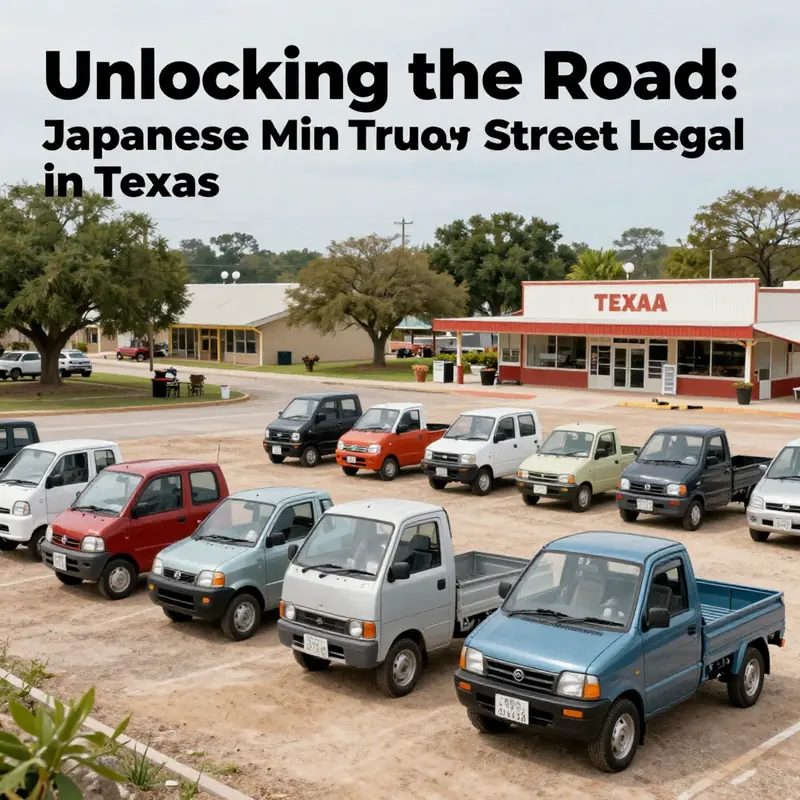
Japanese mini trucks have made a grand entrance onto Texas roads, fostering excitement among local businesses and enthusiasts. With the passage of Senate Bill 1816 in March 2025, these small, versatile vehicles can finally be registered and used, bringing a wave of opportunity and efficiency. In this article, we will explore the legal framework surrounding Japanese mini trucks, delve into the necessary regulatory compliance, and highlight the myriad practical uses and economic impacts these mini trucks are bringing to Texas’s vibrant community. Join us as we navigate this exciting development and uncover how these vehicles can enhance daily operations for small business owners and provide unique transport solutions for hobbyists.
Tiny Titans on Texas Highways: Navigating the Legal Path for Japan’s Kei Trucks
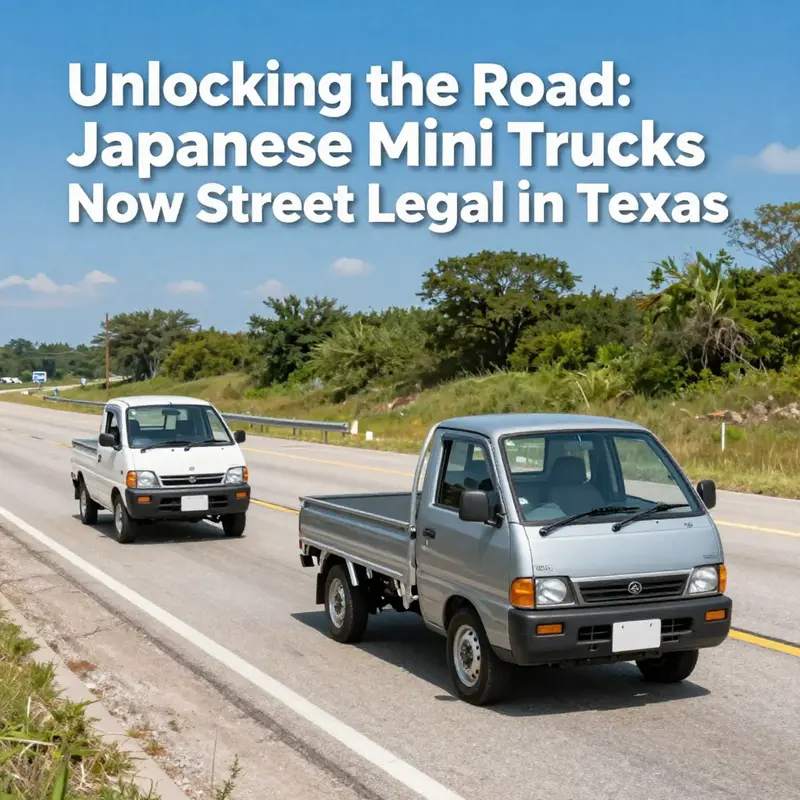
In the broad sweep of Texas road culture, where open landscapes and long-haul appetite for efficiency have long shaped how people move goods and themselves, a quiet shift has taken root in the conversation about small, Japanese-made trucks. These kei-class machines, compact and surprisingly capable, have captured the imagination of farmers, delivery operators, campers, and mobile businesses seeking a balance between practicality and cost. The question at the heart of this chapter is not merely whether these tiny workhorses can travel the same routes as full-size pickups but how a state legislative move makes that possibility stable, predictable, and legally defensible. The story begins with a practical problem: even when a vehicle from Japan meets federal import standards and turns twenty-five, twenty-five years on the market, it can still be hard to register in Texas. The old framework treated many of these vehicles as misfits for state infrastructure, failing to harmonize with safety, emissions, and size requirements that Texas imposes on non-native vehicles. That friction between Federal timing and State gatekeeping prompted a legislative response aimed at clearing a path rather than erasing the road rules themselves. The result, as it has unfolded, is a formal pathway that recognizes age, origin, and mechanical limitations while insisting that the vehicle remain safe and roadworthy on Texas highways. This is not a blanket invitation; it is a carefully structured doorway that opens only to vehicles that meet clear criteria and pass the kind of basic checks Texas expects for any vehicle that shares its streets with cars, trucks, and emergency services alike. The chapter that follows traces that doorway from its earliest conception to its practical implications for everyday Texans who want to use these small trucks for work, for family, or for a mobile business model. It is a narrative about how a state’s engineering and public safety priorities can align with a cultural appetite for more affordable, fuel-efficient transportation, without compromising the standards that keep roads safe and efficient for everyone.
The crucial turning point in this story is Senate Bill 1816. Introduced in 2023 by State Senator Kelly Hancock, the proposal did not arrive as a sudden mandate but as a thoughtful plan to create a formal, predictable pathway for importing and registering older Japanese vehicles—especially those in the mini-truck and compact pickup category. The aim was to bridge a long-standing gap: vehicles that could be legally imported under federal rules often hit a brick wall at the state level because of the way Texas enforces safety, emissions, and size restrictions on in-state road use. The proposed framework sought to harmonize the federal import standard with Texas’s own vehicle registration requirements, transforming a tailwind of import familiarity into a concrete route to on-road legality.
At the heart of SB 1816 are a few precise eligibility criteria that turn a potentially cumbersome process into a straightforward checklist. First, the vehicle must be at least twenty-five years old. That baseline is a recognition of the federal standard that permits importation of older autos once they have aged beyond a certain cutoff, but it also creates a practical horizon for buyers and sellers who can gauge value with a stable, predictable year marker. Second, the vehicle must have been manufactured in Japan. This keeps the pathway focused on a particular class of engineering and regulatory culture, one that Texas regulators have studied and understood. Third, engine displacement must be no more than 1.2 liters. That cap is more than a technical figure; it signals an emphasis on efficiency and on the kind of power band that suits rural and urban Texas driving alike, while staying within the intention of recognizing small, lightweight trucks that were designed for efficiency rather than raw power. Finally, the vehicle must be capable of reaching a top speed that exceeds 80 kilometers per hour, roughly 50 miles per hour. This threshold acknowledges that the vehicle needs to be practical for everyday road use, not merely city streets or backroads. It is a guardrail against registering something that cannot maintain traffic flow on Texas highways, while still leaving room for the kind of spirited, low-speed cruising these trucks are known for in other markets.
The combination of these criteria—age, origin, engine size, and speed capability—drives the practical effect of SB 1816. It creates a finite set of vehicles that can qualify for a formal registration pathway, while also preserving safety and compatibility with existing road infrastructure. The logic is twofold: first, the age criterion ensures there is a well-established vehicle platform with a history of durable construction and simple parts availability. Second, the engine and speed thresholds tilt the equation toward vehicles that are lightweight and economical but still capable of practical highway driving. ForTexas, a state that values road safety and emissions control, this is a careful calibration rather than a deregulation. It recognizes the value of these compact vehicles to rural operations and small businesses while ensuring they remain within the bounds of roadworthiness.
If the bill becomes law—and in the period described it did progress toward formal adoption—the practical path to registration would hinge on compliance with standard state inspections and documentation. In many states, the process would involve presenting a vehicle title and proof of ownership, undergoing a safety inspection to verify basic system integrity, and confirming emissions compliance where applicable. In a framework tailored to these Japanese mini trucks, the emphasis would be on demonstrating that the vehicle’s essential safety features—brakes, lights, tires, and structural integrity—are in good order and that the vehicle can operate predictably on Texas roads. Because these are older vehicles, the administrative process is designed to prevent gaps where safety could be compromised, while not adding punitive red tape that could deter legitimate use by rural landowners or small business operators. The approach is not to reinvent basic compliance but to align this class of vehicles with the same broad expectations that apply to other older, imported vehicles that enter the road system through established channels.
The broader social and economic implications of the bill are visible in everyday Texas life. This is not merely about legality; it is a shift in how communities can deploy light-duty transport for everyday tasks. For rural farmers, a compact truck can offer a tangible advantage in hauling feed sacks, tools, fencing supplies, or seed across broad tracts of land where a larger pickup may be overkill or less fuel-efficient. For small delivery outfits, the ability to register a small, economical vehicle can translate into lower operating costs and easier maintenance in tighter urban districts where parking and maneuverability matter. And for those who use these vehicles for camping, outdoor recreation, or even as mobile business platforms—where a small, reliable base vehicle can become a kitchen, a workshop, or a showroom on wheels—the legal pathway provides a sense of legitimacy that complements the practical benefits.
The practical realization of these ideas, of course, rests on more than a single statute. It requires a culture of compliance and a set of community expectations that align with both state policy and local enforcement realities. In Texas, vehicle registration and roadworthiness are not abstract concepts; they are daily concerns for people who rely on their vehicles to work, to run families, and to pursue commerce. The SB 1816 framework is meant to be transparent and predictable. If a vehicle owner can demonstrate that the vehicle belongs to the eligible class, has the necessary documentation, and can pass the required checks, then the registration can proceed in a manner consistent with other older, federally imported vehicles. For many Texans, that means a straightforward process, with clear timelines and minimal ambiguity about what is required to keep a little work truck on the road. It also means an opportunity to educate a wider audience about the realities of these kei trucks: their small footprints, their simple mechanical setups, and their potential to reduce fuel usage and operating costs while contributing to regional logistics in agriculture, craft, and service sectors.
Within this framework, the narrative naturally leads to questions about how people can stay informed and engaged with the evolving policy landscape. The state’s legislative records and official updates will be the primary source of truth for the exact language, the status of the bill, and any amendments that might alter eligibility or the registration process. For readers who want to dig into the policy themselves, the official Texas Legislature website offers the text of the bill, the legislative history, and any floor debates or committee reports that shed light on how the provisions were conceived and refined. This is not a matter of speculation but of record; the kind of public-access information that helps owners plan purchases, evaluate costs, and anticipate the steps needed to bring a vehicle onto the road.
In the meantime, the public conversation has already moved beyond the abstract. Farmers in rural districts have begun to explore the practicalities of using these compact trucks for hauling and routine farm tasks, and small-business operators have started to map out how a mobile operation could leverage a legal, registered kei truck. The appeal is straightforward: these vehicles are lightweight, highly maneuverable, and often inexpensive to acquire or repair compared to larger work trucks. They are, in a word, economical in use. That combination—economy plus the potential for practical utility on large properties or short-haul routes—helps explain the momentum behind the policy discussion. It also signals a broader curiosity about how Texas can blend traditional driving culture with innovative, lower-cost transportation options that still meet the state’s safety expectations.
To readers who want to connect with communities that are exploring these questions in real time, there is value in tapping into existing online conversations and resources. One hub that has followed the topic closely offers a repository of articles, reviews, and practical insights for those curious about mini trucks in everyday life. For ongoing community updates, visit minitrucksocala.com/blog/. This resource can provide context on how owners perceive the practicalities of registration, how garages and shops adapt to the needs of older, smaller trucks, and how local market dynamics shape the decisions people make about ownership and operation. While the primary legality rests on the statutory framework, the lived experience of owners and operators helps illuminate how this policy translates into day-to-day use and how communities adapt to new kinds of transportation options.
In parallel to the domestic debate, there is also a broader pattern at work: the growing demand for compact, efficient mobility in a era of rising fuel costs and concerns about emissions. Texas is a large and diverse state, with agricultural corridors, growing urban nodes, and sprawling rural landscapes that require flexible, economical solutions. The introduction and potential adoption of a formal pathway for Japanese mini trucks is in part a response to that landscape. It acknowledges a practical truth: there are scenarios in which a smaller, lighter vehicle can do the job reliably, with lower fuel consumption and simpler maintenance, without sacrificing essential performance. It also recognizes that road safety and emissions remain non-negotiable. The legislative approach, therefore, is not an invitation to bypass safety or to flood the roads with untested machinery. It is a careful calibration of a niche transportation option within a framework that maintains accountability and consistency with the state’s broader vehicle laws.
The current status of SB 1816, and the logic behind its structure, can be summarized as a story of balance. The state balances openness to a new class of vehicles with a disciplined approach to vehicle safety, compliance, and performance standards. It balances the needs of rural economies with the realities of urban traffic. It balances the desire for affordable, fuel-efficient mobility with the long-standing Texas commitment to road safety. For enthusiasts, businesses, and farmers who observe this balance, the path forward is as much about preparation as it is about policy. They must gather the right documentation, understand the inspection and registration steps, and stay attuned to any changes in the bill’s status as it moves through committees and votes. And as they do, the chapter of Texas policy continues to unfold, bringing with it a practical foothold for a class of vehicles that has long been a fixture of other world markets but only recently found its place within Texas’s regulatory landscape.
External context, like the status of the bill itself, remains important to monitor. The Texas Legislature’s official site provides ongoing updates, text, amendments, and floor actions that can clarify what changes may occur before and after signing. For readers seeking to anchor their decisions in the most authoritative sources, this public record is indispensable. It is the formal record of a policy moment that could redefine what counts as street-legal in a state long proud of its road culture. As the policy community, farmers, and small business owners watch the process, the practical implications become clearer: a future where a small, efficient truck from Japan can be legally registered and used alongside the more familiar workhorses on Texas roads, under a framework designed to protect safety and encourage responsible usage.
In sum, the question—are Japanese mini trucks street legal in Texas?—is answered not by a single rule but by a structured approach that honors the best qualities of both global engineering and local governance. The path laid out by SB 1816 envisions a careful integration of a niche vehicle class into the broad, busy traffic tapestry of Texas. It is an answer that fits a state with deep agricultural roots, vibrant small-business ecosystems, and a growing appetite for economical, adaptable transportation solutions. Whether a rural farmer, a delivery operator, or a curious enthusiast, a potential owner can now see a plausible route—one that begins with aging, Japan-made engineering, moves through a transparent registration process, and ends with legitimate access to the road. The road remains the definitive measure of policy success, and in this case, the road is widening to welcome a new kind of vehicle without compromising the safety or the shared responsibility that Texans expect from everyone who shares the pavement.
External Resource: Official status and bill text can be found at the Texas Legislature site: https://capitol.texas.gov/.
Small on the Road, Big on Compliance: Mapping Texas’ Regulatory Path for Japanese Mini Trucks
When a state quietly rewrites a corner of its transportation ledger, the ripple effects can be surprising. In Texas, the arrival of a legal pathway for older Japanese micro trucks marks more than a regulatory tweak; it reframes how rural operation, small-business logistics, and everyday mobility intersect with state law. The movement from a gray area to a clearly charted course did not emerge from a single law alone but from a sequence of legislative steps that together create a practical route from import to street. Central to this shift are two pillars: Senate Bill 1816, which opened the door for registering imported, older Japanese vehicles, and HB 4578, which outlines the framework for the activities surrounding those imports, including the need for state compliance before public road use. This chapter follows that path, threading a narrative that balances legal specifics with real-world implications for farmers, delivery workers, campers, and small-business operators who seek efficient, economical transportation without stepping outside the boundaries of Texas’s road rules.
The legal premise is precise. Vehicles that originate in Japan, have displacement limits of no more than 1.2 liters, and post a top speed above 80 kilometers per hour—roughly 50 miles per hour—cross a threshold that signals a potential for on-road use under the right conditions. The age criterion matters as well; these models are typically from the 1990s and early 2000s, well beyond the 25-year mark by federal import standards, which had previously created a gap between federal eligibility and state registration. The practical consequence is that a class of compact, fuel-efficient workhorses can move from private yard curiosity into legitimate, insurable, and road-legal operation. In agrarian pockets of rural Texas, this shift has already begun to translate into tangible gains: reduced fuel costs, easier access to remote fields, and the agility to perform multiple functions—from hauling supplies to supporting mobile services—without the footprint and cost of a full-size pickup.
To understand why the new regulatory path resonates, it helps to recall the friction that preceded it. Federal rules had long permitted import of older Japanese vehicles, given their age and compliance with certain standards. Yet state regulators often hit a snag when evaluating these you-can-import-but-can-you-drive-them locally questions. The disconnect between federal import eligibility and state road-legal status created a frustrating paradox for farmers, small operators, and enthusiasts who wanted the practicality of a compact, efficient vehicle without breaking Texas law. SB 1816, in this sense, acts as the bridge. It does not erase all regulatory checks; rather, it aligns them with a shared understanding of what makes a vehicle suitable for public roads in Texas today. In practical terms, the law establishes a framework for titling and registration that recognizes the vehicle’s age and origin while requiring the same general standards of safety, emissions, and operation that Texas applies to any vehicle that enters its road system.
Embedded in this regulatory recalibration is a sober attention to safety and accountability. HB 4578, introduced during the 89th Legislature, further clarifies the state’s framework for Japanese mini trucks. The bill provides clear guidelines ensuring that these vehicles meet state requirements before they can be operated on public roads. It speaks to the public-interest concerns that accompany any expansion of eligible vehicle types on a state’s streets: how these trucks are titled, how they are registered, and how their operation is monitored for safety and compliance. The document handling and legislative commentary around HB 4578 emphasize the need for a transparent process—one that reconciles the vehicle’s historical design with Texas’s modern standards for road use. The official record situates HB 4578 as a concrete step in shaping the day-to-day realities of people who rely on these vehicles for work, mobility, and small-business ventures. For readers who want to trace the precise legislative language, the public record provides a detailed frame of reference, including the provisions that guide registration, titling, and on-road operation.
In this narrative, the regulatory path is not a dry ledger of rules but a living system that connects the workplace, the field, and the community with the highway. The adjustments focus on a few core requirements that ensure reliability and safety on the road while acknowledging the vehicles’ unique character. A vehicle that enters the Texas road system under this regime must be Japanese in origin, carry an engine displacement of no more than 1.2 liters, and demonstrate a top speed that exceeds 80 km/h. The combination of these elements ensures that the vehicle is capable enough for practical use on state roads while remaining within a predictable envelope that engineers, inspectors, and law enforcement can assess. The law also implicitly recognizes the ecological and economic realities behind the demand for compact, fuel-efficient transportation. In a state characterized by vast rural expanses and a growing need for efficient delivery and service options, these vehicles present a pragmatic answer that blends legacy technology with contemporary usability.
From a procedural standpoint, the compliance journey begins with documentation and proof of origin. Because these trucks are older imports, the applicant often must establish the vehicle’s age and Japanese manufacture. The next step concerns the engine and performance metrics—verifying that the displacement does not exceed the 1.2-liter threshold and that the designed top speed aligns with the standard that unlocks registration possibilities. But age and engine size are not the only gates. Safety and emissions play their parts too, as Texas’s public-road standards demand certain minimums in areas ranging from braking systems to lighting and exhaust characteristics. The operational reality is that the vehicle must prove itself not merely as a collectible or novelty but as a viable participant in the state’s traffic system. The standard expectations apply as they would to any other vehicle: seat belts, visibility, audible signaling, and appropriate safety equipment aligned with state requirements. The difference is that the path to prove those qualifications is tuned to a specific class of imported vehicles, rather than to a broad spectrum of more common, newer models.
HB 4578’s provisions reinforce this approach by outlining duties for the agencies involved and the steps the applicant must undertake. The law makes explicit that compliance is a prerequisite for practical road use, turning a permissive stance into a responsibility shared by the importer, the owner, and the state. This is not a license to bypass inspections or to operate a vehicle with lax standards; instead, it is a formalization of a process that acknowledges the vehicle’s historical identity while ensuring it can safely share Texas road space with other traffic. The practical result for the user is clarity: a vehicle that meets these criteria will be eligible for registration and titling, with the expectation that it will meet the same baseline expectations that apply to other road-legal vehicles. The regulatory path, thus, becomes less a loophole and more a defined corridor that accommodates the practicalities of older imports without compromising public safety.
As the new regulatory framework unfolds, its impact on everyday life in Texas becomes visible through stories of ordinary use. Farmers who previously managed with makeshift arrangements and less efficient transport find that mini trucks can haul feed, tools, and equipment in a way that is both economical and nimble. Delivery operators discover a niche solution for short-haul routes in rural and semi-rural settings, where the smaller footprint translates into easier parking, reduced fuel consumption, and the ability to access properties that would be challenging for larger vehicles. Campers and outdoor enthusiasts appreciate the potential for compact, mobile living arrangements that are easier to navigate on forest-service roads and backcountry byways. Small businesses, including mobile services that require a compact, stationary platform or a small-load vehicle, see potential for flexible operations with lower overhead. These stories, while diverse in their applications, share a common thread: the regulatory path has provided a legitimate, orderly way to use vehicles that were previously constrained by regulatory mismatches rather than by mechanical capability.
The social and logistical implications extend beyond colonizing new niches for transport. The new framework also invites a broader conversation about how states adapt to evolving transportation needs while maintaining the public interest. It prompts questions about maintenance responsibilities, insurance coverages, liability, and the ongoing process of compliance verification as vehicles age, accumulate mileage, or undergo modifications. Because the vehicles in question originate from a different regulatory culture, the adaptation requires a vigilant, collaborative approach among owners, dealers, inspectors, and law-enforcement partners. In practice, this means ongoing education, clear documentation trails, and a consistent standard for what constitutes road-worthy safety in the context of these older Japanese designs. The state’s willingness to accept these vehicles on public roads hinges on that ongoing vigilance, and it rests on the idea that progress in mobility can be achieved without erasing the line that separates safe, predictable transportation from the risky and unregulated.
For readers exploring the mechanics of compliance, it can be helpful to connect with communities that have wrestled with similar questions. The online conversation around micro-trucks in Texas highlights a shared curiosity and a practical desire for stability. A representative thread in the broader online ecosystem emphasizes a few practical steps: confirm export origin and age, prepare a clear title chain, obtain an accurate vehicle identification number history when available, verify emissions documentation, and arrange for a basic inspection that covers essential safety features. The overarching message is that the regulatory path is navigable, but it requires meticulous preparation and a clear understanding of the standards that Texas applies to road use. Within this context, the chapter’s emphasis is less about the exotic appeal of the vehicles and more about the disciplined process that makes legal operation possible.
From a cultural standpoint, the Texas experience also highlights how footwear in the regulatory world—bureaucracy, standards, and inspection—often aligns with what users already value in equipment: reliability, efficiency, and adaptability. These are traits that the introduced class of vehicles tends to embody. They are small, economical, and surprisingly capable for certain tasks, especially when used in the right settings. The new law does not promise a one-size-fits-all solution; instead, it offers a pragmatic option for people who need practical transport that can be tailored to specific local conditions—ranging from rural farms to urban-district delivery must-haves—without surrendering safety or accountability. In this sense, the regulatory shift is as much about social utility as it is about legal permission. It is about recognizing the legitimate needs of communities that value mobility that is affordable and flexible, even when that mobility comes in a compact, unassuming form.
As with any significant policy adjustment, there are cautionary notes that deserve attention. Not every micro truck will become eligible for registration automatically. Each vehicle must justify its compliance on its own merits, with documentation that demonstrates compliance with the criteria. Local authorities may still enforce road safety standards with diligence, and owners should anticipate that inspections could emphasize aspects of the vehicle that are critical to safe operation—brake performance, lighting, tire integrity, and the reliability of the quick-responsive systems that modern traffic relies on. These checks are not punitive in spirit; they are preventive in function, ensuring that the practical benefits these vehicles offer do not come at the cost of road safety. The balance Texas seeks to strike is one of inclusion paired with accountability, a balance that can be sustained only through careful compliance and continuous oversight.
Within this frame, it is natural to look to the specific legislative materials to anchor expectations. The public record for HB 4578 confirms the intent to standardize activities related to these imports and to translate that standardization into a robust, enforceable process. For readers who want to examine the exact provisions and language, the Texas Policy Research repository provides the official document and analysis. This reference serves as a map for the mechanics of the law and illuminates how the pieces fit together—from import origin to on-road status. It is the kind of document that helps readers understand not just what is allowed but how the system verifies and validates the vehicle’s compliance at each step. For those seeking a broader understanding of how this legislative wave interacts with other transportation policies, the external resource offers a precise, well-documented vantage point.
To bring a human dimension to the regulatory journey, consider how community discussions and practical implementation converge. Small-business owners who incorporate these vehicles into their logistical strategies are often drawn to the potential for lower operating costs and the convenience of a vehicle that can be adapted for specialized roles. Rural operators see a vehicle class that reduces wear on roads and dirt lanes, while still providing enough performance to support timely deliveries and responsive service. Campers and outdoor-oriented ventures discover new flexibility—vehicles that can be a home base for fieldwork and exploration without imposing the overhead of larger vehicles. The common thread across these stories is that regulation, when crafted with clarity and administered with consistency, becomes an enabling factor for innovation on the ground rather than a barrier. It is about aligning the old engineering of compact Japanese micro trucks with the modern expectations of Texas’s roads and communities.
Finally, this chapter closes with a reminder about the broader landscape of regulation and technology. While the current framework is designed for older imports, it sits within a wider conversation about how jurisdictions adapt to evolving mobility needs. The balance between preserving safety standards and enabling practical, economical transportation is a recurring theme in transportation policy. The Texas path demonstrates that, with thoughtful legislation and careful administration, a state can expand its toolbox to meet people where they are. It is a case study in translating a niche interest into a widely usable public good, one that may inspire other states to examine how they accommodate aging but capable vehicles within their own safety and environmental regimes.
For readers who want to dive deeper into the cultural and practical dimensions of this topic, the following resource offers a useful backdrop to the regulatory specifics discussed here: Mini Trucks Cala blog. It provides broader context on the community, customization, and usage of compact Japanese trucks in contemporary settings, offering perspectives that complement the legal framework described above.
External reference for precise legislative language and analysis:
HB 4578 – 89th Legislature – Texas Policy Research: https://www.texastribune.org/2026/01/31/hb-4578-texas-mining-trucks/
Tiny, Tough, and Texas-Ready: How Japanese Mini Trucks Are Redefining Mobility on Texan Roads
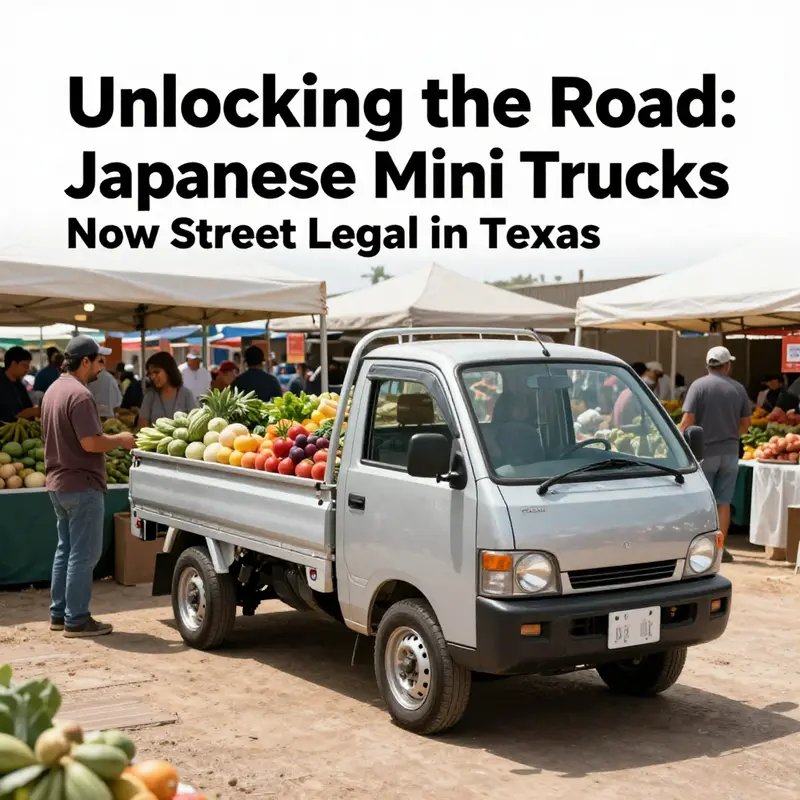
A quiet shift has begun along Texas roads and rural lanes that once seemed perfectly sized for full-sized pickups, big trailers, and the long, repetitive rhythms of farm-to-town commerce. Japanese mini trucks, once seen as curiosities or relics of distant auto markets, are moving into the mainstream of practical transportation as a legal option for thousands of Texans. The change did not appear overnight. It grew out of legislative work that recognized a simple equation: when a vehicle is small, efficient, and durable, and when law and policy align with broader goals of rural productivity, environmental stewardship, and small-business viability, the result is not a novelty but a reliable tool. The question at the core of this chapter—are Japanese mini trucks street legal in Texas?—has become less about a single yes or no and more about a pathway to smarter movement, cost savings, and new possibilities for services and livelihoods across a state defined by vast distances and diverse communities.
To understand the transformation, one must start with the legal framework itself. In March 2025, Texas legislators enacted provisions that finally clarified how older Japanese vehicles could be imported and registered for road use without being stymied by century-old interpretations of state regulations. The core of this policy hinge is the triad of criteria that a vehicle must satisfy to qualify for registration: it must be manufactured in Japan, it must carry an engine displacement not exceeding 1.2 liters, and its top speed must exceed 80 kilometers per hour (roughly 50 miles per hour). These criteria are more than technical thresholds; they define the practical envelope in which compact, economical mobility can exist on Texas streets and highways. It is a deliberate balancing act: allow access to older, well-maintained vehicles that meet modern environmental and safety expectations, while preserving the standards that Texans rightly expect for on-road performance.
Within this framework, the most visible beneficiaries are the kinds of vehicles born from Japan’s kei car culture—compact, efficient, and engineered to do more with less. In the Texas landscape, those advantages translate into real-world benefits. The smallest of the fleet can be surprisingly capable: a compact truck with a modest engine can move seeds, feed, irrigation supplies, and repair tools across a rural property with far less fuel burn than a larger pickup. On the street, narrow lanes, steady traffic in small towns, and the occasional need to navigate a busy urban corridor become less intimidating when the vehicle itself is designed to fit where larger vehicles cannot. The weight and size reductions also contribute to lower maintenance costs, fewer parts-exchange complexities, and a vehicle platform that is easier to service in rural garages or small-town repair shops. This is not simply about novelty; it is about aligning a specific category of transportation with a region’s economic realities and environmental considerations.
The legislative shift did not occur in a vacuum. It arrived after advocacy and the careful mapping of a real, unmet need. Advocates highlighted a common-sense advantage: when a vehicle meets federal import standards by age (more than 25 years old) and still performs adequately on emissions and safety tests, it should not be indefinitely stranded on the import side of the policy wall. In rural Texas, where farms and small businesses must stretch every dollar, the ability to register these compact vehicles unlocks a critical toolkit for day-to-day operations. Farmers can replace gas-guzzling trucks with a fleet of compact movers that handle seed, fertilizer, and equipment with a fraction of the fuel consumption. In urban and peri-urban markets, mobile service providers and food vendors discovered a new way to operate—one that blends mobility with sustainability—thanks to the lower operating costs and smaller parking footprints that these mini trucks offer. The practical value is grounded in simple arithmetic: lower purchase/maintenance costs, reduced fuel bills, and fewer downtime moments caused by costly repairs or fuel shortages.
From a design standpoint, the appeal of these vehicles lies in what they are built to do and how efficiently they do it. Kei-style engineering in Japan emphasizes compact dimensions, light weight, and practical payloads. The result is a vehicle that can negotiate tight spaces, access narrow lanes, and deliver meaningful cargo capacity without the burden of a large chassis. In Texas, that translates into a form of mobility that is not only efficient but also adaptable. A small farmer can shuttle seeds between plots with an easy-to-park solution, a rural contractor can haul light tools and spare parts without burning through fuel, and a mobile vendor can cart cooking equipment and supplies to a park, a festival, or a market with greater reliability and lower cost per mile. In many instances, these mini trucks remain in excellent condition even after decades of use, an unintended testament to their utilitarian design and the careful maintenance habits of their original owners. The Texas Department of Motor Vehicles has noted that many of these imports retain original paint and possess remarkably clean engine compartments, signaling a culture of care among owners that translates into lower downtime and fewer urgent repairs.
There is also a broader cultural and environmental story threaded through the adoption. In tech-centric hubs like Austin and Dallas, these mini trucks have become more than workhorses; they are symbols of a pragmatic, low-carbon approach to mobility. Some enthusiasts describe emissions profiles that, in certain comparisons, are markedly lower than those of larger, high-performance vehicles. While anecdotal, such observations point to a growing sentiment: that small, efficient, well-maintained vehicles can deliver comparable utility with a lighter environmental footprint. The conversation around emissions is not purely aspirational; it is anchored in the real-world implications of reduced fuel consumption and the corresponding impact on urban air quality and rural energy use. The discussions that have animated communities—from DIY conversions in online tutorials to practical demonstrations in markets and on farms—reflect a broader cultural shift toward sustainable, affordable mobility. Platforms and communities dedicated to the upfitting and use of these trucks have proliferated, sharing plans for camper conversions, tool vans, repair wagons, and other mobile business formats. In this sense, the mini truck phenomenon intersects with a broader trend toward flexible, small-footprint entrepreneurship that is well-suited to the diverse economies across Texas.
The practical outcomes on the ground have begun to crystallize in a few telling numbers and narratives. A central Texas farmer who swapped a larger, fuel-hungry vehicle for a 25-year-old compact truck reportedly saved more than three thousand dollars in annual fuel costs. That is not a marginal improvement; it represents a meaningful shift in the farm’s operating budget, enabling more consistent pricing and potentially higher margins on crops and inputs. In urban-adjacent markets, mobile vendors who converted these mini-trucks into food carts or service vans reported a dramatic drop in monthly fuel bills—from rough estimates of six hundred dollars a month to as low as one hundred fifty dollars. Those savings accumulate quickly, reinforcing the case that these small vehicles can be not just practical but economically transformative for small businesses navigating tight margins, seasonal demand, and rising overhead. When multiplied across hundreds or thousands of operators, the economic ripple becomes a meaningful contribution to local economies—especially in rural communities where transportation costs can be a limiting factor for small-scale production and distribution.
The regulatory environment has further reinforced this broader effect by creating a legitimate, predictable pathway to legality and operation. The new framework does not blanket-legalize every old Japanese vehicle; rather, it establishes a transparent standard for aging imports that meet modern emissions and safety expectations. This clarity reduces the frictions that previously left many potentially useful vehicles idle or stranded on the import side of policy. It also spurs a niche market for registered pre-owned compact trucks, including maintenance and upfit services that cater to farmers, contractors, mobile vendors, and recreational users. The presence of a large, legally compliant, on-road fleet creates opportunities for local mechanics, parts suppliers, and service centers that specialize in smaller platforms—an ecosystem that strengthens rural and small-town economies by creating jobs and demand for compatible parts and expertise.
An important driver of this shift has been community organizing and advocacy, which helped bring attention to the practical implications of these vehicles for everyday Texans. Groups arguing for practical mobility options emphasized how these compact vehicles can fill gaps left by larger fleets, especially in agricultural settings where narrow lanes, rough farm lanes, and short-distance transport of inputs demand nimble, efficient machines. The advocacy work connected friendly to the federal standard that allows older vehicles to be imported as long as they meet safety and emissions requirements and as long as the state recognizes them through a compliant registration pathway. The resulting policy combination—age-based eligibility, engine displacement and top-speed thresholds, and a clear process for registration—has opened the door not only to practical use but also to innovation and experimentation in how these vehicles are deployed. In a sense, the policy reframes these mini trucks from curiosities to viable, everyday tools that fit the unique logistical needs of Texas life—from the backcountry to the city park, from the farmer’s field to the curb where a mobile vendor serves customers.
For readers who want to explore the subtleties of how these vehicles are used in real-world settings, the online communities surrounding mini trucks offer a wealth of practical examples. Owners share their preservation tips, discuss emissions testing routines, and compare the operating costs of different configurations—tools that help new buyers assess whether a compact, Japan-origin vehicle can meet their needs. The discourse also reveals how owners adapt these trucks to specific tasks, such as small-load hauling on rural properties, light-duty repair vans for field service, or compact camper setups for weekend escapes. The DIY culture surrounding these vehicles—reflected in many how-to videos and tutorials—emphasizes a practical ethos: maximize utility with a small, carefully maintained platform, and keep the vehicle in good repair to reap the long-term cost savings. In this way, the vehicles become not only a transportation solution but also a form of adaptable entrepreneurship that aligns with the broader Texan values of resourcefulness and independence.
The social and economic implications extend beyond the individual operator to the communities that interact with them. Farmers provide a glimpse of the agricultural economy reimagined through a smaller, more nimble supply chain. A compact truck fleet can provide more flexible delivery routes, enabling farmers to move seeds, fertilizer, and tools between plots with less downtime and fewer trips on heavy-haul roads. Mobile services—whether food, repair, or other on-site offerings—benefit from lower capital and operating costs, enabling more people to experiment with new business models that meet local demand. The reduced noise and lower emissions of these small trucks can also contribute to better neighborhood compatibility in small towns and urban cores, which increasingly prioritize pedestrian-friendly streets and air quality. The upshot is a new, practical layer to Texas’s diverse mobility ecosystem: a move toward functional, affordable, and sustainable transport that serves people where they live, work, and innovate.
If there is a single throughline in this evolving story, it is the sense that a policy that enables a legally registered, older Japanese mini truck to share the road with larger vehicles can coexist with safety expectations and environmental standards while delivering tangible economic gains. The chapter’s data point about a farmer’s annual fuel savings and the experiential reports from mobile vendors illustrate a broader truth: when policy, market demand, and design synergy converge, a transportation category once thought of as peripheral can become core to everyday life. This is not a wholesale replacement of larger vehicles. It is a complement—an option that broadens the spectrum of mobility choices available to Texans and fosters a more resilient rural and urban economy. The emerging picture is one of models that honor a heritage of efficient engineering while applying it to contemporary needs. In that sense, the Japanese mini truck is not merely a curiosity on Texas roads; it is a practical instrument that helps communities, small businesses, and households navigate the costs and constraints of modern transportation with greater confidence and creativity.
For readers interested in seeing how communities discuss and adapt to this mobility shift, a useful starting point is the broader online conversation that gathers perspectives from farmers, truck operators, and hobbyists alike. These discussions underline a simple, enduring truth: when small, well-maintained equipment is paired with clear regulatory pathways and a culture of practical optimization, transportation can stay affordable, reliable, and responsive to local needs. The road ahead for Japanese mini trucks in Texas looks less like a trend and more like a durable component of the state’s mobility landscape, with roots in careful policy design, a culture of careful upkeep, and a community-wide willingness to experiment with new, efficient ways to get from point A to point B.
External reference and broader context can be found in official regulatory communications that outline the specifics of eligibility and operation for these vehicles, including the age, displacement, and speed criteria and the registration process that makes road use possible for qualifying imports. For a concise summary of the regulatory basis that underpins this shift, see the official state communication describing the policy implementation and its practical implications: https://www.texas.gov/news/2025/03/hb478-japanese-mini-trucks-legally-operated. For ongoing discussions, case studies, and practical tips from communities already integrating these vehicles into their work, one can explore community-focused resources and up-to-date commentary at the mini trucks platform, which offers broad perspectives on ownership, maintenance, and creative upfits such as mobile camper conversions and tool vans: minitrucksocala.com/blog/.
In sum, the question of legality has evolved into a broader conversation about fit, function, and value. The answer is now more nuanced and affirmative: Japanese mini trucks can operate on Texas roads legally, provided they meet the established standards and are registered through the proper channels. Their presence on rural lanes and city streets speaks to a pragmatic, incremental approach to mobility that prioritizes affordability, reliability, and sustainable use of resources. The chapter that follows will continue to trace how these vehicles are deployed—from the fields to the markets to the curbside workshop—and what their expanding footprint means for policy, business, and everyday life on the Texas landscape.
Final thoughts
The introduction of Japanese mini trucks as street-legal vehicles in Texas represents not only a significant regulatory shift but also a golden opportunity for small business owners and enthusiasts alike. These compact and efficient vehicles are versatile enough to meet a variety of needs, from enhancing delivery services to becoming essential tools for agriculture and mobile businesses. As the trend gains momentum, we can expect an even greater economic impact in local communities. Embrace the change, explore your options, and consider how a Japanese mini truck can enrich your Texas experience, whether you are running a business or pursuing your passion for unique vehicles.