
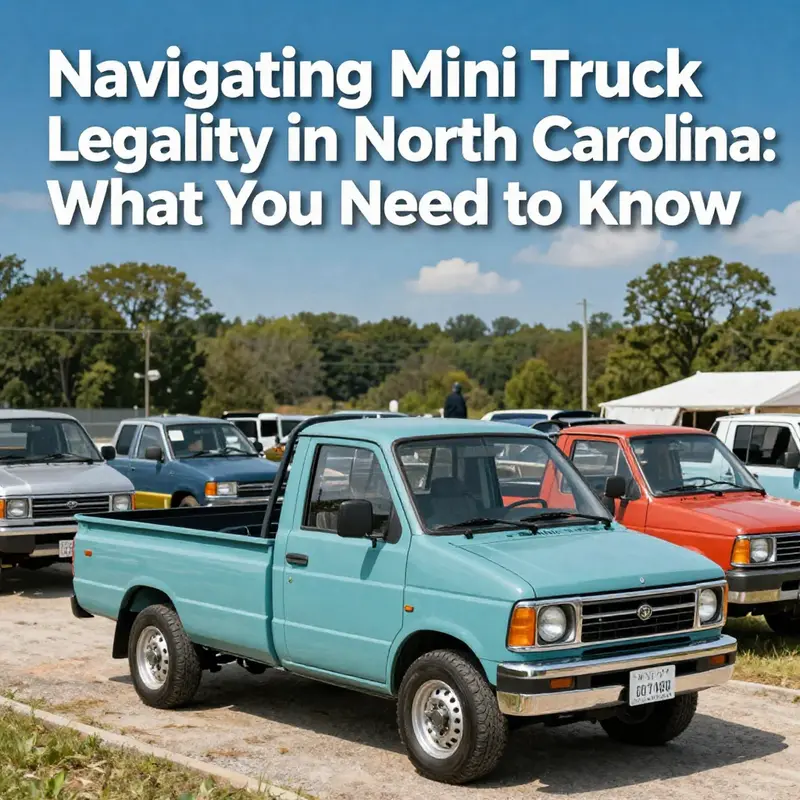
For small business owners, residential property owners, and mini truck enthusiasts in North Carolina, understanding the legal landscape surrounding mini trucks is crucial. These practical vehicles—often beloved for their compact size and versatility—offer unique advantages for personal and commercial use. Yet, navigating the rules and regulations can seem daunting. This article aims to provide clarity on several key areas: the legality of mini trucks, specific regulations that govern their use, guidelines for public road usage, required safety and emission standards, and the essential steps for proper ownership and registration in North Carolina. With a friendly, conversational tone, this guide will help you make informed decisions while ensuring that your mini truck experience is enjoyable and compliant with state laws.
null
null
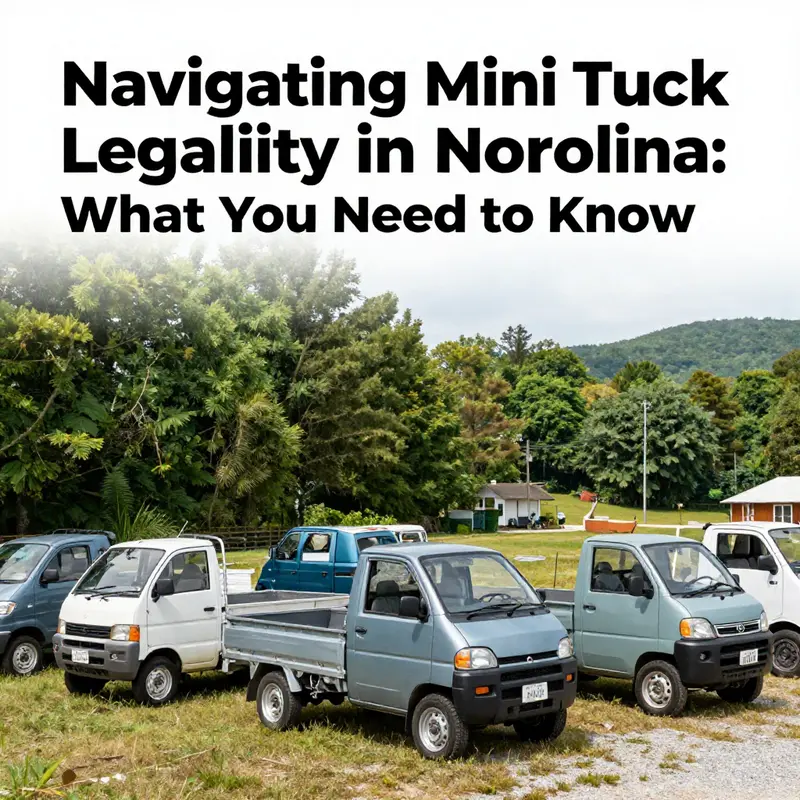
Small Wheels, Narrow Rules: Navigating North Carolina’s Kei-Truck Landscape
In North Carolina, owning a mini truck sits in a regulatory gray zone: useful on private land but limited on public roads. Private-property use is more permissive, allowing farms and large parcels to use these compact vehicles without registration or insurance requirements tied to public highways. However, when you intend to drive on public streets, NC motor vehicle codes require registration, insurance, safety inspections, and a vehicle that meets weight, lighting, emissions, and crash-safety standards. Kei-style mini trucks often fall outside typical road-legal thresholds, making on-road operation uncommon and discouraged by regulators who seek uniform safety standards. For buyers, this means a practical distinction: keep the truck on private property, or pursue a model that satisfies state road-legal criteria or substantial adaptations. The takeaway is that North Carolina does not ban mini trucks outright, but road-legal use is constrained and heavily dependent on meeting regulatory requirements. Always consult the DMV or official guidance before attempting to register or insure such a vehicle on public roads.
Tiny Haulers on North Carolina Roads: Navigating the Conditional Legality of Mini Trucks
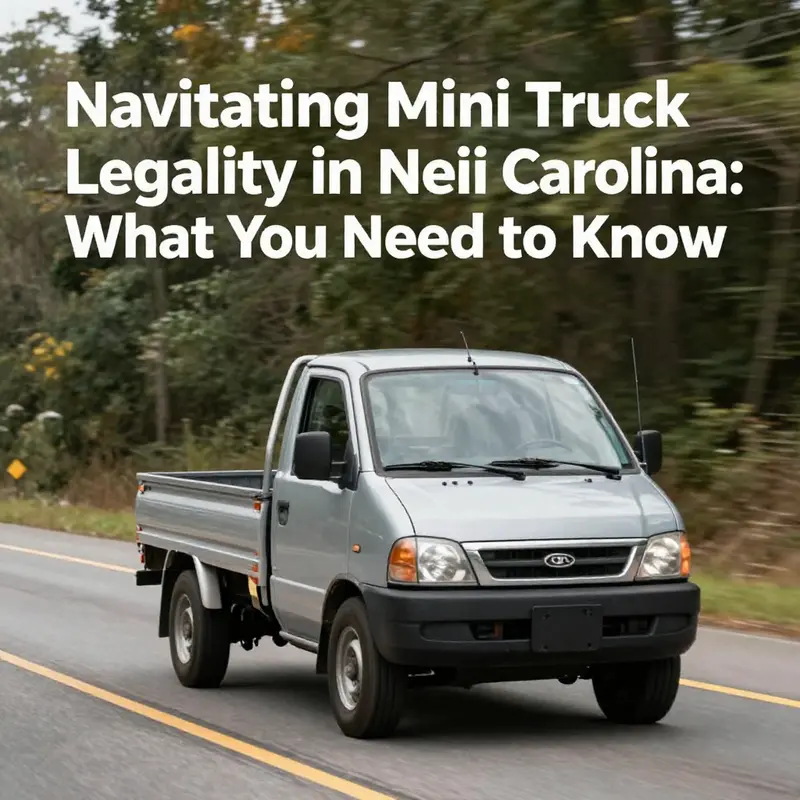
In the rhythm of North Carolina’s landscapes, where farms meet suburbs and delivery tasks thread through small businesses, a curious vehicle category has drawn interest from many drivers who crave efficiency without overwhelming size. Mini trucks, often described in the popular lexicon as kei trucks—a nod to a Japanese origin—carry a particular appeal: they are compact, economical, and surprisingly versatile for light-haul duties. Yet the question that lingers for anyone considering one on public roads is not just whether they exist, but whether they can legally share the same stretch of asphalt as larger pickups and sedans. The answer is nuanced: mini trucks are conditionally legal in North Carolina. Ownership is permitted, but their operation on public roads is constrained by a framework of safety, emissions, and registration requirements that must be met before any wheel turns on a highway. The legal landscape is not about permission granted once and forgotten; it is a continuous standard-check that mirrors the broader philosophy of vehicle regulation in the state. If you are contemplating using a mini truck for business tasks, personal errands, or farm work, you will want to understand the underlying logic of these rules and how to align a vehicle with the law so that it remains a legitimate, responsible tool rather than a liability on wheels.
Central to this framework is the recognition that legality hinges on compliance rather than merely ownership. The state’s policy is clear: a mini truck may be owned in North Carolina, but driving it on public roads requires that the vehicle meets a spectrum of criteria designed to ensure safety, environmental responsibility, and road-readiness. This means that the vehicle must conform to state safety standards, satisfy emissions requirements where applicable, and be registered correctly with the proper title and plates. In practice, what this means is a process of verification and certification. The vehicle’s basic structure—its frame, braking system, lighting, and seat belts—will come under scrutiny, not to punish ingenuity, but to safeguard riders, pedestrians, and other road users. Emissions, a perennial focus of modern vehicle policy, are also part of the checklist. The state seeks to balance the usefulness of compact utility vehicles with the imperative to limit air pollutants, especially in areas where air quality programs are active. The result is that mini trucks, when thoughtfully prepared and properly registered, can operate on public streets; when they fall short of the standards, they cannot be legally driven, regardless of ownership.
For anyone who wants to walk through the exact steps, the path is straightforward in theory, but it requires careful attention to detail in practice. The first essential step is to confirm how the vehicle is classified and whether it is eligible for operation as a road-going vehicle in North Carolina. Classification affects registration, insurance, and inspection requirements, and it can be a subtle point because some kei-style vehicles may be treated as light trucks or as light-duty commercial vehicles depending on their configuration and use. Once classification is established, the vehicle must meet state safety standards. These standards cover basic operational equipment—headlights, taillights, turn signals, braking performance, mirrors, and seat belt compliance, among other items. The logic here is simple: a vehicle intended to operate on public roads should be visible, controllable, and safe for the driver, passengers, and others sharing the road. Alongside safety, emissions considerations come into play. North Carolina requires emissions compliance where applicable, which may depend on the county and the vehicle’s specifications. The crucial point is that compliance, not mere possession, is what unlocks lawful use on public highways.
The registration process further reinforces that the mini truck in question must be properly documented. A title, registration, and license plate are the formal markers that the state recognizes the vehicle as a roadworthy instrument rather than a private, off-road curiosity. The process typically involves verifying ownership, providing proof of compliance with safety and emissions standards, and ensuring that the vehicle’s identity matches the official records. Once registered, the vehicle is subject to ongoing requirements, including possible periodic inspections and adherence to state insurance requirements. Insurance, in particular, deserves thoughtful consideration. Insurers evaluate risk and exposure, and the novelty of a small, non-standard vehicle can affect coverage options and premium levels. Some insurers may require disclosures about the intended usage, modifications, or commercial applications. Working with an informed agent helps ensure that coverage aligns with how the mini truck is used, protecting both the driver and the business or household relying on the vehicle.
The practical implications of this regulatory approach are instructive. It is not that North Carolina discourages the use of compact utility vehicles; rather, it recognizes their functional advantages while insisting that safety, environmental stewardship, and accountability remain central. For small business operators, landscapers, farmers, or rural property managers, the conditional legality can be a meaningful enabler: a vehicle that fits tight spaces, offers surprising payload capacity for its size, and reduces operating costs when properly certified and registered. But the ride comes with a governance ride-along—regular checks, compliance updates, and adherence to a defined set of standards. The upshot is that owning a mini truck and operating it on public roads is feasible in North Carolina, provided the vehicle is brought into compliance with the state’s safety and emissions mandates and is properly registered with the DMV. The process integrates with the broader transportation regulatory framework and aligns with public safety priorities, ensuring that a practical, economical tool does not become a legal vulnerability.
In practice, navigating these requirements often means engaging with official resources and, when necessary, seeking guidance from the North Carolina Department of Transportation and the North Carolina Division of Motor Vehicles. These agencies oversee vehicle registration, inspections, and compliance with state laws. The guidance they provide is pragmatic: it outlines how to verify eligibility, how to document conformity, and what steps to take if a vehicle initially fails to meet standards. For readers seeking a conversational overview, communities and hobbyist circles discussing mini trucks frequently emphasize the same core message: plan ahead, verify the vehicle’s compliance, and maintain records that prove ongoing conformity. In this sense, the mini truck becomes not just a piece of equipment, but a governed asset in a regulated transportation system that values efficiency as long as safety and accountability are preserved.
As readers consider how this chapter threads into the broader article, a practical note emerges: even with conditional legality, the road ahead requires due diligence. Before purchasing, modifying, or using a mini truck on North Carolina’s public roads, take the time to consult official sources and confirm the current requirements. Regulations can evolve, and what is true one year may change as standards tighten or as enforcement practices shift. A direct line of inquiry to the state agencies—through the DMV and the Department of Transportation—will provide the most reliable guidance. For those who want to see how the community discusses these topics and candidly shares personal experience, the following resource offers a broader perspective on the practicalities, challenges, and shared knowledge around mini trucks: minitrucksocala.com/blog/.
Ultimately, the question of legality boils down to alignment with the law: ownership is not a free pass to drive; compliance is. With this understanding, a mini truck can indeed serve as a competent, efficient tool for a range of tasks, from yard maintenance to light commercial duties. The key is to approach the vehicle not as a novelty, but as a governed asset that must reflect the state’s standards for safety, emissions, and formal recognition through proper registration. The conditional nature of its legality is not a barrier but a framework that ensures that the benefits of a compact, capable vehicle can be realized responsibly and with confidence. As you finalize your plans, keep in view the official sources that articulate the specific steps, keep documentation up to date, and stay engaged with the community resources that can offer practical tips for navigating the subtleties of inspection checklists and registration updates. The road is navigable, but it rewards preparation and adherence to criteria that protect everyone who shares the journey.
External resource for further guidance: North Carolina Department of Transportation – Vehicle Registration & Safety: https://www.ncdot.gov/dmv/vehicle-registration
Navigating North Carolina’s Mini Truck Road-Use Rules: Safety, Emissions, and Registration
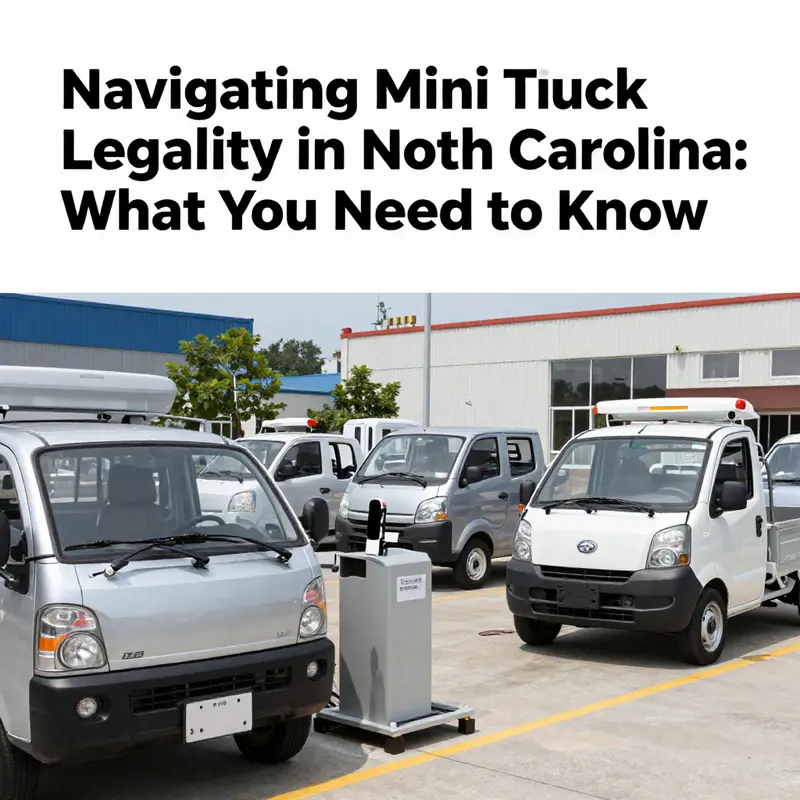
In North Carolina, owning a Kei-style mini truck is one thing; using it on public roads is another. The state’s approach frames road-legal use as a balance of safety, emissions compliance, and the registration framework. A mini truck can be owned and transported legally, but driving it on paved highways requires meeting a trio of standards that are designed to keep smaller, niche vehicles from compromising highway safety or air quality.
Safety compliance sits at the core of the process. North Carolina expects any vehicle operated on public streets to meet basic, widely understood requirements. For mini trucks, this means ensuring the lighting system is fully functional and compliant with on-road standards for headlights, taillights, brake lights, and turn signals; that braking performance is reliable enough for the vehicle’s weight and intended use; that tires carry adequate tread and are appropriate for street driving; and that the chassis and body are structurally sound without critical corrosion or damage that could undermine occupant protection. Beyond the hardware, there is a clear obligation to have valid registration and insurance. Without current registration that aligns with how the state classifies a road-use vehicle, and without insurance that meets liability requirements, a mini truck cannot be legally driven on public roads—even if ownership is legitimate. The emphasis is practical: safety is not a barrier to novelty, but a baseline requirement so that compact work vehicles can share the road with standard passenger cars and larger trucks.
Emissions requirements add another layer. North Carolina aligns on-road emission rules with federal EPA standards, which means a mini truck must be certified as meeting applicable limits. The emphasis is particularly relevant for vehicles manufactured or imported after dates when EPA standards tightened. In practical terms, owners should verify that the engine, exhaust, and emission-control devices carry the appropriate certifications, and that the vehicle’s emissions profile conforms to the applicable rules at the time of manufacture or import. This is about environmental responsibility, but it also helps determine eligibility for registration and, in some cases, whether specific roads or hours of operation are restricted for the vehicle.
The third pillar is state-level regulatory oversight. Ownership is permitted, but the Department of Transportation may impose restrictions based on physical characteristics such as weight, overall dimensions, and engine displacement. If the vehicle is outside established ranges, it may not be approved for unrestricted road use. Practically, this creates a two-step check: first understand the baseline specs of the vehicle and whether they fit within an allowed category; second, confirm that the particular configuration you own or plan to buy is eligible for registration and on-road use. Since classification can influence registration pathways, permissible routes, and even the need for inspections, it is wise to consult official sources before turning the key. The most authoritative guidance in North Carolina comes from the state DOT and the DMV, and a quick review of those portals can prevent missteps.
For anyone turning these requirements into a practical plan, a simple approach helps keep the process moving. Start with a safety audit: verify that all lights work, test the brakes for responsiveness, inspect tires for wear and suitability for on-road use, and ensure the chassis and body are sound. Gather proof of ownership, proof of insurance, and any labels that indicate compliance with relevant standards. Next, address emissions: look for manufacturer documentation or labels that confirm EPA certification status and verify whether any testing or special steps are required in North Carolina. If in doubt, contact the DMV or NCDOT for guidance rather than inferring rules from other jurisdictions. After that, evaluate regulatory status: check whether your vehicle’s weight, dimensions, and engine displacement place it in a category allowed for road use, or whether a permit or special confirmation is needed. If required, pursue any inspections or confirmations requested by the DMV. This process is not about discouraging innovation; it is about ensuring that a small, niche vehicle can operate safely and legally on the state’s roads.
The practical reality is that compliance is an ongoing condition, not a one-time hurdle. Owning the vehicle is legal, but driving on public roads often requires ongoing verification that the vehicle remains in good standing with safety and emission standards, and that its use stays within any limits set by the state for weight, dimensions, or engine size. The goal is to enable useful, compact vehicle solutions without compromising highway safety or air quality. With a clear checklist and a willingness to engage with the administrative steps, owners can enjoy the advantages of a small, capable vehicle while staying compliant.
For readers seeking up-to-date guidance, the official North Carolina Department of Transportation and DMV portals are the best starting points. They provide the current rules, required forms, and contact points for questions about safety equipment, emission certification, and road-use eligibility. In practical terms, this means checking those sources whenever you are considering a purchase, before attempting to register the vehicle, and whenever you plan to operate on public roads. The objective is straightforward: a mini truck can be a legitimate, practical tool for work or recreation in North Carolina, provided you follow the state’s safety, emissions, and registration requirements.
Ownership, Registration, and Road Limits: Understanding Mini Trucks in North Carolina
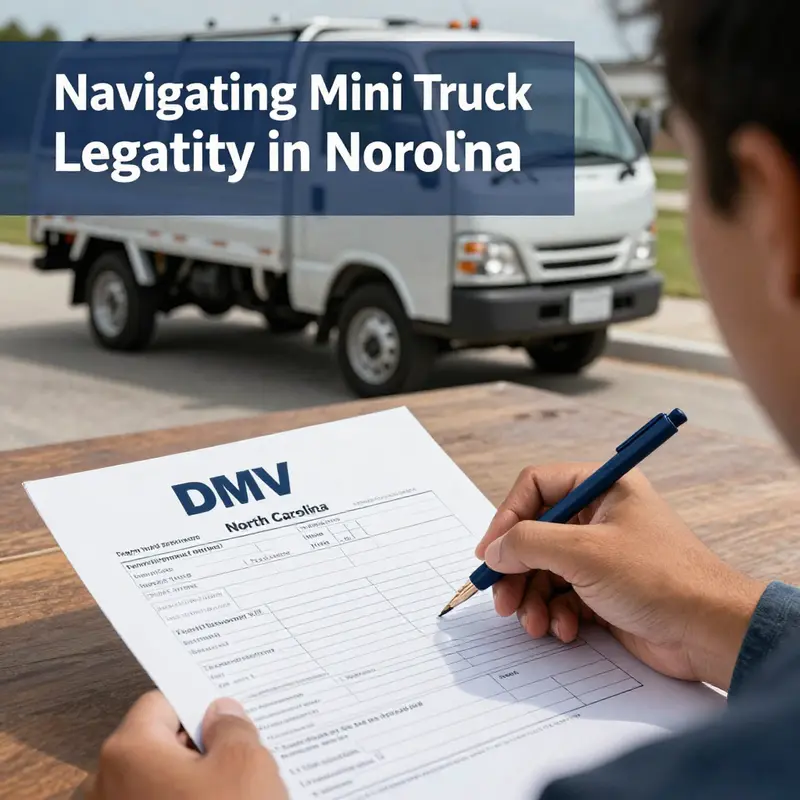
The question of whether mini trucks can legally ride on North Carolina roads isn’t a simple yes or no. It rests on how the vehicle is classified, how closely its design mirrors standard passenger cars, and how thoroughly it meets the state’s safety, emissions, and registration standards. In North Carolina, these compact, kei-style vehicles occupy a gray zone between on-road utility and off-road work gear. They can be owned and, under certain conditions, permitted on public streets, but they are not granted free rein the way conventional automobiles are. The law treats them differently not because of a lack of utility but because of design features that distinguish them from typical cars and light trucks. This distinction matters greatly for anyone considering ownership, because it shapes every phase from purchase to road use, and, crucially, from the moment you turn the key to the moment you park at the curb after a trip to the hardware store or a remote work site. To understand this landscape fully, it helps to follow a single through-line: ownership is permissible, but operation is regulated, and every badge of compliance—title status, safety equipment, and insurance—counts toward lawful use on public roads. This is why the process reads more like a careful alignment with DMV rules than a casual purchase. The core idea is that mini trucks may be legal in a limited sense, but their road legitimacy hinges on a combination of classification, equipment, and registration that keeps them distinct from ordinary passenger vehicles. Those who want to use these vehicles on public roadways must first acknowledge that they are entering a regulated space where off-road heritage and urban practicality collide. A practical way to situate this is to picture the vehicle as a tool: valuable on the work site and in rural corridors, yet requiring formal permissions to share space with everyday traffic. This framework helps explain why some owners keep their mini trucks strictly on private property, while others navigate the hurdles to obtain restricted road access. If you plan to drive on public roads, you will need to map out the steps ahead—starting with how the vehicle is classified by the state, and ending with the precise requirements you must meet to stay compliant as you drive. When you weigh the costs and responsibilities, the picture becomes clearer: legal access comes with responsibilities that parallel those of standard vehicles, even if the vehicle itself looks and feels smaller or more utilitarian. In this context, the regulatory emphasis is not on denying utility but on ensuring that any vehicle sharing public space can be seen, heard, and protected like other traffic participants. Safety features play a central role in this equation. The vehicle must be equipped with core signals and structures that drivers and pedestrians rely on every day. Headlights, brake lights, turn signals, mirrors, and a horn are not decorative add-ons; they are the minimum thresholds that transform a niche vehicle into a legally operable unit on the road. The absence of these features is not merely a minor defect—it’s usually a decisive barrier to on-road use. Beyond the mechanical basics, the vehicle must often be registered with the North Carolina DMV as a “special purpose” or “off-highway” vehicle. This designation reflects its distinct purpose and design and signals that the vehicle is not a standard passenger car by occupation and by functionality. Even when a mini truck is successfully registered under this category, its on-road allowances remain tightly restricted. It is typical for such vehicles to be prohibited on highways, interstates, and major roadways unless specific permissions are granted by authorities. The rules are not a simple prohibition on all on-road activity; rather, they delineate a controlled envelope in which the vehicle may operate. That envelope can resemble a public roadway at times but inherently prioritizes safety and compatibility with existing traffic. For many owners, the practical consequence is that a mini truck can help with light-duty tasks and short trips to nearby destinations, provided those trips occur within the restricted corridors defined by law. The experience of operating under these constraints is distinctive. You must carry a valid driver’s license and liability insurance that covers the vehicle, just as you would for any other motorized mode on the road. The insurance requirement is not merely a precaution; it is the social contract that makes public sharing possible. It ensures that, in the event of an incident, the injured party can still recover, and the owner bears the financial responsibility tied to road use. Ownership transfer follows the familiar process, yet with particular attention to the vehicle’s special status. The title must be properly signed over by the seller, and the new owner must complete a title application, along with proof of identity, applicable fees, and a registration form. The thinking here is simple: even in a market that values flexibility and compact design, formalities matter when a vehicle travels in public space. This is where the idea of gifting a mini truck intersects with legal obligations. A transfer, even a no-money exchange, requires documentation to ensure that the vehicle’s status remains consistent with DMV records. Such rigor protects both parties and helps keep the vehicle within the framework of state rules. In practical terms, this means the journey from ownership to operation is a careful, document-driven path rather than a casual shift from one person to another. The end result is a system that balances utility with accountability, enabling owners to use a compact, capable vehicle while maintaining the safety and order of the road network. For readers who want a touchstone for practical considerations and current interpretations, the NC DMV’s own guidance on mini trucks and UTVs serves as an essential reference point. It maps out how these vehicles are treated in terms of title status, registration categories, and required safety equipment, and it clarifies what is allowed on public roadways and what remains off-limits. If you are exploring ownership, it makes sense to consult that official resource as you plan a purchase, a transfer, or a registration. For readers who want a broader, ongoing perspective on the world of compact work vehicles and their evolving roles, the minitrucks blog offers a space to explore practical considerations and community insights. See the minitrucks blog for additional perspectives and user experiences that illuminate the day-to-day realities of ownership and operation. minitrucks blog. The broader takeaway is that legality in North Carolina hinges on aligning the vehicle’s design, features, and registration with regulatory expectations. When these dimensions are in harmony, a mini truck can be a lawful, efficient tool on certain roads and in certain contexts. When they are not, the vehicle may be limited to private property or require modifications or permissions that extend beyond routine ownership. To be sure of current requirements, it is wise to consult the official DMV page or speak with a licensed professional who can interpret the latest rules as they apply to your specific vehicle and your intended use. An up-to-date understanding also helps you anticipate fees, inspection needs, and potential restrictions when the vehicle’s circumstances change—such as a modification that affects safety features or a move from one county to another, where local interpretations can vary even within the same state framework. The regulatory environment is not static; it evolves as safety expectations shift and as new vehicle configurations enter the market. Staying informed minimizes surprises and supports responsible ownership that respects both the law and other road users. As you consider the path from ownership to on-road use, remember that the priority is to secure a compliant baseline: safety equipment, proper registration, and appropriate insurance. With those provisions in place, you enter a space where utility and legality can coexist. The practical implication is that if your goal is frequent, long-distance driving on major roads, a miniature utility vehicle is unlikely to substitute for a standard passenger vehicle. If your needs are modest—a quick trip to a nearby site, light hauling, or occasional use on back roads—it is feasible to pursue a compliant setup that keeps you within the law. In sum, mini trucks can be legal in North Carolina under regulated, clearly defined conditions. The key is to approach ownership with a respect for the regulatory structure that governs vehicle use on public roads, and to align the purchase, modification, registration, and insurance steps with that structure. For readers seeking additional context and practical perspectives, the NC DMV’s guidance remains the authoritative source, while community resources and experienced owners offer real-world nuance that helps bridge policy and practice. External reference: https://www.dmvnc.com/vehicles/mini-trucks-and-utvs.aspx
Final thoughts
Understanding the legal landscape for mini trucks in North Carolina is essential for anyone considering ownership or looking to enjoy the benefits of these vehicles. By grasping the laws surrounding their use, registration, and compliance with safety standards, you can ensure a hassle-free experience. Navigating local regulations doesn’t have to be intimidating; with the right information and preparation, your mini truck can be a practical and enjoyable asset in your day-to-day life. Stay informed, comply with regulations, and embrace the flexibility that comes with owning a mini truck in North Carolina.