
The allure of mini trucks captivates many, from small business owners looking for reliable transport to enthusiasts with a flair for customization. However, understanding the legal landscape governing these vehicles is crucial for anyone considering ownership or operation. In this guide, we’ll explore the intricacies of mini truck legality in the U.S. throughout five detailed chapters. From federal regulations overseeing safety and emissions to state-specific rules that could impact your driving experience, we’ve got you covered. Whether you’re eager to hit the road or just exploring options, this article will equip you with vital knowledge about registration, compliance, and popular mini truck models on the market today.
The Patchwork of Permission: How Mini Trucks Navigate the U.S. Road-Use Landscape
Mini trucks have carved out a curious niche in the United States, where the question of legality is less a single federal verdict and more a mosaic of state choices, local interpretations, and a web of safety and emissions standards that rarely align neatly with one another. The road-worthiness of these compact workhorses hinges on a constellation of factors: how the vehicle is designed, its size and weight, the engine, the presence of required safety equipment, and, crucially, how well it can prove compliance with the standards that govern traditional cars and light trucks. In practice, this means that a mini truck might be perfectly street-legal in one state and run afoul of another’s rules, or it might be treated as a different category altogether if the vehicle strays into the realm of off-road or recreational use. The result is a regulatory environment that rewards meticulous attention to federal benchmarks while inviting close scrutiny at the state level, where the most practical questions about day-to-day operation are resolved by DMV clerks, law enforcement officers, and insurers who interpret the rules through a local lens. And because the federal framework itself stops short of a single definition for mini trucks, the onus falls on buyers and operators to verify specifications, certificates, and registrations with the right authorities before turning the ignition keys.
At the core is a tension between federal expectations and state discretion. The federal government does not issue a blanket street-legal stamp specifically for every miniature pickup or micro-truck; instead, those vehicles must fall under the broader umbrella of safety standards that apply to vehicles sold for on-road use. A vehicle that passes the standard safety tests and carries the appropriate certification can meet FMVSS—Federal Motor Vehicle Safety Standards—and, by extension, qualify for registration in most jurisdictions. Yet many mini trucks are either not built to the same crash-test pathways as full-size automobiles or are marketed in ways that blur the line between a conventional automobile and a utility vehicle intended for light-duty work or off-road tasks. When a vehicle is designed with features more typical of off-road or light commercial use, regulators and insurers may scrutinize it more closely to determine whether it truly belongs on a public roadway, and if so, what equipment is necessary to support safe operation.
Emissions considerations compound the federal picture. Vehicles entering the U.S. road system must meet EPA standards for pollutants and greenhouse gases. This is not merely a bureaucratic checkbox; it translates into real-world consequences for a vehicle’s eligibility to be sold, registered, and insured. A mini truck that uses an engine and exhaust system which cannot meet the EPA’s requirements will struggle to achieve on-road status, even if its chassis and body are otherwise compliant with FMVSS. The interplay between safety and emissions can be delicate. A compact vehicle that prioritizes light weight and utilitarian design may excel in urban maneuverability or tight-worksite access, but if its emissions profile falls short, its road-legal prospects diminish, or its operation on public streets becomes restricted to certain times, areas, or toll-free enforcement zones.
From the driver’s seat, the practical implications of this legal patchwork appear in micro-decisions about where and how to drive. In some states, these vehicles are treated as off-highway or recreational equipment when used on public roads. In such places, the law may require essential safety gear—seat belts, proper lighting, mirrors, and a valid registration—to be present and functioning. The penalties for noncompliance can range from fines to vehicle impoundment, and in certain jurisdictions, driving such a vehicle on a public road without the appropriate designation can trigger more serious charges. Other states take a stricter view, restricting or even prohibiting street use unless the vehicle meets a defined set of standards and is registered accordingly. The result is a risk-laden landscape for would-be owners who assume a simple “is it street-legal?” answer and discover instead a conditional yes, a conditional no, or a perhaps—a temporary exemption granted through a permit, pilot program, or special-use authorization.
Insurance and licensing occupy their own parallel tracks. In many cases, insurance providers do not treat mini trucks as standard automobiles. Some insurers classify them as specialty vehicles, a category that often carries higher premiums and more restrictive terms. Licensing can be straightforward in some states, requiring nothing more than a valid driver’s license, but other jurisdictions may impose additional requirements based on the vehicle’s size, weight, or engine displacement. A few states experiment with alternative licensing paths that resemble motorcycle or moped classifications for particularly small, low-speed variants. These nuances reflect the broader reality that the road status of mini trucks is less about a universal rubric and more about the precise blend of design, use-case, and local enforcement expectations.
For people who approach a mini truck as a practical tool for urban errands, small business delivery, or campsite logistics, this complexity does not erase utility—it reframes how one plans, equips, and insures the vehicle. It prompts a careful early‑stage checklist: confirm that the unit is designed with on-road use in mind, verify a valid DOT certification or equivalent proof of compliance, and ensure that emissions conforms to the state’s standards. It also means confirming how the state will treat the vehicle in terms of registration, plate issuance, and any required safety equipment. Where a vehicle is intended primarily for off-road or restricted-use application, operators must be mindful of the rules that limit public-road operation and the potential surcharges or penalties that can accompany noncompliance. In short, the legal status of mini trucks on U.S. roadways turns on a precise alignment of federal safety and emissions criteria with the state’s road-usage policies, and it is this alignment that ultimately determines whether a given mini truck can be a practical, legal companion for daily driving or only a specialty vehicle for limited, controlled environments.
The practical upshot for readers of this article—and for prospective buyers who gather information across sources—is that there is no universal, one-size-fits-all answer. A mini truck might be perfectly legal to drive in one state, while the same model, in a different configuration or with a different engine, could become a road-infringing risk elsewhere. This is why sources that synthesize federal guidelines and state-level variations are invaluable. For a broad, ongoing perspective on regulations and practical considerations, the Mini Trucks Blog offers a consolidated look at how rules evolve and what operators can expect in different regions. The blog serves as a useful bridge between federal intent and local practice, and it can help readers stay informed about new rules, pilot programs, and clarifications that regulators publish as the market and technology change. Mini Trucks Blog
Where documentation exists, it remains critical to consult the right authorities. The U.S. Department of Transportation and state DMVs are the authoritative sources for whether a given mini truck satisfies federal certification and receives proper registration. The National Highway Traffic Safety Administration provides guidance on how vehicles are classified for regulatory purposes, and this guidance helps illuminate why a vehicle is treated as a light-duty truck in some contexts while being relegated to an OHV or recreational category in others. Because the specifics can hinge on tiny changes in the vehicle’s labeling, feature set, or intended use, a seemingly minor modification can alter the legal status of a vehicle from road-legal to restricted or noncompliant. The practical implication is clear: diligence matters. Before taking a mini truck onto public streets, a potential owner should verify DOT certification, confirm compliance with FMVSS, ensure EPA emissions are within the state’s requirements, and secure registration and title in the jurisdiction of operation. Keeping records of safety features, crash-test information, and emissions conformity can expedite the process if questions arise during inspections or renewals.
The regulatory reality also invites a broader, more measured perspective on safety. Mini trucks are small, nimble, and often more maneuverable than their larger counterparts. That advantage can be offset by limitations common to smaller platforms: reduced crash protection in certain angles of impact, limitations in occupant protection in the absence of robust crash-structure design, and the importance of appropriate tires, lighting, and braking systems. When a vehicle is used intensively for commercial purposes or on busy urban routes, these safety considerations become more pronounced. It is not merely a matter of legal access but of reliable performance under the conditions drivers routinely encounter. In this sense, the question of legality evolves into a question of responsibility: for operators to ensure not only that they can legally use the vehicle but that they can do so in a way that minimizes risk to themselves and others on the road.
For readers who want a grounded sense of how these rules are applied in real life, the path is to start with federal guidance and then map it onto state practice. The absence of a universal standard means that a careful, model-specific inquiry is essential. If a mini truck is intended for day-to-day road use, prospective owners should prepare a dossier: the exact vehicle specifications and build, a copy of safety certification documents, confirmation of emissions ratings, and proof of registration. They should also consult the state DMV and, if possible, speak with an insurer to understand policy coverage and premium implications. When properly aligned, a mini truck can function on public roads with the same legitimacy as many other light-duty vehicles, offering a unique blend of cost efficiency, nimble handling, and practical utility. If the vehicle’s purpose leans toward off-road adventures or limited-access work sites, the rules may be more permissive or more restrictive, depending on the jurisdiction and how the vehicle is marketed and used.
In sum, the road legality of mini trucks in the United States is not a fixed verdict but a negotiated outcome that reflects the ongoing dialogue between federal standards and state implementations. It rewards diligence, documentation, and a willingness to coordinate with the right agencies. For readers who want to stay current and informed, the combination of federal guidance, state regulations, and practical commentary from industry-focused outlets provides the most reliable compass. External authorities remain the ultimate source for the final determination, and a careful, model-specific approach will usually yield the best path toward lawful and safe usage on public streets. For a direct, authoritative reference on vehicle classification and related safety considerations, consult the National Highway Traffic Safety Administration’s vehicle classification guidelines: https://www.nhtsa.gov/vehicle-classification.
Safety Compliance as the Gatekeeper: How Mini Trucks Earn Their Place on U.S. Roads
Safety compliance functions as the gatekeeper for mini trucks seeking to share every mile of American pavement with larger vehicles. It is a web of standards designed to keep occupants safe and other road users protected, not just a single rule. This chapter outlines the federal framework, how FMVSS and EPA rules apply to mini trucks, and what this means in practice for buyers and drivers. The National Highway Traffic Safety Administration (NHTSA) writes and enforces FMVSS, addressing crashworthiness, restraint systems, lighting, braking, and stability. Emission controls from the EPA ensure that these vehicles meet environmental limits just like other roadworthy vehicles. The interaction with state rules creates a landscape that can vary by location, so buyers should check their DMV or transportation authority for any extra criteria beyond federal compliance. Registration and titling follow the same general path as other passenger or commercial vehicles, with documentation that reflects VIN, engine specs, weight, and compliance status. The practical takeaway for consumers is simple: verify FMVSS conformity, confirm EPA compliance, review labeling and documentation, and check state-specific requirements before driving on public roads. The chapter ends with a note to consult official sources for up-to-date standards and compliance pathways.
Small Cars, Big Rules: How State and Federal Standards Shape Mini Trucks on U.S. Roads
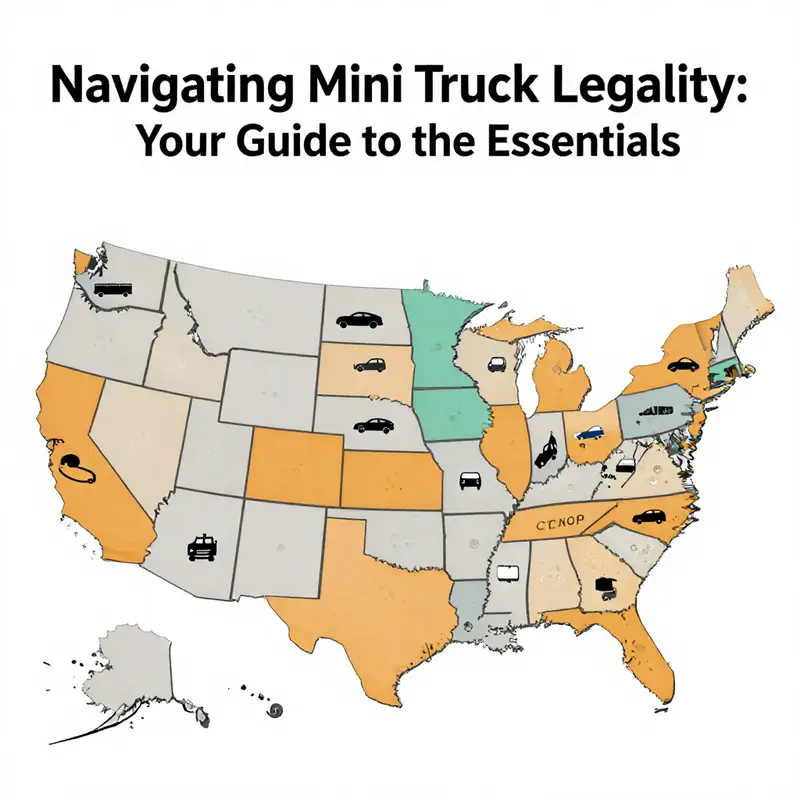
In the United States, mini trucks occupy a curious corner of the road. They are small enough to navigate crowded streets, yet substantial enough to handle utility tasks that would strain a smaller car. Because they straddle categories between cars, light-duty trucks, and sometimes specialty or low-speed vehicles, their road legality isn’t a single carve-out but a carefully balanced map of federal safety rules and state-specific tweaks. To understand when a mini truck can truly be driven on public highways, it helps to see how federal standards set a baseline and how states layer on their own requirements. The result is a practical framework that, while complex, is navigable for buyers, drivers, and regulators alike when approached with care and attention to design, certification, and paperwork.
At the core of federal regulation lies the National Highway Traffic Safety Administration (NHTSA), which directs the safety architecture that all road-legal vehicles must meet through the Federal Motor Vehicle Safety Standards (FMVSS). These standards cover a broad sweep of vehicle performance: crashworthiness, structural integrity, lighting, seat belts, and other core safety features that affect both occupants and pedestrians. Emissions considerations, handled by the Environmental Protection Agency (EPA), sit alongside these safety mandates to ensure that a vehicle’s operation on public roads aligns with nationwide air-quality objectives. For mini trucks, this means that to even be offered for sale or put on a road, the vehicle must conform to FMVSS and emit in a manner consistent with EPA rules. A mini truck sold in the United States should carry a valid Department of Transportation (DOT) certification plate or label that confirms compliance with these federal standards.
This federal baseline creates a universal floor. It means that, regardless of the state you operate in, a well-designed mini truck that meets safety and emissions requirements is, in principle, eligible for road use. But federal rules do not exist in a vacuum. They are intended to provide a consistent national standard while allowing states the flexibility to address local conditions. The practical consequence is that the same mini truck could be treated one way in one state and slightly differently in another, depending on specific state interpretations of “on-road” use, registration practices, and licensing expectations. Most states follow the federal framework closely, but there are notable deviations when it comes to registration, titling, and the vehicle’s classification on public roads.
A central distinction in this landscape is the difference between standard, full-speed road use and the more specialized world of low-speed vehicles (LSVs) and other utility-focused designs. LSVs are typically designed to operate at limited speeds and often share road space with conventional cars on streets with lower speed limits. In some states, mini trucks that are specifically certified as LSVs can be permitted on certain roadways that meet their speed capabilities, provided they remain properly titled, insured, and compliant with federal LSV standards. In practice, not every mini truck qualifies as an LSV, and not every street permits LSV operation. States like California, Texas, and Florida illustrate the spectrum of approaches. California, for example, requires that any vehicle operated on public roads be registered with the state’s DMV and conform to emission standards, with the added layer that some low-speed electric vehicles must meet California’s stricter environmental criteria or obtain specific registrations. In Texas and Florida, the LSV framework provides a path for slower, lighter vehicles on limited-access routes or roads with set speed limits, subject to federal LSV criteria and proper documentation. These state-specific rules underscore a simple truth: even a federally compliant mini truck still needs the right paperwork, the right registration, and the right local acceptance to be legitimately street-legal.
Some drivers assume that a “mini truck” is always street-ready simply by virtue of its size. The real question lies in design and certification. A compact or mini pickup built as a standard light-duty truck, and certified to FMVSS and EPA rules, is broadly eligible for road use in most states. However, a smaller vehicle that is assembled from a kit, or one that is designed primarily for off-road use or as a specialty vehicle, may fall outside the standard highway-legal box unless it has been specifically designed and certified for highway use. This distinction matters because registration and titling hinge not only on the vehicle’s appearance but on its compliance trail—documentation that demonstrates adherence to federal safety and emissions standards, as well as any state-specific certifications required for road operation. For anyone evaluating a mini truck—whether as a work tool, a hobby, or a daily driver—the path is the same: confirm compliance with FMVSS and EPA, ensure proper DOT labeling or certification, and check with the state DMV about registration, titling, and any additional state flags that might affect operability on public roads.
Beyond safety and emissions, the question of who can drive and where one can drive also gains complexity. In many states, driving a recognized passenger vehicle, regardless of size, requires a valid driver’s license. When a mini truck is treated as a light-duty truck, it often follows the licensing norms for such vehicles, including standard licensing for the operator. Yet some state programs and local ordinances may introduce nuances—especially for those vehicles that push the envelope in terms of weight, gross vehicle weight rating (GVWR), or emitted pollutants. Local restrictions can affect highway access, protected lanes, or even city streets and neighborhoods. Road planners and regulators may consider factors such as speed capability, vehicle classification, and traffic flow when deciding where a mini truck may legally operate. The practical implication for owners is straightforward: even if you meet federal safety and emissions standards, you should verify whether your intended routes could include restricted corridors or require special permissions.
Insurance and registration complete the on-ramp to lawful operation. A mini truck, like any other vehicle, must be properly registered and titled in the state where it is operated, with insurance coverage appropriate to its use. The registration process typically requires proof of ownership, a VIN that matches the federally recognized standards, and compliance documentation proving that the vehicle meets FMVSS and emissions requirements. The DMV or equivalent state agency will provide the exact procedures, fees, and any state-specific forms. In some jurisdictions, you may also need a special inspection or a certificate of conformity to demonstrate ongoing compliance with safety standards. The broader lesson is that road legitimacy rests on a chain of compliance that begins with federal standards and is reinforced by state administration and local rules. Skipping any link in that chain invites penalties, insurance issues, or a risk to personal safety and public welfare.
For readers navigating this landscape, the simplest rule is to treat a mini truck as a legitimate road vehicle only after confirming three things: federal safety and emissions compliance, proper DOT certification, and state-level registration with any accompanying licensing or insurance requirements. With these in place, a mini truck can be a practical, economical option for light-duty work and personal use without straying into the unregulated tailwinds of the road, where laws and enforcement vary more widely. It’s worth noting that the information landscape can shift as manufacturers explore new configurations, and as states evaluate their own traffic safety and environmental goals. To stay current, drivers should consult the state’s DMV, and for federal touchpoints, reference agencies like NHTSA and the EPA. And because the mini-truck community tends to share experiences and practical know-how, readers can gain a broader sense of how regulation plays out on the ground by keeping an eye on the community’s evolving discussions—such as those found in the minitrucksocala blog. This hub of practical perspectives complements the official channels, offering real-world context about registration quirks, road permissions, and everyday use.
Despite the nuance, a core sentiment remains consistent: when a mini truck is designed, certified, and documented to meet federal safety and emissions standards, and when it is properly registered and insured in the state of operation, it can function as a legitimate road vehicle in much of the United States. The boundaries of that legitimacy are not a single line, but a constellation of rules that reflect a balance between broad national safety and local control. The result is a regulatory environment that can accommodate a range of vehicle designs—from conventional light-duty pickups to modern, compact utility vehicles—while preserving the safety and efficiency of road traffic. With regulatory clarity guiding design choices and paperwork, mini trucks can remain a practical, law-abiding option for those who need a capable yet compact vehicle for work, recreation, or everyday errands. As manufacturers continue to innovate and as state programs evolve, the road map will continue to refine how these small but capable machines fit into our shared transportation system.
External resource: https://www.nhtsa.gov
Registration Realities for Mini Trucks: How Federal Standards and State Rules Shape Road-Ready Status
When people ask whether mini trucks are legal on U.S. roads, the answer isn’t a simple yes or no. There isn’t a distinct federal category called mini trucks that carries its own nationwide registration protocol. Instead, road legality for these compact, lightweight pickups hinges on two intertwined streams: how the vehicle is built to meet federal safety and environmental standards, and how each state applies its own rules for ownership, titling, insurance, and on-the-road operation. The pathway to registration begins with the vehicle’s classification at the federal level. If a mini truck is designed and certified to meet the appropriate safety standards, it carries the Department of Transportation (DOT) certification and adheres to the Federal Motor Vehicle Safety Standards (FMVSS). At the same time, the engine and exhaust system must comply with environmental rules set by the Environmental Protection Agency (EPA). These federal credentials are not mere paperwork; they are the bedrock that allows a vehicle to be legally driven on public highways, and they are the first filter a prospective buyer or builder must clear before ever approaching a state DMV window. The more recent regulatory environment around emissions adds another layer of complexity. The 2024 Final Rule, which updates how light- and medium-duty vehicles are tested and regulated for pollutants, tightened NOx and particulate matter limits for a broad swath of vehicles. While the rulemaking process unfolds largely in federal venues, the practical impact lands at the doorstep of manufacturers, importers, and anyone who converts a vehicle for street use. For a clearer sense of the rulemaking record and how these standards evolve, the EPA docket remains the authoritative source of technical analyses and public comments. A direct path to that ongoing dialogue is available through the official docket where these emissions standards are discussed and debated.
This federal backbone matters because states rely on it when they decide whether a vehicle can be titled, insured, and plated for everyday driving. If a mini truck is certified to FMVSS and EPA standards, a state DMV typically treats it as a light- or, depending on its weight and configuration, a medium-duty vehicle. The crucial threshold often cited for these categories is a Gross Vehicle Weight Rating (GVWR) of around 10,000 pounds or less. Vehicles in this range generally fall under the same broad set of registration and compliance expectations as other light- and some medium-duty trucks. However, even with a compatible GVWR, a vehicle’s road status is not guaranteed if a state has special restrictions or additional requirements. Some states, for instance, impose extra inspections, or require an emissions test at the time of registration, or mandate certain safety features to be present on the vehicle before it can be plated. Other states keep tighter reins on vehicles that blur the line between “truck” and “utility vehicle,” applying distinct rules to commercial uses, fleet registrations, or vehicles intended for off-road work.
The state-by-state nature of registration means that owners must see their DMV (or its equivalent) for concrete, location-specific guidance. In practical terms, registering a mini truck typically involves proving ownership with a title, showing proof of insurance, paying the registration fee, and completing any state- or locality-specific checks. In many states, a vehicle inspection is required either annually or at the time of initial registration. Emissions testing can be a recurring requirement in regions with stricter air-quality programs, mapped to the 2024 rule changes and any state-adopted adaptations. The interplay between federal compliance and state administration means that as long as a vehicle claims equivalence to a light- or medium-duty truck and carries the appropriate DOT and EPA certifications, most hurdles at the DMV are administrative rather than conceptual. Yet the exact steps—and the documentation needed—vary by state. To anticipate what you’ll face at the counter, start with the basics: a valid title in your name, the vehicle’s registration documents, a current proof of insurance, and any forms your state DMV requires for new or imported vehicles, plus any VIN-verification paperwork if the vehicle was assembled or modified outside traditional manufacturing channels.
A practical nuance worth noting is how the vehicle’s design and its intended use influence registration and on-road legitimacy. Vehicles assembled from kits or converted from non-road-legal platforms can fall into gray areas, especially if they lack a clear, federally certified highway-use designation. Some states are strict about how a vehicle can be driven on public roads if it originated as an off-road utility vehicle or a chassis-kit build. In those cases, the path to legality often requires additional steps: ensuring the vehicle meets FMVSS safety standards, obtaining a formal highway-use certification, and sometimes undergoing a more rigorous inspection process to verify that lighting, braking, and occupant protection systems align with road-legal expectations. Conversely, mass-produced mini trucks and compact pickups manufactured to meet standard federal criteria usually have a straightforward route to registration, provided the GVWR and other specs place them within the light- or medium-duty category and the vehicle carries the necessary DOT/EPA documentation.
From a driver’s perspective, the commercial-use question can complicate matters further. A vehicle used for business purposes might trigger fleet registration channels, commercial liability insurance considerations, and potentially different plate classes or reporting requirements. Even in such scenarios, the central premise remains the same: a road-legal mini truck must satisfy both federal standards and state registration conditions. The reliance on a consistent federal framework helps bring some predictability to the process, but the final say lies with the state’s registration authorities, which interpret and apply those federal standards in the context of local traffic laws, emissions programs, and road-safety priorities.
To illustrate how these threads come together in practice, consider the everyday experience of someone shopping for a compact pickup with the intention of using it for both personal transport and light-duty work. The buyer would verify that the vehicle’s GVWR is within the threshold that prompts light- or medium-duty classification and that the vehicle bears a DOT safety certification label and EPA-compliant emissions controls. If the vehicle checks all those boxes, the next step is to engage the state DMV. You’ll typically present ownership proof, civic registrations forms, proof of insurance, and, where applicable, evidence of a mandatory safety or emissions inspection. In some states, you’ll have to prove VIN integrity—confirming that the vehicle’s identification matches the paperwork and that the VIN is legible and verifiable by the inspector. If the inspection or emissions documentation is current and aligns with state standards, the vehicle is registered and plated, and the owner can legally drive it on public highways.
This stage of the journey is where practical knowledge matters most. The nuances of each state’s rules often determine whether a vehicle can be used as a passenger vehicle, a light commercial vehicle, or a vehicle reserved for certain types of work. For readers who want context on how metal and rubber meet the road in a broader set of compact-truck decisions, a focused comparison of different compact-truck platforms can be insightful. For example, you can explore comparing-kingstar-kruzr-models-specs-features. Such resources help illuminate how vehicle design choices—ranging from chassis construction to engine tuning and safety equipment—affect not only performance but eligibility for highway use under typical state rules. While the specifics of each model aren’t the sole determinants of legality, they shape how straightforward the registration process may be and whether any additional modifications would require re-certification or re-inspection.
As one looks across the landscape of mini trucks and their roadworthiness, a recurrent theme emerges: road legality rests on a combination of certified design and diligent adherence to local regulatory requirements. Buyers should approach the purchase and registration process with two questions in mind. First, does the vehicle carry valid federal certification for safety and a compliant EPA emissions footprint? Second, does the intended state allow the vehicle to be registered and operated as a street-legal vehicle, given its weight, intended use, and any regional environmental or safety inspections? Answering these questions requires a careful review of both federal standards and the specific state’s DMV guidelines, as well as an honest assessment of whether any non-standard elements—like a kit-built frame or non-traditional powertrain—will require extra certification steps. While the core concepts are consistent across the country, the endpoint—whether you receive a title, license plate, and permission to drive on public roads—depends on the precise combination of GVWR, compliance stickers, and state interpretations of what constitutes acceptable road-legal equipment.
In the end, the central truth about mini-truck registration in the United States is that legality is a product of compliance and recognition. Compliance with federal safety standards and EPA emissions rules creates a universal baseline. State DMVs then translate that baseline into concrete requirements for ownership, inspection, and licensing within their jurisdictions. For the practical reader, this means doing the upfront homework: confirm federal certifications, check the vehicle’s GVWR against the typical light- or medium-duty range, verify that emissions systems meet the latest standards, and anticipate the state-by-state steps that will govern registration and ongoing road use. If you’re considering a vehicle that fits squarely within those federal definitions and you’re prepared to meet a state’s registration demands, you’re likely looking at a road-legal mini truck rather than a novelty that cannot be plated. The process is less about discovering a universal rule and more about ensuring alignment across three layers: the vehicle’s built-in compliance, the regulatory framework that governs emissions and safety, and the state-specific road-use policies that grant or withhold the final permission to drive on city streets and highways. For anyone navigating this space, the journey from showroom or shop floor to public roads is a carefully choreographed sequence, with federal and state authorities each playing a crucial role in turning a compact vehicle into a legally compliant highway companion.
External resources provide authoritative guidance on the emissions front as regulatory standards continue to evolve. For an in-depth look at the ongoing EPA rulemaking and its implications for light- and medium-duty vehicles, consult the EPA docket linked earlier. This external resource is essential for understanding the broader regulatory context that ultimately influences whether a particular mini truck can be registered and operated on public roads in your state.
External resource:
EPA emissions standards docket: https://www.regulations.gov/docket/EPA-HQ-OAR-2022-0829
Tiny, Street-Legal Power: The Real-World Legality of America’s Mini Trucks
Small doesn’t have to mean illegal. In the United States, mini trucks navigate a legal landscape built on the same rails as any other highway-ready vehicle, but with a few unique speed bumps. The core truth is straightforward: mini trucks can be perfectly legal to drive on public roads. They become legal only when they meet the same baseline requirements that apply to other light-duty trucks and passenger vehicles, and when they align with the rules of the state in which they will be operated. At the federal level, the vehicle must satisfy safety standards and emissions regulations that govern all highway-legal light-duty vehicles. The National Highway Traffic Safety Administration sets the Federal Motor Vehicle Safety Standards, and the Environmental Protection Agency enforces emissions norms. A vehicle intended for public roads must carry a valid Department of Transportation certification and demonstrate compliance with those FMVSS. Without that certification, a vehicle cannot be marketed or sold as street legal in the U.S. A vehicle that fails to meet EPA emissions requirements cannot be registered for road use either. This is not a quirk of mini trucks alone; it is how the broader category of light-duty and commercial vehicles is regulated. Yet mini trucks occupy a narrow, specific niche within that framework. They are most often treated as light-duty trucks or utility vehicles, depending on design, weight, and intended use. The distinction matters because it influences how states classify them, how insurance treats them, and what kind of licensing or equipment might be required. Safety and emissions are not abstract standards; they are clearly defined tests and criteria designed to protect occupants, other road users, and the environment. A factory-built mini truck that is designed for highway speeds will have passed crash tests appropriate to its class, and it will have exhaust and engine configurations that comply with emissions limits. In practice, this means a purchaser can expect a road-legal status that is consistent across states, provided the vehicle meets federal standards and is properly registered. The real-world consequence is reassurance: a consumer can drive a compact pickup without fear that a regulatory trap will suddenly derail a commute. The flip side is equally important. If a vehicle is engineered as a specialty or off-road machine, or if it is assembled from non-original parts, the road-legal equation shifts. A kit-built rig or a utility-vehicle base that has not been certified for highway use may be restricted or entirely prohibited from public roads. In such cases, the vehicle might be restricted to private property, closed courses, or limited-access terrains. The difference is not a minor nuance; it is a fundamental determinant of whether a vehicle can legally share the highway with standard cars and trucks. The same logic extends to the gray area of imports. A globally popular compact pickup sold in other regions may intrigue buyers who want a certain aesthetic or capability. However, if a model is not officially sold in the United States, importing one for street use typically requires bringing it into compliance with U.S. safety and emissions rules. In practice, that often means substantial modifications and certification work that many enthusiasts do not pursue, or cannot economically justify. The upshot is that a non-certified import is not street-legal by default, and turning it into a compliant highway vehicle is a complex, rigorous process. The role of state governments in this puzzle should not be overlooked. States frequently implement their own rules on vehicle size, weight, or intended use that can affect legality. Some states, for instance, restrict the operation of ultra-short or ultra-light vehicles on public highways, or limit access to certain roadways. Others may require additional equipment like lighting, tires, or mirrors, or impose special registration categories for vehicles that blur the lines between passenger cars and commercial trucks. In short, a mini truck that is fully compliant at the federal level is typically welcome on state highways, but the exact registration, title, and permitted usage may hinge on local rules. Within this regulatory frame, a few practical steps help buyers and owners stay on the right side of the law. First, verify federal compliance. A DOT certification and FMVSS adherence are the bedrock. Second, ensure the vehicle meets EPA emissions standards. Third, check the state’s DMV or equivalent agency for any state-specific rules that could affect registration, title, or operation—knowledge that can prevent a late registration headache or a costly compliance fix. Fourth, confirm that the vehicle is designed for highway use, with proper tires, lighting, and safety equipment that meet minimal highway standards. The easiest path to peace of mind is choosing a factory-built, highway-capable compact pickup designed for the U.S. market. Such vehicles are engineered to meet the federal and state expectations that keep streets predictable and safety-focused. They minimize the gray areas that arise with nonstandard configurations, salvaged builds, or off-road-only designs. For readers who want to dig deeper into the broader landscape of mini trucks in the U.S., the ongoing coverage available on dedicated industry blogs offers context and updates that reflect shifting models, new regulations, and evolving consumer expectations. For a broader read, consider the community’s ongoing discussions and practical insights at the Mini Trucks USA blog, which captures real-world experiences and regulatory considerations that owners frequently encounter. Mini Trucks USA blog. The chapter’s intent is not to prescribe a single path but to illuminate the terrain so readers can navigate it with confidence. If a reader is curious about the legitimacy of a specific vehicle, the prudent move is to consult the state’s DMV and the federal guidance found on official sources. The U.S. Department of Transportation and the National Highway Traffic Safety Administration publish safety and registration standards that remain consistent across jurisdictions, and those standards are the backbone of any road-legal status. In practice, this means a practical, careful buyer can determine road legality by confirming federal certification, emissions compliance, and a clean registration trail in the state where the vehicle will be operated. The story is not about chasing novelty but about reliability—trust that the vehicle you choose has been designed for the highway, that it will perform within the safety envelope expected by other drivers, and that it won’t become an obstacle because it does not meet the necessary standards. The concept of legality, in this sense, boils down to a straightforward equation: safety, emissions, and proper documentation align, and the vehicle is permitted to share the road. When that alignment exists, mini trucks can serve as practical, fuel-efficient, urban-triendly transportation options that fit neatly into the broader tapestry of American road use. They function not as niche curiosities but as legitimate members of a diverse fleet, capable of performing daily tasks with efficiency while maintaining the predictable accountability that car owners expect. The fascination with small, capable trucks often rests on their balance of practicality and efficiency—attributes that appeal to a wide range of drivers. Yet the legitimacy of that appeal rests on a legal foundation that is uniform across the country, even as it acknowledges regional variations. As regulations evolve and new models enter the market, the core requirement remains constant: roadworthiness—defined by federal safety and emissions compliance—and rightful, traceable ownership and registration. In that sense, the myth that “mini trucks aren’t legal in the U.S.” dissolves under scrutiny. The reality is more nuanced but clear. When properly built, certified, and registered, a mini truck is legally road-ready, with every mile of travel backed by the same regulatory safeguards applied to any other light-duty vehicle. The journey from showroom to highway is thus a measured path through a system designed to protect people, promote cleaner air, and ensure predictability for drivers who share the road. For readers who want to see how this plays out in everyday decisions—from choosing a model to understanding the paperwork involved—the broader regulatory ecosystem remains the compass. It points to the same destinations: verify federal compliance, ensure emissions conformity, and respect state rules for registration and use. The law, after all, is less about size than about alignment with standards that keep roads safe for everyone. External resources such as the NHTSA’s official pages offer clear guidelines on safety standards and registration expectations, ensuring that enthusiasts and potential buyers have access to authoritative information when evaluating a mini truck’s highway viability. https://www.nhtsa.gov
Final thoughts
Understanding the legality of mini trucks in the U.S. is essential for anyone who wishes to own or operate one. By familiarizing yourself with federal compliance standards, state regulations, registration requirements, and the vehicles themselves, you can confidently navigate this landscape. Ensure your mini truck is road-ready and compliant, and you’ll be hitting the roads in no time with your trusty vehicle. Stay informed, and make the most of your mini truck experience to support your business or hobby!