
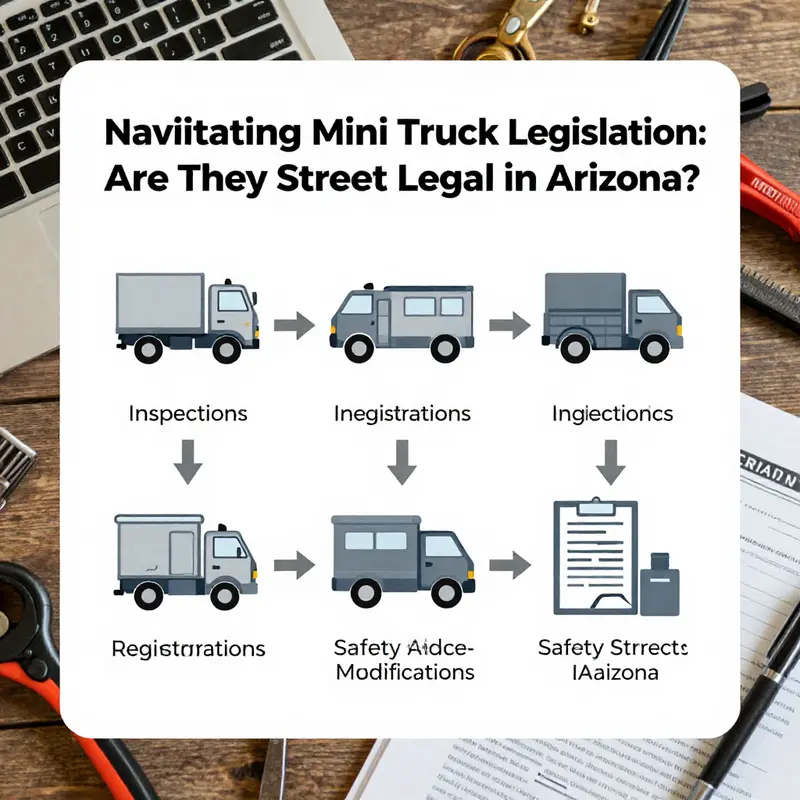
Mini trucks, often adored for their compact size and versatility, have become a popular choice for many enthusiasts, business owners, and DIY hobbyists across Arizona. However, before planning to hit the open road, it’s essential to understand the legal landscape. The path to making a mini truck street legal in Arizona can be complex, but this guide will provide clarity and actionable steps. In the following chapters, we’ll uncover the current legal status of mini trucks, explore the safety regulations that impact their street legality, compare them to small vehicles outside of Arizona, and outline the necessary steps to ensure compliance. With this knowledge in hand, you can enjoy your mini truck adventures while staying on the right side of the law.
Crossing the Line: Navigating Arizona’s Legal Landscape for Mini Trucks
If you have ever wondered whether a tiny, boxy pickup you see perched on a sunlit Phoenix street can legally share the road with full-sized vehicles, you are not alone. The question of whether mini trucks—compact, low-profile pickups that resemble the popular Kei trucks from abroad—are street legal in Arizona touches a practical boundary between enthusiast curiosity and formal compliance. The short answer is nuanced: these diminutive workhorses can operate on public roads in Arizona, but only after they meet a mesh of state and federal requirements. The larger truth is that Arizona does not issue a blanket legalization for all mini trucks. Instead, it enforces a framework that aggregates safety, emissions, and vehicle-specific conformity. In practice, the legality hinges on whether a particular vehicle, in its current form and configuration, can be certified, titled, registered, insured, and operated without violating the core standards set by state regulators and federal safety authorities. This is not merely a matter of appearance or local ordinance; it is a question of whether a vehicle can be shown to meet the same on-road reliability and environmental benchmarks that every other road-going vehicle must meet, regardless of size or origin. To understand this fully, one must tether the discussion to the broader regulatory ecosystem that governs motor vehicles at the federal and state levels while staying mindful of Arizona’s specific implementation through the Arizona Department of Transportation (ADOT) and the Motor Vehicle Division (MVD). The result is a landscape that rewards careful scrutiny and formal processes over improvisation and shortcut. The path to legality begins with the fundamentals: does the vehicle meet the safety and emissions requirements that apply to any motor vehicle intended for highway use, and is it properly registered and titled through the MVD so that a license plate can be issued and insurance can be secured for road operation? These questions sit at the core of what makes a mini truck a permissible traveler on Arizona’s roads rather than an off-road curiosity that happens to be parked outside a storefront or tucked into a farm gate. The state’s expectation is straightforward in concept, though the practical application can require precise documentation and, in some cases, a formal modification program. The vehicle must be equipped with the essential safety elements that Arizona insists on for front-row passengers and other road users alike. That means functional seat belts for all seating positions, properly aligned headlights and taillights that illuminate at the right times and with appropriate intensity, reliable brake lights, turn signals, and adequately positioned mirrors. Beyond the lighting and visibility package, the vehicle must meet safety standards for occupant protection, crashworthiness where applicable, and stability features that are consistent with what the state considers reasonable for traffic scenarios ranging from urban corridors to rural highways. Emissions compliance is another pillar of legality. Arizona follows federal emissions standards, as administered by agencies like the U.S. Environmental Protection Agency (EPA). A vehicle that arrives in the state with a clean bill of emissions across applicable tests and documentation is more likely to pass muster than one that ships in without a verifiable emissions profile. When a Japanese- or foreign-made mini truck does not originally come with these attributes, owners face a decision point: modify the vehicle to meet standards, or abandon the attempt to register it for general road use. This is not a hurdle that can be cleared by minor tweaks alone. The regulatory lens requires a holistic view of how the vehicle was manufactured and whether those manufacturing choices align with U.S. safety and environmental expectations. The on-paper requirements are only part of the picture. Arizona, like many states, does not have a one-size-fits-all decree that says, “All mini trucks are illegal.” Instead, it uses a combination of federal benchmarks and state-level vehicle codes to determine eligibility for street use. In practical terms, a vehicle must be classifiable as a passenger vehicle or a light-duty truck and must be able to demonstrate highway-worthiness through its components, construction, and performance. Some readers may wonder whether there is a parallel universe where mini dune buggies, micro-trucks, or purpose-built, street-legal variants ride the same lanes as full-size pickups. Indeed, there exists a category of smaller, road-legal utility vehicles that can be operated if they are properly registered and meet safety criteria. These are typically custom-built or heavily modified to satisfy inspection regimes and regulatory checks, and they are not simply any small, imported chassis that happens to look right. The difference is that the latter are accepted into the regulatory fold only after a formal process: a comprehensive inspection, a verified title, a valid VIN, and the correct registration status with the MVD. The unmodified mini truck that arrives from abroad—unprepared to show compliance with U.S. safety and emissions requirements—generally cannot be registered for public-road use in Arizona. This is not merely a preference or a matter of local policy; it is the legal framework that governs vehicle street-ability across the state. If you are considering a miniature pickup for daily driving, a prudent first step is to contact the Arizona MVD or a licensed dealer who can verify whether the exact model year and configuration can be registered. The MVD can confirm whether the necessary documentation, inspections, and potential modifications are feasible under current regulations. In this respect, the process is less about identity of the vehicle’s era and more about the vehicle meeting the standards of a modern, federally aligned highway vehicle. A good starting step for any prospective owner is to verify the VIN and model year against the current federal and state registration requirements. This is important because vehicles produced after a certain date may be subject to revised safety and production consistency requirements that could complicate or even block registration if those standards are not met. The need to verify is underscored by the evolving nature of safety standards and the advent of updated guidelines at the federal level. The landscape became more complex in recent years as safety regulators tightened definitions of acceptable materials in cargo areas, structural integrity, and seating configurations. In the United States, agencies involved in these standards are known for updating rules in ways that ripple across vehicle design and the way cars and trucks are certified for use on public roads. The concept that a vehicle must align with a designated set of safety specifications and production-consistency rules means that, even if a mini truck appears to be in good shape and seems roadworthy, it might still fail to receive the required approvals if it does not meet these updated criteria. In an era of heightened scrutiny of light-duty trucks, the debate often moves beyond mere ride height and wheel size to deeper questions of safety architecture and occupant protection. The regulatory narrative around small pickups emphasizes that recent rulemaking has targeted not only the presence of basic safety equipment but also more granular disclosures about cargo areas and seating arrangements. In some interpretations, this aligns with an international trend toward more complete, explicit reporting on vehicle features to prevent misrepresentation about what a vehicle can safely carry and how its occupants are secured. While this may appear distant from the day-to-day experience of driving a tiny truck up a desert grade, it matters when a vehicle crosses the threshold into legality. The practical takeaway for readers is clear: the legality of a mini truck in Arizona is not a matter of charm or novelty. It is a matter of verifying compliance with current federal and state standards, ensuring proper documentation, and completing any required modifications or inspections so that the vehicle can be legally titled and registered for highway use. This is the moment where enthusiasts value patience over impulse, because the road is not a testing ground for curiosity; it is a regulated space where safety and responsibility must come first. For a broader sense of how the mini truck phenomenon fits into the wider scene—beyond the legal checklist and into the culture of customization and road-use ethics—many readers turn to community resources and blogs that discuss the hobby and its practical implications. If you are curious about the community and its ongoing conversations, you can explore the Minitrucks CaLa blog for perspectives, builds, and discussions that illuminate the lived reality of owning and operating these compact vehicles. Minitrucks CaLa blog. Beyond personal curiosity, the legal pathway remains intact: consult the Arizona MVD for official guidance, particularly regarding vehicle registration, titling, and the status of any single model with a unique history. The MVD’s vehicle registration and titling information is essential for anyone who wants to bring such a vehicle into compliance and into everyday traffic. The official framework emphasizes that, in Arizona, compliance is not a cosmetic matter but a regulatory requirement that must be documented and validated through the proper channels. While the culture around mini trucks includes creative customization and practical adaptations, these pursuits must be reconciled with the safety, labeling, and emissions conventions that are part of the modern transportation system. The regulatory narrative is thus one of alignment rather than exception. For those who encounter a model that appears to meet the aesthetic of a road-true mini truck but lacks the necessary documentation, the prudent course is to pause and verify rather than assume. The formal steps involve confirming the vehicle’s compliance with EU, U.S., or other recognized safety standards where applicable, ensuring that a compliant emissions profile exists, and pursuing a compliant title and registration through the MVD. If a vehicle cannot be shown to meet these standards—if it cannot be properly titled or does not have the necessary safety equipment—it should not be operated on public streets. The consequences for noncompliance range from fines to impoundment, and in some cases, the vehicle may be restricted from operation until it is brought into compliance. As federal and state standards continue to evolve—driven by research, testing, and new safety data—the legal status of mini trucks in Arizona remains dynamic. The best approach for any prospective owner is to treat the process as a careful, methodical project rather than a quick purchase. This means engaging with the MVD early, being prepared to present documentation that demonstrates compliance, and understanding that the vehicle’s current configuration may require modifications or even a staged registration plan. It also means recognizing the limits of the buying experience. A vehicle without a verifiable compliance history may be perfectly serviceable, but it will face significant hurdles if it cannot be demonstrated to meet the required safety and emissions standards. The topic is not merely about documentation; it is about ensuring a vehicle that shares the road with others does not undermine safety norms or environmental responsibilities. In this sense, Arizona’s approach aims to balance the enthusiasm for compact, efficient transportation with a solid commitment to public safety. The state recognizes that small trucks can offer practical benefits—maneuverability in tight spaces, lower center of gravity, and potentially better fuel economy—yet all these advantages must be pursued within a lawful framework that guarantees roadworthiness and accountability. For readers who are weighing options, the pathway forward is clear: identify a mini truck that has been—or can be—brought into compliance, initiate the registration and titling process with the MVD, secure appropriate insurance, and operate within the boundaries set by the state. It is a disciplined approach that protects the owner, other road users, and the broader community while preserving the utility and charm that mini trucks bring to the landscape. And while the content here draws on a variety of regulatory considerations and recent developments—such as the broader federal emphasis on safety reporting and production consistency—there is no substitute for direct confirmation from official sources. The Arizona MVD’s guidance, along with professional dealership advice, remains the most reliable compass for anyone navigating this terrain. For definitive guidance, always consult the Arizona Motor Vehicle Division (MVD) or visit a local DMV office to verify whether a specific model qualifies for registration. Official guidance can be found at the Arizona MVD site: https://www.azmvd.gov/.
Between Compact Utility and Public Road Provenance: How Arizona’s Safety Rules Define Street-Legal Mini Trucks
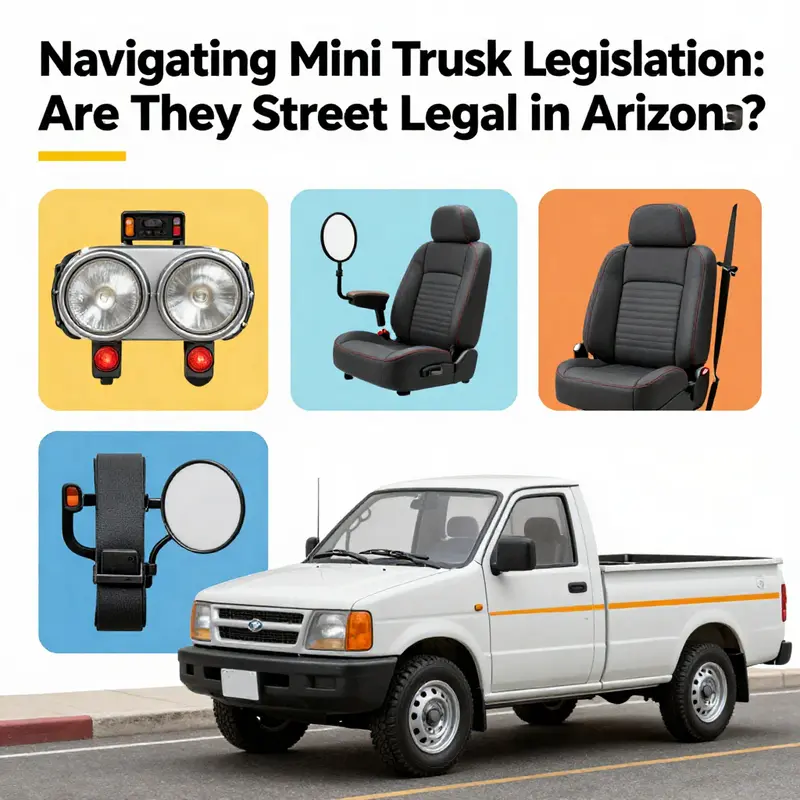
In a landscape where small, nimble pickups have carved out a niche for practical daily use and weekend adventure, Arizona sits at a crossroads. Mini trucks, often modeled after compact Kei-style designs, evoke both utility and novelty. The question, however, is not about capability but about legality: can these miniature workhorses share the same roads as larger, purpose-built pickups? The answer hinges on a careful reading of state rules that govern what it means for a vehicle to be street-legal. In Arizona, the street-legal status of these mini trucks is not automatic or universal. It is earned through compliance with a chain of requirements set by the Arizona Department of Transportation (ADOT) and the Motor Vehicle Division (MVD). These agencies reflect a broader framework designed to ensure that any vehicle operating on public roadways meets safety norms, emissions standards, and proper documentation. What feels like a simple vehicle choice soon reveals layers of regulatory nuance that can transform a tiny vehicle from a curiosity into a compliant, road-ready asset—or into a tollable, unregistered risk on highways, streets, and neighborhoods alike.
The first layer to understand is classification. In practice, many mini trucks resemble small pickup-style machines but are often categorized differently from standard passenger vehicles or conventional light-duty pickups. Some models can be grouped with off-highway vehicles (OHVs) or utility task vehicles (UTVs) that are designed for controlled environments rather than full highway use. This classification matters because it informs which standards apply. When a vehicle is designated as an OHV, it generally faces restrictions about where it can operate. For public road use, those same OHVs must be altered to meet highway-safety and emissions requirements, a process that typically includes structural modifications and a formal inspection. Arizona’s regulators look at a vehicle’s design, safety equipment, and intended use as signals of whether it should be street-legal. They also consider whether the vehicle has a title, a valid registration, and liability insurance—elements that legally tether a vehicle to the road network and the financial responsibility that comes with it.
To truly ride on Arizona streets, a mini truck must satisfy a battery of criteria. It needs proper lighting—headlights that perform in all weather, brake lights that indicate deceleration, turn signals that communicate intent to other drivers, and mirrors that provide adequate rear visibility. It must have seat belts for all occupants and matching safety equipment that aligns with federal and state expectations. Emissions standards cannot be bypassed either. Depending on the vehicle’s age and the area in which it operates, the state may require emissions testing or proof that the vehicle’s exhaust system minimizes pollutants to acceptable levels. These checks are not decorative; they are enforcement-ready. Vehicles that fail to meet these criteria risk being deemed illegal for street use and may be subject to towing, fines, or impoundment if found operating on public roadways.
Beyond safety and emissions, the practical aspects of registration form a dense but navigable path. Arizona requires that street-legal vehicles carry a valid title and license plate, be insured, and be registered with the MVD. The documentation is not merely bureaucratic paperwork; it is the public acknowledgment that the vehicle is an authorized participant in the state’s traffic system. For mini trucks imported or assembled from components sourced outside the United States, the question is usually whether those components can be reconciled with Arizona’s road-legal framework. Importers and owners often encounter a mismatch between a vehicle’s original design intent and the regulatory expectations of U.S. roadways. A car that rolls off a factory line in another country with a different suite of safety features may lack essential elements required by Arizona’s standards. In many cases, this gap means that without modifications—and sometimes without professional engineering oversight—the vehicle cannot be registered for street use.
The story does not end with a firm rule that “no mini truck can ever be street-legal in Arizona.” There are pathways to legal operation for select vehicles. Some mini trucks, when thoroughly modified to meet highway-safety standards, can become legally operable on public roads. The key is certification for highway use, a set of safety features, and a formal registration with a valid title and license plate through the AZ MVD. In practical terms, this often involves transforming an OHV-leaning design into something that resembles a highway-ready vehicle in terms of structure and safety equipment. It may include reinforcing the frame, upgrading the lighting and signaling to DOT-compliant levels, ensuring a full complement of seat belts, and installing an appropriate emissions-control system. In some cases, a modular or custom-built small vehicle that is specifically certified for highway operation can qualify. The path is not universal and is rarely a simple plug-and-play; it typically requires involvement from qualified mechanics, possibly aftermarket vendors who specialize in highway-legal conversions, and the blessing of the MVD after a thorough inspection.
The practical reality, however, is that the majority of imported mini trucks do not arrive in Arizona “ready to register.” They arrive with configurations built for different regulatory contexts and markets, where the set of required safety equipment and the aggressiveness of emissions controls differ from those mandated on Arizona roads. This mismatch can include differences as basic as lighting configurations, mirror placement, or seat belt standards, and it can extend to the presence or absence of certain safety features that are assumed in the American market. In many instances, to meet Arizona requirements, owners must pursue substantial alterations to the vehicle’s hardware and, occasionally, to its software or calibration of engine management systems to align with emissions rules.
Enforcement plays a non-symbolic role in this landscape. Law enforcement and traffic-violation authorities in Arizona are tasked with verifying that vehicles on public roadways meet the state’s regulations. When a mini truck is identified as non-compliant, the consequences can range from a stop-and-interact citation to a full stop of the vehicle’s operation on public roads. In the most stringent scenarios, a non-compliant vehicle can be removed from service and must return to a compliant state before it can resume operation. The risk is not merely financial; it is about public safety. Arizona’s focus on consistent safety standards reflects a common national approach: keeping traffic streams predictable and reducing risk by ensuring that every vehicle on the road adheres to a baseline of protective features.
Given the complexity of classification, conversion, and compliance, it is wise to treat the process as a structured project rather than a casual modification. The first step is always to seek official guidance. The Arizona MVD and the ADOT provide the primary channels for information about eligibility, required equipment, and the steps to obtain a title, registration, and plate. Because regulations evolve and region-specific requirements can shift with changes in emissions testing or highway safety standards, consulting the official resources is essential. In practice, this means checking the MVD’s online resources and, when necessary, visiting a local DMV office to confirm the exact path for a particular model and its intended use. The decision to pursue street-legal status for a mini truck in Arizona is best framed as a regulated journey rather than a speculative gamble.
For individuals who want a deeper model-specific understanding, there are community discussions and detailed model comparisons that shed light on how different designs align with Arizona’s rules. These discussions often explore how various mini trucks handle safety equipment, weight distribution, and electrical systems in the context of road-legal requirements. They provide practical clues about what kinds of modifications tend to withstand the scrutiny of inspection and what trade-offs are commonly encountered in the registration process. For readers who want a model-focused lens, a comprehensive comparison that highlights safety features and compliance trade-offs can offer helpful context. For an example of such a model-oriented discussion, see the comparison on a popular mini-truck information site: comparing Kingstar KruZR models specs features.
The arc from unaffixed curiosity to registered street-legal status is a negotiation with safety standards, not a negotiation of personality. The state’s rules call for a cohesive upgrade path: if a mini truck is intended for highway travel, it must be equipped with the same foundational protections many motorists take for granted in larger vehicles. From a practical perspective, this means that owners must be prepared to invest in quality components and to work with professionals who understand Arizona’s testing and inspection regime. The idea is not to diminish the appeal of these compact vehicles but to ensure that the road they share remains safe for everyone. The careful balance between affordability, practicality, and compliance is where the reality of street-legal mini trucks in Arizona takes shape. Owners who approach the process with diligence and a willingness to align their vehicles with the state’s standards are often rewarded with a vehicle that retains its compact character while gaining the legitimacy and reliability that an on-road designation requires.
In the end, the journey toward street legality in Arizona is an exercise in due diligence and design alignment. It demands that a vehicle’s core safety features, emissions profile, and documentation align with the expectations set forth by the ADOT and MVD. It also invites a broader awareness of how regulations affect vehicle choices and ownership experiences. For some, the route will lead to a fully compliant, highway-ready mini truck that performs capably on urban streets and rural routes alike. For others, the path may reaffirm that a mini-truck on dirt trails or private property is a better fit than a vehicle destined for public roads. Either outcome reflects a state that prioritizes road safety and regulatory clarity, even as enthusiasts appreciate the charm and utility that compact vehicles can offer.
As this chapter connects to the broader arc of the article, it is important to reiterate the practical takeaway: street legality in Arizona hinges on meeting specific safety, emissions, and documentation requirements that may require significant modification to a mini truck’s original configuration. The process is not guaranteed by the vehicle’s size or market of origin. It is earned through a combination of compliance, inspection, and proper registration, and it often benefits from professional guidance. When in doubt, the safer course is to rely on the MVD as the authoritative source and to approach any conversion with a plan that prioritizes safety and integrity over speed or minimal compliance. The landscape is dynamic, and official guidance can shift with changes in technology and environmental standards. By staying informed and engaging with the right specialists, owners can navigate the road-legal terrain and determine whether a given mini truck can be part of Arizona’s roadways—or if its future belongs to off-road or private-use drives.
For readers seeking a practical, model-focused perspective on how different mini trucks handle safety and compliance, the comparison linked above can offer useful context and illustrate how some designs approach regulatory requirements. And for ongoing, authoritative guidance, the official Arizona MVD site remains the primary reference point. official Arizona MVD site
Small Wheels, Big Road Rules: Navigating Arizona’s Path to Street-Legal Mini Trucks
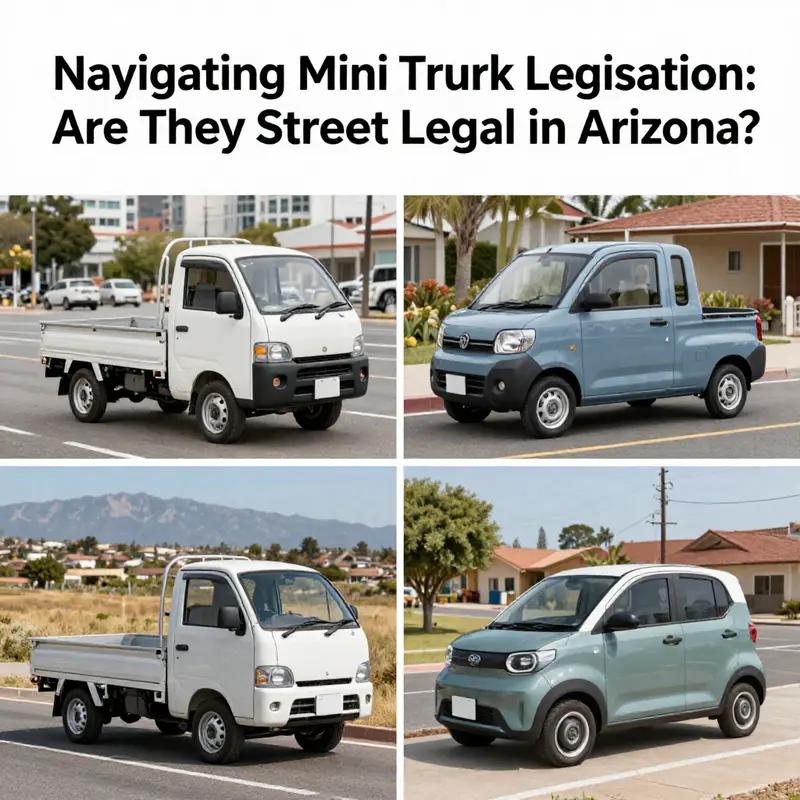
Mini trucks have long captured the imagination of drivers who crave practical, compact vehicles capable of light-duty work and easy maneuvering in tight spaces. But in Arizona, the road is not a free-for-all for every tiny pick-up with a bed. The state treats these small trucks with the same responsibility it applies to any other vehicle that shares public lanes, and that means a careful, standards-driven journey from import to registration. The question of whether a mini truck can legally share Arizona’s highways, therefore, is less about aesthetics and more about compliance with a structured engine of rules. In practice, most Kei-style mini trucks imported from overseas arrive with very different regulatory assumptions than those that govern highway operation in the United States. They often come stripped of the safety features, lighting configurations, emissions controls, and documentation that Arizona mandates for vehicles using public roads. This is not merely a bureaucratic hurdle; it is a matter of safety, accountability, and the shared obligation to ensure that every vehicle on the street can respond predictably in emergencies, at speed, and in a way that is trackable by authorities and insurers alike. The road rules in Arizona are designed to ensure that any vehicle moving along with other traffic can be expected to perform to a baseline standard—an expectation that sometimes sits uncomfortably with the minimalist design philosophy of small, lightweight trucks. Yet the possibility of turning a mini truck into a road-legal machine exists, provided the vehicle is properly modified, inspected, titled, and registered through the Arizona Motor Vehicle Division (MVD) under the guidance of ADOT. In other words, the journey from “toy-like convenience” to “highway-usable utility” requires more than a simple legality by virtue of origin or intention; it requires a formal pathway that aligns the vehicle with state standards for safety, emissions, and roadworthiness. The precise steps can feel abstract at first, but they map onto the same framework that governs all street-legal vehicles: a well-documented chain of compliance that connects the vehicle’s capabilities to the public safety expectations that AZ law enshrines. For readers who are curious about the practical implications and who want a baseline picture before exploring possibilities, this dynamic is the hinge on which many conversations about mini trucks in the desert hinge. The key is to understand that, in Arizona, street-legal status is not automatic; it is earned through a process that confirms the vehicle’s readiness for public operation, not merely its novelty or compact size. To help ground this chapter in concrete terms, consider a general rule of thumb: if a mini truck does not meet the state’s safety equipment and emission standards, it cannot legally travel on public roads until it is properly altered and validated through the MVD. This understanding aligns with the broader pattern in many jurisdictions that seek to balance the benefits of small, efficient transport with the shared duty to maintain a safe, orderly traffic system. Recognizing this balance is also why the Arizona approach often invites careful, stepwise modification rather than a wholesale exemption. It is helpful to keep in mind that while standard mini trucks are typically not street-legal in their off-the-lot configuration, there exists a pathway through which a vehicle can be transformed into a compliant for-road machine. This is a critical distinction that shapes expectations for buyers, hobbyists, and commercial operators alike. Importantly, the path is not a shortcut; it is a formal process that requires thorough documentation, verification of safety features, and proof of emissions compliance. For those who want a baseline sense of where to begin, the MVD and ADOT offer official guidance, and local vehicle inspectors are often invaluable allies in translating regulatory language into practical changes that can pass inspection. Within this regulatory frame, there is also room for nuance. Arizona does recognize the existence of specialized, legally compliant vehicles designed for highway use when they meet stringent requirements. These are not simply “street-legal by title”; they are purpose-built or carefully converted machines that have undergone rigorous testing, certification, and inspection. In many cases, this means a vehicle must be certified for highway use, fitted with the standard safety features expected of any road-proven vehicle, and then registered with a valid title and license plate. The result is a vehicle that can be legally driven in Arizona, furnished with seat belts, appropriate lighting, mirrors, and other required safety equipment, and able to meet ongoing emissions standards. The door to that possibility remains narrow, however. The reality is that many imported mini trucks, with their light chassis, limited crash structure, and market-specific emission regimes, do not automatically satisfy a U.S. or Arizona certification. They may not carry the necessary safety equipment—such as compliant headlights, brake lights, turn signals, and properly positioned mirrors—and they may lack emissions control technologies recognized by U.S. regulators. In the eyes of ADOT and the MVD, this is not a moral judgment about the value of these vehicles but a practical assessment of risk, accountability, and the ability to verify compliance. The practical next step for anyone considering turning a mini truck into a street-legal AZ vehicle is to anticipate a modification and registration project, not a simple purchase. The modification pathway can involve upgrading or reinstalling critical safety components, installing a compliant lighting system, and integrating an emissions control solution that aligns with federal and state expectations. It may also mean reconfiguring interiors to ensure occupant safety with seat belts, appropriate seating arrangements, and crashworthy design features. The exact modifications depend on the vehicle and the end-use plan, but the underlying principle is consistent: the vehicle must be demonstrably safe, demonstrably compliant, and demonstrably traceable in terms of ownership, insurance, and taxation. Alongside the mechanical and regulatory changes, Arizona’s registration process demands formal documentation. Prospective owners must navigate the titles, VIN verification, and registration workflow through the MVD. They must show proof of ownership, provide a title or proof of import, and present documentation that the vehicle meets the state’s safety and emissions standards. They may also be required to secure insurance that mirrors the vehicle’s use and risk profile. The process culminates in an inspection that verifies compliance in practice, not just on paper. It is this practical, document-backed validation that transforms a privately owned mini truck from a curiosity into a highway-ready asset. Such a journey can be lengthy, and it invites a candid assessment of whether the end use justifies the investment of time, resources, and compliance costs. The micro-mobility landscape outside Arizona offers a broader frame for understanding why these conversations matter. In many major urban areas, the deployment of compact, efficient vehicles—whether for personal mobility, small-scale cargo, or last-mile delivery—has accelerated in response to congestion, parking constraints, and emissions goals. These regions have embraced a mix of regulatory pathways, infrastructure investments, and incentive structures that support safe operation while maintaining performance standards. The regional variation is telling: some places lean toward enabling smaller vehicles with streamlined inspection regimes, while others insist on rigorous conformity checks before any road use. The Deloitte Insights perspective on micromobility and urban transportation helps situate Arizona within this global shift. The commentary underscores how cities are experimenting with micro-vehicles as part of a wider strategy to ease congestion and reduce emissions, while simultaneously addressing safety and regulatory concerns. The arc is not about abandoning standards; it is about aligning them with evolving mobility needs, and Arizona’s framework for mini trucks reflects that ongoing tension. For readers who want a touchstone beyond regulatory texts, the broader narrative of micromobility aligns with what many Arizona enthusiasts experience on the ground: a strong appetite for compact, versatile vehicles paired with a sober recognition that road use comes with a corresponding set of responsibilities. The practical takeaways for someone contemplating a street-legal mini truck in Arizona are straightforward, though not trivial. First, it is essential to approach the project as a compliance program rather than a hobby project. Second, expect to engage with both the MVD and a qualified vehicle inspector early in the process to determine which safety and emissions upgrades will be necessary. Third, prepare for documentation that traces the vehicle’s history, modifications, and compliance steps, because the state requires a verifiable chain of custody for roadworthy status. Finally, remember that not every mini truck will qualify for highway use, even with extensive modifications. Some configurations simply do not meet the baseline structural or regulatory thresholds, and in those cases, the vehicle is best kept for off-road use or as a specialty utility unit that remains within private property or controlled environments. The more informed the buyer, the more realistic the expectation about timelines, costs, and the likelihood of success. For readers seeking practical context on the ownership and modification journey, the gradual evolution of these vehicles in the market is frequently discussed in online communities and specialist outlets. A useful reference point is the Minitrucks Cali blog, which documents experiences, examples, and practical considerations that come with owning and customizing compact utility vehicles. See Minitrucks Cali blog for a sense of real-world perspectives, while keeping in mind that every vehicle’s regulatory pathway remains uniquely tied to its condition and intended use. In the bigger picture, Arizona stands at a crossroads where curiosity about tiny payloads meets the heavy responsibility of road safety. The global shift toward smaller, more efficient urban transport continues to push jurisdictions to refine how they evaluate, certify, and integrate these vehicles into public life. While Arizona’s rules are explicit and sometimes exacting, they are also part of a broader conversation about mobility, accessibility, and the way cities balance innovation with accountability. The result is a landscape in which a mini truck can, under the right conditions, become a legitimate street-legal vehicle, but only after it passes through a well-defined gatekeeping process. For anyone who has been tempted by the compact charm of these workhorses, the message is clear: do not assume street-legal status by origin or intention. Respect the process, prepare for the compliance journey, and engage with the right professionals who understand both the mechanical specifics and the regulatory yardstick. The road, in other words, is negotiable, but it is not default. As the urban mobility narrative continues to unfold, Arizona’s particular stance on mini trucks offers a vivid example of how local regulation interacts with global trends in micromobility. The story is ongoing, and the outcome at the intersection of engineering, law, and practical use will continue to evolve as technology and policy adapt to new transportation needs. External resources and ongoing analyses, such as the Deloitte insights on micromobility and urban transportation, help place Arizona’s experience in a wider context and remind readers that the journey toward street-legal micro-vehicles is both regulatory and cultural, requiring careful attention to standards, documentation, and the evolving priorities of cities and citizens alike. External reference: https://www2.deloitte.com/insights/us/en/industry/technology/micromobility-future-of-urban-transportation.html
null
null
Final thoughts
Understanding the intricacies of mini truck legislation in Arizona can feel overwhelming, but it’s absolutely manageable with the right information. By grasping the legal implications, safety requirements, and the necessary steps to ensure compliance, you can enjoy driving your mini truck without fear of legal repercussions. Whether you’re a business owner needing a compact utility vehicle or a hobbyist eager to take your mini truck on new adventures, being informed is the key to success. Embrace the adventure with knowledge and let the roadways be your canvas for exploration!