

Owning a mini truck in Kentucky can be a dream come true, especially for local small business owners and enthusiasts seeking to enhance mobility and utility. However, with ambition comes responsibility, particularly when it comes to understanding the legal landscape surrounding these compact vehicles. This article delves into the necessary compliance requirements, vital modifications needed for legality, and the nuances of Kentucky’s regulatory stance on mini trucks. By the end, you will have a clear roadmap to ensure your vehicle meets all necessary standards, allowing you to hit the road with confidence and legal assurance.
Making a Mini Truck Roadworthy in Kentucky: Practical Compliance Steps and Requirements
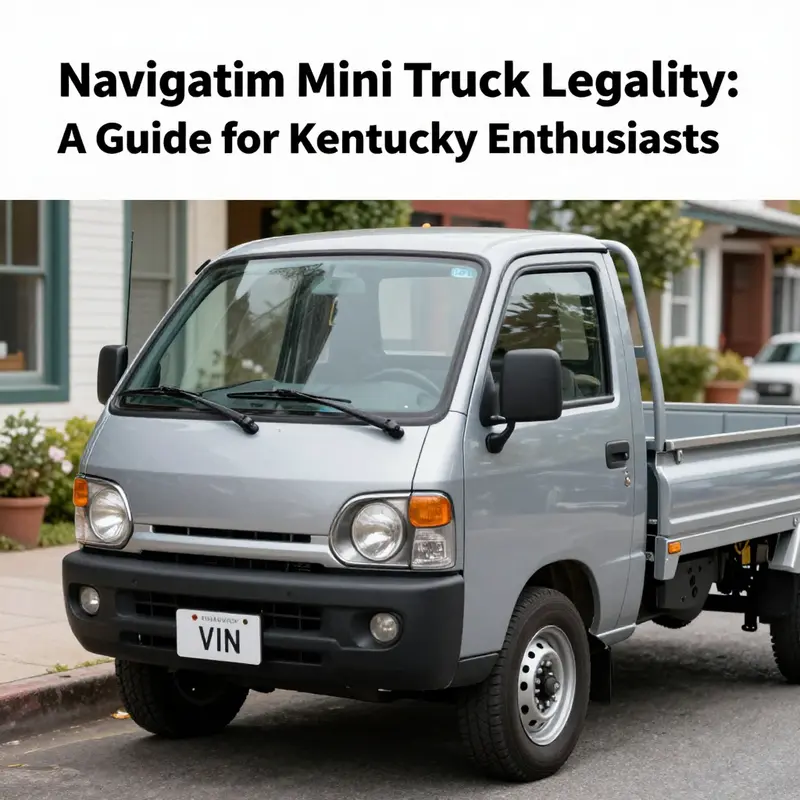
Understanding Kentucky’s Compliance Pathway
Driving a mini truck on Kentucky roads is possible, but it requires careful alignment with both federal standards and state requirements. Whether you own a compact work truck designed overseas or a small utility vehicle assembled domestically, the same fundamentals apply: the vehicle must be registered, inspected, and equipped to meet safety and emissions expectations. This chapter walks through those real-world steps and the specific items inspectors look for. It also explains the documentation you must present, common modifications that bring older or imported units up to standard, and practical tips to reduce delays and unexpected costs.
The first legal checkpoint is registration. Kentucky treats mini trucks as motor vehicles for public road use. That means you must register the vehicle with the Kentucky Transportation Cabinet and secure valid license plates before you drive it on public roads. Registration is not a mere formality; it confirms the vehicle’s identity, ownership, and declared status. For an imported mini truck, a clear title and a Vehicle Identification Number, or VIN, are essential. If the truck arrived without a VIN or with an old identification method, you must have a VIN assigned and documented by the proper authorities before the registration process can continue.
Closely tied to registration is the proof of identity and ownership. Bring the bill of sale, the foreign title or export documents if applicable, and any paperwork that shows the chain of custody from seller to you. When a vehicle is imported, customs forms and the import declaration can also be required. If the truck was previously registered in another U.S. state, surrendering the out-of-state title or providing a proper release will help the Kentucky office complete the transfer. Keep copies of everything; inspectors and clerks often ask for multiple documents during inspection, emissions checks, and registration.
A vehicle that will be licensed for road use must meet a set of safety items that are straightforward yet strict. Inspectors look for properly working lighting, including headlights, high beams, taillights, brake lights, reverse lights where applicable, and turn indicators. Reflectors and side markers must be present when required by size and design. Mirrors must provide the driver with adequate rearward visibility; most mini trucks need both side mirrors and an interior mirror, unless the vehicle’s design makes an internal mirror impractical.
Braking systems are non-negotiable. Every vehicle driven on public roads must have brakes that respond reliably and meet state standards. That includes both the primary braking system and emergency backups. Inspectors will check pedal feel, stopping performance during an on-road test when required, and visible condition of brake lines and components. Brake lights must illuminate whenever the system is engaged. If the truck uses drum brakes, expect an assessment of lining condition and operation. For newer models or modified systems, certification or professional inspection documentation can be useful.
Tires must be roadworthy. DOT-approved tires are expected for highway use. Inspectors check for tread depth, sidewall integrity, and proper load ratings. Mini trucks often use smaller wheels; ensure replacements meet DOT specifications and are sized correctly for the vehicle’s axle and load capacity. Using off-road or agricultural-only tires can create compliance problems if they lack DOT approval.
Seat belts and occupant protection are central to safety compliance. Any seating position intended for use on public roads should have appropriate restraint systems. If the vehicle’s original configuration lacks modern seat belts, many owners must retrofit lap or lap-shoulder belts to meet state requirements. Retrofitting should be performed by a qualified technician who can certify anchor points and proper installation. Airbags are a federal requirement on many passenger vehicles, but mini trucks that began life as farm or off-road machines may fall into different regulatory categories. Still, seat materials, secure mounting, and restraint belts are routinely inspected.
Lighting, braking, mirrors, tires, and belts address the immediate physical safety checklist. Kentucky also enforces emissions standards. The state requires that vehicles comply with applicable pollution-control rules. Depending on the county of registration, an emissions test may be required. Some mini trucks, particularly older imports, need upgrades to meet these rules. That might mean installing a catalytic converter, rebuilding or replacing an older carburetor system, or adding an onboard diagnostic system compatible with current testing equipment. Bringing an older engine into compliance can be one of the more costly steps, but it’s frequently unavoidable for registration.
Import and conversion work often center on a few common fixes. Headlights that produce insufficient output are usually replaced with DOT-compliant units. Turn signals and brake lights may need rewiring or replacement to meet brightness and placement standards. Mirrors can be swapped to reach regulatory size and field-of-view requirements. If a mini truck is governed to a very low top speed, removing or modifying the governor to allow safe merging and highway speeds can be necessary, but any performance changes should be documented and inspected for safety implications. Suspension and steering components must be robust enough for road speeds and loads, so upgrades are common when small utility vehicles are pressed into regular street use.
A VIN is more than an identification tag; it is a compliance gateway. Vehicles built or sold overseas sometimes either lack a VIN or carry a manufacturer code that the National Highway Traffic Safety Administration (NHTSA) does not recognize for U.S. registration. In Kentucky, the Transportation Cabinet relies on the VIN to verify manufacturing details, model year, and whether federal safety equipment was installed at the factory. If your truck lacks a VIN or displays an incomplete one, contact the Cabinet for instructions on how to obtain a Kentucky-assigned VIN. This process typically includes a visual inspection by a certified agent, proof of ownership, and payment of administrative fees.
Temporary registration is available in some circumstances. Visitors who bring a mini truck into Kentucky can apply for temporary plates, but they still must satisfy all applicable safety and emissions rules before driving on public roads. Temporary tags are a short-term solution that allows transport or movement to a repair shop or inspection site. They are not a substitute for full registration. Always verify the conditions and length of validity for temporary tags with the Transportation Cabinet.
The inspection and compliance experience varies depending on whether your mini truck is newly imported, previously registered in another state, or manufactured to U.S. standards. A vehicle with a clear U.S. title and a complete FMVSS-compliant build will often sail through registration and inspection. In contrast, an import may require a sequence of fixes and re-inspections. Budget both time and money for this process. Typical costs include inspection fees, registration and plate fees, parts for lighting and emissions upgrades, and labor for retrofits like seat belt installation and VIN assignment. Rarely, structural repairs or extensive engine work may be necessary if the vehicle has been modified or poorly maintained.
To reduce surprises, compile a packet of documentation before you visit a registration office. Include the title or bill of sale, any export/import documentation, customs clearance forms if relevant, receipts for major repairs or retrofits, and any manufacturer or seller specifications that describe the vehicle’s original configuration. If you had work completed to meet standards, ask the shop for written verification. A signed statement from a qualified mechanic or inspector can smooth the process and avoid repeated trips.
Enforcement and penalties are practical realities to consider. Operating a vehicle on public roads without proper registration, functioning safety equipment, or emissions compliance can lead to fines, impoundment, and mandated repairs. For some drivers, a brief daily fine accrues until the vehicle is corrected and legal. In addition, noncompliant vehicles can receive citations that affect insurance coverage. If the vehicle is involved in an accident while not meeting Kentucky’s standards, insurers may deny coverage or reduce payouts. Ensuring compliance protects you legally and financially.
Many owners discover that aligning a mini truck to Kentucky standards opens up options for safe and practical use. A compliant vehicle is easier to insure, resell, and operate across state lines. Some modifications that are required for road legality also improve everyday function. Upgraded lights improve nighttime visibility. Better brakes and tires improve stopping distances and handling. Adding modern emissions controls reduces environmental impact and often improves fuel efficiency. Think of compliance work as an investment in reliability and resale value as much as a regulatory hurdle.
If you need practical examples or community experience, the MiniTrucksSoCal blog offers owner stories and modification guides that cover common conversion tasks. Those accounts can help you estimate costs and anticipate inspection comments. For official, up-to-date rules and procedural steps, consult the Kentucky Transportation Cabinet. Their website provides forms, inspection procedures, and contact information for regional offices when questions arise. Following their guidance reduces delays and clarifies the exact documentation you must bring to each appointment.
Navigating the compliance pathway is mostly about preparation. Confirm the vehicle has a valid VIN, ensure all lighting and safety items are functioning, verify that brakes and tires are in good condition, and address emissions requirements for your registration county. Gather and organize ownership and import documents. If necessary, schedule a professional inspection or retrofit before making your registration appointment. These steps shorten the process and help avoid multiple trips.
When in doubt, contact the Cabinet’s regional office. Clerks and inspectors can advise on VIN assignment, temporary registration rules, and the specific emissions testing requirements for your county. Use their official guidance as the final word. Even when owner communities provide helpful tips, the state’s directives determine lawful operation. With correct paperwork and a compliant vehicle, mini trucks can be an economical, versatile transport solution for Kentucky drivers.
External resource: For official procedures, forms, and contact details, see the Kentucky Transportation Cabinet: https://www.kentucky.gov/department-of-transportation
Internal resource: For hands-on owner perspectives and modification tips, see the MiniTrucksSoCal blog: MiniTrucksSoCal blog
From Kei to Kentucky: Navigating the Road-Ready Path for Mini Trucks in the Bluegrass State
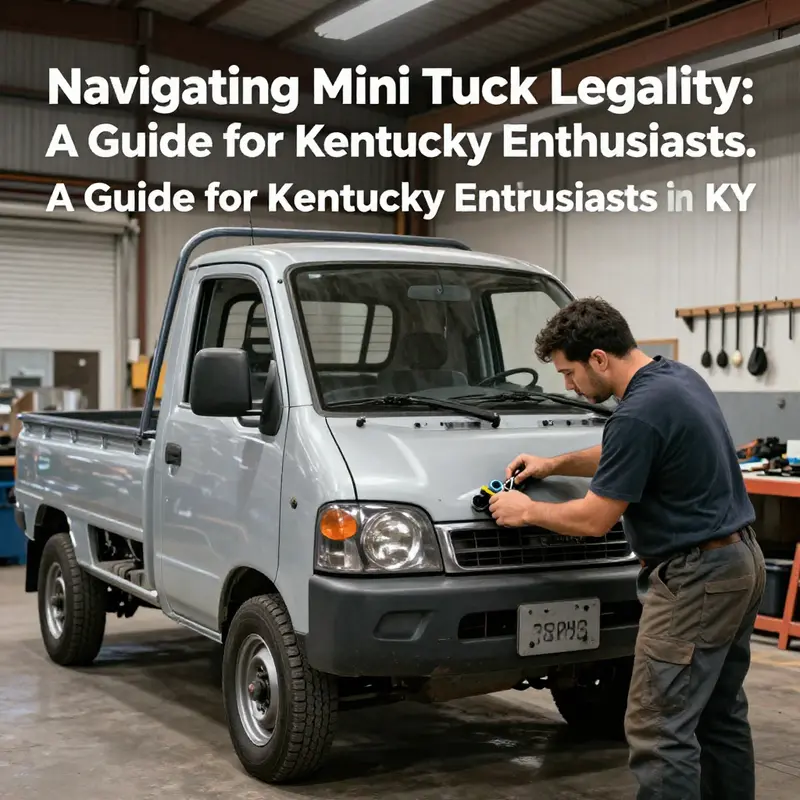
A quiet street in Kentucky can feel like a stage for small, practical workhorses with big personalities. Mini trucks—often nicknamed kei trucks in their country of origin—arrive on U.S. soil with a mix of fans and skeptics. The curiosity is not merely about cuteness or efficiency; it’s about whether these compact machines can join ordinary traffic without inviting complications from the law. The short answer is that street legality in Kentucky hinges on a careful alignment with both federal safety standards and state regulatory procedures. The longer answer reveals a disciplined pathway filled with specific checks, meaningful upgrades, and a procedural rhythm designed to ensure every vehicle that rides on public roads meets predictable safety and environmental requirements. In Kentucky, like many states, legality isn’t a given handout; it’s the result of a documented, inspected, and financially supported process that respects the public’s safety and the integrity of the state’s road network. As you consider bringing a mini truck into the Commonwealth, the story unfolds with a shared premise: the vehicle must perform on the street not just as a curiosity but as a trustworthy tool that can be driven safely in all weather, on all types of roads, and alongside heavier, larger vehicles that share the same asphalt arteries.
Any discussion of street legality starts with the essential framework: federal motor vehicle safety standards, or FMVSS, provide the baseline for most vehicles sold for highway use in the United States. Kentucky does not depart from this framework; it reinforces it through its own processes, inspections, and registrations. A mini truck, regardless of its origin, becomes legal on Kentucky roads only after it demonstrates compliance with the standards that govern visibility, control, emissions, and crashworthiness. A vehicle without a VIN or with undocumented modifications faces a higher barrier; a VIN is not merely a serial code. It’s a certificate that the vehicle has been identified in a manner compatible with state records and with the broader system of law enforcement and vehicle safety administration. This requirement is not symbolic. It ensures a traceable history for every car, truck, or micro-truck that prowls the state’s highways. The journey toward a valid VIN often involves a validation step if the truck is imported or altered in meaningful ways. The Kentucky Department of Vehicle Regulation (DVR) ultimately oversees this process, confirming that the vehicle’s identity aligns with its documented title and registration and that the vehicle’s history can be traced in case of recalls, safety campaigns, or inspections.
Beyond the VIN, the road-legal mini truck must wear its safety features wherever its operator travels. Lighting is the first set of everyday expectations. Headlights that illuminate the road ahead, taillights and brake lights that signal intention to stop or slow, and turn signals that communicate lane changes or turning commands are not decorative; they are essential cues for other drivers. In practice, the requirement means the vehicle’s lighting must be present, functional, and mounted in standard locations where other road users expect to find them. If a headlight is misaligned or a brake light flickers, the inspection will flag the deficiency, and the owner will need to correct it before the vehicle can be certified for street use. Mirrors are another non-negotiable safety feature. A rearview mirror provides a direct line of sight to the activity behind the vehicle, which is vital for safe lane changes and merging. The windshield, too, must meet safety expectations—typically a laminated or tempered glass that resists fractures and holds together during impact. These safety elements are not mere recommendations; they are the baseline expectations that help ensure the mini truck does not become a rolling hazard on crowded roads.
Emissions are the third essential pillar. The Kentucky emissions landscape has evolved to reflect broader environmental goals while accommodating the wide variety of vehicle types that navigate its streets. Older or modified mini trucks may require exhaust system improvements to align with state requirements. Catalytic converters, proper mounting of exhaust components, and prevention of excessive emissions are common topics during the modification and inspection phases. The goal is to reduce atmospheric pollutants to levels that meet state standards, a task that often prompts owners to install or upgrade pollution control devices if they are not already present in the vehicle’s original configuration. The interplay between emissions and performance is delicate. Owners must avoid tradeoffs that weaponize the vehicle’s exhaust toward sheer loudness or performance boosts that drive emissions beyond acceptable limits. Kentucky’s inspectors look for a balance: the vehicle must be roadworthy, emissions compliant, and capable of contributing to the overall air-quality picture rather than undermining it.
Then there are tires and brakes—the practical interfaces between a vehicle and the road. Highway-ride tires with adequate tread depth safeguard against hydroplaning and provide reliable grip in weather that can range from bright sun to sleet and snow. The state’s standards do not tolerate worn, undersized tires or tires rated only for off-road use when a bridge or a busy city street demands confident stopping power. Braking performance must be reliable, with systems that can bring the vehicle to a predictable stop under normal driving conditions. The modern driver expects brake testing as a matter of routine; Kentucky’s process enshrines that expectation, ensuring that a mini truck does not roll away from the curb when a driver momentarily takes their foot off the accelerator until traffic conditions permit. The tire and brake requirements are not abstract; they affect everyday road safety, from merging on busy urban corridors to negotiating rural grades where a quick, controlled stop can be the difference between a smooth stop and a hazardous miscue.
The inspection sequence, a jewel in the DVR’s regulatory crown, stitches these components together. A vehicle that looks the part in a showroom or at a port can fail a road-use evaluation if any link in the safety chain is missing or defective. The safety inspection acts as a final checkpoint that the vehicle can legally operate on public roads. It confirms the presence of a valid VIN, the functionality of lighting and mirrors, the integrity of seat belts, the presence of a safe and intact windshield, and the existence of proper emission controls. It also confirms that the truck’s roadworthiness aligns with Kentucky’s traffic safety expectations. The inspection is not a mere formality; it is an assessment that demands thoroughness. The inspector will verify that the vehicle’s modifications—if any were necessary to bring it into compliance—were performed in a manner that preserves or enhances structural integrity and occupant protection. This is particularly relevant for older or highly customized mini trucks, where modifications can range from simple upgrades to cosmetic changes that do not address safety deficiencies.
For many people, the path to legality begins with a conversation with the DVR or a trusted inspection facility. While the core requirements are stable, the specifics can vary based on the vehicle’s origin, its current condition, and the extent of any modifications performed to adapt it to U.S. road use. Kei trucks, with their compact frames and efficient designs, have carved out a niche in the U.S. market precisely because they are economical and maneuverable. Yet their compactness also means that integrating them into the standard road-use ecosystem demands thoughtful adjustments. Importantly, Kentucky does not reject these vehicles outright; it simply requires them to demonstrate compliance with a clear set of criteria and to pass the mandatory safety checks. This approach aims to preserve road safety while allowing individuals to use what they consider a practical, economical tool for light-duty tasks or urban commuting.
The practical reality of converting a kei truck into a street-legal vehicle, then, is a story of balance. Some owners confront the challenge of removing a speed governor or upgrading specialist components that the U.S. market expects by default. Others focus on upgrading lighting arrangements to ensure adherence to mounting heights and visibility standards. Still others address the emissions question by ensuring the exhaust system and catalytic converters meet the appropriate standards for the vehicle’s configuration and age. The common thread is attention to detail and a willingness to invest in the vehicle’s compliance rather than merely relying on a bare minimum to qualify for registration. In the end, compliance is about reliability as much as legality. A mini truck that has undergone the right upgrades and passed the DVR’s safety inspection becomes a quiet, efficient, capable contributor to daily life in Kentucky, offering an economical option without compromising other drivers’ safety or the state’s environmental commitments.
To those navigating this process, the practical takeaway is straightforward: begin with due diligence on the vehicle’s identity and condition, plan for the inspection, and approach modifications with safety as the guiding principle. If you are considering importing a kei truck or any other compact vehicle, a clear checklist helps prevent delays. Confirm the existence of a valid VIN or begin the validation process; verify that the vehicle has proper lighting, mirrors, and safety features; assess the exhaust and emissions systems for compliance; ensure tires and brakes meet highway requirements; and prepare to document ownership and obtain the necessary registration and title through the DVR. Importantly, the DVR’s official site provides the most reliable, up-to-date guidance, and prospective drivers should use it as their primary reference point to avoid misinterpretations that could complicate the process. The department’s guidelines are designed to be precise and navigable, with steps that acknowledge the realities of modern vehicle importation and modification, while still prioritizing public safety and environmental integrity.
The narrative, beyond its procedural spine, also hints at something more personal: the pride of owning a vehicle that is not merely a vehicle but a practical tool adapted with care for local conditions. Kentucky’s roads, with their blend of urban corridors and rural byways, reward a vehicle that handles with confidence and predictability. A kei truck that has traveled a careful path toward compliance is capable of performing essential tasks—hauling supplies, ferrying tools, navigating tight spaces in older downtown districts—without drawing the attention of law enforcement for the wrong reasons. The legality conversation is not about limiting innovation but about guiding it through a framework that respects both individual needs and collective safety. Within that framework, modest, unobtrusive enhancements become the bridge between a vehicle’s original design and its new life on Kentucky streets. The result is not a temporary workaround but a documented, safe truth: this mini truck belongs on public roads just as reliably as any other light vehicle that has earned its place through compliance and care.
For readers seeking concrete, action-oriented guidance, the process can feel iterative and nuanced, especially when the vehicle originates from another country or from off-road design traditions. A practical approach is to treat the journey as a sequence of verify-and-adjust steps, not a single leap toward compliance. First, examine the VIN and ownership documentation, then run a careful audit of lighting, mirrors, seat belts, and windshields. Next, review the exhaust system and emissions readiness, ensuring that any required converters or emissions-control components are present and functioning. Then turn attention to tires and braking performance, confirming that the tires are highway-rated and that brakes respond consistently under standard road conditions. Lastly, prepare for the safety inspection by collecting all relevant paperwork, including inspection results from prior checks if available, as well as proof of ownership and registration forms. These steps, taken with patience and attention to detail, form the backbone of a successful transition from foreign design to Kentucky street legality.
As with many regulatory journeys, there is value in referring to community-informed resources that provide perspective, checklists, and practical notes from people who have walked the path before. One practical route is to explore a centralized resource that aggregates experiences, considerations, and commentary around mini trucks in the U.S. and beyond. The site serves as a living guide for hobbyists and owners who want to understand the broader landscape of mini-truck compliance, inspection realities, and the tacit knowledge that comes from hands-on work on a vehicle that sits between an off-road utility and a conventional highway vehicle. In addition to official channels, such community content can help someone prepare for what to expect at the inspection station and how to frame the conversation with a DVR representative. To connect with these practical discussions, readers may explore the Mini Trucks CalA blog for ongoing coverage and practical insights. Mini Trucks CalA blog
The chapter’s throughline remains robust: legality in Kentucky is not a verdict given in advance but a status earned through compliance. The regulatory framework guards road safety by ensuring every vehicle that shares the public way can be seen, heard, and controlled predictably. For the kei-truck enthusiast, the path is a disciplined one—one that requires deliberate preparation, methodical modifications, and a thorough understanding of the state’s inspection and registration protocols. In this sense, the road-legal mini truck becomes a reliable partner in everyday tasks, a compact ally that can negotiate city blocks and rural lanes without compromising safety or environmental goals. The journey blends practical mechanics with regulatory intelligence, creating a model of how small, efficient design can align with large-scale public safety objectives. For those eyeing a Kentucky road as the next home for a compact workhorse, the message is clear: respect the standards, plan the upgrades, and approach the inspection as a collaborative process with the DVR. When done correctly, a mini truck does not merely exist on the road; it earns its steady, predictable place within Kentucky’s traffic ecosystem.
For readers who want a final reminder of where to look for official guidance, the Kentucky DVR remains the authoritative source for procedures, documentation requirements, and the step-by-step path to registration and title transfer. I encourage anyone contemplating import or modification to consult the DVR’s resources early in the planning stage, to avoid potential delays and to ensure every modification aligns with the state’s safety and emissions expectations. The road to legality in Kentucky is best traveled with up-to-date, primary-source information guiding the steps, so visits to the DVR site can provide clarity about current forms, inspection criteria, and fee structures that may change over time. External resources also exist to help translate the technical requirements into practical actions, but the DVR’s official guidance should be your primary compass when taking a kei truck from garage to public street in the Bluegrass State.
Official procedures and more detailed, current guidelines can be found at the Kentucky Department of Vehicle Regulation’s website and related resources: https://dvr.ky.gov
Bluegrass Compliance: Navigating the Path to Street-Legal Mini Trucks in Kentucky

On a sunlit Saturday with gravel under the tires and a sunset glow on the bluegrass, many hopeful owners imagine a compact workhorse zipping through farm lanes and city streets alike. The dream centers on the appeal of small, economical transport—a vehicle that can squeeze through tight spaces, carry modest loads, and sip fuel while turning heads with its curious, almost toy-like silhouette. Yet in Kentucky, as in many states, the path from possession to street-legal operation is not a simple matter of ownership. Public road use requires a careful alignment with a framework of federal and state rules that exist to ensure safety, environmental stewardship, and reliable identification on the highways. The journey from trailer to Thoroughbred of the road hinges on compliance with a ledger of standards that can feel technical and exacting, but when approached in a thoughtful sequence, the process becomes less a hurdle and more a roadmap to responsible driving.
At the core, Kentucky’s approach reflects a national architecture designed to harmonize safety and emissions with the diverse shapes and origins of modern vehicles. The Kentucky Department of Vehicle Regulation, the state agency charged with steering these matters, requires that any vehicle operated on public roads meet the federal safety standards and emission criteria embraced by the nation’s framework. For a compact Japanese micro truck to be considered street-legal in Kentucky, it must satisfy a triad of anchors: a valid Vehicle Identification Number (VIN), a complete and functional set of safety features (lighting, mirrors, seat belts), and an emissions footprint that sits within established limits. The VIN is more than a number; it is the vehicle’s passport, linking it to a chain of compliance that can be traced and audited. Without a VIN, a vehicle cannot be convincingly registered or insured for public use.
The safety ensemble is equally non-negotiable. Headlights, tail and brake lights, turn signals, and appropriate lighting in all weather, along with mirrors placed to provide a clear field of view for the driver, form the baseline. Tires must bear the DOT stamp, a badge of endurance and compatibility with highway-level performance expectations. Inside, working seat belts are essential, not merely decorative, because they are the first line of defense should a collision occur. Emissions compliance is not just a matter of air quality policy; it is a practical driver’s-license to operate in many jurisdictions. Older or heavily modified vehicles often require adjustments—engine tuning, exhaust configurations, and sometimes catalytic systems—that bring the vehicle’s emissions profile into alignment with federal expectations. Kentucky’s rules do not permit a glossy windshield or a polished chrome finish to replace the fundamental, measurable aspects of safety and emissions; the vehicle must pass a standard that remains consistent with the broader federal regime.
The regulatory landscape makes a crucial distinction between ownership and operation. Owning a compact micro truck may be permissible, but using it on Kentucky public highways requires careful adherence to size, weight, and safety criteria. This divide can surprise new owners who assume that a vehicle’s novelty or its utility on private property automatically translates into road legality. The KDVR’s guidance consistently emphasizes that what matters most for street use is not merely the vehicle’s footprint or its curb appeal, but its compliance with the safety and environmental rules that apply even to vehicles that originate outside the United States. In practice, this means that imported micro trucks must either be certified for sale in the United States or undergo modifications to become compliant with FMVSS (Federal Motor Vehicle Safety Standards) and EPA emission standards before registration can proceed.
The question of federal compliance cannot be separated from state inspection and registration procedures. The FMVSS is a national standard set that covers a broad spectrum of safety items—from structural integrity to restraint systems and lighting performance. The EPA standards function in tandem to regulate emissions and related controls. Kentucky’s process ensures that any vehicle traversing state roads can be traced back to these two pillars of federal oversight. When a micro truck arrives from overseas, the owner must demonstrate that it has either an existing, valid certification under FMVSS and EPA rules or that it has undergone modifications that render it compliant. In some cases, this pathway requires a comprehensive certification through an approved importer or an equivalent process that validates conformity. Without such certification, the vehicle risks being deemed illegal for road use, regardless of its registration status.
Another layer concerns vehicle dimensions and weight. The KDVR imposes rules designed to preserve safe interaction with other traffic and with roadway infrastructure. Micro trucks, by their very design, occupy a unique space on the spectrum of road-legal vehicles. Their compact frames can pose challenges when measured against U.S. weight classifications or dimensional thresholds. The GVWR, or gross vehicle weight rating, is a crucial measure that can determine whether a vehicle fits into a category deemed safe for highway operation. If a vehicle’s dimensions or weight exceed allowable limits, registration may be denied or require a carefully managed modification plan to reduce weight or adjust the vehicle’s configuration so that it aligns with state expectations. This is not merely a bureaucratic moment; it is a practical check on how the vehicle interacts with road geometry, braking performance, and tire load ratings. The result is a process that often blends the mechanical with the regulatory, asking owners to consider both the vehicle’s physical realities and the law’s expectations.
The journey toward compliance also requires attention to insurance and registration. Kentucky, like other states, expects all road-registered vehicles to carry valid insurance and to be properly registered. Insurance is not just a financial safeguard; it is a practical verification that a vehicle is recognized within a system designed to respond to claims, investigations, and routine law enforcement checks. The registration process, in turn, ties the vehicle to a legal identity on the road. The combination of VIN validation, safety feature functionality, emissions compliance, and insurance coverage creates a comprehensive checkpoint that deters unsafe or non-compliant operation while enabling legitimate use for owners who have navigated the regulatory terrain with care.
For anyone contemplating the practical steps, the recommended approach places diligence upfront. Begin by verifying the specific model’s status with the Kentucky Department of Vehicle Regulation or a licensed motor vehicle dealer who understands import regulations. The goal is not to guess a vehicle’s legality but to confirm it through documentation and inspection that align with FMVSS and EPA standards. The reality is that possession and operation exist on different planes; one can own a small, well-built micro truck, but its use on public roads is conditional upon meeting a clear set of standards. The modern driver’s responsibility is not only to operate safely but to ensure that the vehicle’s certification trail—VIN, importer certificates, modification records, inspection results, and emissions compliance—sits in order. Without that traceability, even a visually charming vehicle can become a liability rather than a legitimate option for daily use.
As owners plan their path, the practicalities of bringing a micro truck into Kentucky often surface questions about the steps involved. A common route begins with an assessment of whether the vehicle has a U.S. market certification or the pathway to achieve it. In some instances, this involves working with an experienced, licensed importer who can navigate the necessary test procedures and verify that safety standards are met. The importer may help prepare the vehicle for inspection by ensuring that critical components—including visibility elements, seat belts, and mirrors—are up to code and that the lighting configuration adheres to applicable requirements. After these preparations, the vehicle must pass a certified inspection and be registered with the state. This inspection confirms that the vehicle can be driven on public roads without creating undue risk to the driver, passengers, or other road users. It is during this phase that documentation plays a central role; the inspector reviews the vehicle’s VIN, verifies the presence and integrity of safety features, and confirms emissions compliance as part of the registration decision.
In the spirit of responsible ownership, many owners discover that some micro trucks require modifications to align with U.S. standards. Typical adjustments may involve enhancing lighting systems to ensure proper illumination at night and in adverse weather, upgrading or replacing mirrors to meet visibility standards, and installing or updating seat belts and restraint hardware to ensure occupant protection. Emissions systems might require changes to the exhaust configuration or catalytic components to reduce pollutants to levels compatible with U.S. regulations. Additionally, a key mechanical adjustment can involve the removal or disabling of speed governors that limit top speed to a level inconsistent with highway operation. Each modification must be documented, and the vehicle must be re-inspected to confirm continued alignment with FMVSS and EPA regulations. The carefulness of this phase is not merely about ticking boxes; it is about ensuring that a vehicle whose footprint is modest still presents a reliable and predictable performance profile under real-world driving conditions. And this reliability, in turn, underpins the confidence of insurance providers who underwrite road-use, a factor that intersects with the broader intent of public safety and accountability.
The sensory memory of Kentucky’s roadways—the rolling hills, the tight bends, the farm lanes that disappear into a distant tree line—adds a narrative layer to the regulatory one. In rural stretches, compact trucks can serve utilitarian purposes: farm supply runs, small-scale deliveries, or maintenance tasks in tight spaces where larger vehicles would be impractical. Yet the same roads that reward nimble maneuverability can challenge a vehicle whose braking response, lighting performance, and occupant protection are still being validated against federal standards. The law reflects this reality by emphasizing that the vehicle’s design and the owner’s practices must harmonize with the state’s expectations for safety, emissions, and accountability. It is not enough to own a “quirky” vehicle or a clever workaround; the road requires a vehicle that is demonstrably road-ready across a spectrum of scenarios—from rain-slick highways to poorly lit country lanes and from city intersections to rural farm entrances. The practical takeaway for owners is clear: invest in a clear compliance plan, document every step, and maintain a proactive posture toward inspection and renewal of compliance as rules or interpretations evolve over time.
A critical corollary of this framework is the imperative to stay aligned with authoritative guidance. The Kentucky Department of Vehicle Regulation remains the definitive source for the current status and procedures. That means regular consultation with the agency or its official channels, especially when contemplating changes to a vehicle’s configuration or embarking on an import pathway. It also means consulting reputable, licensed professionals who operate in the import and compliance space and who understand how FMVSS and EPA requirements apply to vehicles with non-traditional origins. The broad message to potential owners is straightforward: be curious, be thorough, and be patient. The process rewards meticulous preparation, precise documentation, and a willingness to engage with the system rather than bypass it. In the end, the payoff is straightforward as well—a legitimate, insured, and road-ready micro truck that can traverse Kentucky’s streets and roads with predictable behavior and a clear legal status. For a broader sense of how these themes play out in practice and in related journeys, readers may explore practical perspectives from a comprehensive community resource that chronicles real-world experiences with mini trucks.
For those seeking a practical starting point that speaks directly to the broader hobbyist and practical user community, a good pathway is to review ongoing discussions and posts in the micro-truck enthusiast space. These sources, while not substitutes for official guidance, can illuminate common challenges and share firsthand accounts of what it takes to bring a small transport vehicle into compliance. They also provide context for how enthusiasts balance the joys of compact utility with the responsibilities of road compliance, a balance that is central to the Kentucky experience. When one reads these conversations, the central themes emerge clearly: preparation, transparency, and adherence to standards. The road to legality is less about a single clever adjustment and more about an integrated approach that respects both the letter of the law and the reality of driving on diverse Kentucky roadways.
To keep the narrative grounded in concrete steps, consider the following practical touchpoints. Before acquiring a micro truck with road-use ambitions, contact the Kentucky Department of Vehicle Regulation to confirm whether the vehicle can be brought into compliance via certification or through modifications. Engage a licensed dealer or importer with a documented track record of handling vehicles with nonstandard origins. Obtain a clear, written plan for any modifications and the associated inspections, ensuring that all changes are reversible if needed and fully auditable. Gather and retain all documentation, including import paperwork, certification statements, modification records, and evidence of emissions compliance. Prepare for a potential inspection by ensuring that all safety features work reliably and that the vehicle’s lighting and mirrors meet current standards. Finally, secure a registration and insurance package that recognizes the vehicle as a lawful participant in Kentucky’s traffic system and is aligned with the vehicle’s actual use, whether that use is cyclic, grocery-store run, or rural courier work.
This chapter does not exist in isolation. It is part of a broader exploration of how modern, smaller, and more affordable transportation options intersect with state regulation and everyday driving. The chapter invites readers to imagine a spectrum of outcomes—from fully compliant street use to careful limitations on where and when such a vehicle may operate. The goal is not to discourage curiosity or innovation but to anchor it in a clear, practical understanding of the regulatory environment. In that sense, Kentucky’s stance on micro trucks embodies a thoughtful balance: it recognizes the utility and appeal of compact, economical vehicles while preserving a robust framework designed to safeguard road users and the stability of the road network. And for readers who want to see how these themes connect with a wider ecosystem of lightweight, adaptable transportation, a quick glance at related discourse and community contributions can provide a richer sense of what is possible when compliance and practicality converge. For one such entry point, see the general hub that curates a wide array of micro-truck conversations and practical notes on ownership, modification, and use, which can be a helpful companion as you chart a course toward legality in Kentucky. https://minitrucksocala.com/blog/
In closing, the core message is one of purposeful, informed action. The dream of owning a tiny, efficient vehicle for both work and everyday life can be realized within Kentucky’s regulatory framework, provided that owners approach the process with diligence, patience, and a respect for the rules that keep all road users safe. The road to legality is not a single test or a single signature; it is a comprehensive journey that weaves together identification, safety, emissions, and accountability. For anyone who has ever stood at the crossroads of portability and policy, the path is not merely about getting a vehicle onto the street. It is about ensuring that the community shares the road with confidence in the vehicle’s safety, its environmental footprint, and its adherence to the standards that exist to protect every traveler. When that balance is achieved, Kentucky’s roads welcome the unique utility of compact, economical transport as a legitimate, supported option rather than a hazard waiting to happen. And as the regulatory landscape evolves, staying connected with official guidance remains the best compass for drivers who want to keep their clearance, their coverage, and their conscience intact.
External resource for current procedures and status: a trusted official reference is available through the Kentucky Department of Vehicle Regulation at https://www.kdvr.ky.gov. For further reading and community perspectives on related topics, the broader micro-truck discourse and practical insights can be explored in the referenced industry hub, which provides ongoing commentary and posts about ownership, modification, and use in real-world settings. To learn more about the practical realities and community experiences, see the hub linked above.
Final thoughts
Making your mini truck street legal in Kentucky involves understanding and adhering to specific compliance requirements and potential modifications. By following the guidelines laid out in each chapter of this article, you can confidently navigate the process of transforming your mini truck into a compliant vehicle ready for the streets of Kentucky. Stay informed and proactive about legal matters, ensuring your mini truck journey is both enjoyable and lawful.