
Whether you’re a business owner looking for a compact transport solution, a resident considering a unique vehicle for property maintenance, or a mini truck enthusiast eager to navigate Maryland’s streets, understanding the legality of mini trucks in Maryland is crucial. Mini trucks, or Kei trucks, offer a charming and efficient way to get around, but their street legality depends on meeting specific regulations. This article explores the overall street legality of mini trucks in Maryland, dives into safety and emissions standards, and outlines necessary registration requirements. By the end, you’ll have a clearer understanding and ready answers for your mini truck journey in Maryland.
Small Wheels, Big Rules: Kei Trucks and Maryland Roads
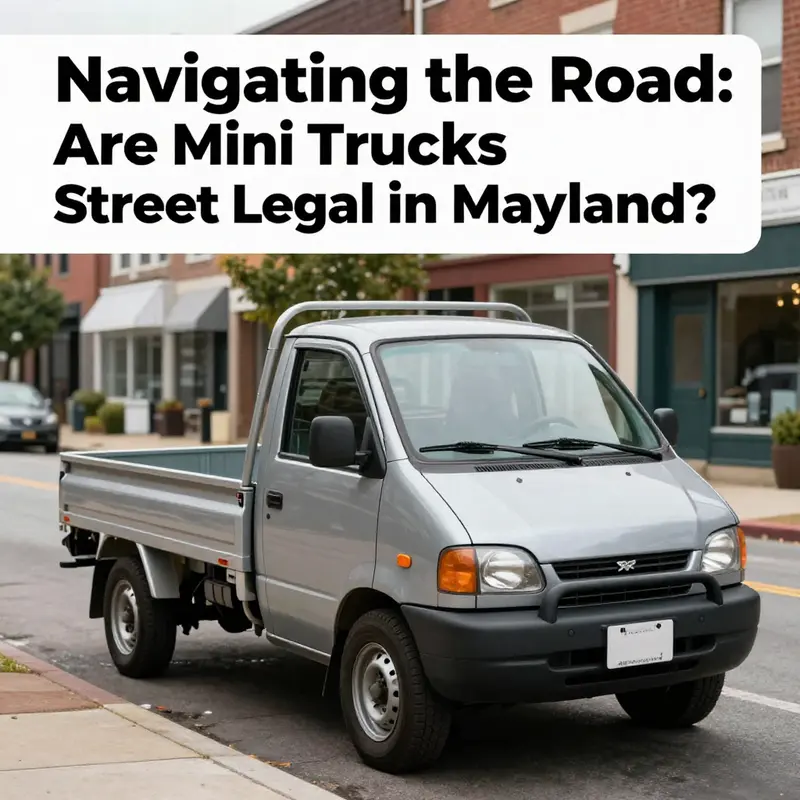
In Maryland, ownership of a Kei truck is allowed, but operating one on public roads requires compliance with roadworthiness, emissions, and registration standards.\nThe Maryland Motor Vehicle Administration (MVA) acts as the gatekeeper for title status, registration, and licensing.\nKei trucks are often imported and may require inspections, modifications, or documentation to meet state requirements before they can be legally driven on Maryland streets.\nRoadworthiness covers lights, brakes, tires, and load-capable suspension; all must meet state safety standards and function predictably in everyday traffic.\nEmissions compliance may involve testing or certification to satisfy Maryland limits for pollutants.\nRegistration with the MVA is the formal step that records ownership and vehicle characteristics so the vehicle can be lawfully operated; nonconforming vehicles may need additional paperwork or modifications.\nIn practice, many Kei trucks can be street-legal if owners complete the required steps, but the process is not a shortcut—it’s a careful, stepwise path that emphasizes safety and accountability.\nBefore driving, verify that the vehicle has current registration, proof of insurance, and any required inspection or certification documentation.\nFor official guidance, contact the MVA or consult their website for the latest rules, forms, and procedures.\nAcross Maryland, enforcement actions can arise if a Kei truck is unregistered, underinsured, or not meeting safety standards, so prospective buyers should plan thoroughly and verify requirements before registering or operating.
What Maryland Requires to Make a Mini Truck Road‑Ready: Safety and Emissions Essentials
Every mini truck owner who hopes to drive on Maryland roads must navigate a clear set of safety and emissions expectations. These small, efficient vehicles often arrive from overseas with design priorities that differ from U.S. road-vehicle norms. Maryland does not treat them as toys. The state requires that any vehicle operated on public roads meet the same core safety and environmental standards as other motor vehicles. That reality shapes what you must inspect, upgrade, document, and maintain before registration and each time you take the mini truck out.
A state safety inspection is the first gate. Inspectors focus on essential systems that affect crash risk and basic control. Brakes are non‑negotiable. The inspection looks for effective stopping power across all wheels, no leaking hydraulic lines, and no seized components. Brake pads, shoes, and drums or rotors are examined for wear. Brake balance between axles and visible evidence of recent repair matter. Steering and suspension come next. Excessive play in the steering, worn tie rods, leaking shocks, or broken mounts are immediate failures because they compromise directional control. Tires are checked for sufficient tread depth, proper sizing, and visible damage. Many mini trucks are fitted with light, agricultural, or off‑road tires; Maryland requires road‑worthy tires with appropriate load ratings and intact sidewalls.
Lighting and visibility equipment are a common hurdle. Headlights must aim correctly and provide both high and low beams. Turn signals and brake lights must function as intended. Reflectors and tail lamps must be present and visible. Side marker lights and amber/ red reflectors may be required depending on the vehicle configuration. Side and rearview mirrors need to deliver clear sight lines for lane changes and backing. If a mini truck lacks required mirrors or its mirrors are damaged, expect an inspection failure until the issue is corrected.
Seating and occupant restraints are also part of the picture. Seat belts must be installed, anchored properly, and in working condition. Maryland’s inspection looks for secure anchors and functioning buckles. If the vehicle was imported without belts for each seating position, installing and properly anchoring belts is a standard modification. While advanced passive systems such as airbags are not always retrofittable, belts are a baseline requirement for safety compliance.
Exhaust and emissions meet state and federal overlap. Maryland aligns its emissions expectations with federal Environmental Protection Agency standards. That means the vehicle’s emissions control system must function and limit visible smoke, vapors, and excessive hydrocarbons. Inspectors will check for obvious exhaust leaks, missing catalytic converters where applicable, and a properly sealed exhaust system that vents away from occupants. For modern vehicles, emissions inspections commonly include reading diagnostic trouble codes through the vehicle’s onboard diagnostics (OBD) interface. Imported mini trucks with no OBD port or with engines not tied to modern engine control units may require alternative testing or proof of compliance. If the engine or its control systems do not meet Maryland’s emissions rules, the vehicle will not pass for road use until the issues are resolved.
It is important to understand that many Kei‑style mini trucks were designed for narrow local roads and low speeds. They sometimes lack equipment assumed standard in American vehicles. That mismatch is where modifications come in. Common modifications that bring a mini truck into compliance include installing DOT‑approved headlights and taillights, upgrading mirrors, fitting seat belts with proper anchors, replacing tires with DOT‑rated ones that match the vehicle’s load requirements, and adding or upgrading the exhaust system to include emissions control devices. Mechanical upgrades to brakes and steering components are also frequent. Some owners elect to upgrade wiring and add a modern instrument cluster or a speedometer calibrated in miles per hour, improving clarity for both drivers and inspectors.
Documentation and administrative steps cannot be overlooked. Registration requires proof of ownership and a vehicle identification number that the Motor Vehicle Administration accepts. If the mini truck was imported, bring any import paperwork and the title from the exporting country if available. The MVA may require a physical VIN inspection and verification that the vehicle matches the submitted documents. Expect to present receipts for major work that was required to pass inspection. If an inspector previously rejected the truck for safety or emissions reasons, documented repairs and replacement parts will smooth the path to passing on a subsequent attempt.
Routine maintenance and recordkeeping help ahead of inspection. Keep receipts for brake work, tire purchases, and emissions‑related repairs. Maintain a simple service log that shows when air filters, spark plugs, and fluids were replaced. These items affect both emissions and safety performance. A truck with a clogged air filter, fouled plugs, or old oil often emits more pollutants and may fail an emissions check. Clean filters, fresh spark plugs, and properly gapped ignition components improve combustion and lower visible and measurable emissions.
Insurance and legal readiness go hand in hand with inspections. Most insurance underwriters require proof of registration and a valid inspection before issuing a policy for road use. Insurers also expect that the vehicle is safe to operate. If your mini truck has nonstandard equipment, discuss it with your agent. Modifications that affect safety—such as non‑OEM suspension changes or altered seat anchoring—can influence coverage terms. Disclose modifications so your policy matches the vehicle as driven.
Practical safety advice for daily use reinforces legal compliance. Confirm that all lights are functional before each trip. Check tire pressure and condition regularly; underinflated tires change handling and braking distances. Practice cautious loading. These trucks have compact frames and lower gross vehicle weight ratings than full‑size pickups. Overloading a mini truck can quickly exceed design limits, overstress brakes, and degrade steering response. Secure cargo to prevent shifting loads that could destabilize the vehicle in turns. Use rated tie‑downs and avoid stacking cargo that obstructs rear visibility or muffles signal lights.
Expect iterative work. Many mini truck owners report that making a vehicle pass Maryland’s inspection is not a single shop visit but a process of adjustments, repairs, and re‑inspection. The exact scope depends on the truck’s condition at arrival and its original equipment. Some owners find that a relatively small investment—new tires, replacement lights, and seat belts—does the job. Others face larger mechanical work like brake overhauls or engine repairs to pass emissions. Plan for both time and money when converting an imported mini truck to a road‑legal machine.
What about vehicles that fail to meet state or federal standards? Not every mini truck will be salvageable for public road use. If a vehicle cannot be brought up to inspection standards without prohibitive cost, alternative uses exist. Private property, farms, and closed communities may allow operation under private rules that do not require state registration. Recreational or off‑road use may be an option for vehicles that lack necessary street equipment. Keep in mind that operating a noncompliant vehicle on public roads exposes the owner to fines, seizure, or liability if an accident occurs. It is generally safer and more economical to complete the necessary modifications for legal operation or to avoid public roads altogether.
Given the technical and regulatory intersections, a helpful approach is to address safety and emissions simultaneously. Start with a thorough mechanical inspection by a mechanic experienced with imported or small utility vehicles. Ask the mechanic to produce a checklist of items likely to fail a Maryland inspection. Use that checklist to prioritize work. Some tasks are low cost and high impact, such as replacing worn brake pads or installing proper lighting. Other tasks—engine rebuilds or emissions system retrofits—take more time and budgeting.
When making modifications, choose parts intended for road use. DOT‑approved lighting, U.S.‑rated tires, and certified seat belts meet recognized standards. Avoid improvised fixes. Improperly installed seat belt anchors, for example, can fail in a crash and create greater legal exposure. Similarly, altering the exhaust system to increase noise or removing emissions control devices risks failing inspection and possible penalties. Keep replacement parts receipts and installation records; these demonstrate good faith efforts to comply and can help at the MVA counter.
Communication with the Motor Vehicle Administration matters. The MVA publishes inspection and emissions requirements and can answer questions about specific vehicles. If your mini truck has an uncommon configuration, call or visit an MVA branch before spending heavily on modifications. In some cases, the MVA can advise whether a particular upgrade is necessary. They can also clarify documentation needed to register an imported vehicle, and whether a vehicle will be routed through a special approval process. For general inspection requirements, the MVA’s official guidance is the primary authority.
Local laws and enforcement also matter. While Maryland sets state standards, local jurisdictions may practice varying degrees of enforcement. Urban areas with emissions programs may be stricter about smog and OBD checks. Enforcement intensity can affect how often inspections flag emissions issues and how aggressively local police act on noncompliant vehicles. Owners who plan to drive in counties with active emissions programs should budget for more frequent testing and potential repairs.
Safety systems beyond the inspection checklist improve day‑to‑day risk. Installing a clear, bright backup light and an audible reverse alarm can help avoid low‑speed collisions while backing. Adding reflective tape to the rear and sides improves visibility for other drivers at night. A small fire extinguisher, securely mounted, is a prudent addition. These measures do not replace required inspections, but they reduce accident risk and demonstrate a commitment to safety.
Finally, understand that regulations evolve. Emissions standards and safety expectations change as technology improves and as state and federal policy shifts. For owners who plan to keep a mini truck for many years, periodic reviews of compliance are useful. A truck that passes inspection today may need different parts or documentation several years later if rules tighten or if emissions testing regimes expand.
For a practical next step, owners should prepare a checklist that aligns mechanical status with inspection focus areas. Confirm brakes, steering, suspension, tires, lighting, mirrors, and seat belts. Verify exhaust integrity and emissions controls. Organize ownership and import documents. Keep service receipts and a repair log. Finally, confirm requirements and schedule an inspection with the Motor Vehicle Administration. That procedural discipline reduces surprises and streamlines the path to legal, safe use of a mini truck on Maryland roads.
For official inspection and emissions guidelines, consult the Maryland Motor Vehicle Administration’s vehicle safety inspection requirements: https://mva.maryland.gov/vah/vehicle-safety-inspection-requirements
You can also find practical owner‑level information and community guidance on mini truck topics at the mini truck blog: https://minitrucksocala.com/blog/
On the Edge of the Road: Navigating Maryland’s Registration Odyssey for Mini Trucks
**On the edge of the road in Maryland, the question of whether a mini truck can truly belong to the regular traffic stream sits at the intersection of curiosity and regulation. The tiny workhorse from the far side of the Pacific might attract a second glance in a Maryland driveway, yet once it is parked in a public lot or put to work on a local street, it enters a legal landscape that treats small, efficient utility vehicles with the same seriousness as any other streetable machine. This chapter is not a mere catalog of requirements. It is a narrative about what it takes to bring a compact, high mileage friendly machine into the heart of a state known for meticulous road rules, safety inspections, and emissions standards. It is a story about documentation, compliance, and the practical steps that turn a kei truck from a curiosity into a legitimate member of Maryland’s on road fleet, ready to carry tools, cargo, or a weekend market venture with equal legitimacy and responsibility.
Maryland does not forbid ownership of mini trucks. The practical reality is that ownership is distinct from on road use. A small truck might be perfectly legal to own and import, but to be driven on state roads it must pass the same tests that govern every other vehicle in the state. The governing philosophy is straightforward: a vehicle must be safe, must meet emissions norms, and must be properly registered to be allowed into the stream of traffic. The emphasis is not on the size of the vehicle, but on its conformity to the standards that Maryland has adopted for all street vehicles. The challenge for a prospective owner is to understand what those standards are, how to demonstrate conformity, and where to seek guidance when the path seems unclear. The path begins with the official gatekeepers, the Maryland Motor Vehicle Administration, commonly known as the MVA, and the agencies that oversee safety and emissions at the federal level, the National Highway Traffic Safety Administration and the Environmental Protection Agency. Even with a well reasoned plan, the journey often reveals two truths that drive the registration process: first, the specifics of a vehicle can matter as much as its general category; second, the state relies on a clear, auditable paper trail that shows compliance from the moment the vehicle leaves the factory floor or the importer floor to the day it wears Maryland plates.
To understand the Maryland registration odyssey, imagine a chain of required checkpoints rather than a single hurdle. The first checkpoint is eligibility. Not every mini truck that finds its way into the state qualifies for registration or for use on public roads. The MVA looks at the history of the vehicle, its origin, and its current condition. Importantly, the vehicle must meet state motor vehicle safety standards and emissions norms. The second checkpoint is documentation. The owner must assemble a bundle of documents that proves ownership, establishes identity, and shows that the vehicle has cleared the relevant safety and emissions gates. These documents include proof of ownership or sale, a bill of sale, any import documents, and, crucially, evidence that the vehicle is compliant with applicable safety standards. The third checkpoint is the emissions and safety perimeter. Here the vehicle must demonstrate that it can legally operate within Maryland air quality guidelines and that it is equipped with functioning lights, brakes, tires, seat belts, mirrors, and other safety equipment that the state requires. The fourth checkpoint concerns registration and licensing. The vehicle must be registered with the MVA and must display valid Maryland license plates. Without registration, the vehicle cannot be legally driven on public roads, even if it physically exists in the state. The fifth checkpoint concerns modifications and compliance. As many kei trucks arrive from abroad, they may not initially mirror U.S. safety or emissions configurations. In such cases, modifications or special approvals may be necessary. The sixth checkpoint, crucial for importers and buyers, involves federal conformity. The NHTSA and the EPA govern the standards that imported vehicles must meet to enter U S roads, and the vehicle must be able to demonstrate evidence of compliance with those federal rules.
This chain is not a mere formality. It reflects a broader policy aim: to ensure that small trucks that serve as workhorses for tradespeople, farmers, or enthusiasts do not bypass the essential guardrails that preserve road safety and air quality. It also reflects the practical reality that the market for mini trucks often includes vehicles that were never intended for the U S market when new. Importers and buyers must therefore navigate an additional layer of scrutiny: proving that the vehicle either conforms to U S safety standards or can be modified to do so without compromising the fundamental function of the vehicle. For Maryland residents, this means that the journey from import to street legal is as much about paperwork as it is about mechanical readiness.
The most dependable path is to engage directly with the MVA. The agency can clarify eligibility based on the vehicle in hand, confirm the list of documents required for registration, and outline any state specific steps that apply to the particular kei truck model. Because vehicle registration rules can evolve, even if the state has not enacted major changes recently, the MVA remains the primary gatekeeper for the official record that makes a vehicle a legal participant in Maryland traffic. The MVA can also provide guidance on how Maryland views modifications that might be necessary to meet safety or emission criteria. These conversations can save a prospective owner from pursuing a path that ends in a registration stall and a failed inspection. The practical advice is to prepare for a dialogue with the MVA, anticipate questions about the vehicle history and its conformity, and present a clear, organized packet of information that demonstrates a path toward compliance rather than a detour.
In parallel with the MVA process, the broader regulatory environment also matters. The federal safety standards set by NHTSA apply to vehicles imported for use on U S roads. A kei truck arriving from Japan will be evaluated against those federal standards, and the importer or owner may need to provide conformity documentation or to undertake modifications to bring the vehicle into alignment with FMVSS guidelines. Emissions considerations, coordinated by the EPA, also come into play. Maryland, like many states, requires that emissions controls on vehicles meet the applicable federal and state standards. The exact tests and thresholds can vary depending on the vehicle’s age, engine type, and configuration. For a small, purpose driven vehicle that has a different exhaust and fuel management profile than typical U S market trucks, the path to compliance can involve a careful examination of the engine control system, the exhaust after treatment, and the overall performance characteristics that contribute to the state’s air quality objectives.
One practical implication of this setup is that many mini trucks are not simply dropped into the registration line with a set of standard results. They often require a deliberate review of whether the vehicle has the necessary safety equipment. For a mini truck to be street legal in Maryland, it must feature a complete lighting package that includes headlamps, tail lamps, turn signals, and reflectors in working order. It must have functional brakes that can reliably bring the vehicle to a stop within the expected distance, and tires that meet the applicable tread depth and load rating requirements. The economy-minded nature of mini trucks should not mask the reality that safety features must be present and in good repair. In addition, the vehicle must have mirrors, seat belts that function as intended, a horn that works, and an appropriate speedometer and odometer to reflect the vehicle’s movement accurately. Maryland’s inspections, while not always identical for every vehicle type, assess these components to confirm road readiness.
The documentation story, though, is where the process truly becomes concrete. For the brand new owner or the importer, having a clear chain of ownership, proof of import, and any conformity certificates is essential. If a vehicle has already been titled in another jurisdiction and is only now being brought into Maryland, the documentation must establish the chain of title that transfers into Maryland. The MVA will want to see that the vehicle is not only physically sound but also legitimately owned and legally transferred into Maryland. This emphasis on traceability is not an obstruction but a safeguard. It helps ensure that the vehicle is not only safe and compliant but also properly accounted for in the state’s records, which in turn makes future transactions, resales, and even the sale of the vehicle or its registration renewal more straightforward.
The question of fees often emerges at the same time as references to safety and inspections. Registration costs, title fees, and potential special assessment or inspection charges can vary depending on the vehicle’s weight, its intended use, and its registration class. A mini truck, being a compact vehicle with a unique cargo profile, may fall into a classification with specific fee structures. The MVA and related agencies can provide an itemized estimate that helps owners budget for the entire process from import to plate. The important point is not the exact dollar amount in isolation, but the recognition that the financial aspect is integral to the legal recognition of the vehicle. The costs reflect the state’s investment in road safety and environmental stewardship, ensuring that an otherwise attractive tool for work does not become a hidden liability on the road.
Beyond the formal checkpoints, there are practical realities that shape the day to day experience of owning and operating a mini truck on Maryland roads. A core consideration is insurance. Insurance providers evaluate the vehicle in light of its safety profile, its performance on the road, and the likelihood of a claim. Even before arriving at the MVA for registration, a prospective owner should check the availability of appropriate coverage. The fact that a small truck may carry light loads or be used for commercial tasks does not diminish the need for robust coverage. A policy that accounts for the vehicle specifications, including its mass, braking performance, and even year of manufacture, helps ensure that the vehicle remains on the road and that the owner is protected in the event of an accident. The relationship between insurance and registration underscores the systemic nature of the process — the state requires that a vehicle be recognized as lawfully operable, but the owner is also obliged to protect that operation with reliable financial coverage.
This alignment of safety, compliance, documentation, and insurance is what transforms a mini truck from a curiosity into a registered, street legal vehicle in Maryland. It is a demonstration of how a state can welcome innovative, efficient, and practical transportation solutions while preserving the core expectations for road safety and environmental responsibility. The journey is not about a single form or a one time inspection; it is an ongoing relationship with the state authorities that requires attention to the vehicle, its history, and its evolving compliance status. The chapter understands that for many readers, the path may seem intricate, particularly for those who have imported a kei truck or those who are evaluating a used import. The guidance remains consistent: engage with the MVA, verify federal conformity where necessary, gather complete documentation, and be prepared for a process that emphasizes accountability as much as accessibility.
A final layer of nuance arises when considering the typical life course of a mini truck in Maryland. Because these vehicles were often designed for different regulatory environments, owners may encounter incremental steps rather than an immediate green light. In some cases, the vehicle may require a modification or an additional component to satisfy safety or emission requirements. In others, it may be possible to demonstrate compliance through documentation that confirms conformity with federal standards. The key is to approach the process with patience and thoroughness, recognizing that the state’s aim is to protect road users and the environment, while still allowing space for practical, compact options that can contribute to small business operations, personal use, or hobbyist pursuits.
For readers who want to connect with a community of people who have navigated the Maryland registration path for mini trucks, there is value in tapping into peer experiences. These experiences can illuminate the nuances of different models, export histories, and the types of modifications that have helped other owners achieve compliance. A reliable source of ongoing discussions, practical tips, and real world case studies can provide a sense of what to expect when approaching the MVA with a kei truck in hand. For ongoing discussions and anecdotes, visit minitrucksocala.com/blog/. This resource offers a window into the lived experiences of people who have walked a similar path, complementing the official guidance with practical, on the ground knowledge about registration, inspection, and road use.
In closing, the Maryland registration journey for mini trucks is a layered process that honors the values of safety, accountability, and practicality. It is a testament to how a small but effective vehicle can be integrated into the state road system when its journey from import to plate is transparent and well documented. The road to compliance is not a straight line but a carefully plotted course that respects both the vehicle’s potential as a useful tool and the state’s obligation to maintain safe, clean air and secure streets. If the reader is considering a kei truck as a practical addition to their working life in Maryland, the best course is to begin with a candid conversation with the MVA, gather the necessary documents, evaluate the federal and state standards that apply, and prepare for a process that, while detailed, ultimately leads to a vehicle that is legally and responsibly part of the state’s road network. For official guidance, visit the Maryland MVA. Maryland MVA.
Final thoughts
Understanding the street legality of mini trucks in Maryland not only helps enthusiasts enjoy their vehicles safely but also supports business owners in utilizing them effectively for local operations. From comprehending safety and emissions standards to addressing the registration complexities, this journey is all about empowerment and compliance. With the information at your fingertips, you’re now better prepared to act on your mini truck ambitions in Maryland.