
Navigating the laws around mini trucks in New York can be a daunting task for enthusiasts and business owners alike. While these compact vehicles offer versatility and efficiency, understanding their street legality is crucial for compliance and safety. This article delves into the legal requirements, classifications, safety standards, and implications of owning a mini truck in New York. By breaking down these components, we aim to equip you with the knowledge needed to make informed decisions regarding mini truck ownership and operation in the Empire State.
Navigating the Borderline: What It Takes for Mini Trucks to Be Street-Lriendly in New York
When people ask whether mini trucks can legally roll down New York streets, the answer is not a simple yes or no. It hinges on how the vehicle is classified, whether it meets federal and state safety standards, and whether the paperwork aligns with the DMV’s expectations. In New York, as in many states, the roadworthiness of any vehicle starts with the basics: ownership proof, proper registration, and a frame that satisfies safety and emissions requirements. In practice, that means a mini truck must be more than a novelty or a farm tool if it is to share the same asphalt with ordinary cars and buses. It must be designed or documented as a vehicle that the state recognizes as road-ready, and it must clear a chain of checks that verify its safety for public highways. The key is to understand not just what the vehicle looks like, but how it is defined and regulated by authorities. The process reflects a broader philosophy of road safety that prioritizes verifiable ownership, traceable history, and demonstrable compliance with standards before a vehicle is permitted to operate where pedestrians and other drivers are present. For people who are curious about the practical realities behind the headline, the story is less about the novelty of a compact chassis and more about the mechanics of certification, inspection, and registration that turn a vehicle into a legal instrument of mobility within the state’s traffic ecosystem. To get a clearer sense of how that ecosystem functions, it helps to start from first principles: what the DMV requires, how import or rebranding affects eligibility, and what the typical hurdles look like in real life. The New York DMV treats street legality as a function of safety, accountability, and regulatory alignment rather than purely of dimensions or horsepower. In this light, a mini truck must be a legitimate, road-appropriate machine, not merely a recreational toy or a private farm conveyance that secretly hopes to slip onto public roads. The practical takeaway is that many mini trucks, particularly those marketed for leisure or agricultural use, do not meet the stringent criteria needed for road use in New York. The broad rule is that only vehicles that fit into a defined category—commonly a light-duty, commercially oriented vehicle—can be considered for street status, and even then only after passing a rigorous sequence of checks. Those checks begin with ownership documentation and extend through to insurance and emissions compliance, forming a chain that ensures only vehicles with traceable histories and verifiable standards are allowed to operate on public roads. And the chain is not purely mechanical; it includes documentation that demonstrates the vehicle’s eligibility to be imported or used domestically, along with proof that it adheres to federal safety standards. This is where the matter often becomes nuanced. A mini truck that comes from overseas, or one that has been heavily modified, may initially appear to meet the boutique appeal of a small, efficient vehicle, but it must still be reconciled with FMVSS, DOT, and EPA considerations that govern what can legally be sold, registered, and operated in the United States. The DMV’s emphasis on compliance means that modifications cannot be cosmetic alone; they must address fundamental safety features such as lighting, braking, tires, seat belts, and the overall crashworthiness of the vehicle. The documentation trail matters as well. Proof of ownership is not merely a bill of sale; it is a record that connects the vehicle to a specific owner and a specific vehicle identity number. For imported mini trucks, the DMV expects CBP documents that verify legal entry and clearance into the United States. This requirement is not merely bureaucratic busywork; it is a risk management measure. It helps ensure that the vehicle’s history can be traced in the event of title disputes, theft recovery, or safety recalls. The next phase—vehicle inspection and emissions compliance—serves as the practical demonstration that the machine can fulfill its public obligation to operate safely and cleanly. A safety inspection examines the engine, exhaust system, lights, brakes, steering, tires, and the integrity of the chassis. Emissions testing, meanwhile, ensures the vehicle contributes no disproportionate pollution, aligning with state goals to reduce air quality impacts. It is not enough to be physically capable of moving; the vehicle must also be fit for the air it breathes and the environment it travels through. Once these steps are successfully completed, the vehicle can be registered, and a title can be issued. Registration fees in New York vary according to weight, age, and vehicle type, reflecting the state’s system of attributing regulatory costs to the characteristics of the vehicle. Insurance is the final financial anchor in this sequence. New York’s minimum liability coverage—designed to shield both victims and drivers in case of an accident—becomes a non-negotiable requirement before the vehicle can share the road with other insured motorists. This framework illustrates a broader principle: street legality is an ongoing commitment, not a one-time checkbox. Ownership needs to be demonstrable, the vehicle must pass inspections and meet emissions standards, and ongoing compliance with FMVSS and state regulations is expected throughout the life of the vehicle on public roads. The reality for many mini trucks is that their typical use cases do not align with the letter of the law. A compact, off-road-oriented vehicle might shine on private property or at a farm, but when put into the urban or suburban traffic mix, it risks falling afoul of the regulations designed to prevent unsafe or unregistered vehicles from circulating widely. The gap between a vehicle’s intended role and the legal framework around road use is where much confusion arises. It is common to encounter models that were never designed for the U.S. market, or that were adapted after manufacture to meet certain standards. In such cases, owners often face revisiting compliance, sometimes requiring changes to meet FMVSS or DOT/EPA standards, or even reclassifying the vehicle as a different category. This is not merely a matter of changing stickers or adding accessory equipment; it is a systematic adjustment that could alter the vehicle’s eligibility and, consequently, its value, insurance, and registration requirements. For readers seeking practical clarity, it helps to consult official guidance, as the New York DMV outlines the sequence—ownership verification, CBP documentation for imports, inspections, emissions, registration, title, and insurance. The pathway is clear, though not trivial. It rewards patience and thorough record-keeping, and it places responsibility squarely on the owner to ensure that every step is completed and verifiable. The overarching narrative remains consistent: the street legality of mini trucks in New York is not determined by their size or weight alone. It is determined by regulatory alignment, safety assurance, and formal recognition by state authorities. When a mini truck checks all the boxes—documented ownership, compliant imports, passable safety and emissions tests, proper registration and title, and adequate insurance—it earns a license to be a road-going vehicle. When it does not, it is relegated to private property or controlled environments. The pragmatic implication for enthusiasts and prospective buyers is to approach each vehicle not as an intuitively street-legal machine but as a regulated object that must be vetted through the DMV process. A useful way to stay connected with ongoing conversations in this space is to explore resources that discuss the broader context of mini trucks, their variants, and the evolving regulatory landscape. For readers who want to dig deeper into practical discussions around these topics, the Mini Trucks Blog offers accessible background and commentary that can illuminate how hobbyists and owners think about compliance without sacrificing curiosity. Mini Trucks Blog. This kind of reading, combined with official guidance, helps paint a fuller picture of what it takes to move a mini truck from concept to lawfully rolling on New York streets. Those who prefer a more formal reference point can always consult the state’s primary regulator, the New York DMV, which provides the definitive checklist and forms needed to pursue road registration and title. For the official framework, see the DMV’s documentation and the related sections on vehicle safety and emissions standards. External resources provide critical corroboration and up-to-date requirements, ensuring that anyone considering this path can navigate changes in law, policy, and enforcement practices. You can review the New York DMV’s official pages for the most current requirements and forms as you plan your road-ready mini truck journey. External resource: https://dmv.ny.gov/.
From Classification to Compliance: Navigating Mini Truck Legality on New York Streets
Classification, compliance, and street access. These are not abstract ideas but the practical gates that determine whether a mini truck can share New York’s public roads. In this state, as in many others, the question of legality starts with how the vehicle is classified and whether it meets a set of regulated standards. The New York Department of Motor Vehicles treats any vehicle that travels on public streets as a motor vehicle that must conform to safety, emissions, and registration requirements. The path from a compact, on-paper novelty to a legally operable road vehicle is narrow and defined, shaped by the vehicle’s design, its intended use, and what it can prove about compliance with federal and state rules. This is not a debate about taste or trend; it is a matter of standing before the law with a vehicle that performs within its noted limits, and that performance is what ultimately determines whether a mini truck belongs on a given road in New York.
A central lens through which to view this topic is classification. Mini trucks can differ widely in drivetrain configuration, body design, size, weight, and declared purpose. The DMV and broader regulatory framework treat these elements as signals about a vehicle’s intended use and its safety profile. A key practical distinction lies in whether a vehicle is considered a motor vehicle designed for street operation or something else that must remain on private property. Drivetrain configuration—two-wheel drive versus four-wheel drive—appears at first glance to be a technical footnote. Yet it matters in how a vehicle grips the road, handles adverse conditions, and ultimately how it is evaluated for compliance with safety standards. A vehicle’s design, including its body style and overall footprint, also informs a regulator’s view of its compatibility with public infrastructure. Size and weight categories can influence everything from tire specifications to required lighting, and these factors feed directly into what the state will allow on public roadways.
When we turn to the state’s own framework, two pathways stand out for mini trucks that might seek street legality in New York. The first is the Low-Speed Vehicle category. LSVs are designed for slow, urban travel and are subjected to a concrete speed envelope: typically, a maximum speed of 25 miles per hour. Their operation is usually limited to streets where the posted speed limit is 35 mph or lower, and even then they’re often restricted to designated roadways or private property rather than the full public street system. The equipment list for LSVs is nontrivial: seat belts, rearview mirrors, turn signals, brake lights, a horn, and proper headlights are part of the package. Importantly, the vehicle must be produced by a qualified manufacturer and must meet the applicable FMVSS—federal motor vehicle safety standards. The vehicle must also be registered in New York with the appropriate state plates. In practice, many mini trucks marketed as light-duty or recreational vehicles do not meet every criterion to qualify as an LSV. Those that do qualify face a much narrower operating environment but stand a legitimate chance of legal road use if all boxes are checked.
A separate but related category includes golf carts. Golf carts generally appear with similar usage restrictions: they are primarily permitted in controlled settings such as private communities or campuses and typically do not enjoy broad on-street rights inside the state’s public road network. While the lines can blur in some communities or with particular local ordinances, the overarching state framework places golf carts in a category with limitations that resemble those of LSVs rather than full-fledged street vehicles.
But the reality for many mini trucks is stark: the majority of models designed for casual use—whether for leisure, light-duty transport, or agricultural tasks—simply do not align with the strict safety and regulatory thresholds that NY requires for on-road operation. A vehicle may be small, but if it was not designed and manufactured as a motor vehicle that satisfies FMVSS, if it cannot meet emissions standards, or if it lacks proper registration, it does not gain a pass to roam public streets. In those cases, the vehicle remains restricted to private land, where the state’s safety and regulatory considerations are less onerous or where local permissions permit specific uses. The distinction is not just about speed or horsepower; it’s about the vehicle’s overall conformity to a system designed to ensure safety, environmental stewardship, and accountability for road users.
Another nuance emerges when owners contemplate modifications or repurposing. Some would-be on-road mini trucks are altered in ways that push them toward classifications like ATVs or non-motorized campus vehicles. In New York, such reclassifications do not automatically confer on-road privileges. ATVs, for example, are generally restricted on public roads, unless a narrow set of exemptions applies. Even when a vehicle is technically street-legal under one framework in another state, New York’s rules focus on the vehicle’s original design, its FMVSS compliance, and its ability to be properly registered and insured in the state. This is not about banning innovation but about aligning on-road use with defined safety and regulatory expectations. In practice, this means careful due diligence before assuming a mini truck can legally run the streets simply because it is small or affordable.
For anyone considering bringing a mini truck into the flow of traffic in New York, the prudent approach is to start with the model’s classification and the manufacturer’s stated compliance framework. The vehicle must be designed and manufactured as a motor vehicle suitable for public streets, and it must meet a bundle of safety criteria, a compliant emissions footprint, and a process of registration. The owner should verify that the vehicle, in its intended configuration, is eligible for NY registration and insurance, and that it can be operated within the light-speed corridor and roadway limitations that come with an LSV designation if that path is chosen. If the model cannot satisfy these conditions, the alternative—using the vehicle exclusively on private property or within controlled environments—remains the only legitimate option without a special permit.
The practical steps of this due diligence are straightforward but important. Prospective owners should collect credentialed documentation from the manufacturer about FMVSS compliance and safe design features. They should confirm the vehicle’s top speed and confirm that the intended use aligns with the LSV constraints if that route is pursued. They should recognize that even if a mini truck is legally operable in another state, it may not be in New York without a parallel set of qualifications. They should plan for vehicle registration, proof of insurance, and the possibility of inspection requirements to verify compliance with safety and emissions standards. They should also anticipate local nuances, since some municipalities may impose additional restrictions or permit-based allowances that complement—but do not override—the state framework.
For those who want a sense of where to start their research, a practical path is to consult a broad overview of mini trucks and their street-legal considerations that can illuminate the classification landscape and the compliance thresholds. A reputable internal resource offers insights into how practitioners compare different mini truck designs, their specifications, and how those details map onto regulatory eligibility. This can provide useful context about how drivetrain configurations, body styles, and intended purposes influence the likelihood of obtaining on-road status. To explore these perspectives, you can visit the internal resource at minitrucksocala.com/blog. As always, the official, up-to-date guidance from the New York DMV remains the most authoritative source for determining whether a specific model qualifies for operation on public roads.
Ultimately, the journey from a compact, appealing mini truck to a vehicle that can legally share New York’s streets hinges on a clear chain: classification informs compliance, and compliance informs eligibility. The two are inseparable. A vehicle that cannot meet FMVSS, emissions, and registration requirements will remain a private-use asset, regardless of its charm or utility. Conversely, a model that aligns with the LSV pathway, or that meets the full motor-vehicle criteria and is properly registered, can join the ranks of street-legal vehicles within the limits of its designated operating terrain. The balance between design intention and regulatory reality is the core truth that governs mini trucks in New York, and this balance shapes both consumer decisions and the broader landscape of on-road mobility in the state.
For those seeking authoritative guidance, the most current details come from the New York DMV’s official guidance. See the state’s guidelines directly at https://www.dmv.ny.gov.
Tiny Trucks, Big Rules: Navigating New York’s Safety Standards and the Road to Legality
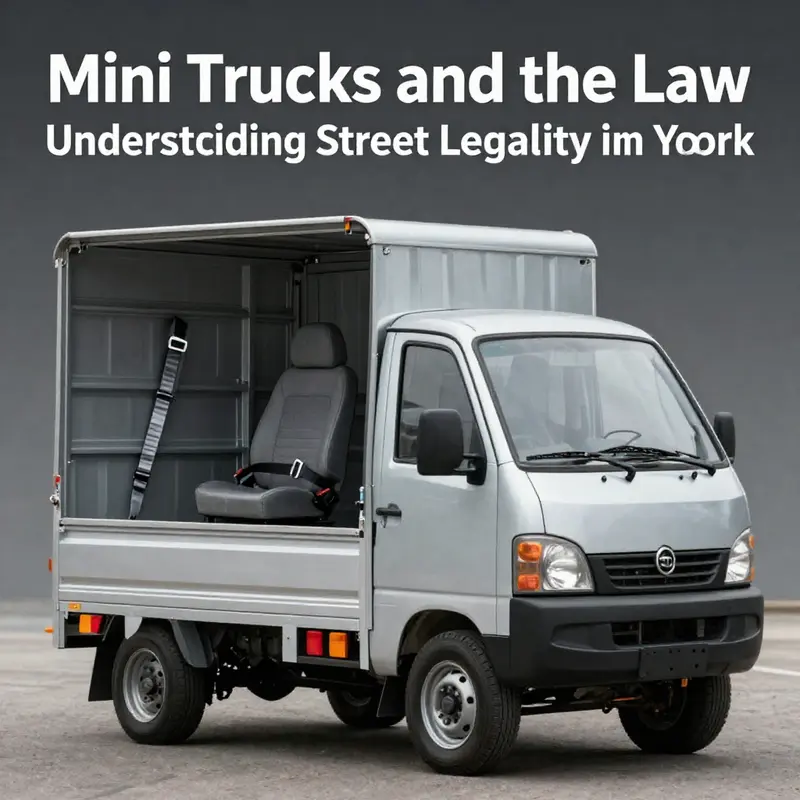
On New York roads, the question of whether mini trucks can be driven legally hinges on how the vehicle is built, classified, and registered. In practice, the New York Department of Motor Vehicles treats mini trucks largely the same way it treats other small utility vehicles: only those that meet defined safety standards and are properly registered may share public streets. At the federal level, the National Highway Traffic Safety Administration sets minimum safety performance standards that apply to all motor vehicles, including those marketed as mini trucks. For low-speed vehicles, FMVSS 500 through 504 come into play, outlining requirements for speed, visibility, lighting, wiring, crashworthiness, seat belts, and overall structural integrity. The common thread in those standards is not just performance in a test, but a robust set of features that protect the occupants and other road users. A mini truck that qualifies as a low-speed vehicle must generally cap its maximum speed at 25 miles per hour and be equipped with the essentials: a proper seat belt arrangement, usable mirrors, turn signals, brake lights, a horn, and functioning headlights as well as rear lighting that makes it conspicuous at dusk or in bad weather. It must also be designed and built by a qualified manufacturer and must meet FMVSS compliance the moment it rolls off the assembly line, not just after a parametric retrofit. Once a vehicle satisfies these federal criteria, a state-level process enters the picture. In New York, the Department of Transportation and the State Police supervise how LSVs are operated and registered, with practical rules that shape whether a given mini truck can truly claim road status. One of the central provisions is that LSVs are generally limited to roads where the posted speed limit is 35 miles per hour or less. That threshold matters, because it creates a clear boundary between what can be considered a low-speed vehicle and a standard automobile on more heavily trafficked routes. Highways and expressways, by definition, remain off-limits to LSV operation, regardless of the vehicle’s equipment, unless extraordinary circumstances, local ordinances, or special permits apply. The licensing and registration requirement for mini trucks is straightforward but nontrivial: a driver must hold a valid license, and the vehicle must be registered with the New York State DMV and carry the appropriate plates. The DMV’s rules also mean that LSVs that are registered can be inspected in many cases, especially if the vehicle is used for commercial purposes or in settings with frequent use. In practice, this combination of federal safety standards and state-specific rules creates a narrow lane for what some people call mini trucks on New York roads. The nuance is important because a great number of mini trucks on the market—whether purchased for entertainment, a hobby, or farm work—do not meet the strict FMVSS 500-504 criteria or fail to pass the registration and inspection regime that NY demands. Those vehicles may look like small pickups or utility machines, but on public streets they are typically relegated to private property or to specialized, off-road uses. The scene of the typical backyard or rural farmyard is full of such machines, and their owners often forget that the same legal framework that governs cars, trucks, and passenger vans applies to the path they want the vehicle to tread on public pavement. It is this misalignment—between appearance and compliant features—that leads to the common conclusion that most mini trucks are not street-legal in New York. However, there is a pathway for a vehicle to be nested inside the law if it is specifically designed and certified as an LSV, and if it originates from a qualified manufacturer that can demonstrate FMVSS compliance to both federal and state authorities. Even then, the freedom to use the vehicle is constrained: the operator must be old enough to hold a license, and the choice of roads is restricted to those with speed limits not exceeding 35 mph. The vehicle itself must be properly registered and maintained, with inspections to verify safety features remain in working order. In practice, the line between a legal LSV and a noncompliant mini truck is narrow and fragile, and it can be disrupted by modifications that affect braking performance, lighting, or structural integrity. A well-meaning owner who adds a heavy-duty bumper, an aftermarket lighting package, or a nonstandard lift kit can inadvertently push a vehicle out of FMVSS compliance, rendering it illegal on public streets. That reality underscores a broader point: legal status is fundamentally tied to compliance, not to a charming silhouette or nostalgic badge. The New York landscape of vehicle use includes not only private streets and driveways but also campus lanes, industrial parks, and rural routes where limited-speed vehicles may be permitted under carefully defined conditions. Yet those conditions are not a blanket invitation to drive a small truck everywhere; they are a reminder that the vehicle’s classification is a legal one, not just a marketing label. For readers seeking precedent and practical guidance, it helps to review the state’s own resources and the federal framework that underpins them, and to recognize that the gap between what a vehicle looks like and what it is legally allowed to do is the real boundary. The distinction matters for buyers, fleet managers, and hobbyists who may imagine a tiny truck as a convenient, legal workhorse for every street and neighborhood. The reality is more nuanced: in New York, the legality of mini trucks rests on the alignment of design, manufacturing quality, and ongoing compliance with both FMVSS and New York’s own registration and operating rules. As the story of a vehicle moves from showroom to street, it passes through a regulatory checkpoint that validates its safety credibility and its lawful use. If a mini truck is declared an LSV and passes the necessary inspections, it can travel on designated roads at modest speeds, with the driver holding a valid license, the vehicle bearing correct plates, and the vehicle’s safety systems in skilled, consistent operation. If not, what remains is a vehicle that can legally appear on private property, staging areas, or controlled demonstration settings but not on the public roadway. For readers who want a practical sense of how these standards work in everyday terms, a helpful entry point is a dedicated resource that explains the broader landscape of safety standards for small utility vehicles and the ways in which these standards shape real-world use. Readers can also explore ongoing discussions and community experiences in related mini-truck forums and blogs, which provide practical perspectives on how people navigate the rules while balancing convenience, affordability, and safety. For those who want to cross-check the regulatory framework directly, official guidance from the New York DMV and the state’s law enforcement agencies is the primary source of truth. This includes information about vehicle classification, registration procedures, licensing requirements, and safety compliance for vehicles operating in New York State. The broader takeaway is that, while the design and spirit of mini trucks can be appealing for many uses, the road to legality is governed by a precise and protective safety regime that prioritizes preventing crashes, injuries, and disruptions to traffic flow. A reader who starts with FMVSS standards, follows the registration steps, and stays within the boundaries of 25 mph for the vehicle and 35 mph for allowed roadways is pursuing a compliant path that aligns with both national standards and New York’s regulatory framework. To learn more about the practical nuances and to keep up with any changes in the law, consult the official DMV resources and consider engaging with reputable motor vehicle safety communities. For a general sense of ongoing content and discussions about mini trucks, you can visit the Mini Trucks Blog. See also the official NY DMV page for the most current rules and definitions. External resources offer a broader perspective on how other states handle the issue and provide comparative insights that can help readers gauge New York’s relative stance. The Federal government’s FMVSS standards and state guidelines shape the actual street-legal status of mini trucks, and the careful compliance path is the best predictor of whether a particular vehicle, in a given setting, will be considered lawful to drive on public roads. The bottom line is that most mini trucks do not qualify as street-legal in New York, but a carefully designed and correctly documented LSV, maintained and operated within the allowed speed and location constraints, can find a narrow lane of permissible use on certain roads and at certain times. External resources for direct regulatory reference: https://www.dmv.ny.gov
Tiny Haulers, Big Rules: Navigating Mini Trucks and Low-Speed Vehicles on New York Streets
New York’s streets present a paradox for tiny cargo vehicles. Their compact size promises easy maneuvering in dense urban corridors, but the state’s road rules keep that promise tightly regulated. In practice, whether a mini truck can legally share a lane with a sedan depends less on its size and more on how the vehicle is classified and how it is built. The state’s motor vehicle rules draw a clear line between low-speed vehicles designed for public road use and the many little trucks that are used on farms, at venues, or for recreation. In plain terms, a mini truck is not automatically a street-legal car in New York; it becomes legal only if it fits a precise category and passes the checks that accompany that category. The difference is not merely semantic; it translates into a cascade of requirements around speed, safety equipment, manufacturing standards, registration, insurance, and the places where the vehicle can operate. The result is a landscape where curiosity can collide with compliance, and where the path to lawful use often travels through formal registration and a careful technical audit. For readers exploring the practical implications, this terrain matters as much as the hardware itself.
Low-speed vehicles, or LSVs, present a separate lane of legality. In New York, an LSV is defined by its performance rather than its appearance: a vehicle that can reach up to 25 miles per hour and is permitted on roads with speed limits of 35 mph or less. To qualify, an LSV must meet certain Federal Motor Vehicle Safety Standards requirements and be outfitted with a standard set of safety features—seat belts, headlights, turn signals, reflectors, rearview mirrors, a horn, and appropriate lighting. These criteria are not optional add-ons; they are the ticket to road access, even as the vehicle has inherently limited protection compared to a full-size passenger car. The regulatory logic behind the LSV category is simple in principle: the speed late in traffic, when combined with lighter construction and shorter stopping distances, creates a different risk profile than driving a regular car at highway tempo. New York’s approach embraces that risk calculus by confining LSVs to the slow lanes and shorter routes, thereby keeping them out of the streams of faster traffic and on routes where their performance envelope is manageable. In a way, the LSV framework is a pragmatic compromise between mobility and safety, a concession to use-cases such as campus shuttles, retirement communities, and certain industrial corridors where slower vehicles can operate with a clear set of guardrails.
By contrast, most mini trucks do not fall into the LSV category. They are commonly treated as off-road or non-highway vehicles, and their open-bed layouts emphasize hauling rather than commuting. Because they often lack the FMVSS-aligned safety framework and because they frequently do not meet emission or crash standards required for street use, they are treated as non-highway vehicles when found on public streets. In practical terms this means that, on a typical day, a mini truck without the proper classification will be illegal to operate on a public road. Their owners would face fines, towing, or more serious penalties if they were observed driving in traffic. Some operators seek to reclassify their mini trucks under different regulatory umbrellas—such as commercial or utility vehicles—but this route is not simple. It involves compliance with a slender set of criteria, often under state or municipal programs, and most often demands specialized inspection, insurance, and a formal registration process that many vehicles never meet. The public consequence of these barriers is that many mini trucks remain strictly private-property devices, used on farms, private campuses, or private courses where no public roadway is involved. In short, the default answer is strict: most mini trucks are not street-legal in New York unless they are explicitly reorganized to fit a recognized category with corresponding registrations and safety certifications.
People drawn to these vehicles sometimes wonder if there is a loophole, a back door that permits street use. The answer is nuanced. If a mini truck is thoroughly redesigned to meet the definitions of an LSV or another permissible category, and if the conversion passes a rigorous safety audit, then doorways can open to some public streets under limited conditions. That path is rarely traveled, partly because it demands a manufacturer-grade approach to safety equipment, consistent compliance to FMVSS, and a formal registration that can be costly and time-consuming. Even so, the legitimate use would be restricted, typically to surface streets, municipal facilities, or limited-purpose corridors, with a careful check on both the speed and the traffic mix. For many owners, the practical constraint is the cost of conversion and the complexity of certification, not merely the physics of a lower top speed. In addition, activities such as running a mini truck on a highway or most parkways remain out of reach unless the vehicle is re-engineered into a vehicle class approved for those thoroughfares, a feat that is rarely feasible for a hobbyist’s build. The risk of misclassification is significant: enforcement officers rely on stamped documentation, VIN identity, and the visible fit of the required equipment to determine legality in real time. The specter of penalties weighs heavily against improvisation, and that weight shapes daily decisions for owners considering public-road use.
To navigate this landscape wisely, many people establish a baseline understanding of how New York treats these machines. Official guidance, such as it exists, comes from the state Department of Motor Vehicles and is supplemented by traffic safety rules that shape road use. The DMV website provides the most authoritative definitions for LSVs, the criteria they must meet, and the limitations on where they can operate. It is a necessary step for anyone considering using a mini truck on public roads to review these standards, check whether their vehicle qualifies, and determine what sized route is permissible. The summary online reinforces the distinction: LSVs are not the same as typical mini trucks, and most mini trucks do not fit the conditional path to legality. For people who want to understand the broader conversation surrounding mini trucks and their road-use reality—for instance, how different hobbyists talk about these vehicles—the minitrucksocala blog offers accessible discussions that can help readers interpret formal rules in plain language. minitrucksocala blog.
Ultimately, the practical takeaway is straightforward in tone if not in every case: unless a mini truck is built, certified, and registered to meet a recognized category such as an LSV, it should not be assumed to be road-legal in New York. Public roads are structured to prioritize predictable interactions among vehicles of similar speeds and protections, and that structure is designed to limit exposure to higher-risk scenarios. Private property, off-road courses, and defined corridors may still be appropriate venues for these compact machines, but each location has its own safety and liability considerations. The road-legal status hinges on compliance, not on aesthetics or intent. This is not a moral judgment about innovation or the appeal of small, light-duty work vehicles; it is a reminder that legality follows specifications and registrations as a matter of public safety and regulatory clarity.
For official guidance, readers may consult the New York DMV’s resources and the general rules that apply to low-speed vehicles, as well as the broader traffic-safety standards that govern what can and cannot be operated on public streets. The underlying point remains consistent: the legal pathway is narrow, and the steps to reach it are technical and formal. As the regulatory conversation evolves, the best practice is to verify classifications, confirm any required inspections, and pursue documented compliance before attempting to use a mini truck on public roads. This careful, rule-driven approach protects both individuals and the broader driving ecosystem. For those seeking further context on how hobbyists discuss these topics in more informal settings, the related blog we mentioned can serve as a bridge to practical interpretations while keeping sight of the official standards. And as always, when in doubt, check the authoritative source before turning a key and heading toward busy streets: the NY DMV site, accessible at https://www.dmv.ny.gov.
Curbside Ambiguity to Road-Ready Reality: Navigating New York’s Mini Truck Regulations for Owners
On the surface, a mini truck may look like a compact, nimble solution for everything from campus logistics to farm chores. Yet in New York, the road-legal status of these pint-sized workhorses sits inside a dense lattice of regulations that can change the entire equation of ownership. The state’s approach does not automatically elevate all small utility vehicles into street-ready status. Instead, it asks owners to prove that their vehicle fits a defined category, meets safety standards, and is registered correctly for the intended use. This is not a one-and-done assessment. It is a nuanced alignment of weight, speed, equipment, and purpose, all designed to ensure that a vehicle small in stature does not become a liability on a crowded urban roadway.
The practical reality for most people is that mini trucks occupy a gray zone. They are not automatically classified as ordinary passenger cars, nor are they automatically treated like standard commercial trucks. The DMV’s guidance hinges on precise classifications that hinge upon the vehicle’s specifications and the way it is used. In everyday terms, that means a thorough look at the vehicle’s Gross Vehicle Weight Rating, its design features, and the nature of its work. If a mini truck is deemed to be a Low-Speed Vehicle, or LSV, it can have a pathway to road use—but only if it mounts the required features and is registered accordingly. The LSV pathway is not a loophole so much as a regulated entry point: a vehicle can navigate public roads at modest speeds, but it must meet a defined set of criteria. For New York, the emphasis is clear: the maximum speed must not exceed 25 miles per hour, and the vehicle must be equipped with essential safety devices. Seats with belts, proper mirrors, turn signals, brake lights, a horn, and appropriate headlamps are not merely convenience features; they are the minimum standards that distinguish a road-legal LSV from a vehicle that should stay off the highway and only roam private property or limited-access sites.
Even when a mini truck clears the safety bar and is registered as an LSV, it remains subject to the jurisdictional nuances of New York’s regulatory environment. The FMVSS, or Federal Motor Vehicle Safety Standards, set the blueprint for what manufacturers must deliver in terms of structural integrity, crash protection, and critical safety systems. The state expects that any LSV proceeding onto public streets has come from a manufacturer that adheres to these federal standards, ensuring a baseline of safety for occupants and other road users. The practical implication for owners is that the vehicle’s origin and build quality matter almost as much as its speed or its payload capacity. A vehicle that looks like a small van or a compact utility vehicle might still fail to meet FMVSS criteria if it was not designed to the required specifications. In other words, design intent matters. It is not enough to be small; it must also be properly engineered to meet the safety expectations that accompany street use.
This framework naturally gives rise to misclassification risks. An owner who registers a mini truck as a passenger vehicle evaluates insurance costs against a familiar, everyday policy. The reality is stark: commercial auto insurance, which is typically required for business use—think deliveries, on-site work, or freight-related tasks—tends to be more expensive than personal auto coverage. The premium reflects the higher risk profile associated with business operations: more frequent use, longer exposure, and a broader set of potential liabilities. If a vehicle is misclassified—registered as a passenger car while it is, in practice, serving a commercial function—the owner can face enforcement actions, including fines and liability gaps in the event of an accident. The DMV’s insistence on accurate categorization is not a bureaucratic trap; it is a guardrail designed to ensure both the operator and the public bear risk in a clearly defined way. The consequences of misclassification extend beyond the immediate premium bill and can touch liability coverage, recourse, and even the validity of an accident claim.
Then there are the everyday operational realities that shadow any attempt to use a mini truck on busy urban streets. In a city as dense and regulated as New York, emission standards and traffic management initiatives increasingly influence what can drive where and when. The broader city environment—particularly in highly trafficked corridors and business districts—means that older or non-compliant mini trucks may encounter greater scrutiny. New York’s broader policy environment includes initiatives aimed at reducing emissions and optimizing traffic flow. As these programs expand, owners may confront restrictions that effectively limit the use of non-compliant vehicles during peak hours or in zones with strict environmental or congestion pricing rules. The practical effect is that even a vehicle that is technically road-legal under DMV definitions can face an array of restrictions that shape when and where it can operate. For a prospective owner, this means a realistic calculation beyond initial purchase price: what is the total cost of ownership when you factor in potential retrofit requirements, ongoing inspections, and limitations on access to certain routes or parking zones?
Local zoning and municipal rules add yet another layer of complexity. Some towns or cities require permits or special permissions for commercial vehicles. Even if the vehicle itself complies with FMVSS and is properly registered, the places you can park it, the hours you can operate it, or the specific roads you may use could be restricted. In practice, this could translate into a scenario where a mini truck is perfectly acceptable for a rural drive or a campus shuttle but encounters friction in urban neighborhoods with tight curb spaces, narrow lanes, or restricted loading zones. The overarching message for owners is that the state’s rules are necessary, but the local layer of rules can be equally decisive in determining whether the vehicle can do the work it was bought to perform.
What does all this amount to for the person who buys, operates, or plans to use a mini truck in New York? The answer hinges on thoughtful due diligence and a clear-eyed understanding of the rules before the keys are handed over. It begins with verifying how the vehicle is classified by the DMV and whether it qualifies as an LSV. If it does, the owner must secure proper registration and the appropriate insurance that aligns with the vehicle’s use. It includes ensuring compliance with FMVSS principles for any on-road use and accepting that safety equipment is a non-negotiable requirement. It also means recognizing that even a legally registered LSV may face limitations in certain zones or during certain times, particularly within dense metropolitan regions that have added layers of environmental and traffic-management policies.
For owners, this is as much a planning process as it is a legal one. The journey starts with a careful review of official guidance and a candid assessment of how the vehicle will be used. It proceeds to confirm the vehicle’s build and source, ensuring it aligns with federal standards. It then moves toward obtaining the right insurance, a step that protects not just the owner but also the broader driving public. Finally, it includes awareness of local rules, parking restrictions, and potential permit requirements that could affect day-to-day operations. The overarching takeaway is straightforward: in New York, most mini trucks remain legally constrained to private use or specific, limited areas unless they meet stringent criteria and carry the proper registrations. Owners should approach ownership as a regulated affair rather than a casual convenience.
For readers seeking practical direction and a more expansive discussion on the broader landscape of mini trucks, the mini truck blog provides ongoing insights and community perspectives that complement this chapter. It can serve as a helpful companion resource as rules evolve and new interpretations of safety and registration emerge. To explore these ongoing conversations, visit the mini truck blog. mini truck blog
As a final note, prospective owners should consult official sources to confirm current classifications and requirements. The New York DMV’s Vehicle Classification framework remains the definitive reference for understanding whether a particular mini truck qualifies as an LSV, a passenger vehicle, or a different category altogether. For official guidance on how New York handles vehicle classifications, see the DMV’s detailed overview here: NY DMV Vehicle Classification.
Final thoughts
Understanding the legality of mini trucks in New York is key for enthusiasts and owners looking to enjoy their vehicles on public roads. With specific regulations, classifications, and safety standards in place, making informed decisions is vital. Whether you are a small business owner considering a mini truck for efficiency or an enthusiast eager to hit the road, being aware of these implications ensures a seamless experience. Always stay updated on local laws, keep your mini truck properly registered, and prioritize safety. The road ahead can be enjoyable and compliant with the right knowledge!