
In the vibrant landscape of Oklahoma, mini trucks have carved out a niche, appealing to everyone from local business owners to automotive enthusiasts. These compact utility vehicles, often celebrated for their versatility and maneuverability, are typically street legal under certain regulations. However, understanding the specifics of what it takes to drive one legally on Oklahoma roads is crucial for potential owners. This article will guide you through the essential regulations governing mini trucks, delve into low-speed vehicle classifications, explain the significance of inspections, and highlight the requisite insurance and registration protocols. By the end, you’ll have a comprehensive grasp of how to ensure your mini truck is ready for the streets.
null
null
On the Road in Oklahoma: Demystifying Mini Trucks, LSVs, and the Legal Landscape
On the road in Oklahoma, the appeal of a compact, capable mini truck sits beside a web of regulations that define exactly where and how such vehicles may travel. The question of legality isn’t a simple yes or no; it unfolds as a landscape of classifications, safety standards, and local rules that vary from county to county and even from one municipality to the next. What starts as a search for practicality—affordable maintenance, easier parking, lower emissions—quickly becomes a careful reading of state statutes, federal safety standards, and the practicalities of everyday driving. To see how this plays out, it helps to start with the essential distinction that shapes every subsequent decision: the difference between low-speed vehicles and the broader category of mini trucks that can be used on public roads in Oklahoma, and how the speed, design, and intended use of a given vehicle push it into one lane or another on the state’s roadways. In this space, the terms mini truck and low-speed vehicle (LSV) sit in a close yet consequential proximity. Mini trucks are often marketed as compact utility workhorses, yet not every model that wears that label qualifies as an LSV. The boundary is defined not by size but by speed and safety design. Oklahoma follows a framework that echoes broader national standards while recognizing that the practicalities of state and local enforcement require a tailored approach to what can legally share the road with conventional passenger cars and larger pickups. At the core of this framework is the definition of an LSV as a motor vehicle designed to travel between 20 and 25 miles per hour. This definition carries more than a number; it anchors a set of safety expectations that align with federal norms enforced by the National Highway Traffic Safety Administration. An LSV isn’t simply a slower substitute for a car. It is a vehicle engineered to meet specific safety criteria: reliable headlights for nighttime visibility, brake lights that communicate stopping intent to following drivers, turn signals for predictable lane changes, seat belts to protect occupants, and reflective or conspicuous materials to boost visibility in varying light conditions. In Oklahoma, those safety features are not merely recommendations; they are prerequisites for road legality. The concept of speed is a practical gatekeeper. A mini truck that tops out at 40, 50, or even 60 miles per hour doesn’t fit the LSV category. When a vehicle exceeds the LSV speed range, it generally falls outside the LSV classification and is treated as a regular motor vehicle under state law. That has broad implications: it enters the standard registration process, insurance requirements, and licensing expectations that apply to standard passenger vehicles or larger trucks. This distinction matters because it shapes the path an owner must take to operate legally on Oklahoma’s public roads. The regulatory framework in Oklahoma balances a desire to offer flexible, lower-cost transportation options with public safety concerns. The state’s approach mirrors a larger national conversation about how to accommodate lighter, low-emission alternatives while ensuring that any vehicle sharing the road with cars, motorcycles, and buses meets basic safety standards. The Oklahoma Department of Public Safety (ODPS) and, by extension, the federal FMVSS requirements, guide what is permissible. For a vehicle to be street legal in Oklahoma, it must include the essentials: proper lighting that makes the vehicle visible and its actions predictable; seat belts that protect occupants in a collision; valid license plates that indicate registration status; and a set of compliance markers that demonstrate conformity to emissions standards where applicable. The process also includes registration and insurance, which are not mere formalities but the mechanism by which the state-trusted system confirms a vehicle’s presence on the road and the driver’s responsibility to cover potential liabilities. In many ways, the practical test of legality comes down to how precisely a given vehicle aligns with these criteria. Some mini trucks, particularly those that originate from off-road or agricultural categories, can blur the line. Vehicles designed primarily for off-road use may be prohibited from public roads unless they have been modified and approved for highway operation. This is where the distinction between a recreational or off-road vehicle and a genuine street vehicle becomes significant. In Oklahoma, such vehicles might require a formal inspection and registration process to be considered street legal, a pathway that can involve additional documentation, compliance verification, and, in some cases, money and time. It is not simply a matter of swapping tires for street-oriented ones and praying for the best; it involves a clear acknowledgement that certain design features may disqualify a vehicle from road use unless the manufacturer’s specifications, safety standards, and local regulations align. The landscape is further shaped by local jurisdictions within the state. Oklahoma counties and municipalities may impose restrictions that go beyond state law. A vehicle that qualifies as an LSV under state definitions might be restricted on certain roadways, or its operation might be limited to daylight hours in some areas. Some places may require that such vehicles operate only on roads with a posted speed limit of 35 mph or less, a rule designed to minimize conflicts with faster, heavier traffic. Others may require special routes or lanes, specific signage, or even daylight-only operation to mitigate safety risks associated with mixed traffic. For drivers, this means that the responsibility to know the law isn’t simply about the vehicle’s technical classification. It extends to understanding how local rules affect day-to-day driving. The practical upshot is straightforward but real: if you’re considering a mini truck or an LSV as a regular means of transportation in Oklahoma, you should plan for a little legwork at the outset. Begin with the official sources. The ODPS and its online resources provide the baseline definitions, requirements, and steps to take when registering and licensing. The state’s approach emphasizes a transparent process, one designed to help owners navigate the often-complex surf of speed limits, safety equipment, and documentation. But the job doesn’t end there. Because local rules can diverge from state norms, it is prudent to check with the county clerk or local enforcement agencies about any additional constraints that might apply to your particular route or neighborhood. The result is not a rigid, one-size-fits-all prescription but a practical, two-layer framework: comply with the state standards for safety and highway eligibility, and then respect the local rules that may further tailor how and where you can operate. In this environment, owners are often advised to treat the process less as a checkbox exercise and more as a careful, ongoing partnership with the state and their communities. Investments in safety features—headlights that cut cleanly through dusk, reliable brake systems, properly configured turn signals, and sturdy seat belts—pay dividends not only in legal compliance but in everyday safety. Likewise, ensuring proper registration and insurance isn’t just about avoiding fines; it is about establishing accountability and financial protection for all road users. For those who want a broader sense of how the mini truck world fits into Oklahoma’s road culture, a broader exploration can be found in the industry conversations found on dedicated Mini Trucks Blog sections. These resources offer a window into model variations, practical considerations for ownership, and reflections on how small, utilitarian vehicles perform in real driving conditions. Mini Trucks Blog provides that broader context without substituting for official regulatory guidance. It is important to reiterate that official guidance for legality remains anchored in the state’s public safety channels. The Oklahoma Department of Public Safety and its published rules are the authoritative source for what constitutes street-legal status for LSVs and mini trucks alike. The balance between enabling affordable, low-emission transportation options and maintaining public safety continues to guide decisions at both the state and local levels. As technology evolves and new forms of small, efficient mobility enter the market, Oklahoma officials and citizens alike will continue to assess how best to regulate these advances. The ongoing conversation is not about limiting mobility but about ensuring that any vehicle sharing the road with others is predictable, safe, and accountable. This requires ongoing dialogue among manufacturers, regulators, and drivers about design standards, speed limits, and enforcement realities as the vehicle landscape changes. For potential owners, practical steps remain clear. Start by confirming whether the vehicle you plan to use falls within the LSV speed band or exceeds it, which places it into the regular motor vehicle category with its own set of registration and insurance requirements. Verify that the vehicle includes the core safety equipment required by law, such as headlights, brake lights, turn signals, seat belts, and reflective materials, and make sure it can meet emissions standards where applicable. Then check with your local authorities about any additional restrictions on roads or time-of-day operations. If you’re unsure where to begin, the ODPS site is a reliable anchor, and local clerks can guide you through county-specific rules. When in doubt, seek confirmation before taking a vehicle into public traffic; this is especially important in rural areas where road configurations can differ significantly from urban settings. While the idea of driving a compact, efficient truck around town is appealing, the practical reality is that legality is a moving, jurisdictional target. The goal is to harmonize the vehicle’s design and capabilities with the rules that apply where you live and drive. The result is a transportation option that is both viable and compliant, offering the benefits of lower operating costs and reduced emissions without compromising safety or legal standing. For those who want to trace further details about vehicle classifications and potential model-specific considerations, the landscape continues to evolve. As lawmakers and regulators respond to new vehicle technologies—electric drivetrains, automated features, and modular platforms—the rules will adapt. Staying informed is less about chasing a trend and more about ensuring reliable access to a road-legal, practical mobility solution. Official guidelines and updates are available through the Oklahoma Department of Public Safety, which remains the authoritative portal for the state’s traffic-safety framework. For official guidelines, visit https://www.dps.ok.gov.
Under the Hood of Oklahoma Roads: How Inspections and Standards Define Mini Truck Legality
Oklahoma’s appeal for a small, capable workhorse that can slip through tight city streets or park beside a shop is undeniable. Mini trucks promise practical utility with a footprint that feels almost cartoonishly compact next to full-size pickups. Yet the right to roll down a public road is not a given for every compact or utility vehicle bearing a similar silhouette. In Oklahoma, the road to street legality for a mini truck is navigated through a blend of state vehicle regulations, inspection regimes, and a classification system that keeps the road safe while recognizing the different realities these vehicles present. The core question—are mini trucks street legal in Oklahoma?—unfolds into a more nuanced answer: yes, under the right conditions, and with ongoing compliance that keeps the vehicle aligned with safety, emissions, and road-use standards.
At the heart of the matter is how Oklahoma classifies the vehicle and what the state expects to see when a mini truck is evaluated for street use. The typical path for a compact or utility vehicle that resembles a mini truck involves a careful alignment with the broader framework that governs passenger cars, light trucks, and specialized on-road equipment. This framework begins with the basics of safety, then extends into technical specifications, and culminates in a formal process of registration, inspection, and insurance. Each step is intended to ensure that the vehicle can perform reliably and safely on public roads without placing other motorists or pedestrians at undue risk. The practical effect is that many mini trucks can be street legal, but only if they meet a set of concrete conditions that the state enforces through inspections and documentation.
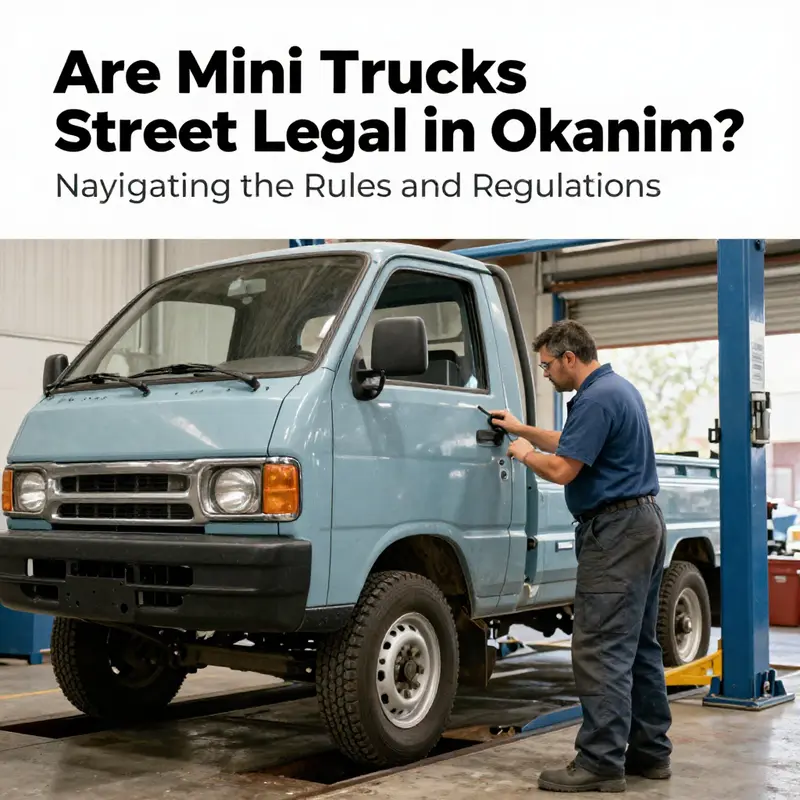
From a safety perspective, the inspection criteria function as the gatekeeper for a vehicle’s on-road life. Oklahoma inspectors scrutinize core safety systems that are universal across most road-legal vehicles. Functioning headlights illuminate the way after dark and in poor weather, while the brake system must respond predictably to the driver’s input. Turn signals must clearly communicate intended movements to other road users, and seat belts are more than a courtesy—they are a statutory requirement designed to reduce injury in the event of a collision. Emission controls, while sometimes a nuanced topic for smaller or older vehicles, form part of the same evaluative landscape in many jurisdictions. Whether emissions standards apply to a particular mini truck can depend on the vehicle’s age, engine type, and the county in which it is operated, reflecting the state’s attempt to balance environmental concerns with practical mobility.
Beyond safety and emissions, the vehicle’s own specifications and classification carry significant weight. In Oklahoma, the determination of whether a mini truck qualifies as a legitimate motor vehicle—versus an off-road vehicle, an agricultural machine, or another category—is central to the legality question. The regulations set minimum thresholds for weight, size, and engine displacement that define a motor vehicle’s on-road status. If a given mini truck fails to meet these thresholds or lacks essential on-road equipment, the door to public-road operation can close, even if the vehicle is perfectly capable of light work or urban errands. This is not simply a matter of taste; it is a codified standard designed to ensure that any vehicle sharing the pavement has a predictable footprint in terms of mass, acceleration, braking capacity, and occupant protection.
The role of inspections in maintaining legality cannot be overstated. Regular inspections serve as a rolling safety net, catching wear and modifications that drift away from acceptable norms. A vehicle that once rolled through a check might drift out of compliance as components wear, or as the owner adds after-market features that alter performance or safety. The consequence of a failed inspection is not merely a minor setback. It often triggers a suspension of registration, and with that suspension comes a loss of the right to operate on public roads until the issues are corrected and the vehicle is re-inspected. This mechanism reinforces the principle that legality is a dynamic state, not a one-time stamp, and it highlights the ongoing responsibility of the vehicle owner to maintain roadworthiness across the vehicle’s lifecycle.
Among the most common touchpoints in inspections are enhancements or alterations that affect safety or compliance. For example, a mini truck owner might be tempted to swap or modify lighting to achieve a particular look or to improve visibility. While modification is not inherently outlawed, it must stay within the boundaries of state codes and the inspection checklist. Lights, for instance, must meet certain standards for brightness, color, and pattern to be legally interpreted as headlights, brake lights, or turn signals. It’s a reminder that a vehicle’s character can be shaped by what is added to it, but the lawful character is defined by what remains compliant with the regulatory framework.
Engine and exhaust configurations also figure into the equation. Emissions standards are not universal across all vehicles and regions, but when they apply, they demand that the mini truck’s powertrain and exhaust system do not contribute uncontrolled pollutants. In practice, this means that an engine displacement that was designed for a different purpose or an exhaust setup that bypasses certain controls can undermine the vehicle’s eligibility for road use. In such cases, owners may be forced to revert to compliant configurations or pursue formal modifications and registrations that authorize highway use for a vehicle originally not intended for public roads.
A frequently underappreciated facet of street legality lies in the precise vehicle classification under Oklahoma law. The state treats a vehicle’s legal status in large part through a classification lens—whether it is a standard motor vehicle, a low-speed vehicle (LSV), or another category with distinct rules. When a mini truck is classified as an LSV or as a different on-road category, it may navigate a separate path through safety standards and operating limitations, which can be more lenient in some respects but also more restrictive in others. Conversely, if the vehicle is deemed to be a lightweight or compact vehicle that nonetheless must meet full motor vehicle standards, the inspection and registration requirements become more stringent. This classification determines not only what is required at the point of inspection but also how the vehicle must be registered, what insurance is necessary, and which roads it may traverse.
The practical consequence of these regulatory intricacies is that owners must approach ownership with an awareness of the ongoing responsibilities that road legality entails. It is not enough to purchase a mini truck and hope for the best. It requires a deliberate alignment with the state’s inspection schedule, a commitment to keeping safety systems in working order, and a willingness to adjust or revert modifications as needed to maintain compliance. From the daily maintenance of tires and lights to the periodic rechecks of brake performance and emissions outputs, the road-legal life of a mini truck in Oklahoma is an ongoing project rather than a one-off achievement.
This dynamic is also reinforced by the registration and insurance requirements that accompany street-legal status. A vehicle may look ready to roll, but without valid registration and proof of insurance, it cannot legally operate on public streets. The documentation is more than bureaucratic red tape; it is a formal record that a vehicle has met the necessary safety, environmental, and usage standards and that the owner is prepared to assume the responsibilities that come with public-road operation. The process typically involves presenting the vehicle for inspection, submitting the necessary paperwork, and paying any applicable fees. Once complete, the vehicle receives a license plate and can be insured under a standard policy that reflects its classification and intended use. The interplay between the inspection, registration, and insurance steps creates an integrated system designed to protect road users while accommodating the practical needs that drive people toward mini trucks in the first place.
Owners who want to stay aligned with the evolving regulatory landscape should maintain a close reading of official guidance from the Oklahoma Department of Public Safety. The DPS publishes guidelines and inspection checklists that help vehicle owners understand precisely what is expected during inspections and what changes might trigger a need for re-approval. Rather than guessing at requirements or relying on informal anecdotes, owners can anchor their decisions in the official rules, and when in doubt, they can reach out to the DPS for definitive answers. This direct path to clarity is invaluable given how easily small, well-meaning modifications can drift into non-compliance, especially as standards are updated or as new interpretations of the law take hold.
For readers seeking practical, community-informed perspectives while navigating these rules, there is a broader ecosystem of resources that discusses what it means to own and operate a mini truck in the era of stringent road-safety expectations. The community has long debated trade-offs, such as how certain light modifications might affect visibility or how weight distribution can influence handling, all within a framework that emphasizes staying within the law. For readers who want a consolidated starting point and ongoing commentary, the linked blog provides a useful portal to practical insights and shared experiences, including updates that reflect how local enforcement and state policy respond to evolving vehicle technologies. minitrucksocala blog.
Despite the complexities, the system’s intention is straightforward: enable responsible ownership of compact, utilitarian vehicles while preserving road safety and environmental standards. If a mini truck satisfies the inspection criteria, meets the minimum specifications for a motor vehicle, and remains in good standing through ongoing maintenance, then it can proudly share the road with other vehicles. If it does not, then it remains effectively confined to private property or off-road use until adjustments restore compliance. This balancing act is especially important in communities that value both practical mobility and predictable safety outcomes. It reflects the state’s recognition that mobility options must align with the physical realities of the road—weights, speeds, and emissions that influence braking distances, pedestrian safety, and overall traffic dynamics.
The practical takeaway for current and prospective owners is a structured, proactive approach. Start by confirming the vehicle’s classification in the state’s eyes and identifying the specific inspection criteria that will apply. Then perform a self-audit of safety features, ensuring headlights, brake lights, and turn signals operate reliably. Confirm seat belts are present and functional, and verify that the vehicle’s emission configuration aligns with applicable standards for your county and vehicle type. If you intend to modify the vehicle, plan changes carefully and verify that each modification remains compliant, or be prepared to pursue an approved modification path that gains road-legal authorization for highway use. Regular maintenance becomes not just a best practice but a legal obligation, preserving the vehicle’s on-road status year after year.
The final piece of the puzzle is the administrative framework: registration, insurance, and ongoing inspections. These elements convert a technically roadworthy vehicle into a legally operable one. They also provide a clear record trail that can be essential if you encounter a roadside check or a local enforcement inquiry. This is not a barrier to mobility but a guardrail that protects everyone who shares the road. For anyone who wants to navigate this landscape with confidence, the official guidance remains the most reliable compass. The Oklahoma Department of Public Safety’s vehicle registration and inspection requirements lay out the standards in precise terms and offer checklists and contact points for questions. Accessing that official resource helps avoid misinterpretation and supports responsible ownership. Official regulatory reference: https://www.ops.ok.gov/dps/vehicle-registration-and-inspection-requirements.html.
On the Roadway Equation: Insurance, Registration, and Road-Readiness for Oklahoma’s Mini Trucks
In Oklahoma, a compact, utilitarian vehicle must meet safety, registration, and insurance requirements to operate on public roads. Mini trucks—often called utility tasks vehicles or compact pickups—fall in a regulatory gray area and must be verified for road use by meeting federal safety standards, having working headlights and signaling, seat belts for occupants, and, where required, emissions controls. The road-ready status is earned through proper documentation from the owner, including proof of ownership and a title application, plus registration fees handled by the Oklahoma Department of Public Safety. Insurance is mandatory liability coverage with minimums that protect other road users, and some policies may require endorsements to cover on-road operation for vehicles not built as standard passenger cars. For off-road or agricultural designs, inspections or modifications may be needed before registration is approved. DPS guidance outlines exact forms, fees, and steps; prospective owners should consult the official DPS site or contact a licensed dealer to confirm eligibility, secure insurance, and complete the registration process before driving a mini truck on public roads. The state’s framework emphasizes safety and accountability to ensure that these practical vehicles contribute to mobility without compromising road safety.
Final thoughts
Understanding the legal framework for mini trucks in Oklahoma is not just about compliance; it’s about maximizing the utility of these versatile vehicles. By adhering to the regulations concerning street legality, low-speed vehicle classifications, inspections, and insurance requirements, both small business owners and enthusiasts can enjoy the unique benefits that mini trucks offer. Ensuring you’re well-informed and prepared will not only keep you on the right side of the law but also enhance your riding experience.