
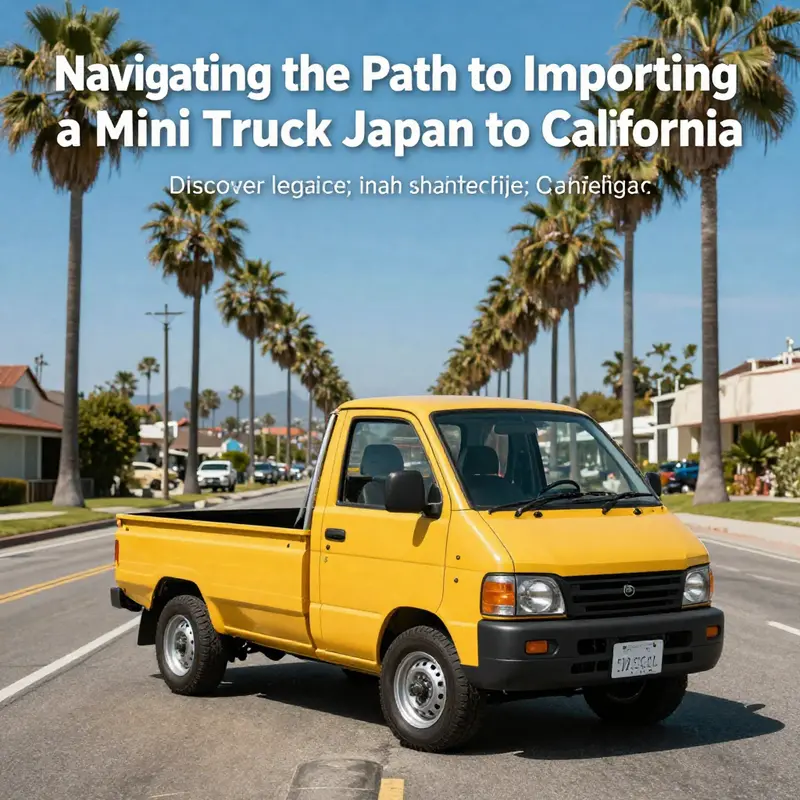
For small business owners, residential property owners, and mini truck enthusiasts in California, the allure of importing a mini truck from Japan can be tantalizing. These vehicles are compact, versatile, and perfect for a range of tasks—from deliveries to off-road adventures. However, the road to ownership comes fraught with legal complexities, stringent safety regulations, and practical hurdles. This guide will help you navigate these challenges—from understanding the legal requirements under the 25-year rule to grappling with safety and emissions standards. We’ll also tackle the practical challenges you might face during the import process and take a glimpse into the future production shifts of mini trucks in the U.S. Join us as we explore this exciting journey together!
null
null
Standards at the Gate: Navigating California’s Emissions and Safety Rules When Importing Japanese Mini Trucks
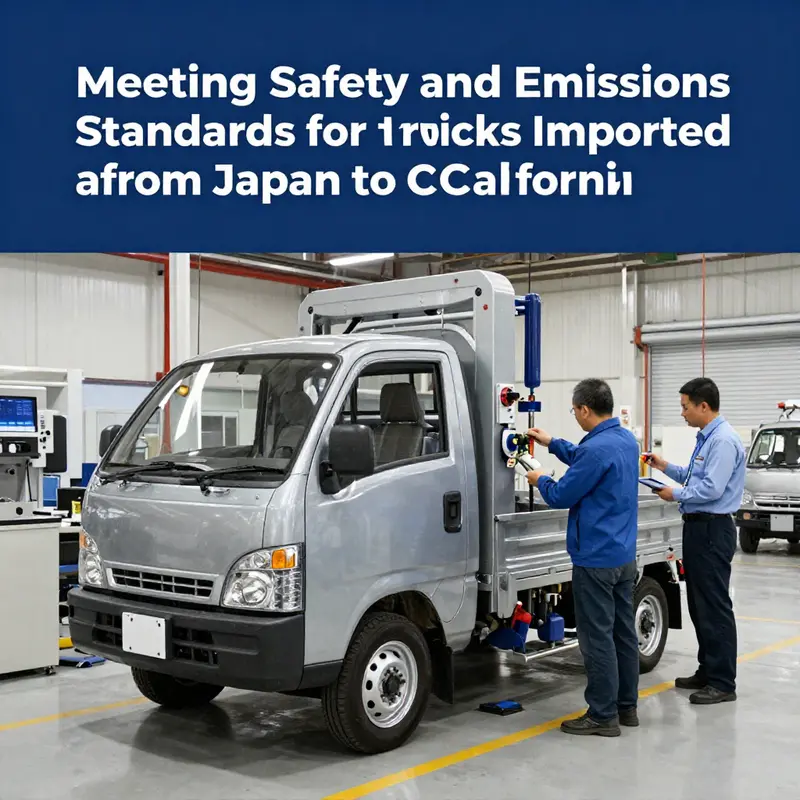
Bringing a small Japanese truck into California is not a simple matter of finding a seller and arranging a ship date. It unfolds at the intersection of federal vehicle safety rules and California’s stricter air quality standards. The process hinges on understanding which standards apply to a given model year, what exemptions exist for older vehicles, and how the compliance journey actually plays out at the border and in the state’s evaluation system. The landscape is complex, and it rewards careful planning, honest assessment of a vehicle’s origin and condition, and a clear sense of how far a particular truck must travel down the modification path before it can legally drive on California roads. The challenge is not merely about import paperwork; it is about aligning a vehicle’s design and its emissions footprint with the state’s rigorous expectations while navigating a regulatory architecture that treats older and newer machines quite differently.
California’s authority to set its own emissions standards stems from a waiver granted by the federal Environmental Protection Agency. That means the state can demand performance criteria that go beyond federal baselines. For anyone contemplating an import, this translates into a sobering reality: even if a Japanese mini truck meets the letter of federal requirements in its country of origin, it must still satisfy California’s specific rules to enter and stay on the road here. The path your truck takes is therefore not universal; it shifts with the model year and, in practice, with the vehicle’s emissions and safety profile. The drama, if you will, centers on whether the truck falls under the so-called 25-year rule or must pass an independent U.S. certification cycle under CARB and FMVSS standards.
The core question—whether a mini truck can be imported in a usable form—hinges on two complementary pillars: emissions controls and safety systems. For vehicles manufactured after 1998, the California Air Resources Board (CARB) requires compliance with a series of emission-control standards that cover evaporative emissions, exhaust emissions, and the onboard diagnostics system. This trio is not decorative; it functions as the state’s way of ensuring that imported vehicles do not introduce excess volatile organic compounds, nitrous oxides, or other pollutants into the air, while also maintaining a modern baseline for engine light diagnostics and serviceability. In practice, that means an importer must demonstrate that a vehicle’s fuel system, evaporative control, catalytic converter performance, and exhaust treatment meet CARB’s requirements, and that the onboard diagnostic system can communicate with compliant diagnostic equipment. This is more than a paperwork exercise. It is a technical validation that requires testing, documentation, and, in many cases, modifications that can be substantial.
Alongside CARB, the National Highway Traffic Safety Administration enforces the federal motor vehicle safety standards, or FMVSS. These standards cover crashworthiness, lighting, braking, and seat belts, among other safety features. The friction here is that many Japanese mini trucks were designed for compact urban use, with lighter frames and smaller crumple zones than typical U.S. pickups or SUVs. Some configurations that are perfectly adequate in a narrow Japanese street scenario may struggle to demonstrate crash resilience by U.S. criteria, particularly in frontal impacts with larger vehicles. The end result is that COD (certificate of conformity)-style certainty cannot be assumed based on common-sense evaluation alone. The vehicle must stand up to rigorous testing or be shown to be substantially equivalent to a compliant U.S.-market surrogate. In other words, meeting the standards is not optional; it is non-negotiable for any newer import that aims to enter the state legally.
If you plan to import a vehicle that is 25 years old or older, there is a more permissive door in California’s system. The so-called 25-year rule means vehicles that are at least 25 years old from their model year can be imported without meeting the current CARB and FMVSS standards. This rule provides a logical exit for enthusiasts who want a true vintage machine that reflects older engineering and emissions philosophies. However, even this path is not a free pass. The older vehicle cannot be substantially altered from its original configuration, and there are still hurdles to clear. The proof of compliance must show that the vehicle’s emissions control system was not significantly modified and remains close to how it was when it left the country of origin. Additionally, even under the 25-year rule, there are practical realities: the vehicle needs to be admissible at the port of entry, pass a basic compliance review, and, in many cases, undergo a limited inspection. The goal is to ensure that a 25-year-old machine, while not meeting today’s standards, does not become an extraordinary source of pollutant or safety risk.
The exemptions don’t stop with the 25-year rule. There exists a separate, historical category often referred to as the “show or display” rule, which applies to certain older vehicles—generally those built before 1975. The show-or-display pathway is intended for non-commercial use, gatherings, and exhibitions rather than daily driving. This exemption is rarely applicable to modern mini trucks, which are typically newer than the mid-1970s threshold. It underscores a broader truth: California’s regulatory approach is nuanced, with carved-out avenues for different vintages, but the practical reality for most current imports is a tight compliance corridor around emissions, safety, and configuration fidelity.
For those who fall outside the easy 25-year pass, the compliance process becomes an explicit journey. Importers should be prepared to document and demonstrate emissions-control-system compatibility and to undergo inspection by a certified testing facility. That process commonly involves a close look at the vehicle’s emissions control components, including catalytic converters, fuel systems, and the integrity of the system’s emissions devices. Depending on the outcome, modifications may be required to meet CARB’s certification, including adjustments to evaporative emissions controls or the addition of OBD-compatible diagnostic systems. The cost and complexity of this journey are nontrivial. It is not simply a matter of importing a car and driving it off the ship. The vehicle may need to be reconfigured for U.S. roads, which could involve changes to lighting, mirrors, or even seat belts that satisfy FMVSS expectations.
The practical implications of all this extend beyond the port. Once the truck clears the import check, California’s state-based inspection and registration process will come into play. Even if the vehicle arrives in the country in a condition that seems compliant on paper, the reality on the ground is a layer of verification. CARB’s official processes typically require an inspection, the submission of third-party test results, and, if necessary, further adjustments to the vehicle’s emissions system. Importers frequently work with specialized entities who understand both the nuances of CARB’s certification framework and the logistics of international transport, because the merging of these domains—emissions engineering and cross-border movement—creates a specialized skill set.
The world of mini trucks is not static. Recent chatter around the industry shows a notable shift: some Japanese manufacturers have started discussing the possibility of producing small trucks in the United States to better serve North American demand. This strategic pivot aims to sidestep tariffs, shorten supply chains, and align with local standards more directly. While this development does not erase the challenges of importing from Japan today, it does suggest a longer-term trajectory where California-bound mini-trucks could arrive via local production rather than full-scale imports. In the near term, however, the path remains as a careful balancing act between the 25-year rule and the rigorous certification pathway for newer models. Understanding this balance is essential for anyone weighing the dream of a compact, agile truck on California roads against the regulatory realities that govern what can legally enter the state.
As you weigh options, a practical touchstone is to follow reputable sources that track policy shifts and real-world approvals. For those who want a straightforward overview of how these standards translate into the day-to-day import process, the ongoing commentary in industry-focused outlets can be invaluable. These resources often explain what it takes to conduct emissions testing, to secure CARB certification, and to structure an import so that it remains compliant from port of entry through registration. If you are exploring this path, you may also find it helpful to consult a community of fellow enthusiasts who share insights into the logistics, timelines, and hidden costs associated with importing a mini truck into California. A good starting point is the Minitrucks California blog, which offers broad coverage of policy changes, practical workflows, and field experience that can illuminate the practical side of what regulations mean in real terms. Minitrucks California blog.
Ultimately, the journey of bringing a Japanese mini truck to California hinges on clear-eyed assessment and careful navigation of the regulatory gate. If you are drawn to a brand-new experience and you want a vehicle to meet contemporary emissions and safety expectations, the 25-year rule likely won’t help you today, and you’ll be looking at the more challenging, certification-driven route for newer models. If you are drawn to the character and charm of a true vintage micro-truck, the 25-year door opens, but you must respect the constraint of not substantially altering the vehicle and you must be prepared for the potential need to surf through a certification or inspection process. The choice, in other words, is not simply between import and not import; it is about choosing a path that aligns with your timeline, budget, and tolerance for regulatory nuance. In the end, the question remains: can a person bring a Japanese mini truck to California? Yes—under the right conditions. But those conditions are precise, and the gatekeepers—CARB, FMVSS, and port authorities—are careful about who passes and how. The result is a landscape where patience, diligence, and a willingness to engage with the regulatory process matter as much as the desire for a compact, practical vehicle on the West Coast.
For official guidance and the specifics of how emissions certification is handled, see the California Air Resources Board’s Vehicle Emission Certification page. CARB Vehicle Emission Certification.
Tracing the Path: Importing a Japanese Mini Truck to California — Realities and Roadblocks
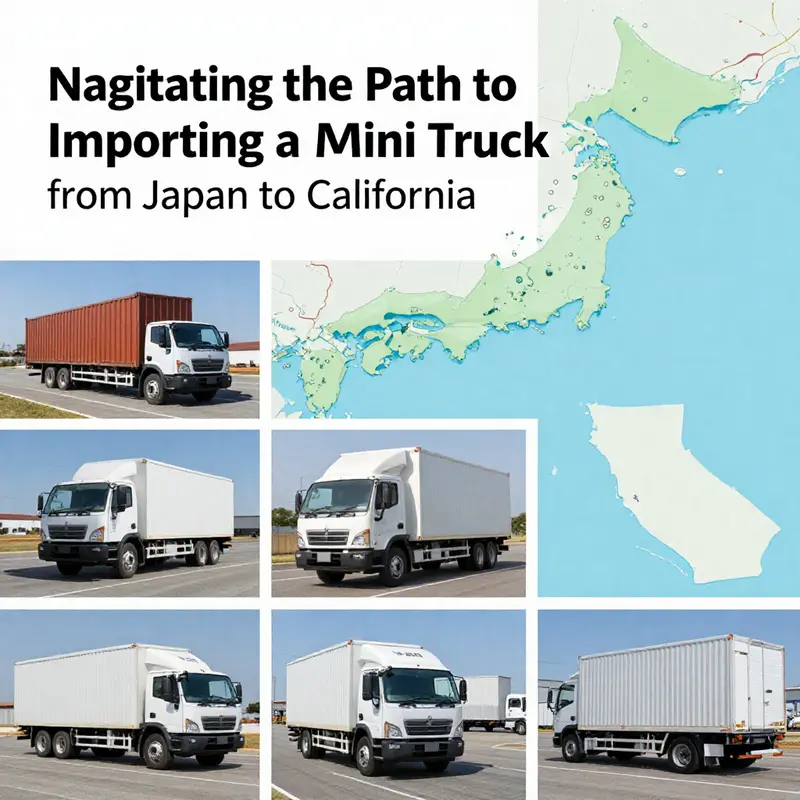
The appeal of a compact Japanese mini truck in California is real, but turning that dream into a titled vehicle requires navigating a mix of rules, costs, and logistics. The U.S. federal framework treats imported vehicles through safety and emissions standards.
Vehicles newer than 25 years may be subject to a different pathway than older models. In practice, if the truck is 25 years old or more, many importers can rely on an exemption from most modern certification requirements. For newer models, expect a more involved process that typically requires an experienced importer to handle emissions testing, safety certification, and paperwork. Even when the regulatory path is navigable, total costs can exceed the purchase price when you factor shipping, insurance, port fees, duties, taxes, and potential modifications for U.S. compliance.
The best approach for those who want to act now is to pursue a 25-year-old candidate with a reputable importer who understands the documentation and timelines. If you are considering a newer truck, plan for a longer timeline, higher costs, and a willingness to accept the possibility that the ideal import may be a waiting game or a U.S.-built alternative. The landscape is evolving with shifts in domestic production and changes in import policy, but the core idea remains: do due diligence, budget carefully, and stay flexible on model and condition to maximize the odds of a successful California arrival.
Shifting Gears: How Production Moves in Japan and the United States Reshape the Path to California’s Mini Trucks
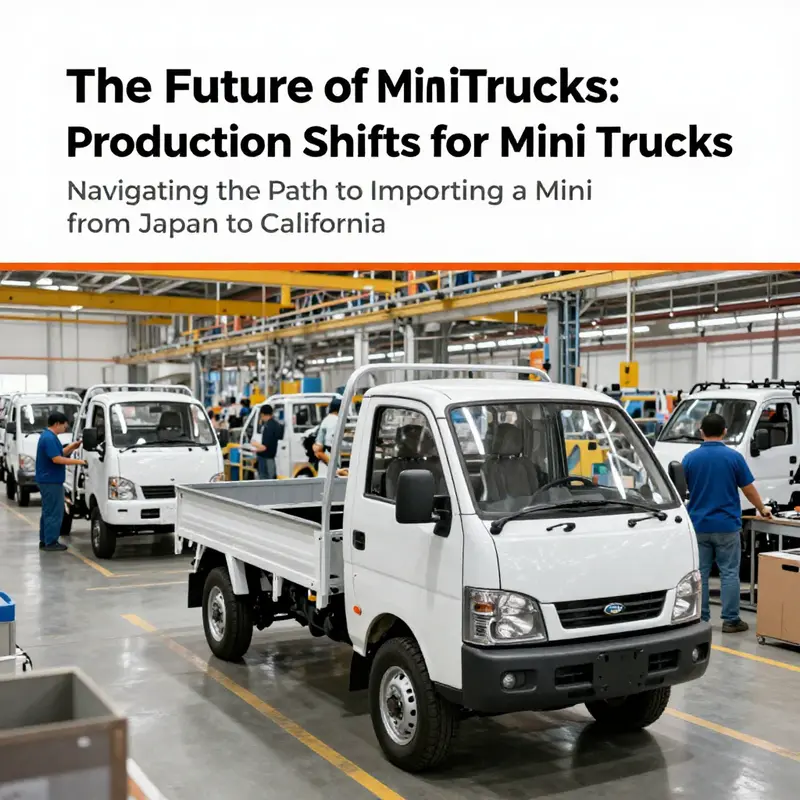
The idea of a compact, nimble mini truck crossing oceans and borders to land in California has long carried both promise and complication. For city crews, small businesses, and rural operations alike, a vehicle that can slip through traffic, park in tight spots, and still haul a meaningful payload is compelling. Yet the lane from an overseas factory to a California curb is paved with regulatory checkpoints, cost calculations, and supply-chain questions that change as markets and policies evolve. In exploring the future of mini trucks, it’s useful to thread together three strands: how the legal import framework currently works, what the shifting geography of production could do for availability and price, and how California—already a hub for innovation and commerce—might see a new wave of locally produced, near-market options. When you put those threads together, a clearer, more nuanced picture emerges of what it means to bring a Japanese mini truck to the Golden State today and in the near future.
The legal terrain that governs importing any light vehicle from overseas is anchored in a fundamental, age-based rule. The federal standard in the United States blocks most imports of vehicles that are less than 25 years old unless they meet U.S. safety and emissions standards or are certified specifically for the American market. This is not a mere bureaucratic hurdle; it is a substantial gatekeeping regime crafted to ensure that separate regulatory regimes for safety and the environment apply to every vehicle that will roam U.S. roads. The practical implication is stark: if a mini truck was manufactured after 2001, it cannot be imported legally unless it has EPA and DOT certification that proves it can meet U.S. standards with respect to exhaust emissions, fuel economy, crashworthiness, and other safety criteria. If, however, the vehicle was built in 2001 or earlier, it falls under the exemption that allows importation without conforming to those current standards—provided the vehicle can clear the other logistical steps associated with international shipping, duties, and customs. For most individuals, this is the only straightforward pathway to bringing a Japanese mini truck into the U.S.—to seek out a model that is already 25 years old or older when it arrives on American soil.
But even with the correct age, the import process is not a simple handoff. A prospective buyer must account for EPA and DOT certification costs and the complexity of the testing process when dealing with newer models. The paperwork that goes with emissions testing, safety compliance, and potential modifications is not trivial, and it is overwhelmingly handled by specialists who manage these certifications on behalf of importers or manufacturers. The reality is that attempting to import a more recent model as a private consumer is a high-cost, time-consuming proposition, often beyond what most buyers are prepared to handle. The older models, while more accessible on paper, still require careful navigation of shipping logistics, duties, and possible post-import modifications to align with U.S. requirements, such as compliance with lighting and mirror specifications or anchor points for seat belts. This is not about a single number on a spec sheet; it is about the cumulative product of licensing, testing, and possible retrofit costs that can push the total price well past initial expectations.
The practical challenges closely mirror the regulatory ones. Availability of a suitable 25+-year-old model in sound condition is not guaranteed. The stream of cars that age into legal import status can be irregular because it depends on what appears in the Japanese used-vehicle market, what buyers in Japan retire, and how aggressively exporters curate inventories for global buyers. Then there is the shipping feasibility—getting a relatively small, lightweight vehicle across the Pacific into U.S. port facilities, managing the containerized logistics, and passing customs with the proper tariff classifications—and, of course, the duties that accompany the import process. After arrival, there may be a need for modifications to lighting, mirrors, and interior fittings to meet U.S. regulations. Even if the vehicle slips past the registration gauntlet, the ongoing costs—insurance, maintenance, and spare parts compatibility with U.S. infrastructure—must be factored in. The picture becomes clear: the direct route to California via imported Japanese mini trucks is feasible in principle, but in practice it remains a niche, price-sensitive, and time-intensive affair for individual buyers.
Amid this regulatory friction, another thread has begun to pull at the fabric of the traditional import model: the possibility that production itself could move closer to North American customers. A notable strategic development in this area is the consideration by a major Japanese automaker to locate small-truck production within the United States, targeted at the North American market. While the specifics of which facility or what model lineup are not the point here, the underlying logic is telling. Building close to California’s demand center would dramatically cut tariffs and shipping costs, shorten lead times, and allow brands to tailor features to local preferences more readily. Such a shift would also help mitigate some of the volatility that comes with exchange rates and cross-border regulatory sweeps that can complicate import programs. In other words, production realignment is less about a single plant and more about rethinking the end-to-end supply chain so a compact, urban-focused vehicle can be brought to market with fewer friction points.
The geography of manufacturing is already showing signs of this recalibration beyond traditional auto assembly lines. California, with its dense urban markets, supply chains, and innovations ecosystem, is becoming a focal point for broader manufacturing pilots in the region. Although one might read these developments as isolated to a few high-profile projects, they echo a broader trend: when industrial capacity is located closer to demand, it improves responsiveness and resilience. The public record in regional development and industry reporting underscores how California’s proximity to major ports, diverse labor pools, and strong logistics networks can make it an attractive site for near-shore or on-shore assembly of compact commercial vehicles. Even when the projects in question are not auto assembly endpoints themselves, the signaling effect is real: the ecosystem is evolving toward a future where local production can meet local needs with greater speed and efficiency.
This shift has important implications for California’s mini-truck landscape. If production moves stateside, it is reasonable to expect a broader portfolio of small-truck options designed for the urban and suburban environments that characterize the state’s daily life. These vehicles would likely emphasize compact dimensions, maneuverability, and efficient powertrains—features already championed by kei-inspired design in Japan but adapted to meet U.S. emissions and safety expectations more naturally when produced domestically. The California market should not be imagined as simply a rear-guard importer of Japanese models; rather, it could become a beneficiary of a more integrated, near-market manufacturing model. In such a scenario, a local assembly footprint could reduce the time between order and delivery, lower transportation costs, and align vehicle specifications with the realities of California regulations and consumer preferences.
The broader market context also matters. In the United States, mini trucks—often labeled as mid-size pickups in domestic markets—have gained traction because of their versatility, economical ownership costs, and the ease with which they can be used for urban delivery, small-business tasks, or weekend recreational activity. Their compact form factor translates into simpler parking, shorter turning radii, and the ability to operate in tight spaces that larger pickups cannot easily conquer. In addition, the consumer appetite for affordable, fuel-efficient urban workhorses aligns with regulatory environments that favor clean emissions and efficient technology. The shift toward domestic production does not erase the appeal of importing, but it changes the calculus: for a portion of the market, near-market production could provide faster access, better customization, and potentially lower total cost of ownership over the vehicle’s lifecycle. For California buyers evaluating the “can I get one from Japan?” question, the production shift presents a twofold opportunity. It broadens the horizon beyond the 25-year rule’s narrow window while offering a credible pathway to new, compliant, and locally supported vehicles in the near term.
Even as these production shifts unfold, the core trade-offs of importing remain instructive. The 25-year rule is a blunt instrument in a market that increasingly rewards nuance: the exact model year, the certification status, and the country’s export practices all influence whether a vehicle can legally enter the country and at what price. For newer models, even if one theoretically could pursue certification, the cost and complexity are prohibitive for most private buyers. The alternative—the older models—carries with it a practical calculus of condition, ongoing maintenance, and eventual adaptation to U.S. standards. The reality remains: many Californians will either wait for a domestically produced option that aligns with federal and state driving standards or seek out a well-vetted, 25+-year-old import that has already cleared the legal gates and is ready for registration.
In this evolving landscape, information and local knowledge become essential. Prospective buyers who want to understand the current state of play should keep an eye on both regulatory developments and the industry’s strategic moves toward U.S. production. While the regulatory framework won’t disappear or relax overnight, the industry’s response—toward closer-to-market manufacturing, localized assembly, and more targeted product development for the U.S. market—could tilt the balance in favor of California-based availability in the medium term. For those who want practical, reader-friendly perspectives on the local mini-truck ecosystem, a centralized blog hub that consolidates market insights and user experiences can be a valuable resource to bookmark as the situation evolves. Reading about the latest developments and user reviews can help you understand not only what’s possible today but what might become feasible in the near future.
To explore broader consumer perspectives and updates in the California mini-truck scene, you can visit a dedicated blog hub that aggregates relevant discussions and content on these vehicles. Mini Trucks California blog hub.
As the industry continues to recalibrate its approach to production geography, the question of how a California resident might access a mini truck from Japan shifts from a straightforward import scenario to a layered decision-making process. Do you pursue a 25+-year-old import that can be legally registered with the proper paperwork, taking into account the long lead times and potential retrofits? Or do you wait for a domestically produced variant that better aligns with U.S. standards, is supported by local after-sales networks, and offers a shorter, more predictable path to ownership? The best answer may depend on your priorities: urgency, total cost of ownership, willingness to adapt to a potential future product lineup, and the value you place on local manufacturing benefits. Either route reflects a broader trend in the global automotive landscape: supply chains that were once defined by distance and ocean freight are increasingly influenced by proximity, policy signals, and the evolving demands of customers who live and work in places like California where urban life and small-business efficiency are ongoing priorities.
For readers who want to further explore the industry dynamics that shape these shifts and the potential implications for California’s market, it helps to consider the broader policy and business environment. While one article may discuss a major Japanese automaker evaluating U.S. production as a strategic move, the practical takeaway remains: production location matters. It matters for pricing, for the speed of delivery, for the ability to tailor features to local needs, and for the long-term viability of owning a vehicle whose service network and supply chain are anchored in the region where you live. The narrative here is not that imports are disappearing or that California will suddenly be flooded with domestically built mini trucks tomorrow. Rather, it is that the balance between imports and domestic production is tilting in ways that could make access to these vehicles easier, more predictable, and more aligned with local requirements over time.
If you want to see how industry observers are framing the broader shifts in production strategy, you can consult industry coverage that highlights the trend toward U.S.-based small-truck production. One such source discusses the strategic considerations a major Japanese automaker is weighing as it contemplates moving small-truck production to South Carolina, a move aimed at improving domestic supply chain efficiency and market responsiveness. This context helps illustrate the real-world implications of the trend and why California’s market could be a compelling focal point for new manufacturing capacity in the near future.
External resource: https://www.autonews.com/industry/isuzu-considering-moving-small-truck-production-to-south-carolina
Final thoughts
Navigating the complexities of importing a mini truck from Japan to California isn’t just about compliance with laws and regulations—it’s about embracing a unique driving experience tailored to your needs. Whether you’re eager to tackle the challenges of the 25-year rule, ready to ensure safety and emissions compliance, or excited about the local production shifts, there are numerous avenues available. While the path may seem daunting, the rewards of owning a classic mini truck are well worth the effort. By staying informed and proactive, you can successfully bring a piece of Japanese innovation into your Californian life.