
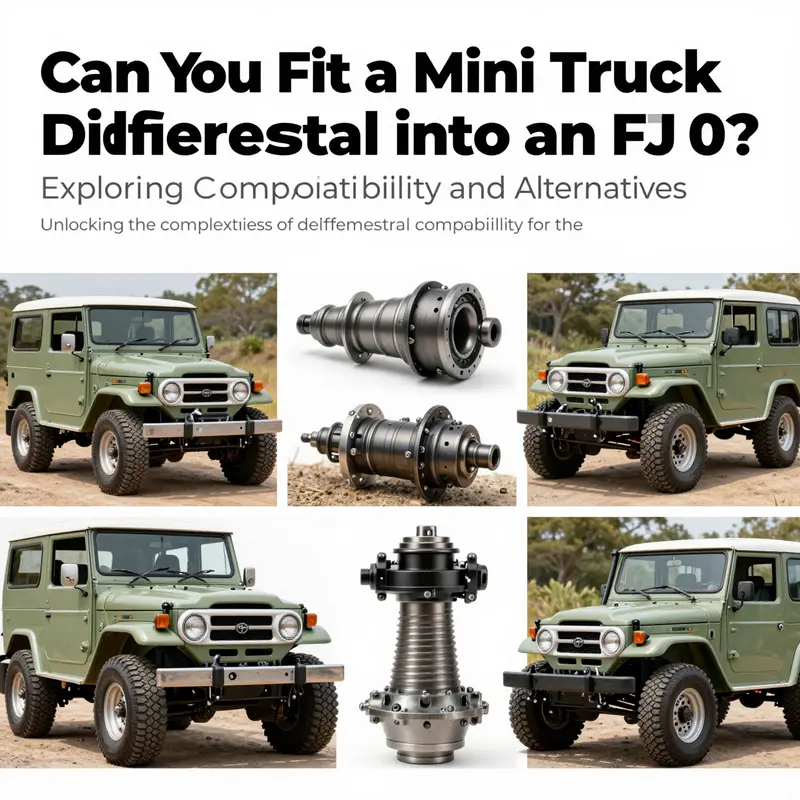
For enthusiasts and hobbyists considering modifications on their beloved Toyota FJ40, the question arises: can a mini truck differential be a feasible option? Understanding the compatibility of a mini truck diff with the FJ40 is not just a question of fitting parts together; it dives deep into the intricacies of both vehicles’ drivetrains, their unique features, and the curated modifications in between. As we venture through this article, we will explore the compatibility of differentials, a detailed analysis of the FJ40’s original drivetrain, modern alternatives such as the new Toyota Land Cruiser FJ, and the challenges involved in custom modifications. Whether you are a local small business owner, a residential property owner, or a mini truck enthusiast, this exploration aims to provide clarity and insight into your modification journey.
null
null
Can a Mini Truck Diff Find a Home in an FJ40? A Thorough Dive into Drivetrain Compatibility and the Craft of Off-Road Reliability
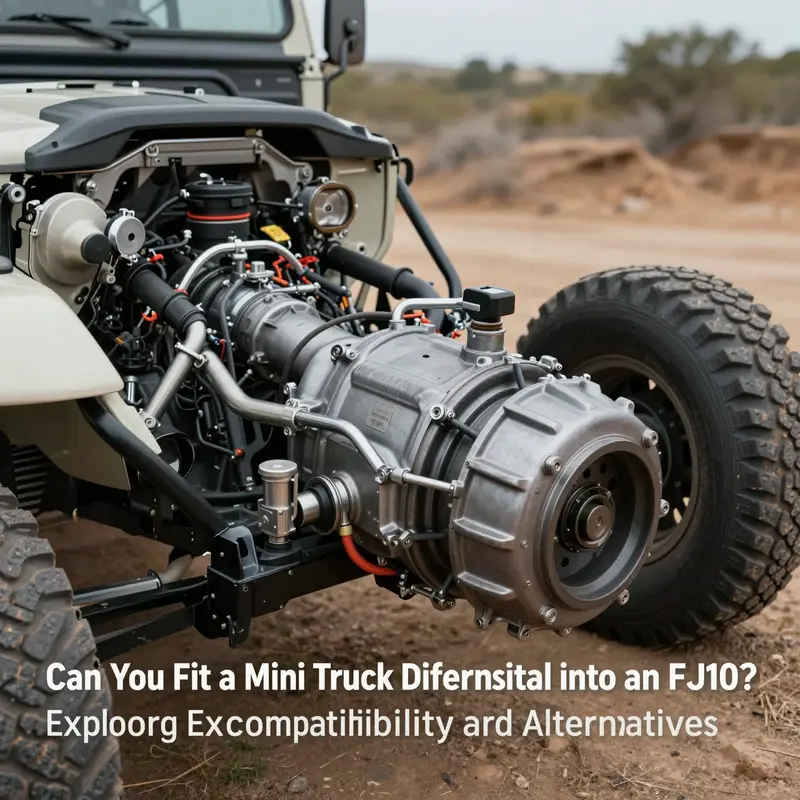
The question, at first glance, seems simple: can a mini truck differential be dropped into an FJ40 to unlock new combinations of gearing, traction, and off-road capability? Yet the deeper truth, drawn from the collected research and the lineage of the FJ40, runs much more nuanced. There is no documented, credible source in the provided materials that confirms such a swap as feasible, practical, or advisable. The phrase mini truck diff is itself ambiguous, a shorthand for a broad spectrum of potential axles and gear assemblies that come from compact trucks rather than dedicated off-road platforms. Because there is no explicit reference to a swap of this kind in the sources, any assessment must proceed from first principles about what the FJ40’s drivetrain is designed to do, how its components interoperate with the chassis, and what modern interpretations of the FJ40 bring to the table without losing sight of the classic vehicle’s architecture. In that sense, this chapter weaves together the enduring logic of the FJ40’s drivetrain with the realities of attempting an uncharted swap, while also acknowledging the project’s scope and risk for a dedicated enthusiast who might be tempted to chase an unconventional path to capability.
The foundation of the FJ40’s off-road prowess rests on a drivetrain philosophy built around mechanical robustness and deliberate engagement. The body-on-frame construction provides a straightforward, sturdy platform for the drivetrain to live in and work within. This is not a unibody architecture where small misalignments can accumulate into performance impairments; it is a ladder frame that tolerates the harsh demands of rough terrain, long expeditions, and the unpredictability of off-road surfaces. The 4WD system is likewise purposeful, typically manifesting as either a part-time or a full-time arrangement depending on the model year and configuration. The core virtue here is control. A manual shift transfer case enables the driver to engage or disengage the front axle as needed, with a low-range setting designed to multiply torque and maximize crawling ability. In practical terms, 4L mode is where a trail becomes navigable and where the vehicle earns its keep by moving when the surface refuses to yield to momentum alone. The system’s design recognizes that traction can be a moving target on rock, sand, mud, or loose gravel, and the driver’s decisions, supported by mechanical locks, are often what keeps the vehicle moving rather than raw horsepower alone.
Locking mechanisms play an equally critical role in the FJ40’s ability to stay ahead when traction is scarce. A central differential lock and an electro-mechanical rear differential lock are not cosmetic features; they are essential tools for maintaining propulsion when a wheel loses grip. In the context of off-road progression, these locks can dramatically reduce the spinning of a single wheel and transform a potential stalling moment into a measured forward push. The intention behind such locks is not to create a miracle of traction but to minimize power waste and maximize available grip in adverse conditions. The modern reinterpretations expand on this concept with more sophisticated electronic controls and, in some cases, differentials that are integrated into a broader system of torque management. Yet the shared thread across eras is that the drivetrain’s ability to deliver torque to a wheel that has traction remains the cornerstone of the FJ40’s legendary capability.
From a powertrain perspective, the FJ40’s evolution mirrors the broader shift in off-road philosophy: a move from simplicity and reparability to a blend of performance and efficiency that still respects the vehicle’s rugged DNA. The classic FJ40 served with a dependable inline-six and a manual transmission, a combination prized for reliability in remote environments where field repairs could be the sole option. What emerges in modern incarnations is a substantial leap in power and refinement. On the one hand, a 3.5-liter twin-turbo V6 with a 10-speed automatic transmission offers formidable on-demand torque and smooth, rapid shifting across technical terrain and long, high-speed traverses. On the other hand, a hybrid option pairs a 2.4-liter engine with an electric motor to deliver a combined 305 horsepower and 500 Nm of torque, coupled with a remarkable efficiency metric that suits long highway runs and cross-country trips. The presence of such dual powerplants in modern FJ40 models reflects an aspiration to preserve the vehicle’s indispensable off-road capabilities while broadening its appeal to drivers who value torque curves, predictable throttle response, and improved fuel economy. The pairing of engine and transmission thus evolves without dissolving the fundamental principle that torque delivery, in a controlled, predictable fashion, is paramount for off-road confidence.
The chassis and suspension work in concert with the drivetrain to optimize traction and articulation. The non-load-bearing frame configuration, though a relic in some respects, still underpins a philosophy of resilience. It allows the suspension to articulate with a degree of freedom that keeps all tires in contact with the terrain, maximizing traction while absorbing the jolts and impacts that would otherwise translate into drivetrain stress. In many modern builds, sophisticated aftermarket shocks—whether from established suppliers or bespoke configurations—provide improved wheel travel and stability. The result is not merely a smoother ride, but a drivetrain that can translate a wider sweep of wheel movement into forward momentum on uneven ground. Upgraded braking systems, including the option for four-wheel disc brakes, further reinforce the ability to control momentum after descent or on steep sections. The overall effect is a package in which the drivetrain, chassis, and suspension are harmonized to convert raw mechanical energy into purposeful movement with reliability.
Given that harmonious architecture, the question of replacing the FJ40’s differential with a mini truck differential demands more than a simple bolt-in solution. The reality is that a diff swap of this kind would implicate not just the ring gear and pinion but also the axle shafts, the carrier bearings, the gear ratios, the flange patterns, the driveshaft lengths and joint angles, and the structural mounting points of the diff housing within the axle housing. The track width of the axles, the spacing between wheel hubs, the pattern of the bolt holes on the flange, and the diameter of the output shafts all influence not only fitment but also longevity and noise, vibration, and harshness (NVH) characteristics. The driveshafts must align with the transfer case and transmission in both length and angle to avoid excessive vibration or premature U-joint wear. A misalignment of a few degrees can create undesirable vibration at cruising speeds or even lead to premature fretting of bearings due to non-ideal operating angles. Setting such angles correctly requires precise measurement, custom fabrication, and sometimes bespoke crossmembers and mounting brackets to maintain geometry within the tolerances the FJ40’s drivetrain expects.
The complexity deepens when you consider the diffs themselves. A different differential assembly carries its own gear ratios and torque capacities, and those must be matched to the engine’s output, the chosen transmission, and the vehicle’s intended use. In a classic off-road platform like the FJ40, where torque delivery at low speeds is often the defining feature of success on a trail or rock garden, the ratio between the selected final drive and the torque curve of the engine matters a great deal. A mismatched ratio can rob the vehicle of its crawl capability, degrade fuel economy, or cause heat buildup in the differential under heavy load. The pinion angle must be managed carefully to maintain proper engagement with the ring gear and to prevent power loss through inefficient contact. Beyond mechanical fitment, there is the question of reliability. An aftermarket or non-identical differential might not be designed to survive the same environments that the FJ40’s original drivetrain was engineered to withstand.
There are, of course, anecdotes in the broader modification culture about using parts from different vehicles to tailor a build. The sources mention that some custom projects involved using FJ40 components to modify other Toyotas, such as a Dyna truck, but these cases illuminate the complexity rather than offering a blueprint for diff swaps. They demonstrate the level of customization and the ingenuity required, and they highlight that such modifications are not routine. In short, there is no credible, data-backed instruction in the supplied materials that would support a straightforward, recommended swap of a mini truck differential into an FJ40. If a project begins from this premise, it becomes an engineering undertaking of the highest order, demanding comprehensive measurements, mock-ups, stress analysis, and a willingness to revisit fundamental design assumptions. It also implies a willingness to accept potential compromises in reliability, maintenance, and parts availability—areas where the FJ40’s original drivetrain is particularly strong.
This is not to say there is no value in exploring alternative approaches. For enthusiasts who crave a different flavor of traction or gearing, the more prudent path, guided by the available information, would be to optimize within the existing architecture. That might mean upgrading to an advanced locking differential within the original axle housing, refining the center locking mechanism, or selecting gearsets and compatible limited-slip components that preserve the intended torque delivery while improving grip. It could also involve tailoring suspension tuning to maximize wheel contact and control, or selecting modern braking and cooling improvements to handle higher loads or extended excursions. The overarching principle remains consistent: any modification that alters how torque is delivered to the wheels should be evaluated against the vehicle’s chassis, suspension, steering geometry, and intended use, not merely against the desire for a different piece of hardware.
For readers who want to ground their exploration in broader context, a useful point of reference lies in how compact, modern interpretations of off-road classics handle drivetrain packaging. While the historical FJ40 laid down the blueprint for mechanical reliability and predictable control, the contemporary redesigns expand the toolbox with electrified or turbocharged powertrains, while still honoring the core ethos of traction and durability. If the reader is curious about how the latest incarnations balance performance and efficiency, a useful resource is the official specification overview of the modern FJ40 interpretation. It demonstrates how the platform evolves while maintaining the essential character of its legacy. And for enthusiasts seeking related perspectives, the Mini Trucks Cali Blog offers a perspective on how compact platforms manage drivetrains and axles in practical terms, which can inform discussions about fitment, clearances, and the realities of engineering constraint. Mini Trucks Cali Blog
In closing, the current body of information does not confirm a straightforward, repeatable method to install a mini truck differential in an FJ40. The combination of a body-on-frame chassis, a time-tested part-time or full-time 4WD system with locking differentials, and the carefully tuned powertrain and suspension configuration all work together to deliver the FJ40’s renowned off-road capability. Any attempt to substitute a non-standard differential must be treated as a bespoke engineering project, undertaken with rigorous measurement, planning, and a clear understanding of the potential for unintended consequences. The vehicle’s enduring appeal rests not on the badge or the latest horsepower figure alone, but on a coherent drivetrain that has proven its reliability in some of the world’s toughest environments. Changing one of its most fundamental pieces without a robust, project-wide strategy risks losing that reliability in pursuit of a different kind of capability. And while curiosity about unconventional swaps is a healthy instinct among off-road devotees, the sources suggest that, for now, the FJ40’s differential remains best appreciated in its original or carefully integrated, professionally validated configurations rather than as part of an improvised, one-off exchange with a compact-truck differential.
External resource: https://www.toyota.com.au/vehicles/fj40
Can a Mini Truck Diff Fit the FJ40? Navigating Modern Alternatives and the Realities of a Differential Swap

The question of whether a mini truck differential can be made to live under an FJ40 has a practical instinct behind it: people want to keep the rugged DNA of the early Toyota off-roader while chasing improved wheel-locomotion and traction. Yet the historical record in the data available for this chapter makes one thing clear. The FJ40’s original drivetrain, defined by a body-on-frame construction, a part-time four-wheel-drive system, and a rear differential that often carried a locking function, was engineered around a very specific chassis, axle geometry, and mechanical envelope. A swap as ambitious as inserting a non-native “mini truck” differential into that framework would require far more than simply bolting a different ring gear onto a pinion. It would demand a rethinking of axles, driveshafts, suspension geometry, braking hardware, steering dynamics, and even the calibration of the vehicle’s powertrain management, if the car’s electronics could be persuaded to cooperate with the new hardware. The information at hand does not confirm such a swap as feasible, practical, or even advisable, and it cautions readers to weigh the substantial engineering and safety implications before pursuing any form of differential transplant on a classic chassis.
What the sources do provide is a clear context for evaluating any proposed swap against the reality of the FJ40’s lineage and the contemporary landscape of off-road capability. The original FJ40 was defined by a robust, no-nonsense architecture. Its frame was designed to tolerate the stresses of rough terrain, and its part-time four-wheel-drive system was tuned for controlled engagement on low-traction surfaces. A rear differential lock, commonly present in the era’s setups, was a practical tool for getting out of sticky situations, but it was part of a package that prioritized mechanical reliability and a straightforward, maintainable drivetrain. The very idea of swapping to a different differential body demands a matching of several subsystems: the diameter and placement of axle shafts, the circumference of the ring gear, the pinion geometry, the backlash tolerance between gears, the driveshaft joints and yokes, and the mounts that align those components with the frame. Even if a so-called mini truck differential could physically occupy the same space, the alignment of driveline angles, the longitudinal spacing of axles, and the path of suspension articulation would demand precision engineering that goes well beyond a simple hardware change.
In parallel, the advanced, modern interpretation of the Land Cruiser family—an evolution that the chapter’s sources label as a “Baby Land Cruiser” or a compact, modern FJ—helps frame the decision logic around any major swap. This new generation, unveiled at a recent mobility show, is built on the IMV platform and positions the FJ as a compact, pragmatic option that retains genuine off-road capability without inheriting the heavy complexity of larger Land Cruisers. Its design is inherently about balancing compact dimensions with the rugged character that buyers expect from a Land Cruiser lineage. The dimensions alone reveal a critical constraint: a length of around four and a half meters and a notably short wheelbase, combined with a simple, robust engine and a part-time four-wheel-drive system. The drivetrain architecture is designed for predictability, not for an endless series of bespoke modifications. The engine, a 2.7-liter naturally aspirated unit paired with a six-speed automatic, reinforces a philosophy of straightforward reliability rather than a landscape of swaps that would require bespoke control systems and recalibration.
What this means for the question of a mini truck differential is that the modern FJ’s philosophy—lean, durable, and easy to service—does not naturally invite or reward large, untested exchanges of the core drivetrain. If a builder is hoping to extract more capability from a classic platform, there are two broad roads: alignments within the existing mechanical family or pivot toward a modern alternative that preserves the spirit of the original while offering factory-backed features and easier support. The modern FJ concept, as described in the sources, even offers optional rear differential locks to enhance off-road grip. This points to a design space where traction-improving hardware is integrated with a known chassis geometry and a proven axle configuration, rather than a patchwork of mismatched components from different vehicle families. In other words, while the fantasy of a quick diff swap is tantalizing, the reality of mechanical harmony in a 40-year-old rig points toward restraint and a search for compatibility rather than conquest.
That reality becomes even clearer when we consider the broader landscape of viable, modern alternatives that fulfill the same emotional and functional goals the swap seeks to achieve. The new Land Cruiser FJ, built around the IMV platform, offers a compact, purpose-driven approach to off-road capability. Its design language borrows the spirit of the original FJ40—boxy silhouette, rugged stance, and a focus on practical performance—without dragging along the baggage of older mechanical underpinnings that resist modern calibration and parts supply. The initial powertrain choice—a reliable natural-aspirated four-cylinder paired with an automatic transmission and a part-time four-wheel-drive system—puts durability first and keeps the driveable, everyday aspect of the vehicle intact. Of course, this is not a clone of the FJ40, nor is it intended to be; it is a thoughtful contemporary reimagining that acknowledges how parts availability, longevity, and serviceability influence a driver’s long-term ownership experience. In a sense, the modern FJ embodies a design philosophy that the FJ40 enthusiasts have long desired in a package that remains feasible to purchase and maintain in a real market.
That same philosophy informs the list of credible alternatives readers may consider when the dream is less about a one-off mechanical miracle and more about possessing a compact, capable, road-friendly adventure vehicle. A compact- to subcompact-size Jeep, with a modular approach to drivetrain options and a long-standing appetite for off-road performance, is a direct reference point in the narrative. A Mazda with elevated ground clearance and available all-wheel drive presents another path for those seeking a balance between on-pavement comfort and off-road capability. The Suzuki Jimny, celebrated for its compact footprint and exceptional approach to tight trails, emphasizes how size and simplicity can trump weight and complexity on challenging terrain. In markets where a larger, more powerful alternative to classic Land Cruisers is desired, the Fortuner sits in, offering a muscular package with proven durability. And finally, certain modern editions from brands known for rugged design—while not identical in intent to a vintage FJ40—offer in-house systems that can deliver the sort of adventure-ready experience many FJ40 fans crave without the constraints and headaches of a mass modification project.
As readers weigh these paths, a recurring theme emerges. The most reliable way to realize off-road ambition, especially in a vehicle with the aura of the FJ40, is to work within a platform that has documented, tested compatibility and an ecosystem of parts and service expertise. The chapter’s research underscores this point through a comparison of the modern FJ’s straightforward drivetrain, the practical option of selectable rear locking mechanisms, and the broader ecosystem of compact, capable modern alternatives. Rather than wrestling with a bespoke, and perhaps irreproducible, differential swap, many enthusiasts find that upgrading within the established framework—whether that means locking diffs on a modern FJ or choosing a contemporary compact with a proven off-road spec sheet—delivers more return on investment, durability, and peace of mind.
For readers who want to explore how such compact platforms stack up against each other in terms of specs, capabilities, and the kind of ownership experience they deliver, a detailed comparison guide to various compact off-road models can be illuminating. It serves as a practical resource that helps translate the abstract notion of “more grip” into tangible outcomes like ground clearance, approach and departure angles, suspension articulation, and real-world reliability. When contemplating an upgrade from a classic FJ40, this perspective becomes indispensable, since the objective shifts from a single mechanical tweak to a broader, integrated approach to capability that respects both the vehicle’s heritage and the realities of modern engineering.
For readers who want to see how the landscape in this space is evolving, a deeper dive into the current generation’s models and their specifications can be helpful. A dedicated reference that surveys model-by-model differences offers a clearer map of what is feasible today and what might be the domain of future restorations and restomods. And while the idea of a one-to-one swap with a non-native differential remains a topic of curiosity, the practical guidance that flows from the chapter’s synthesis points toward a strategy that prioritizes compatibility, serviceability, and long-term reliability over bespoke, high-risk modifications. If you’re curious how compact platforms manage the balance between off-road capability and daily driving, the chapter also points toward a useful, real-world guide to comparing and contrasting those options—an essential step before any serious plan to modify a classic FJ40 takes shape.
Within this framework, one practical direction is to explore a broader set of sources that discuss compact, capable platforms and their drivetrains in a way that keeps restoration and enjoyment alive without compromising safety or reliability. For readers who want a concise, model-focused comparison, a well-curated guide that examines recent compact off-road models and their specs can be a valuable resource. To further inform readers who are weighing the merits of different compact platforms, a recommended path is to consult comparative literature that emphasizes how new and classic configurations handle roadwork and rough terrain alike. In the end, the journey from a vintage FJ40 to a modern, capable compact is not a single swap but a thoughtful evolution—one that respects the core intent of the vehicle while embracing the engineering realities of contemporary automotive design.
Internal link reference: for readers curious about how small, capable platforms compare in the market today, a detailed comparison guide on KingStar Kruzr models and specs offers a useful lens through which to view the spectrum of compact off-road readiness. See: comparing KingStar Kruzr models and specs.
External resource: for a broader context on how Toyota’s current Land Cruiser family approaches off-road capability within a compact package, an external overview provides useful background on the philosophy that underpins the contemporary FJ and its peers. External reference: https://www.toyota-global.com/vehicles/land_cruiser/
null
null
Final thoughts
Navigating the possibility of fitting a mini truck differential into a Toyota FJ40 presents a range of fascinating challenges and considerations. From understanding drivetrain compatibility to exploring modern alternatives like the new Toyota Land Cruiser FJ, it’s clear that modifications require careful planning and expertise. For hobbyists and enthusiasts, it can be incredibly rewarding to delve into the mechanical intricacies and may lead to innovative solutions and enhancements to their beloved vehicles. Ultimately, educating oneself about potential options and modifications ensures that you can enjoy the full potential of your FJ40.