

For mini truck enthusiasts and FJ40 aficionados, the question of whether a mini truck differential can be installed into a classic Toyota FJ40 is compelling and technical. Both vehicles have their loyal following, and the process of modification often ignites passionate discussions among hobbyists and local automotive experts. This article dives deep into three pivotal aspects: understanding differential compatibility, assessing axle and suspension fitment challenges, and exploring the drive shaft and gear ratio implications. Each chapter builds towards a comprehensive understanding of this unique integration, helping you navigate the potential hurdles and solutions as you consider making changes to your vehicle.
Beyond the Swap: Navigating the Geometry and Gears of an FJ40 Differential Upgrade with a Mini Truck Diff
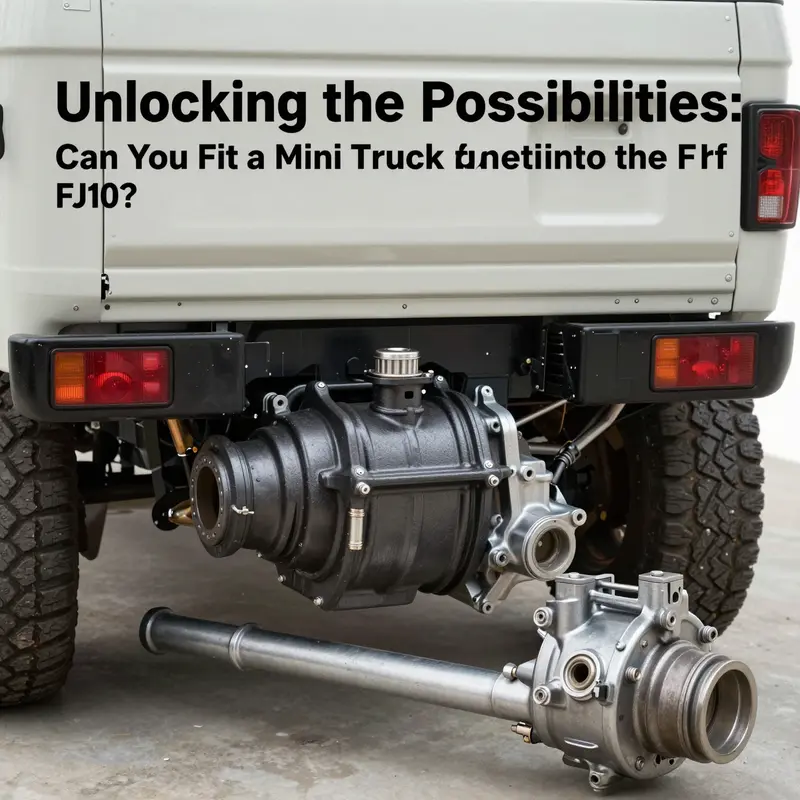
The question lingers like a tire tread in soft sand: can a mini truck differential actually live inside an FJ40? It’s more than a curiosity about fitment. It’s a study in how drivelines communicate with chassis geometry, how a single component can ripple through handling, torque delivery, and freedom on the trail. The Toyota FJ40 is celebrated for its rugged simplicity—solid axles front and rear, leaf springs, a sturdy frame, and a history steeped in expeditions rather than showroom efficiency. Its rear differential is more than a wall of steel; it is a carefully tuned piece of a drivetrain that has to deliver reliable low-end torque, endurance in harsh terrain, and predictable behavior when the trail gets slick. A mini truck differential, by contrast, belongs to a smaller, sometimes lighter class of vehicles where packaging, gear ratios, and bolt patterns are optimized for different use cases. When a chapter in a build asks for a new heart, the question shifts from “could this fit” to “what must change so a heart can beat safely and reliably?” The answer, like most good off-road projects, is rarely a simple yes or no. It is a careful assessment of compatibility, a ledger of compromises, and a plan that respects the physics of moving heavy objects along uneven ground.
To begin with, the most obvious hurdle is compatibility in the fundamentals. The FJ40’s differential sits within a robust, narrow-but-sturdy solid axle assembly that is designed around specific drum or modern-style gear sets, depending on the model year and market. The axle shafts, mounting perches, and the carrier housing all follow a rhythm that syncs with the leaf-sprung suspension and the geometry of a classic off-roader. A mini truck differential, meanwhile, carries its own design intent—likely tuned for a different track width, a distinct carrier type, and a gear ratio aimed at a balance between payload efficiency and highway manners. Across the board, the key compatibility questions circle back to a handful of technical realities: axle shaft diameter and spline count, the bolt pattern of the differential housing on the axle ends, the overall width of the assembly, the length and angle of the drive shafts, and the gear ratio that will govern torque delivery at the wheels. If any of these are misaligned, the result is more than a squeak or a vibration. It can be a chain of misfires that stresses bearings, torques the pinion out of spec, and introduces wobble that years of hard use will amplify rather than dampen.
When you bring forward a candidate differential from a different class of vehicle, the first thing you realize is that the body of the heavy question is geometry. Track width matters because the FJ40’s wheel wells and fenders are spaced for a particular stance. A slightly wider or narrower diff changes the track width, and that reverberates through steering leverage, tire contact with the ground, and the behavior of the suspensions under articulation. The bolt patterns that anchor the diff to the axle housing are not just a matter of “do holes line up?” They are about the envelope of forces in which the shafts and bearings must operate. The FJ40’s rear perches are oriented for a specific rotation axis and a particular spring mount geometry. If the mini truck differential has different perch spacing, you either concede fabricating custom perches or accept a less-than-ideal spring alignment that can warp how the leaf springs cycle under compression. Either path adds cost, time, and potential safety concerns. It’s not simply a matter of mounting a unit in an empty space; it’s a re-engineering of the entire axle assembly to ensure the unit is not only bolted in but breathing in harmony with the rest of the chassis.
Another critical thread in this conversation is the pinion and drive shaft choreography. The pinion angle, which governs how the drive shaft transmits torque into the differential, is a delicate balance in a vintage off-roader that relies on classic leaf-spring geometry and predictable drivetrain dynamics. A misaligned pinion angle can induce vibration, accelerated U-joint wear, and a yawing feel under acceleration or deceleration—effects magnified on rugged terrain where speeds are low and loads are high. If the mini truck differential uses a different pinion height or a different flange connection than the FJ40’s standard output, the path to a clean installation quickly narrows to either extensive machining or a different approach entirely. Drive shafts have to be cut to length, U-joint angles must be harmonized, and yokes must be compatible with the axle’s output flange. The worst-case scenario is a mismatch that leads to a split or a collapse under load, which would be dangerous in the wilderness or on a remote trailhead.
Gear ratio is another stubborn gatekeeper in this puzzle. A differential is not a stand-alone gear box; it is the final stage in a chain of gears that translates engine torque into wheel torque. The ratio determines how many engine revolutions are required to rotate the wheels once and, crucially for off-road driving, how much torque is delivered at low speeds. The FJ40, depending on year and configuration, runs a compact gear set matched to the engine’s torque curve and the expected highway gearing. A mini truck differential could easily come with a ratio that is mismatched to the FJ40’s final drive. If the ratio is too steep, the vehicle may feel sluggish in low-speed rock crawling yet run out of breath on steep climbs. If the ratio is too shallow, the engine spins too fast at highway or off-road speed, bringing noise, heat, and efficiency penalties. The presence of a locker or limited-slip mechanism in the target differential adds another layer of complexity: the engagement geometry, the carrier type, and the control mechanism must be compatible with the FJ40’s gearing, as well as with the operator’s expectations for traction and predictability under load.
Beyond the numerical relationships lies the pressure of real-world fitment. A classic FJ40 chassis was never modernized with the same tolerance stack as a contemporary vehicle. That means even small deviations in axle width, mount holes, or clearance can become a cascade of issues. The column of noise and vibration—often dismissed as a “quirk” in older builds—can be a symptom of misaligned components that never truly settle. In the worst cases, a poorly matched diff can reduce ground clearance where it matters, alter steering geometry, or create unintended contact between the driveshaft and suspension components during articulation. The tolerances that engineers push to create a dependable platform in a factory setting are rarely forgiving when a builder is chasing a change in the heart of the drivetrain. This is not a critique of ingenuity but a reminder that swap projects must weigh the likelihood of extensive fabrication against a dependable, repeatable outcome. It’s easy to dream of a drop-in replacement. The reality is that drop-in, in this context, is a misnomer: a drop-in cannot be assumed to exist without major adjustments.
The legal and safety considerations cannot be brushed aside. Drivetrain modifications carry implications for braking performance, steering response, and rollover resistance, all of which are amplified on an older, heavier, highly capable off-roader like the FJ40. The state of roadworthiness and compliance for a self-modified drivetrain varies by jurisdiction, but the common thread is clear: the vehicle must remain safe to operate at both legal speeds and realistic trail speeds. Any project that alters the differential must include a validation phase—rigid testing of under-load behavior, torque delivery in various gear selections, and a thorough check of the suspension’s ability to maintain tire contact with the ground under adverse conditions. Skimping on this phase is exactly how a plan meant to improve reliability becomes a risk that undermines the vehicle’s most celebrated qualities: its reliability and its rugged simplicity.
Given the scope of the challenge, the practical path forward is rarely a simple direct swap. The consensus among experienced builders is that direct compatibility between a mini truck differential and an FJ40 is unlikely without significant re-engineering. There are two routes that many builders consider seriously. The first is to stay within the family of components that have documented fitment through credible builds. This often means selecting a differential from a model that shares more fundamental dimensions with the FJ40, yet still requires careful gearing work and possibly custom axle ends. The second route favors a broader reimagining of the drivetrain: the installation of a modern, high-strength differential that has proven compatibility with the FJ40’s leaf-sprung, solid-axle layout through established packages. In either case, the project becomes less about a straightforward swap and more about a chassis-aware, engineering-driven adaptation—an approach that respects the FJ40’s legacy as a platform built for durability, simplicity, and the joy of exploration rather than for the uncertain matchmaking of disparate components.
Importantly, this is not a lament about impossibility. It is a reminder that the world of vintage builds rewards thorough measurement, informed decision-making, and a willingness to adapt the plan when the geometry speaks loudly. If the goal is to improve traction or to tailor the torque curve for a specific expedition profile, there are paths that preserve the FJ40’s character while offering modernity in a controlled, safe manner. A common pattern is to use a differential with a known track width and mounting footprint and to adjust the axle housing and perches through careful fabrication. This does not guarantee a “plug-and-play” result, but it offers a disciplined framework: measure twice, cut once, verify alignment, and validate under load. Embracing this ethos reduces the risk of compromising steering integrity, brake balance, and the vehicle’s essential weighting—the triad of control that makes or breaks an off-road drive.
As you navigate this terrain, it helps to anchor your planning in real-world references. Official documentation for the FJ40, including service manuals and historical engineering notes, provides the baseline for the vehicle’s mechanical dimensions and tolerance envelopes. Community forums and builder journals in the off-road world often host reports from builders who have pursued similar paths. These sources can illuminate practical pitfalls that numbers alone fail to reveal—the way a given track width interacts with a particular wheel offset, or how a certain gear ratio affects the feel of low-speed steering on rough terrain. While the theoretical discussion of carrier types and hole patterns is essential, the lived experience of others who have wrestled with equivalent challenges can be equally instructive. It’s in the exchange of lessons learned through trial and error that a build transitions from a glossy plan to a reliable, trail-ready reality. For those who want to see the community’s perspective, a broad look at practical build discussions offers a wealth of nuance that goes beyond the dry math of combinations and tolerances.
The bottom line remains nuanced. There is no definite yes or no to the question of a direct mini truck diff swap into an FJ40. The architecture of both vehicles has evolved around different design constraints, and the resulting mismatch, in most cases, will require extensive fabrication, reevaluation of mounting points, and a rebalancing of the entire drivetrain. Yet in the hands of a technically adept builder with access to the right tools and a disciplined plan, the challenge can be approached as a mechanical puzzle rather than a stubborn obstacle. The process of evaluating compatibility becomes a method for learning about how a classic platform like the FJ40 distributes load, manages articulation, and preserves safety while embracing a modern or alternative drivetrain philosophy. If the pursuit is about improving capability while maintaining the vehicle’s spirit, then the thoughtful conclusion is not a blanket rejection, but a careful, documented plan built upon accurate measurements, validated assumptions, and a readiness to adapt the project’s scope to the realities of the chassis.
For readers looking to dive deeper into practical considerations and broad discussions around these kinds of off-road build questions, community resources and general build narratives can provide a useful compass. See the ongoing conversations and reflections in community blogs that host build stories, lessons learned, and technical notes on similar swap challenges. minitrucksocala.com/blog/ offers a starting point for those who want to explore how builders think about component compatibility, mounting strategies, and the balance between staying true to an original platform and embracing modern reliability. This is not a guide to a guaranteed outcome; it is a doorway into the careful, measured thinking that underpins any responsible, well-documented off-road upgrade. For anyone considering a mission of this magnitude, the path forward is clear: assemble accurate specifications, seek professional engineering counsel, and proceed with a plan grounded in the physics of the chassis and the realities of fabrication, rather than in the romance of a dream swap.
External reference and further technical grounding can be found in official manuals and trusted technical resources that document the foundations of differential design and drivetrain integration. As you study and compare, you’ll see how the universal principles of torque, geometry, and material science apply regardless of the vehicle’s era. The journey is as important as the destination, because the right approach preserves not just performance, but also the safety and reliability that a true overlander relies on when the trail grows uncertain. External resource: https://www.toyota.com/owners/manuals/
Axles, Angles, and Real-World Tradeoffs: The Realities of FJ40 Diff Integration with a Mini Truck Diff
The Toyota FJ40 has earned a rugged reputation for its simple, workhorse charm and predictable solid-axle handling. When you imagine swapping a differential from a mini truck, you’re reconfiguring the drivetrain interface, weight distribution, and how the vehicle traverses rocks, sand, and mud. This chapter explores the fitment realities, the engineering questions you would confront, and the practical paths that respect the original platform while pursuing modern gains. Key challenges include axle length and mounting point mismatch: the FJ40’s wheelbase and leaf-spring geometry are fixed, while a mini truck diff is often shorter and uses different bolt patterns. Direct swaps can cause mounting misalignment, crooked tire wear, toe-in/out changes, and steering wander. Alignment reverberates through steering geometry, suspension travel, and tire contact, especially on uneven terrain. Suspension load and weight distribution must be re-evaluated when a different differential is introduced. If the new unit imposes heavier loads or different torque, springs and dampers must maintain ride height and articulation, or risk sag and geometry shifts. Drive-system compatibility is another pitfall: half-shaft interfaces, spline counts, flange patterns and pinion geometry may diverge, creating misaligned U-joints and driveline lash. Braking layouts may need rethinking to avoid clearance issues and maintain pedal feel. Gear ratios matter: a different ratio alters engine torque at the wheels, rpm operating range, and traction control behavior. In off-road use, mismatched gearing can cause surging or bogging. The practical recommendation is to pursue OEM-aligned upgrades within the same chassis family and perform a staged engineering assessment with mock-ups, measurements, and controlled testing. In the 40-series family, many upgrades bolt in with minimal rework, preserving steering geometry and brake behavior. Engaging with off-road communities and verified build threads provides real-world validation. Bottom line: a direct mini-truck differential swap into an FJ40 is unlikely to be straightforward or advisable without substantial customization. Safer paths include platform-appropriate upgrades and professional assessment to vet cross-platform ideas. For readers seeking a broader sense of how these discussions unfold, consult official OEM documentation and professional resources for compatibility checks. External reference: https://www.toyota.com/
Between Shafts and Ratios: The Real-World Consequences of Installing a Mini Truck Differential Into an FJ40
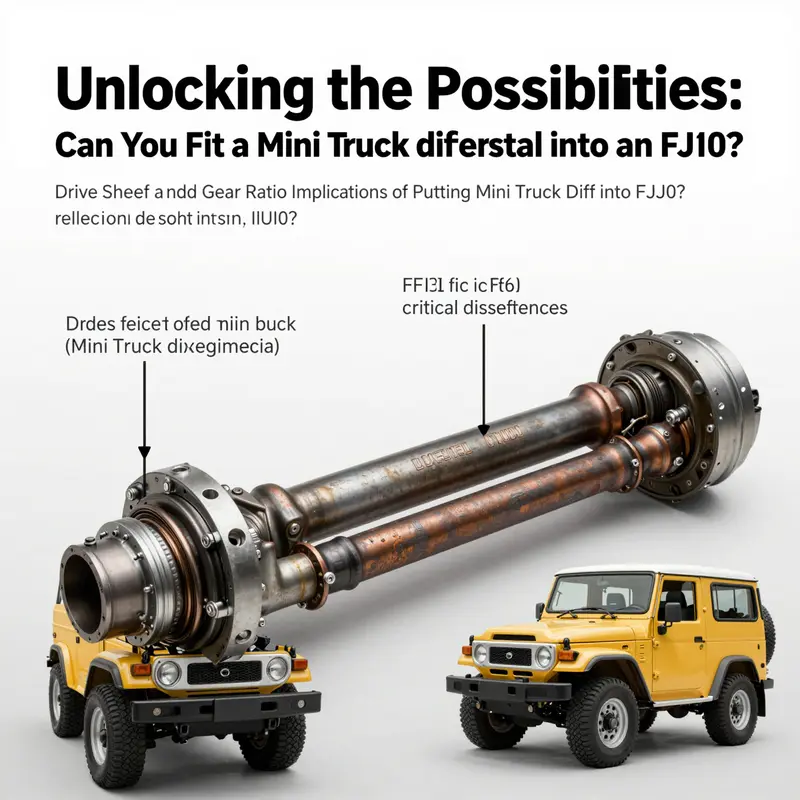
The impulse to swap a differential from a smaller, lighter truck into a stalwart, classic SUV like the FJ40 is born from a desire to squeeze more traction, durability, or a certain character out of a legendary platform. Yet the deeper you dive, the more the project reveals itself not as a simple bolt-on upgrade but as a full recalibration of the drivetrain’s physical language. The FJ40 is built around robust, no-nonsense engineering that assumes a very specific relationship between drive shafts, axles, gears, and the way torque travels from the engine to the wheels. A mini truck differential, no matter how strong or clever its design, does not automatically fit that language. The result can be a cascade of alignment fears, vibration, and safety concerns if the project is pressed without a patient, technical approach. This chapter traces the core consequences of such a swap by following the two most consequential threads: the drive shaft system and the gear ratio regime, two levers that determine how a vehicle actually behaves when the road or trail demands everything from a hill climb to an obstacle negotiation.
From the outset, the drive shaft is the first boundary line between theoretical capability and practical reality. The FJ40’s drivetrain depends on solid axles and a relentless, straightforward path for torque to travel from the transmission to the wheels. In this setup, the drive shafts, their joint angles, and their mounting points are all sized to harmonize with a particular set of axle housings, yokes, and flange interfaces. A mini truck differential, by contrast, is usually paired with a narrower or differently engineered axle tube, distinct flange bolt patterns, and a pinion angle that assumes a different front-to-rear geometry. The moment you try to splice one system into the other, the first domino to fall is the drive shaft angle. Even small mismatches in pinion angle can magnify into vibrations, accelerated U-joint wear, and, worst-case, a loss of uniform power delivery at critical moments on rough terrain. The result is not just discomfort or noise; it is a real risk of joint fatigue and eventual failure under load. The consequence is a vehicle that seems to hammer itself through the trail rather than glide with the predictable, controlled torque on which the FJ40’s reputation rests.
The challenge of drive shaft compatibility goes beyond a single angle. It encompasses the length of the shafts, the diameter of the tubing, and the precise geometry of the joints at both ends. On the FJ40, the rear shaft must accommodate the differential’s output flange, the pinion, and the suspension’s articulation without colliding with the chassis or the control arms during full suspension travel. A mini truck differential, selected for a different chassis geometry, often comes with an output flange or spline count that simply cannot be matched to the FJ40’s universal joints without redrilling, re-flanging, or fabricating entirely new adaptors. And even when a conversion seems possible on paper, the physical reality—sheet metal clearance, brake lines, fuel lines, and exhaust routing—suddenly demands a level of custom fabrication that dwarfs what hobbyists typically expect from a weekend swap. The work is not merely mechanical but spatial: you must map every potential interference point, every potential hot-spot where a line or a tube could melt, rub, or abrade away under vibration. The more you map, the more you realize that the project is about preserving or re-creating a very precise choreography rather than improvising a one-off fix.
One cannot ignore the bolt-pattern and mounting interface realities either. The FJ40’s axle housings and the transmission cross member are designed around a particular spacing, a precise bolt pattern, and a predictable mounting height. A mini truck differential often lives in a world of different mounting footprints, another set of bolt layouts, and an axle tube diameter that simply doesn’t line up without intrusive machining. The practical implication is that even if the mechanical ends line up in theory, the reality is that you spend a good deal of the time chasing idle clearances, shoring up brackets, and fabricating new mounting points. The stage is set for a deeper dilemma: alignment is not a one-off alignment; it is a continuous process of maintaining balance across the drivetrain angles as the suspension moves, the vehicle loads, and the tires contact varying terrains. When the angles drift with travel, all that torque has to be transmitted through more complex, less forgiving joints; the potential for vibration rises, and with vibration comes wear, hotter heat, and a higher risk of differential failure in the field.
If drive shaft geometry forms the first boundary, gear ratio forms the second and equally unforgiving boundary. The FJ40, especially in its robust, off-road configuration, lives with gear ratios that favor torque multiplication at very low speeds—a necessity for crawling, steep climbs, and slow, rock-strewn segments. The rear differential is selected to harmonize with that mission: a relatively high reduction ratio, designed to keep wheels turning under heavy loads with ample torque while maintaining manageable engine RPMs in the off-road range. A mini truck differential, however, is often selected for different applications where ride comfort, fuel economy, or city living is prioritized. Its gear set is typically tuned for different drag, different input torque curves, and different torque handling characteristics. When you transplant such a gear set into an FJ40, you are not simply swapping gears; you are rewriting the torque landscape under the vehicle. The direct consequence is a mismatch between engine speed, wheel speed, and the kind of traction the tires can deliver at low speed. On an obstacle-strewn trail, where you need maximum low-speed torque and predictable lugging ability, a misaligned gear ratio can translate into delayed engagement, bogging down on initial bite, or an initial surge that bucks the vehicle into a loss of momentum. The vehicle may feel strong at the top end, but the practical off-road tasks demand stability and frictionless control at the bottom end—precisely where the small differential struggles to cooperate with the larger system.
From there, the discussion slides into the nested complexities of compatibility in the context of the differential’s carrier type and the way the two axles manage power distribution. A classic solid-axle setup, like the FJ40’s, works in concert with a particular type of differential carrier, with strong bearings and a lubrication system tuned to the kind of service life that off-road abuse demands. A mini truck differential might bring a different carrier philosophy, perhaps one that prioritizes different clutch packs, different bearing preload, or even a different kind of lubrication flow. If you attempt to force a mismatch, the result can include uneven torque transfer across wheels, unpredictable locking behavior, or differential chatter that invites premature wear in the teeth and carrier bearings. In other words, you are testing the heart of the axle’s ability to manage load, to lock and unlock as needed, and to distribute torque in ways that maintain traction on uneven terrain. These are not cosmetic changes; they are fundamental alterations to how the vehicle answers the trail’s call.
The safety and legal implications of such a swap should be a routine part of the planning. When one replaces the center of gravity and momentum of the drivetrain with a mismatched component, the risk profile shifts. The vehicle’s handling characteristics can be altered in ways that are not intuitive. You may find yourself with a drivetrain that works fine under controlled lab conditions yet behaves unpredictably under off-road stress: sudden binding, unexpected wheel hop, or a tendency toward oversteer or understeer at critical moments. On rough terrain, such behavior is not merely uncomfortable; it is dangerous. Legal considerations follow from the safety implications. Stricter enforcement or inspection regimes in some regions may scrutinize drivetrain alterations for compliance with emissions, safety standards, and vehicle identification consistency. The potential for a hidden, noncompliant modification means that, in practice, this route can complicate ownership, registration, and the ability to drive the vehicle on public roads.
These are not mere theoretical musings. They reflect the practical, road-tested reality of how a drivetrain behaves when the physics inside the axles are altered. The fix is not to pretend the mismatch will disappear with a clever bracket or a longer driveshaft. The fix, if pursued at all, requires a deliberate, engineering-based approach: precise measurement of the existing geometry, careful selection of a differential that aligns with the FJ40’s axle and suspension layout, and a plan that embraces the required fabrication work as a system-level project rather than a collection of ad hoc adjustments. For builders who want to pursue a higher-risk, higher-reward strategy, the path rarely involves a direct swap. Instead, it is a careful, staged plan that could include upgrading to a purpose-built heavy-duty differential system designed to fit the FJ40’s dimensions and its load bearing requirements, plus a reassessment of gearing to preserve crawl capability and road drivability. Across that process, one truth stands out: compatibility is not a feature; it is a design constraint that governs the entire build.
To those who seek practical guidance from communities and builders who have walked this path, there is a wealth of experience that can illuminate the decision. The best advice is to treat any differential swap not as a bolt-on project but as a re-engineering task. Before you even acquire parts, you collect precise measurements for the frame, the suspension mounting points, the axle housings, the drive shafts, and the transmission outputs. You compare the pinion angles across full suspension travel, you map the potential for interferences with brake lines and exhausts, and you evaluate the thermal and lubrication requirements for the new arrangement. The process is meticulous because the consequences of shortcuts show up not in a glossy spreadsheet but in the form of drive line vibration, drivetrain noise, or, worse, catastrophic failure under load. It is a reminder that durability for off-road hardware is often built on conservative engineering rather than bold improvisation.
In the spirit of exploring credible paths, it helps to turn to resources that focus on the harmony of original components with careful enhancements. For enthusiasts who want to consider their options without losing sight of the FJ40’s fundamental design, community experiences and technical discussions are invaluable. A good starting point is to immerse in broader drivetrain discussions available on established hobbyist platforms and write-ups that emphasize the delicate balance between drive shafts, gear ratios, and axle geometry. These conversations reinforce the principle that any drivetrain modification should be guided by system-wide thinking rather than a single sensational capability. They also remind readers that, while a particular swap might be technically feasible in a controlled setting, it rarely translates into a reliable, driveable solution in the dirt without significant, precise engineering.
For those who want to explore real-world perspectives from builders and enthusiasts, the Mini Trucks Blog can be a helpful resource for understanding how small-truck components interact with classic chassis, even if those posts don’t describe a direct FJ40 swap. Mini Trucks Blog offers a broad lens on how people approach modifications, alignment challenges, and the practicalities of getting unusual combinations to behave respectably under real road and trail conditions. This kind of community-driven knowledge is invaluable when you confront the unknowns of a project that sits at the edge of conventional practice.
If one still wants a more systematic, technically grounded reference that covers the fundamentals of FJ40 drivetrains, the broader literature on off-road drivetrains is helpful. An external resource that discusses the technical considerations, available upgrades, and maintenance practices for classic off-road platforms can provide a sober, engineering-focused backdrop to any proposed swap. It is important to approach such resources with a critical eye, ensuring that recommendations align with the specific geometry and operating envelopes of your vehicle. The key takeaway is not to shy away from ambitious experimentation, but to pursue it within a disciplined framework that respects the vehicle’s original design intent and the realities of its physical constraints.
Bottom line: the idea of a direct, bolt-in mini truck differential swap into an FJ40 is, in most cases, impractical and fraught with risk. The most reliable way forward is to work within the established, proven pathways for improving off-road capability—paths that emphasize compatibility, geometry, and controlled performance. If the goal is to improve low-end torque, reliability, and traction without compromising safety or on-road legality, the prudent choice is to pursue purpose-built upgrades or carefully matched differential assemblies intended for this chassis, accompanied by appropriate gearing and strengthened driveshafts. This approach respects the vehicle’s original design while delivering meaningful improvements in the contexts where it truly matters: slow-speed control on challenging surfaces and long-term durability under relentless off-road use.
For those who want to explore community experiences and practical perspectives, consider delving into the broader conversations that accompany well-documented builds. These discussions often highlight the importance of preserving alignment, maintaining proper lubrication, and avoiding drastic compromises to the vehicle’s fundamental geometry. They remind readers that while creative engineering can open doors, it must do so without sacrificing the very attributes that define the FJ40’s rugged, reliable character. In the end, the journey is as valuable as the destination. It teaches a careful respect for mechanical harmony and honors the spirit of a platform that has endured for decades because its designers understood the importance of balance between torque, speed, traction, and the trails that demand both.
External resource for further reading: External Reference on FJ40 Drivetrain Fundamentals
Final thoughts
In conclusion, while the idea of swapping a mini truck differential into a Toyota FJ40 is exciting, it poses significant compatibility challenges requiring careful consideration. Differential sizing, axle configurations, and drive shaft alignments create a complex landscape for modification. However, with the right insights and expert consultations, owners can explore whether such changes could enhance their off-road experience. As you embark on your vehicle modification journey, remember to assess every element meticulously, ensuring that your classic FJ40 remains not just functional but drives its powerful heritage into new adventures.