

Understanding the Texas Street Legality Framework for Mini Trucks
Whether a mini truck is street legal in Texas comes down first to how the state classifies it. TxDMV and the county tax offices that process registration sort vehicles into defined categories — passenger cars, trucks, and off-highway or non-standard vehicles among them. A kei-class mini truck or an imported cab-over usually falls outside the passenger-car definition, which brings a different set of rules into play.
Size and origin change which requirements apply. A small imported truck was often not built to meet U.S. emissions or safety standards, and its dimensions can put it in a class the state treats differently. Origin matters for the same reason: a vehicle built for a foreign market and imported later is handled as a non-standard or gray-market vehicle, not a domestic one.
Federal and state rules stack on top of each other. NHTSA and the EPA set the national standards for vehicles entering the country and decide whether an imported truck can be brought in at all. Texas layers its own requirements on top for titling, registration, inspection, and road use. A truck can satisfy one layer and fail the other, so both have to be met before it counts as street legal.
Imported and non-standard vehicles usually need a VIN assigned or verified through a law enforcement inspection before Texas will title them. Only after the VIN is confirmed, the inspection it needs is passed, and registration is issued does the truck legally belong on public roads. For owners weighing options, understanding how to buy a pre-owned mini truck responsibly helps avoid a vehicle that cannot clear these steps.
To register or sell a street-legal mini truck in Texas, the vehicle has to meet a defined list of state requirements before it can share the road with full-size pickups. The core items to verify:
- Valid VIN or state-assigned VIN – The vehicle must carry a verifiable 17-character VIN. If it has no manufacturer VIN, Texas requires you to apply for a state-assigned number before titling.
- Proper titling and bonded paperwork – You need a clean, transferable title or a bonded title supported by customs forms and bills of sale, so the state can confirm lawful ownership. When you are picking up a used unit, it helps to know what to review first, as covered in this guide to buying pre-owned mini trucks.
- Passing the required inspection – The truck must clear the VIN verification Texas requires to title an imported vehicle, plus an emissions test if your county requires one. Brakes, steering, suspension, and structural integrity still have to be sound for the truck to be operated legally.
- Functioning lights and signals – Headlights, taillights, brake lights, turn signals, and reflectors must all work correctly so other drivers can see and anticipate your moves.
- Compliance with emissions rules where applicable – In counties that require emissions testing, the powertrain must meet the applicable standards or qualify for an exemption.
- Valid registration and proof of insurance – You must register the truck with your county tax office and carry the minimum liability insurance Texas demands of any motor vehicle.
- Roadworthy tires, mirrors, and windshield – Tires must meet tread and load standards, and the truck needs functional mirrors and an intact, compliant windshield.
How VIN Assignment Works for Mini Trucks in Texas
A Vehicle Identification Number (VIN) is the unique, permanent code that identifies one specific vehicle. In the United States, most cars and trucks carry a standardized 17-digit VIN that encodes the manufacturer, model year, plant, and production sequence. That number ties a machine to its title, registration, and history.
Imported mini trucks rarely follow that format, and that is where most registration headaches start. Many Japanese kei trucks and similar imports arrive with a shorter chassis number, often only 9 to 12 characters. Those numbers were issued under foreign manufacturing rules, not the 17-digit standard U.S. agencies require, so Texas does not recognize the original number as a compliant VIN.
With no standard identifier, the state has to assign one. That is where VIN assignment comes in. The Texas Department of Motor Vehicles (TxDMV) manages the process, authorizing inspections and issuing the replacement number. Nothing is issued until the vehicle itself is physically examined to confirm its identity and origin.
Documentation drives the whole process. Owners typically need the import paperwork, customs entry forms such as CBP Form 7501, a bill of lading, foreign registration records, and any manufacturer’s statement of origin. Together these documents prove the truck was lawfully imported and legitimately owned, and missing or inconsistent origin paperwork can stall a Texas VIN application for weeks.
Once the inspection and records check out, the state issues an assigned number and a label or plate is affixed to the vehicle. That number then flows onto the title application and registration. Buyers reviewing used inventory often weigh this step carefully, since a cleanly documented history makes any later inspection far smoother, as covered in this guide on buying pre-owned mini trucks. A mini truck VIN is only useful for street legality once it has been verified, assigned, and properly recorded by the state.
Key Takeaways
- A VIN is a unique vehicle identifier; US standard format uses 17 characters.
- Imported mini trucks often carry shorter, non-compliant chassis numbers.
- The TxDMV oversees VIN assignment and physical inspection.
- Import documents and origin paperwork are essential to the process.
- The assigned VIN becomes the basis for title and registration.
The paperwork usually tells you which path a truck is on. Choosing the right one when buying a pre-owned mini truck often comes down to which of these scenarios you are actually looking at.
| Scenario | Documentation Required | VIN Status | Likely Legality Outcome |
|---|---|---|---|
| Original import VIN (OEM Japanese chassis number) | Foreign title or export certificate, customs entry (CBP Form 7501), Bill of Lading, and a completed inspection on Form VTR-68-A | Retains the factory import VIN, typically 9-12 characters and often non-conforming to the 17-digit federal standard | Mixed; frequently denied a clean Texas title unless the truck clears an approved importer process or reaches the 25-year exemption, though a passing inspection can unlock registration |
| No VIN present (stripped, missing, or unreadable plate) | Physical VIN inspection, ownership affidavits, and a law enforcement or TxDMV inspection to verify the vehicle is not stolen | No verifiable VIN exists on the chassis, so an identity cannot be confirmed | Poor; usually blocks titling outright until the vehicle is inspected, an assigned number is issued, or ownership is legally proven |
| State-assigned VIN | Application for an assigned or state-issued VIN, inspection report, proof of ownership, and any supporting title or bill of sale | A new state-generated number replaces the missing or non-conforming identifier | Generally favorable; once assigned and inspected, the truck can often be titled and registered as a street-legal vehicle |
| Bonded title VIN | Surety bond equal to roughly 1.5x the vehicle value, ownership affidavits, VIN inspection, and an application for a bonded title through the county tax office | The existing VIN remains on the chassis and is recorded on the bonded title documents | Conditional; a valid path to registration, but the title carries a three-year bonded restriction and can face scrutiny for off-road or non-conforming imports |
The cleaner and more verifiable the VIN trail, the smoother the road to Texas street legality. Missing or non-conforming identifiers push you toward the assigned or bonded routes instead.
The Texas Safety Inspection Process for Mini Trucks
Once a mini truck has a Texas-assigned VIN, it still has to clear the inspection the state requires before it can be registered and driven on public roads. The routine safety inspection Texas ran for decades ended for most non-commercial vehicles on January 1, 2025, so owners are no longer chasing a yearly sticker. What still applies to an imported mini truck is the VIN inspection that confirms its identity, an emissions test if you register it in a county that requires one, and, for rebuilt or salvage vehicles, a safety review. Here is how the process runs and how to prepare for it.
Step 1: Scheduling the Appointment
The owner books a mini truck inspection at an authorized Texas inspection station. Because mini trucks are imported vehicles, not every station handles them, so confirming in advance that the location works with assigned-VIN vehicles prevents a wasted trip. Bring the title, proof of insurance, and the VIN assignment paperwork to the appointment.
Step 2: Documentation Check
The inspector reviews the paperwork first to confirm identity and legitimacy: the title application, the assigned VIN documentation, proof of ownership, and valid insurance. Any mismatch between the physical truck and the documents stops the inspection before the mechanical checks begin.
Step 3: VIN Verification
The inspector physically locates the assigned VIN plate and confirms it matches the number printed on the official documents. They check that the plate is securely attached and unaltered. This step prevents fraud and confirms the truck is the same vehicle described in the records.
Step 4: Safety Component Checks
Where a safety review is required, the inspector examines and tests the components that keep the truck roadworthy. Even when it is not, these are the items that have to work for the truck to be legally driven:
- Lights: Headlights, taillights, brake lights, turn signals, and reflectors must all function correctly.
- Brakes: Service brakes and the parking brake are tested for proper stopping power and balance.
- Tires: Tread depth, sidewall condition, and correct inflation are verified on every wheel.
- Steering: The system is checked for excessive play, smooth response, and secure linkage.
- Windshield: Glass must be intact, free of cracks in the driver’s view, and paired with working wipers.
- Mirrors: A rearview mirror and side mirrors must be present, adjustable, and unobstructed.
- Horn: The horn must sound clearly and operate from the driver’s position.
- Safety equipment: Seat belts, and where required, emergency or reflective gear are confirmed to be present and functional.
Faulty equipment is a leading reason vehicles fail roadside checks, which is exactly what Operation Safe Driver Week and its focus on vehicle condition is built around.
Step 5: Final Reporting
After all checks are complete, the inspector records the results on the official inspection report and issues a passing or failing determination. A passing report allows the owner to move forward with registration and plates. A failed report lists the specific defects that must be repaired and re-inspected before the truck can legally take the road.
Each stage builds on the one before it. Owners who gather documents early and take care of lights, brakes, tires, and other components ahead of time usually move through the inspection quickly and avoid a repeat visit.
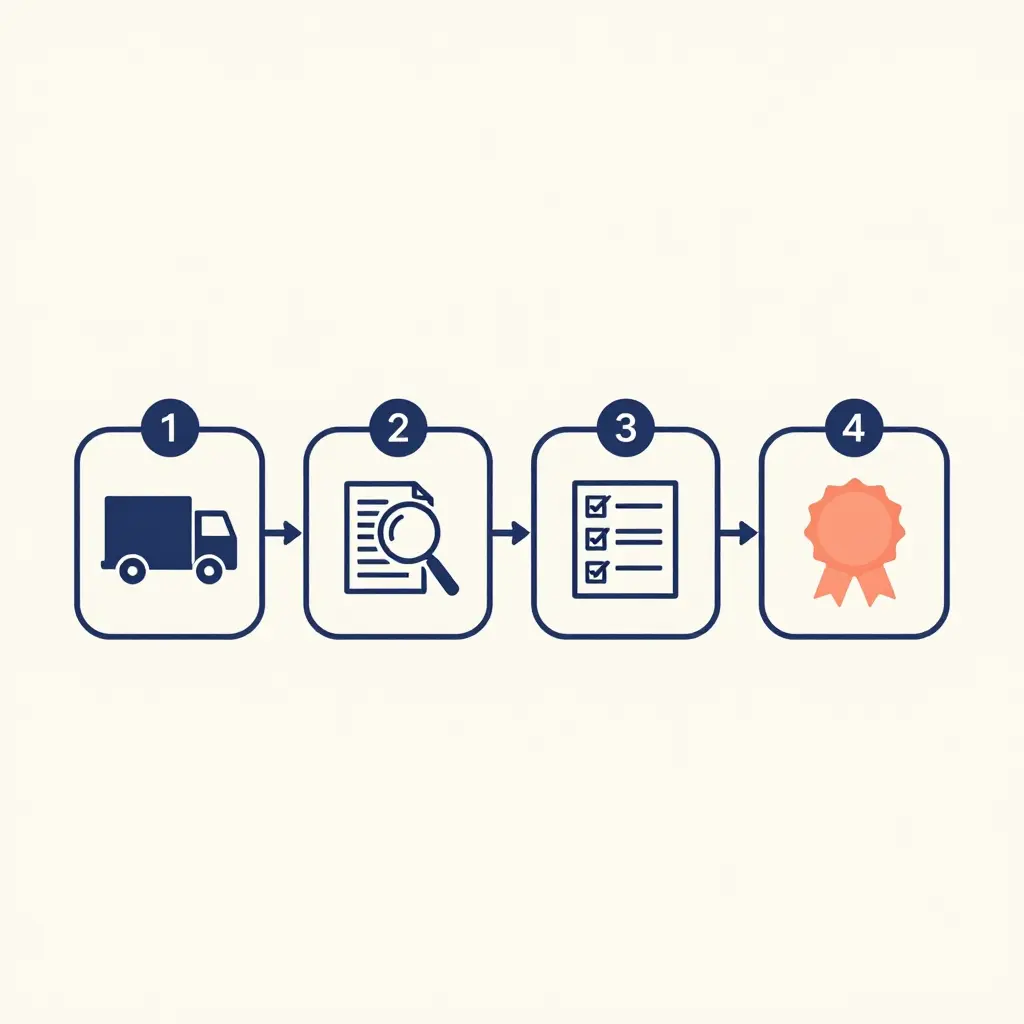
The diagram lays the process out as a straight line: present the vehicle, verify its documents, complete the checklist, and either get approval or get flagged for repair.
Common Reasons Mini Trucks Fail a Texas Inspection
A mini truck Texas inspection is the last hurdle between a fun import and a legal daily driver. Vehicles that show up with mismatched paperwork or missing equipment get turned away fast. These are the problems owners run into most.
Missing or Mismatched VIN
Imported kei trucks often arrive with only a JDM chassis number, not a 17-digit VIN. Inspectors cannot verify a title against a number that does not exist in state records, so the vehicle fails inspection on the spot. The fix is to complete a VIN assignment or reassignment through the county tax office and attach the new plate before scheduling a re-test.
Non-Compliant Lighting
Headlights aimed for left-hand traffic, missing side markers, or absent turn signals guarantee a rejection. Lighting must meet federal standards. Owners typically replace or re-aim units, add DOT-approved reflectors, and confirm every turn, brake, and hazard function works.
Inadequate Braking
Worn pads, leaking lines, or an ineffective parking brake fail the safety portion. Brakes must hold the vehicle on a grade and stop it evenly. Servicing the system and documenting the repair resolves this.
Worn Tires
Tires below the legal tread minimum, mismatched sizes, or sidewall damage are automatic failures. Replacing them with correctly rated sets clears the issue.
Missing Safety Equipment
No windshield, wipers, horn, mirrors, or seat belts means no pass. Adding the required equipment brings the truck into compliance.
Documentation Gaps
Missing titles, insurance, or import forms stall the process. Owners should gather the bonded title, bill of sale, and proof of coverage before arriving.
| Issue | Consequence | Resolution |
|---|---|---|
| Mismatched VIN | Rejected immediately | Apply for VIN assignment |
| Bad lighting | Safety failure | Install DOT-compliant lights |
| Weak brakes | Safety failure | Repair and re-inspect |
| Worn tires | Automatic fail | Replace with rated tires |
| Missing gear | Fail | Add required equipment |
| Paperwork gaps | No test | Collect title, insurance, forms |
Every one of these items feeds into street legality, and most failures are fixable. The link below shows how often vehicles turn up not road-ready — results from 161 trucks found unfit for the road. Address these points early and a mini truck can pass cleanly on the first attempt.
Why Mini Trucks Get Turned Away at Texas Inspections
Not every rejection is mechanical. When Texas inspectors flag a mini truck, the reasons fall into a handful of repeating categories, and knowing them is the first step toward getting your vehicle street legal and keeping it that way.
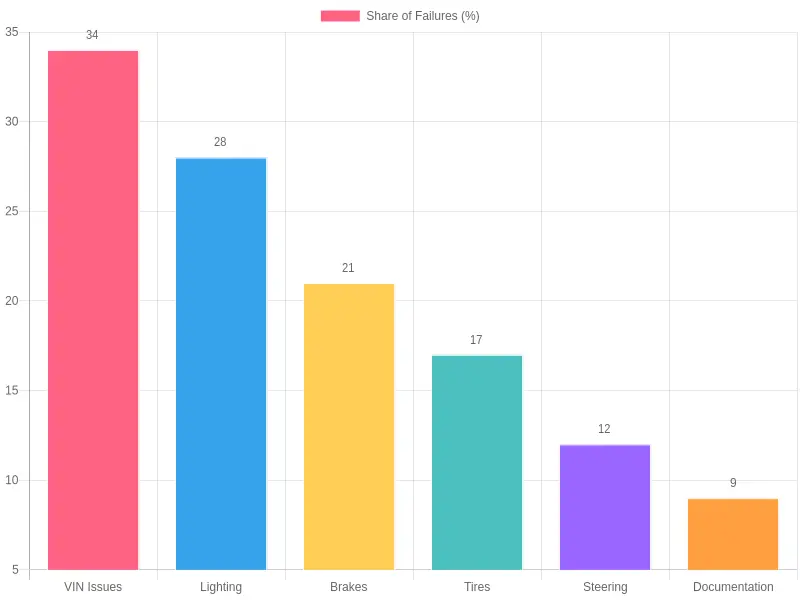
Takeaway: VIN issues are the most common single reason mini trucks fail Texas inspections, at roughly 34% of failures — an identity and paperwork problem more than a mechanical one.
How VIN Assignment and Inspection Combine to Decide Street Legality
Whether a mini truck can legally be driven on Texas roads is not one decision but two linked ones, and both have to go right: VIN assignment and a passing inspection. If either is missing or fails, the vehicle cannot be registered for road use.
Step 1: VIN Assignment Comes First
A mini truck imported from overseas often arrives without a VIN that any U.S. state will recognize. Before anything else can happen, the owner must obtain a proper VIN assignment. This process verifies the vehicle’s origin, confirms it meets the relevant federal and state standards, and issues an official identification number that gets recorded in the state system. Without that number, the vehicle effectively does not exist for registration purposes. No VIN means no title, and no title means the inspection stage can never even begin.
Step 2: Inspection Confirms What the VIN Promises
Once a VIN is assigned, the vehicle moves to inspection. A certified inspector checks the vehicle against its records, and where an emissions or safety check applies, verifies the equipment those rules cover. A passing inspection does one critical thing: it puts the state’s confirmation into the official record, showing that the specific vehicle tied to that VIN has been checked and found compliant. That record is what transforms a VIN number into actual street legality.
When One Element Is Missing
If the VIN is never assigned, inspection cannot proceed, and the truck stays off-road. If the VIN exists but the vehicle fails inspection, the owner receives a rejection and must make repairs before retesting. In both cases, the state record stays incomplete, and registration is denied.
Starting with a mechanically sound vehicle simplifies both steps, which is why reviewing options for buying pre-owned mini trucks helps buyers avoid inspection surprises.
VIN assignment creates the vehicle’s legal identity, and a passing inspection proves that identity is roadworthy. Both have to succeed before Texas grants street legality.
Owner Preparation Checklist: Before You Pursue VIN Assignment
Owners who get organized before applying tend to move through the Texas process with far fewer delays than those who apply first and collect paperwork later. The steps below run in order, because each stage depends on the one before it.
Gather your origin documents first. Start by collecting every record that proves where the vehicle came from and how you acquired it. This typically includes the import declaration, bill of sale, customs entry forms, and any foreign registration or export certificate. For a mini truck Texas owners purchase from an importer, a clean and complete document trail is the foundation of everything that follows. Missing paperwork here will stall the entire application.
Resolve title issues before anything else. If the vehicle has no title, a branding error, or a mismatched name, address that now. Contact your county tax office to clarify what Texas requires for your specific situation, and correct any discrepancies between the VIN on the frame and the VIN on your documents. A title problem discovered late can force you to restart the process.
Verify equipment and roadworthiness next. Confirm that lights, brakes, mirrors, seat belts, and emissions-related components meet Texas standards. Because many mini trucks arrive configured for off-road or agricultural use, inspection preparation often means adding or adjusting safety equipment before the appointment.
Arrange the inspection last. Once documents and equipment are in order, schedule the inspection with the appropriate authority. Bring your organized file, and confirm the appointment requirements in advance. Owners who connect with an established mini truck community often learn practical tips that make this final stage smoother.
Working in that order – documents, title, equipment, then inspection – keeps VIN assignment and inspection preparation on track from the start.
Document Completeness Impact on Inspection Eligibility
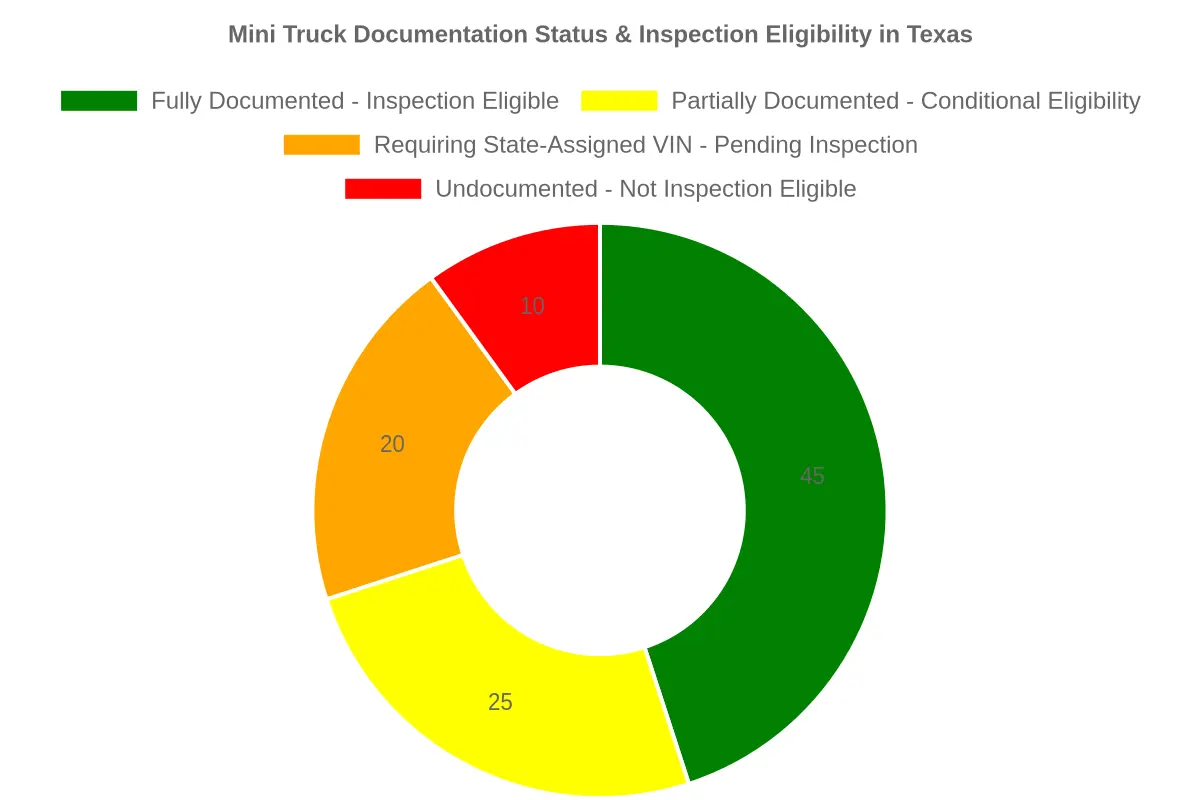
Across the mini truck community, roughly 45% of vehicles are fully documented and inspection eligible. The other 55% face partial, pending, or blocked eligibility depending on their paperwork and VIN status.
Conclusion: Documentation and Condition Decide Everything
Street legality for a mini truck in Texas rests on two things: a documented identity and a roadworthy vehicle. Neither works alone. A clean VIN paired with a failed inspection will not clear the bar, and neither will a solid truck with no title trail.
VIN assignment establishes identity. It gives a mini truck Texas-specific documentation that authorities can trace, verify, and register; without it, the vehicle stays an unidentifiable import no matter how well it runs. Inspection ties that identity to a real vehicle. It puts the state’s confirmation in the record and, where an emissions or safety check applies, verifies the truck meets the standards. When both fall into place, the pathway becomes predictable. Owners who source complete paperwork and bring mechanically sound vehicles move through registration smoothly; those who skip either step run into delays, rejections, or repeat inspections. Following a careful process, such as buying a pre-owned mini truck, helps reduce those risks.
For buyers, that means due diligence on two fronts at once: verify titles, customs records, and VIN plates before purchase, then evaluate brakes, lights, and structural condition before the inspection appointment. Treating documentation and condition as separate checks is how regulators actually review a vehicle, and the same split defines enforcement. Identity and condition are the measurable standards separating legal operation from non-compliance. Brand, price, and popularity do not enter into it: a mini truck is legal on Texas roads when its identification is assigned and recorded and its condition passes inspection.