
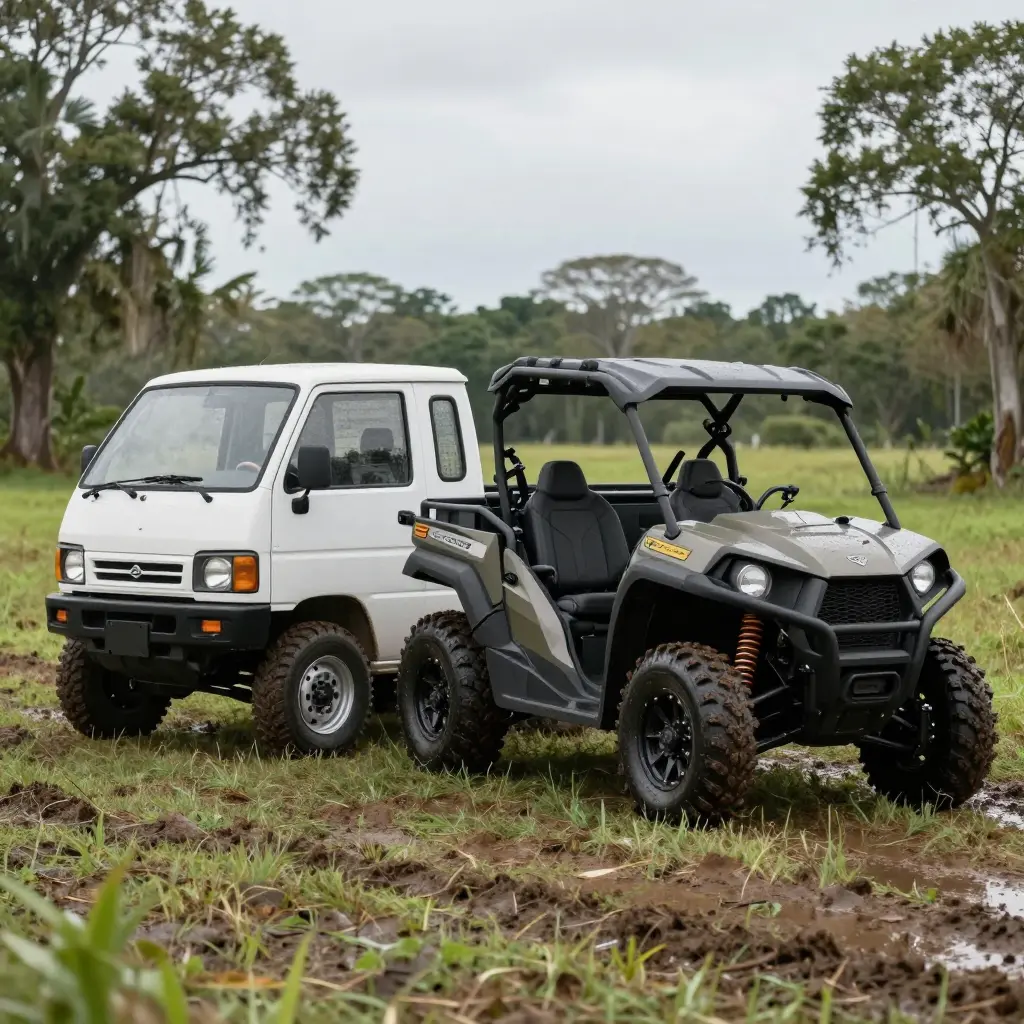
Why Florida’s Wet Pastures Force a Vehicle Decision
If you are choosing between a mini truck vs side-by-side UTV for a Florida farm, look at traction before anything else on the spec sheet. Seasonal rains, a high water table, and soil that stays saturated for days turn every acre into a traction test, and two-wheel drive often is not enough.
Ground conditions, not showroom numbers, decide which machine earns its keep here. Pastures that look firm in the dry season go soft after one storm, and the water table can stay high for weeks.
The comparison below covers the 4WD systems in each class, how they handle deep mud, five-year ownership costs, payload and towing capacity, and what Florida law allows on roads and public land.
There is also a pre-purchase checklist for used machines, since buying pre-owned mini trucks means checking traction hardware and drivetrain wear yourself.
Farmers here make this call every season. It comes down to how traction, weight, and ground pressure interact on your ground, and the answer is not the same for everyone.
The Core Problem: Saturated Soil, Standing Water, and How 4WD Actually Helps
Florida is flat, its soils run from heavy clay to sand, and it rains all year. That adds up to low soil bearing capacity, the ground’s ability to hold weight without giving way. On level land, water has nowhere to drain, so it pools until the soil stops behaving like dirt and starts behaving like soup. A wet pasture can turn impassable after one afternoon storm.
Traction, not horsepower, decides whether you get stuck. A 200-horsepower truck on street tires digs in faster than a modest 4WD machine with the right tread, because power without grip just spins.
The Three Physical Factors
- Soil saturation: Water fills the gaps between soil particles, weakening the bonds that hold the ground together and cutting its load-bearing strength.
- Tire contact pressure: The weight each tire pushes onto the ground. Narrow, heavily loaded tires concentrate force and sink; wider tires spread it out.
- Drivetrain distribution: How torque travels from the engine to the axles and wheels, which determines whether pulling power reaches firm ground or just spins a buried tire.
4WD (four-wheel drive) sends engine torque to both the front and rear axles, so all four wheels can pull; all-wheel drive does the same job, often automatically. Mud is saturated soil and water mixed into a soft, slippery mass, ground pressure is the force a vehicle exerts per unit of ground area, and flotation is a vehicle’s ability to stay on top of soft ground instead of sinking into it.
By spreading torque and lowering ground pressure, 4WD keeps a machine moving through a wet pasture where two-wheel drive would stall. Understand that mechanism first, then talk to the local mini truck community before you compare models.
Powertrain, Ground Clearance, and Tire Options
On paper the two classes look close. In a soaked pasture, the hardware sorts them out fast.
Powertrain and Gearing
Mini trucks are Kei-based, with 660cc-800cc inline, liquid-cooled, fuel-injected engines, a 5-speed manual, and a real transfer case that gives you 2WD, 4WD, and low range (4L). Many add a mechanical rear locking differential. The setup crawls through gumbo mud at walking pace and delivers torque predictably, with no belt to slip.
Side-by-sides mostly use 700cc-1000cc gas or diesel engines driving a CVT belt, with modes from 2WD to 4WD to 4WD-lock and a front locking differential on premium trims. They feel quick, but belt heat and water ingestion are real risks in deep mud. Drivetrain layouts vary a lot between models, so it is worth comparing KingStar Kruzr specs and features before you buy.
Ground Clearance
Mini trucks offer roughly 7.5-9.5 inches of clearance, with approach angles near 30-40 degrees and departure angles of 25-35 degrees. UTVs clear more ground: 10-14 inches, with approach angles from 60 degrees up. That extra air matters when rutted lanes hide stumps, but the truck’s longer wheelbase bridges soft spots a short UTV drops straight into.
Tire Selection
Tires decide flotation. Mini trucks typically wear narrow agricultural or turf treads about 8-10 inches wide, which cut through slop and leave less rutting on tender pasture. Side-by-sides fit wider 25-30 inch all-terrain or mud-terrain tires whose lugs self-clean and claw through muck.
| Spec | Mini Truck | Side-by-Side UTV |
|---|---|---|
| Engine | 660-800cc inline, liquid-cooled | 700-1000cc gas or diesel |
| Transmission | 5-speed manual | CVT belt drive |
| Drive modes | 2WD, 4WD, 4L low range | 2WD, 4WD, 4WD-lock |
| Ground clearance | 7.5-9.5 in | 10-14 in |
| Approach angle | 30-40 deg | 60+ deg |
| Tire size | 8-10 in wide, ag/turf tread | 25-30 in, all-terrain or mud-terrain |
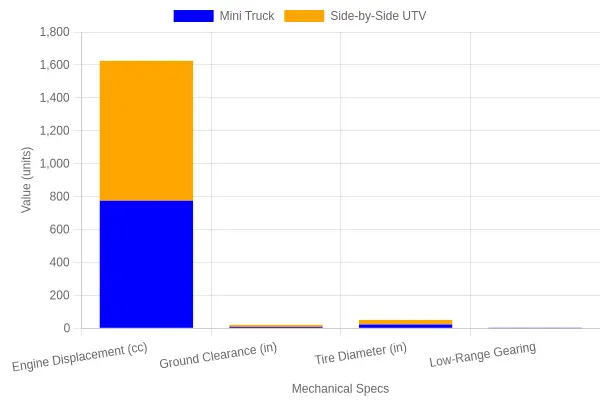
The UTV has the edge in clearance and tire bite. The mini truck has the edge in gearing, manual control, and predictable low-speed grunt through wet-season mud.
The table below compares the two classes spec by spec, from drivetrain and clearance to payload and seating.
Mini Truck vs Side-by-Side UTV: Key Specifications
| Specification | Mini Truck | Side-by-Side UTV |
|---|---|---|
| Drivetrain type | Rear-wheel drive with part-time 4WD | Part-time or on-demand 4WD, some full-time AWD |
| Engine category | Small-displacement inline gasoline or diesel (approx. 0.6-1.5L) | Single- or twin-cylinder gasoline, some diesel or electric (approx. 400-1000cc) |
| Selectable 4WD | Yes, manual 2WD/4WD, often with low range | Yes on most utility models, plus 2WD/4WD and 4WD Lock modes |
| Locking differential availability | Commonly available; rear (and sometimes front) on 4WD trims | Rear diff-lock available on many utility models; varies by brand |
| Ground clearance | Approx. 6-9 in stock; lift kits common | Approx. 10-14 in, higher from the factory |
| Cargo bed payload capacity | Approx. 770-1,760 lb depending on model | Approx. 600-1,000 lb typical |
| Towing capacity | Approx. 1,000-2,000 lb, some higher | Approx. 1,500-2,500 lb depending on model |
| Seating | 2 (bench or buckets) inside an enclosed cab | 2 to 6 in side-by-side bench seating |
| Fuel type | Gasoline or diesel | Gasoline, some diesel or electric |
| Typical use on wet ground | Enclosed cab and heavier footprint; 4WD and aggressive tires help traction but weight can sink in soft mud | Lighter weight and higher clearance improve flotation on wet pasture; widely favored in muddy Florida conditions |
A side-by-side UTV usually wins on flotation and ground clearance in wet pasture, while a mini truck delivers more enclosed-cab utility and payload. The right pick depends on whether mud or hauling costs you more, which matters when you are evaluating a pre-owned mini truck as a budget-friendly option.
Total Cost of Ownership: Where the Real Money Goes
Sticker price is only the start. Over five years, the real cost sits in fuel, tires, parts, and repairs.
Purchase Price
New side-by-side UTVs typically run $12,000-$25,000, while a clean pre-owned mini truck often lands between $6,000 and $15,000. That head start compounds, so review pre-owned value and inspection points before you buy.
Operating & Fuel Costs
Mini trucks run small gasoline or diesel engines and haul heavy loads cheaply. UTVs burn more fuel per acre worked, and the gap widens every season you rack up hours.
Tires, Parts & Maintenance
Both classes need oil, filters, and brake checks every 50-100 hours. Wet pasture drives the rest. Standing water cracks sidewalls, packs mud into wheel bearings, and corrodes undercarriage protection, so expect more tire swaps, U-joint and CV wear, and rust repair on either machine. A solid 4WD system gets you through muck, but it does not stop moisture from eating drivetrain parts.
Resale Value
Mini trucks tend to hold value longer on agricultural demand and their reputation for durability. UTVs depreciate faster once the first owner upgrades.
Budget an extra 15-20% a year for accelerated wear, and stay ahead of it with undercoating, greasing, and tire rotation. Maintain the machine before the mud does, and the cheaper one usually wins.
Mini Truck vs Side-by-Side UTV: What You’ll Actually Pay Each Year
The chart below estimates annual ownership costs across the four categories that hit a Florida farm owner’s wallet hardest.
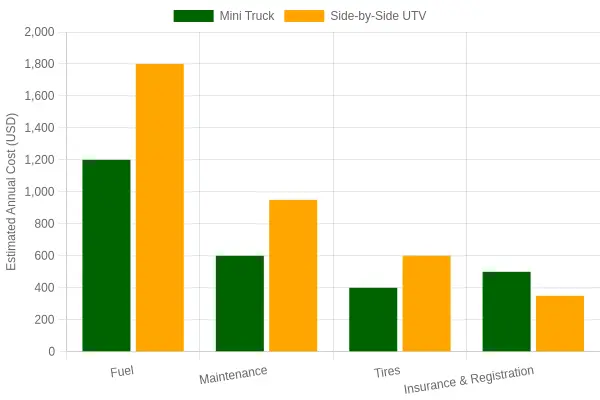
In this model, the side-by-side UTV runs roughly 32% more per year on the three biggest variable categories – fuel, maintenance, and tires – about $1,650 more annually than the mini truck. The mini truck’s only disadvantage is insurance and registration, where it costs about $150 more per year because of on-road titling requirements. Over five years, the variable-cost gap comes to more than $8,000; net of that registration difference, the mini truck is still roughly $7,500 ahead.
If this purchase competes with other big-ticket equipment on the farm, work out the long-term numbers before you sign. Managing finances as a first-time truck owner covers fuel, maintenance, and the rest of what ownership costs.
A Quick Note on the Numbers
The figures above are estimates for planning only. Actual costs depend on how many hours you run the machine, local fuel prices, how hard you work it in mud and wet pasture, and your insurance carrier. Treat this as a starting framework, not a guarantee, and adjust it to your operation.
Payload Capacity
A mini truck carries roughly 770-1,760 lb in a steel cargo bed about 6 feet long, depending on the model, so a pallet of feed, a bundle of fence posts, or a loaded tool chest usually moves in one trip. A side-by-side UTV tops out near 600-1,000 lb in a shorter, sometimes tilting bed, which means two or three trips for the same load.
Towing Ratings
Mini trucks pull roughly 1,000-2,000 lb through a standard receiver hitch, and some models list more – enough for utility trailers and small implements on the road. Side-by-side UTVs tow roughly 1,500-2,500 lb, but only at low speed and mostly off-pavement, so road travel with a loaded trailer stays off the table.
Hitch Configuration
Mini truck hitches accept common ball mounts plus wiring for trailer lights and brakes. Side-by-side UTV hitches are 2-inch receivers restricted to light trailers and are not highway-rated.
Realistic Florida Tasks
Both handle hauling feed and moving tools. Fence posts and trailer work on the road favor the mini truck. Compact side-by-side UTVs win narrow gateways and tight pens, but not bulk loads.
Weight and Wet Pasture
Weight raises traction only until the tires break through the surface. On wet pasture, saturated soil ruts fast and compacts deeper. Lighter side-by-side UTVs float better; a fully loaded mini truck digs in and leaves lasting tracks.
Deciding
Match bed size, towing rating, and ground pressure to your real loads. Compare mini truck models and specs first.
Factors to Weigh Before You Buy
The choice comes down to matching one machine to your ground, chores, and budget. If you are considering a used import, start with a primer on buying pre-owned mini trucks. Then weigh these against your daily work:
- Mud traction – Aggressive tires and a genuine 4WD system decide whether you crawl through soup or sink to the axles after a summer downpour.
- Ground clearance – Extra clearance keeps the undercarriage off root balls and deep ruts, especially in low, boggy corners.
- Payload capacity – Hauling feed, fence posts, or a full sprayer tank needs a bed rated for working weight, not weekend groceries.
- Street legality – If you run errands or travel between parcels, confirm the vehicle can be titled, insured, and driven on public roads.
- Maintenance cost – Simple imports often sit at the affordable end of upkeep, while premium UTVs can carry pricey service schedules.
- Parts availability – Check that belts, filters, and consumables can be sourced quickly instead of waiting weeks on backorder.
- Seating needs – Count your passengers; two-seaters stay nimble and cheap, while crew configurations suit families and hired hands.
- Seasonal water conditions – Florida’s wet and dry seasons turn the same field into two different jobs, so plan for the worst months, not the best.
Start with drainage and soil type. Well-drained sandy ground rewards agility, lighter weight, and lower cost, so a nimbler rig makes sense. Heavy clay or chronically flooded pasture pushes 4WD, ground clearance, and aggressive tires to the top of the list.
Street Legality, Registration, and Insurance on Florida Farms
A mini truck and a side-by-side UTV often share a barn on Florida farms and almost nothing else legally. Knowing the differences upfront saves headaches later.
Titling and Registration
Mini trucks were built for overseas markets, and many do not meet U.S. federal motor vehicle safety standards, so titling and registration can be complicated and can change from year to year. Some Florida owners pursue limited agricultural or off-highway titling; the outcome often depends on the model and the county.
A side-by-side UTV, by contrast, is typically sold as an off-highway vehicle (OHV) and usually is not titled or registered for normal road use at all.
Operating on Public Roads
Florida law does permit some OHVs, including side-by-side UTVs, to cross certain public roads under limited circumstances, often to move between fields or reach adjoining agricultural land. Mini trucks tend to face stricter scrutiny and are frequently restricted to private property unless a specific exemption or local allowance applies. Neither should be assumed “street legal.”
Agricultural and Off-Highway Exemptions
Both vehicle types may qualify for agricultural or off-highway exemptions that cover low-speed operation on farm property and short road crossings. Those carve-outs are narrow and situational.
Insurance Considerations
A vehicle used mainly on private property may fall outside a standard auto policy. Many insurers treat a side-by-side UTV under a separate powersports or farm policy, while imported mini trucks can be harder to insure. Ask your agent about a farm or inland marine policy.
Rules change often, so confirm current local and state requirements with your county tax collector and the Florida DMV, and see what the Ocala mini truck community is saying, before you buy.
A Quick Visual Shortcut Before You Commit
The four questions that matter most on wet Florida ground: how saturated the ground gets, whether you need to drive on public roads, how heavy your typical cargo load is, and how many people you need to carry. The flowchart below maps those questions to the two machines most Florida operators end up weighing, a mini truck or a side-by-side UTV.
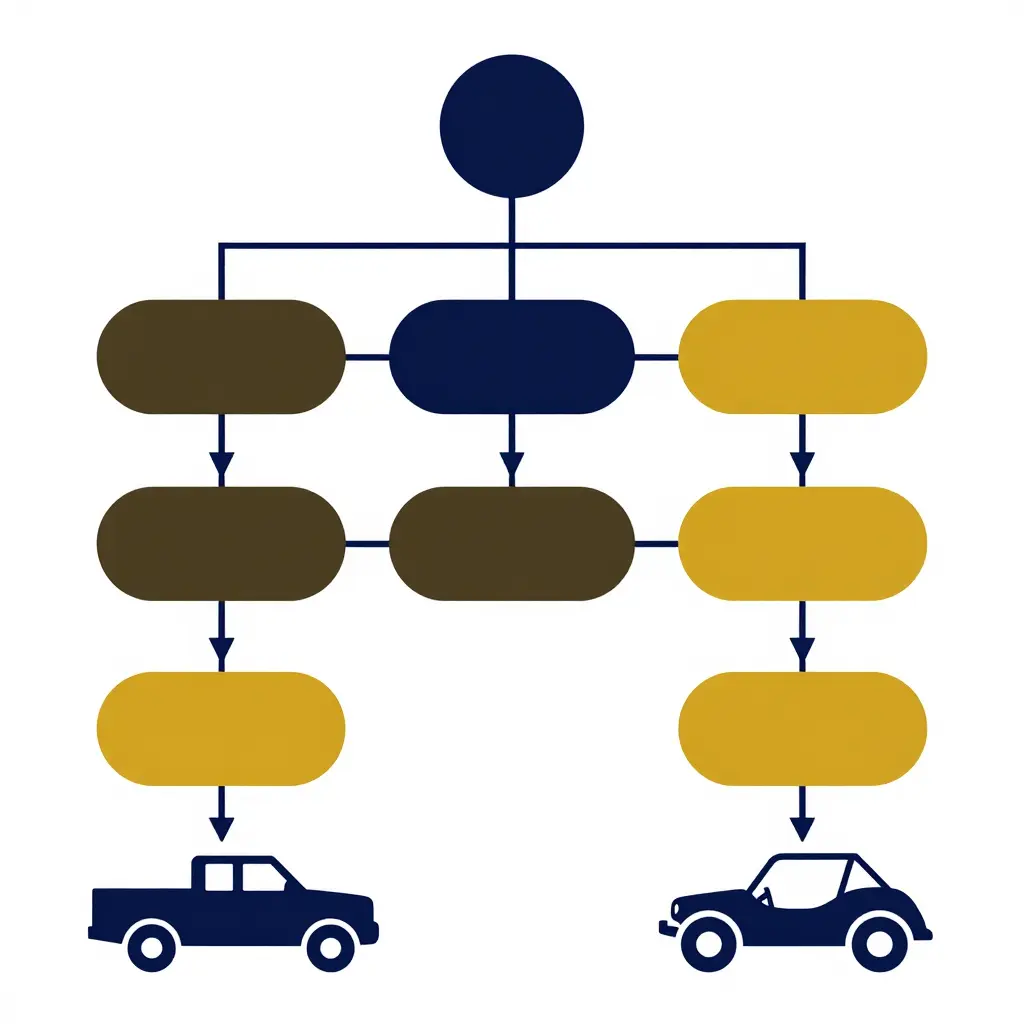
Read it top to bottom. Ground that stays boggy through the rainy season, heavy daily loads, and a need to share the road on the way to the feed store all point toward a mini truck. Tighter acreage, lighter loads, and a machine that never touches pavement point toward a side-by-side. Plenty of operations land in the middle, which is where an honest look at your real workload pays off. If you lean toward the truck, it is worth understanding what to check before buying pre-owned so you do not inherit someone else’s mud-season headache.
Treat the chart as a conversation starter, not a verdict. Those same four answers shape every later decision about tires, clearance, and payload.
The problem starts the moment saturated soil loses its load-bearing strength. On flat Florida ground, summer deluges trap water for weeks, and every pass risks turning pasture into a rutted bog. Both mini trucks and side-by-side UTVs cross mud and standing water, but they fail differently. A 4WD mini truck carries more weight per tire, so in deep mud it sinks until the chassis drags and four-wheel drive just spins four buried wheels. Lighter UTVs float higher and stay mobile in soupy conditions, yet they often lack the torque to pull heavy loads through the same slop.
Flotation Beats Raw Power
Flotation is a function of ground pressure, calculated as vehicle weight divided by tire footprint. Wider tires and lower inflation spread that load, keeping the machine on top instead of cutting deep ruts. Mini trucks benefit dramatically from wider flotation tires, while UTVs gain from larger-footprint upgrades. Weight distribution matters too: rear-biased loads dig deeper, so balance cargo across the axles and keep ballast modest.
Recovery and Self-Rescue
Carry a winch rated above your vehicle’s weight, sturdy rated recovery points, and a tow strap with no metal hooks that can become projectiles. Self-recovery techniques such as gentle throttle, reverse-and-roll, and traction boards limit the wheelspin that churns soil into permanent mud.
Timing Protects Long-Term Soil Health
Driving the same lines repeatedly compacts soil, smothers roots, and expands bare mud patches season after season. Access fields only after rainfall drains, rotate travel lanes, and lower ground pressure to preserve structure. Wider flotation tires, managed loads, and planning around weather keep Florida farms productive; comparing detailed model specs and features before you buy helps you match the vehicle to your ground.
Frequently Asked Questions: Mini Truck vs Side-by-Side UTV on Florida Farms
Here are the questions we hear most from ranchers, homesteaders, and property owners across the state.
Which vehicle handles deep mud better?
For truly deep, soupy mud, a side-by-side UTV with aggressive tires, high ground clearance, and low curb weight usually floats across the surface better than a heavier mini truck. When mud gives way to firmer, waterlogged clay, though, a mini truck’s weight and torque help it claw forward where a lighter UTV may spin. In the mini truck vs side-by-side UTV debate, deep mud favors the UTV and mixed terrain often favors the truck. Match the machine to the worst ground you regularly cross, not the easiest.
Is 4WD alone enough for wet pastures?
No. Four-wheel drive helps, but it is not a fix for saturated ground. 4WD sends power to all wheels, which improves traction and cuts the odds of getting stuck, but it cannot overcome tires packed with clay or ground that has lost all bearing strength. Pair it with the right tread and sensible driving habits and you get much further. Relying on 4WD with smooth or worn tires is the fastest way to bury an axle.
How does tire choice change performance?
Tires are arguably the biggest single factor in how any vehicle behaves on wet ground. Wide, aggressive-lug tires spread weight and bite into soft mud, while ribbed or turf-style tires minimize surface damage on established pasture. Tire pressure matters too: lowering it slightly increases the contact patch and flotation. If you upgrade only one thing, make it the tires.
Which option is cheaper to maintain?
Mini trucks generally cost less to maintain over the long run. They use common automotive-style parts, widely available tires, and simple diesel or gas engines many owners can service themselves. Side-by-side UTVs often carry higher prices for proprietary components and dealer-only service. For budget-conscious Florida farms, a mini truck frequently wins on total cost of ownership, especially when you are buying a pre-owned mini truck in solid condition.
Are mini trucks street legal in Florida?
It depends on how the vehicle is titled and equipped. Some mini trucks can be registered for road use in Florida when they meet lighting, safety, and titling requirements, but rules vary and others remain limited to private property. Confirm current registration and inspection details with your local tax collector’s office before purchasing. A quick phone call here prevents an expensive surprise.
How can I reduce pasture damage from vehicle traffic?
Drive when the ground is driest, and vary your routes so no single path gets churned into a permanent rut. Keep speeds low, avoid sharp turns on wet grass, and use lighter tires or lower pressure to spread the load. Rotating gate access points and laying gravel on high-traffic lanes also helps. Small changes in habit protect grass far more than any single machine upgrade.
Conclusion and Decision Recap
There is no single winner in the mini truck vs side-by-side UTV debate, and that is the honest answer. The choice comes down to your land: how well the soil drains, how conditions shift across Florida’s wet and dry seasons, whether you need to haul real weight or heavy trailers, and what street-legal registration you require. Two variables decide more than any spec-sheet headline. 4WD capability determines whether you keep moving when the ground turns soft, and tire selection determines how well that power reaches the mud. Get those two right and either machine earns its keep.
On the trade-offs, side-by-side UTVs shine in tight quarters, ride rough ground with more suspension travel, and trailer easily between properties. Mini trucks counter with a real cargo bed, higher payload, the possibility of road registration, and lower long-term cost per ton hauled. For a wet pasture problem that repeats every rainy season, that difference matters: a UTV tackles short, technical runs, while a mini truck moves feed, fence posts, and livestock supplies without a second trip.
If you are still weighing trims, a focused comparison of KingStar KruZr models by specs and features is a smart next step to match capacity and drivetrain to your workload. Then do the practical thing: review current inventory, confirm the specifications that matter most to your farm, decide on your drainage, hauling demands, and legal needs, and verify 4WD and tire setup in person. Buy for the ground you actually have, not just the easy season.