
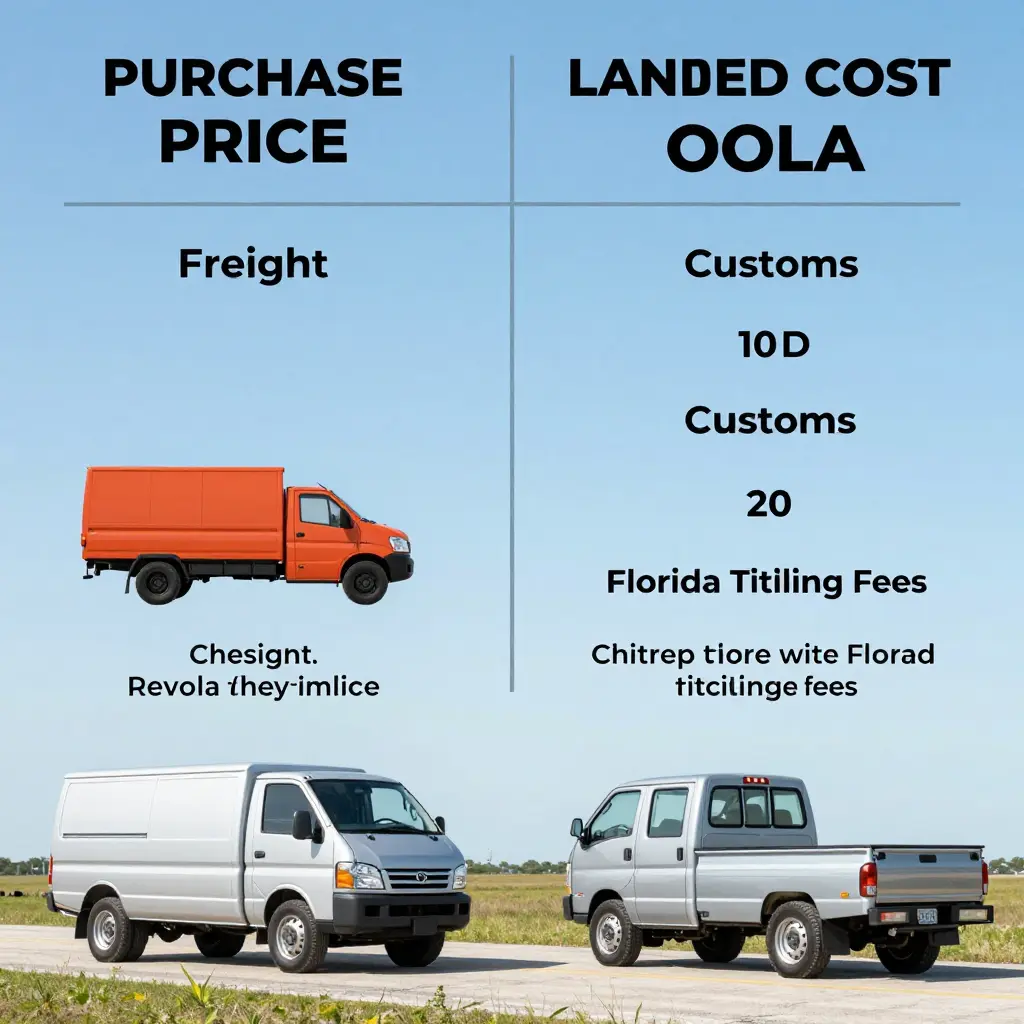
Purchase Price vs. True Landed Cost: Why the Sticker Is Only the Beginning
The first number you notice when you shop for an imported mini truck is the asking price. It is on the listing, it is what you negotiate over, and it feels like the real cost. It is not. What you actually pay to put a running, titled truck in your Ocala driveway is the landed cost, and it always runs higher than the asking price.
Landed cost stacks up in layers. The purchase price is the bottom one; four more sit on top before the truck is yours.
Freight. Moving a mini truck from an overseas seller to a U.S. port costs money. Ocean freight, terminal handling, and inland transport to Central Florida are quoted separately and rarely show up in the original advertisement.
Customs and duties. Every imported vehicle clears U.S. Customs and Border Protection. You pay applicable duties, tariffs, and processing fees based on the truck’s declared value and classification. These charges are mandatory, and they rise when tariff rates change.
Port and brokerage. A licensed customs broker handles the paperwork, and the broker’s fee, plus port storage, inspection, and release charges, becomes part of what you owe. Cutting corners here usually costs more in delays.
Titling and registration. Florida requires the vehicle to be titled and registered, which brings state fees, possible inspections, and plate costs that vary by county.
Add the layers and you have the landed cost, the only figure that reflects what you really spend. Buyers who plan ahead, and who understand managing the finances of first-time ownership, make better decisions because they see the whole picture instead of one tempting number.
Purchase Price vs Landed Cost Breakdown for a Mini Truck in Ocala
The number on the sales listing is the starting line, not the finish. The landed cost is everything you pay to ship the truck, clear it through customs, title it, and make it road-legal in Marion County. The line items below add up fast.
| Cost Component | Typical Range (USD) | Who Charges It | Notes |
|---|---|---|---|
| Base Purchase Price | $8,000 – $15,000 | Overseas dealer, auction, or exporter | The truck itself, before any shipping, duty, or paperwork. Condition and model drive the spread. |
| Ocean Freight | $1,200 – $2,500 | Freight forwarder / shipping line | Cost to ship from the overseas port to a US port. Sharing container space keeps it lower. |
| Marine Insurance | $150 – $400 | Cargo insurance provider | Protects the truck against loss or damage at sea. Usually a small percent of declared value. |
| US Customs Duty | $250 – $1,500 | US Customs and Border Protection (CBP) | Import duty based on the truck’s classification and declared value. Confirm the correct HS code first. |
| Customs Brokerage Fee | $100 – $300 | Licensed customs broker | Flat fee to file entry paperwork and clear your truck through CBP. |
| Port Handling/Storage | $150 – $500 | Port terminal / warehouse | Unloading, moving, and short-term storage at the US port. Extra days on the dock cost more. |
| Inland Freight to Ocala | $400 – $900 | Domestic trucking company | Hauling the truck from the port to Ocala. Distance and carrier choice set the rate. |
| Florida Title Fee | $75 – $90 | Florida HSMV / county tax collector | State fee to print a Florida title in your name. Paper vs. electronic changes the price slightly. |
| Florida Registration Fee | $30 – $225 | County tax collector (Ocala is in Marion County) | Annual fee based on vehicle weight. First-time Florida registrations may add a $225 initial fee. |
| Sales Tax | $500 – $1,000 | Florida Department of Revenue / tax collector | Florida’s 6% sales tax plus the Marion County surtax, applied to the taxable value. |
| Total Estimated Landed Cost | $11,000 – $22,000 | All of the above combined | Everything you pay, all-in, to have a titled, registered, road-ready mini truck in Ocala. |
The price you see overseas is not the full cost. Budget by mapping the journey stage by stage, because your mini truck freight cost is several layers stacked on the purchase price. Each layer has its own price and its own reason to move.
Ocean Freight: Container vs. RoRo
Ocean freight is the largest single line item, the price of crossing the water. You choose between two methods:
- RoRo (Roll-on/Roll-off): Your truck is driven onto a specialized vessel on its own wheels. For a single running vehicle it is usually the cheapest option, because you pay for space rather than a whole box.
- Container shipping: Your truck is secured inside a steel box, often a shared 20-foot container. It offers more protection from weather and rough handling, costs more, and may require partial disassembly to fit.
Rates also move with route and volume; port capacity and congestion can nudge them up or down. You can see how port capacity shapes shipping rates as terminals expand.
Marine Insurance
Marine insurance covers your vehicle while it is at sea. Expect to pay roughly 1-3% of the declared value. Skipping it saves a little upfront but leaves you exposed if the truck is damaged or lost in transit.
Port Handling and Storage
Once the ship docks, the truck must be unloaded, cleared, and staged. Port handling fees pay for the terminal’s labor and equipment. Storage, often called demurrage, is a daily charge that begins if you do not collect the vehicle quickly, and it adds up fast.
Inland Trucking to Ocala
Ocala is inland, so your truck needs a final leg by road from its port of entry. Many inbound vehicles clear through Florida ports such as Jacksonville, Tampa, or Miami, then finish the trip on a flatbed or car carrier.
How Freight Costs Vary
Your final ocean freight to Ocala figure swings on three things: the shipping method (RoRo is generally cheaper than container), the origin country (distance and route frequency both matter), and the vehicle’s size and weight (heavier, larger trucks cost more to move). The chart below shows how method and origin change the number.
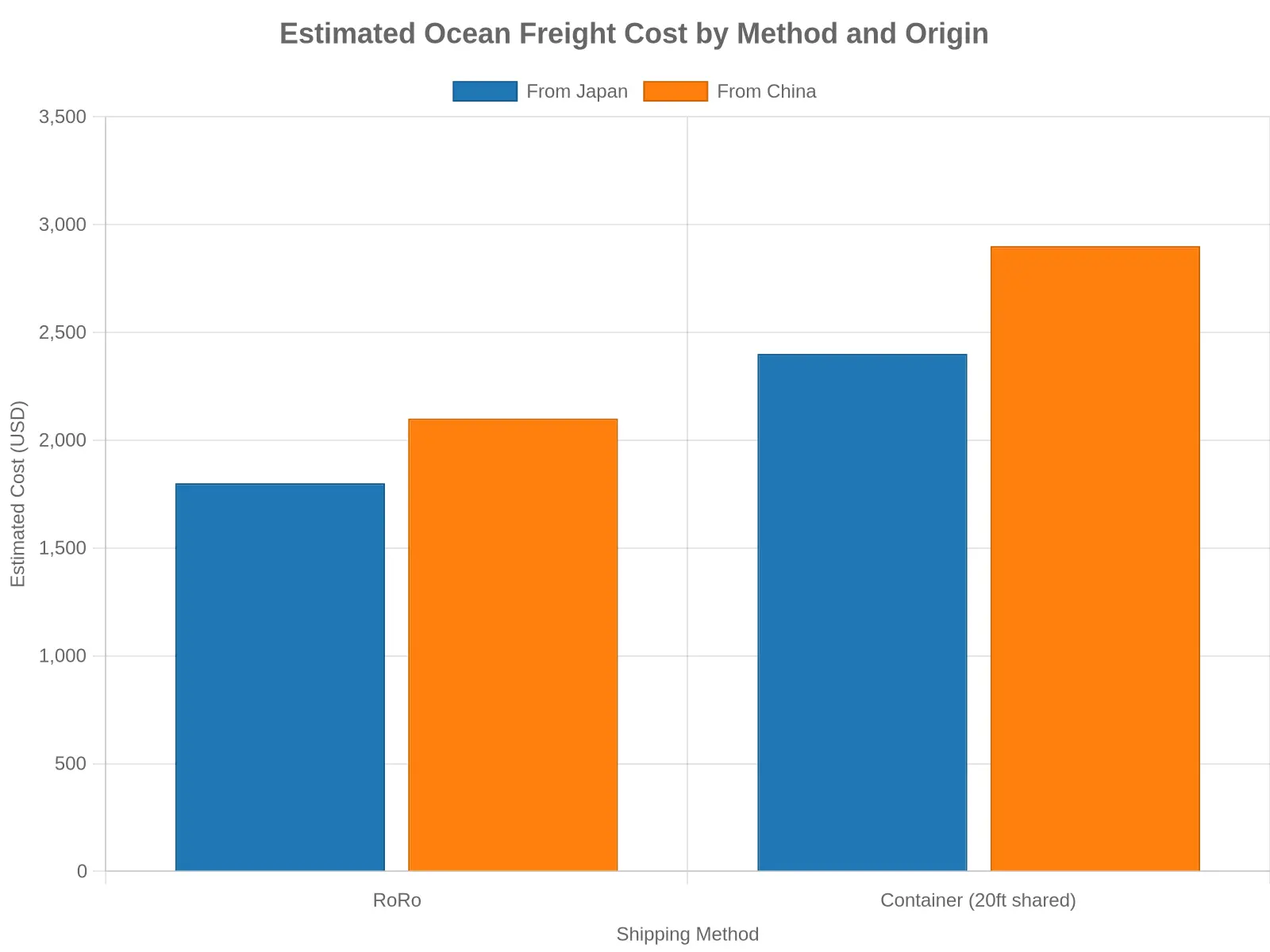
As a rough planning baseline, budget the following:
| Freight component | Typical cost range |
|---|---|
| Ocean freight (RoRo) | $1,800 – $2,400 |
| Ocean freight (container) | $2,400 – $3,500 |
| Marine insurance | 1-3% of declared value |
| Port handling and staging | $300 – $700 |
| Inland trucking to Ocala | $400 – $900 |
Add these figures to the purchase price to get the true landed cost, and always ask your freight forwarder for a written quote before you commit.
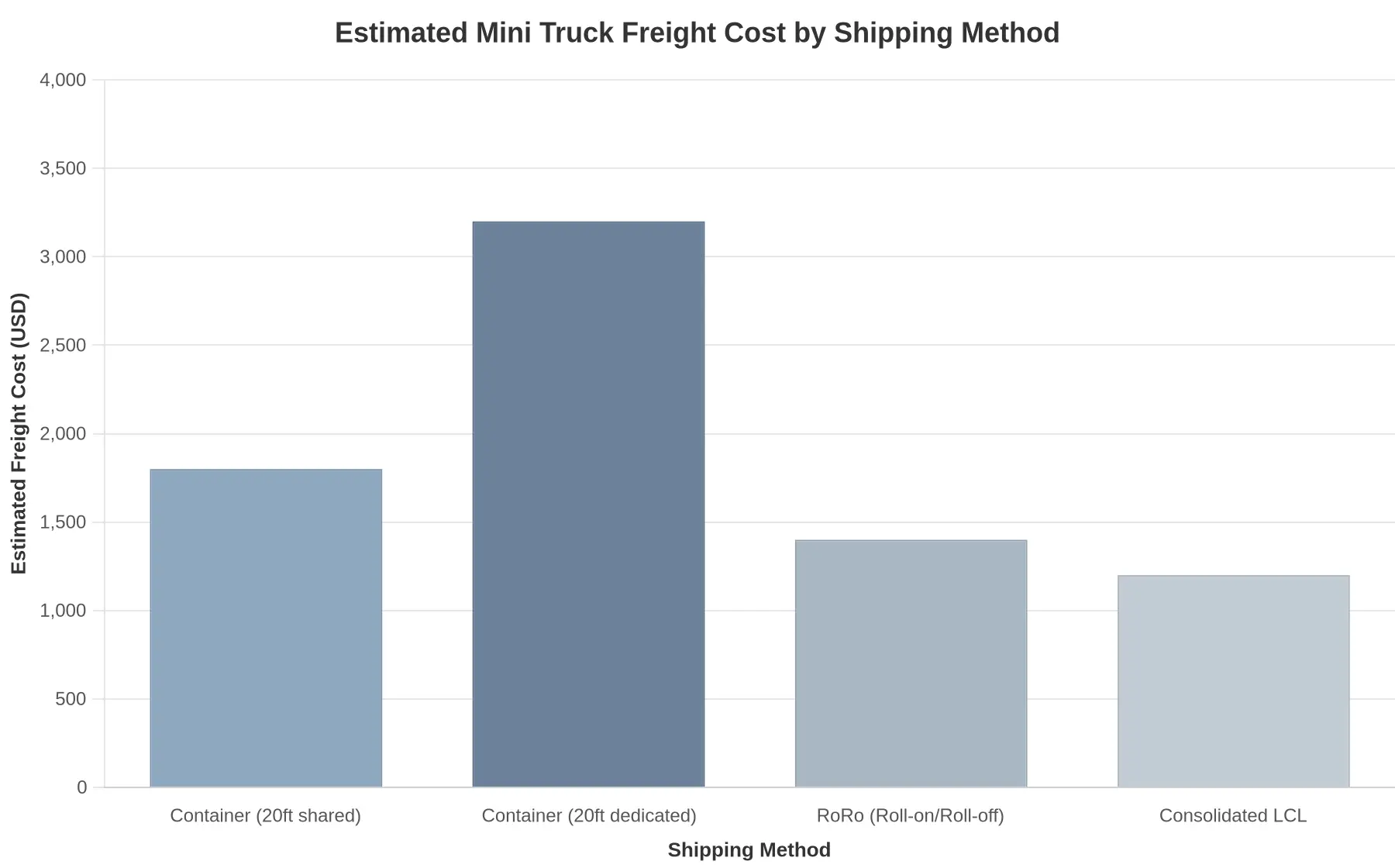
The chart above shows how freight costs differ across the shipping methods used for mini truck imports into Florida. A dedicated 20-foot container sits at the premium end (roughly $3,200) because you have the box to yourself and get priority handling. Consolidated LCL is the cheapest entry point (roughly $1,200) because you share space with other cargo. RoRo and shared containers fall in between, trading cost against handling convenience and port availability. Treat these as planning benchmarks; actual quotes depend on origin port, season, fuel surcharges, and inland trucking to Ocala.
Customs Duties and Import Charges: What Mini Truck Buyers Actually Pay
When a mini truck arrives at a U.S. port, the purchase price is only the starting point. Government and service fees stack up before the vehicle is released, and together they make up a large share of your import charges. For a Florida importer, knowing each line item prevents surprises at the port.
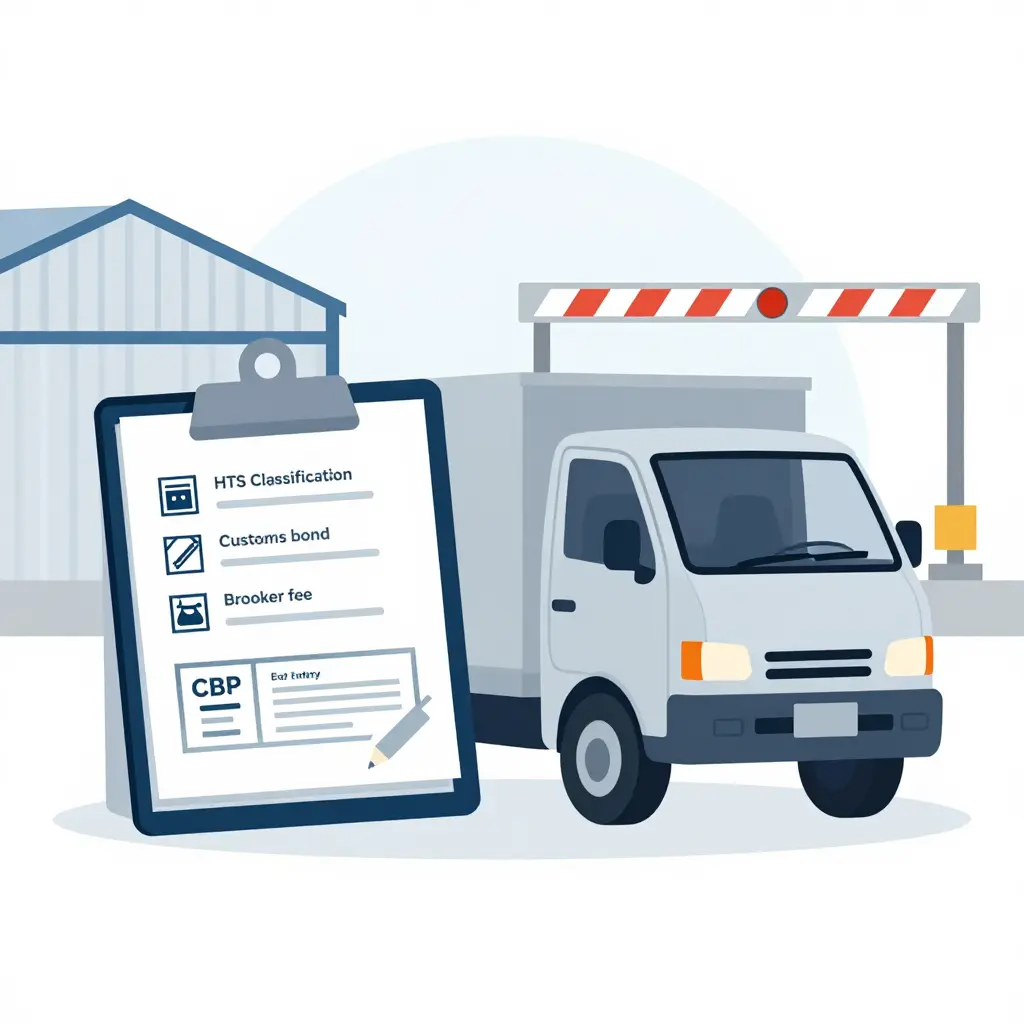
HTS Classification Sets the Duty Rate
Every imported vehicle gets a code under the Harmonized Tariff Schedule (HTS), the government’s master list of product categories and their tax rates. The HTS code is the biggest single factor in your mini truck customs duty, because each subheading carries its own percentage. Mini trucks and light trucks generally fall under heading 8704, and a change in classification can move the rate from roughly 2.5 percent to 25 percent. Getting the classification right, with paperwork to support it, is what keeps you paying the correct amount.
The Customs Broker Fee and the Customs Bond
A customs broker is a licensed professional who files your entry with U.S. Customs and Border Protection (CBP) and clears the vehicle. Brokers charge a flat fee, often in the range of $100 to $200 per shipment, and can also handle HTS classification and remote-location entries for an extra charge.
A customs bond is a financial guarantee that you will pay the duties and fees you owe. A single-entry bond covers one shipment and suits a one-time purchase. A continuous bond covers shipments for a full year and suits repeat importers. Bond costs are small next to the vehicle value but are mandatory for most commercial entries.
The Merchandise Processing Fee (MPF)
The Merchandise Processing Fee is an ad valorem charge that CBP collects to fund processing. It is calculated as a small percentage of the vehicle’s value, about 0.3464 percent, and is subject to a minimum and a maximum cap that CBP adjusts every fiscal year. Because the fee is capped, it stays modest on a single mini truck, but it still appears on your entry summary.
How Tariffs on Light Trucks Raise Landed Cost
Imported light trucks have long faced a steep tariff, often called the “chicken tax,” that can reach 25 percent of the vehicle’s value. That is ten times a typical passenger-vehicle rate, and it applies directly to the landed cost. On a $10,000 truck, a 2.5 percent rate adds about $250 in duty, while a 25 percent rate adds about $2,500. Because a higher rate multiplies against the vehicle value, it amplifies every percent of increase in your purchase price and freight. This is the same dynamic that reshapes pricing across the wider truck market, which is why tariff shifts deserve close attention when you compare quotes across suppliers.
Documents Buyers Must Prepare
A clean entry depends on complete paperwork. Mini truck buyers should gather the following before the vehicle ships:
| Document | Purpose |
|---|---|
| Bill of lading | Proves shipment and identifies the cargo |
| Commercial invoice | States the purchase price used to calculate duty |
| CBP Form 7501 | The entry summary filed with customs |
| EPA Form 3520-1 | Confirms emissions compliance |
| DOT Form HS-7 | Confirms the vehicle meets safety standards |
| Certificate of origin | Supports the HTS classification and any trade preference |
The purchase price is only part of the story. Duty rate, broker fee, bond, and the Merchandise Processing Fee together determine your true landed cost, and getting the HTS classification right is the fastest way to control that total.
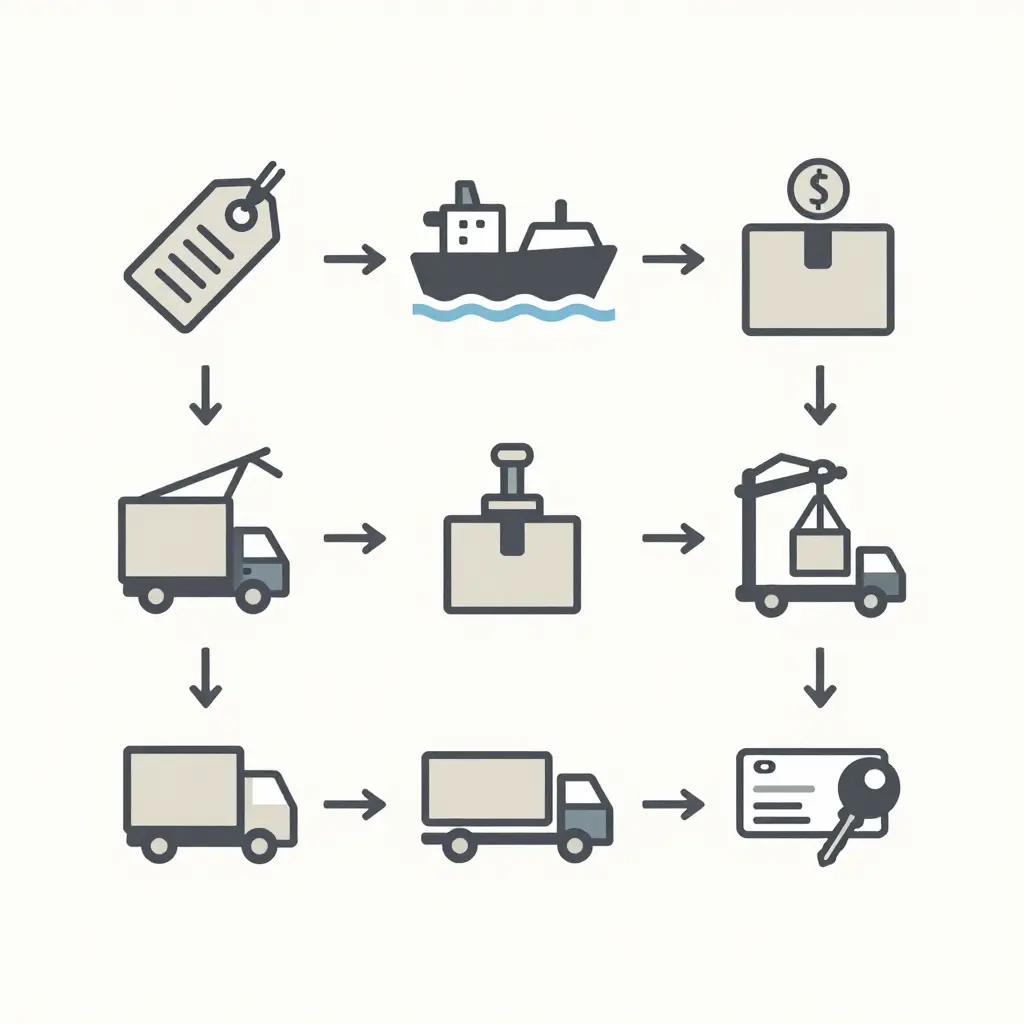
The diagram above maps the six stages that turn a low overseas sticker price into a full landed cost. Each arrow is a handoff that adds cost:
- Purchase Abroad – the vehicle is bought from an overseas seller, establishing the base purchase price.
- Ocean Freight – the truck is shipped across the ocean, adding freight charges and marine insurance.
- US Customs Clearance – import duties, tariffs, and customs brokerage fees are assessed on entry.
- Port Handling – terminal handling, unloading, and port storage fees accrue.
- Inland Freight to Ocala – the truck is trucked from the port of entry to Ocala, Florida.
- Florida Titling & Registration – the state title, registration, and plate finalize legal ownership.
Every stage adds cost before you turn the ignition, so budget for the sequence, not just the truck. If you are comparing options, look at the local market and other owners before you commit.
Florida Titling and Registration Fees for a Mini Truck in Ocala, Marion County
When you title and register a mini truck in Ocala, Marion County, your money goes to two government offices: the Florida Department of Highway Safety and Motor Vehicles (FLHSMV) and the Marion County Tax Collector. Knowing which fee goes where keeps your estimate accurate and stops you from double-counting when you total the landed cost.
Fees Paid to FLHSMV
The state sets and collects the statutory charges, and Florida titling fees are uniform statewide, so the same schedule applies whether you buy in Ocala or anywhere else in the state. For a typical mini truck, expect:
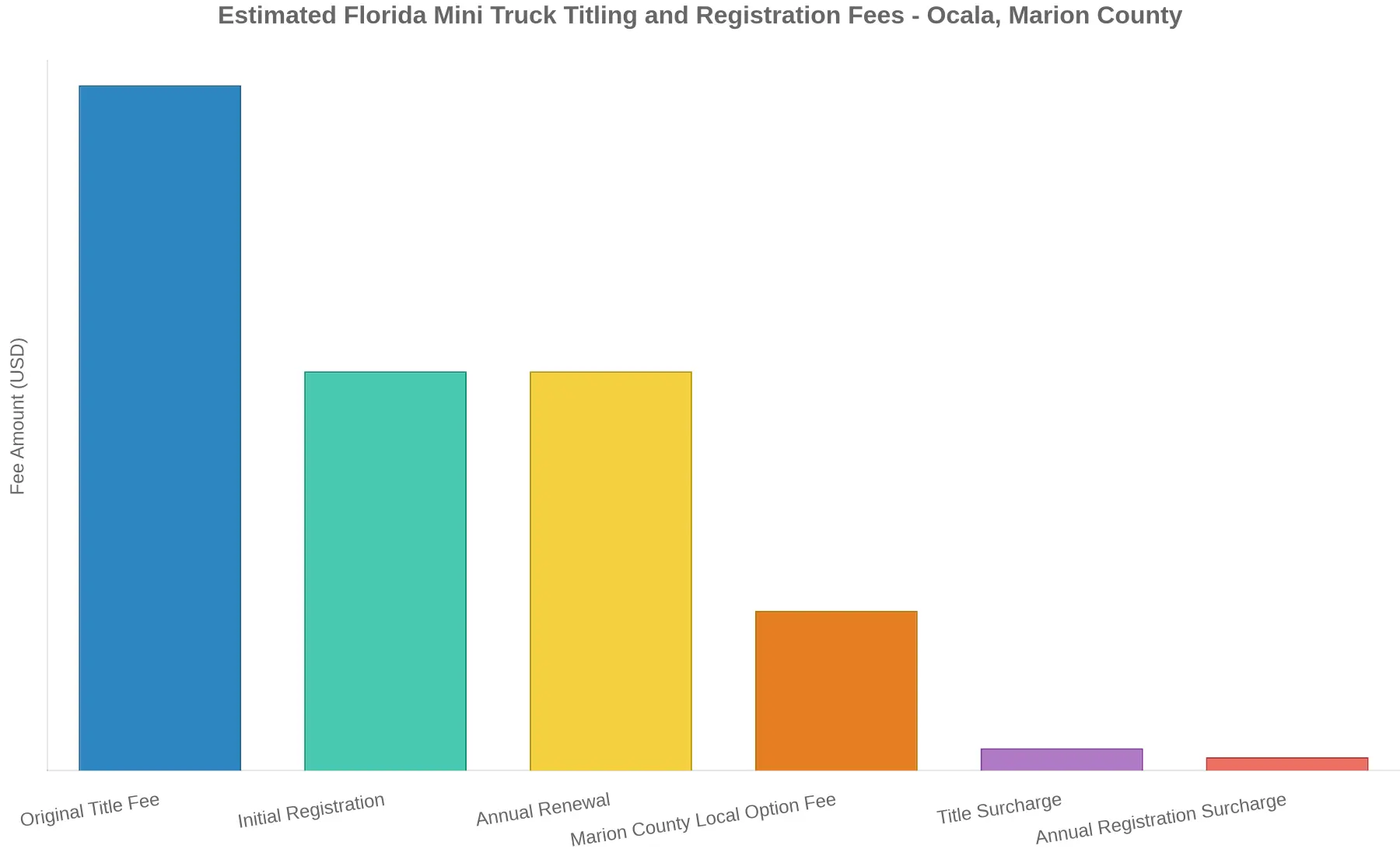
- Original Florida certificate of title: approximately $77.25, rising if a lien is recorded.
- Duplicate Florida certificate of title: roughly $75.25 when the original is lost or the prior owner never transferred it.
- Initial vehicle registration: the base registration fee, calculated from the truck’s net weight.
- Annual registration renewal: due each year, tied to your birthdate.
- Impact and surcharge fees: a flat title surcharge (about $2.50) plus an annual registration surcharge (about $1.50).
Fees Paid to the Ocala Tax Collector
The local layer is where Marion County diverges from the state baseline. The Ocala tax collector adds a Marion County local option registration fee of roughly $10 to $25, charged in addition to the state registration. This is a county-level amount, so it can change if local officials adjust the schedule. The tax collector’s office also processes the title work and collects sales tax on behalf of the state.
Sales Tax on a Florida-Titled Mini Truck
Sales tax applies when the vehicle is titled in Florida. The state rate is 6 percent, and Marion County adds a 1 percent discretionary surtax, for a combined 7 percent of the taxable purchase price. On a $12,000 mini truck, that comes to $840. Sales tax is often the single largest line item after freight and customs, so it belongs in the landed-cost math, not a footnote.
Fee Breakdown at a Glance
The table below summarizes the estimated charges. Values are representative and should be confirmed with the Ocala tax collector before purchase.
| Fee Item | Paid To | Typical Amount |
|---|---|---|
| Original Florida certificate of title | FLHSMV | ~$77.25 |
| Duplicate certificate of title | FLHSMV | ~$75.25 |
| Base registration fee (first-year, weight-based) | FLHSMV | ~$30-$50 |
| Annual registration renewal | FLHSMV | ~$30-$50 |
| Marion County local option fee | Ocala tax collector | ~$10-$25 |
| Title and registration surcharges | FLHSMV | ~$4.00 |
| Florida sales tax (6% + 1% county) | FLHSMV / tax collector | 7% of taxable price |
Note that the weight-based registration figure above is separate from Florida’s one-time initial registration fee of $225, which applies the first time a vehicle is registered in the state. If this is your first Florida registration, add it to the total.
FLHSMV vs. County Tax Collector: What Is the Difference
The distinction is structural. FLHSMV sets the statute-driven title, registration, and surcharge amounts that apply across Florida. The Marion County Tax Collector is the local agent that collects these sums, adds the county-level local option fee, and transmits the state portion upward. When you see one total at the counter, you are paying both an agency fee and a county service fee in a single transaction.
For first-time importers, this matters because the registration total is not just the state figure. It is state registration plus the county fee plus surcharges. Add sales tax and the one-time title cost and you have the real cost of putting the truck legally on Ocala roads. Buyers who skip this step routinely underestimate the landed cost by several hundred dollars. It also helps to plan for renewal timing and cash flow, since the annual registration recurs every year; see this guide to managing the finances of first-time vehicle ownership for a broader budgeting approach.
How These Fees Add to the Total Landed Cost
Picture a $12,000 mini truck. Add freight, customs duties, and brokerage. Then layer on the one-time title fee, the initial registration plus Marion County local option fee, the surcharges, and 7 percent sales tax. The purchase price is only the starting point; the titling and registration stack typically pushes the delivered cost meaningfully higher. Treating each fee as a separate, known line item is the most reliable way to compare a mini truck’s sticker price against its true landed cost in Ocala.
What the Numbers Reveal
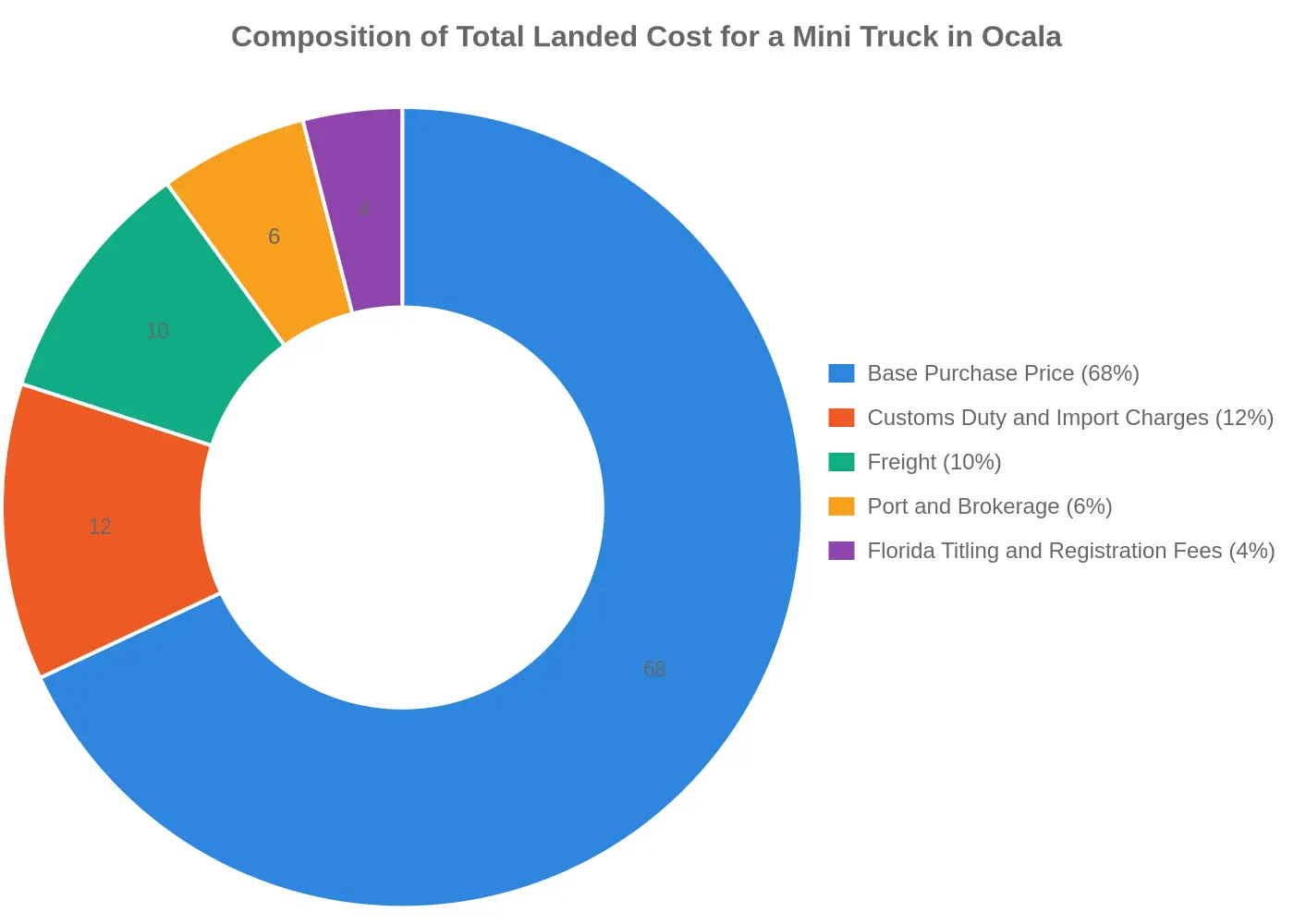
The doughnut chart above breaks the total landed cost of a mini truck in Ocala into five layers. The base purchase price dominates at roughly 68% of what you actually pay. The remaining 32% is where first-time importers often get caught off guard.
The layers stack up like this:
| Cost Category | Approximate Share |
|---|---|
| Base Purchase Price | 68% |
| Customs Duty and Import Charges | 12% |
| Freight | 10% |
| Port and Brokerage | 6% |
| Florida Titling and Registration Fees | 4% |
Why the Smaller Slices Still Matter
It is easy to fixate on the sticker price and assume the rest is rounding error. It is not. The four non-purchase layers come to nearly a third of your total outlay:
- Customs Duty and Import Charges (12%) – the largest add-on after the vehicle itself, driven by duty rates and import processing. Factor it in early if you are comparing models on paper.
- Freight (10%) – ocean shipping, inland transport, and handling all feed this slice, and it scales with distance, weight, and how the truck is secured for transit.
- Port and Brokerage (6%) – stevedoring, terminal fees, and the licensed broker who clears your paperwork. Skipping a knowledgeable broker rarely saves money in the long run.
- Florida Titling and Registration Fees (4%) – the smallest slice, and the one that makes your mini truck legal on Ocala roads.
The Takeaway
The purchase price sets the ceiling, but the landed cost is what leaves your bank account. Budget only for the vehicle and ignore freight, duty, brokerage, and Florida titling fees, and an exciting purchase turns into a financial surprise.
Keeping the paperwork and the license plate process painless helps, and so does knowing the local owners and resources around Ocala’s mini truck scene before you commit to a purchase.
How to Calculate Your Total Landed Cost Step by Step
Calculating total landed cost means adding every layer of expense, not just the sticker price. Work through these steps in order and write down each number as you go.
- Record the purchase price. Start with the vehicle’s base price from the seller or auction. This is your foundation figure, before any shipping or government charges.
- Add ocean freight and marine insurance. Ocean freight covers transport across the water, while marine insurance protects the truck in transit. Both are quoted separately, so total them together.
- Add customs duty and import charges. U.S. Customs and Border Protection assesses duty on the declared value. Add the duty amount plus any merchandise processing or import fees.
- Add brokerage and port handling fees. A customs broker clears your paperwork, and the port charges for unloading and storage. These fixed charges stack up fast.
- Add inland freight to Ocala. Trucking the vehicle from the arrival port to Ocala is a separate line item. Distance and carrier rates set this figure.
- Add Florida title and registration fees. Florida requires a title application and registration for road use. Include both, plus any plate or notary costs.
- Add sales tax. Florida sales tax applies to the purchase, and some counties add a surtax. Confirm whether your transaction is taxable before finalizing.
- Sum the total. Add every line together to reveal your true landed cost. Compare it against the purchase price to see the real markup.
Once you can calculate total landed cost confidently, comparing deals and sticking to a budget becomes far easier. For more help, see our guide to managing finances as a first-time truck owner.
Frequently Asked Questions About Mini Truck Import Costs in Ocala
Is the purchase price the same as the landed cost?
No. The purchase price is only the vehicle’s sticker cost from the seller. The landed cost is the true total, which adds international freight, customs duty, port handling, brokerage, Florida sales tax, and titling fees. In Ocala, the landed cost of a mini truck commonly runs 25 to 40 percent above the purchase price.
How much does customs duty add to a mini truck import?
U.S. Customs and Border Protection assesses duty based on the vehicle’s classification and declared value. For most mini trucks entered as light-duty cargo vehicles, the duty rate typically lands between 2.5 and 25 percent, depending on tariff classification and engine size. Always request a written duty estimate before committing to purchase.
What are Florida titling fees for a mini truck?
Florida charges a title fee of roughly $75 to $85, plus a registration fee that varies by weight and county. In Marion County, expect an additional $225 or so for the initial registration, tag, and local surcharges. A licensed motor vehicle dealer typically handles the paperwork and rolls these costs into your total.
Does shipping method change the total cost?
Yes. Roll-on/roll-off (RoRo) shipping is the cheapest option but exposes the vehicle to handling risk, while container shipping costs more but offers better protection and lets you combine multiple units. Port choice, routing, and seasonal freight rates also swing the number significantly, so the shipping method directly affects your landed cost.
Are there hidden port or brokerage fees?
They are not hidden, but they are often overlooked. Expect terminal handling charges, customs brokerage fees, ISF filing, pier pass, and possible demurrage if paperwork is delayed. These line items can add several hundred dollars. A transparent importer will list every port and brokerage fee upfront so nothing surprises you at pickup.
Do I pay Florida sales tax on an imported mini truck?
Yes. Florida requires sales tax on the purchase, calculated at the 6 percent state rate plus any county surtax. Imports coming through a port of entry are assessed at the time of titling. Provide proper customs documentation and a bill of sale to ensure the tax is calculated correctly and avoid penalties later.
What is the biggest cost factor overall?
The vehicle’s purchase price remains the single largest component, usually 60 to 75 percent of your landed cost. Freight and customs duty together form the second-largest bucket. That is why negotiating the vehicle price and choosing an efficient shipping route matter far more than trimming small port fees.
How can I reduce my total mini truck import cost?
Buy from a reputable supplier, consolidate shipments when possible, and consider purchasing a pre-owned mini truck to cut the base price. Working with a local Ocala importer who already understands customs and Florida titling also prevents costly mistakes and rework that quietly inflate your final bill.
Conclusion: The True Landed Cost Picture for Ocala Buyers
When you set out to buy a mini truck in Ocala, the number that catches your eye is the sticker price. That figure tells only part of the story. The true landed cost is the sum of three layers: the purchase price, the freight and customs duties required to bring the truck into the country, and the Florida titling and registration fees needed to make it street-legal. Each layer carries its own variables, and each one can shift your final outlay by hundreds or even thousands of dollars. Buyers who watch only the purchase price are often surprised when the other two layers come due.
Understanding how these costs combine is what separates a prepared buyer from one who is caught off guard at the port or the tax office. The takeaway is straightforward:
- Purchase price is one component of your total investment, not the final figure you will pay.
- Freight charges vary by origin, shipping method, and distance, so get them quoted in writing before you commit.
- Customs duties and import fees are mandatory and calculated on the declared value of the vehicle.
- Florida titling fees, registration costs, and any applicable taxes form the final layer.
- Accurate early estimates prevent budget shortfalls and last-minute stress.
Before you commit to any purchase, estimate your complete landed cost across all three layers: purchase price, freight and customs, and Florida titling and registration. Planning for each layer in advance keeps your budget realistic and your ownership experience positive. Do the math first, then buy with confidence. If you want to budget wisely from the outset, learning how to manage finances as a first-time truck owner is a practical next step.