
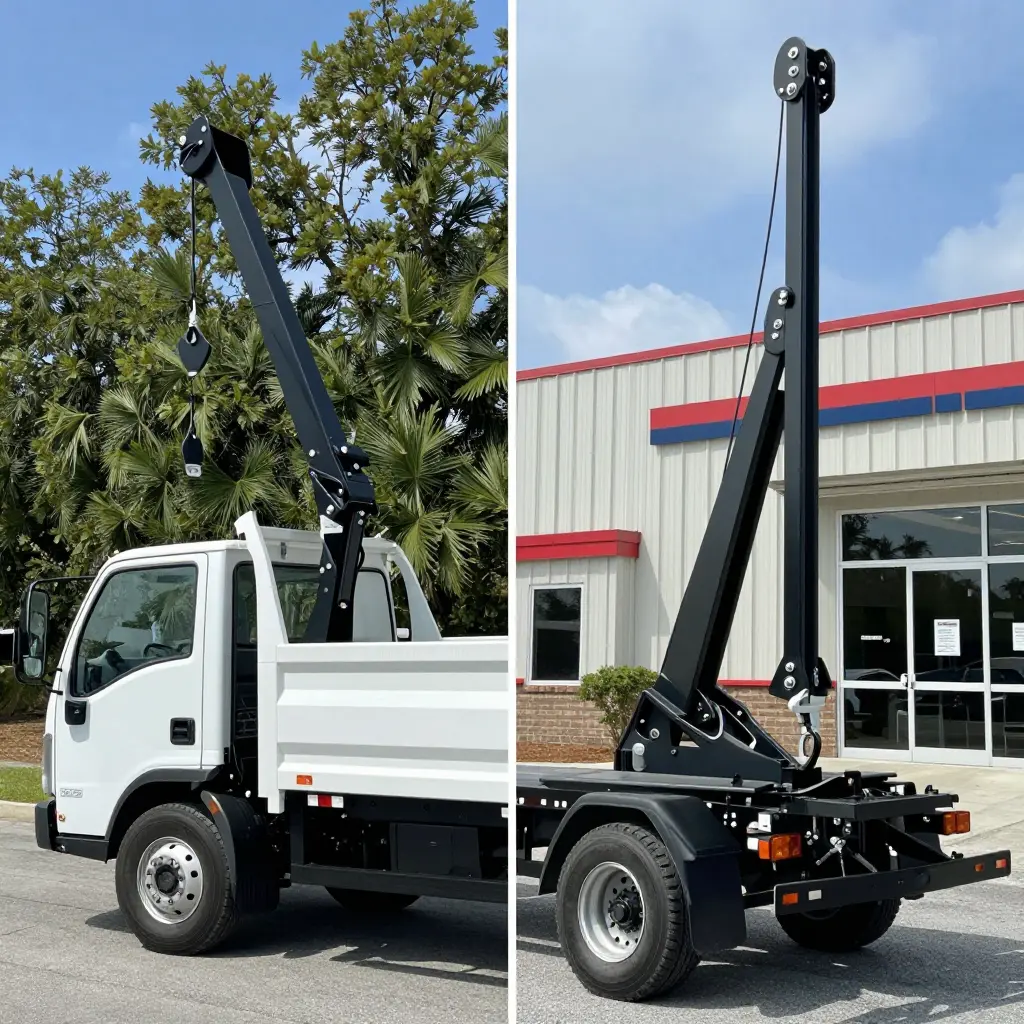
A mini roll off truck is a commercial truck built to carry, lift, and dump roll off containers. Its chassis is smaller than a full-size roll off truck’s, so it fits on tight job sites and costs less to run. In the waste business, trucks this size usually handle 10 to 15 cubic yard containers loaded with construction debris, household junk, or light commercial waste.
Every mini roll off truck uses one of two loading systems, and the choice between a hook lift and a cable hoist shapes most of the purchase. A hook lift pulls the container onto the bed with a hydraulic hook. A cable hoist pulls it with a winch and steel cable. The two differ in container compatibility, dumping angle, weight limits, and how much hand work the operator does. Those differences decide what you can haul and how fast a crew can move.
The comparison below is for waste management, dumpster rental, junk removal, and construction debris companies, along with independent haulers around Ocala, Florida. It covers how the two systems work, what each costs to own, and what local dealers actually keep in stock. If you are weighing used equipment, start with buying pre-owned mini trucks and judge condition before you commit.
How a Hook Lift System Works on a Mini Roll Off Truck
A hook lift is a hydraulic mechanism that lets one truck carry, dump, and exchange containers without a trailer. It has two main assemblies: a tilting subframe and a hydraulic arm mounted at the rear.
The Articulating Hydraulic Arm
The arm pivots at the rear of the subframe and is powered by one or more hydraulic cylinders. Extending the cylinders sweeps the arm through an arc, over the container and down toward the lift bar. Retracting them pulls the container onto the bed. One operator runs the whole motion.
Hook Engagement With the Lift Bar
The curved steel hook at the tip of the arm catches the container’s lift bar, a horizontal bar welded across the container’s front. Once the hook seats under the bar, it carries the full weight of the loaded container. If the hook is not seated squarely, the load can shift during the lift, so the operator checks the engagement before raising it.
The Dump-and-Retrieve Motion
To dump, the tilting frame raises the front of the bed and the contents slide out the rear under their own weight. Retrieving a container reverses the sequence: the frame tilts, the arm extends, the hook locks onto the lift bar, and the container is pulled aboard. That cycle is what makes container swaps fast.
Key Mechanical Characteristics
| Characteristic | Typical Behavior |
|---|---|
| Hydraulic pressure | 2,500-3,500 PSI at the working circuit |
| Flow requirement | 8-15 GPM to cycle the arm predictably |
| Tilting frame | Pivots 45-55 degrees for clean dumping |
| Container compatibility | Standard hook lift bodies with matched lift bars |
| Varied lengths | Adjustable hook travel and frame geometry |
Adjustable arm geometry is what lets one chassis handle containers of different lengths. Extending or limiting hook travel lets the system carry short and long bodies while keeping weight balanced over the rear axle. For a lower entry price, buying pre-owned mini trucks is one route to the same capability.
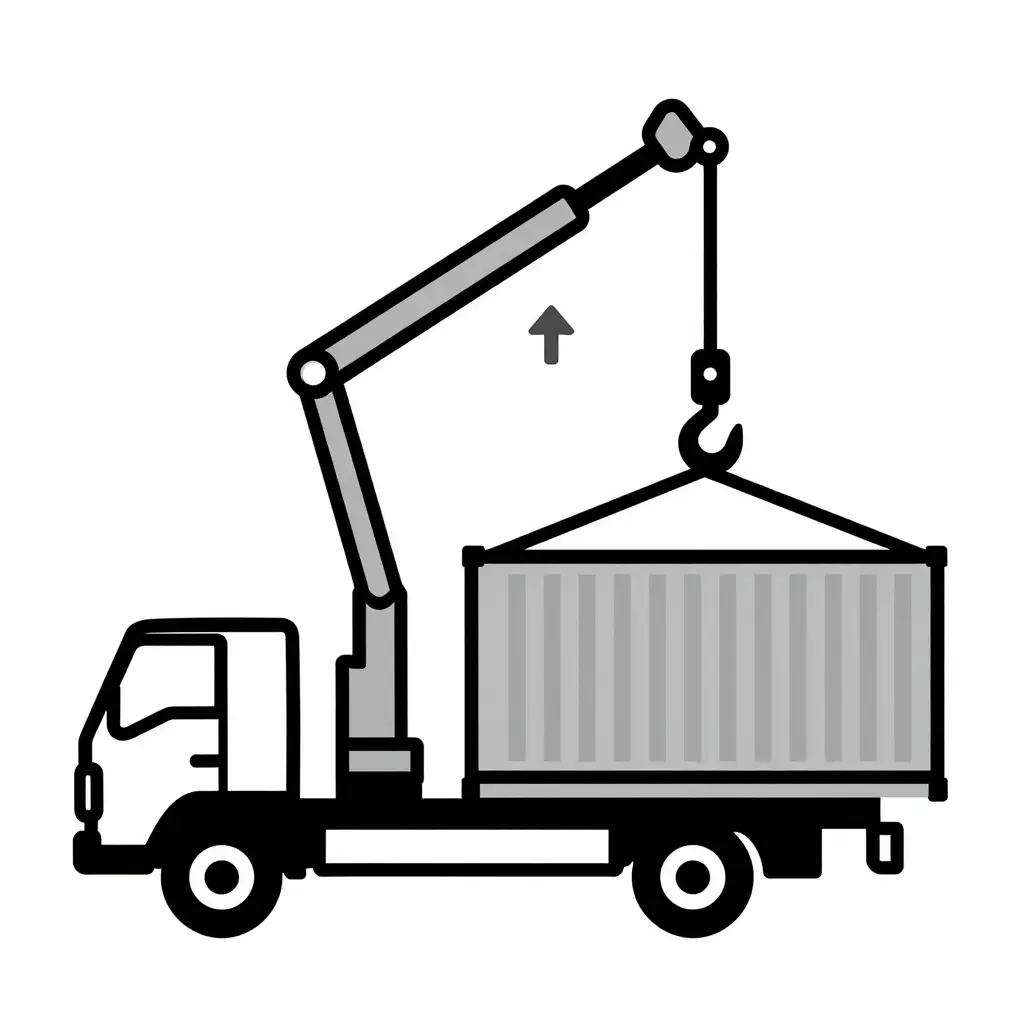
The schematic shows the sequence in its simplest form. A hydraulic arm pivots the tilting frame up at the rear hinge, and the curved hook catches the container’s lift bar and drags it forward onto the chassis. Reverse the motion and the container slides off on its own, the same action that empties it. The geometry also explains the tradeoff: a hook lift gives up some of a cable hoist’s raw pulling power in exchange for flexibility.
How the Cable Hoist System Works on a Mini Roll Off Truck
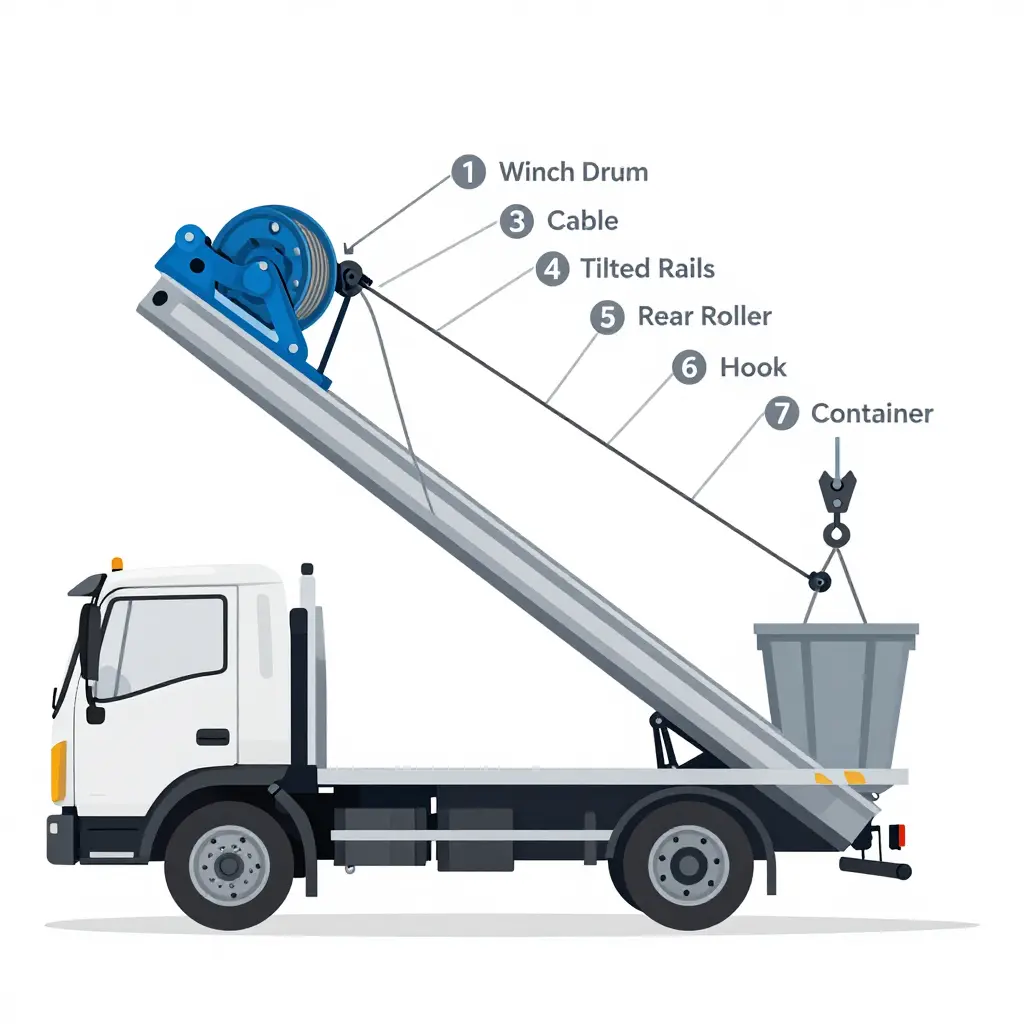
A cable hoist moves containers by pulling, not lifting. On a mini roll off truck, a winch drum turns cable tension into pulling force, dragging the container up a set of tilted rails and onto the bed. The design is old and simple, and that is why it still shows up so often on lighter-duty work.
Winch, Cable, and Sheave Arrangement
The winch sits at the front of the frame, ahead of the container. A PTO or an electric-over-hydraulic pump drives the drum, which spools a single length of steel cable. The cable runs through one or more sheaves, grooved pulleys that guide the line and reduce friction as the load angle changes. Sheaves are sized to the cable diameter so the wire rope bends without kinking.
Pulling the Container Up the Tilted Rails
To load, the operator tilts the rear of the bed until the rails sit at a shallow angle to the ground, pays out cable, hooks the container, and engages the winch. As the drum winds, the container drags up the rails on the steel bed and rollers rather than being lifted off the ground. Once it is fully aboard, the bed returns to horizontal and a locking mechanism secures the container for transport.
The Rear-Anchored Roller and Hook Design
The tail of the frame ends in a heavy roller. The cable runs from the winch at the front, back over that roller, then down to the container, so the pull comes from the rear and stays low during the initial breakaway, when the most force is needed to overcome friction and the container’s weight on the ground. The hook at the cable’s end is simple and replaceable, which matters because it takes the worst of the shock loading and wears first.
Load Handling and Container Length Flexibility
Because a cable hoist pulls from a single point at the front of the container, it handles a wide range of container lengths. A longer bed accepts many container sizes without changes to the winch, which suits dumpster rental fleets that mix and match bins. Load capacity comes from the winch rating, cable strength, and rail geometry rather than a fixed lifting arm.
Cable Maintenance Considerations
The whole load rides on one steel line, so maintenance matters. Inspect the cable for fraying, broken strands, and corrosion, keep it lubricated, and replace hooks and sheaves on a schedule. A worn cable is a safety risk; it is one of the first things to check when buying a pre-owned mini truck.
Cable Hoist vs Hook Lift: A Mechanical Comparison
| Feature | Cable Hoist System | Hook Lift |
|---|---|---|
| Lifting action | Drags container up tilted rails | Lifts and tilts container with a hydraulic hook arm |
| Point of attachment | Single front hook and cable | Rigid hydraulic hook arm |
| Container length flexibility | High, wide range of lengths | Moderate, matched to arm geometry |
| Main wear parts | Cable, sheaves, hook | Hydraulic arm, pivot pins, cylinders |
| On-ground container handling | Container slides, must be aligned | Arm can reach and reposition |
| Mechanical complexity | Low | Higher |
| Typical maintenance focus | Cable inspection and lubrication | Hydraulic fluid and cylinder service |
Mechanically, the cable hoist is simpler: fewer moving parts, lower cost, and easy field repair. The hook lift trades some of that simplicity for easier handling and the ability to pick up containers that are not perfectly lined up. Both remain common on mini roll off fleets.
Hook Lift vs Cable Hoist: Side-by-Side Comparison for Mini Roll Off Trucks
The table below compares the two systems across the specifications that affect a purchase.
Hook Lift vs Cable Hoist at a Glance
| Feature | Hook Lift System | Cable Hoist System | Notes |
|---|---|---|---|
| Lift mechanism | Hydraulic arm hooks the bar and pulls the container onto the chassis | Winch winds a steel cable over a sheave to drag the container up a sloped bed | The hook lift pulls with a rigid arm; the cable hoist pulls on cable tension, so cable wear and stretch matter more |
| Container compatibility | Hook-style containers with a reinforced hook bar; open-top, enclosed, and specialty bodies | Cable-style containers with a loop and roller; mostly open-top roll off boxes | Not interchangeable. Buying the wrong container type means replacing the fleet |
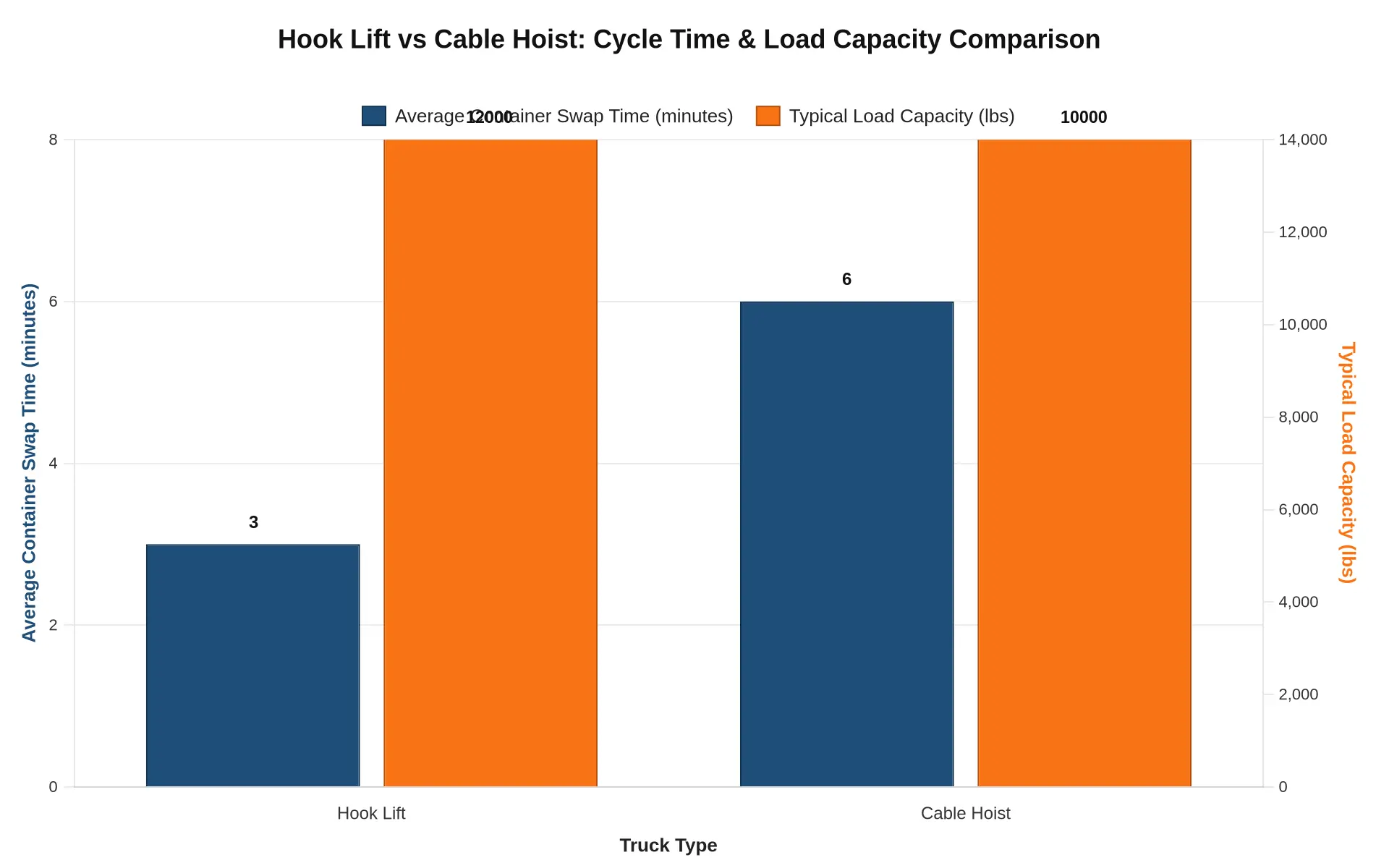
| Cycle time | Faster: typically 30-60 seconds per pick-up or drop-off, with no cable to rig | Slower: typically 60-120 seconds, because the operator rigs and releases the cable each time | Faster cycles mean more stops per shift on high-volume dumpster rental routes |
| Hydraulic requirements | Higher flow and pressure; a larger pump and tank to drive the arm under full load | Lower demand; the winch does most of the work, so a smaller pump and reservoir are enough | A hook lift usually needs a more capable PTO and hydraulic package on the chassis |
| Typical maintenance items | Hook arm pivot pins, hydraulic cylinders, hoses, seals, and the hook bar itself | Winch cable, sheaves and pulleys, drum brakes, and roller assemblies on the container | Cables wear faster; the hook lift spreads wear across hydraulics and pivots |
| Operational flexibility | High; handles varied container lengths, and the tilt action helps dump and spread loads | Moderate; tied to cable-rated boxes and a fixed pull geometry, less forgiving of nonstandard containers | A hook lift suits mixed fleets that switch body types often |
| Best-fit applications | Dumpster rental, junk removal, construction debris, and multi-container routes that need speed | Heavy, simple single-box hauling such as large open-top debris boxes on fixed routes | Match the system to route density and container turnover |
| Relative operational efficiency | Higher on high-turnover routes; more stops per shift and less setup time | Lower on high-volume routes, but cost-effective for low-frequency, heavy single-load hauls | The efficiency gap widens as daily stop counts rise |
How to Read This Table
- If profit depends on stops per day, cycle time comes first. The hook lift’s arm-and-hook design is faster.
- If the chassis has limited PTO capacity, or you haul fewer, heavier loads, hydraulic demand matters more. A cable hoist is often the cheaper build.
- Check your container inventory before anything else. The two systems need different containers, so the boxes you already own usually decide the choice before the spec sheet does.
On a used truck, the hoist type is already fixed and the container pairing usually comes with it. Reviewing pre-owned mini trucks can show what you are actually inheriting before you commit to a fleet build.
Operational Differences: Hook Lift vs Cable Hoist in Daily Use
Those numbers mean little until you see where they come from on a route.
Cycle Time
Cycle time depends on how the container is engaged, not on engine power.
- A hook lift’s hydraulic hook grabs the front bar and pulls the container onto the frame in one motion. Figure 30-60 seconds for a pick-up or a drop-off.
- A cable hoist requires the operator to run out cable, hook the container, and manage slack while the winch drags it up the rails. Figure 60-120 seconds per pick-up or drop-off, sometimes more.
- The gap adds up. On a 20-stop route, the slower system can put 20 to 40 extra minutes on the shift.
Dumping Efficiency
- A hook lift’s tipping frame and hook reach a high, controlled dump angle quickly, so sticky or packed loads release cleanly.
- A cable hoist raises the container by winching it up the tilt rails. An uneven load can make the container bind or skew, and the operator has to reset before it empties.
Handling Unevenly Loaded, Wet, or Heavy Debris
- Wet construction debris, soaked yard waste, and top-heavy loads are a cable hoist’s weak point. The cable follows the path of least resistance and the container can drift.
- A hook lift’s rigid hook keeps the container tracking straight even when the weight sits to one side, so fewer dumps are aborted and less repositioning is needed.
Operator Training
- Hook lift: fewer manual steps and no cable to feed, so new operators pick it up quickly.
- Cable hoist: cable inspection, spooling, and clearing jams take more training and discipline to avoid snapped cables and bent rails.
Jobs Each System Favors
- Hook lift: dumpster rental routes with many stops, junk removal, and mixed construction debris where speed and reliability matter.
- Cable hoist: single-site long hauls, cost-driven fleets, and simple long-distance drops where a lower upfront price outweighs slower cycles.
Bottom Line for Ocala Buyers
For dumpster rental and junk removal routes, a hook lift’s faster cycles, cleaner dumping, and shorter training curve make it the safer default. A cable hoist still makes sense when the work is steady long-haul hauling and upfront cost drives the decision. On a used truck, the body type is much harder to change later than the truck around it, so decide the system before you buy and review guidance on buying pre-owned mini trucks before you commit.
Decision Factors: Choosing Between Hook Lift and Cable Hoist
The right system depends less on brand than on how you run the business. Work through the points below before putting money into a chassis and lifting mechanism.
- Container fleet compatibility. Hook lifts need a standard hook-and-bar interface, so check whether your existing dumpsters match it or can be retrofitted with compatible bars. Cable hoists work with older or mixed fleets but may need reinforced container floors to survive repeated dragging.
- Hydraulic system capacity. Hook lifts typically need higher flow and pressure to lift and tilt heavy containers, so confirm the truck’s pump and PTO can support the cycle time you need. Cable hoists are lighter on hydraulics but need a properly rated winch and cable to avoid premature wear.
- Job site access. Tight urban lots, residential driveways, and uneven construction sites favor a hook lift’s controlled placement and short approach. A cable hoist can work in constrained spaces too, but the drag-and-pull motion needs a clear, stable path to avoid a cable snap or a misaligned container.
- Driver training. Both systems have a learning curve. A hook lift rewards operators who understand engagement angles and load ratings; a cable hoist demands close attention to cable routing and tension. Budget for hands-on training and written procedures before the first revenue job.
- Maintenance overhead. Hook lift assemblies have fewer wear parts overall, but the lifting arm and hydraulics need regular inspection. Cable hoist systems consume cables, sheaves, and winch components more often. Keep a maintenance calendar and spare cables on hand to limit downtime.
- Total cost of ownership. Add purchase price, container retrofit costs, fuel, downtime, and resale value, then compare the total against expected haul volume. If you are weighing new against used equipment, see this guide to buying pre-owned mini trucks to model depreciation and upfront savings.
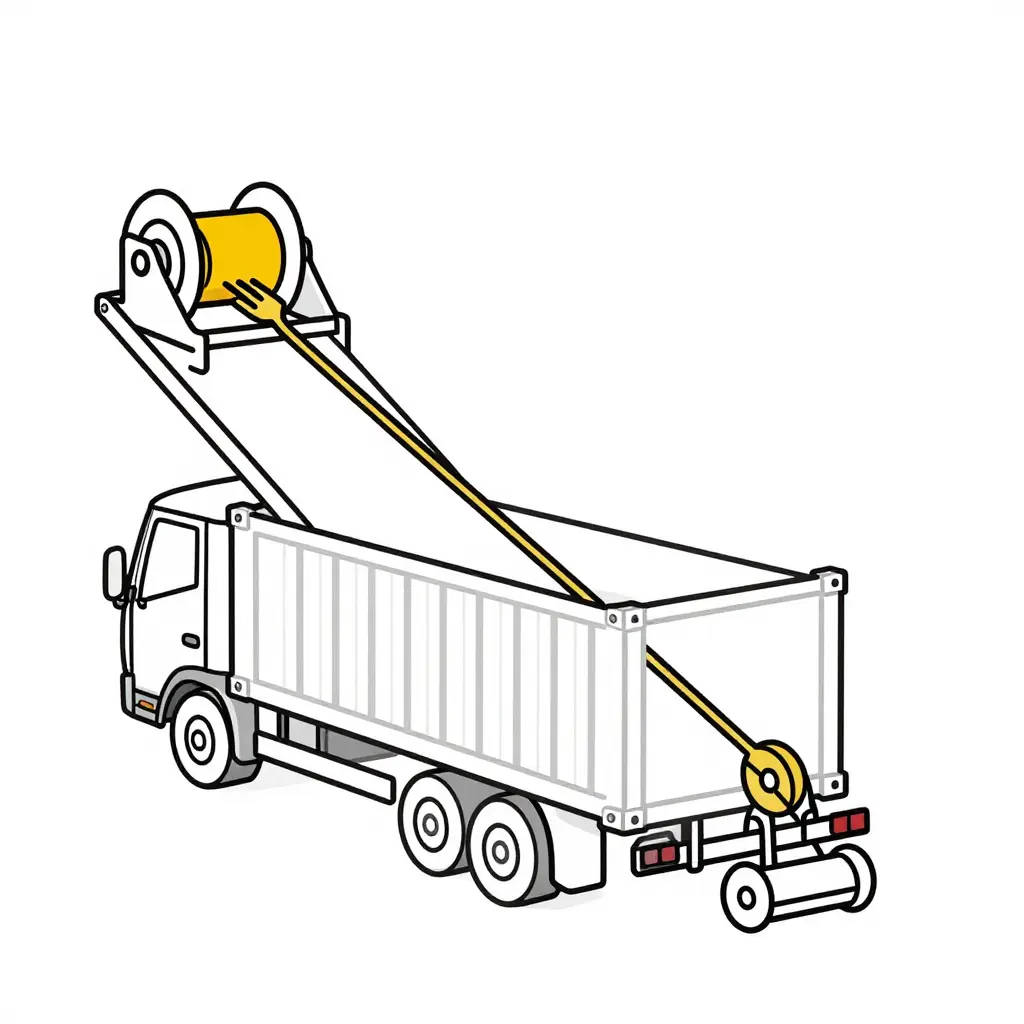
A clean line-art schematic of the cable hoist mechanism shows the rear rails as an incline, the winch drum up front, the cable path through the sheaves, the rear roller at the tail, and the container being winched up the incline, with an arrow for the pulling motion.
Ocala Dealer Stock Availability: Hook Lift vs. Cable Hoist and How to Assess Inventory
Not every lot carries the same equipment, and dealers fall into three rough categories. Full-line commercial truck dealerships keep completed units and bare chassis on site, so availability is usually verifiable the same day you visit. Specialized upfitters and body builders often stock hoist bodies, subframes, and hydraulic kits rather than finished trucks, which means a purchase depends on both their body inventory and a separate chassis source. Independent resellers may hold only one or two units, often trade-ins or fleet retirements.
Why Hook Lift and Cable Hoist Stock Diverges
Dealers stock the two systems in different proportions. Hook lifts turn over quickly because they accept a range of container sizes and suit dumpster rental, junk removal, and construction debris work. Cable hoist trucks tend to sit thinner on local lots, so buyers who need that system may wait longer or look outside Marion County. Know which system fits your routes before you arrive; a lot with deep hook lift inventory may have almost nothing in cable hoist. Other operators in the Ocala mini truck community can tell you which configurations actually move.
The Role of Chassis Availability
Even when a dealer lists a mini roll off truck as in stock, the chassis is often the real constraint. Cab-over and conventional chassis arrive in allocations, and a missing wheelbase or GVWR rating can stall a sale while the hoist body sits in the yard. Ask whether the unit is a complete, drivable truck or a body waiting on a chassis, and get the exact GVWR, wheelbase, and cab configuration. A firm delivery date usually means the chassis is on hand; a delivery range often means the dealer is waiting on an inbound allocation.
How Pre-Owned Inventory Shortens Lead Times
A pre-owned unit already has a mounted body, a titled chassis, and a maintenance history, so the upfit window disappears. That is why a used truck can be ready in days rather than months. Review current listings and inspection practices before you buy; this guide to buying pre-owned mini trucks is a starting point. Check hour-meter readings, hydraulic pump condition, and subframe welds before you commit.
Evaluating Inventory Depth and Turnaround
A short checklist separates genuine stock from a single demo unit. Depth, specification match, and condition all affect how fast you can take delivery.
| Inventory Factor | What to Check | Why It Matters |
|---|---|---|
| Unit type | Hook lift vs. cable hoist on the lot | Determines container compatibility |
| Chassis | GVWR, wheelbase, cab configuration | Drives build and delivery timing |
| Depth | Number of comparable units available | Signals real stock, not a lone demo |
| Condition | New, demo, or pre-owned | Affects lead time and pricing |
Turnaround ranges from the same day for a complete pre-owned unit to several weeks or months when a body must be mounted on an allocated chassis. Compare dealers on inventory depth, build specifications, and lead-time estimates rather than on promises.
Dealer Stock and Availability in the Ocala Market
In Central Florida, dealers tend to concentrate on-lot inventory on a few high-turnover configurations. Listings most often show hook lifts on medium-duty chassis in roughly the 12,000-26,000 lb GVWR class, with 12-14 foot containers. Those units sell because they match everyday dumpster rental, junk removal, construction debris, and light demolition work, and because one hook lift can pick up containers of several lengths without extra equipment. Standard cab, automatic-transmission, base-hydraulics models are common floor stock; they sell fastest and need the least customization.
Cable hoist trucks are more often order-specific builds. Availability tracks local demand: they suit operators who routinely handle long, wet, or unusually dense debris, but fewer regional lots keep them as standing inventory. A stock cable hoist unit can be scarce, and a buyer may end up in a factory or upfitter queue. A pre-owned mini truck can shorten the wait when a new build is not available.
Specification choices drive lead time more than anything else. Chassis brand, GVWR, cab and axle configuration, tarping, container length, and hydraulic capacity all push a truck away from generic stock and toward a made-to-order build. The closer a configuration is to a common regional spec, the more likely it is to be on the ground; the more specialized it is, the longer the order window. Buyers who can accept standard configurations usually wait the least, and highly tailored rigs should be planned well in advance.
Total Cost of Ownership: Hook Lift vs Cable Hoist
The purchase price is only the first cost. Ownership costs for a roll off truck run across capital, hydraulic upkeep, consumables, fuel, and resale value, and the balance between the two systems shifts with how hard the truck works.
Purchase Price
A cable hoist costs less up front. The winch-and-cable mechanism is simple, so a cable hoist truck generally runs 15 to 30 percent below a comparable hook lift. The hook lift’s premium comes from its hydraulic arm, tilt frame, and controls.
Hydraulic System Upkeep
A hook lift uses hydraulics for every lift, tip, and release, so cylinders, hoses, pumps, and fluid add recurring cost. A cable hoist’s winch has far fewer hydraulic parts, which keeps routine upkeep cheaper until the cable becomes the main expense.
Cable and Hook Replacement Frequency
Cables wear under heavy debris loads and constant cycling; a busy operation might replace them several times a year. Hook lift hooks and hydraulic parts last longer, but each repair costs more, so over a long service life the two paths can meet.
Fuel and Payload Efficiency
A cable hoist truck is lighter because it has no heavy lifting arm, which leaves more room for payload. A hook lift’s mechanism adds weight, trimming net payload and costing a little fuel. For operations paid by the ton, that gap is money.
Resale Considerations
Hook lift trucks tend to hold value better. One truck handling many containers keeps used demand strong. Cable hoist models sell into a smaller buyer pool, though low maintenance costs appeal to budget-minded operators.
How Duty Cycle Drives the Math
Duty cycle decides it. Operations that swap containers many times a day get enough speed and labor savings from a hook lift to offset the higher price and hydraulic upkeep. Operations that swap occasionally usually come out ahead with a cheaper cable hoist. Sound financial planning as a first-time truck owner helps map these costs against cash flow.
Side-by-Side Cost Comparison
| Cost Category | Hook Lift | Cable Hoist |
|---|---|---|
| Purchase price | Higher (hydraulic hook arm) | Lower (winch mechanism) |
| Hydraulic upkeep | Higher | Lower |
| Cable/hook replacement | Infrequent, higher cost per event | Frequent cable replacement |
| Payload and fuel | Slightly lower payload, higher fuel | Higher payload, lower fuel |
| Resale value | Stronger | Moderate |
| Best duty cycle | High-frequency | Low-frequency |
Frequently Asked Questions About Mini Roll Off Trucks in Ocala
Which system is easier to operate, a hook lift or a cable hoist?
A hook lift is generally easier. The hydraulic arm lifts and dumps the container with little manual alignment. A cable hoist requires the operator to attach the cable and manage the winch, which takes more practice. For new drivers, a hook lift means a shorter learning curve and less risk of damaging the container.
Can one truck run both hook lift and cable hoist containers?
Not without modification. A hook lift lifts containers by a bar with its hydraulic hook and tilt frame; a cable hoist drags them by a loop with a winch and cable. Standard containers are not interchangeable, though specialty adapters exist. Commit your container fleet to one system.
What payload can a mini roll off truck handle?
Most carry 8,000 to 12,000 pounds of payload, depending on the chassis, axle rating, and container weight. Lightweight containers help you stay within legal limits. Confirm the truck’s GVWR and Florida weight regulations before loading a full container.
How do I verify that mini roll off truck dealers Ocala actually have stock?
Ask for the unit’s VIN, current date-stamped photos, and written confirmation that the truck is on the lot. A reputable dealer will schedule an in-person inspection or send a live video walkaround. Confirm container availability at the same time, since it varies.
What should I inspect on a pre-owned unit?
Check the hydraulics for leaks, the hook or winch cable for wear, and the tilt frame for cracks or repaired welds. Look at the chassis for rust and frame damage, and read the maintenance records before you commit. Our pre-owned mini truck buying guide covers the full checklist.
Is a hook lift or cable hoist better for tight spaces?
A cable hoist often needs more room because it drags containers along the ground. A hook lift places the container with less ground friction. For tight residential driveways, a hook lift usually fits better. Where maneuverability matters less and cost matters more, a cable hoist is a reasonable choice.
Conclusion
Neither system wins everywhere. Three things decide it: the container fleet you already own or plan to build, the jobs you run most often, and the budget you can commit up front and over the truck’s service life. A cable hoist rewards operators who already own cable-compatible containers and run simple, high-volume hauls. A hook lift suits operations that switch between container sizes and want long-term flexibility.
Before ordering blind, confirm what local dealers actually keep in stock so you can inspect a system in person. When you compare dealers, ask for specifications you can verify, parts and service support, and documented warranty terms rather than promotional promises. Confirm container compatibility before you commit, and let your fleet and job mix decide the system. Our guide to evaluating a pre-owned mini truck has a fuller pre-purchase checklist.