
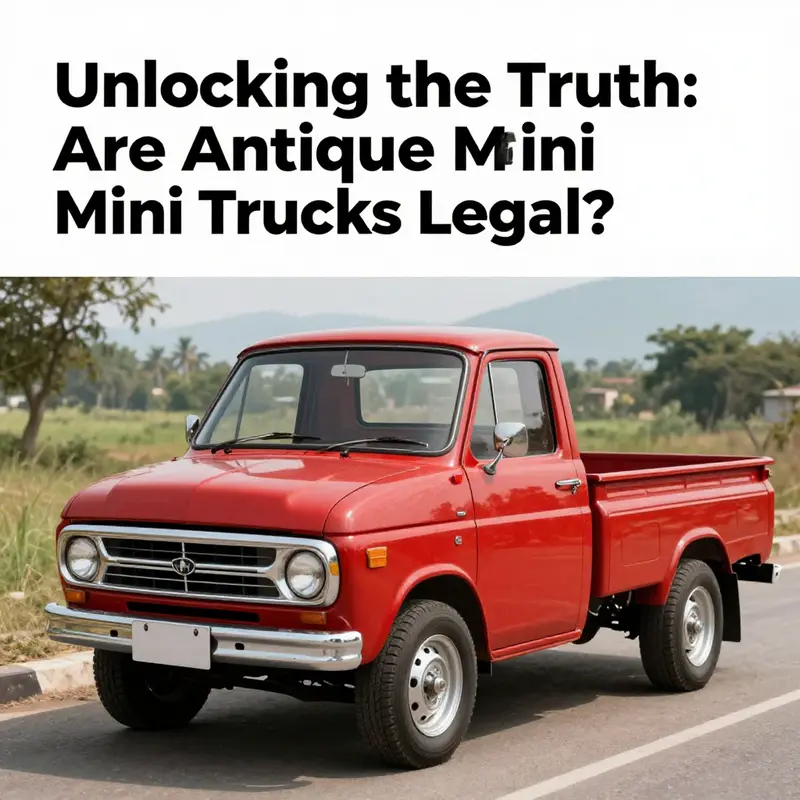
A question that often crops up among mini truck enthusiasts and local business owners alike is: are antique mini trucks allowed on the roads of Pakistan? This inquiry dives deep into not only the age of these vehicles but their registration status, compliance with local laws, and the implications of being classified as ‘antique’. Understanding this landscape is essential for hobbyists who wish to maintain or utilize older models, and business owners who might see the value in these nostalgic vehicles. Over the next few chapters, we will uncover the legal status of antique mini trucks, assess the specific regulations they need to comply with, and evaluate the potential impacts on their usage. Whether you’re a property owner looking to invest or a mini truck hobbyist eager to hit the roads, we’ve got you covered!
Antique Mini Trucks in Pakistan: Registration, Safety, and the Pragmatic Path to Legality
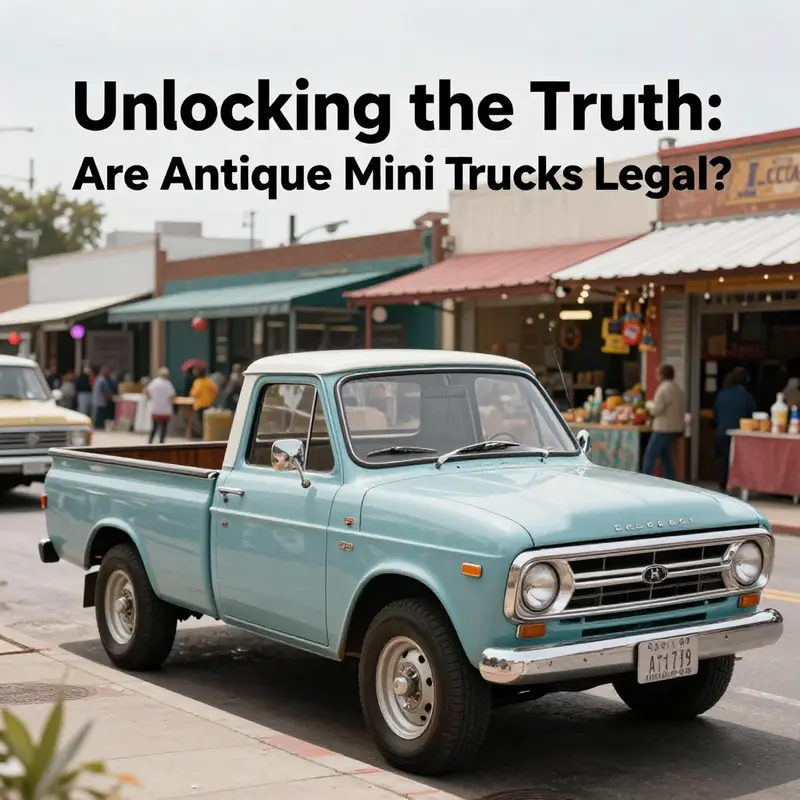
In Pakistan there is no nationwide antique category for mini trucks. Legality on public roads rests on three practical pillars: the vehicle must be properly registered and display a valid RC, it must be insured (typically with third-party liability coverage), and it must meet basic road safety and emissions standards where applicable. A vehicle may look old and carry a nostalgic appeal, but that appearance does not grant a legal exemption from registration, inspection, or insurance requirements. Older vehicles may face transitional or lenient treatment in some inspections, reflecting the realities of parts availability and maintenance, yet they must still pass the required checks to remain roadworthy. The absence of an antique label does not prevent lawful operation once the paperwork and safety criteria are satisfied. Conversely, an unregistered or uninsured vehicle remains illegal regardless of age. For Kei trucks and other compact micro-utility vehicles, the same rule applies: legality is earned through compliance, not through a vintage badge. Local incentives or ceremonial recognitions may exist, but they do not replace the core duties of registration, insurance, and ongoing maintenance. Operators should focus on keeping the RC current, carrying valid insurance, and ensuring vital systems such as brakes, lighting, tires, and where relevant emissions are up to standard. The practical takeaway is clear: an old-looking mini truck can be legal if it is properly documented and maintained; a neglected or unregistered vehicle cannot be driven on public roads.
Old, Not Obsolete: Navigating the Legality and Practical Realities of Antique Mini Trucks on Pakistani Roads
In Pakistan, the question of whether a mini truck can be considered legal simply because it looks old or carries the aura of an antique is more nuanced than a single label might suggest. The road to legality for any vehicle hinges on concrete, verifiable steps: proper registration, current license plates, regular safety and technical inspections, and the right kind of insurance. The absence of a formal, nationwide, official category called “antique vehicle” for micro or mini trucks means that many assumptions about antique status do not automatically confer any regulatory advantage. Instead, the actual legal protection or constraints come from the vehicle’s documented status and its compliance with the traffic rules that govern all motorized road users. This is a practical distinction, and it matters because it shapes how owners use their vehicles, how authorities enforce rules, and how a community of drivers views the risks and responsibilities of operating a vintage-looking workhorse in a dense urban or semi-urban setting.
To begin with, there is a crucial point that often gets overlooked in casual discussions: the legal framework in Pakistan does not carve out a special category for antique mini trucks. There is no universal, codified “antique mini truck” status in the country’s motor vehicle regulations. Instead, the law looks at the vehicle’s identity through the lens of registration records, technical compliance, and the ability to demonstrate ongoing financial responsibility through insurance. This means that a mini truck, regardless of its age, must be registered with the relevant government department—typically the provincial or divisional traffic authority—be issued a valid Registration Certificate, and pass the required inspections. If these elements are in place, the vehicle can be operated legally; if any one of them is missing, the vehicle becomes a legal liability or a target for penalties and impoundment.
The most immediate implication of this arrangement is that age alone does not grant immunity from scrutiny or from the obligations every driver bears. In practice, a 1980s Japanese mini truck, often known in import markets as a Kei truck, tends to be treated by Pakistani authorities as a regular commercial or light-duty vehicle. Its on-road status is determined by whether it has a valid registration, whose data reflects the vehicle’s identity, ownership, and periodical renewals; whether the plates remain clearly displayed and legible; whether the vehicle passes the mandatory safety and, where applicable, emissions checks; and whether it carries the mandated insurance, at least a third-party liability policy. If all these are present, the vehicle can legally share the road with newer models and newer technologies. If any of these elements are missing or out of date, the status shifts toward non-compliance, regardless of how classic or charming the vehicle may look.
One of the most practical frames for understanding this is to imagine legality as a chain of obligations rather than a single banner that says “antique.” The registration chain begins with an official registration record. Without it, there is no proof of ownership, no way to track the vehicle’s identity, and no means for the authorities to ensure that the vehicle complies with the safety norms and roadworthiness standards applicable to that particular class of vehicle. The next link is the license plate, which must be legible and tied to the registration. Then there is the periodic safety inspection. In Pakistan, this encompasses a broad range of checks—brakes, tires, lighting, visibility, and, increasingly, emissions considerations. It is worth noting that for older vehicles, the standards may be adapted or relaxed in certain jurisdictions, recognizing the reality that parts for older models can be scarce and that the original design may not meet contemporary benchmarks. Still, the emphasis remains on proving that the vehicle is safe enough to operate and that it will not impose undue risk on other road users. Finally, the insurance requirement stands as the financial backstop. Even if a vehicle is permitted to operate under a special set of conditions, driving without valid insurance remains illegal and exposes the owner to penalties and the possibility of uninsured losses.
The absence of a nationwide antique designation means that the symbol of age is not a license in itself. Yet, this is not to say that antique status has no practical consequences. In some localities, government bodies or districts may offer temporary reliefs or incentives for historical vehicles, particularly for events or exhibitions that celebrate heritage and culture. These are usually tied to specific programs, times, and routes, and they do not grant general permission to operate every day on busy urban corridors. They are, effectively, narrow exemptions that acknowledge the cultural or ceremonial value of certain old vehicles rather than broad, systemic policy. Outside these occasions, an antique label does not automatically void the normal regulatory framework nor does it bestow a blanket freedom to ignore traffic laws, maintain substandard safety, or bypass regular maintenance.
The case of Japanese mini trucks, which populate many fleets in the country’s urban and peri-urban markets, adds another layer of context. These vehicles are predominantly imported as light commercial options for short-haul work, with a footprint that suits narrow streets and steep alleys more gracefully than larger trucks. Their legality rests on being treated as standard commercial vehicles, registered and insured accordingly. The fact that their design comes from a different era and a different regulatory environment does not, in itself, shield them from the Pakistani regulations that govern all motor vehicles. What matters is whether the vehicle meets the local requirements for registration and roadworthiness and whether it is operated with the necessary documentation. In a sense, these kei trucks are a reminder that the operational reality of legality hinges on practical compliance rather than on the mere aura of antiquity.
When people contemplate the potential benefits of antique status, it is tempting to imagine exemptions from taxes or reduced fees, or special access for display at historic venues. The reality, however, is more nuanced and varies by location. While there is no uniform national antique vehicle tax regime across Pakistan, local authorities may offer incentives during specific events or for vehicles that are demonstrably part of a recognized historical collection or heritage program. Such exemptions or reductions are typically situational and can be revoked if the vehicle ceases to meet the criteria or if its use diverges from the purposes for which the relief was granted. Owners who pursue any form of historic designation should prepare to document the vehicle’s period integrity, its maintenance history, and its present condition. Documentation might include service records, photographs of the vehicle at different times, and, in some frameworks, a professional appraisal that attests to its historical value. Even where such processes exist, the practical implications for everyday use are often limited. A historically designated vehicle may be restricted from daily commuting and may be limited to parades, exhibitions, or special events. In other words, the antique label tends to be a shield for heritage preservation rather than a broad license for mobility.
Understanding these dynamics is essential for owners who see value in keeping a mini truck on the road for practical work, while also appreciating its potential historical significance. The balance between heritage and utility is delicate. On one hand, keeping an old vehicle moving can be a meaningful way to preserve a piece of industrial and social history, especially in a country where small, efficient vehicles played a key role in urban logistics. On the other hand, the day-to-day realities of maintenance, safety, and compliance can be demanding. Parts for older engines, brakes, and electrical systems may be scarce or expensive, and the availability of skilled technicians who can diagnose and repair vintage systems can be limited. When maintenance becomes challenging, owners often face tough choices about continued operation, retrofit options that preserve appearance while meeting safety standards, or even the decision to decommission and replace rather than preserve. Each choice carries regulatory implications and potential costs that can begin to look daunting when viewed against the backdrop of a city’s traffic realities and a household budget.
The broader environmental and policy context adds further nuance. Emission standards, in particular, have become more stringent in many places around the world as cities strive to reduce pollution and improve air quality. Older vehicles typically struggle to meet modern limits without costly retrofits. In Pakistan, the enforcement spectrum can vary by city and by the specifics of a vehicle’s registration category. Some urban centers pursue targeted restrictions on older, higher-emission vehicles entering congested zones, especially during peak hours. This reality can place antique-appearing mini trucks at a crossroads: their appearance may evoke nostalgia or heritage, but their day-to-day operation may be constrained by practical realities of emissions compliance and urban traffic management. Thus, motorists who cherish their vintage-looking workhorses must navigate not only the letter of the law but also the practicalities of urban mobility in a place where road space is often scarce and road safety norms are actively enforced.
From a practical standpoint, the core question remains straightforward: can a mini truck legally operate in Pakistan if it is treated as an antique? The answer is nuanced. A mini truck can be legal if it ticks all the boxes for registration, plate presentation, periodic inspection, and insurance. The label of antique, while potentially attractive for cultural or ceremonial reasons, does not automatically create a legal loophole or exemption from these requirements. The chain of compliance does not loosen simply because the vehicle is old; rather, the regulatory emphasis remains on demonstrable roadworthiness and accountability to the public safety framework. Conversely, an old-looking vehicle that lacks registration, proper plates, or insurance is illegal on the road regardless of its appearance. This is a grounding principle that applies to all vehicle categories and highlights the essential truth: legality in this context is procedural, not ornamental.
For those who want to anchor their understanding in official guidance, the most authoritative sources in Pakistan are the agencies responsible for vehicle registration, licensing, and roadworthiness. The Transport Department’s official channels, including the central portal, lay out the requirements for registration, license issuance, inspections, and insurance. These resources specify the documents needed, the timelines for renewal, and the conditions that must be met to maintain a vehicle’s lawful status. In practice, a vehicle owner should approach these processes proactively, ensuring that all paperwork is complete and up to date, and that any safety or emissions concerns are addressed before the vehicle is driven on public roads. The principle is simple: legality is a matter of record and compliance, not merely a historical label.
In addition to the core regulatory framework, there are cultural and social dimensions to consider. A community of enthusiasts who appreciate vintage mini trucks often seek to celebrate the vehicles in exhibitions, parades, and shows. The appeal of these machines lies not only in their design but in their stories—the way they transformed urban logistics, how they navigated narrow streets, and the role they played in supporting small businesses. These narratives feed a broader appreciation for mobility heritage and the ingenuity of compact body designs suited to crowded landscapes. When this curiosity crosses into legal territory, it becomes important to distinguish between showcasing a vehicle and using it as a daily transport solution. The former may be accommodated under special-event allowances, while the latter requires the same regulatory compliance that any commercial vehicle must meet. In this sense, the antique impulse and the regulatory impulse are not enemies; they are two sides of the same coin—the desire to keep a vehicle that once moved goods, and still moves people or products, connected to the roads of today while respecting safety and responsibility.
For readers seeking practical avenues to verify their own vehicle’s status, the first step is to consult the official Transport Department resources. These portals typically provide checklists, required forms, and contact points for inquiries. The process begins with the vehicle’s Registration Certificate (RC), which should reflect the vehicle type, engine number, chassis number, and ownership details. A valid RC forms the backbone of the vehicle’s legal identity. From there, the license plate must be renewed on schedule, and the vehicle must pass the periodic inspection, which often includes checks of brakes, lights, steering alignment, tire condition, and, depending on the jurisdiction, emissions testing. If all goes well, the vehicle demonstrates its compliance with road safety standards and gains the right to operate on public roads. If it does not, owners have to address deficiencies, which may involve repairs, part replacements, or, in some cases, a reclassification with authorities to reflect changes in the vehicle’s condition or usage. Across all these steps, insurance provides a financial protection layer for both the vehicle owner and other road users, reinforcing the broader social contract that governs motorized mobility.
The practical takeaway for anyone who owns or contemplates owning a mini truck that resembles an antique is clear. Respect for the regulatory process matters more than the aesthetic appeal of the vehicle. A well-documented, properly insured, and roadworthy mini truck, even if it looks old enough to have participated in a different era of urban commerce, can operate legally. But a vehicle that lacks registration or insurance or that fails to meet inspection standards is not lawful to drive, irrespective of how vintage its exterior may appear. This perspective respects both the public interest in road safety and the cultural interest in preserving a piece of transport history. It also places the onus on the owner to remain vigilant about regulatory changes, to stay informed through official channels, and to engage with the system in a constructive way rather than relying on the romantic notion that age alone guarantees privilege on the streets.
For readers who want to explore the broader cultural context and the more global conversation around antique and historic vehicles, there are resources that discuss how different jurisdictions balance heritage value with modern safety and environmental standards. While the specifics vary, the underlying principle holds: antique designation, where it exists, is usually about recognition and preservation rather than a broad license to bypass contemporary rules. In places where antique programs exist, they almost always involve an application process, documentation of originality or period-correct restoration, and in some cases inspections by certified assessors. These measures aim to preserve the historical integrity of the vehicle while ensuring that it remains safe to operate when it is used in ways that align with the program’s aims. The general lesson for Pakistan is to view antique status as a potential, limited cultural instrument rather than a blanket regulatory exemption.
Those who want to explore the broader kei-truck culture that informs these discussions can dive into dedicated regional content that examines how these compact vehicles are used, restored, and valued in different markets. For readers curious about the broader kei-truck culture, a useful resource is the Minitrucks California blog, which offers insights into design, community, and practical considerations around these vehicles. For a broader snapshot of related topics and ongoing discussions about mini trucks, visit
As a final note, the global perspective on antique vehicle programs reinforces a consistent logic: the legitimacy of operating an old vehicle is anchored in verifiable compliance. The National Highway Traffic Safety Administration (NHTSA) in the United States, for example, outlines how historic or classic vehicle programs operate within a framework of safety standards and regulatory oversight. While this particular chapter centers on Pakistan and the specific regulatory environment there, the external reference helps readers appreciate that many jurisdictions share a common emphasis on safety, documentation, and use-case limitations when it comes to vehicles that carry historical appeal. Adoption of similar practices locally would not only clarify legal expectations for owners of mini trucks with vintage looks but would also support efforts to preserve mobility heritage in a way that respects modern road safety and environmental goals. For readers seeking a broader international context on antique vehicle principles, consult the external resource provided by official safety authorities and recognized heritage organizations.
External resource: https://www.nhtsa.gov
Old Wheels, Public Roads: Decoding Antique Status and the Legality of Mini Trucks in Pakistan
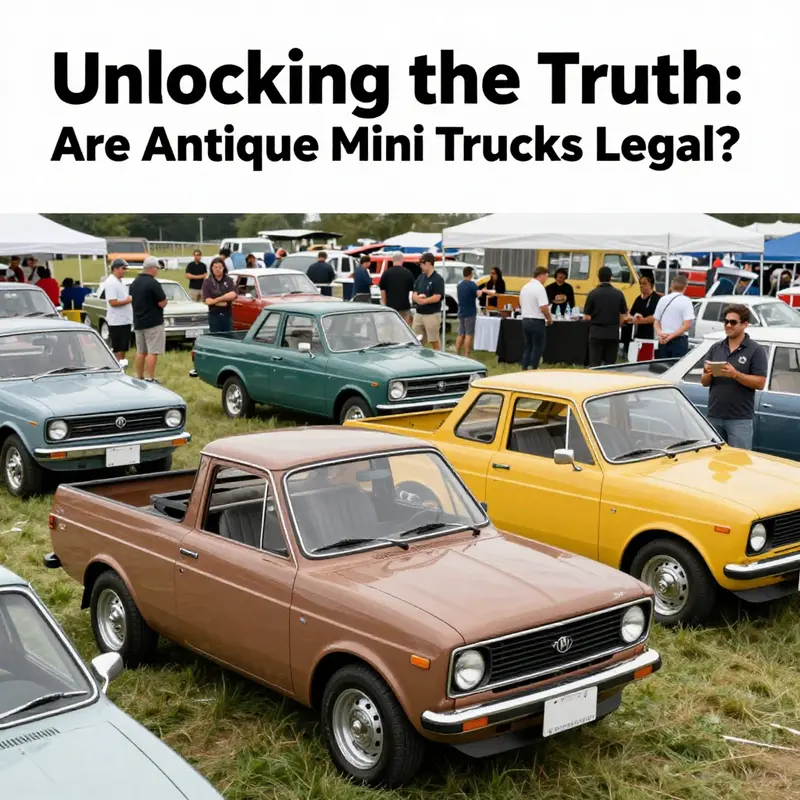
On the surface, the question—are mini trucks legal if antique?—invites a simple yes-or-no answer. But the legal reality in Pakistan is subtler and more practical than any single label can capture. The journey of a tiny Japanese kei truck imported for urban deliveries, or a locally sourced mini truck with decades behind its steering wheel, travels not merely along a road but through a web of administrative checkpoints, safety standards, and regulatory interpretations. In Pakistan, as in many other countries, the mere fact that a vehicle wears an aged patina or bears the stamp of earlier decades does not automatically confer a special exemption or privilege. Legal status hinges on the same bedrock requirements that govern any motor vehicle: proper registration in the national or provincial vehicle registry, possession of a valid registration certificate, compliance with safety and emissions norms as applicable to the era and category of the vehicle, and the presence of mandatory insurance. These are the non-negotiable pillars that determine whether a mini truck may be driven legally, whether its operator can claim the protections of the road, and whether authorities would regard it as a legitimate participant in traffic. Any old vehicle is, first and foremost, a registration and compliance challenge. If it lacks an official record, a current registration certificate, an up-to-date fitness inspection, and a valid insurance cover, the vehicle operates in a legal grey area at best and, in practical terms, remains parked in that grey area. The law in this respect is clear enough: legality is not about nostalgia or the aura of antiquity. It is about documented conformity to standards and regulations that ensure public safety, environmental responsibility, and accountability on the road. A micro-truck might be old and charming, but its roadworthiness, not its age, determines its legal standing. The absence of a dedicated, national category for “antique” vehicles—specifically tailored to micro-trucks—means that a mini truck cannot rely on a blanket antique exemption to override the normal requirements. The Pakistan Transport Department and related road-transport agencies do not assign a universal antique label that would automatically ease registration, shorten inspection cycles, or exempt the vehicle from fundamental mandates. In practical terms, this means the chain of legality proceeds along the same rails for a 1980s Japanese kei truck as it does for a contemporary light commercial vehicle, subject to the realities of the era of manufacture and the current regulatory framework enacted by the relevant authority. The absence of a singular antique category does not render old mini trucks illegal, but it does underscore the need for rigorous adherence to the standard path: registration first, followed by licensing and insurance, and then periodic inspections to confirm continued compliance with the roadworthiness requirements that apply at the time of inspection. This is a crucial point for any owner or operator who imagines that aging alone grants a free pass through the regulatory gate. The older a vehicle is, the more important it becomes to demonstrate continuous compliance across a spectrum of safety and operational criteria. A vehicle’s age does not suspend these obligations; instead, it can complicate them. The core of legality, then, rests on a triad: a valid registration record with the appropriate government body, a registration plate that remains current, and the machinery that keeps the vehicle safe to operate in the eyes of the law. The insurance component is equally indispensable. In Pakistan, third-party liability insurance is a standard requirement for road use. The justification is straightforward: even a small, seemingly innocuous mini truck can pose risks in urban traffic, and the insurance framework ensures that victims or property damaged in an accident have a clear path to compensation. Insurance is not a mere formality; it is a legal shield for both the driver and other road users, and it interacts with the vehicle’s own maintenance status. If an antique-looking mini truck is meticulously registered but lacks insurance, its status shifts from a potentially compliant historical asset to an illegal operator. Thus, the chain of legality comprises registration, licensing, inspection, and insurance. Each link must be present and current for the vehicle to be considered lawful on the road. This is true irrespective of whether the vehicle began life in 1980s Japan or in a more modern era, and it is particularly relevant for the many mini trucks circulating in Pakistan that originated as Japanese kei trucks. These vehicles were designed for urban delivery and short-distance work, with compact dimensions, efficient fuel use, and a form factor well-suited to congested streets. Their legal life on Pakistani roads is sustained not by nostalgia but by the ability to satisfy the regulatory prerequisites that govern any on-road vehicle. The popularity of kei trucks in urban Pakistan is a practical testament to this point. They are valued for their nimbleness and economical operation in dense traffic, their ease of parking, and their suitability to small businesses that require reliable, affordable transport for daily tasks. Yet their continued use on public roads depends on maintenance and compliance. A kei truck, seemingly primitive by modern standards, can still meet the law if it has been properly registered, inspected, insured, and kept in roadworthy condition. The condition for this is not a special antique status; it is adherence to the same regulatory framework that applies to any light vehicle in the country. In this sense, the antique label is not a legal passport but rather a contextual feature that can, in some cases, influence certain expenses or privileges, depending on local policies or event-specific allowances. It is crucial to distinguish between “legal on the road” and “legal with special allowances.” A vehicle might be permitted to operate because it has a valid registration and insurance, but local authorities could still impose restrictions on its use in certain zones or during certain hours, especially if the vehicle’s emissions profile is high or if its safety systems are not contemporary by urban standards. The practical implications of such restrictions vary widely by city and province, and they are not tied to antique status alone. They reflect broader regulatory aims—managing traffic flow, reducing pollution, and maintaining safety in public spaces—rather than preserving a specific historical class of vehicles. The legal framework, then, has two synchronized axes. One axis focuses on the universal, timeless obligations that every vehicle must meet to be permitted on public roads: registration, licensing, insurance, and periodic safety checks. The other axis attends to the more dynamic, local constraints that can impact where, when, and how a vehicle is allowed to operate. For old mini trucks, this second axis means navigating urban emission policies, noise ordinances, and any city-specific prohibitions on older, less efficient engines. It also means acknowledging maintenance realities. Where modern vehicles often benefit from a broad supply of spare parts and standardized components, older mini trucks—especially those that originated in overseas markets and were imported as used vehicles—may present maintenance challenges. Parts may be scarce, repair knowledge specialized, and the cost of upkeep higher. In a regulatory sense, however, maintenance is not merely a matter of comfort or operational convenience; it is a safety imperative that intersects with legality. A vehicle that cannot reliably brake, illuminate, or emit within permissible levels can fail a required inspection regardless of its age. The interplay between the antique narrative and the legal regime reveals a nuanced truth: an antique status can be a social or cultural designation in some places, but on Pakistan’s roads it does not automatically deliver a legal override. If a mini truck is old and not registered, or if it lacks a current RC, or if its safety and emission levels do not meet the standards prescribed for its class, the vehicle stands outside the bounds of legality. Conversely, a vehicle that is strictly kept within the letter of the law—properly registered, insured, inspected, and maintained—can operate legally regardless of its age. This is a pragmatic view that aligns with the core message of the national regulatory framework: legality is defined by verifiable compliance, not by the sentimental or historical value of a vehicle. The broader implications for owners and operators become a matter of planning and stewardship. Owning an antique mini truck presents opportunities and challenges. On the one hand, a vehicle with a storied past may enjoy a certain cultural appeal, a tangible link to a region’s commercial heritage, and, in some contexts, the possibility of local incentives or special exhibitions that celebrate historic transportation. These circumstances can create temporary exemptions or facilitations for events, display, or research purposes. However, these allowances are typically constrained to specific contexts and are not general rules that would enable daily operation. A vehicle that remains within the norm—registered and insured—retains its practical utility for business or daily transport, while the antique designation remains more a matter of provenance and display than a ticket to unfettered road use. The practical balance for most operators is straightforward: treat the vehicle as a working asset that must meet the same safety and regulatory standards as any other vehicle and reserve any antique status for non-operational or event-based use. In this sense, the antique label becomes a cultural lens rather than a license to bypass the standard process. A deeper layer of complexity, as highlighted in broader research, concerns how modifications can alter compliance status. If an owner modifies a mini truck—adding a lift kit, swapping the engine, or altering the exhaust system in ways that affect emissions or safety performance—these changes can push the vehicle outside the scope of its original approval. The regulatory authorities may view such alterations as fundamental enough to require re-certification or, in worst cases, denial of registration. This risk underscores a principle that applies across jurisdictions: alterations to dimensions, performance, or safety-critical systems can invalidate a vehicle’s original compliance and jeopardize its legal status. Modifications that render a vehicle non-compliant might also complicate the pursuit of antique recognition, should the owner seek such a designation through preservation programs. If a kei truck has undergone significant changes—such as engine replacements with non-original components, substantial bodywork alterations, or suspension modifications that affect structural integrity—the case for antique status becomes more fragile. In many regulatory environments, heritage or antique classification hinges on the preservation of the original design and configuration to a meaningful degree. When those elements have been altered beyond a threshold, the vehicle may be reassessed as non-original or as a heavily modified vehicle, which invites a different regulatory pathway and often different tax, fee, or inspection implications. Here, the practical takeaway is clear: the legal avenue for an antique mini truck rests not on the age of its chassis or the year on its registration, but on the degree to which its current state preserves the original form and function compatible with the appropriate regulatory framework. This is why owners who want to pursue an antique designation—whether for exhibitions, cultural purposes, or historical study—must approach the process with a clear sense of the preservation standards expected by their authorities. They should keep meticulous records of the vehicle’s original specifications, document any alterations with attention to compliance implications, and ensure that the vehicle maintains a verifiable history that supports its authenticity without compromising road safety. In addition to formal regulations, there are community and policy dynamics that shape how antique mini trucks are perceived and managed. Local authorities may be more permissive toward historic display, parades, or controlled demonstrations of vintage transport. Such contexts often operate under special permits and temporary waivers that are explicitly bounded by safety, traffic management, and environmental considerations. The distinction between a vehicle allowed to participate in a parade under a temporary permit and one routinely driven in daily commerce is a crucial one. For a business relying on a mini truck for regular deliveries, the daily operation remains tethered to standard compliance, rather than any festival-like exception. The practical implication is that, regardless of antique appeal, the vehicle’s day-to-day legality depends on meeting core safety, registration, and insurance requirements, with any antique status delivering only ancillary, context-specific allowances rather than a broad, universal exemption. The regulatory conversation around antique status and mini trucks is further enriched by the recognition that a substantial portion of these vehicles in Pakistan come from overseas markets, notably Japan, where kei trucks have a long-standing history of urban use and compact efficiency. This background matters because it frames expectations about parts availability, service networks, and typical maintenance cycles. It also highlights a core regulatory truth: the decision to allow a vehicle to operate is not made in a vacuum. It is informed by the vehicle’s ability to comply with safety and environmental standards, the practicality of maintaining those standards over time, and the legitimacy of its documentation. The practical consequence for owners is that the age of a mini truck does not guarantee exemption from inspection or renewals, nor does it automatically guarantee a favorable interpretation of its antique status. What matters is ongoing compliance and the ability to present a coherent, well-supported case to the transportation authorities that the vehicle, in its current form, remains a safe and responsible member of the road ecosystem. This is the nuanced reality that underpins the broader discussion of antique status in the context of Pakistan’s road-transport landscape. It invites a measured approach: if a mini truck is to be treated as antique in any formal sense, it must be pursued within a framework that emphasizes preservation, documentation, and adherence to the letter of the law. If it is to be used as a functioning commercial asset, its path must remain squarely within the standard regulatory envelope—registration, license, insurance, and periodic safety and environmental checks—without relying on the antique label to bypass essential requirements. The question of legal status, then, is a question of alignment with regulatory expectations rather than a question of nostalgic appeal. In closing, the practical rule for anyone who owns or plans to acquire a mini truck in Pakistan is simple in spirit: legality hinges on the full, current participation in the formal regulatory system, not on the mere aging or aesthetic that might qualify a vehicle for a heritage exhibit. An antique aura can add cultural value and may unlock selective, event-based opportunities, but it does not automatically override the need for registration, license, inspection, and insurance. A glossy finish may catch the eye, but the legal road is navigated through the steady light of compliance, and that light must stay on, year after year, as long as the vehicle remains in operation. For readers seeking a community angle or practical guidance drawn from collective experience, the Mini Trucks Blog offers a place to explore how other owners navigate the balance between history and law, the daily realities of upkeep, and the social dimensions of keeping small, efficient transport on the road. Mini Trucks Blog. For a broad, authoritative comparison of vehicle standards and classifications beyond the local context, the UK government guidance provides a reference point for how many regulatory systems approach antique or historic classifications, which can illuminate differences and commonalities in international practice. See https://www.gov.uk/guidance/vehicle-standards-and-classifications for additional context that can inform readers about the general principles, even as Pakistan maintains its own specific regulatory framework.
Final thoughts
In summary, the legality of antique mini trucks in Pakistan is a nuanced topic. While their age might evoke a sense of nostalgia, the key to their road legality lies in proper registration, safety compliance, and adherence to local regulations. This ensures that these vehicles not only honor their past but continue to serve their purpose in a modern context. Whether you’re considering purchasing an antique mini truck or are simply a fan of these classic vehicles, staying informed about the pertinent legalities will enhance your experience and investment.