

Mini trucks were once the epitome of practicality, but in recent years, they’ve been reinvented to meet contemporary needs. With urbanization accelerating and environmental concerns taking center stage, is there a resurgence of these compact vehicles? This article delves into the modern evolution of mini trucks. From the sleek electric variants making waves in the automotive market to their utility in industrial settings, and how they align with green initiatives, we explore the current relevance of mini trucks. By examining their cultural significance, we can appreciate how these vehicles are regaining popularity among local small business owners, property owners, and enthusiasts alike.
Small Power, Urban Purpose: The Quiet Comeback of Compact Electric Mini Trucks

In the arteries of the modern city, where curb space is precious and streets teem with competing demands, a quiet rethinking of what a truck should be is taking shape. The term “mini truck” is no longer tethered to a single, nostalgic image from the past. Instead, it describes a set of compact, highly adaptable vehicles that marry cargo utility with an economy and footprint that urban life demands. These aren’t reissues of old models wearing a vintage coat; they are purposeful, contemporary tools designed to move goods and people efficiently in dense environments. The urban landscape has shifted in ways that reward small, agile machines: tighter streets, rising fuel costs, tighter emissions rules, and the relentless growth of last‑mile logistics. In that context, the mini truck is evolving into a distinct category—lightweight, electric, and smart enough to navigate both a warehouse floor and a city street with the same ease.
What makes this evolution compelling is less about the romance of a smaller pickup and more about how design literacy has changed. Manufacturers recognize that investors and end users want a vehicle that can perform day‑to‑day tasks with minimum fuss: quick charging, reliable range for daily routes, predictable maintenance, and a cargo hold that can be reconfigured for tools, parts, or passengers without compromising safety. The result is a new kind of compact utility vehicle that can function in a factory yard, at a construction site, or as a city‑dweller’s weekend helper—while keeping emissions low and operating costs sensible. This shift mirrors a broader move toward electrification across segments that historically leaned on internal combustion engines. Electric propulsion is not merely a greener option; it’s a strategic enabler of the form factors that urban fleets need most: compact dimensions, flat floors, and electric drivetrains that deliver torque at low speeds for hauling, maneuverability, and precise control in tight spaces.
Importantly, the current resurgence is grounded in practicality rather than nostalgia. The modern mini truck’s appeal rests on how well it balances three interlocking needs: payload practicality, urban maneuverability, and total cost of ownership. In cities, parking, congestion, and energy efficiency are not abstract concerns; they translate into real dollars saved per mile. Battery technology has matured to the point where a compact electric truck can cover a day’s worth of deliveries or site movement with a dependable charge left at the end of the shift. Sophisticated energy management means that these vehicles can reclaim some of their energy through regenerative braking during city driving, further extending range without adding complexity to the user experience. The design challenge, then, is to preserve cargo capacity and versatility while trimming weight and length enough to fit within city constraints. The result is a toolbox on wheels that can squeeze into tighter loading bays, pass through narrow alleys, and retrace urban routes with a level of efficiency that simply wasn’t possible with older, larger trucks.
The broader appeal of compact electric mini trucks also lies in their versatility for a variety of work environments. In industrial and warehouse settings, these vehicles stand out for their maneuverability and lower operating costs. They can shuttle tools, materials, and personnel around sprawling campuses, airports, factories, and distribution centers with a nimbleness that reduces wait times and improves productivity. In many cases, fleets operating in these contexts will opt for vehicles with modular cargo configurations and durable, easy‑to‑clean interiors. The emphasis is on a workstation ethos—where the vehicle is not just a means of transport but a moving platform that can be adapted to a specific job with minimal downtime. In construction zones and on dockside operations where space is a premium and noise restrictions limit what can be used, compact electric mini trucks can perform critical tasks without imposing the same energy costs or emissions concerns as their larger counterparts. The practical implications extend to maintenance as well; simpler powertrains, standardized components, and fewer moving parts can translate into lower maintenance overhead and longer service intervals, which matter a lot when fleets are counting every dollar in an urban logistics budget.
One of the most consequential shifts is the central role of electrification in redefining what a mini truck can be. Battery packs that are scalable, safety‑minded, and quick to swap or recharge are redefining the life cycle of these vehicles. The capability to recharge overnight or during a short mid‑day break reduces the risk of downtime that used to plague small fleets. Moreover, the modular nature of modern electric powertrains means that a vehicle can be repurposed for different tasks with relative ease. A compact chassis can handle a flatbed for materials transport one day and switch to a box or cargo‑box configuration the next, enabling a business to adapt to shifting work requirements without investing in multiple different platforms. This adaptability sits at the heart of the mini truck’s return: it is not merely a smaller version of a full‑size truck but a lean, intelligent tool tailored for the rhythms of urban life and the pace of modern commerce.
The global market for these vehicles reflects a blend of regional needs and technological maturity. In densely populated regions of Europe and Asia, manufacturers have embraced compact electric vans and mini trucks to meet last‑mile delivery pressures while complying with tighter emissions standards. In many of these markets, the value proposition is clear: smaller, cleaner vehicles can access congested cores, reduce congestion costs, and help businesses meet sustainability targets without sacrificing reliability or capacity. The urban consumer is also shifting attitudes toward ownership and use patterns. Shared mobility models, micro‑fulfillment in residential neighborhoods, and the growing acceptance of small electric workhorses for neighborhood errands contribute to a broader ecosystem in which compact, efficient trucks are not a niche but a practical choice for everyday needs. The result is a thriving ecosystem of design, regulation, and service infrastructure—charging networks, battery warranties, telematics, and safety standards—that supports the sustained growth of this category.
Yet even as electrification anchors the revival, design ingenuity remains essential. The best compact mini trucks manage to maximize usable space without inflating overall dimensions. They reconfigure cargo areas to accommodate a range of payloads—from bulk materials to delicate equipment—while protecting the operator and improving ergonomics. Inside, controls are streamlined, with an emphasis on intuitive operation and robust safety features. Modern fleets increasingly demand smart capabilities: telematics that track battery health, range forecasting that reflects route and load conditions, and remote diagnostics that keep downtime to a minimum. The human element remains central; operators who once handled manual handling and longer routes now benefit from vehicle attributes that reduce fatigue and improve safety. The synergy of human skills and machine efficiency is what keeps the mini truck’s return not only possible but compelling.
For readers who want a clearer window into how these shifts are playing out in industry discourse, consider the broader research that frames this chapter. It emphasizes that the modern mini truck is defined by electrification, modularity, and a refined balance between utility and efficiency. It notes that while cargo space may be reimagined to accommodate electric components and safety systems, the essential utility—the ability to carry tools and materials where larger trucks cannot—remains intact. The spirit of the mini truck endures in its adaptability and the pragmatic sense that a compact, well‑engineered vehicle can do a surprising amount when designed with intention. This is not about reviving a classic silhouette; it is about translating a practical concept into a durable, future‑proof tool for urban logistics and small‑scale enterprise.
One practical way readers can connect with these ideas is to explore perspectives from industry voices that track how fleets and manufacturers are adapting to the era of urban electrification. For further reading on the trajectory of electric mini trucks and their role in city logistics, you can consult the in‑depth analysis titled Electric Mini Trucks: The Future of Urban Logistics. It provides detailed insights into current models, charging infrastructure, regulatory compliance, and real‑world use cases that are shaping this category today. As you consider potential applications—whether for a delivery route that serves a dense neighborhood or a worksite where access is limited—keep in mind how the blend of compact size, electric efficiency, and modular cargo design can align with your needs. The combination of urban demand, environmental responsibility, and advancing battery technology suggests that the mini truck’s comeback is not a revival of a past form but a reimagining that fits the constraints and opportunities of the modern metropolis.
For those seeking deeper context on industry shifts and practical implementation, a read through the Mini Trucks blog can offer useful angles and real‑world examples that complement this chapter’s themes. You can explore more insights at the Mini Trucks blog, which curates perspectives on how these compact vehicles are evolving in different markets and configurations. Mini Trucks blog.
Taken together, the current moment signals a thoughtful, scalable transition. The mini truck’s comeback is not a loud chorus but a steady, pragmatic chorus: smaller footprints, cleaner energy, smarter design, and the flexibility to adapt to a wide range of urban tasks. It is the kind of evolution that speaks to planners, business owners, fleet managers, and city residents who crave efficiency without sacrificing capability. In this sense, the rebirth is less about nostalgia and more about necessity—an answer to the realities of dense cities where every square meter and every kilowatt matters. The modern mini truck embodies a compact, electric, and adaptable ethos that may not shout from the rooftops, but works quietly every day to keep urban commerce moving. And as cities continue to pursue better air quality, lower operating costs, and faster last‑mile delivery, the logic of the compact, electric mini truck will only strengthen, inviting more players to refine, deploy, and scale these capable little workhorses across diverse urban landscapes.
External resource: Electric Mini Trucks: The Future of Urban Logistics. https://www.electrictrucknews.com/electric-mini-trucks-the-future-of-urban-logistics/
Small, Mighty, and Mission-Driven: Are Mini Trucks Returning to Power Modern Work and Logistics?
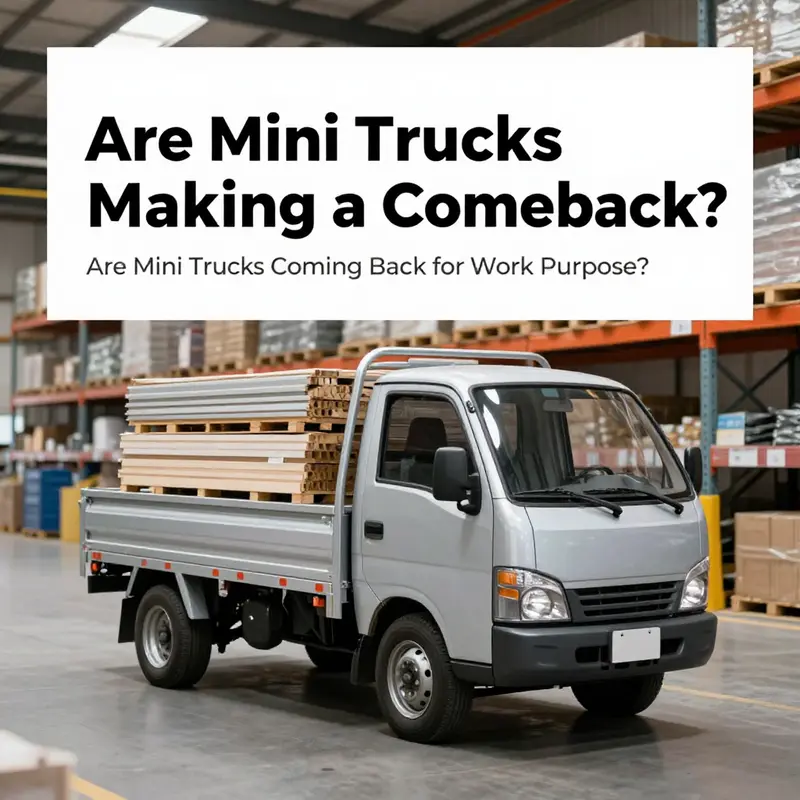
Questions about whether mini trucks are returning circle around nostalgia, yet the 2026 landscape shows something different. The category has evolved from a retro feeling into a practical class of compact work vehicles designed for dense streets and restricted sites. The industrial and logistics data illustrate a steady, not dramatic, expansion. These vehicles bridge personal mobility and professional duty, offering a rare mix of small footprint, efficient energy use, and usable payload. In many markets, fleets are adopting small electric drivetrains and hybrids that comply with emissions standards while staying affordable to operate. Rather than a simple revival of a classic design, the trend reflects a broader shift toward purpose-built tools that fit tight urban grids and modern warehouses.
Key advantages begin with size and maneuverability. In crowded centers, their compact frames can thread narrow alleys, slip through congested routes, and park in spaces where larger trucks cannot. This access translates into more addresses per route, reduced dwell times, and higher throughput in a single shift. A lighter weight translates into improved energy efficiency and gentler wear on roads and parking infrastructure. The payload gap with full-size trucks is managed through modular bodies and configurable configurations—open cargo beds, closed vans, or small tipping platforms—that support small businesses and mid-size fleets alike. Operators appreciate the reliability, predictable maintenance, and lower insurance costs that come with simpler systems. The overall economics can be compelling when every minute of delivery time affects cash flow.
Beyond city streets, the appeal grows in sites where terrain is uneven or space is limited. On construction yards, in agricultural settings, and within campus-level logistics networks, their size helps them traverse rough lots without the weight and size penalties of bigger machines. For daily tasks, they transport tools, parts, and materials with a flexibility that reduces trips back to a central depot. In warehousing, they function as agile shuttles, moving crates from staging zones to loading docks with minimal handling effort. The possibility to swap bodies—where a single platform serves as a cargo bed, a small van, or a tips-on-demand unit—lets a single investment cover multiple workflows. Fleets value resilience, because these vehicles can be repaired locally with common parts and kept online longer through straightforward service routines.
Electrification anchors the modern mini truck narrative. Battery electric configurations shine in urban routes where stop-and-go cycles dominate. They cut fuel costs, lower emissions, and reduce noise in residential districts. Though range is limited by design, the daily miles needed for many urban tasks are well within reach, and quick charging or swappable battery strategies can minimize downtime. A growing slice of the segment includes specialized variants aimed at municipal and industrial use, such as compact electric units adapted for on-site firefighting, water, or hazardous waste tasks. These are practical tools that meet stricter environmental rules while preserving consistent service in tight spaces. As energy density improves and charging infrastructure expands, manufacturers are blending battery power with lightweight construction to close any remaining gap between compact and mid-size trucks in terms of payload and range. This convergence expands the use cases across last-mile delivery, on-site mobility, and temporary operations during construction and events.
Design choices reflect a philosophy of durability and simplicity. Manufacturers are leaning toward lighter materials and modular components that ease repairs and upgrades. Dashboards emphasize clarity, with robust controls and intuitive interfaces that reduce the learning curve for new operators. Cab interiors are designed for fatigue resistance, climate comfort, and easy cleaning, because urban and industrial settings put cabins through harsher daily wear. Safety features have matured to include stable acceleration profiles, reinforced cabs, and standardized load distribution guidelines that protect drivers and cargo on uneven surfaces. The upshot is a dependable platform that can be deployed across sectors—from small delivery outfits to university campuses and agricultural operations—without demanding specialized training or extended downtime. In practice, this means maintenance teams can source common parts locally and keep fleets productive on tight budgets.
Economic logic often matters more than technology alone. While high-capacity, full-size trucks deliver more payload, the total cost of ownership for compact trucks can be markedly lower in dense urban environments. They consume less fuel, incur lower insurance costs, and need smaller parking footprints. In many fleets, the ability to maintain tight service windows translates to steadier throughput and reduced risk of delays during peak demand. Cities that push for cleaner air and quieter streets create favorable conditions for compact, low-emission workhorses. The strategic value lies not only in the vehicle itself but in the efficiency of the operating model: better scheduling, faster turnaround, and more predictable maintenance cycles. When each delivery slot is valued, the compact class becomes a scalable backbone for diverse operations, from parcel couriers serving apartment blocks to campus services coordinating daily tasks across multiple buildings.
On the broader logistics landscape, mini trucks function as a bridge between micro-fulfillment nodes near cities and larger regional hubs. They support agile delivery tactics that push goods closer to customers while maintaining reliability and speed. In on-site facilities—manufacturing plants, airports, and warehouses—they enable material handling with reduced manual effort, gliding through aisles and between racks with a smaller footprint. Rural and peri-urban contexts gain from their versatility as well: they haul feed, tools, and equipment across fields and yards, delivering consistent performance in variable weather and uneven terrain. This cross-cutting versatility—urban, suburban, and agricultural—creates a compelling argument for keeping the compact vehicle family in production and development. It isn’t about a single market or a single design; it’s about a modular approach that can be tuned to the job at hand and the local regulations that shape the job.
Market data underscores this point. Operators cite uptime, predictable maintenance, and the ability to spec the vehicle to a narrow duty cycle as decisive factors. The appeal lies not in chasing novelty but in achieving reliability and cost containment where it matters most: in the field where time, space, and energy matter. That is why a growing number of fleets are revisiting small, efficient work vehicles as a permanent component of their lineup. The conversation shifts from whether the category will reappear to how rapidly it will broaden its reach across different sectors and geographies. The evidence points to a steady, scalable growth path driven by a simple truth: when you need to move goods efficiently in tight spaces, smaller can be smarter than larger, again and again.
For ongoing updates and practical perspectives, industry readers can turn to the minitrucksocala blog, which aggregates field-tested experiences, maintenance tips, and deployment insights from fleets of varied sizes. These narratives translate macro-trends into actionable decisions for companies facing budget constraints and tight urban corridors. The blog offers real-world case studies that illuminate what works in practice, not just what looks good on a spec sheet. Readers are invited to explore broader discussions about compact utility vehicles and their changing roles in modern work life; the conversations there connect engineers, operators, and fleet managers in a shared goal of efficient, resilient logistics. minitrucksocala blog.
In sum, mini trucks are not merely coming back in a look-alike form. They are becoming essential tools in the modern urban and industrial stack. Their evolution—driven by electrification, smarter safety systems, modular bodies, and a focus on total-cost-of-ownership—maps closely to how companies organize delivery, construction, farming, and warehousing today. The nostalgia remains as a backdrop, but the operational reality is forward-looking: small, nimble, and adaptable vehicles fill gaps that larger trucks cannot reach quickly enough. The question for managers and planners is no longer whether to invest in a compact workhorse, but how to tailor a family of such vehicles to fit the unique rhythms of their networks. That tailoring, in turn, shapes the pace at which micro-fulfillment, last-mile resilience, and on-site logistics become the new standard rather than an exception.
For deeper technical context and practical depth, see the Sinotruk Mini Truck Guide. Sinotruk Mini Truck Guide.
Green Lights, Small Wheels: The Modern Mini Truck Revival

The resurgence of the mini truck concept is not mere nostalgia but a practical response to how cities rethink mobility, how emissions rules tighten, and how last-mile logistics operate in a margins-driven economy. In 2026 the mini truck is a family of compact, efficient tools designed for contemporary needs without overwhelming urban space. The environmental calculus is straightforward: smaller, lighter, and cleaner vehicles emit less, use less energy, and leave more room for people and pedestrians; at the same time the full life cycle of a vehicle remains a crucial consideration from manufacture to charging, maintenance, and end of life. Regulators are raising air quality standards and urban fleets are increasingly expected to meet stringent thresholds while staying reliable. Electric propulsion is positioned as the core path for many deployments because it aligns with policy and practical operation in dense environments. The technical advances behind this shift are significant: better battery chemistry, faster charging, longer cycle life, and smarter thermal management reduce downtime and total cost of ownership. The smaller footprint helps with curbside space, loading zones, and maneuvering through crowded corridors, while still delivering meaningful payloads. This makes the business case clear: energy costs, maintenance, and penalties favor compact electric platforms when deployed at scale, especially in zones with strict emissions rules or incentives for clean fleets. Beyond vehicle design, the ecosystem—depot charging, route planning, and municipal policy—plays a decisive role. Co-located charging at depots, streamlined permitting for small electric fleets, and dynamic curb management amplify the advantages of compact platforms and enable higher service levels with lower environmental impact. The social benefits are tangible as well: quieter streets, reduced visible pollution, and better urban livability around logistics hubs. In neighborhoods where curb space is scarce, the practice of using smaller vehicles can ease congestion and improve pedestrian safety. Commercially, the total cost of ownership may tilt in favor of mini trucks when operations are optimized for last-mile work, particularly as incentives and decarbonization targets evolve. In short, the mini truck revival is a convergence of policy, technology, and urban design that creates a scalable, green alternative for modern city logistics. For practitioners, the story is not just about a vehicle class but about an approach to urban mobility that values efficiency, resilience, and responsibility. The arc of policy and market forces suggests these vehicles will continue to grow in sophistication and reliability, proving that small is a strategic choice for cleaner cities and smarter fleets. For further reading, regulators and industry groups offer guidance on standards, charging best practices, and lifecycle considerations that help fleets implement these solutions responsibly.
Cultural Echoes and Compact Roles: Are Mini Trucks Reclaiming Space in Popular Culture and City Life?

Vehicles have always been more than means of moving bodies or freight. They are living artifacts of a society’s rhythms, values, and contradictions. In the current chapter, the focus turns to the cultural imprint of what many researchers call the new generation of mini trucks—those small, efficient, and purpose-built machines designed for dense urban landscapes and agile work fleets. The question isn’t simply whether a nostalgic revival is underway; it’s whether a renewed cultural relevance is emerging around compact, electric, and highly maneuverable utility vehicles. In this sense, the “comeback” is less a revival of a bygone look and more a reimagining of a vehicle’s role in daily life. Urbanization presses in from all sides, fuel costs rise, emissions regulations tighten, and city dwellers demand transport that respects space, noise, and time. In response, the modern mini truck does not merely mirror the past; it adapts the spirit of the mini truck—small, efficient, and purpose-built—into new forms and functions that mesh with contemporary city living and contemporary cultural sensibilities.
Take, for a moment, the broad arc of vehicle culture across regions. In places where streets become stages for everyday commerce and social interaction, vehicles evolve beyond their utilitarian duties. They become portable microcosms of a community’s identity. This is the core idea behind a long-standing tradition in South Asia, where trucks are not just carriers but canvases, carriers of stories, and even social commentary. The art and decoration that transform heavy vehicles into colorful, communicative vessels show how spaces inside and outside a city can be a shared gallery and a shared memory. This is not simply about aesthetics; it is a language that communicates belonging, aspiration, and collective memory. When a city’s buses and trucks bear intricate designs, calligraphy, and emblematic motifs, they say something about who the community is, what it values, and how it navigates the world together. The point is not to romanticize a specific visual style but to recognize that vehicles are portable social texts that cities read aloud, day after day.
In this cultural logic, the modern mini truck enters not as a merely practical tool but as a flexible platform for identity expression and social coordination. Its small footprint and nimble handling align with urban demand for efficiency, not just economy. In countries and regions where narrow streets, congestion, and tight parking define daily life, the appeal of compact, electric, and highly adaptable work vehicles grows. The urban worker, tradesperson, or last-mile courier finds a tool that moves with the city’s pace rather than fighting against it. The design philosophy behind these vehicles emphasizes energy efficiency, modular utility, and safety—qualities that resonate with a cultural shift toward responsible consumption and shared space. The result is not a throwback but a retooling of a vehicle’s social contract: a compact unit that can traverse a busy street, deliver essential goods, and still participate in the flow of city life without dominating it.
The Pakistan truck-art tradition offers one revealing lens through which we can understand this cultural tension and potential shift. Truck art has long served as a public, mobile canvas where painters, calligraphers, and designers tell local stories and reflect communal beliefs. These decorated conveyances become itinerant exhibits of identity, faith, politics, and humor. They travel through neighborhoods and across regions, carrying not only cargo but a chorus of voices that speak to shared experiences and history. The art form survives modernization because it speaks to something deeper than aesthetics: vehicles become mirrors of who we are in motion. In parallel, the modern mini truck seeks to honor the value of intimate, accessible transport while embracing contemporary constraints like emissions targets and urban noise ordinances. In other words, the cultural significance here is not about a single, static image but about a evolving practice where vehicles act as public-facing, mobile cultural markers.
This evolving practice has important implications for how we conceive a “comeback.” The revival is not a revival of a specific historical look or a particular lineup of models; it is a revival of a vehicle’s social utility and its capacity to be a platform for community life. In fast-growing cities around the world, the mini truck becomes a pragmatic symbol of adaptation. It signals a willingness to downsize, to electrify, and to reconfigure the urban landscape to make room for essential, low-cost mobility. The practical benefits—low operating costs, easy maneuverability, and the ability to operate in tight spaces—become cultural advantages when they support small businesses, neighborhood markets, and delivery services essential to urban vitality. When these vehicles are embraced for their function and their perceived compatibility with a sustainable urban lifestyle, their cultural value expands beyond the farmyard or the factory floor to become part of the city’s social fabric.
Yet culture also shapes the form of the modern mini truck. Designers and manufacturers are increasingly conscious of tone and context—how a vehicle looks, how it sounds, and how it feels to be inside. The aesthetics of a mini truck in 2026 are less about flamboyant ornamentation and more about intelligent, adaptable design. Safety and comfort for operators, the integration of smart features for route optimization and cargo management, and the ability to customize interiors for different industries are all part of the cultural calculus. This shift mirrors broader social moves toward personalization within shared spaces. People want to see themselves reflected in the tools they use, even when those tools are work vehicles. In this sense, the mini truck becomes a canvas for practical identity, a way to signal values—efficiency, community orientation, and environmental responsibility—without sacrificing reliability or cost efficiency.
As this cultural work proceeds, a sense of continuity with older forms remains visible, especially in the language of space and movement. The mini truck—whether seen in a city street, a warehouse forecourt, or a quiet residential curb—operates at the boundary between private necessity and public exposure. It is a small, trusted partner in the choreography of daily life, a participant in the urban dance of loading, unloading, and moving on. The cultural significance grows when we consider how this mobility supports small business ecosystems, enables service delivery in underserved neighborhoods, and contributes to the daily cadence of urban commerce. In this sense, the mini truck’s cultural value is not about spectacle or novelty; it is about reliability, adaptability, and respect for the city’s pace and space.
If we track the threads of urban design, vehicle culture, and economic necessity, a more nuanced picture emerges. The comeback, if one wants to name it that, is closely tied to how cities structure their streets, how employers manage fleets, and how communities perceive and negotiate space. A city that prioritizes curb management, quiet operation, and safe, accessible routes for small vehicles will likely see a cultural embrace of compact, electric transport as a natural extension of its urban identity. Conversely, in places where policy and infrastructure lag, the symbolic power of the mini truck may struggle to translate into broader cultural adoption. This is not a simple triumph of form over function, nor merely a nostalgic impulse. It is a convergence of practical needs and cultural values around sustainability, locality, and human-scale mobility.
For readers who want to explore more about how vehicle culture is imagined, lived, and discussed in contemporary contexts, the broader blog space of the mini-truck community offers ongoing reflections, case studies, and visual storytelling that bridge street-level observation with design thinking. You can visit the Minitrucks hub for deeper immersion into how communities picture and inhabit these compact platforms as social actors. minitrucksocala blog. This invitation to explore further is not a call to uniformity but an invitation to observe how many threads—historical artistry, urban necessity, technological innovation, and personal identity—interweave around a small, capable vehicle that keeps showing up where the city lives.
In the end, the cultural significance of mini trucks lies in their ability to connect people, places, and practices through mobility that respects both space and time. They symbolize a shift toward urban practicality without surrendering individuality. They carry not only payloads but stories, aspirations, and everyday resilience. As cities continue to evolve, the compact, electrified, and adaptable vehicle will likely remain a meaningful component of how we move through and make sense of our shared urban world. For those who watch vehicle culture closely, the “comeback” of mini trucks is less about retro nostalgia and more about recognizing that the essence of the mini truck—small, efficient, and purpose-built—still speaks to a modern longing for mobility that is humane, economical, and connected to community life. And if the trend continues, those voices will keep echoing through city streets as these practical machines quietly redefine what it means to travel, work, and belong in crowded spaces.
External resources for readers seeking broader context on the cultural dimensions of vehicle art and urban mobility include a detailed examination of truck art in Pakistan, which illuminates how vehicles become cultural touchstones within evolving modernity. For a broader perspective on how these cultural narratives intersect with transportation, see the BBC article on Truck Art in Pakistan: https://www.bbc.com/news/world-asia-58794321.
Final thoughts
The evolution of mini trucks is not just about returning to the past; it reflects a broader shift towards practicality, sustainability, and community. From electric models addressing environmental challenges to the logistical applications that make them indispensable in modern business environments, mini trucks are not merely a nostalgic reminiscence, but a vital component of our contemporary landscape. Understanding this resurgence allows us to appreciate their role in both personal and professional capacities. Whether you’re a local business owner needing a reliable vehicle, a resident looking for compact transportation, or an enthusiast excited about the latest innovations, the future of mini trucks is bright.