
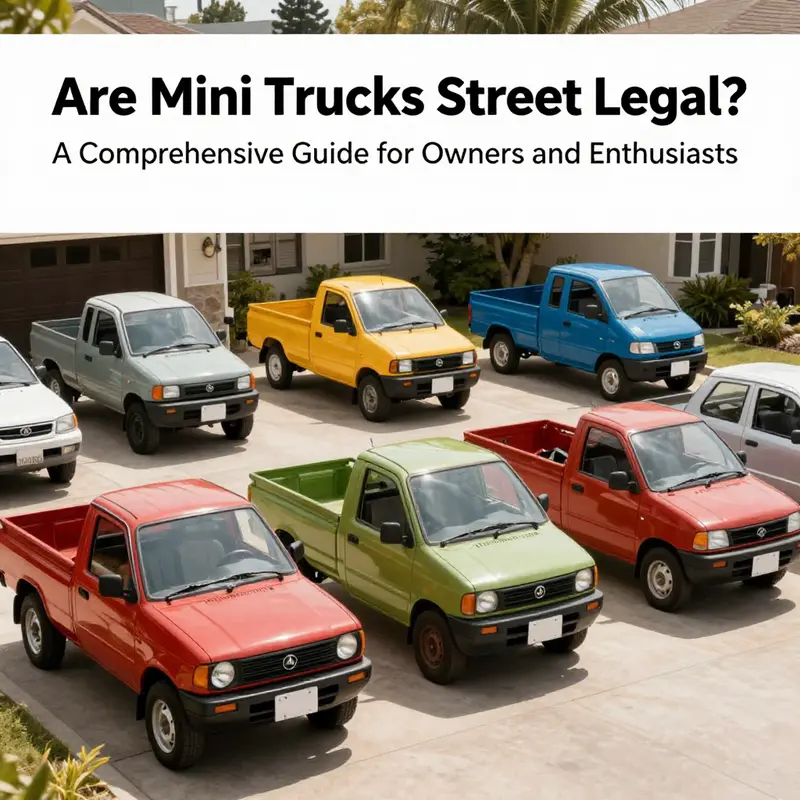
As the popularity of mini trucks continues to grow among local small business owners, residential property owners, and enthusiasts, many find themselves wondering about one critical question: Are mini trucks street legal? This guide aims to uncover the legal implications, classifications, and key considerations surrounding mini trucks, providing essential insights into what makes a mini truck suitable for street use. From understanding which models comply with local regulations to exploring the risks of non-compliance, we have you covered. Each chapter offers valuable information to help you confidently navigate the world of mini trucks.
Between Workhorse and Road Vehicle: Navigating the Legal Tightrope of Non-Street-Legal Mini Trucks
The line between a compact work vehicle and a legally driven street machine is thinner than many buyers expect. Mini trucks, celebrated for their efficiency, maneuverability, and compact footprint, often arrive in the market wearing a dual identity. On the surface they promise practical usefulness, a nimble companion for a small business or a clever urban runabout. Under the hood, however, they may be designed for off road or private property use, and that distinction carries real legal weight. This chapter dives into the implications of operating these small machines on public streets and reveals why most of them, despite their charm, do not meet the requirements to be treated as street legal in many jurisdictions. The goal is not to single out brands or short-list specific models, but to illuminate the general framework that governs how society classifies and regulates vehicles that look like miniature trucks yet behave almost like toy or off road machines when pushed toward public roads.
Non-street legal mini trucks arise most often in contexts where the vehicle is intended for private land, farms, construction sites, or recreational off-road terrain. They may be built with limited lighting, modest suspensions, or simple controls that fail to align with the standards that govern roadworthy vehicles. The red flags are not always obvious at first glance. A vehicle might have a bed, a small cargo area, and a compact chassis, which makes it attractive for tight spaces. But when you peel back the layers—the safety equipment, the emission controls, the mandatory identification markings, and the regulatory paperwork—the gaps become clear. The legal system treats road use and private property use as two different regimes, each with its own set of requirements, and a single product can fall into one regime or the other based on how it is marketed, sold, and used in practice.
The heart of the issue is classification. In many places, a vehicle is not automatically street legal because it lacks basic safety features that the law expects all on-road vehicles to have. Headlights, brake lights, turn signals, and mirrors are not cosmetic extras; they are survival gear for road users who share the space with cars, buses, and pedestrians. A valid vehicle identification number or serial number is another pillar of accountability, enabling authorities to trace maintenance histories, verify ownership, and ensure compliance with safety standards. Emissions controls, noise regulations, and tire standards further tie a vehicle to its on-road category and its environmental footprint. If a mini truck misses one of these thresholds, it is unlikely to be registered, insured, or allowed to operate on public roads without additional modifications. The question then becomes how to distinguish between a vehicle that can be legally driven on streets in a limited, low-speed capacity and one that remains confined to private property or off-road zones.
A meaningful portion of the discussion centers on the low-speed vehicle category, often abbreviated as LSV in many locales. Vehicles designed to be street legal in this niche still face stringent conditions. They must typically be classified under an on-road category that recognizes their limited speed and lighter construction. In practice, this means a capped top speed—commonly around 25 miles per hour (about 40 kilometers per hour)—along with specific lighting requirements, reflectors, and safety equipment. They must carry a VIN, be titled, and undergo registration with the relevant motor vehicle authority. They are also required to be insured, and their use on public roads is often restricted to certain zones, times, or road types. The appeal of LSVs lies in the possibility of shared use with standard cars on streets that are slow and secondary, but the boundaries are not forgiving. If a vehicle exceeds the speed threshold, lacks proper lighting, or does not have the necessary safety equipment, it immediately shifts back into the realm of non-street-legal status with all of the accompanying legal exposure.
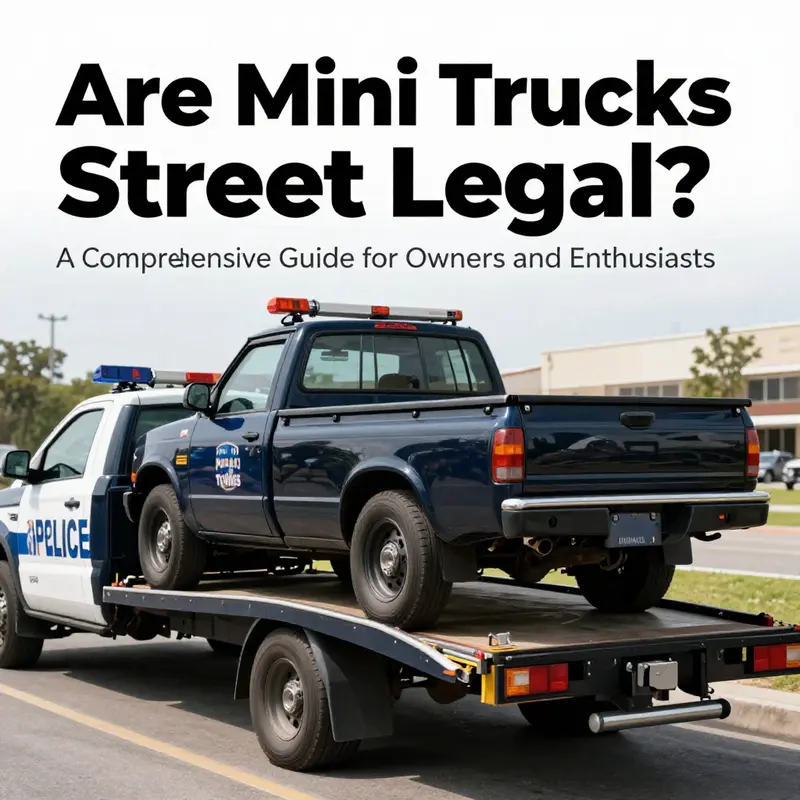
The practical reality is that laws differ widely across countries, states, and even municipalities. Some places may have clear, proscriptive rules about how a new class of micro vehicles is treated, while others leave a lot of interpretation to local authorities. The consensus across many jurisdictions is that the safest course is to treat a mini truck as street legal only if it conforms to the official classification, possesses a VIN, can be properly registered and insured, and meets the full spectrum of safety and environmental standards expected of road-going vehicles. Without this alignment, driving on public roads becomes a regulatory breach that may invite fines, vehicle impoundment, or more severe penalties depending on the jurisdiction and the specifics of an incident. The upshot is that the presence of a bed and wheels is not a license to operate where a normal passenger vehicle would. The vehicle must earn its street status through a formal process, and the process begins with a clear understanding of local DMV guidelines and regulations.
The confusion that surrounds consumer expectations is a recurring theme. Many buyers encounter mini trucks in retail or online marketplaces that emphasize utility, efficiency, and compact dimensions. Some marketing materials blur the distinction by describing these machines as suitable for “light on-road use” or by presenting them alongside other small utility vehicles that do meet street standards. The problem is that a vehicle’s marketing language does not automatically confer regulatory status. The law looks at the design, production, and intended use as a whole, not at a picture in a brochure. This is where education becomes essential. A casual buyer can be lulled into believing that a vehicle with a simple dashboard and a bed belongs on public streets, only to discover that the local DMV or traffic code requires a different classification altogether. The manufacturer might acknowledge the off-road orientation in fine print, but by then the decision to operate on public roads has already been made in haste or convenience. The end result is a mismatch between what is bought, what is legally allowed, and what is actually practical for daily use in a city or suburb.
To navigate this terrain, it helps to approach the question of legality as a structured inquiry rather than a tentative judgment. The first step is to consult the local DMV or equivalent authority and request a formal classification for the specific vehicle model in question. This inquiry should yield whether the model is eligible for on-road registration and under what conditions. The second step is to verify the existence and integrity of essential safety features. Are there working headlights and brake lights? Do turn signals exist and operate properly? Are there mirrors positioned for rear visibility? Does the vehicle carry a valid VIN? Is there a compliant tire specification? These elements are not mere boxes to check; they are the building blocks that protect drivers, passengers, and other road users. The third step is to confirm the vehicle’s emission and noise profile. Emissions compliance is a crucial doorway to road legality in many regions, particularly in areas with strict environmental standards. If a vehicle cannot demonstrate compliance, it may face costly retrofits or may be barred from on-road operation altogether. The fourth step is to secure insurance and ensure that registration, titling, and all related paperwork align with the car-spotting reality of the vehicle. Without insurance, a traffic violation can escalate into a broader liability and financial exposure in the event of an accident.
For readers who want a concrete example of the kind of official guidance that shapes these decisions, consider the official vehicle classification and registration resources provided by the state DMV system. While the exact rules vary, the underlying logic is consistent: a vehicle must be built and used in a way that keeps it within a predictable safety envelope, allows for reliable identification, and ensures accountability on the road. The legislative and regulatory landscape has grown more complex as demand for compact, efficient vehicles has increased, especially in dense urban environments where space is at a premium. In practice, that means a small, low-speed truck cannot simply be parked in a driveway and driven to work every day without a careful, documented path to compliance. The path frequently involves confirming that the model is legally recognized as an LSV or another on-road category, ensuring it carries a VIN, and completing the registration and insurance steps that give the vehicle a legitimate standing on public streets.
The consequences of ignoring these steps are not merely theoretical. Driving an unregistered, uninsured, or non-compliant vehicle on public roads carries real penalties. Fines can accumulate quickly, and authorities may impound the vehicle on the spot. Points on a driver’s license can follow, depending on the jurisdiction, with broader implications for insurance premiums and future driving privileges. In some scenarios, more serious charges could arise if the situation involves an accident or allegations of endangerment. Beyond the legal penalties, there is the liability dimension. In a collision, the operator of a non-street-legal mini truck faces heightened personal exposure. Insurance coverage can be challenged, and liability for damages or injuries can rest with the operator as well as the vehicle’s owner. Liability extends beyond the immediate incident to the broader question of whether the vehicle was properly registered, equipped, and used in accordance with applicable laws. These are not abstract concerns; they directly affect financial well-being and personal risk in everyday life.
This is not a call to dampen the appeal of micro and compact utility options. Rather, it is an invitation to recognize that the allure of efficiency must be balanced against the responsibilities that accompany road use. The market responds when buyers demand clarity and safety on the road. Manufacturers, in turn, face the challenge of aligning product design with regulatory expectations so that the same vehicle can be a practical tool in a business context and a legally compliant option for everyday mobility. Consumers can play a constructive role here as well by asking pointed questions about safety features, emissions, title status, and the necessary steps to achieve road legality before making a purchase. In practice, this means approaching a mini truck as a potential road vehicle only after confirming that it can be properly registered, titled, insured, and kept within the safety and environmental standards that govern on-road transportation.
The broader takeaway for readers who are weighing the street-use prospects of a mini truck is that the decision is not purely about dimensions or load capacity. It hinges on a clear understanding of regulatory classifications and the practical steps needed to meet them. The most reliable path is to start with the local DMV’s guidelines and to treat the vehicle as a project that must earn its street status through formal compliance. If the vehicle cannot satisfy the on-road criteria, the next best course is to reserve it for private land, closed courses, or designated off-road areas where the risk of violating traffic laws is minimized. This approach protects the owner from costly penalties and preserves the vehicle’s utility by ensuring it remains a legitimate tool within its appropriate domain. For readers who want a broader perspective and ongoing updates, the Mini Trucks Blog offers a curated space to explore how these evolving classifications intersect with daily life and small-business needs. Mini Trucks Blog
When this chapter looks ahead to future developments, it becomes clear that the tension between innovation and regulation will continue to shape the market. Jurisdictions may refine their definitions of what constitutes a street-legal micro vehicle, potentially expanding or narrowing the set of features required for on-road use. Advances in battery technology, safety systems, and vehicle intelligence will also influence how regulators evaluate small trucks that are designed to be both practical and safe on crowded streets. The central thread remains constant: if you aspire to drive a mini truck on public roads, you must navigate a formal process that proves the vehicle adheres to the relevant safety, emission, and identification standards. If the process proves too complex or costly, many operators will choose to maximize the vehicle’s value on private land or on designated routes that expressly prohibit public-road use. In this context, the journey from aspiration to legality is as much a legal-technical undertaking as it is a practical decision about where and how the vehicle will be used. The result is a diverse ecosystem of vehicles that are either fully street legal, street legal through a narrow low-speed category, or confined to private or controlled spaces, each with its own rules of operation and accountability. For those who seek authoritative guidance, the official regulations and classifications published by the state authority provide the definitive framework to determine whether a given mini truck earns its place on public roads. External resources can illuminate the path, but the starting point remains grounded in formal classification, documentation, and compliance steps that hold up in real-world use. To keep discussions grounded, it helps to remember that the ultimate arbiter of street legality is the local regulatory environment, and the safest practice is to verify that environment before turning a private-use vehicle into a daily road companion. For readers who want a broader context and ongoing discourse, the Mini Trucks Blog is a valuable resource, offering insights that complement the regulatory framework discussed here. Mini Trucks Blog
External resource: For official guidance on vehicle classification and registration, consult the California DMV’s Vehicle Classification and Registration page. California DMV – Vehicle Classification and Registration
Street-Legal Mini Trucks on Public Roads: Classification, Requirements, and the Road-Ready Gatekeepers
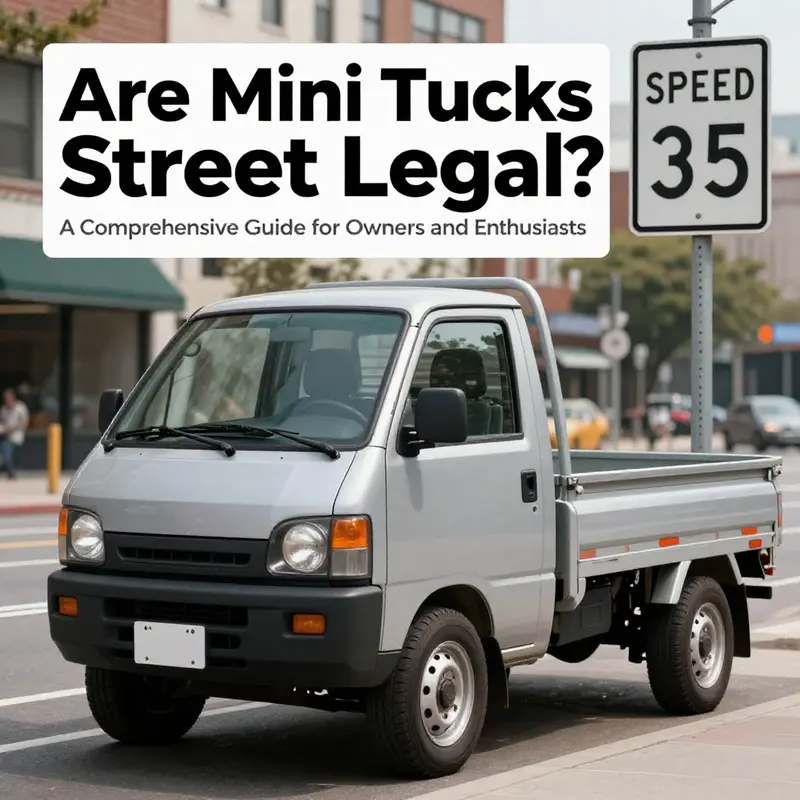
In the broader conversation about mini trucks, street legality is not a simple checkbox. It hinges on a vehicle’s underlying design, its adherence to regulatory standards, and the legal framework of the place where it will be operated. Across different regions, the same compact, utilitarian silhouette can be treated as either a lawful urban helper or as an off-road curiosity. The distinction matters not only for what you can drive, but for how you register, insure, and protect yourself and others on public streets. The central idea is straightforward: some mini trucks are purpose-built for road use and carry the necessary certifications, while most are designed for other settings and fail to meet the safety, emissions, and compliance criteria required for daytime roading. The challenge is to understand where the line lies and how it shifts from one jurisdiction to another, so that a buyer does not inadvertently purchase a vehicle that cannot legally roll on public lanes where they live. The arc of this chapter follows that line with an emphasis on classification and the practical requirements that make a mini truck road-ready rather than a novelty or a toy. It also keeps a close eye on the broader implications for urban mobility, safety, and personal responsibility, because the legal status of these small workhorses directly shapes how people use them in daily life and how insurers, dealers, and authorities view them in the fleet of city transportation options.
A useful way to start is with a widely recognized category from Japan, the Kei truck. Kei, in this context, refers to specific regulatory constraints that cap engine displacement and overall dimensions. Typically, Kei trucks are limited to 660 cc or less, and these limits produce tangible outcomes. Tax incentives can be substantial, and the path to registration and ownership is often smoother than for larger, non-specialized vehicles. The practical effect is that a Kei-style mini truck can be a legitimate roadway participant in jurisdictions that recognize it as a compliant low-displacement, compact vehicle. Even with these advantages, many jurisdictions still require that the vehicle be certified to meet local standards for safety, emissions, and general roadworthiness before it can be titled and insured. The Kei model category is a prime example of how regulatory design can harmonize urban practicality with a government’s tariff and safety objectives, but it also shows how the line between street legitimacy and street compliance is drawn with multiple teeth: size, power, emissions, and a verifiable lineage that promises accountability on the road.
Beyond Kei trucks, the landscape broadens to include various microcars and small utility vehicles that manufacturers either adapt to local regulations or tailor from the ground up to qualify as street-legal in a given market. In many places, these are considered the modern descendants of the city car or the micro-utility segment. The essential criterion remains the same: the vehicle must be designed and certified to meet the jurisdiction’s safety and environmental rules, not merely to resemble a small truck or a vehicle that can crawl through a city block when new. The distinction between domestic and foreign origins becomes relevant here, too. Some regions rely on national or regional standards that mirror familiar frameworks, while others blend international norms with local testing and inspection requirements. The upshot is that a vehicle can be legal in one country and not in another because the governing rules rely on different testing regimes, labeling conventions, and registration processes. This is why, even when a mini truck appears compact and friendly, a careful check with local authorities is not just prudent but essential.
When we speak of the requirements for street legality, several non-negotiables come into focus. First, regulatory compliance is the baseline. A compliant street-legal vehicle must be manufactured or certified to meet the safety and emissions guidelines accepted by the jurisdiction it operates in. Certification or inspection can be a prerequisite before the vehicle is permitted to hit public roads. This is how authorities ensure that a compact vehicle intended for urban use does not merely look the part but can be expected to perform safely in unpredictable traffic conditions. The second pillar is design criteria, which translate into a concrete set of features that a vehicle must have. Lighting systems are not optional; they include properly functioning headlamps, tail lights, turn signals, and reflectors. A vehicle must also integrate a reliable braking system and be equipped with safety restraints such as seat belts that meet the standards for all carried occupants. Crashworthiness is another critical test, extending beyond the presence of airbags to include structural integrity that helps protect occupants during a collision. Emissions compliance is not an afterthought either. The engine, exhaust, and related controls must meet prescribed environmental limits, especially in regions pushing toward lower urban emissions. These elements collectively determine whether a tiny truck can be trusted to operate in mixed traffic during the day and at night.
A vehicle’s path to street legality also involves documentation and administrative steps. A valid Vehicle Identification Number (VIN) or an equivalent manufacturer’s serial number is often a prerequisite to registration. The VIN creates a traceable identity, which is crucial for recalls, insurance, and enforcement. In parallel, the vehicle must be titled and registered with the local or national motor vehicle authority—think of it as a formal recognition that the vehicle is a legal participant in road traffic. Insurance is not optional; it is typically required to legally operate, and the provider will assess the vehicle’s classification, power, and safety features before extending coverage. A small, seemingly innocent vehicle that lacks these elements becomes a liability on public roads, exposing the operator to fines, impoundment, or more serious consequences in the event of an accident. The administrative dimension, though it may sound bureaucratic, is what translates a theoretical road-compatibility into practical, everyday legality.
A crucial element in understanding street legality is recognizing the regional variations that define which vehicles qualify and how they must be equipped. In the United States, many people tie street legality to compliance with the Federal Motor Vehicle Safety Standards (FMVSS) administered by the National Highway Traffic Safety Administration (NHTSA). Vehicles within this ambit must meet tests and labeling requirements that the FMVSS prescribes, and manufacturers often provide documentation to prove conformity. The European Union follows a parallel but distinct path under ECE regulations, which emphasize a rigorous suite of safety, lighting, and emissions tests. The differences between FMVSS and ECE are not mere formalities; they shape the exact configuration a street-legal mini truck must adopt, from the positioning and intensity of headlamps to the official procedures for certification or homologation. The practical implication for buyers and operators is clear: a model sold as “street-legal” in one market may require additional adaptations or may be expressly restricted in another. The risk of assuming universal legality is real, and the safest course is to verify the vehicle’s classification and the steps needed to register it wherever one intends to drive it.
To navigate this landscape responsibly, the best course is to engage with the local Department of Motor Vehicles or its equivalent. They provide the definitive guidance on whether a particular mini truck, including any modifications, can be registered, titled, and insured for street use. That tends to involve confirming the vehicle’s certification documents, its eligibility to be classified as a low-speed vehicle or another relevant category, and any road restrictions unique to the jurisdiction. It is not enough to rely on a dealer’s assurances or the vehicle’s appearance; what matters is formal recognition under the law, which ensures that the rights and duties of ownership translate into lawful operation. In practice, those duties extend to ensuring the vehicle remains compliant over time through inspections, maintenance, and updates to meet evolving regulatory requirements. The safety of the operator and other road users depends on this due diligence.
As with many regulatory questions, context matters. In Japan, for example, the Kei framework demonstrates how size and displacement can drive both practical benefits and legal pathways. In other markets, similar logic applies to microcars and compact trucks, albeit with different numeric limits and certification routes. In every case, the common thread is that street legality is not a one-and-done achievement. It is a dynamic designation that reflects ongoing compliance, proper registration, and continual adherence to standards throughout the vehicle’s life. This is why prospective buyers should treat a compact, road-ready truck not as a playful one-off but as a carefully engineered, regulated device designed to perform reliably within a city’s traffic ecosystem and under the watchful eye of authorities.
In practice, street-legal mini trucks occupy a useful niche for urban mobility: they promise nimble handling, easy parking, and a footprint that fits into tight city environments. Yet the same features that make them attractive can blur into a regulatory gray area if the vehicle is not properly equipped or certified. The balance required is not about diminishing convenience; it is about ensuring that the vehicle contributes to a safer, cleaner urban transport fabric. The responsible path is clear: verify the model’s compliance with local rules, confirm whether it requires a special category like a low-speed vehicle, and complete the registration and insurance processes before hitting any public road. It is a path that rewards patience with the confidence that comes from knowing one’s vehicle is legally and safely integrated into the traffic system. For readers who want practical pointers on where to start, the minitrucks blog offers perspectives and case studies that illuminate the day-to-day considerations of owning and operating a mini truck in different settings. You can explore that resource here: minitrucks blog.
Ultimately, the question of whether a mini truck is street legal comes down to a concrete chain of requirements and confirmations. It is not solely about the vehicle’s size or its power. It hinges on standard-compliant construction, a traceable identity, official certification, and entry into the official registry. It requires a crash-aware design, a robust lighting system, seat belt compliance, emissions controls, and a legal pathway to registration and insurance. It demands that the vehicle be evaluated against the specific rules of the jurisdiction in which it will operate, with the possibility of additional modifications or distinctions for low-speed use or restricted road access. This layered approach ensures that the small yet ambitious category of street-legal mini trucks fulfills its promise: to deliver urban efficiency without compromising safety. As cities continue to grapple with congestion and emissions, these vehicles can play a constructive role when their legality is clear, documented, and maintained over time.
For those seeking deeper comparisons and narratives about how different models behave in the real world, a broad view of the microcar and city-vehicle ecosystem is valuable. It helps readers understand how a vehicle designed for urban mobility is translated into a legal tool for daily work and travel. The bottom line remains that, while certain mini trucks can be street-legal, the majority are not by default. Prospective buyers and current owners should treat legality as an ongoing discipline rather than a one-time purchase, and they should actively engage with local authorities to ensure ongoing compliance. This mindset is essential for anyone who wants the practical benefits of a compact, efficient vehicle without stepping into the legal gray area that could jeopardize insurance, fines, or freedom to move on public roads. External resource: https://www.nhtsa.gov
Are Mini Trucks Street Legal? Navigating Local Laws, DMV Classifications, and Registration Realities
When people consider mini trucks for urban hauling or light utility work, the first question is whether these compact vehicles can legally operate on public streets. The answer isn’t a simple yes or no; it hinges on local definitions of roadworthy, the vehicle’s design, and how the rules are enforced in a given jurisdiction. In many places, most mini trucks on the market are intended for off-road, novelty, or display use and lack the features that many regulators expect for street use. They may be missing proper lighting packages, mandated safety equipment, a valid vehicle identification number, and emissions controls that roadworthy status requires. Without these, registration or insurance is often unavailable or with significant caveats. Yet there exists a narrower subset of mini trucks that are purpose-built to meet street-legal requirements, frequently marketed as low-speed vehicles (LSVs) or similarly categorized, with restrictions that keep them distinct from full-size trucks. These models are designed to fit within specific classifications, speed thresholds, and safety standards that some regions recognize as enabling lawful road use. The practical upshot is that legal status is highly place-specific; what is allowed in one district might be denied in another. Consequently, before committing to ownership or operation, it is essential to check directly with the local DMV or equivalent authority for definitive guidance. The DMV will classify the vehicle based on its design, equipment, and intended use, and will spell out the insurance, licensing, and registration implications. This classification affects premium structures, coverage options, and possible endorsements or special licenses; it also influences which roads you may legally drive on and at what speeds. In many jurisdictions, a passenger-vehicle designation supports standard licensing, while a light truck or commercial classification can trigger additional requirements, inspections, or endorsements. The federal layer—where it exists—sets baseline safety and emissions expectations, but local rules determine the exact road-legal status. Vehicles originating from markets with different regulatory frameworks often require modifications to meet local standards, such as proper lighting, seat belts for all seating positions, reflectors, and validated emissions conformity. A valid VIN is also a crucial anchor for titling and insurance; without a VIN, or with a misrepresented VIN, road legality is compromised and insurers may decline coverage. In some places, vehicles must pass an inspection before registration, while in others inspections are routine but not strictly required for every case. Road-use restrictions may be in place, limiting access to certain streets, highways, or hours of operation. These constraints reinforce that street legality is not a function of engine size alone but how the vehicle fits the traffic system and the safeguards the law requires. Practical steps to verify legality include: – Determine your vehicle’s intended use and confirm whether it can meet local safety and emissions standards with minimal modification. – Ensure a VIN exists and can support title and registration in your jurisdiction. – Confirm the insurance pathway for the chosen classification and obtain any required endorsements. – Check the DMV’s official guidance and any additional local ordinances that could affect where and when you can operate the mini truck. – Gather documentation from the seller or importer, such as a compliance certificate, bills of sale, proof of ownership, and any inspection records. If you need practical context, consult reputable consumer guides and official DMV resources, and consider speaking with others who have navigated the process in your area. By taking a disciplined, location-specific approach, you can determine whether a given mini truck can be legally driven on public roads and what steps are required to reach that status. In short, street legality for mini trucks is not universal; it is a moving target shaped by local definitions, enforcement, and the vehicle’s compliance with safety, emissions, and documentation requirements.
null
null
Final thoughts
Understanding the legal framework governing mini trucks empowers small business owners, property owners, and enthusiasts to make informed decisions regarding their vehicles. Whether you’re considering purchasing a mini truck or seeking to operate one legally, awareness of local laws and compliance is crucial. By following the guidelines laid out in this article, you can ensure your mini truck experience is enjoyable and lawful, avoiding potential pitfalls that come with non-compliance.